
Asia Pacific Garden Plastics Market (2025-2030)

The Asia Pacific Garden Plastics Market was valued at $1950.5 Million in 2025 and projected to reach to $2685 Million by 2030, representing a compound annual growth rate of 6.6%. The Asia Pacific garden plastics market is positioned for sustained growth through 2030, driven by demographic shifts and lifestyle changes across the region.


| Market Size in | USD 26.32 MN |
| Market Forecast in | |
| CAGR | |
| Forecast Period | |
| Units Considered | Value (USD MN) |
Asia Pacific Garden Plastics Market Trends and Insights
- Asia Pacific's 6.6% compound annual growth rate outpaces the global average, driven by rising urbanization, increasing disposable incomes, and growing consumer interest in outdoor living spaces across the region.
- The market encompasses a diverse range of products including garden furniture, planters, irrigation systems, and protective coverings tailored to Asia Pacific's varied climatic conditions. Asia Pacific's garden plastics sector benefits from strong manufacturing capabilities and cost-competitive production bases throughout the region.
- Key markets within Asia Pacific, including China, India, and Southeast Asia, are witnessing accelerated adoption of plastic garden products due to their durability, low maintenance requirements, and affordability compared to traditional materials.
- Between 2025 and 2030, Asia Pacific is expected to capture significant market share as e-commerce penetration increases and organized retail channels expand across emerging economies in the region..
Key Market Statistics
- CAGR (2025-2030) 6.6% CAGR
- Market Size, 2025 ~USD 1950.5 Million
- Forecast, 2030 ~USD 2685 Million
- Geography Asia Pacific
Asia Pacific Garden Plastics Market Overview
Regional Growth Outpacing Global Average :
Asia Pacific's 6.6% CAGR significantly exceeds the global average of 5.2%, positioning the region as a high-growth market for garden plastics through 2030.
Urbanization Driving Market Expansion :
Rapid urbanization across Asia Pacific is fueling demand for garden plastics as consumers in growing metropolitan areas seek space-efficient outdoor living solutions and landscaping products.
Rising Disposable Incomes :
Increasing purchasing power among middle-class consumers in emerging Asia Pacific economies is accelerating investment in outdoor home improvement and garden enhancement products.
Strong Market Valuation Growth :
The market is projected to grow from USD 1,950.5 million in 2025 to USD 2,685.0 million by 2030, representing substantial expansion opportunities across the region.
Asia Pacific Garden Plastics Market Dynamics
- Urbanization trends, coupled with rising disposable incomes in key markets like China, Japan, and India, are creating strong demand for innovative garden plastic solutions.
- Consumer preferences for low-maintenance, durable outdoor products are accelerating adoption of plastic alternatives to traditional materials. Looking ahead, the region's growth trajectory will be supported by increasing consumer interest in outdoor living spaces and home beautification.
- Market players should focus on product innovation, sustainability initiatives, and localized distribution strategies to capitalize on Asia Pacific's expanding middle-class consumer base and evolving outdoor lifestyle preferences..
Market Ecosystem
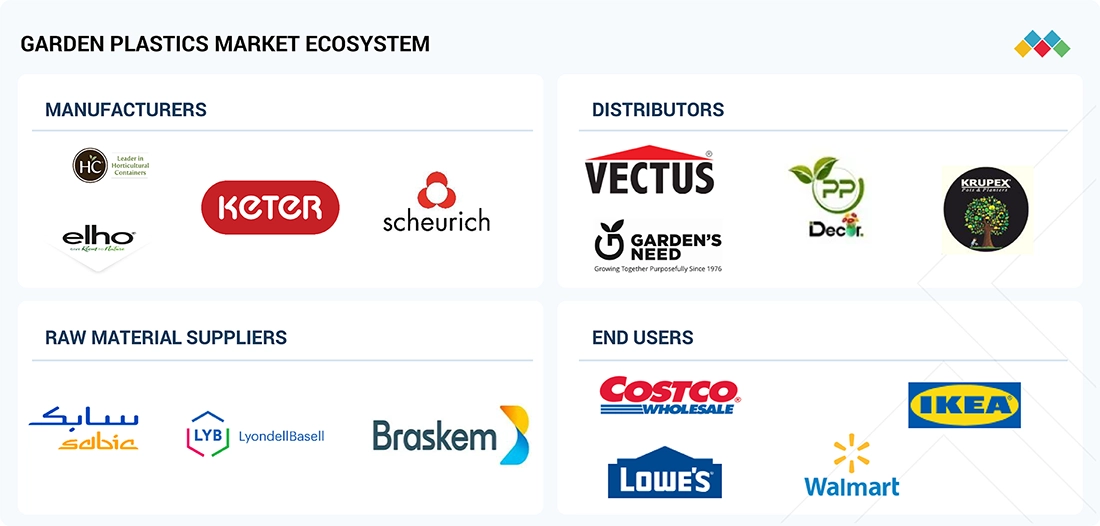
Garden Plastics Market: COMMERCIAL USE CASES ACROSS INDUSTRIES
| COMPANY | USE CASE DESCRIPTION | BENEFITS |
|---|---|---|
 |
Produces resin-based garden storage, outdoor furniture, and planters for residential and commercial use. | Durable, UV-resistant, lightweight products that are easy to handle and maintain. |
 |
Manufactures modular garden planters, outdoor storage units, and decorative landscaping solutions. | Versatile designs with recyclable materials, supporting sustainability and flexible garden setups. |
 |
Offers functional garden products like pots, planters, and self-watering systems for homes and commercial spaces. | Eco-friendly, recyclable materials with innovative designs that simplify gardening and reduce water usage. |
 |
Provides premium flower-pots and decorative planters for indoor and outdoor applications. | High-quality aesthetics with excellent weather and UV resistance for long-lasting use. |
 |
Produces branded outdoor and garden solutions, including Playmobil-themed planters and children’s gardening sets. | Durable, child-safe, and visually appealing products that enhance brand-driven consumer engagement. |
Logos and trademarks shown above are the property of their respective owners. Their use here is for informational and illustrative purposes only.
Related Ecosystem
Resins And Polymers
- Polycarbonate
- Acrylonitrile Butadiene Styrene (ABS)
- Epoxy Resin
- Light Commercial Vehicles (LCVs)
- Polypropylene (PP)
- Basf se
- DOW CHEMICAL COMPANY
- Solvay sa
- Saudi arabia basic industries corporation (sabic)
- DuPont de Nemours, Inc.
Key Takeaways
- Asia Pacific garden plastics market will grow from USD 1,950.5M (2025) to USD 2,685.0M (2030) at a 6.6% CAGR, outpacing global growth.
- Rapid urbanization and rising middle-class populations across Asia Pacific are driving demand for affordable, durable garden plastic products.
- Asia Pacific's strong manufacturing infrastructure and cost advantages position the region as both a major production hub and consumption center.
- E-commerce expansion and organized retail growth in Asia Pacific emerging markets will accelerate market penetration through 2030.
Garden Plastics Market Report Scope
| Report Metric | Details |
|---|---|
| Base Year | 2025 |
| Fastest Growing Segment | –PP (Plastic Type) |
| Forecast Period | 2025–2030 |
| Growth Rate | CAGR of 5.2% from 2025 to 2030 |
| Largest Segment | COMMODITY PLASTICS (Plastic Type) |
| Market Size Base Year (Billions) | ~USD 3.61 (2025) |
| Revenue Forecast (Billions) | ~USD 4.65 (2030) |
| Segments Covered | Plastic Type, Composition, Application |
Asia Pacific Garden Plastics Market Report Segmentation
3 segment dimensions are covered across the global market.
By Plastic Type
- Commodity Plastics
- Engineering & Performance Plastics
- –Abs
- –Hdpe
- –Ldpe
- –Other Commodity Plastics
- –Other Engineering & Performance Plastics
- –Pa
- –Pom
- –Pp
- –Pvc
- –Pvdf
- –Tpe
By Composition
- Glass Fiber Reinforced
- Mineral-Filled
- Other Compositions
- Unfilled
By Application
- Glass Fiber Reinforced
- Greenhouse & Tunnel Coverings
- Irrigation Systems
- Mineral-Filled
- Mulch Films
- Other Applications
- Other Compositions
- Pots & Containers
- Raised Beds & Garden Liners
- Unfilled
Target Audience
- Garden Plastics Manufacturers : Manufacturers need Asia Pacific-specific market data to identify expansion opportunities, understand regional demand drivers, and develop localized product strategies for high-growth markets.
- Distributors & Retailers : Distribution partners require country-level insights to optimize inventory management, identify emerging markets, and align supply chains with regional growth patterns and consumer preferences.
- Investment & Private Equity Firms : Investors need comprehensive Asia Pacific market analysis to evaluate acquisition targets, assess growth potential, and make informed capital allocation decisions in the garden plastics sector.
- Strategic Business Planners : Corporate strategists use regional market forecasts to guide market entry strategies, competitive positioning, and long-term business development in Asia Pacific's high-growth landscape.
- Market Research & Consulting Teams : Research professionals require detailed Asia Pacific data to support client advisory services, competitive analysis, and market intelligence reports for stakeholders across the value chain.
Key Companies in the Asia Pacific Garden Plastics Market
| Company | HQ | Ownership | Strongest segments |
|---|---|---|---|
| THE HC COMPANIES, INC. | United States | Public Company | Pots & Containers,Irrigation Systems,Greenhouse & Tunnel Coverings, |
| HORST BRANDSTäTTER GROUP | Germany | Private Company | Pots & Containers,Raised Beds & Garden Liners,Irrigation Systems, |
| GRIFFON CORPORATION INC. | United States | Public Company | |
| BERRY GLOBAL INC. | United States | Private Company | Agriculture, greenhouse, and mulch films,Pots, containers, and rigid garden packaging,Irrigation-related and garden liners products, |
| RKW GROUP | United States | Private Company | Greenhouse & Tunnel Coverings and Garden Films,Pond Liners, Raised Beds & Garden Liners,Mulch Films and Surface Protection Films, |
| BASF | Germany | Public Company | Commodity Plastics (HDPE, LDPE, PP, PVC),Engineering Plastics,Performance Plastics (ABS, PA, PVDF, POM, TPE), |
THE HC COMPANIES, INC.
The HC Companies, Inc. is a publicly traded American company founded in 1968 with approximately 275,000 employees, operating in the consumer products sector.
HORST BRANDSTäTTER GROUP
Horst Brandstätter Group is a German private company with roots dating back to 1876, operating in the manufacturing sector.
GRIFFON CORPORATION INC.
Griffon Corporation Inc. is a publicly traded American company founded in 1959 with 5,100 employees, engaged in manufacturing and home and garden products.
BERRY GLOBAL INC.
Berry Global Inc. is a private American company established in 1967 with 42,000 employees, specializing in plastic packaging and engineered materials.
RKW GROUP
RKW Group is a private American company founded in 1957 with 3,000 employees, operating in the plastics and packaging industry.
BASF
BASF is a publicly traded German chemical company founded in 1865 with over 106,000 employees, serving as one of the world's largest chemical manufacturers.
Countries within Asia Pacific - compare and drill down
| Country | 2025 size (native) |
|---|---|
| China | USD 1308.8 Million |
| Japan | USD 570.2 Million |
| India | USD 132.6 Million |
| South Korea | USD 259.7 Million |
| Rest Of Asia Pacific | USD 413.7 Million |
Country market size visualization
Reasons to Buy this Report
- Regional Growth Intelligence : Gain detailed insights into Asia Pacific's 6.6% CAGR and understand why this region outperforms global averages, enabling strategic market entry and expansion decisions.
- Country-Level Market Data : Access granular market sizing for major Asia Pacific economies including China, Japan, India, and South Korea to identify high-potential markets and competitive landscapes.
- Consumer Trend Analysis : Understand urbanization patterns, disposable income growth, and outdoor living preferences specific to Asia Pacific consumers to tailor product offerings and marketing strategies.
- Competitive Positioning : Benchmark your business against regional market dynamics and identify growth opportunities in the fastest-expanding segment of the global garden plastics market.
- Forecast-Driven Planning : Leverage 2030 projections (USD 2,685M market size) to develop long-term business strategies, investment plans, and resource allocation for Asia Pacific operations.
Frequently asked questions
What is the current size of the Asia Pacific garden plastics market?
The Asia Pacific garden plastics market is valued at USD 1,950.5 million in 2025 and is projected to reach USD 2,685.0 million by 2030.
What is the growth rate for garden plastics in Asia Pacific?
Asia Pacific's garden plastics market is growing at a compound annual growth rate (CAGR) of 6.6% from 2025 to 2030, which exceeds the global average.
Which countries drive the Asia Pacific garden plastics market?
Key markets within Asia Pacific include China, India, and Southeast Asian nations, which are experiencing accelerated adoption due to urbanization and rising disposable incomes.
What factors are driving growth in Asia Pacific's garden plastics sector?
Growth drivers in Asia Pacific include urbanization, increasing middle-class populations, growing interest in outdoor living spaces, e-commerce expansion, and the affordability of plastic products compared to traditional materials.
How does Asia Pacific's market growth compare to global trends?
Asia Pacific's 6.6% CAGR outpaces the global garden plastics market CAGR of 5.2%, reflecting the region's stronger economic growth and consumer demand dynamics.
RESEARCH METHODOLOGY
To accurately estimate the size of the global garden plastics market, this study took four key steps. Through comprehensive secondary research, we compiled data sources relating to garden plastics, related outdoor plastic use, and polymer use more broadly in landscaping and gardening. We cross-referenced this data against primary research based on interviews with stakeholders through the entire value chain of garden plastics, that included raw material suppliers, plastic compounders, product manufacturers, distributors, and end users (retailers & landscapers). An accurate estimation of the total size of the market could take both top-down and bottom-up approaches, with market segmentation and data triangulation methods applied to strengthen size estimates of the various segments and subsegments of the garden plastics market.
Secondary Research
We developed a market landscape for companies providing garden plastics and related solutions using a combination of secondary data sources, both publicly available and paid evaluation of company product portfolios, industry publications, and trade databases. The following sources were examined to assess macroeconomic and industry-level trends influencing garden plastics uptake: Bloomberg, Factiva, Business Standard, and the World Bank. In addition, we used annual reports from our climate policy framework assessment, press releases, sustainability reports, and investor briefings of garden plastics manufacturers and bio-based (derived from renewable biomass) polymer manufacturers and as well as guidance from industry associations, environmental policy frameworks, and whitepapers related to bioplastics. This research led to an understanding of the various components of the garden plastics value chain, the top players in the garden plastics business, how the market is categorized, innovation developments in technology, and related information on the garden plastics ecosystem.
Primary Research
In the primary research process, various primary sources from both the supply and demand sides were interviewed to obtain qualitative and quantitative information for this report. The primary sources from the supply side included industry experts, such as Chief Executive Officers (CEOs), Vice Presidents (VPs), marketing directors, technology and innovation directors, and related key executives from several key companies and organizations operating in the garden plastics market. After the complete market engineering (calculations for market statistics, market breakdown, market size estimations, market forecasting, and data triangulation), extensive primary research was conducted to gather information and verify and validate the critical numbers arrived at. Primary research was also conducted to identify the segmentation types, industry trends, competitive landscape of garden plastics offered by various market players, and key market dynamics, such as drivers, restraints, opportunities, challenges, industry trends, and key player strategies. In the complete market engineering process, the top-down and bottom-up approaches and several data triangulation methods were extensively used to perform the market estimation and market forecasting for the overall market segments and subsegments listed in this report. Extensive qualitative and quantitative analysis was performed on the complete market engineering process to list the key information/insights throughout the report.
Following is the breakdown of interviews with experts:
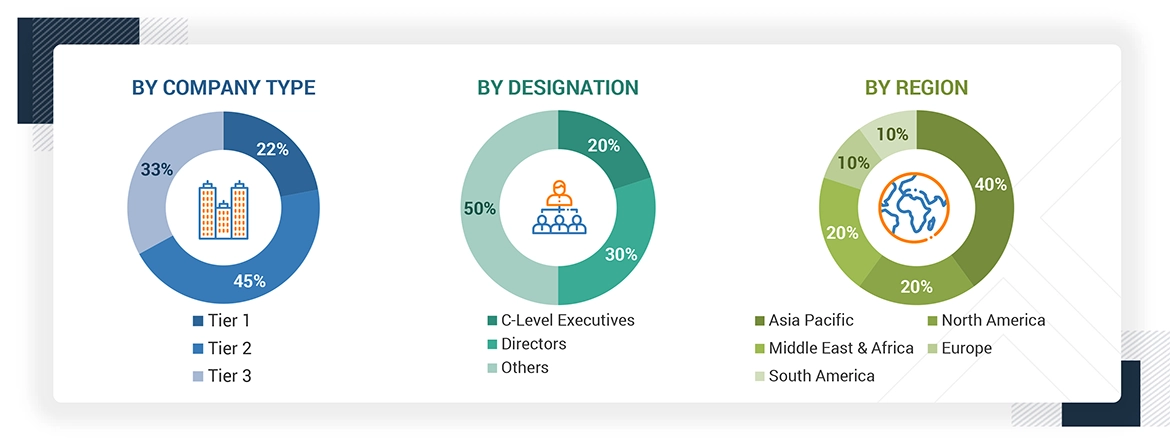
Note: Other designations include sales, marketing, and product managers.
Tier 1: >USD 1 Billion; Tier 2: USD 500 million–1 Billion; and Tier 3: < USD 500 million.
To know about the assumptions considered for the study, download the pdf brochure
Market Size Estimation
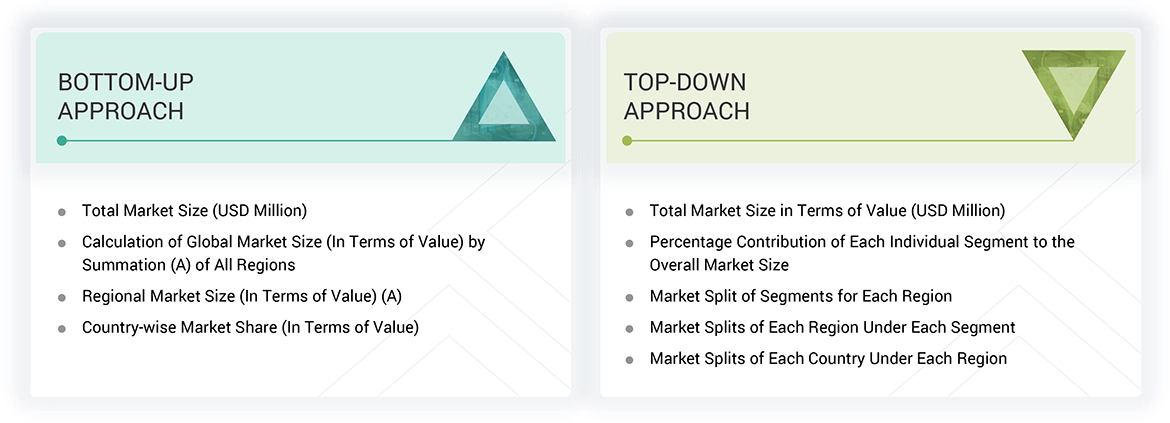
The top-down and bottom-up approaches were used to estimate and validate the size of the garden plastics market. These approaches were also used extensively to estimate the sizes of various dependent market segments. The research methodology used to estimate the market size included the following:
Data Triangulation
After arriving at the overall market size using standardized market estimation methodologies, the garden plastics market was segmented into multiple applications, plastic types, compositions, and regional markets. Data triangulation and market breakup procedures were applied, wherever necessary, to complete the market engineering process and derive accurate statistical insights for each segment and subsegment. The triangulation process was employed when we analyzed and validated data from the supply-side metrics (production capacities, availability of plastic types, technology adoption) and demand-side trends (application growth, regulatory adoption) to ensure consistency and accuracy in final market estimates.
Market Definition
Garden plastics are a broad category of plastic-based materials developed and designed for outdoor gardening and landscaping. Garden plastics are commonly used to create garden furniture, pots and planters, watering cans, compost bins, storage containers, fencing, and decorative landscaping. Garden plastics can be produced from a variety of materials commonly of polypropylene (PP), polyethylene (PE), polyvinyl chloride (PVC), polystyrene (PS), acrylonitrile butadiene styrene (ABS), and increasingly recycled or bio-based plastics. They have many benefits: durability, weather resistance, UV stability, lightweight, and flexible shape/Moldability. In the past, garden plastics were made from fossil-fuel based polymers. Today, environmental awareness and changing regulations are driving garden plastics toward materials containing recycled content, circular plastics, and biodegradable materials. Garden plastics can be manufactured with standard processes such as injection molding, blow molding, rotational molding, and extrusion. The garden plastics market is becoming increasingly important to the plastic and consumer goods industries as urban gardening and DIY landscaping are emerging as popular trends and as demand for both functional and visually appealing outdoor garden and landscape products increases.
Stakeholders
- Garden Plastics Manufacturers
- Raw Material Suppliers
- Downstream Converters and Processors
- Distributors and Traders
- Industry Associations and Regulatory Bodies
- End Users
Report Objectives
- To define, describe, and forecast the size of the global garden plastics market based on type, application, composition, and region in terms of value and volume
- To provide detailed information on the significant drivers, restraints, opportunities, and challenges influencing the market
- To strategically analyze micromarkets concerning individual growth trends, prospects, and their contribution to the market
- To assess the growth opportunities in the market for stakeholders and provide details on the competitive landscape for market leaders
- To forecast the market size of segments and subsegments for North America, Europe, Asia Pacific, South America, and the Middle East & Africa
- To strategically profile key players and comprehensively analyze their market shares and core competencies
- To analyze competitive developments such as product launches, acquisitions, expansions, partnerships, and agreements in the garden plastics market
- To provide the impact of AI/Gen AI on the market
Get the Full Garden Plastics Market Report
Full forecast, segment splits, and company analysis for all Garden Plastics Market.
- US Garden Plastics Market
- Canada Garden Plastics Market
- Mexico Garden Plastics Market
- Germany Garden Plastics Market
- France Garden Plastics Market
- UK Garden Plastics Market
- Italy Garden Plastics Market
- Spain Garden Plastics Market
- China Garden Plastics Market
- Japan Garden Plastics Market
- India Garden Plastics Market
- South Korea Garden Plastics Market
- South Africa Garden Plastics Market
- Brazil Garden Plastics Market
- Argentina Garden Plastics Market
- Rest Of Europe Garden Plastics Market
- Rest Of Asia Pacific Garden Plastics Market
- GCC Countries Garden Plastics Market
- –Rest Of GCC Countries Garden Plastics Market
- Rest Of South America Garden Plastics Market
Need a Tailored Report?
Customize this report to your needs
Get 10% FREE Customization
Customize This Report
