
India Gas Separation Membrane Market (2025-2030)

The India Gas Separation Membrane Market was valued at $75.5 Million in 2025 and projected to reach to $115.9 Million by 2030, representing a compound annual growth rate of 9.0%. India's gas separation membrane market is poised for accelerated growth as the nation's industrial sector modernizes and adopts advanced separation technologies.


| Market Size in | USD 26.32 MN |
| Market Forecast in | |
| CAGR | |
| Forecast Period | |
| Units Considered | Value (USD MN) |
India Gas Separation Membrane Market Trends and Insights
- This 9.0% compound annual growth rate reflects India's increasing demand for advanced separation technologies across industrial applications, driven by rapid industrialization and stringent environmental regulations.
- India's chemical and petrochemical sectors are primary adopters of gas separation membranes, leveraging these technologies for enhanced operational efficiency and cost reduction. The forecast period through 2030 demonstrates India's commitment to adopting cleaner production methods and sustainable industrial practices.
- India's growing focus on hydrogen production, nitrogen generation, and oxygen enrichment applications is propelling membrane technology adoption across manufacturing hubs.
- Additionally, India's expanding pharmaceutical and food processing industries are creating new opportunities for gas separation membrane deployment, positioning India as a key growth market within the Asia Pacific region..
Key Market Statistics
- CAGR (2025-2030) 9.0% CAGR
- Market Size, 2025 ~USD 75.5 Million
- Forecast, 2030 ~USD 115.9 Million
- Country India
India Gas Separation Membrane Market Overview
Market Valuation Growth :
India's gas separation membrane market is valued at USD 75.5 million in 2025, with projections reaching USD 115.9 million by 2030, representing a robust 9% CAGR driven by industrial expansion and technological adoption.
Industrial Demand Surge :
Rapid industrialization across India's chemical, petrochemical, and refining sectors is accelerating demand for advanced gas separation technologies to enhance operational efficiency and reduce production costs.
Regulatory Compliance Driver :
Stringent environmental regulations and emission control standards in India are compelling industries to adopt gas separation membranes for cleaner production processes and sustainable operations.
Outpacing Global Growth :
India's 9% CAGR significantly exceeds the global market growth rate of 7.4%, positioning the country as a high-growth opportunity for membrane technology providers and industrial solution vendors.
India Gas Separation Membrane Market Dynamics
- The convergence of rapid industrialization, increasing environmental consciousness, and government initiatives promoting clean manufacturing practices creates a favorable ecosystem for market expansion.
- Key sectors including petrochemicals, oil & gas refining, and specialty chemicals are investing heavily in membrane-based solutions to optimize processes and meet regulatory standards. The forecast period through 2030 will witness sustained momentum driven by rising energy costs, growing demand for high-purity gases, and technological innovations in membrane materials.
- India's position as a manufacturing hub and the government's focus on sustainable industrial practices will further catalyze adoption.
- Strategic investments by both domestic and international players in R&D and production capacity will strengthen market competitiveness and accessibility across India's diverse industrial landscape..
Market Ecosystem
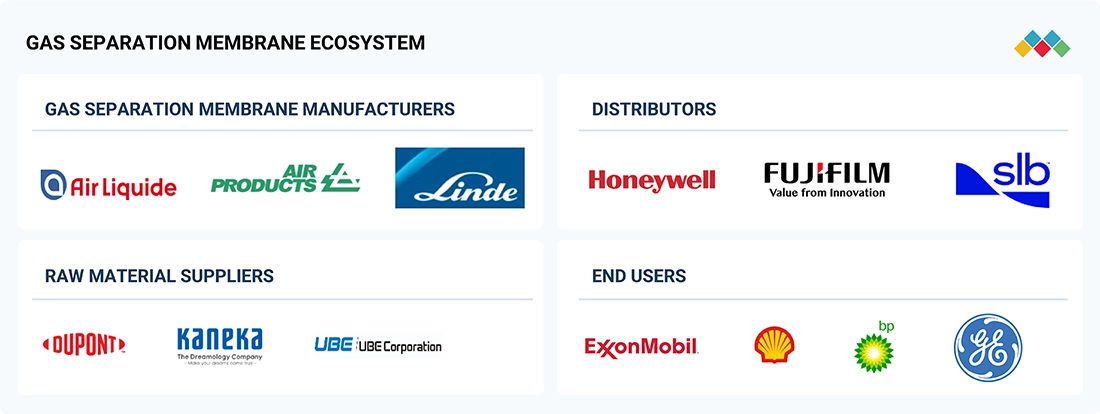
Gas Separation Membrane Market: COMMERCIAL USE CASES ACROSS INDUSTRIES
| COMPANY | USE CASE DESCRIPTION | BENEFITS |
|---|---|---|
 |
Gas separation membranes can be applied in acid gas removal (CO2 and H2S), nitrogen rejection, and post-combustion CO2 capture from large refineries and petrochemical plants | Lower operating costs compared to cryogenic distillation and reduced carbon intensity of LNG and petrochemical value chains. |
 |
Shell is investing heavily in blue and green hydrogen projects, as well as biogas plants in Europe. Gas separation membranes are vital for H2/CO2 separation in blue hydrogen and CO2/CH4 upgrading in RNG facilities. | Strengthens Shell’s hydrogen economy positioning by producing high-purity hydrogen and supports Shell’s net-zero ambitions with scalable CO2 separation for CCUS projects. |
 |
BP operates numerous offshore platforms and is leading CCUS cluster projects in the UK (e.g., Net Zero Teesside). Membranes are well-suited for compact, space-limited offshore environments where traditional separation is too bulky. | Reduces offshore platform footprint and weight while increasing efficiency and enhances project economics of CCUS hubs by lowering CO2 separation costs. |
 |
GE operates in gas turbines, power plants, and industrial systems. Membranes can be integrated into flue gas CO2 capture, oxygen enrichment for combustion, and hydrogen recovery from syngas. | Improves efficiency of gas-fired power plants through oxygen-enriched combustion and enables cost-effective CO2 capture retrofits for existing GE turbine customers. |
Logos and trademarks shown above are the property of their respective owners. Their use here is for informational and illustrative purposes only.
Related Ecosystem
Membranes
- Reverse Osmosis
- Acetone
- Bioremediation
- Cartridge Filters
- Granular Activated Carbon
- Veolia
- Toray Industries, Inc.
- PALL CORPORATION
- DuPont de Nemours, Inc.
- Pentair plc
Water Purification
- Corrosion Inhibitors
- Cartridge Filters
- Fiberglass
- Reverse Osmosis
- Acetone
- Veolia
- Kemira oyj
- SOLENIS
- Basf se
- CALGON CARBON CORPORATION
Key Takeaways
- India's gas separation membrane market is valued at USD 75.5 million in 2025 and expected to reach USD 115.9 million by 2030, representing a 9.0% CAGR.
- India's industrial sectors, particularly chemicals, petrochemicals, and pharmaceuticals, are driving significant demand for advanced gas separation membrane technologies.
- India's focus on sustainable manufacturing and hydrogen economy development is accelerating adoption of gas separation membranes across the country.
- India's market growth outpaces the global average of 7.4% CAGR, positioning India as a high-growth market within Asia Pacific.
Gas Separation Membrane Market Report Scope
| Report Metric | Details |
|---|---|
| Base Year | 2025 |
| Fastest Growing Segment | SPIRAL WOUND (Module) |
| Forecast Period | 2025–2030 |
| Growth Rate | CAGR of 7.4% from 2025 to 2030 |
| Largest Segment | PLATE & FRAME (Module) |
| Market Size Base Year (Billions) | ~USD 1.17 (2025) |
| Revenue Forecast (Billions) | ~USD 1.67 (2030) |
| Segments Covered | Module, Application, Material Type |
India Gas Separation Membrane Market Report Segmentation
3 segment dimensions are covered across the global market.
By Module
- Hollow Fiber
- Other Modules
- Plate & Frame
- Plate And Frame
- Spiral Wound
By Application
- Air Dehydration
- Carbon Dioxide Removal
- H2S
- Hydrogen Recovery
- Nitrogen Generation & Oxygen Enrichment
- Other Applications
- Vapor/Gas Separation
- Vapor/Vapor Separation
By Material Type
- Cellulose Acetate
- Other Material Types
- Polyimide & Polyaramide
- Polysulfone
INDIA: GAS SEPARATION MEMBRANE MARKET, BY APPLICATION, 2025–2030
| Segment | 2025 | 2026 | 2027 | 2028 | 2029 | 2030 | CAGR (%) |
|---|---|---|---|---|---|---|---|
| AIR DEHYDRATION | 2.63 | 2.87 | 3.13 | 3.41 | 3.73 | 4.07 | 9.2 |
| CARBON DIOXIDE REMOVAL | 16.22 | 17.72 | 19.29 | 21.05 | 23 | 25.09 | 9.1 |
| H2S | 4.51 | 4.92 | 5.35 | 5.82 | 6.35 | 6.91 | 8.9 |
| HYDROGEN RECOVERY | 14.15 | 15.45 | 16.81 | 18.33 | 20.01 | 21.82 | 9 |
| NITROGEN GENERATION & OXYGEN ENRICHMENT | 18.91 | 20.5 | 22.15 | 23.99 | 26.01 | 28.16 | 8.3 |
| OTHER APPLICATIONS | 6.03 | 6.6 | 7.2 | 7.87 | 8.62 | 9.41 | 9.3 |
| VAPOR/GAS SEPARATION | 6.19 | 6.77 | 7.39 | 8.09 | 8.86 | 9.69 | 9.4 |
| VAPOR/VAPOR SEPARATION | 6.83 | 7.49 | 8.19 | 8.98 | 9.86 | 10.8 | 9.6 |
| TOTAL | 75.47 | 82.31 | 89.52 | 97.52 | 106.44 | 115.95 | 9 |
Target Audience
- Chemical & Petrochemical Manufacturers : Indian chemical and petrochemical producers need market intelligence to evaluate membrane technology investments, optimize production processes, and meet environmental compliance standards while maintaining cost competitiveness.
- Membrane Technology Providers : Global and domestic membrane manufacturers require India-specific market data to assess growth opportunities, understand local demand patterns, and develop targeted strategies for market penetration and revenue growth.
- Industrial Equipment Suppliers : Equipment vendors serving India's industrial sector need insights into gas separation membrane adoption trends to identify cross-selling opportunities and develop integrated solutions for their customer base.
- Investment & Private Equity Firms : Investors evaluating opportunities in India's industrial chemicals and materials sector require detailed market analysis to assess growth potential, identify acquisition targets, and make informed capital allocation decisions.
- Government & Policy Makers : Indian government agencies and policy bodies need market data to understand industrial adoption of clean technologies, evaluate regulatory effectiveness, and develop informed policies supporting sustainable industrial growth.
Key Companies in the India Gas Separation Membrane Market
| Company | HQ | Ownership | Strongest segments |
|---|---|---|---|
| HYDROGENICS | Canada | Private Company | OnSite Generation (HySTAT, HyLYZER, PEM stacks),Power Systems (HyPM motive and stationary), |
| LINDE PLC | United Kingdom | Public Company | Atmospheric gases (oxygen, nitrogen, argon, rare gases),Process gases (hydrogen, CO2, CO, helium, acetylene, specialty and electronic gases),Engineering & turnkey process plants, |
| AIR LIQUIDE | United States | Public Company | Large Industries (on-site, pipeline, cogeneration),Industrial Merchant (bulk, packaged gases, hardgoods, services),Healthcare (medical gases, homecare, specialty ingredients), |
| AIR PRODUCTS AND CHEMICALS, INC. | United States | Public Company | Atmospheric gases (oxygen, nitrogen, argon),Process gases (hydrogen, helium, CO2, CO, syngas),Specialty gases, |
| HONEYWELL INTERNATIONAL INC. | United States | Public Company | Industrial Automation (controls, sensing, PPE, smart energy),Building Automation (software, controls, fire, security, services),Energy and Sustainability Solutions / UOP, |
| UBE CORPORATION | United States | Public Company | Mobility,Delivery,Freight, |
| DIC CORPORATION | United States | Public Company | Hardlines (sporting goods, fitness, golf, fishing),Apparel,Footwear and Cleats, |
| PARKER HANNIFIN CORP | United States | Public Company | Diversified Industrial – Motion and Control (hydraulics, pneumatics, electromechanical),Diversified Industrial – Filtration, Fluid Conveyance, and Sealing,Aerospace Systems – Commercial, |
| SCHLUMBERGER LIMITED | United States | Public Company | Digital & Integration,Reservoir Performance,Well Construction, |
| AIRRANE | South Korea | Public Company | Nitrogen generation membranes,Oxygen generation membranes,Dehumidification and vapor permeation/pervaporation, |
| ATLAS COPCO GROUP | Sweden | Public Company | Compressor Technique (air and gas, air treatment, medical air),Vacuum Technique (vacuum pumps, abatement, integrated systems),Industrial Technique (assembly tools, machine vision, fastening), |
| EVONIK INDUSTRIES AG | Germany | Public Company | Advanced Technologies,Custom Solutions,Infrastructure, |
HYDROGENICS
Hydrogenics is a Canadian private company founded in 1995 with 187 employees, specializing in hydrogen and fuel cell technologies.
LINDE PLC
Linde PLC is a United Kingdom-based public company founded in 1879 with 65,034 employees, operating as a global industrial gases and engineering company.
AIR LIQUIDE
Air Liquide is a United States-based public company founded in 1902 with 63,126 employees, providing industrial gases, services, and solutions worldwide.
AIR PRODUCTS AND CHEMICALS, INC.
Air Products and Chemicals, Inc. is a United States-based public company founded in 1940 with 21,194 employees, specializing in industrial gases and chemicals.
HONEYWELL INTERNATIONAL INC.
Honeywell International Inc. is a United States-based public company founded in 1885 with 101,000 employees, operating across aerospace, building technologies, and performance materials sectors.
UBE CORPORATION
UBE Corporation is a United States-based public company founded in 2009 with 35,000 employees, engaged in chemical manufacturing and related industrial operations.
DIC CORPORATION
DIC Corporation is a United States-based public company founded in 1948 with 68,400 employees, operating in the chemical and materials manufacturing industry.
PARKER HANNIFIN CORP
Parker Hannifin Corp is a United States-based public company founded in 1917 with 57,950 employees, specializing in motion and control technologies.
SCHLUMBERGER LIMITED
Schlumberger Limited is a United States-based public company founded in 1926 with 109,000 employees, providing oilfield services and technology solutions globally.
AIRRANE
Airrane is a South Korea-based public company founded in 2001, operating in the industrial technology sector.
ATLAS COPCO GROUP
Atlas Copco Group is a Sweden-based public company founded in 1873 with 56,473 employees, specializing in industrial tools, equipment, and services.
EVONIK INDUSTRIES AG
Evonik Industries AG is a Germany-based public company founded in 1847 with 30,643 employees, operating in specialty chemicals and advanced materials.
Reasons to Buy this Report
- Market Size & Growth Validation : Obtain precise market valuation data for India (USD 75.5M in 2025) with verified 9% CAGR projections through 2030, enabling accurate financial forecasting and investment decision-making for regional operations.
- Competitive Positioning Intelligence : Understand India's market dynamics relative to global trends (7.4% CAGR), identifying competitive advantages and market gaps specific to the Indian industrial landscape for strategic market entry or expansion.
- Sector-Specific Application Insights : Access detailed analysis of gas separation membrane adoption across India's chemical, petrochemical, and refining industries, enabling targeted product development and marketing strategies for high-demand segments.
- Regulatory & Compliance Framework : Gain comprehensive understanding of India's environmental regulations driving membrane adoption, helping businesses align product offerings with compliance requirements and capitalize on regulatory-driven demand.
- Investment & Expansion Planning : Leverage India-specific market forecasts and growth drivers to evaluate expansion opportunities, identify partnership prospects, and allocate resources effectively in this high-growth emerging market.
Frequently asked questions
What is the current market size of gas separation membranes in India?
India's gas separation membrane market was valued at USD 75.5 million in 2025 and is projected to grow to USD 115.9 million by 2030.
What is the expected growth rate for India's gas separation membrane market?
India's gas separation membrane market is expected to grow at a compound annual growth rate (CAGR) of 9.0% from 2025 to 2030.
Which industries in India are driving demand for gas separation membranes?
India's chemical, petrochemical, pharmaceutical, and food processing industries are the primary drivers of gas separation membrane demand.
How does India's market growth compare to global trends?
India's gas separation membrane market is growing at 9.0% CAGR, which exceeds the global average of 7.4%, making India a high-growth market.
What applications are fueling growth in India's gas separation membrane market?
India's hydrogen production, nitrogen generation, oxygen enrichment, and sustainable manufacturing applications are key growth drivers for gas separation membranes.
RESEARCH METHODOLOGY
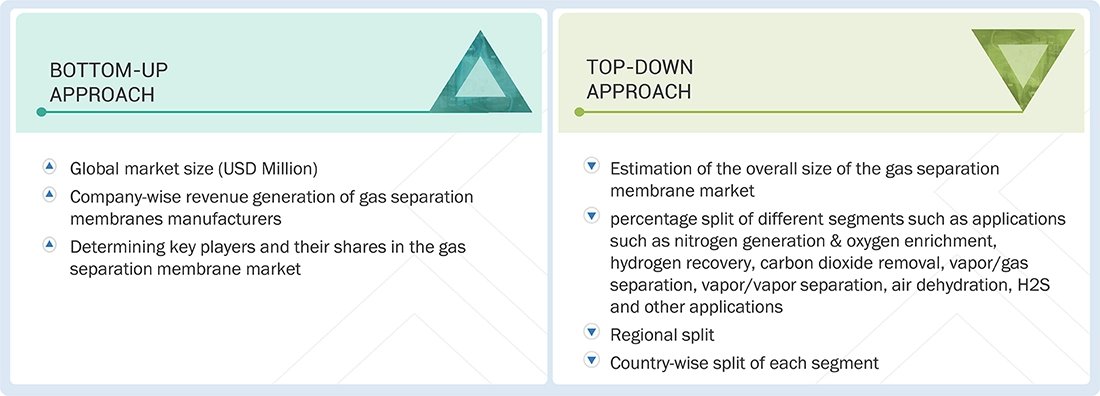
The study involves two major activities in estimating the current market size for the gas separation membrane market. Exhaustive secondary research was done to collect information on the market, peer market, and parent market. The next step was to validate these findings, assumptions, and sizing with industry experts across the value chain through primary research. Both top-down and bottom-up approaches were employed to estimate the complete market size. Following this, market breakdown and data triangulation were employed to determine the market size of segments and subsegments.
Secondary Research
Secondary sources referred to for this research study include financial statements of companies offering gas separation membranes and information from various trade, business, and professional associations. Secondary research has been used to obtain critical information about the industry’s value chain, the total pool of key players, market classification, and segmentation according to industry trends, to the bottom-most level, and regional markets. The secondary data was collected and analyzed to arrive at the overall size of the gas separation membrane market, which was validated by primary respondents.
Primary Research
Extensive primary research was conducted after obtaining information regarding the gas separation membrane market scenario through secondary research. Several primary interviews were conducted with market experts from both the demand and supply sides across major countries of North America, Europe, Asia Pacific, Middle East & Africa, and South America. Primary data was collected through questionnaires, emails, and telephonic interviews. The primary sources from the supply side included various industry experts, such as Chief X Officers (CXOs), Vice Presidents (VPs), Directors from business development, marketing, product development/innovation teams, and related key executives from gas separation membrane industry vendors, material providers, distributors, and key opinion leaders. Primary interviews were conducted to gather insights, including market statistics, revenue data from products and services, market breakdowns, market size estimations, market forecasting, and data triangulation. Primary research also helped in understanding the various trends related to modules, material types, applications, and regions. Stakeholders from the demand side, such as CIOs, CTOs, CSOs, and installation teams of the customer/end users who are seeking Gas separation membrane services, were interviewed to understand the buyer’s perspective on the suppliers, products, component providers, and their current usage of gas separation membrane and future outlook of their business, which will affect the overall market.
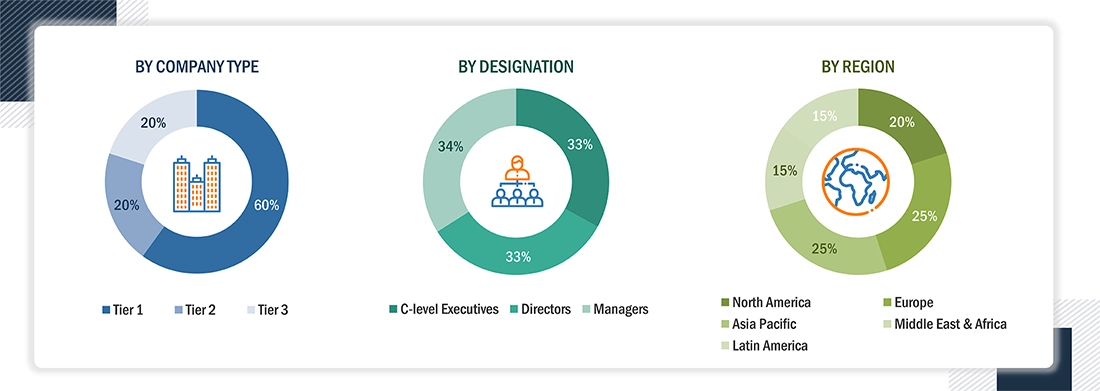
To know about the assumptions considered for the study, download the pdf brochure
Market Size Estimation
The research methodology used to estimate the size of the gas separation membrane market includes the following details. The market sizing of the market was undertaken from the demand side. The market was upsized based on the demand for gas separation membranes in different applications at a regional level. Such procurements provide information on the demand aspects of the gas separation membrane industry for each application. For each application, all possible segments of the gas separation membrane market were integrated and mapped.
Gas Separation Membrane Market : Top-Down and Bottom-Up Approach
Data Triangulation
After arriving at the overall size from the market size estimation process explained above, the total market was split into several segments and subsegments. The data triangulation and market breakdown procedures explained below were implemented, wherever applicable, to complete the overall market engineering process and arrive at the exact statistics for various market segments and subsegments. The data was triangulated by studying various factors and trends from the demand and supply sides. Along with this, the market size was validated using both the top-down and bottom-up approaches.
Market Definition
A gas separation membrane is a selective barrier that allows certain gas molecules to pass through while restricting others, enabling the separation of specific components from a gas mixture based on differences in permeability or solubility. These membranes are typically made from polymers, ceramics, or metals and are engineered in various configurations such as hollow fiber, spiral-wound, and flat-sheet modules to optimize surface area, efficiency, and operational stability.
Stakeholders
- Gas Separation Membrane Manufacturers
- Gas Separation Membrane Distributors and Suppliers
- End-use Industries
- Universities, Governments, and Research Organizations
- Associations and Industrial Bodies
- R&D Institutes
- Environmental Support Agencies
- Investment Banks and Private Equity Firms
- Research and Consulting Firms
Report Objectives
- To define, describe, and forecast the gas separation membrane market size in terms of volume and value
- To provide detailed information regarding the key factors, such as drivers, restraints, opportunities, and challenges influencing market growth
- To analyze and project the global gas separation membrane market, by module, by material type, by application, and by region
- To forecast the market size concerning five main regions (along with country-level data), namely, North America, Europe, Asia Pacific, Middle East & Africa, and South America, and analyze the significant region-specific trends
- To strategically analyze micromarkets with respect to individual growth trends, prospects, and contributions of the submarkets to the overall market
- To analyze the market opportunities and the competitive landscape for stakeholders and market leaders
- To assess recent market developments and competitive strategies, such as agreements, contracts, acquisitions, partnerships & collaborations, and new product developments/new product launches, to draw the competitive landscape
- To strategically profile the key market players and comprehensively analyze their core competencies
Available Customizations
MarketsandMarkets offers following customizations for this market report:
- Additional country-level analysis of the gas separation membrane market
Product Analysis
- Product matrix, which provides a detailed comparison of the product portfolio of each company's market
Get the Full Gas Separation Membrane Market Report
Full forecast, segment splits, and company analysis for all Gas Separation Membrane Market.
- US Gas Separation Membrane Market
- Canada Gas Separation Membrane Market
- Mexico Gas Separation Membrane Market
- Germany Gas Separation Membrane Market
- France Gas Separation Membrane Market
- Italy Gas Separation Membrane Market
- Spain Gas Separation Membrane Market
- Netherlands Gas Separation Membrane Market
- Russia Gas Separation Membrane Market
- Brazil Gas Separation Membrane Market
- Argentina Gas Separation Membrane Market
- China Gas Separation Membrane Market
- Japan Gas Separation Membrane Market
- South Korea Gas Separation Membrane Market
- Saudi Arabia Gas Separation Membrane Market
- UAE Gas Separation Membrane Market
- South America Gas Separation Membrane Market
- Rest Of Europe Gas Separation Membrane Market
- Rest Of Asia Pacific Gas Separation Membrane Market
- GCC Countries Gas Separation Membrane Market
Need a Tailored Report?
Customize this report to your needs
Get 10% FREE Customization
Customize This Report
