
Asia Pacific Generative AI Market (2025-2030)

The Asia Pacific Generative AI Market was valued at $2774.7 Million in 2025 and projected to reach to $23528.7 Million by 2030, representing a compound annual growth rate of 35.7%. Asia Pacific's generative AI market is positioned for transformative growth, with a 35.7% CAGR through 2030.


| Market Size in | USD 26.32 MN |
| Market Forecast in | |
| CAGR | |
| Forecast Period | |
| Units Considered | Value (USD MN) |
Asia Pacific Generative AI Market Trends and Insights
- This represents a compound annual growth rate of 35.7%, reflecting strong regional adoption of AI technologies across enterprise and consumer segments.
- Latin America is emerging as a key growth market, driven by digital transformation initiatives, increasing cloud infrastructure investment, and rising demand for AI-powered solutions in financial services, healthcare, and customer engagement applications. The forecast period through 2030 demonstrates Latin America's commitment to modernizing its technology landscape and leveraging generative AI for competitive advantage.
- Latin America's market growth outpaces many mature regions as organizations prioritize automation, data analytics, and intelligent decision-making tools.
- Key drivers include expanding internet penetration, growing startup ecosystems, and multinational technology companies establishing regional innovation hubs throughout Latin America..
Key Market Statistics
- CAGR (2025-2030) 35.7% CAGR
- Market Size, 2025 ~USD 2774.7 Million
- Forecast, 2030 ~USD 23528.7 Million
- Geography Asia Pacific
Asia Pacific Generative AI Market Overview
Rapid Market Expansion :
Asia Pacific's generative AI market is valued at $2,774.7 million in 2025 and projected to reach $23,528.7 million by 2030, demonstrating exceptional growth potential in the region.
Strong CAGR Performance :
The region is experiencing a compound annual growth rate of 35.7%, driven by increasing enterprise adoption, digital transformation initiatives, and growing investment in AI infrastructure across Asia Pacific economies.
Market Leaders in the Region :
China ($98.8B), Japan ($62.1B), India ($41.5B), and South Korea ($39.9B) are the dominant markets, collectively representing the largest generative AI adoption centers in Asia Pacific.
Emerging Hub Status :
Asia Pacific is establishing itself as a critical growth hub for generative AI, with Singapore ($24.3B) emerging as a regional innovation center and gateway for AI technology deployment across Southeast Asia.
Asia Pacific Generative AI Market Dynamics
- The region's expansion is fueled by massive investments from technology leaders, increasing cloud adoption, and widespread digital transformation across enterprise sectors.
- Countries like China, Japan, and India are driving innovation in AI applications, while emerging markets are rapidly integrating generative AI into business operations. The outlook for Asia Pacific remains exceptionally bullish, supported by favorable government policies, substantial R&D funding, and a large talent pool of AI developers.
- Enterprise adoption across finance, healthcare, manufacturing, and retail sectors continues to accelerate, positioning the region as a critical driver of global generative AI market growth and innovation..
Market Ecosystem
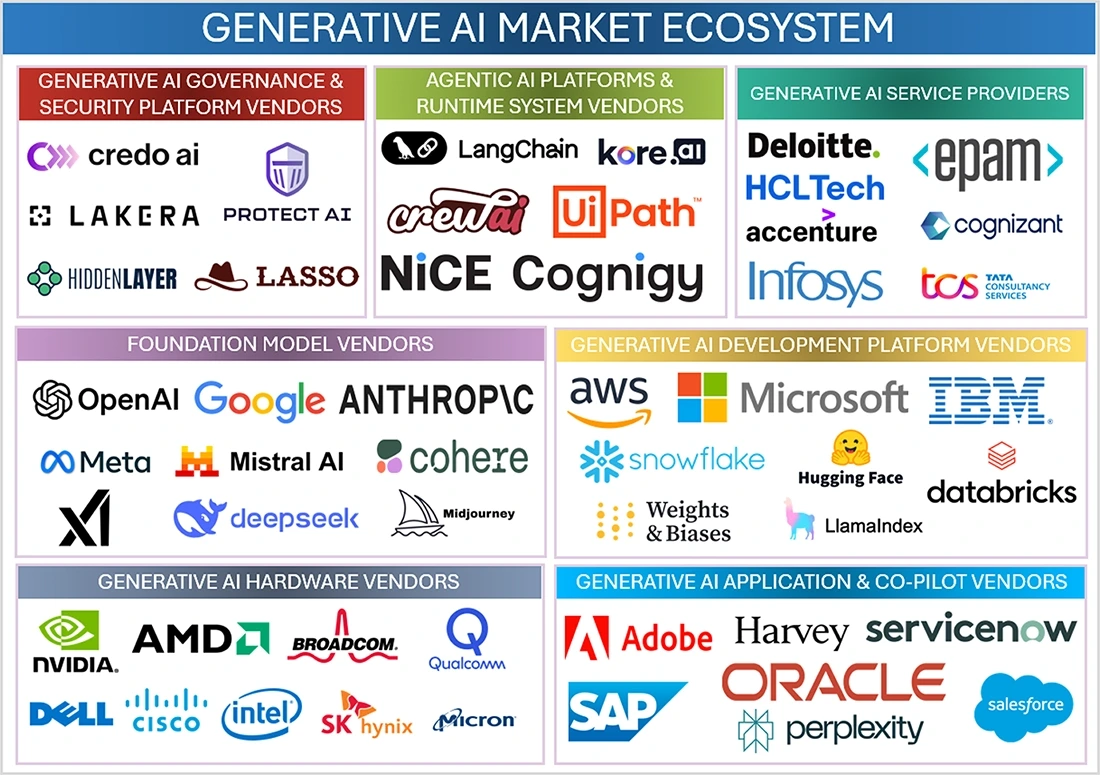
GENERATIVE AI MARKET: COMMERCIAL USE CASES ACROSS INDUSTRIES
| COMPANY | USE CASE DESCRIPTION | BENEFITS |
|---|---|---|
 |
Aditya Birla Capital built a common enterprise generative AI platform using Microsoft Azure OpenAI Service across its nine business lines. The platform supports internal applications, employee productivity, and faster development of AI-enabled financial services workflows. | The shared platform delivered more than 40% cost reduction, while improving productivity and accelerating time to market across participating businesses. |
 |
HK Express implemented a generative AI feedback-analysis pipeline using Google Cloud tools and open-source models to consolidate and interpret customer comments from different parts of the airline. | The airline achieved a 41% efficiency gain in data analysis, allowing a lean team to deliver more granular feedback to business units. |
 |
HubSpot integrated Stability AI models through Amazon Bedrock to expand image-generation capabilities for customers using its marketing and content tools. | The deployment supported a 150% increase in customer demand for image generation, while providing scalable access to creative tools at lower cost. |
 |
Foxconn adopted NVIDIA Omniverse, accelerated computing, AI, and digital twins to simulate factories, monitor production operations, and support planning for AI-enabled smart manufacturing environments. | The system improved real-time production visibility and enabled quicker responses to operational issues, while reducing dependence on physical trial-and-error during factory planning. |
 |
Payments technology company BPC used Amazon Bedrock to build generative AI tools for customer service and software development, including chatbot support and automated code generation and review. | BPC recorded a 66% reduction in chatbot costs, generated 4,000 lines of code, and achieved a 46% code-acceptance rate. |
Logos and trademarks shown above are the property of their respective owners. Their use here is for informational and illustrative purposes only.
Related Ecosystem
Analytics
- Natural Language Processing (NLP)
- Machine Learning
- Supply Chain Management
- Predictive Analytics
- Image Sensors
- International Business Machines Corporation
- MICROSOFT CORPORATION
- Oracle Corporation
- SAP SE
Cloud Computing
- Software as A Service (SaaS)
- Natural Language Processing (NLP)
- Platform as A Service (PaaS)
- Machine Learning
- Supply Chain Management
- International Business Machines Corporation
- MICROSOFT CORPORATION
- Oracle Corporation
- Amazon.com, Inc.
Software And Services
- Natural Language Processing (NLP)
- Machine Learning
- Supply Chain Management
- Predictive Analytics
- Image Sensors
- International Business Machines Corporation
- MICROSOFT CORPORATION
- Oracle Corporation
- SAP SE
- Amazon.com, Inc.
Key Takeaways
- Latin America's generative AI market will grow from $2,774.7M (2025) to $23,528.7M (2030) at a 35.7% CAGR.
- Latin America demonstrates stronger growth momentum than the global average, positioning it as a high-potential emerging market.
- Latin America's adoption is driven by digital transformation, cloud migration, and enterprise demand for AI-powered automation.
- Latin America's market expansion reflects increasing investment in AI infrastructure and talent development across the region.
Generative AI Market Report Scope
| Report Metric | Details |
|---|---|
| Base Year | 2025 |
| Fastest Growing Segment | GENERATIVE AI AGENTS (Gen Ai Saas) |
| Forecast Period | 2025–2030 |
| Growth Rate | CAGR of 43.4% from 2025 to 2030 |
| Largest Segment | MACHINE LEARNING (Technology) |
| Market Size Base Year (Billions) | ~USD 71.42 (2025) |
| Revenue Forecast (Billions) | ~USD 433.09 (2030) |
| Segments Covered | Offering, Infrastructure, Compute, Memory, Memory 2025–2032, Networking Hardware, Nic/Network Adapter, Software, Model Enablement & Orchestration Tool, Gen Ai Saas, Service, Data Modality, Application, Business Intelligence & Visualization, Content Management, Synthetic Data Management, Search & Discovery, Automation & Integration, Generative Design Ai, End User, Type, Use Case, Enterprise, Bfsi, Retail & E-Commerce, Government & Defense, Telecommunication, Media & Entertainment, Transportation & Logistics, Manufacturing, Healthcare & Life Science, Software & Technology Provider, Energy & Utility, Architecture, Modality, Model Size, Technology, Business Function, Enterprise Application |
Asia Pacific Generative AI Market Report Segmentation
39 segment dimensions are covered across the global market.
By Offering
- Infrastructure
- Services
- Software
By Infrastructure
- Compute
- Memory
- Networking Hardware
- Storage
By Compute
- Cpus
- Fpgas
- Gpus
By Memory
- Ddr
- Hbm
By Memory 2025–2032
- Ddr
- Hbm
By Networking Hardware
- Interconnects
- Nic/Network Adapters
By Nic/Network Adapter
- Ethernet
- Infiniband
By Software
- Foundation Models
- Gen AI SaaS
- Model Enablement & Orchestration Tools
By Model Enablement & Orchestration Tool
- Governance & Risk Platforms
- Llmops & Prompt Engineering Tools
- Model Fine-Tuning Tools
- Model Hosting & Access Platforms
- Model Monitoring & Evaluation Tools
By Gen Ai Saas
- Code Generators
- Domain-Specific Gen AI Tools
- Generative AI Agents
- Generative Design & Prototyping Tools
- Synthetic Data Generators
By Service
- Gen AI Training & Consulting Services
- Gen AI Training Data Services
- Integration & Deployment Services
- Managed Gen AI Services
- Model Development & Fine-Tuning Services
- Prompt Engineering Services
- Support & Maintenance Services
By Data Modality
- Audio & Speech
- Code
- Image
- Multimodal
- Text
- Video
By Application
- Automation & Integration
- Business Intelligence & Visualization
- Code Generation
- Content Generation & Curation
- Content Management
- Customer Service Automation
- Data Analysis & Bi
- Generative Design AI
- Information Retrieval
- Language Translation & Localization
- Other Applications
- Search & Discovery
- Synthetic Data Management
By Business Intelligence & Visualization
- Finance Intelligence
- Human Resource Intelligence
- Marketing Intelligence
- Operations & Supply Chain Intelligence
- Sales Intelligence
By Content Management
- Content Curation, Tagging, & Categorization
- Content Generation
- Digital Marketing
- Media Editing
By Synthetic Data Management
- Synthetic Data Augmentation
- Synthetic Data Training
By Search & Discovery
- General Search
- Insight Generation
By Automation & Integration
- Application Development & Api Integration
- Customer Experience Management
- Cybersecurity Intelligence
- Personalization & Recommendation Systems
By Generative Design Ai
- Design Exploration & Variation
- Modeling & Prototyping
- Product Rendering & Visual Collaterals
By End User
- Bfsi
- Consumers
- Education
- Enterprises
- Healthcare & Life Sciences
- It & Ites
- Law Firms
- Manufacturing
- Media & Entertainment
- Other End Users
- Retail & Ecommerce
By Type
- Bfsi
- Energy & Utilities
- Government & Defense
- Healthcare & Life Sciences
- Manufacturing
- Media & Entertainment
- Other Enterprises
- Retail & E-Commerce
- Software & Technology Providers
- Telecom
- Transportation & Logistics
By Use Case
- Automated Report & Commentary Generation
- Automated Sla Reporting
- Citizen Services Chatbots
- Contact Center Intelligence
- Customer Query Resolution
- Demand Forecasting & Inventory Management
- Document Classification & Knowledge Retrieval
- Fraud Detection & Prevention
- Intelligent Underwriting & Claims
- Marketing Content & Campaign Personalization
- Network Operations & Fault Diagnosis
- Osint Briefing & Reporting
- Other Bfsi Use Cases
- Other Government & Defense Use Cases
- Other Retail & E-Commerce Use Cases
- Other Telecommunication Use Cases
- Other Telecommunications Use Cases
- Personalized Finance Advisors
- Personalized Product Recommendations
- Policy Drafting & Legislative Summarization
- Product Description & Seo Content Generation
- Regulatory Reporting & Compliance
- Revenue Assurance & Fraud Prevention
- Threat Scenario Simulation
- Virtual Shopping Assistants
By Enterprise
- Bfsi
- Energy & Utilities
- Government & Defense
- Healthcare & Life Sciences
- Manufacturing
- Media & Entertainment
- Other Enterprises
- Retail & E-Commerce
- Software & Technology Providers
- Telecommunications
- Transportation & Logistics
By Bfsi
- Automated Report & Commentary Generation
- Fraud Detection & Prevention
- Intelligent Underwriting & Claims
- Other Bfsi Use Cases
- Personalized Finance Advisors
- Regulatory Reporting & Compliance
By Retail & E-Commerce
- Customer Query Resolution
- Demand Forecasting & Inventory Management
- Other Retail & E-Commerce Use Cases
- Personalized Product Recommendations
- Product Description & Seo Content Generation
- Virtual Shopping Assistants
By Government & Defense
- Citizen Services Chatbots
- Document Classification & Knowledge Retrieval
- Osint Briefing & Reporting
- Other Government & Defense Use Cases
- Policy Drafting & Legislative Summarization
- Threat Scenario Simulation
By Telecommunication
- Automated Sla Reporting
- Contact Center Intelligence
- Marketing Content & Campaign Personalization
- Network Operations & Fault Diagnosis
- Other Telecommunications Use Cases
- Revenue Assurance & Fraud Prevention
By Media & Entertainment
- Advertising & Campaign Copywriting
- AI Voiceover & Dubbing
- Digital Rights & Ip Protection
- Multilingual Content Localization
- Other Media & Entertainment Use Cases
- Scriptwriting & Narrative Generation
- Synthetic Influencers, Hosts, & Digital Avatars
- Visual Assets Generation & Motion Design
By Transportation & Logistics
- Fleet Management
- Freight Documentation
- Other Transportation & Logistics Use Cases
- Route Optimization
- Traffic Scenario Simulation
- Warehouse Management
By Manufacturing
- Design Generation
- Other Manufacturing Use Cases
- Predictive Maintenance
- Procurement & Supplier Management
- Product Planning & Simulation
- Quality Inspection & Control
By Healthcare & Life Science
- Clinical Trial Protocol Design
- Drug Discovery & Molecule Design
- Ehr Automation
- Medical Imaging
- Other Healthcare & Life Sciences Use Cases
- Personalized Treatment Plans
- Virtual Health Assistants
By Software & Technology Provider
- Business Process Automation
- Code Generation & Debugging
- Customer Support Automation
- Gen AI-Assisted Itsm
- Knowledge Discovery
- Other Software & Technology Provider Use Cases
- Test Case Generation & Qa Automation
By Energy & Utility
- Condition-Based Asset Maintenance
- Digital Twin Simulations
- Grid Operations Management
- Other Energy & Utility Use Cases
- Renewable Energy Forecasting
- Sustainability & Emissions Reporting
By Architecture
- Autoencoding Language Models
- Autoregressive Language Models
- Hybrid Language Models
By Modality
- Code
- Image
- Text
- Video
By Model Size
- 1 Billion To 10 Billion Parameters
- 10 Billion To 50 Billion Parameters
- 100 Billion To 200 Billion Parameters
- 200 Billion To 500 Billion Parameters
- 50 Billion To 100 Billion Parameters
- Above 500 Billion Parameters
- Below 1 Billion Parameters
By Technology
- Computer Vision AI
- Context-Aware Artificial Intelligence
- Generative AI
- Machine Learning
- Natural Language Processing
By Business Function
- Finance & Accounting
- Human Resources
- Marketing & Sales
- Operations & Supply Chain
- Other Business Functions
By Enterprise Application
- Agriculture
- Bfsi
- Energy & Utilities
- Government & Defense
- Healthcare & Life Sciences
- Manufacturing
- Media & Entertainment
- Other Enterprise Applications
- Retail & E-Commerce
- Retail &E-Commerce
- Software & Technology Providers
- Telecommunications
- Transportation & Logistics
Target Audience
- Technology Investors : Identify high-growth investment opportunities in Asia Pacific's generative AI ecosystem with detailed market sizing, CAGR projections, and country-level performance metrics for portfolio allocation.
- Enterprise Decision Makers : Evaluate generative AI adoption trends and competitive positioning across Asia Pacific markets to inform digital transformation strategies and technology vendor selection.
- AI Solution Providers : Understand regional market dynamics, customer segments, and growth opportunities in Asia Pacific to optimize product development, pricing strategies, and market expansion roadmaps.
- Management Consultants : Access Asia Pacific generative AI market intelligence to advise clients on regional expansion, competitive benchmarking, and strategic positioning within the rapidly growing market.
- Government & Policy Makers : Leverage market data to inform AI policy development, investment incentives, and digital economy strategies aligned with Asia Pacific's generative AI growth trajectory and regional competitiveness.
Key Companies in the Asia Pacific Generative AI Market
| Company | HQ | Ownership | Strongest segments |
|---|---|---|---|
| GLOO | United States | Public Company | Gen AI SaaS – Gloo Workspace,Model Enablement & Orchestration – Gloo 360 and platform services,Gen AI SaaS – Gloo Media Network, |
| MICROSOFT | United States | Public Company | Foundation Models (Azure OpenAI and in-house models),Model Enablement & Orchestration Tools (Azure AI Studio, Prompt Flow, GitHub platform),Gen AI SaaS (Microsoft 365 Copilot, Dynamics 365 Copilot, Power Platform, LinkedIn, search), |
| United States | Public Company | Foundation Models (Gemini family and related APIs),Model Enablement & Orchestration Tools (Vertex AI, tooling, infra),Gen AI SaaS (Workspace, Search, YouTube, vertical apps), | |
| ADOBE | United States | Public Company | Gen AI SaaS (Creative & Experience Clouds),Model Enablement & Orchestration Tools,Foundation Models & Model Access, |
| IBM | United States | Public Company | Foundation Models,Model Enablement & Orchestration Tools,Gen AI SaaS, |
| META | United States | Public Company | Foundation Models (Llama and related),Model Enablement & Orchestration Tools,Gen AI SaaS (assistants, creator and business tools), |
| NVIDIA | United States | Public Company | Foundation Models,Model Enablement & Orchestration Tools,Gen AI SaaS, |
| ACCENTURE | Ireland | Public Company | Foundation Models (own IP / custom models),Model Enablement & Orchestration Tools,Gen AI SaaS (solutions and managed services), |
| CAPGEMINI | France | Public Company | Foundation Models,Model Enablement & Orchestration Tools,Gen AI SaaS, |
| HPE | United States | Public Company | Foundation Models,Model Enablement & Orchestration Tools,Gen AI SaaS, |
| AMD | United States | Public Company | Foundation model enablement (GPU/CPU/FPGA software stack),Model enablement & orchestration tools,Gen AI SaaS and application-adjacent software, |
| ORACLE | United States | Public Company | Gen AI SaaS (Fusion, NetSuite, Industry Clouds),Model Enablement & Orchestration Tools,Foundation Models & OCI AI Infrastructure, |
| SALESFORCE | United States | Public Company | Gen AI SaaS (Agentforce, Einstein across clouds, Slack AI),Model Enablement & Orchestration Tools (Data 360, Informatica integrations, platform services),Foundation Models (native and partner-exposed), |
GLOO
Gloo is a publicly traded company founded in 2013 in the United States with 700 employees, providing technology solutions and services.
MICROSOFT
Microsoft is a publicly traded technology company founded in 1975 in the United States with 228,000 employees, providing software, cloud services, and enterprise solutions globally.
Google is a publicly traded technology company founded in 1998 in the United States with 194,668 employees, specializing in search, advertising, cloud services, and artificial intelligence.
ADOBE
Adobe is a publicly traded software company founded in 1982 in the United States with 31,360 employees, providing creative and digital marketing solutions.
IBM
IBM is a publicly traded technology company founded in 1911 in the United States with 264,300 employees, providing enterprise software, cloud services, and IT solutions.
META
Meta is a publicly traded technology company founded in 2004 in the United States with 77,986 employees, specializing in social media platforms and metaverse technologies.
NVIDIA
NVIDIA is a publicly traded technology company founded in 1993 in the United States with 42,000 employees, specializing in graphics processing units and AI computing platforms.
ACCENTURE
Accenture is a publicly traded consulting and technology services company founded in 1951 in Ireland with 799,000 employees, providing digital transformation and IT solutions globally.
CAPGEMINI
Capgemini is a publicly traded consulting and technology services company founded in 1967 in France with 423,405 employees, offering digital transformation and IT services worldwide.
HPE
HPE (Hewlett Packard Enterprise) is a publicly traded technology company founded in 1939 in the United States with 67,000 employees, providing enterprise IT infrastructure and solutions.
AMD
AMD (Advanced Micro Devices) is a publicly traded semiconductor company founded in 1969 in the United States with 31,000 employees, specializing in processors and graphics technologies.
ORACLE
Oracle is a publicly traded software and database company founded in 1977 in the United States with 141,000 employees, providing enterprise software, cloud services, and database solutions.
SALESFORCE
Salesforce is a publicly traded cloud computing company founded in 1999 in the United States with 83,334 employees, specializing in customer relationship management and enterprise cloud solutions.
Countries within Asia Pacific - compare and drill down
| Country | 2025 size (native) |
|---|---|
| China | USD 98755.7 Million |
| India | USD 41513 Million |
| Japan | USD 62073.3 Million |
| South Korea | USD 39852.5 Million |
| Singapore | USD 24304 Million |
Country market size visualization
Reasons to Buy this Report
- Regional Market Segmentation : Gain detailed insights into Asia Pacific's generative AI market with country-level breakdowns for China, Japan, India, South Korea, and Singapore, enabling targeted market entry strategies.
- Growth Trajectory Analysis : Understand the 35.7% CAGR dynamics and forecast expansion from $2.8B to $23.5B by 2030, identifying investment opportunities and market timing for Asia Pacific expansion.
- Competitive Landscape Intelligence : Access comprehensive data on leading markets and emerging hubs within Asia Pacific, including market leaders' strategies and regional competitive positioning for informed decision-making.
- Enterprise Adoption Insights : Discover sector-specific generative AI adoption patterns across Asia Pacific's enterprise segments, including finance, healthcare, manufacturing, and retail for targeted business solutions.
- Strategic Planning Resources : Leverage Asia Pacific-specific market forecasts and trend analysis to develop regional go-to-market strategies, partnership opportunities, and investment allocation decisions.
Frequently asked questions
What is the current size of the generative AI market in Latin America?
Latin America's generative AI market is valued at $2,774.7 million in 2025, with significant growth anticipated through the forecast period.
What is the projected market size for generative AI in Latin America by 2030?
Latin America's generative AI market is forecast to reach $23,528.7 million by 2030, representing an 8.5x increase from 2025 levels.
What is the CAGR for generative AI in Latin America?
Latin America's generative AI market is expected to grow at a compound annual growth rate of 35.7% between 2025 and 2030.
Which industries are driving generative AI adoption in Latin America?
Latin America's key adopting sectors include financial services, healthcare, retail, telecommunications, and professional services, all leveraging AI for operational efficiency.
What factors are accelerating generative AI growth in Latin America?
Latin America's market growth is fueled by digital transformation initiatives, cloud infrastructure expansion, talent development, startup ecosystem growth, and multinational technology investments.
RESEARCH METHODOLOGY
The research methodology for the global generative AI market report involved the use of extensive secondary sources and directories, as well as various reputed open-source databases, to identify and collect information useful for this technical and market-oriented study. In-depth interviews were conducted with various primary respondents, including gen AI software providers, gen AI service providers, gen AI hardware providers, individual end users, and enterprise end users; high-level executives of multiple companies offering generative AI software, hardware & services; and industry consultants to obtain and verify critical qualitative and quantitative information and assess the market prospects and industry trends.
Secondary Research
In the secondary research process, various secondary sources were referred to for identifying and collecting information for the study. The secondary sources included annual reports; press releases and investor presentations of companies; white papers; certified publications such as Journal of Machine Learning Research (JMLR), Transactions of the Association for Computational Linguistics (TACL), Transactions on Machine Learning Research (TMLR), Nature Machine Intelligence, IEEE Transactions on Pattern Analysis and Machine Intelligence, IEEE Transactions on Neural Networks and Learning Systems, ACM Transactions on Intelligent Systems and Technology, Artificial Intelligence, Neural Computation, and Computational Linguistics; and articles from recognized associations and government publishing sources including but not limited to Conference on Neural Information Processing Systems (NeurIPS), International Conference on Machine Learning (ICML), International Conference on Learning Representations (ICLR), AAAI Conference on Artificial Intelligence, Annual Meeting of the Association for Computational Linguistics (ACL), Association for the Advancement of Artificial Intelligence (AAAI), Association for Computational Linguistics (ACL), Institute of Electrical and Electronics Engineers (IEEE), Association for Computing Machinery (ACM), National Institute of Standards and Technology (NIST), and Organization for Economic Co-operation and Development (OECD).
Secondary research was used to obtain key information about the industry’s value chain, the market’s monetary chain, the overall pool of key players, market classification and segmentation according to industry trends to the bottom-most level, regional markets, and key developments from the market- and technology-oriented perspectives.
Primary Research
In the primary research process, a diverse range of stakeholders from both the supply and demand sides of the generative AI ecosystem were interviewed to gather qualitative and quantitative insights specific to this market. From the supply side, key industry experts, such as chief executive officers (CEOs), vice presidents (VPs), marketing directors, technology & innovation directors, as well as technical leads from vendors offering generative AI hardware, software & services, were consulted. Additionally, system integrators, service providers, and IT service firms that implement and support generative AI were included in the study. On the demand side, input from IT decision-makers, hardware managers, and business heads of prominent enterprise end users was collected to understand the user perspectives and adoption challenges within targeted industries.
The primary research ensured that all crucial parameters affecting the generative AI market—from technological advancements and evolving use cases (Customer support, content creation, coding assistance, enterprise search and knowledge retrieval, data analysis and decision support, etc.) to regulatory and compliance needs (GDPR, CCPA, Europe AI Act, AIDA, etc.) were considered. Each factor was thoroughly analyzed, verified through primary research, and evaluated to obtain precise quantitative and qualitative data for this market.
Once the initial phase of market engineering was completed, including detailed calculations for market statistics, segment-specific growth forecasts, and data triangulation, an additional round of primary research was undertaken. This step was crucial for refining and validating critical data points, such as gen AI offerings (generative AI hardware, software & services), industry adoption trends, the competitive landscape, and key market dynamics like demand drivers (Rapid enterprise adoption of generative AI copilots and AI-enabled workflows; Advancements in multimodal, reasoning, and context-aware foundation models; Declining model inference costs and improving compute efficiency; Growing demand for automation across content creation, software development, knowledge management, and analytics), challenges (Ensuring accuracy, reliability, explainability, and consistency of model outputs; Mitigating prompt injection, data poisoning, model abuse, and other generative AI security risks), and opportunities (Expansion of agentic AI and autonomous multi-step workflow orchestration; Development of domain-specific, small, and customized generative AI models; Rising demand for sovereign, localized, and industry-compliant generative AI solutions).
In the comprehensive market engineering process, the top-down and bottom-up approaches, along with several data triangulation methods, were extensively employed to perform market estimation and forecasting for the overall market segments and subsegments listed in this report. Extensive qualitative and quantitative analysis was performed on the complete market engineering process to record the critical information/insights throughout the report.
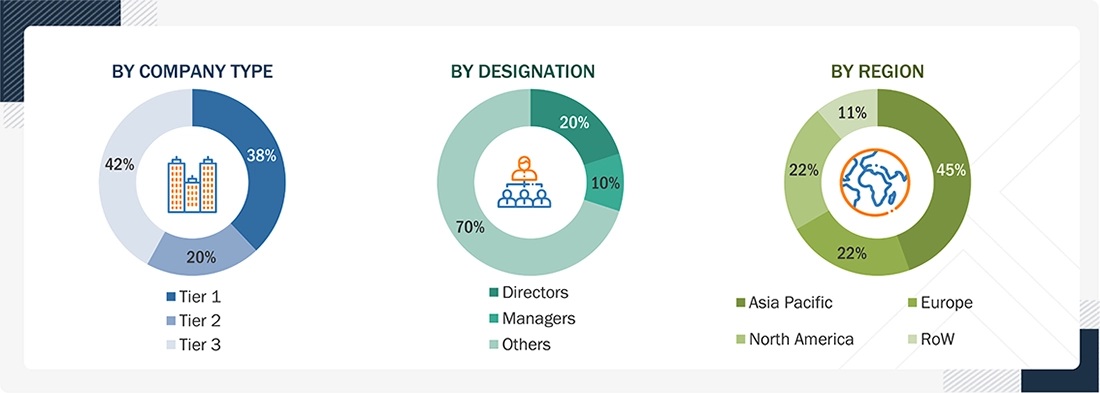
Note: Three tiers of companies are defined based on their total revenue for the year ended 31st December 2025; Tier 1 companies’ revenue is more than USD 1 billion; Tier 2 companies’ revenue ranges between USD 1 billion and 500 million; and Tier 3 companies’ revenue ranges less than USD 500 million
Source: MarketsandMarkets Analysis
To know about the assumptions considered for the study, download the pdf brochure
Market Size Estimation
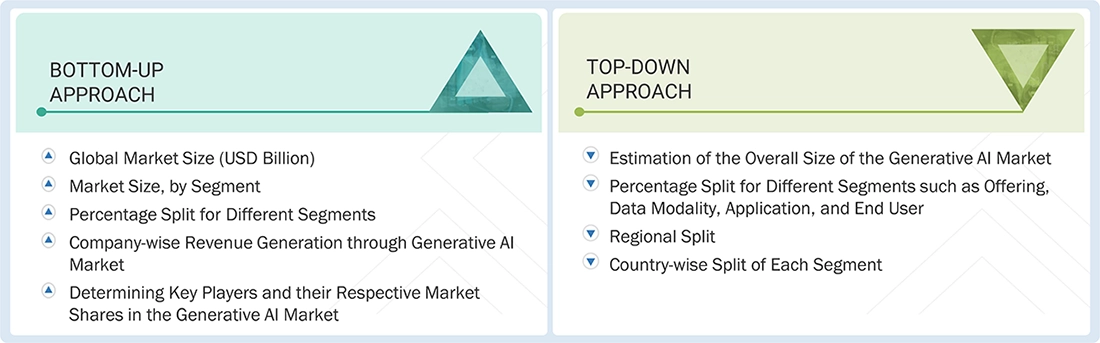
The top-down and bottom-up approaches were employed to estimate and forecast the generative AI market, as well as its dependent submarkets. This multi-layered analysis was further reinforced through data triangulation, which incorporated primary and secondary research inputs. The market figures were also validated against the existing MarketsandMarkets repository for accuracy.
Generative AI Market: Top-Down and Bottom-Up Approach
Data Triangulation
The market was divided into several segments and subsegments after determining the overall market size using the market size estimation processes described above. To complete the overall market engineering process and determine the exact statistics for each market segment and subsegment, data triangulation and market segmentation procedures were employed, wherever applicable. The overall market size was then used in the top-down approach to estimate the size of other individual markets by applying percentage splits to the market segmentation.
Market Definition
Generative AI refers to artificial intelligence systems that can create new content or outputs by learning patterns from large volumes of existing data. Depending on the model and use case, these outputs may include written text, images, audio, video, software code, designs, analytical insights, and automated actions. Unlike traditional AI systems that mainly classify, predict, or detect patterns, generative AI can produce original responses and support users in creating, analyzing, and completing tasks. For this research study, the generative AI market includes the hardware, software, and services required to develop, train, deploy, govern, and operate generative AI models, applications, copilots, and agentic systems across consumer and enterprise environments.
Key Stakeholders
- Academia and research institutions
- AI training dataset providers
- Business analysts
- Channel partners, distributors, and value-added resellers (VARs)
- Cloud service providers
- Consulting and advisory firms
- Enterprise end users
- Gen AI hardware providers
- Gen AI service providers
- Gen AI software developers
- Government and regulatory bodies
- Independent software vendors (ISVs)
- Investors & venture capital firms
- Language service providers
- Market research and consulting firms
- QA teams, DevOps teams, and engineering leaders
- System integrators (SIs) and digital engineering service providers
- Technology providers
- Synthetic data providers
Report Objectives
- To define, describe, and forecast the generative AI market by offering (hardware, software, and services), data modality, application, and end user
- To provide detailed information related to major factors (drivers, restraints, opportunities, and industry-specific challenges) influencing market growth
- To analyze the micro markets with respect to individual growth trends, prospects, and their contribution to the total market
- To analyze the opportunities in the market for stakeholders by identifying the high-growth segments of the generative AI market
- To analyze opportunities in the market and provide details of the competitive landscape for stakeholders and market leaders
- To forecast the market size of segments for five main regions: North America, Europe, Asia Pacific, the Middle East & Africa, and Latin America
- To profile the key players and comprehensively analyze their market ranking and core competencies
- To analyze competitive developments, such as partnerships, product launches, and mergers and acquisitions, in the generative AI market
- To analyze the impact of various macroeconomic factors in the generative AI market across all the regions
Available customizations:
With the given market data, MarketsandMarkets offers customizations based on the company’s specific needs. The following customization options are available for the report.
Brand/Product Comparative Analysis
- Brand/Product comparative analysis of additional vendors
Geographic Analysis
- Inclusion of additional European countries, with breakup by offering, data modality, application, and end user
- Inclusion of additional Asia Pacific countries, with breakup by offering, data modality, application, and end user
- Inclusion of additional Middle East & African countries, with breakup by offering, data modality, application, and end user
- Inclusion of additional Latin American countries, with breakup by offering, data modality, application, and end user
Company Information
- Detailed analysis and profiling of additional market players (up to five)
Get the Full Generative AI Market Report
Full forecast, segment splits, and company analysis for all Generative AI Market.
- France Generative AI Market
- Italy Generative AI Market
- Spain Generative AI Market
- Finland Generative AI Market
- China Generative AI Market
- India Generative AI Market
- Japan Generative AI Market
- South Korea Generative AI Market
- Singapore Generative AI Market
- Saudi Arabia Generative AI Market
- UAE Generative AI Market
- South Africa Generative AI Market
- Israel Generative AI Market
- Brazil Generative AI Market
- Mexico Generative AI Market
- Argentina Generative AI Market
- Rest Of Latin America Generative AI Market
- US Generative AI Market
- Canada Generative AI Market
- UK Generative AI Market
- Germany Generative AI Market
Need a Tailored Report?
Customize this report to your needs
Get 10% FREE Customization
Customize This Report
