
Germany Glass Substrate Market (2026-2031)

The Germany Glass Substrate Market was valued at $384.2 Million in 2026 and projected to reach to $481.7 Million by 2031, representing a compound annual growth rate of 4.6%. Germany's glass substrate market is poised for sustained growth through 2031, driven by the country's dominant position in European manufacturing and increasing demand from automotive electrification and advanced display technologies.


| Market Size in | USD 26.32 MN |
| Market Forecast in | |
| CAGR | |
| Forecast Period | |
| Units Considered | Value (USD MN) |
Germany Glass Substrate Market Trends and Insights
- Germany's position as a leading manufacturing hub in Europe drives significant demand for glass substrates across electronics, automotive, and display applications.
- The country's advanced industrial infrastructure and strong R&D capabilities position Germany as a key market for high-performance glass substrate solutions. Germany's glass substrate market benefits from robust demand in semiconductor packaging, LCD/OLED displays, and photovoltaic applications.
- The forecast period (2026-2031) reflects Germany's commitment to technological innovation and sustainable manufacturing practices.
- Germany's established supply chains and proximity to major European markets further strengthen its competitive advantage in the glass substrate sector..
Key Market Statistics
- CAGR (2026-2031) 4.6% CAGR
- Market Size, 2026 ~USD 384.2 Million
- Forecast, 2031 ~USD 481.7 Million
- Country Germany
Germany Glass Substrate Market Overview
Market Valuation :
Germany's glass substrate market is valued at USD 384.2 million in 2026 and is projected to reach USD 481.7 million by 2031, representing robust growth in Europe's largest industrial economy.
Strong CAGR Performance :
The German market is expanding at a CAGR of 4.6% (2026-2031), outpacing the global average of 3.6%, driven by advanced manufacturing capabilities and technological innovation.
Manufacturing Hub Status :
Germany's position as Europe's leading manufacturing hub creates sustained demand for glass substrates across electronics, automotive, and display sectors, supported by world-class industrial infrastructure.
Sectoral Diversification :
Key applications span automotive displays, consumer electronics, industrial optics, and photovoltaic systems, leveraging Germany's expertise in precision engineering and quality manufacturing standards.
Germany Glass Substrate Market Dynamics
- The 4.6% CAGR reflects strong industrial investment and the transition toward high-performance glass substrates for next-generation applications.
- Germany's commitment to Industry 4.0 and digital manufacturing will further enhance competitiveness in precision glass substrate production. The market benefits from proximity to major European OEMs, established supply chain networks, and continuous innovation in glass coating and processing technologies.
- Rising demand for lightweight automotive components and advanced semiconductor packaging will sustain market expansion.
- Strategic investments in sustainable manufacturing practices and circular economy initiatives position Germany as a premium supplier of high-quality glass substrates in the European market..
Market Ecosystem
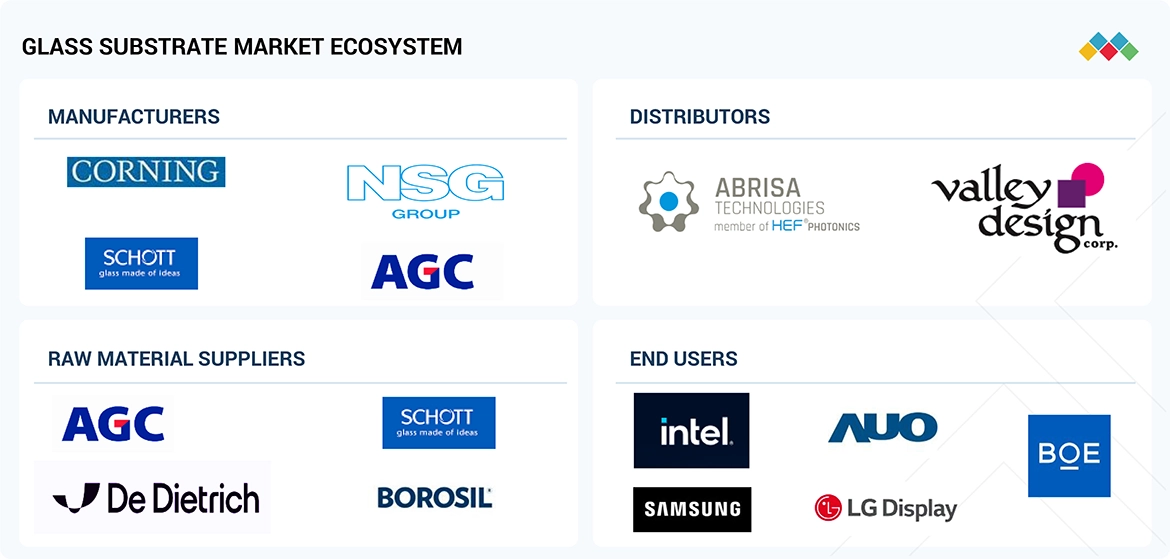
GLASS SUBSTRATE MARKET: COMMERCIAL USE CASES ACROSS INDUSTRIES
| COMPANY | USE CASE DESCRIPTION | BENEFITS |
|---|---|---|
 |
Safe transport containers were engineered for SCHOTT telescope mirror substrates used in the Extremely Large Telescope (ELT) project. The solution was developed to protect ultra-precision glass substrates during complex multimodal transportation from Germany to Chile, minimizing risks from shock, vibration, thermal fluctuations, and handling during sea freight, crane loading, and road transit. | Ensures safe and damage-free delivery of highly sensitive mirror substrates, preserves substrate integrity during long-distance transport, reduces risks related to vibration, shock, and environmental stress, and enables successful handling across multiple transport stages for large, high-value optical components. |
Logos and trademarks shown above are the property of their respective owners. Their use here is for informational and illustrative purposes only.
Related Ecosystem
Automotive Materials
- Light Commercial Vehicles (LCVs)
- Battery Electric Vehicle (BEV)
- Hybrid Electric Vehicle (HEV)
- Fuel Cell Electric Vehicle (FCEV)
- Agricultural Tractors
- AISIN CORPORATION
- GORKOVSKY AVTOMOBILNY ZAVOD
- Continental ag
- Basf se
- BOSCH LIMITED
Ceramics And Glass
- Zirconia
- Alumina Ceramics
- Silicon Carbide
- Silicon Nitride
- Titanate Ceramics
- Saint-gobain
- 3M COMPANY
- Kyocera Corporation
- CERAMTEC GMBH
- COORSTEK INCORPORATED
Decarbonization
- Battery Electric Vehicle (BEV)
- Energy Management Systems
- Fuel Cell
- Fuel Cell Electric Vehicle (FCEV)
- Geographical Information System (GIS)
- TotalEnergies SE
- Siemens ag
- Mitsui & Co., Ltd.
- General Electric Company
- Thyssenkrupp ag
Key Takeaways
- Germany's glass substrate market is valued at USD 384.2 million in 2026 and is expected to reach USD 481.7 million by 2031.
- Germany's market is growing at a CAGR of 4.6%, outpacing the global average of 3.6% during the forecast period.
- Germany's advanced manufacturing capabilities and R&D infrastructure drive demand for high-performance glass substrates in electronics and automotive sectors.
- Germany's strategic location in Europe and established supply chains position it as a critical hub for glass substrate distribution and innovation.
Glass Substrate Market Report Scope
| Report Metric | Details |
|---|---|
| Base Year | 2026 |
| Fastest Growing Segment | SOLAR POWER (End-Use Industry) |
| Forecast Period | 2026-2031 |
| Growth Rate | CAGR of 3.6% from 2026 to 2031 |
| Largest Segment | ELECTRONICS (End-Use Industry) |
| Market Size Base Year (Billions) | ~USD 7.89 (2026) |
| Revenue Forecast (Billions) | ~USD 9.42 (2031) |
| Segments Covered | Type, End-Use Industry |
Germany Glass Substrate Market Report Segmentation
2 segment dimensions are covered across the global market.
By Type
- Borosilicate-Based Glass Substrate
- Ceramic-Based Glass Substrate
- Fused Silica-/Quartz- Based Glass Substrate
- Fused Silica/Quartz-Based Glass Substrate
- Other Types
- Silicon-Based Glass Substrate
By End-Use Industry
- Aerospace & Defense
- Automotive
- Electronics
- Medical
- Solar Power
GERMANY: GLASS SUBSTRATE MARKET, BY END-USE INDUSTRY, 2025–2031
| Segment | 2025 | 2026 | 2027 | 2028 | 2029 | 2030 | 2031 | CAGR (%) |
|---|---|---|---|---|---|---|---|---|
| AEROSPACE & DEFENSE | 36.7 | 38.17 | 39.7 | 41.29 | 42.94 | 44.66 | 46.44 | 4 |
| AUTOMOTIVE | 95.06 | 99.34 | 103.81 | 108.48 | 113.36 | 118.46 | 123.79 | 4.5 |
| ELECTRONICS | 173.61 | 181.75 | 190.2 | 198.96 | 208.04 | 217.45 | 227.2 | 4.6 |
| MEDICAL | 40.74 | 42.78 | 44.92 | 47.16 | 49.52 | 52 | 54.6 | 5 |
| SOLAR POWER | 20.92 | 22.18 | 23.51 | 24.92 | 26.41 | 28 | 29.68 | 6 |
| TOTAL | 367.03 | 384.22 | 402.14 | 420.81 | 440.28 | 460.57 | 481.71 | 4.6 |
Target Audience
- Automotive Manufacturers & Suppliers : German and international automotive OEMs and Tier-1 suppliers require market data to forecast glass substrate demand for vehicle displays, sensors, and electrification components.
- Electronics & Display Producers : Consumer electronics and display manufacturers operating in or sourcing from Germany need localized market insights to plan production capacity and supplier relationships.
- Glass Substrate Manufacturers : Global and regional glass substrate producers require Germany-specific market forecasts to guide investment decisions, capacity planning, and competitive strategy in Europe's largest industrial market.
- Investment & Private Equity Firms : Investors evaluating opportunities in German manufacturing, advanced materials, or automotive supply chains need detailed market sizing and growth projections for due diligence.
- Strategic Consultants & Business Planners : Management consultants and corporate strategists advising clients on European expansion or market positioning require Germany-specific data to support market entry and growth strategies.
Reasons to Buy this Report
- Localized Market Intelligence : Gain deep insights into Germany-specific market dynamics, regulatory environment, and manufacturing standards that directly impact glass substrate demand and supply chain strategies.
- Competitive Positioning : Understand Germany's competitive advantages as Europe's manufacturing leader, enabling strategic decisions on market entry, partnerships, and investment in German production facilities.
- Sectoral Application Mapping : Access detailed analysis of glass substrate applications across German automotive, electronics, and display industries, identifying high-growth segments and customer concentration patterns.
- Growth Trajectory Validation : Validate the 4.6% CAGR forecast with Germany-specific drivers including Industry 4.0 adoption, EV production expansion, and advanced manufacturing investments through 2031.
- Supply Chain Optimization : Leverage market data to optimize sourcing strategies, identify key German suppliers and manufacturers, and plan capacity investments aligned with projected market growth.
Frequently asked questions
What is the current size of Germany's glass substrate market?
Germany's glass substrate market is valued at USD 384.2 million in 2026 and is projected to grow to USD 481.7 million by 2031.
What is the growth rate of Germany's glass substrate market?
Germany's glass substrate market is growing at a CAGR of 4.6% from 2026 to 2031, which exceeds the global CAGR of 3.6%.
Which industries drive demand for glass substrates in Germany?
Germany's glass substrate demand is driven by semiconductor packaging, LCD/OLED displays, photovoltaic applications, and automotive electronics.
Why is Germany a key market for glass substrates?
Germany's advanced manufacturing infrastructure, strong R&D capabilities, and established supply chains make it a critical hub for high-performance glass substrate production and innovation.
What is the forecast market size for Germany's glass substrate market in 2031?
Germany's glass substrate market is forecasted to reach USD 481.7 million by 2031, representing a growth of approximately USD 97.5 million from 2026.
RESEARCH METHODOLOGY
The study involved four major activities to estimate the current size of the global glass substrate market. Exhaustive secondary research was carried out to collect information on the market, the peer product market, and the parent product group market. The next step was to validate these findings, assumptions, and sizes with industry experts across the glass substrate value chain through primary research. The top-down and bottom-up approaches were employed to estimate the overall size of the glass substrate market. Afterward, market breakdown and data triangulation were used to determine the size of market segments.
Secondary Research
The market for companies offering glass substrates is derived from secondary data available through paid and unpaid sources, by analyzing the product portfolios of the major companies in the ecosystem, and by rating the companies based on their performance and quality. For this study, various secondary sources, such as Business Standard, Bloomberg, the World Bank, and Factiva, were referred to identify and collect information on the glass substrate market. In the secondary research process, various secondary sources were referred to identify and collect information related to the study. Secondary sources included annual reports, press releases, and investor presentations from glass substrate vendors, as well as forums, certified publications, and whitepapers. The secondary research was used to obtain critical information on the industry’s value chain, the total pool of key players, market classification, and segmentation from the market and technology-oriented perspectives.
Primary Research
In the primary research process, various primary sources from the supply and demand sides were interviewed to obtain qualitative and quantitative information for this report. The primary sources from the supply side included industry experts, such as chief executive officers (CEOs), vice presidents (VPs), marketing directors, technology and innovation directors, and related key executives from several key companies and organizations operating in the glass substrate market. After the completion of market engineering (calculations for market statistics, market breakdown, market size estimation, market forecasting, and data triangulation), extensive primary research was conducted to gather information and verify and validate the critical numbers derived.
Primary research was also conducted to identify the segmentation types, industry trends, competitive landscape of glass substrate offered by various market players, and key market dynamics, such as drivers, restraints, opportunities, challenges, trends, and key player strategies. In the complete market engineering process, the top-down and bottom-up approaches and several data triangulation methods were extensively used to perform the market estimation and market forecasting for the overall market segments and subsegments listed in this report. Extensive qualitative and quantitative analysis was performed on the complete market engineering process to list the key information/insights throughout the report.
The following is the breakdown of primary respondents:
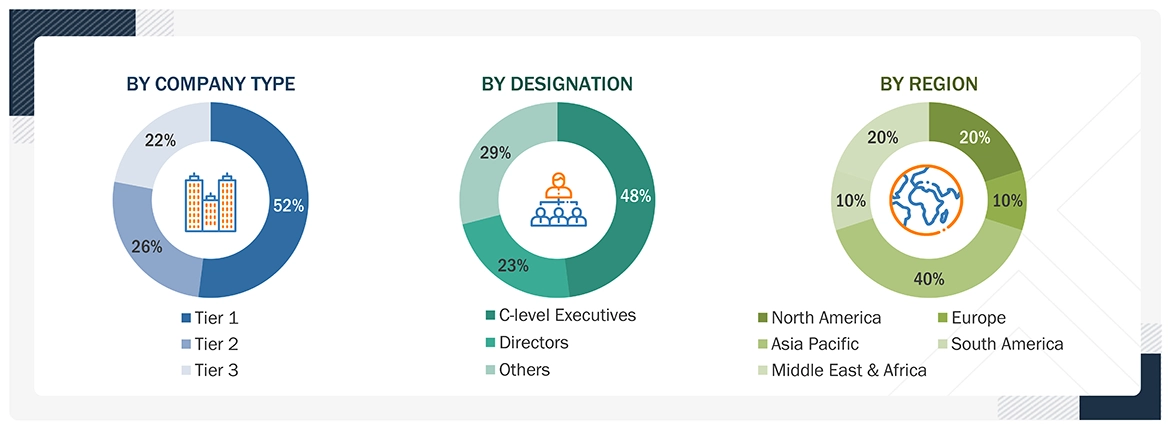
Notes: Other designations include sales, marketing, and product managers.
Tier 1: >USD 500 Million; Tier 2: USD 1OO million– 500 Million; and Tier 3: <USD 100 million
To know about the assumptions considered for the study, download the pdf brochure
Market Size Estimation
Both the top-down and bottom-up approaches have been used to estimate and validate the size of the small satellite market.
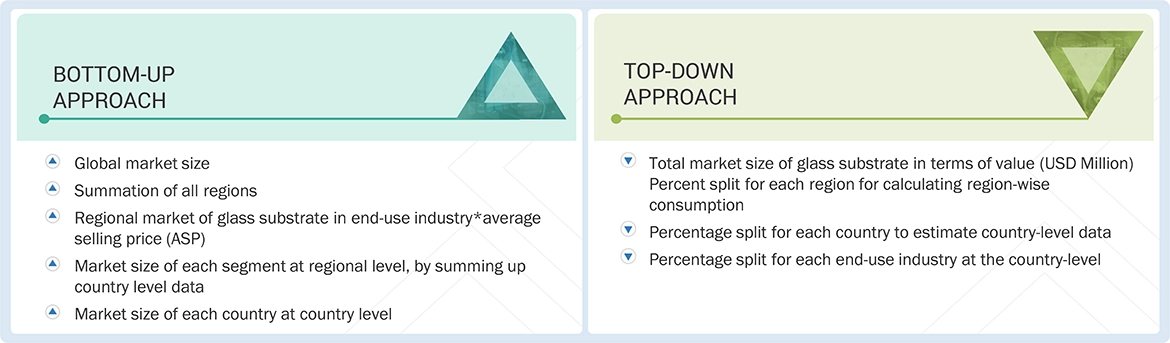
The top-down and bottom-up approaches were used to estimate and validate the size of the global glass substrate market. These approaches were also used extensively to estimate the size of various dependent market segments. The research methodology used to estimate the market size included the following:
Glass Substrate Market : Top-Down and Bottom-Up Approach
Data Triangulation
After arriving at the overall market size using the market size estimation processes, the market was split into several segments and subsegments. The data triangulation and market breakup procedures were employed, where applicable, to complete the overall market engineering process and determine the exact statistics for each market segment and subsegment. The data was triangulated by examining various factors and trends on both the demand and supply sides.
Market Definition
Glass substrates are thin, flat glass boards where a thin circuit is deposited with precision. These are produced using several raw materials, such as borosilicate, silicon, ceramic, fused silica/quartz, soda-lime, and aluminosilicate. They are available as disks and panels. Disk-shaped glass substrates, known as wafers, are mainly used in the manufacturing of semiconductors. Panel-shaped glass substrates are mainly used in the manufacture of LCDs. According to the requirements of end-use industries, the shape, size, thickness, sharpness, and flexibility of glass substrates are decided.
Key Stakeholders
- Raw material suppliers
- Commercial R&D institutes
- Glass substrate distributors and suppliers
- Regulatory bodies
- Industry associations and research institutes
- Local governments
- End users (automotive, medical, electronics, etc.)
Report Objectives
- To define, describe, and forecast the size of the global glass substrate market, by type, and end-use industry, in terms of value and volume
- To forecast the market size of segments for North America, Europe, Asia Pacific, South America, and the Middle East & Africa, along with their respective countries, in terms of value and volume
- To provide detailed information on the significant drivers, restraints, opportunities, and challenges influencing the market
- To strategically analyze micromarkets concerning individual growth trends, prospects, and their contribution to the market
- To assess the growth opportunities in the market for stakeholders and provide details on the competitive landscape for market leaders
- To strategically profile key players and comprehensively analyze their market shares and core competencies
- To analyze competitive developments, such as product launches, expansion, acquisitions, and agreements in the glass substrate market
- To provide the impact of AI/Gen AI on the market
- To provide the macroeconomic outlook for each region covered under the study, and the impact of the 2025 US tariff on the market
Available customizations:
Given the market data, MarketsandMarkets offers customizations to meet client-specific needs.
The following customization options are available for the glass substrate report:
Product Analysis
- A product matrix that gives a detailed comparison of the product portfolio of each company
Regional Analysis
-
A further breakdown of the glass substrate market for additional countries
Company Information
-
Detailed analysis and profiling of additional market players (up to five)
Get the Full Glass Substrate Market Report
Full forecast, segment splits, and company analysis for all Glass Substrate Market.
- France Glass Substrate Market
- UK Glass Substrate Market
- Italy Glass Substrate Market
- Russia Glass Substrate Market
- South Africa Glass Substrate Market
- Brazil Glass Substrate Market
- Argentina Glass Substrate Market
- Rest Of Europe Glass Substrate Market
- Rest Of Asia Pacific Glass Substrate Market
- GCC Countries Glass Substrate Market
- -Rest Of GCC Countries Glass Substrate Market
- Rest Of South America Glass Substrate Market
- China Glass Substrate Market
- Japan Glass Substrate Market
- India Glass Substrate Market
- South Korea Glass Substrate Market
- Taiwan Glass Substrate Market
- Canada Glass Substrate Market
- Mexico Glass Substrate Market
- US Glass Substrate Market
Need a Tailored Report?
Customize this report to your needs
Get 10% FREE Customization
Customize This Report
