
Brazil Government & Public Sector Cybersecurity Market (2026-2031)

The Brazil Government & Public Sector Cybersecurity Market was valued at $729.1 Million in 2026 and projected to reach to $1221 Million by 2031, representing a compound annual growth rate of 10.9%. Brazil's government and public sector cybersecurity market is positioned for substantial growth through 2031, driven by increased digitalization of public services and heightened awareness of cyber threats targeting critical infrastructure.


| Market Size in | USD 26.32 MN |
| Market Forecast in | |
| CAGR | |
| Forecast Period | |
| Units Considered | Value (USD MN) |
Brazil Government & Public Sector Cybersecurity Market Trends and Insights
- This 10.9% compound annual growth rate reflects Brazil's increasing investment in digital infrastructure protection and regulatory compliance across federal, state, and municipal agencies.
- Brazil's expanding threat landscape and mandatory cybersecurity frameworks are driving public sector organizations to modernize their security posture and adopt advanced threat detection solutions. The Brazilian government sector is prioritizing cybersecurity investments to protect critical infrastructure and citizen data amid rising cyber threats.
- Brazil's digital transformation initiatives and compliance requirements under national data protection laws are compelling government entities to allocate substantial budgets toward endpoint protection, identity management, and security operations centers.
- By 2031, Brazil's market growth will be sustained by continued digitalization of public services and heightened awareness of cyber risks among decision-makers..
Key Market Statistics
- CAGR (2026-2031) 10.9% CAGR
- Market Size, 2026 ~USD 729.1 Million
- Forecast, 2031 ~USD 1221 Million
- Country Brazil
Brazil Government & Public Sector Cybersecurity Market Overview
Market Valuation Growth :
Brazil's government and public sector cybersecurity market is valued at USD 729.1 million in 2026, with projections reaching USD 1,221.0 million by 2031, representing significant investment in digital infrastructure protection.
Regulatory Compliance Drivers :
Federal, state, and municipal agencies across Brazil are accelerating cybersecurity investments to meet evolving regulatory requirements and strengthen compliance frameworks for critical infrastructure protection.
Consistent Growth Trajectory :
Brazil's 10.9% CAGR demonstrates sustained market expansion, outpacing broader economic trends and reflecting prioritization of cybersecurity as essential to government digital transformation initiatives.
Expanding Threat Landscape :
Brazil's growing digital infrastructure and increasing cyber threats targeting public sector entities are driving demand for advanced security solutions, threat intelligence, and incident response capabilities.
Brazil Government & Public Sector Cybersecurity Market Dynamics
- Federal and state governments are prioritizing cybersecurity investments to protect sensitive citizen data and ensure continuity of essential services.
- The market expansion reflects Brazil's commitment to strengthening digital resilience across all governance levels. Key growth catalysts include mandatory compliance with data protection regulations, modernization of legacy systems, and rising investment in cloud security and zero-trust architectures.
- Municipal governments are increasingly allocating budgets for cybersecurity infrastructure, while partnerships between public agencies and private security vendors are accelerating solution adoption and innovation in the Brazilian market..
Market Ecosystem
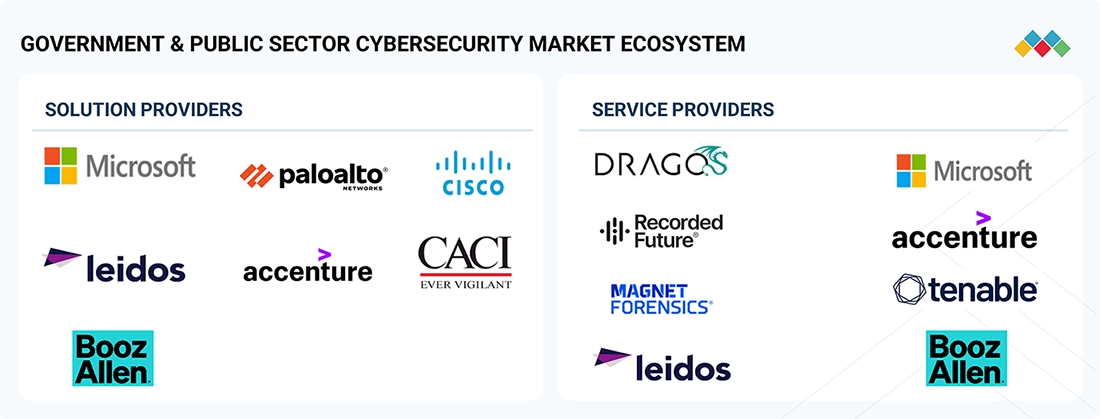
GOVERNMENT & PUBLIC SECTOR CYBERSECURITY MARKET: COMMERCIAL USE CASES ACROSS INDUSTRIES
| COMPANY | USE CASE DESCRIPTION | BENEFITS |
|---|---|---|
 |
The London Borough of Hounslow replaced its remote-site networks with Cisco technology, enabling “smart-borough” services like environmental sensors, automated service workflows, and improved resident data protection. | Faster deployment of smart services and digital governance Stronger network security — internal tests failed unauthorized access attempts | Improved attractiveness as employer helps retain/attract talent |
 |
Hornsby Shire Council modernized its aging IT infrastructure using Fortinet Secure SD-WAN and next-gen firewall/SD-Branch, enabling central network segmentation, 4G/5G backup for mobile teams, unified policy enforcement, and support for digital services. | ~50% reduction in communications costs | Enhanced resilience and redundancy of council networks | Improved readiness for Zero-Trust access and IoT integration | Better user experience and stronger cybersecurity posture |
 |
A central government department implemented a “simple, secure, connected cybersecurity” framework using Palo Alto Networks solutions to streamline operations, enforce Zero Trust, and consolidate security stacks across agencies. | Efficient unified security architecture reducing complexity | Enhanced data protection, compliance, and secure hybrid-work/cloud access | Stronger incident response and continuous threat defense, optimizing public sector security posture |
Logos and trademarks shown above are the property of their respective owners. Their use here is for informational and illustrative purposes only.
Related Ecosystem
Application Security
- Cloud Security
- Security Analytics
- Network Testing
- Web Application Security
- Biometric Security and Authentication System
- International Business Machines Corporation
- MICROSOFT CORPORATION
- Cisco Systems, Inc.
- PALO ALTO NETWORKS, INC
- Fortinet, Inc.
Cyber Security
- Cloud Security
- Biometric Systems
- Data Loss Prevention (DLP)
- Multi-Factor Authentication
- Security Analytics
- International Business Machines Corporation
- Cisco Systems, Inc.
- MITSUI BUSSAN SECURE DIRECTIONS INC
- MICROSOFT CORPORATION
- Allot Ltd.
Endpoint Security
- Cloud Security
- Security Analytics
- Multi-Factor Authentication
- Biometric Security and Authentication System
- Critical Communication Network
- International Business Machines Corporation
- MICROSOFT CORPORATION
- Cisco Systems, Inc.
- PALO ALTO NETWORKS, INC
- Fortinet, Inc.
Key Takeaways
- Brazil's government cybersecurity market will grow from $729.1M (2026) to $1,221M (2031) at a 10.9% CAGR.
- Brazil's public sector is accelerating digital transformation, driving demand for advanced threat protection and compliance solutions.
- Brazil's regulatory environment and critical infrastructure protection mandates are key growth catalysts for cybersecurity spending.
- Brazil's market expansion reflects increasing cyber threats and the need for modernized security operations across all government levels.
Government & Public Sector Cybersecurity Market Report Scope
| Report Metric | Details |
|---|---|
| Base Year | 2026 |
| Fastest Growing Segment | PUBLIC SERVICE INSTITUTIONS (Ownership Type) |
| Forecast Period | 2026–2031 |
| Growth Rate | CAGR of 11% from 2026 to 2031 |
| Largest Segment | SOLUTIONS (Offering) |
| Market Size Base Year (Billions) | ~USD 84.82 (2026) |
| Revenue Forecast (Billions) | ~USD 142.93 (2031) |
| Segments Covered | Offering, Service, Professional Service, Solution Type, Security Type, Deployment Mode, Ownership Type |
Brazil Government & Public Sector Cybersecurity Market Report Segmentation
7 segment dimensions are covered across the global market.
By Offering
- Services
- Solutions
By Service
- Managed
- Professional
By Professional Service
- Design, Consulting, And Implementation
- Risk & Threat Management
- Support & Maintenance
- Training & Education
By Solution Type
- Antivirus/Antimalware
- Compliance & Policy Management
- Dlp, Encryption, And Tokenization
- Firewall & Vpn
- Identity & Access Management
- Log Management & Siem
- Other Solution Types
- Patch Management
By Security Type
- Application Security
- Cloud Security
- Endpoint & IoT Security
- Network Security
By Deployment Mode
- Cloud
- Hybrid
- On-Premises
By Ownership Type
- Defense & Intelligence Agencies
- Federal/National Government
- Public Sector Enterprises
- Public Service Institutions
- State & Local Government
Target Audience
- Cybersecurity Solution Vendors : Vendors need Brazil-specific market data to develop localized product strategies, identify procurement opportunities across federal and municipal agencies, and optimize sales and marketing investments in this growing market.
- Government IT Decision Makers : Brazilian government CIOs and IT directors require market intelligence to benchmark cybersecurity spending, evaluate emerging solutions, and justify budget requests aligned with national digital transformation priorities.
- Investment & Private Equity Firms : Investors targeting Brazil's cybersecurity sector need detailed market sizing and growth forecasts to identify acquisition targets, assess portfolio company performance, and evaluate market entry opportunities.
- Managed Security Service Providers : MSSPs and managed service providers need Brazil market analysis to understand government procurement trends, competitive positioning, and service demand across federal, state, and municipal entities.
- Strategic Consultants & Analysts : Consultants advising government agencies and private sector clients require Brazil-specific cybersecurity market data to inform digital transformation strategies, risk assessments, and technology roadmap recommendations.
Key Companies in the Brazil Government & Public Sector Cybersecurity Market
| Company | HQ | Ownership | Strongest segments |
|---|---|---|---|
| MICROSOFT | United States | Public Company | IAM (identity and access management),Firewall & VPN,SIEM, |
| LEIDOS | United States | Public Company | IAM,Firewall & VPN,SIEM, |
| BOOZ ALLEN HAMILTON | United States | Public Company | IAM,Firewall & VPN,SIEM, |
| CACI | United States | Public Company | IAM,Firewall & VPN,SIEM, |
| ACCENTURE | Ireland | Public Company | Cloud Security,Application Security,Network Security (Firewall & VPN), |
| IBM | United States | Public Company | SIEM & Security Analytics,IAM,Compliance & Governance, |
| PALO ALTO NETWORKS | United States | Public Company | Firewall & VPN (Strata, VM-Series, CN-Series),Cloud Security (Prisma Access, CNAPP, Code to Cloud),Security Operations & SIEM/XDR (Cortex XSIAM, XDR, XSOAR, Xpanse), |
| FORTINET | United States | Public Company | Firewall & VPN (FortiGate and secure networking),IAM and Zero Trust (including ZTNA within SASE),SIEM and Security Operations (FortiSIEM, FortiSOAR, FortiXDR suite), |
| CISCO | United States | Public Company | Firewall & VPN,Network Security (incl. IDS/IPS, segmentation),IAM, |
| CROWDSTRIKE | United States | Public Company | IAM,Firewall & VPN,SIEM, |
| CHECK POINT | Israel | Public Company | Firewall & VPN,IAM,SIEM / XDR & Threat Exposure Management, |
| ZSCALER | United States | Public Company | IAM / Zero Trust Access (ZIA/ZPA as VPN replacement),Firewall & VPN (Zero Trust Firewall, Zero Trust Gateway),SIEM & Security Operations (data fabric, exposure, MDR), |
| TENABLE | United States | Public Company | Vulnerability & Exposure Management (Tenable Vulnerability Management, Security Center, Nessus, Tenable One bundles),Cloud & Application Security (Tenable Cloud Security, Web App Scanning, Nessus Expert),Identity & AI Exposure (Tenable Identity Exposure, AI Exposure), |
| CYBERARK | Israel | Private Company | IAM (Privileged Access, Workforce Identity, Customer Identity),Cloud Security & Secrets Management,Compliance & Identity Governance, |
| BAE SYSTEMS | United Kingdom | Public Company | Network Security (incl. Firewall & VPN),Application Security & SIEM / Threat Analytics,Cloud Security, |
MICROSOFT
Microsoft is a United States-based public company founded in 1975 that employs 228,000 people. The company is a global technology leader providing software, cloud computing, and enterprise solutions.
LEIDOS
Leidos is a United States-based public company founded in 1969 with 50,000 employees. The company provides information technology, engineering, and science solutions primarily to government and commercial clients.
BOOZ ALLEN HAMILTON
Booz Allen Hamilton is a United States-based public company founded in 1914 with 31,500 employees. The company offers consulting, analytics, and digital solutions to government and commercial sectors.
CACI
CACI is a United States-based public company founded in 1962 with 25,000 employees. The company provides information technology and professional services to government and commercial clients.
ACCENTURE
Accenture is an Ireland-based public company founded in 1951 with 799,000 employees. The company is a global professional services firm offering consulting, technology, and outsourcing solutions.
IBM
IBM is a United States-based public company founded in 1911 with 264,300 employees. The company provides enterprise hardware, software, cloud services, and IT consulting solutions globally.
PALO ALTO NETWORKS
Palo Alto Networks is a United States-based public company founded in 2005 with 21,491 employees. The company specializes in cybersecurity solutions including firewalls, cloud security, and threat intelligence.
FORTINET
Fortinet is a United States-based public company founded in 2000 with 15,311 employees. The company develops and provides network security solutions including firewalls and secure access products.
CISCO
Cisco is a United States-based public company founded in 1984 with 86,200 employees. The company designs and sells networking equipment, software, and services for enterprise and consumer markets.
CROWDSTRIKE
CrowdStrike is a United States-based public company founded in 2011 with 11,157 employees. The company provides cloud-based endpoint protection and threat intelligence solutions for cybersecurity.
CHECK POINT
Check Point is an Israel-based public company founded in 1993 with 6,825 employees. The company develops and provides cybersecurity solutions including firewalls, VPN, and threat prevention technologies.
ZSCALER
Zscaler is a United States-based public company founded in 2007 with 7,923 employees. The company provides cloud-based security solutions for secure internet and application access.
TENABLE
Tenable is a United States-based public company founded in 2002 with 1,995 employees. The company develops vulnerability management and cybersecurity exposure solutions.
CYBERARK
CyberArk is an Israel-based private company founded in 1996 with 3,793 employees. The company specializes in identity and access management solutions for cybersecurity.
BAE SYSTEMS
BAE Systems is a United Kingdom-based public company founded in 1979 with 111,400 employees. The company provides defense, aerospace, and security solutions to government and commercial customers.
Reasons to Buy this Report
- Precise Market Sizing for Brazil : Access validated market data specific to Brazil's government and public sector, enabling accurate budget allocation and investment decisions for cybersecurity solutions tailored to Brazilian regulatory and operational requirements.
- Growth Opportunity Identification : Understand Brazil's 10.9% CAGR trajectory and USD 492M market expansion opportunity through 2031, identifying high-potential segments within federal, state, and municipal government agencies.
- Competitive Landscape Intelligence : Gain insights into Brazil-specific vendor positioning, market dynamics, and competitive strategies to effectively penetrate the Brazilian government cybersecurity procurement landscape.
- Regulatory & Compliance Insights : Understand Brazil's evolving compliance frameworks and regulatory drivers shaping government cybersecurity spending, enabling solutions aligned with local requirements and procurement standards.
- Strategic Market Entry Planning : Leverage Brazil-focused market analysis to develop targeted go-to-market strategies, partnership opportunities, and sales approaches for government and public sector cybersecurity solutions.
Frequently asked questions
What is the current size of Brazil's government cybersecurity market?
Brazil's government and public sector cybersecurity market is valued at USD 729.1 million in 2026.
What is the projected market size for Brazil by 2031?
Brazil's government cybersecurity market is forecast to reach USD 1,221.0 million by 2031.
What is the growth rate for Brazil's government cybersecurity market?
Brazil's government cybersecurity market is expected to grow at a compound annual growth rate (CAGR) of 10.9% from 2026 to 2031.
What factors are driving growth in Brazil's government cybersecurity market?
Brazil's market growth is driven by digital transformation initiatives, regulatory compliance requirements, critical infrastructure protection mandates, and rising cyber threats targeting public sector organizations.
Which government sectors in Brazil are investing most in cybersecurity?
Brazil's federal agencies, state governments, and municipal authorities are all increasing cybersecurity investments to protect critical infrastructure, citizen data, and comply with national data protection laws.
RESEARCH METHODOLOGY
Secondary research was conducted to gather information for this technical, market-oriented, and commercial study of the government & public sector cybersecurity market. The next step involved validating these findings, assumptions, and sizes with industry experts across the value chain through primary research. Different approaches, including top-down and bottom-up methods, were used to estimate the total market size. Then, market segmentation and data triangulation techniques were employed to determine the sizes of different segments and subsegments within the government & public sector cybersecurity market.
Secondary Research
During the secondary research process, various secondary sources were reviewed to gather relevant information for the study. These sources included annual reports, press releases, investor presentations from government and public-sector cybersecurity vendors, forums, certified publications, and whitepapers. The secondary research primarily aimed to gather key data about the industry’s supply chain, the major players, market classification and segmentation based on industry trends down to the regional markets, and important developments from both market and technology perspectives. All of this information was further validated through primary sources.
Primary Research
In the primary research process, various primary sources from both the supply and demand sides were interviewed to gather qualitative and quantitative information for this report. The supply side sources included industry experts such as chief executive officers (CEOs), vice presidents (VPs), marketing directors, technology and innovation directors, and other key executives from different companies and organizations operating in the government & public sector cybersecurity market.
In the market engineering process, the top-down and bottom-up approaches were widely used, along with several data triangulation methods, to perform market estimation and forecasting for the overall market segments and subsegments listed in this report. Extensive qualitative and quantitative analysis was conducted on the entire market engineering process to identify key information and insights throughout the report.
After completing the entire market engineering process—which included calculations for market statistics, market breakups, market size estimations, market forecasts, and data triangulation—extensive primary research was carried out to gather information and verify and validate the critical numbers obtained. The primary research also aimed to identify segmentation types, industry trends, the competitive landscape of government and public sector cybersecurity players, and key market dynamics such as drivers, restraints, opportunities, challenges, industry trends, and key strategies.
Following is the breakup of the interviews conducted:
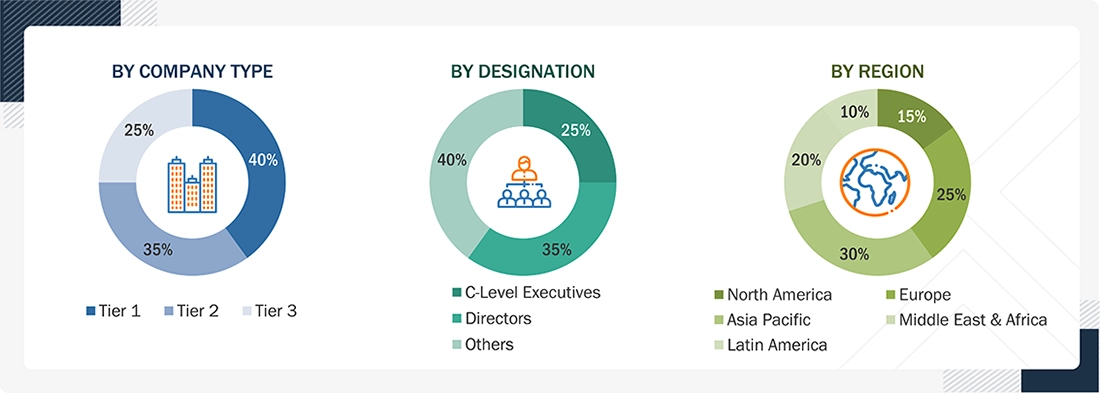
Note: Tier 1 companies: Revenue higher than USD 10 billion; Tier 2 companies: Revenue range between USD 1 and 10 billion; and Tier 3 companies: Revenue range between USD 500 million and USD 1 billion.
To know about the assumptions considered for the study, download the pdf brochure
Market Size Estimation
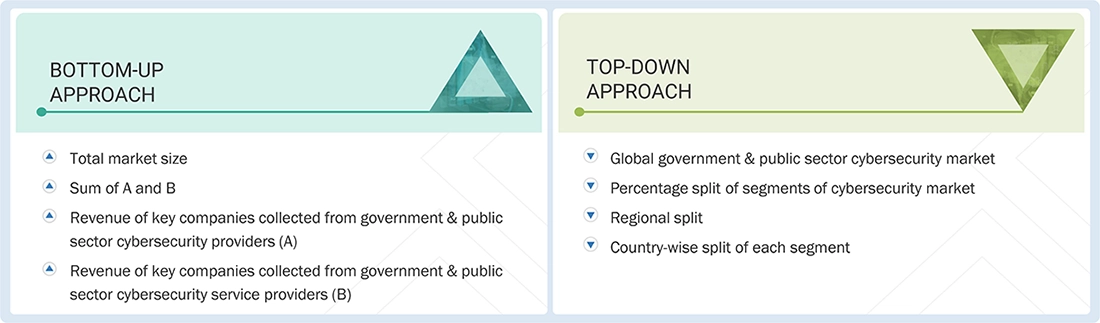
The top-down and bottom-up approaches were used to estimate and validate the size of the government & public sector cybersecurity market, as well as various subsegments within the overall market. The methodology for estimating market size includes identifying key players through secondary research and determining their market shares in respective regions via both primary and secondary research. This process involved analyzing the annual and financial reports of leading market players and conducting extensive interviews with industry leaders, including CEOs, VPs, directors, and marketing executives, to gather valuable insights.
All percentage splits and breakdowns were determined using secondary sources and verified through primary sources. All parameters that affect the market covered in this study were accounted for, examined in detail, verified through primary research, and analyzed to obtain final quantitative and qualitative data. This data was consolidated and added to detailed inputs and analysis from MarketsandMarkets.
Government & Public Sector Cybersecurity Market : Top-Down and Bottom-Up Approach
Data Triangulation
The market was divided into several segments and subsegments after determining the overall market size using the methods described above. The data triangulation and market segmentation techniques were employed, where applicable, to finalize the entire market analysis and obtain precise statistics for each segment and subsegment. The data was triangulated by examining various factors and trends from both the demand and supply perspectives.
Market Definition
The government & public sector cybersecurity market refers to the part of the global cybersecurity industry that includes solutions and services used to protect digital infrastructure, systems, networks, and data for government agencies and publicly owned or government-controlled institutions.
This includes cybersecurity spending by federal, state, and local government entities, such as ministries, departments, agencies, and defense and intelligence organizations responsible for national security and cyber operations.
Additionally, the market includes cybersecurity investments made by public sector institutions across key industry sectors, such as banking (including state-owned banks and central banks), healthcare (public hospitals and national health systems), energy and utilities (state-owned utilities and grid operators), transportation (railways, ports, airports, and public transit systems), telecommunications (state-owned providers and national network infrastructure), and public education institutions, as well as government-owned or managed critical infrastructure assets.
The market is structured into two primary components:
(1) Core Government Entities – Comprising ministries, departments, and agencies across all levels of government, including defense and intelligence bodies
(2) Public Sector Institutions – Comprising operational and service-delivery organizations that are publicly owned or controlled, such as public hospitals, state-owned banks, utilities, transport authorities, and similar entities, even if administratively governed by government bodies
The market covers a wide range of cybersecurity technologies and services, such as network security, endpoint security, identity and access management (IAM), data security, SIEM, cloud security, application security, and managed security services. It is measured by the revenue generated by cybersecurity vendors from public sector end users. The total market size is calculated as 100% of cybersecurity spending by core government agencies, plus a proportional share of cybersecurity expenses within other industry sectors that are owned or controlled by the government.
The scope excludes cybersecurity spending by private sector organizations, including privately owned enterprises operating in regulated industries, as well as public-private partnership (PPP) entities where majority ownership and operational control do not lie with government authorities.
Key Stakeholders
- Cybersecurity Solution Providers
- Network Security Vendors
- Identity & Access Management (IAM) Providers
- Security Information & Event Management (SIEM) Providers
- Cloud Security Providers
- Managed Security Service Providers (MSSPs)
- System Integrators & Cybersecurity Consultants
- Threat Intelligence Providers
- Cybersecurity Training & Awareness Providers
- Government Ministries & Public Sector Agencies
- National Cybersecurity Authorities
- Defense & Intelligence Agencies
- Critical Infrastructure Operators
- IT & Security Departments in Government Organizations
- Regulators & Compliance Authorities
- Cloud Service Providers
- Data Protection Authorities
- Incident Response & Digital Forensics Providers
Report Objectives
- To define, describe, and forecast the government & public sector cybersecurity market based on offering, solution type, security type, deployment mode, ownership type, and region from 2026 to 2031, and analyze the various macroeconomic and microeconomic factors that affect market growth
- To forecast the market size of five major regions: North America, Europe, Asia Pacific, the Middle East & Africa, and Latin America
- To analyze the subsegments of the market in terms of individual growth trends, prospects, and contributions to the overall market
- To provide detailed information related to the primary factors (drivers, restraints, opportunities, and challenges) influencing the growth of the government & public sector cybersecurity market
- To analyze opportunities in the market for stakeholders by identifying high-growth segments of the government & public sector cybersecurity market
-
To profile key players of the government & public sector cybersecurity market
and comprehensively analyze their market size and core competencies - To analyze competitive developments, such as new product launches, mergers and acquisitions, partnerships, agreements, and collaborations in the global government & public sector cybersecurity market
Available customizations:
With the given market data, MarketsandMarkets offers customizations based on company-specific needs. The following customization options are available for the report:
Regional Analysis
- Further breakup of the Asia Pacific market into countries that contribute to the rest of the regional market size
- Further breakup of the North American market into countries that contribute to the rest of the regional market size
- Further breakup of the Latin American market into countries that contribute to the rest of the regional market size
- Further breakup of the Middle East & African market into countries that contribute to the rest of the regional market size
- Further breakup of the European market into countries that contribute to the rest of the regional market size
Company Information
- Detailed analysis and profiling of additional market players (up to 5)
Get the Full Government & Public Sector Cybersecurity Market Report
Full forecast, segment splits, and company analysis for all Government & Public Sector Cybersecurity Market.
- US Government & Public Sector Cybersecurity Market
- Canada Government & Public Sector Cybersecurity Market
- UK Government & Public Sector Cybersecurity Market
- Germany Government & Public Sector Cybersecurity Market
- France Government & Public Sector Cybersecurity Market
- Italy Government & Public Sector Cybersecurity Market
- Russia Government & Public Sector Cybersecurity Market
- China Government & Public Sector Cybersecurity Market
- Japan Government & Public Sector Cybersecurity Market
- India Government & Public Sector Cybersecurity Market
- Australia Government & Public Sector Cybersecurity Market
- Singapore Government & Public Sector Cybersecurity Market
- Mexico Government & Public Sector Cybersecurity Market
- UAE Government & Public Sector Cybersecurity Market
- South Africa Government & Public Sector Cybersecurity Market
- Rest Of Europe Government & Public Sector Cybersecurity Market
Need a Tailored Report?
Customize this report to your needs
Get 10% FREE Customization
Customize This Report
