
Germany HVAC Insulation Market (2025-2030)

The Germany HVAC Insulation Market was valued at $403.3 Million in 2025 and projected to reach to $499.4 Million by 2030, representing a compound annual growth rate of 4.4%. Germany's HVAC insulation market is poised for steady growth through 2030, expanding from USD 403.3 million to USD 499.4 million at a 4.4% CAGR.


| Market Size in | USD 26.32 MN |
| Market Forecast in | |
| CAGR | |
| Forecast Period | |
| Units Considered | Value (USD MN) |
Germany HVAC Insulation Market Trends and Insights
- Germany maintains a mature and regulated HVAC sector driven by stringent energy efficiency standards and building codes that mandate high-performance thermal insulation in heating, ventilation, and air conditioning systems.
- The market in Germany benefits from strong industrial infrastructure, advanced manufacturing capabilities, and a commitment to carbon neutrality targets that accelerate adoption of premium insulation materials. Germany's HVAC insulation demand is supported by renovation activities in the residential and commercial building stock, as well as new construction projects aligned with EU energy performance directives.
- Germany's position as a leading European economy ensures consistent investment in building infrastructure and retrofitting initiatives.
- The forecast period through 2030 reflects steady growth in Germany as end-users prioritize energy efficiency, sustainability, and compliance with evolving environmental regulations.
- Germany's market trajectory underscores the region's emphasis on high-quality, durable insulation solutions that reduce operational costs and environmental impact..
Key Market Statistics
- CAGR (2025-2030) 4.4% CAGR
- Market Size, 2025 ~USD 403.3 Million
- Forecast, 2030 ~USD 499.4 Million
- Country Germany
Germany HVAC Insulation Market Overview
Stringent Energy Efficiency Standards :
Germany's robust building codes and EU energy efficiency directives mandate high-performance thermal insulation in HVAC systems, driving consistent market demand and premium product adoption across residential and commercial sectors.
Mature Market with Steady Growth :
The German HVAC insulation market valued at USD 403.3 million in 2025 demonstrates stable expansion at 4.4% CAGR, reflecting established infrastructure and replacement cycles in Europe's largest economy.
Sustainability and Green Building Focus :
Germany's commitment to carbon neutrality and green building certifications (LEED, BREEAM) accelerates demand for eco-friendly insulation materials and energy-efficient HVAC solutions in new construction and retrofitting projects.
Industrial and Commercial Dominance :
Strong industrial manufacturing base and commercial real estate sector in Germany create substantial opportunities for advanced insulation products in industrial HVAC applications and large-scale building projects.
Germany HVAC Insulation Market Dynamics
- This growth is underpinned by stringent EU energy efficiency regulations, increasing renovation activities in aging building stock, and rising awareness of thermal comfort and operational cost reduction.
- The market benefits from Germany's leadership in sustainable construction practices and technological innovation in insulation materials. Key drivers include mandatory energy performance standards for buildings, growing demand for retrofitting existing structures to meet climate targets, and industrial sector expansion.
- However, market maturity and price competition from alternative materials present challenges.
- Strategic opportunities exist in developing advanced, sustainable insulation solutions and targeting the commercial and industrial segments where energy efficiency investments yield significant returns..
Market Ecosystem
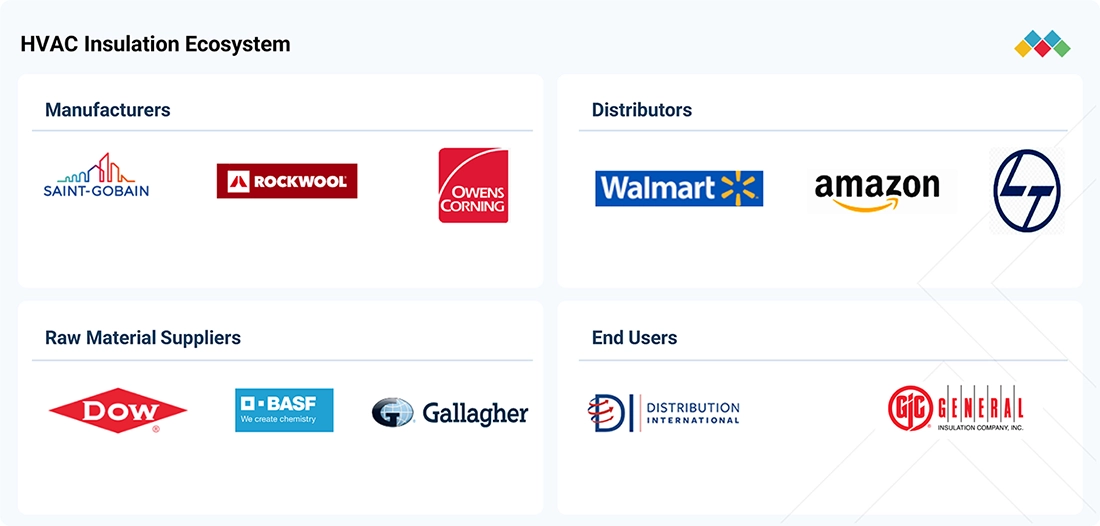
HVAC INSULATION MARKET: COMMERCIAL USE CASES ACROSS INDUSTRIES
| COMPANY | USE CASE DESCRIPTION | BENEFITS |
|---|---|---|
 |
Owens Corning creates insulation products that use different kinds of fiber glass, such as FOAMULAR and Owens Corning Fiberglas duct and equipment insulation | Its insulation solutions are suitable for the HVAC industry and can be utilized in commercial, industrial, and residential buildings to allow for heat loss/gain control | The company also provides duct wrap and pipe insulation products with efficient installation capabilities. | Effective thermal and acoustic insulation | Helps reduce energy consumption and HVAC operating costs | Non-combustible and moisture-resistant options | Improves indoor comfort | Supports energy-efficient and green building designs. |
 |
Saint-Gobain is a brand responsible for insulation solutions in HVAC systems through brands like ISOVER and ArmaFlex | Its products are designed for installations in commercial facilities, industrial plants, and healthcare infrastructure relying on its insulation capabilities, such as thermal, acoustic, and fire safety features. | High thermal performance and fire resistance | Provides acoustic insulation and noise reduction | Helps prevent condensation and moisture-related issues | Offers low-emission and sustainable product options | Suitable for ducts, pipes, and HVAC equipment | Supports energy-efficient building designs. |
 |
Knauf Group is a manufacturer of mineral wool products, including glass wool and rock wool insulation products, offering insulation products that are applied in HVAC systems of different kinds to heat/cool the air | This means that the company uses its insulation materials to minimize thermal gain/loss, improve sound insulation, and provide fire safety features. | Excellent thermal and acoustic insulation | Non-combustible and fire-safe properties | Moisture-resistant and durable solutions | Helps improve HVAC energy efficiency | Supports compliance with building and fire-safety requirements | Suitable for commercial, industrial, and residential HVAC applications. |
 |
The Kingspan Group provides insulation solutions that effectively insulate HVAC ductwork, pipes, and mechanical systems | The phenolic rigid insulation solutions are used in commercial and industrial buildings and wherever there is a need for thermal insulation and little space for installation | The products can be used as they require very little space and have high thermal resistance. | High thermal performance with thinner insulation thickness | Helps reduce energy consumption and heat loss/gain | Enables space-efficient HVAC insulation | Provides fire and smoke performance options | Suitable for demanding applications such as commercial buildings, industrial facilities, and other space-constrained installations | Supports sustainable and energy-efficient building goals. |
Logos and trademarks shown above are the property of their respective owners. Their use here is for informational and illustrative purposes only.
Related Ecosystem
Foam And Insulation
- Fiberglass
- Acoustic Insulation
- Elastomeric Foam
- HVAC System
- Flexible Foam
- Basf se
- Saint-gobain
- ARMACELL INTERNATIONAL
- THE WOODBRIDGE GROUP
- Sekisui Chemical Co., Ltd.
Key Takeaways
- Germany's HVAC insulation market is valued at USD 403.3 million in 2025 and will reach USD 499.4 million by 2030, growing at a 4.4% CAGR.
- Germany's stringent energy efficiency regulations and EU building performance directives drive consistent demand for high-performance thermal insulation materials.
- Germany's mature industrial base and advanced manufacturing infrastructure support the production and distribution of premium HVAC insulation solutions.
- Germany's commitment to carbon neutrality and building renovation initiatives create sustained growth opportunities through 2030.
HVAC Insulation Market Report Scope
| Report Metric | Details |
|---|---|
| Base Year | 2025 |
| Fastest Growing Segment | –PE & CROSS-LINKED PE (Material Type) |
| Forecast Period | 2025–2030 |
| Growth Rate | CAGR of 5.2% from 2025 to 2030 |
| Largest Segment | PLASTIC FOAM (Material Type) |
| Market Size Base Year (Billions) | ~USD 7.06 (2025) |
| Revenue Forecast (Billions) | ~USD 9.1 (2030) |
| Segments Covered | Material Type, Product Type, End-Use Industry |
Germany HVAC Insulation Market Report Segmentation
3 segment dimensions are covered across the global market.
By Material Type
- Mineral Wool
- Plastic Foam
- – Glass Wool
- –Elastomeric Foam
- –Glass Wool
- –Pe & Cross-Link Pe
- –Pe & Cross-Linked Pe
- –Phenolic Foam, Pur, And Pir
- –Phenolic Foam,Pur, And Pir
- –Stone Wool
By Product Type
- Ducts
- Pipes
By End-Use Industry
- Commercial
- Industrial
- Residential
GERMANY: HVAC INSULATION MARKET, BY END-USE INDUSTRY, 2025–2030
| Segment | 2025 | 2026 | 2027 | 2028 | 2029 | 2030 | CAGR (%) |
|---|---|---|---|---|---|---|---|
| COMMERCIAL | 194.4 | 201.5 | 209.1 | 217.1 | 225.7 | 238.2 | 4.1 |
| INDUSTRIAL | 62.5 | 65.2 | 68 | 71.1 | 74.3 | 78.9 | 4.8 |
| RESIDENTIAL | 146.4 | 152.2 | 158.5 | 165.1 | 172.2 | 182.3 | 4.5 |
| TOTAL | 403.3 | 418.9 | 435.6 | 453.3 | 472.2 | 499.4 | 4.4 |
Target Audience
- HVAC Manufacturers & Suppliers : German and international HVAC manufacturers need market-specific data to optimize product portfolios, identify distribution channels, and align offerings with Germany's stringent efficiency standards and growing retrofit demand.
- Building & Construction Companies : Construction firms and real estate developers require insights into insulation material trends, regulatory compliance requirements, and cost-benefit analyses to make informed procurement decisions for residential and commercial projects in Germany.
- Insulation Material Producers : Manufacturers of thermal insulation materials need Germany-specific market intelligence to understand demand drivers, competitive dynamics, sustainability preferences, and opportunities in the commercial and industrial segments.
- Energy Efficiency Consultants & Engineers : Professional consultants advising on building retrofits and energy optimization require detailed market data to recommend appropriate insulation solutions and justify investments based on Germany's regulatory environment and market trends.
- Investment & Strategy Firms : Private equity, venture capital, and strategic consulting firms evaluating opportunities in Germany's construction and materials sectors need precise market sizing and growth forecasts to assess investment viability and portfolio positioning.
Key Companies in the Germany HVAC Insulation Market
| Company | HQ | Ownership | Strongest segments |
|---|---|---|---|
| SAINT-GOBAIN | France | Public Company | Pipes – Mineral Wool (Glass Wool, Stone Wool),Ducts – Mineral Wool (Glass Wool, Stone Wool),Pipes – Plastic Foam (Phenolic, Elastomeric Foam), |
| OWENS CORNING | United States | Public Company | Duct insulation (glass wool, flexible duct media, foam sheathing),Pipe insulation (glass fiber pipe, cellular glass, elastomeric/phenolic foam),Building thermal/acoustic batts and loosefill used in HVAC-intensive projects, |
| ROCKWOOL INTERNATIONAL | Denmark | Public Company | HVAC Duct Insulation (Stone Wool),HVAC Pipe and Technical Insulation (Stone Wool),Glass Wool HVAC Insulation, |
| KINGSPAN GROUP PLC | Ireland | Public Company | Pipes,Ducts,Mineral Wool (Glass Wool, Stone Wool), |
| JOHNS MANVILLE CORPORATION | United States | Private Company | Pipes – Mineral Wool (Glass Wool, Stone Wool),Ducts – Mineral Wool (Glass Wool, Stone Wool),Pipes – Plastic Foam (Phenolic, Elastomeric Foam), |
| L’ISOLANTE K-FLEX S.P.A. | Italy | Private Company | Pipes – Elastomeric Foam,Ducts – Elastomeric Foam Sheets and Rolls,Mineral Wool (Glass Wool, Stone Wool) for HVAC, |
| COVESTRO AG | Germany | Public Company | Pipes,Ducts,Mineral Wool (Glass Wool, Stone Wool), |
| PPG | United States | Public Company | Pipes – coatings and ancillary materials for insulated HVAC piping,Ducts – coatings and ancillary materials for insulated HVAC ducting, |
| HUNTSMAN INTERNATIONAL LLC | United States | Private Company | Pipes – Plastic Foam (Phenolic, Elastomeric),Ducts – Plastic Foam (Phenolic, Elastomeric),Mineral Wool-Linked Chemistries (Binders, Coatings Interfaces), |
SAINT-GOBAIN
Saint-Gobain is a French public company founded in 1665 with 158,616 employees worldwide. It is a major manufacturer of building materials, glass, and high-performance materials.
OWENS CORNING
Owens Corning is a U.S. public company founded in 1938 with 25,000 employees. The company specializes in insulation, roofing, and fiberglass composite materials.
ROCKWOOL INTERNATIONAL
Rockwool International is a Danish public company founded in 1909 with 11,827 employees. It is a leading manufacturer of stone wool insulation and fire safety products.
KINGSPAN GROUP PLC
Kingspan Group PLC is an Irish public company founded in 1965 with 27,526 employees. The company manufactures insulation products, building envelopes, and water and energy solutions.
JOHNS MANVILLE CORPORATION
Johns Manville Corporation is a U.S. private company founded in 1858 with 9,740 employees. The company produces insulation, roofing materials, and engineered products for building and industrial applications.
L’ISOLANTE K-FLEX S.P.A.
L'Isolante K-Flex S.p.A. is an Italian private company founded in 1989 with 2,537 employees. The company specializes in the manufacture of elastomeric foam insulation products.
COVESTRO AG
Covestro AG is a German public company founded in 1863 with 17,806 employees. The company is a leading manufacturer of high-performance polymers and polyurethane materials.
PPG
PPG is a U.S. public company founded in 1883 with 43,500 employees. The company manufactures paints, coatings, specialty materials, and glass products for industrial and consumer markets.
HUNTSMAN INTERNATIONAL LLC
Huntsman International LLC is a U.S. private company founded in 1970 with 6,000 employees. The company produces specialty chemicals, polyurethanes, and advanced materials for various industries.
Reasons to Buy this Report
- Precise Market Sizing for Germany : Access validated market data specific to Germany with exact valuations (USD 403.3M in 2025, USD 499.4M in 2030) and 4.4% CAGR to support accurate business planning and investment decisions in this mature European market.
- Regulatory Landscape Intelligence : Understand Germany's stringent energy efficiency standards and building codes that shape HVAC insulation demand, enabling compliant product development and market entry strategies aligned with local regulatory requirements.
- Competitive Positioning Strategy : Benchmark your offerings against the German market's mature competitive environment, identify growth segments (industrial, commercial, residential retrofitting), and develop targeted strategies to capture market share in this high-value economy.
- Sustainability-Driven Opportunity Assessment : Leverage insights into Germany's green building focus and carbon neutrality commitments to identify opportunities for eco-friendly insulation products and position your solutions within the sustainability-conscious German market.
- Forecast-Based Investment Planning : Utilize the 2030 forecast data to plan long-term investments, resource allocation, and expansion timelines in Germany, with confidence in the 4.4% growth trajectory and market expansion to USD 499.4 million.
Frequently asked questions
What is the current size of Germany's HVAC insulation market?
Germany's HVAC insulation market is estimated at USD 403.3 million in 2025.
What is the projected market size for Germany's HVAC insulation sector by 2030?
Germany's HVAC insulation market is forecast to reach USD 499.4 million by 2030.
What is the growth rate of Germany's HVAC insulation market?
Germany's HVAC insulation market is expected to grow at a compound annual growth rate (CAGR) of 4.4% from 2025 to 2030.
What regulatory factors influence Germany's HVAC insulation market?
Germany's market is shaped by stringent EU energy performance directives, national building codes, and carbon neutrality commitments that mandate high-efficiency thermal insulation in HVAC systems.
Which sectors drive demand for HVAC insulation in Germany?
Germany's demand is driven by residential and commercial building renovations, new construction projects, and industrial facilities seeking to comply with energy efficiency standards and reduce operational costs.
RESEARCH METHODOLOGY
The study involved four major activities for estimating the current size of the global HVAC insulation market. We conducted exhaustive secondary research to collect information on the market, the peer product market, and the parent product group market. Next, we validated these findings, assumptions, and sizes with industry experts across the HVAC insulation value chain through primary research. We used both top-down and bottom-up approaches to estimate the overall size of the HVAC insulation market. Next, the team used market breakdown and data triangulation to determine the size of different market segments and subsegments.
Secondary Research
In the secondary research process, the team referred to secondary sources such as Hoovers, Factiva, Bloomberg BusinessWeek, and Dun & Bradstreet to identify and collect information for this study on the HVAC insulation market. These secondary sources included annual reports, press releases & investor presentations of companies; white papers; certified publications; articles by recognized authors; regulatory bodies; trade directories; and databases.
Primary Research
The HVAC insulation market includes several supply-chain stakeholders, including raw material suppliers, distributors, end-product manufacturers, buyers, and regulatory organizations. The research team interviewed various primary sources from the market's supply and demand sides to gather qualitative and quantitative information. Primary participants on the demand side include key opinion leaders, executives, vice presidents, and CEOs of companies in the HVAC insulation market. Primary sources from the supply side include associations and institutions involved in the HVAC insulation market, key opinion leaders, and processing players.
The following is the breakdown of primary respondents:
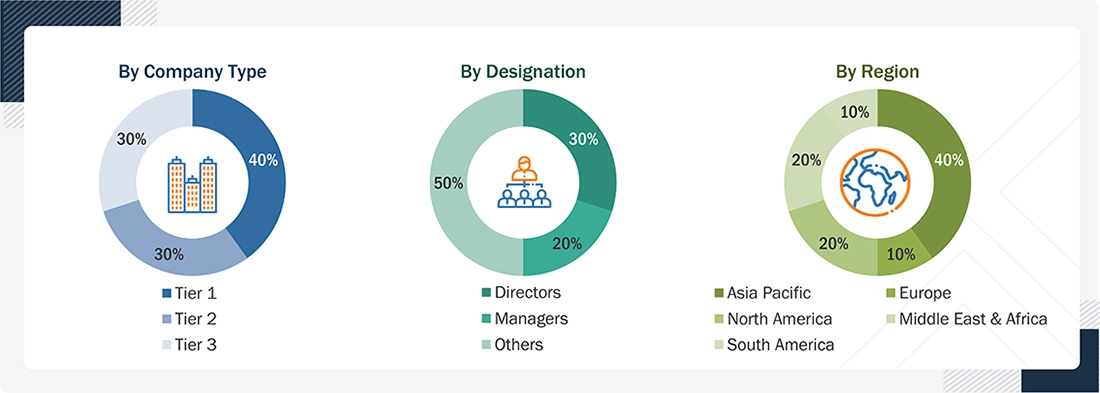
To know about the assumptions considered for the study, download the pdf brochure
Market Size Estimation
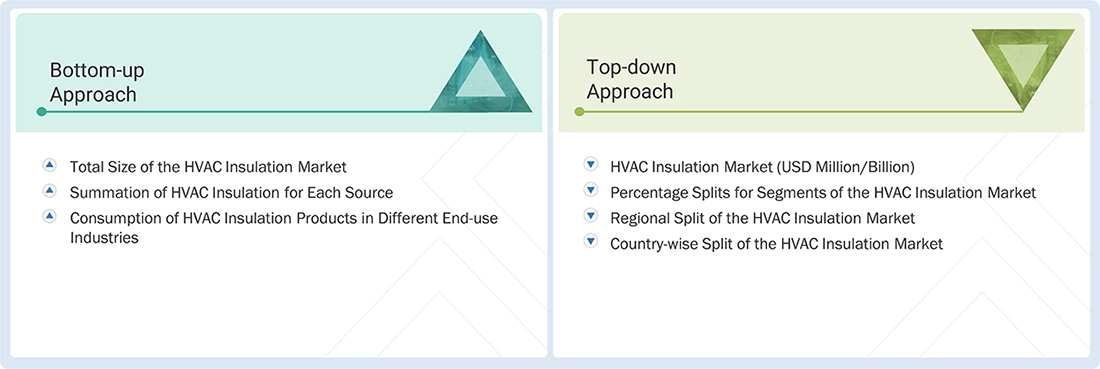
The bottom-up and top-down approaches were used to estimate the HVAC insulation market by material type, product type, end-use industry, and region. The research methodology used to calculate the market size includes the following steps:
- The research team identified key industry and market players through extensive secondary research.
- The team determined the industry’s supply chain and market size through primary and secondary research.
- The team determined all percentage shares, splits, and breakdowns using secondary sources and verified them through primary sources.
- All parameters affecting the markets covered in this research study were accounted for in detail, verified through primary research, and analyzed to obtain the final quantitative and qualitative data.
- The research included reviewing reports, reviews, and newsletters from top market players, along with extensive interviews with leaders such as directors and marketing executives to gather their opinions.
The following figure illustrates the overall market size estimation process employed for this study.
Data Triangulation
After estimating the overall size of the HVAC insulation market using the process described above, the total market was split into several segments and subsegments. Wherever applicable, we used data triangulation and market-breakdown procedures to complete the overall market-engineering process and arrive at precise statistics for all segments and subsegments. The data was triangulated by studying various factors and trends from both the demand and supply sides. The market size was also validated using both top-down and bottom-up approaches.
Market Definition
HVAC insulation refers to the range of materials and solutions used to insulate heating, ventilation, and air conditioning (HVAC) systems to prevent heat loss or gain, enhance energy efficiency, and maintain desired indoor temperatures. It includes insulation for ducts, pipes, chillers, and other system components to optimize thermal performance, reduce energy consumption, minimize noise, and ensure occupant comfort. The HVAC insulation market encompasses products such as fiberglass, mineral wool, foam, elastomeric materials, and eco-friendly alternatives, used across residential, commercial, and industrial sectors. This market is driven by rising energy costs, stringent building codes, sustainability goals, and growing demand for efficient, environmentally friendly building systems.
Key Stakeholders
- HVAC Insulation Manufacturers
- Raw Material Suppliers
- Regulatory Bodies & Government Agencies
- Distributors & Suppliers
- End-use Industries
- Associations & Industrial Bodies
- Market Research & Consulting Firms
Report Objectives
- To define, describe, and forecast the size of the HVAC insulation market in terms of value and volume
- To provide detailed information regarding the key factors influencing the growth of the market (drivers, restraints, opportunities, and challenges)
- To forecast the market size based on material type, product type, end-use industry, and region
- To forecast the market size for the five main regions—North America, Europe, Asia Pacific (APAC), South America, and the Middle East & Africa (MEA)—along with their key countries
- To strategically analyze micromarkets with respect to individual growth trends, prospects, and contributions to the total market
- To analyze the opportunities in the market for stakeholders and provide details of the competitive landscape for the market leaders
- To strategically profile leading players and comprehensively analyze their key developments such as product launches, expansions, and deals in the HVAC insulation market
- To strategically profile key players and comprehensively analyze their market shares and core competencies
- To study the impact of AI/Gen AI on the market under study, along with the macroeconomic outlook
Available customizations:
With the given market data, MarketsandMarkets offers customizations to meet companies' specific needs.
The following customization options are available for the report:
PRODUCT ANALYSIS
- Product matrix, which provides a detailed comparison of the market for different sources of HVAC insulation.
REGIONAL ANALYSIS
- Further breakdown of a country with respect to the HVAC insulation market.
COMPANY INFORMATION
- Detailed analysis and profiling of additional market players.
Get the Full HVAC Insulation Market Report
Full forecast, segment splits, and company analysis for all HVAC Insulation Market.
- China HVAC Insulation Market
- India HVAC Insulation Market
- Japan HVAC Insulation Market
- South Korea HVAC Insulation Market
- France HVAC Insulation Market
- UK HVAC Insulation Market
- Italy HVAC Insulation Market
- Canada HVAC Insulation Market
- Mexico HVAC Insulation Market
- US HVAC Insulation Market
- Brazil HVAC Insulation Market
- Argentina HVAC Insulation Market
- South Africa HVAC Insulation Market
- Rest Of Europe HVAC Insulation Market
- Rest Of Asia Pacific HVAC Insulation Market
- GCC Countries HVAC Insulation Market
- –Rest Of The GCC Countries HVAC Insulation Market
- Rest Of South America HVAC Insulation Market
Need a Tailored Report?
Customize this report to your needs
Get 10% FREE Customization
Customize This Report
