
Middle East HVAC System Market (2025-2030)

The Middle East HVAC System Market was valued at $7840 Million in 2025 and projected to reach to $10130 Million by 2030, representing a compound annual growth rate of 5.2%. The Middle East HVAC System Market is poised for steady growth driven by accelerating urbanization and infrastructure development across the region.


| Market Size in | USD 26.32 MN |
| Market Forecast in | |
| CAGR | |
| Forecast Period | |
| Units Considered | Value (USD MN) |
Middle East HVAC System Market Trends and Insights
- The Middle East's rapid urbanization, expanding commercial infrastructure, and increasing demand for climate control solutions in residential and industrial sectors are driving market expansion.
- The Middle East benefits from substantial capital investment in smart building technologies and energy-efficient cooling systems, particularly across the Gulf Cooperation Council (GCC) nations. During the forecast period from 2025 to 2030, the Middle East HVAC market will be shaped by rising temperatures, stringent building codes, and the region's focus on sustainable development.
- The Middle East's construction boom and retrofitting of existing facilities with advanced HVAC systems present significant growth opportunities.
- Additionally, the Middle East is witnessing increased adoption of IoT-enabled and AI-driven HVAC solutions to optimize energy consumption and reduce operational costs..
Key Market Statistics
- CAGR (2025-2030) 5.2% CAGR
- Market Size, 2025 ~USD 7840 Million
- Forecast, 2030 ~USD 10130 Million
- Country Middle East
Middle East HVAC System Market Overview
Market Size & Growth :
The Middle East HVAC System Market is valued at USD 7,840 million in 2025, with a projected CAGR of 5.2% through 2030, reaching USD 10,130 million by forecast end.
Urbanization Driver :
Rapid urbanization across Middle Eastern cities is fueling demand for advanced climate control solutions in residential complexes, commercial buildings, and hospitality sectors.
Industrial Expansion :
Growing industrial infrastructure development, including manufacturing facilities and data centers, requires sophisticated HVAC systems to maintain optimal operational conditions in extreme climates.
Climate Challenges :
Extreme heat conditions and harsh desert climates in the Middle East necessitate high-performance HVAC systems, creating sustained demand for energy-efficient cooling and ventilation solutions.
Middle East HVAC System Market Dynamics
- Government initiatives promoting smart city projects and sustainable building standards are catalyzing adoption of advanced HVAC technologies.
- The commercial sector, particularly hospitality and retail, continues to expand significantly, creating substantial demand for climate control systems. Energy efficiency regulations and the region's focus on reducing carbon footprints are encouraging adoption of modern HVAC solutions with smart controls and renewable energy integration.
- Rising disposable incomes and increased construction activity in residential sectors further support market expansion.
- The market's 5.2% CAGR reflects moderate but consistent growth, with opportunities emerging in retrofitting existing infrastructure and deploying IoT-enabled HVAC systems..
Market Ecosystem
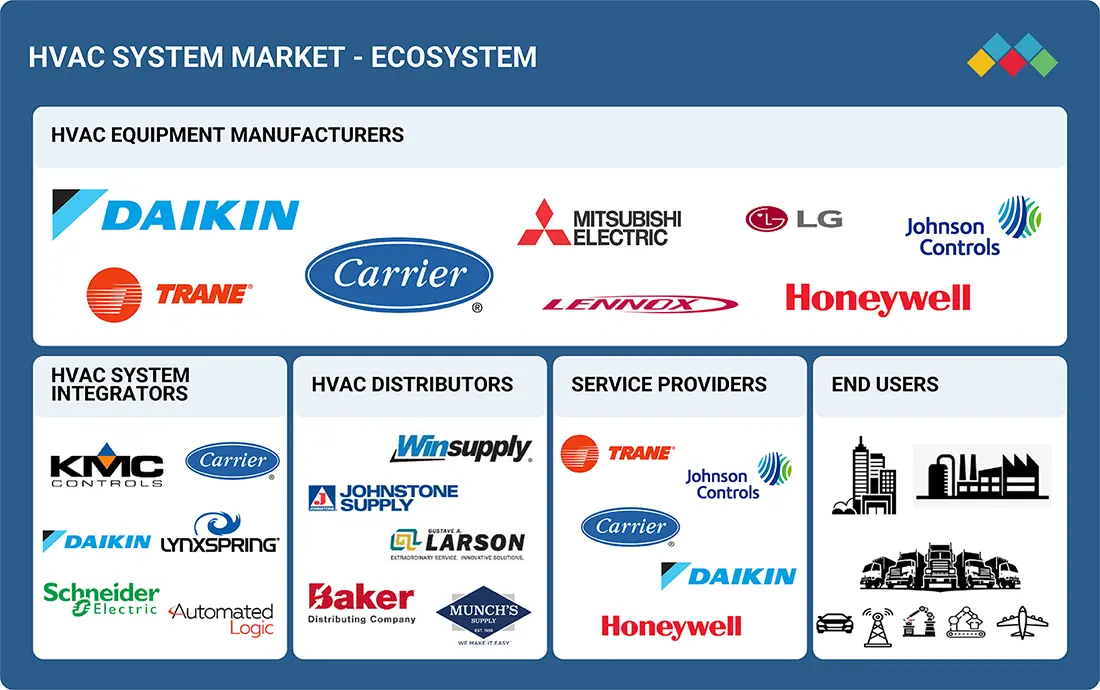
HVAC System Market Growth: COMMERCIAL USE CASES ACROSS INDUSTRIES
| COMPANY | USE CASE DESCRIPTION | BENEFITS |
|---|---|---|
 |
Installed a ductless mini-split system with three comfort zones to provide heating and cooling throughout the condo. | Ductless mini-splits provide humidity control and air filtration to improve the overall air quality in the home and provide energy-efficient heating and cooling. |
 |
AI-driven VRF (Variable Refrigerant Flow) solutions with advanced energy management, optimized temperature control, and real-time monitoring to enhance efficiency and reliability. | The AI-enabled VRF system significantly lowered energy consumption, improved sustainability, and delivered a smarter, more adaptive HVAC experience. |
 |
CITY MULTI VRF zoning systems, Heat2O Heat Pump Water Heater systems, and integrated controls were installed. | The hotel achieved passive house certification and became the first zero-emission hotel in the US, reducing carbon footprint and setting a benchmark for sustainable hospitality. |
 |
Replacement of condenser, air handler, and switch to R-410a refrigerant system. | Carrier comfort series AC proved cost-effective, durable, and sustainable, ensuring significant long-term savings compared to retrofitting. |
 |
Installation of 10 VRV systems, iTM, 1 D-AHU Modular R + DX Coil & ERQ250, 4 Mini SkyAir (7,315 m³/h airflow). | Daikin solution delivered reliable, energy-efficient cooling for railway control systems, reducing operational risks and costs. |
Logos and trademarks shown above are the property of their respective owners. Their use here is for informational and illustrative purposes only.
Related Ecosystem
Key Takeaways
- The Middle East HVAC System Market is valued at USD 7,840 million in 2025 and will reach USD 10,130 million by 2030, growing at a 5.2% CAGR.
- The Middle East's extreme climate conditions and rapid urbanization are primary drivers of sustained HVAC system demand across residential, commercial, and industrial segments.
- The Middle East is increasingly adopting energy-efficient and smart HVAC technologies to comply with regional sustainability initiatives and reduce operational expenses.
- The Middle East's construction sector expansion and government investments in infrastructure development create substantial opportunities for HVAC system manufacturers and service providers.
HVAC System Market Report Scope
| Report Metric | Details |
|---|---|
| Base Year | 2025 |
| Fastest Growing Segment | SUSTAINABLE/GREEN HVAC SYSTEMS (Technology) |
| Forecast Period | 2025-2030 |
| Growth Rate | CAGR of 6.4% from 2025 to 2030 |
| Largest Segment | TRADITIONAL HVAC SYSTEMS (Technology) |
| Market Size Base Year (Billions) | ~USD 299.02 (2025) |
| Revenue Forecast (Billions) | ~USD 407.77 (2030) |
| Segments Covered | Cooling Equipment, End User, Heating Equipment, Ventilation Equipment, Technology, Implementation Type, Service Type, Type |
Middle East HVAC System Market Report Segmentation
8 segment dimensions are covered across the global market.
By Cooling Equipment
- Chillers
- Coolers
- Cooling Towers
- Room Air Conditioners
- Unitary Air Conditioners
- Vrf
- Vrf Systems
By End User
- Commercial
- Industrial
- Residential
By Heating Equipment
- Boilers
- Furnaces
- Heat Pumps
- Unitary Heaters
By Ventilation Equipment
- Ahus
- Air Filters
- Air Purifiers
- Air-Handling Units
- Dehumidifiers
- Humidifiers
- Ventilation Fans
By Technology
- Smart Hvac Systems
- Sustainable/Green Hvac Systems
- Traditional Hvac Systems
By Implementation Type
- New Construction Buildings
- Retrofit Buildings
By Service Type
- Consulting Services
- Installation Services
- Maintenance & Repair Services
- Upgradation/Replacement Services
By Type
- Airports
- Data Centers
- Education
- Governments
- Healthcare
- Manufacturing Facilities
- Offices
- Power Plants
- Retail
- Warehouses
Target Audience
- HVAC Manufacturers & OEMs : Manufacturers need regional market data to assess expansion opportunities, understand local demand patterns, and develop products tailored to Middle East climate and regulatory requirements.
- Construction & Real Estate Developers : Developers require market insights to plan HVAC system specifications for residential, commercial, and industrial projects while optimizing costs and meeting sustainability standards.
- System Integrators & Contractors : Integration firms need market forecasts and segment analysis to identify growth areas, plan service offerings, and position themselves competitively in the expanding Middle East market.
- Investment & Private Equity Firms : Investors need validated market data and growth projections to evaluate investment opportunities in HVAC companies, infrastructure projects, and technology providers in the Middle East.
- Government & Policy Makers : Regional authorities require market intelligence to develop infrastructure policies, sustainability initiatives, and building codes that align with market growth and climate adaptation needs.
Reasons to Buy this Report
- Regional Market Insights : Gain deep understanding of Middle East-specific HVAC market dynamics, including local regulatory frameworks, climate considerations, and regional purchasing behaviors that differ from global trends.
- Growth Opportunity Identification : Identify high-potential segments within the Middle East market, including emerging sectors in smart buildings, data centers, and industrial applications with tailored growth strategies.
- Competitive Landscape Analysis : Understand key players operating in the Middle East HVAC market, their market positioning, and competitive strategies specific to regional demand and infrastructure development.
- Investment & Expansion Planning : Make informed decisions on market entry, expansion, or partnership opportunities in the Middle East with validated market size projections and CAGR forecasts through 2030.
- Strategic Business Development : Develop targeted go-to-market strategies leveraging Middle East-specific insights on urbanization trends, industrial growth, and climate-driven demand for advanced HVAC solutions.
Frequently asked questions
What is the current size of the Middle East HVAC System Market?
The Middle East HVAC System Market is estimated at USD 7,840 million in 2025.
What is the projected market size for the Middle East HVAC System Market by 2030?
The Middle East HVAC System Market is projected to reach USD 10,130 million by 2030.
What is the CAGR for the Middle East HVAC System Market from 2025 to 2030?
The Middle East HVAC System Market is expected to grow at a compound annual growth rate (CAGR) of 5.2% during the forecast period.
What are the primary growth drivers for the Middle East HVAC System Market?
Key growth drivers include extreme climate conditions, rapid urbanization, expanding commercial infrastructure, government investments in smart buildings, and the adoption of energy-efficient cooling technologies.
Which countries in the Middle East are leading the HVAC System Market growth?
The Gulf Cooperation Council (GCC) nations, including Saudi Arabia, the United Arab Emirates, and Qatar, are leading the Middle East HVAC market due to significant construction activity and capital investments.
RESEARCH METHODOLOGY
The research process for this study included systematic gathering, recording, and analysis of data about customers and companies operating in the HVAC system market. This process involved the extensive use of secondary sources, directories, and databases (Factiva and Oanda) to identify and collect valuable information for the comprehensive, technical, market-oriented, and commercial study of the HVAC system market. In-depth interviews were conducted with primary respondents, including experts from core and related industries and preferred manufacturers, to obtain and verify critical qualitative and quantitative information and assess growth prospects. Key players in the HVAC system market were identified through secondary research, and their market rankings were determined through primary and secondary research. This research included studying annual reports of top players and interviewing key industry experts such as CEOs, directors, and marketing executives.
Secondary Research
Various sources were used in the secondary research process to identify and collect information important for this study. These include company annual reports, press releases, investor presentations, white papers, technology journals, certified publications, articles by recognized authors, directories, and databases.
Secondary research was mainly used to obtain key information about the industry’s value chain, the total pool of market players, the market classification according to industry trends to the bottom-most level, regional markets, and key developments from market and technology-oriented perspectives.
Primary Research
Primary research was also conducted to identify the segmentation types, key players, competitive landscape, and key market dynamics, such as drivers, restraints, opportunities, challenges, and industry trends, along with key strategies adopted by players operating in the HVAC system market. Extensive qualitative and quantitative analyses were performed on the complete market engineering process to list key information and insights throughout the report.
Extensive primary research has been conducted after acquiring knowledge about the HVAC system market scenarios through secondary research. Several primary interviews have been conducted with experts from the demand (end user and region) and supply side (heating equipment, cooling equipment, ventilation equipment, implementation type, system type, technology) across four major geographic regions: North America, Europe, Asia Pacific, and RoW. Approximately 60% and 40% of the primary interviews were conducted from the supply and demand sides, respectively. These primary data have been collected through questionnaires, emails, and telephonic interviews.
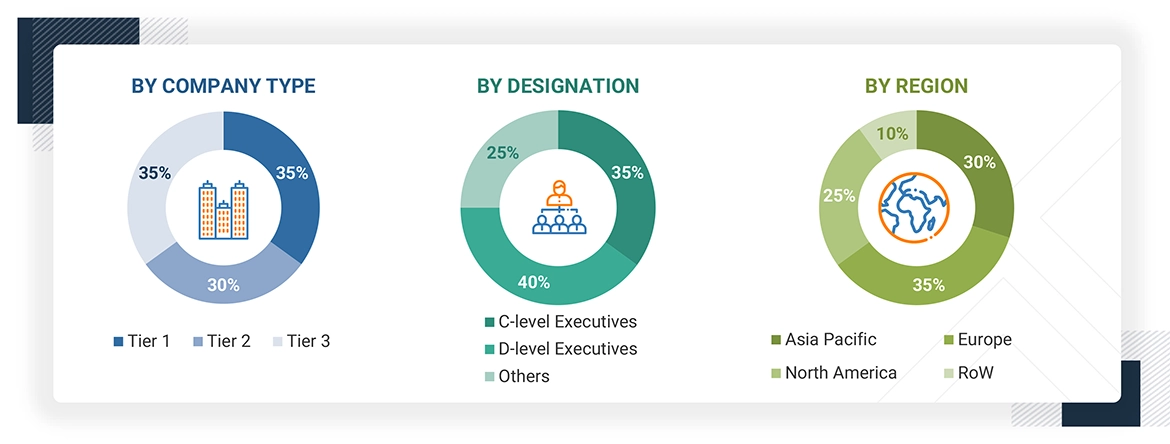
Notes: The three tiers of the companies have been defined based on their total/segmental revenue as of 2024: Tier 1 = >USD 1 billion, Tier 2 = USD 1 billion–USD 500 million, and Tier 3 = USD 500 million.
‘Others’ include sales, marketing, and product managers.
To know about the assumptions considered for the study, download the pdf brochure
Market Size Estimation
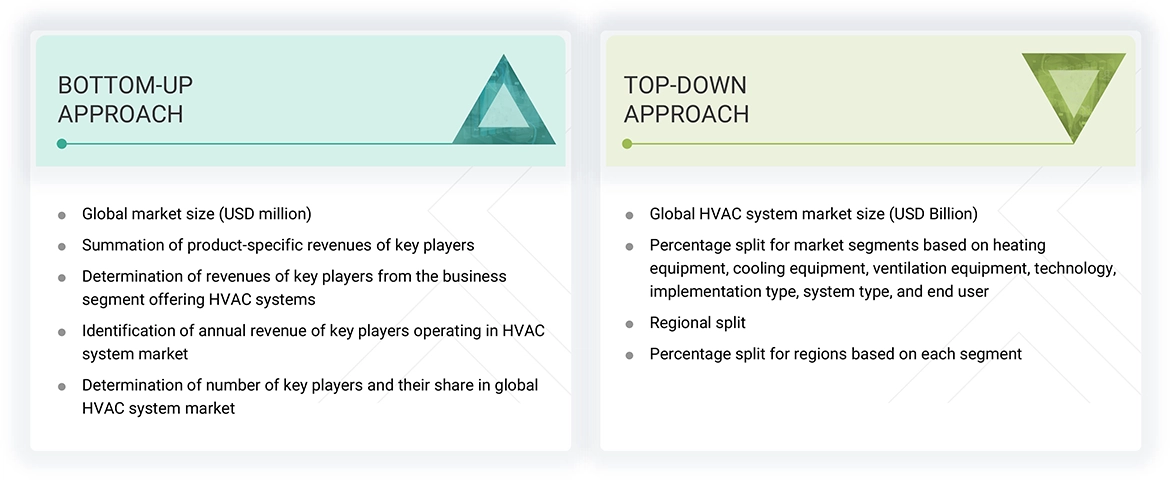
In the complete market engineering process, top-down and bottom-up approaches and several data triangulation methods were implemented to estimate and validate the size of the HVAC system market and various other dependent submarkets. Key players in the market were identified through secondary research, and their market share in the respective regions was determined through primary and secondary research. This entire research methodology included the study of annual and financial reports of the top players, as well as interviews with experts (such as CEOs, VPs, directors, and marketing executives) for key insights (quantitative and qualitative).
All percentage shares, splits, and breakdowns were determined using secondary sources and verified through primary sources. All the possible parameters that affect the markets covered in this research study were accounted for, viewed in detail, verified through primary research, and analyzed to obtain the final quantitative and qualitative data. This data was consolidated and supplemented with detailed inputs and analysis from MarketsandMarkets and presented in this report.
HVAC System Market : Top-Down and Bottom-Up Approach
Data Triangulation
After arriving at the overall market size from the estimation process explained above, the total market has been split into several segments and subsegments. To complete the overall market engineering process and arrive at the exact statistics for all segments and subsegments, market breakdown and data triangulation procedures have been employed, wherever applicable. The data have been triangulated by studying various factors and trends from the demand and supply sides. Along with this, the market has been validated using the top-down and bottom-up approaches.
Market Definition
HVAC system (Heating, ventilation, and air conditioning) is a set of technologies designed to regulate indoor temperature, humidity, and air quality for homes, businesses, or industrial spaces. It includes equipment that controls air circulation, adjusts temperatures via heating and cooling, and ensures adequate ventilation.
It includes various components such as air conditioners, heat pumps, furnaces, ventilation systems, and associated controls and technologies. These components work together to maintain comfortable and healthy indoor environments. Factors like energy efficiency, regulatory standards, climate considerations, and the demand for improved indoor air quality drive the HVAC system market.
Key Stakeholders
- Component Manufacturers
- Government and Research Organizations
- HVAC System Providers
- HVAC Software and Service Providers
- Maintenance and Service Providers
- Original Equipment Manufacturers (OEMs)
- Professional Services/Solution Providers
- Research Institutions and Organizations
- System Integrators
Report Objectives
- To estimate and forecast the size of the HVAC system market, in terms of value, based on cooling equipment, heating equipment, ventilation equipment, technology, implementation type, service type, end user, and region
- To describe and forecast the market size, in terms of volume, based on cooling equipment, heating equipment, ventilation equipment, and region.
- To describe and forecast the market size, in terms of value, for four major regions—North America, Europe, Asia Pacific, and RoW
- To provide detailed information regarding major factors such as drivers, restraints, opportunities, and challenges influencing the market growth
- To provide a detailed overview of the value chain of the HVAC system market
- To strategically analyze micromarkets with regard to individual market trends, growth prospects, and contributions to the total market
- To strategically profile key players and comprehensively analyze their market position in terms of ranking and core competencies, along with a detailed competitive landscape for the market leaders
- To analyze major growth strategies such as product launches, expansions, joint ventures, agreements, and acquisitions adopted by the key market players to enhance their position in the market
- To analyze the AI impact on the HVAC system market
- To analyze the US tariff impact on the HVAC system market
Customization Options
With the given market data, MarketsandMarkets offers customizations according to the company’s specific needs. The following customization options are available for the report::
Get the Full HVAC System Market Report
Full forecast, segment splits, and company analysis for all HVAC System Market.
- Africa HVAC System Market
- Australia HVAC System Market
- Canada HVAC System Market
- China HVAC System Market
- France HVAC System Market
- Germany HVAC System Market
- India HVAC System Market
- Indonesia HVAC System Market
- Italy HVAC System Market
- Japan HVAC System Market
- Malaysia HVAC System Market
- Mexico HVAC System Market
- Nordics HVAC System Market
- Poland HVAC System Market
- Rest Of Asia Pacific HVAC System Market
- Rest Of Europe HVAC System Market
- South America HVAC System Market
- South Korea HVAC System Market
- Spain HVAC System Market
- Thailand HVAC System Market
- UK HVAC System Market
- US HVAC System Market
- Vietnam HVAC System Market
Need a Tailored Report?
Customize this report to your needs
Get 10% FREE Customization
Customize This Report
