
Germany HVAC System Market (2025-2030)

The Germany HVAC System Market was valued at $290 Million in 2025 and projected to reach to $330 Million by 2030, representing a compound annual growth rate of 2.8%. Germany's HVAC System Market is positioned for steady, predictable growth driven by regulatory mandates and industrial modernization initiatives.


| Market Size in | USD 26.32 MN |
| Market Forecast in | |
| CAGR | |
| Forecast Period | |
| Units Considered | Value (USD MN) |
Germany HVAC System Market Trends and Insights
- Germany maintains a mature and stable HVAC market driven by stringent energy efficiency regulations and strong industrial demand across manufacturing and commercial sectors.
- The moderate growth trajectory reflects Germany's established infrastructure and focus on retrofitting existing systems with advanced climate control technologies. In 2025, Germany's HVAC market benefits from the country's commitment to sustainability and carbon neutrality targets, which incentivize adoption of high-efficiency heating and cooling solutions.
- By 2030, Germany is expected to see incremental expansion as industrial automation and semiconductor manufacturing facilities require sophisticated temperature and humidity management systems.
- Germany's position as Europe's largest economy ensures continued investment in HVAC modernization across residential, commercial, and industrial applications..
Key Market Statistics
- CAGR (2025-2030) 2.8% CAGR
- Market Size, 2025 ~USD 290 Million
- Forecast, 2030 ~USD 330 Million
- Country Germany
Germany HVAC System Market Overview
Mature Market Stability :
Germany's HVAC market demonstrates steady growth at 2.8% CAGR through 2030, reflecting a mature and well-established sector with consistent demand from industrial and commercial segments.
Regulatory Compliance Driver :
Stringent EU energy efficiency regulations and Germany's commitment to carbon neutrality by 2045 are primary catalysts for HVAC system upgrades and modernization across all sectors.
Industrial Sector Dominance :
Manufacturing and industrial facilities represent the largest consumer base for HVAC systems in Germany, driven by precision climate control requirements and operational efficiency standards.
Market Valuation Growth :
The German HVAC market is valued at USD 290 million in 2025 and is forecast to reach USD 330 million by 2030, indicating steady expansion despite slower growth compared to global markets.
Germany HVAC System Market Dynamics
- The 2.8% CAGR reflects a mature market where replacement cycles and efficiency upgrades dominate new installations.
- Energy efficiency standards, particularly the EU's Energy Performance of Buildings Directive, continue to incentivize system replacements with advanced technologies. The forecast period through 2030 will see increased adoption of smart HVAC solutions and integrated building management systems, particularly in commercial and manufacturing sectors.
- While Germany's growth rate lags the global 6.4% CAGR, the market's stability, high purchasing power, and stringent quality standards make it an attractive segment for premium HVAC providers focused on long-term sustainability and operational excellence..
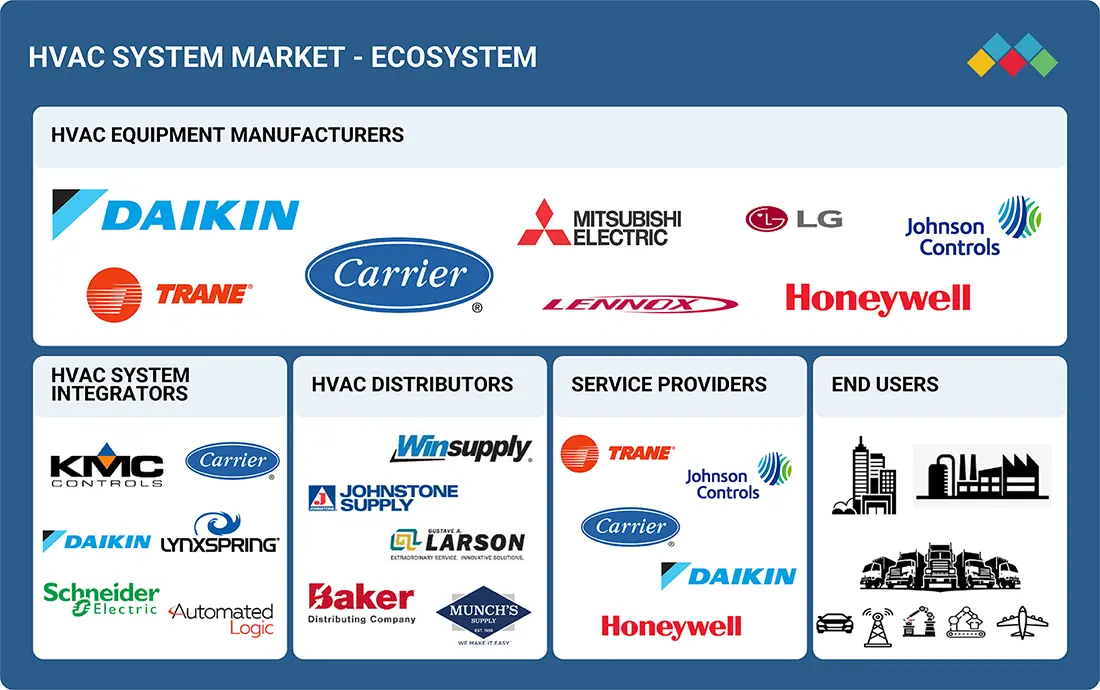
Market Ecosystem
HVAC System Market Growth: COMMERCIAL USE CASES ACROSS INDUSTRIES
| COMPANY | USE CASE DESCRIPTION | BENEFITS |
|---|---|---|
 |
Installed a ductless mini-split system with three comfort zones to provide heating and cooling throughout the condo. | Ductless mini-splits provide humidity control and air filtration to improve the overall air quality in the home and provide energy-efficient heating and cooling. |
 |
AI-driven VRF (Variable Refrigerant Flow) solutions with advanced energy management, optimized temperature control, and real-time monitoring to enhance efficiency and reliability. | The AI-enabled VRF system significantly lowered energy consumption, improved sustainability, and delivered a smarter, more adaptive HVAC experience. |
 |
CITY MULTI VRF zoning systems, Heat2O Heat Pump Water Heater systems, and integrated controls were installed. | The hotel achieved passive house certification and became the first zero-emission hotel in the US, reducing carbon footprint and setting a benchmark for sustainable hospitality. |
 |
Replacement of condenser, air handler, and switch to R-410a refrigerant system. | Carrier comfort series AC proved cost-effective, durable, and sustainable, ensuring significant long-term savings compared to retrofitting. |
 |
Installation of 10 VRV systems, iTM, 1 D-AHU Modular R + DX Coil & ERQ250, 4 Mini SkyAir (7,315 m³/h airflow). | Daikin solution delivered reliable, energy-efficient cooling for railway control systems, reducing operational risks and costs. |
Logos and trademarks shown above are the property of their respective owners. Their use here is for informational and illustrative purposes only.
Related Ecosystem
Key Takeaways
- Germany's HVAC System Market is valued at USD 290 million in 2025 with a projected value of USD 330 million by 2030, growing at a steady 2.8% CAGR.
- Germany's mature market is characterized by high energy efficiency standards and regulatory compliance requirements that drive adoption of advanced HVAC technologies.
- Industrial and semiconductor manufacturing sectors in Germany are key growth drivers, requiring precision climate control systems for optimal operational performance.
- Germany's commitment to carbon neutrality and sustainability initiatives supports long-term demand for energy-efficient HVAC solutions through 2030.
HVAC System Market Report Scope
| Report Metric | Details |
|---|---|
| Base Year | 2025 |
| Fastest Growing Segment | SUSTAINABLE/GREEN HVAC SYSTEMS (Technology) |
| Forecast Period | 2025-2030 |
| Growth Rate | CAGR of 6.4% from 2025 to 2030 |
| Largest Segment | TRADITIONAL HVAC SYSTEMS (Technology) |
| Market Size Base Year (Billions) | ~USD 299.02 (2025) |
| Revenue Forecast (Billions) | ~USD 407.77 (2030) |
| Segments Covered | Cooling Equipment, End User, Heating Equipment, Ventilation Equipment, Technology, Implementation Type, Service Type, Type |
Germany HVAC System Market Report Segmentation
8 segment dimensions are covered across the global market.
By Cooling Equipment
- Chillers
- Coolers
- Cooling Towers
- Room Air Conditioners
- Unitary Air Conditioners
- Vrf
- Vrf Systems
By End User
- Commercial
- Industrial
- Residential
By Heating Equipment
- Boilers
- Furnaces
- Heat Pumps
- Unitary Heaters
By Ventilation Equipment
- Ahus
- Air Filters
- Air Purifiers
- Air-Handling Units
- Dehumidifiers
- Humidifiers
- Ventilation Fans
By Technology
- Smart Hvac Systems
- Sustainable/Green Hvac Systems
- Traditional Hvac Systems
By Implementation Type
- New Construction Buildings
- Retrofit Buildings
By Service Type
- Consulting Services
- Installation Services
- Maintenance & Repair Services
- Upgradation/Replacement Services
By Type
- Airports
- Data Centers
- Education
- Governments
- Healthcare
- Manufacturing Facilities
- Offices
- Power Plants
- Retail
- Warehouses
Target Audience
- HVAC Manufacturers & OEMs : Manufacturers need Germany-specific market data to assess market size, growth potential, and competitive dynamics for product localization, pricing strategies, and distribution channel optimization.
- Industrial & Commercial Facility Managers : Facility managers require market insights to justify HVAC system upgrades, understand regulatory compliance timelines, and evaluate ROI on energy-efficient solutions in Germany's industrial sector.
- HVAC Installation & Service Providers : Service providers need Germany market forecasts to plan capacity expansion, identify growth segments, and develop service offerings aligned with regulatory requirements and customer demand patterns.
- Investment & Private Equity Firms : Investors evaluating German HVAC companies or market entry opportunities require validated market sizing, growth trajectories, and sector dynamics to support due diligence and valuation models.
- Building & Energy Efficiency Consultants : Consultants advising on German commercial and industrial projects need market data to recommend appropriate HVAC solutions, forecast adoption trends, and align recommendations with regulatory mandates.
Reasons to Buy this Report
- Precise Market Sizing for Germany : Access validated market data specific to Germany with accurate 2025 baseline (USD 290M) and 2030 forecast (USD 330M), enabling confident investment and expansion planning in this key European market.
- Regulatory Landscape Intelligence : Understand how German and EU energy efficiency regulations drive HVAC adoption and replacement cycles, allowing you to align product development and marketing strategies with compliance requirements.
- Sector-Specific Demand Insights : Identify growth opportunities within Germany's dominant industrial and commercial segments, with detailed analysis of manufacturing facility requirements and climate control specifications.
- Competitive Positioning Strategy : Benchmark your performance against market growth rates and understand Germany's mature market dynamics to develop differentiated strategies that emphasize quality, efficiency, and regulatory compliance.
- Long-Term Forecast Reliability : Leverage 5-year projections through 2030 to make informed decisions about market entry, capacity planning, and resource allocation in Germany's stable and predictable HVAC sector.
Frequently asked questions
What is the current size of Germany's HVAC System Market in 2025?
Germany's HVAC System Market is estimated at USD 290 million in 2025.
What is the projected market size for Germany's HVAC System Market by 2030?
Germany's HVAC System Market is forecast to reach USD 330 million by 2030.
What is the CAGR for Germany's HVAC System Market from 2025 to 2030?
Germany's HVAC System Market is expected to grow at a compound annual growth rate (CAGR) of 2.8% between 2025 and 2030.
What are the primary drivers of growth in Germany's HVAC market?
Key growth drivers in Germany include stringent energy efficiency regulations, industrial demand from semiconductor and manufacturing sectors, and the country's sustainability and carbon neutrality commitments.
Why is Germany's HVAC market growth rate lower than the global average?
Germany's 2.8% CAGR reflects a mature, well-established market with high existing penetration of HVAC systems, whereas global growth of 6.4% includes emerging markets with greater expansion potential.
RESEARCH METHODOLOGY
The research process for this study included systematic gathering, recording, and analysis of data about customers and companies operating in the HVAC system market. This process involved the extensive use of secondary sources, directories, and databases (Factiva and Oanda) to identify and collect valuable information for the comprehensive, technical, market-oriented, and commercial study of the HVAC system market. In-depth interviews were conducted with primary respondents, including experts from core and related industries and preferred manufacturers, to obtain and verify critical qualitative and quantitative information and assess growth prospects. Key players in the HVAC system market were identified through secondary research, and their market rankings were determined through primary and secondary research. This research included studying annual reports of top players and interviewing key industry experts such as CEOs, directors, and marketing executives.
Secondary Research
Various sources were used in the secondary research process to identify and collect information important for this study. These include company annual reports, press releases, investor presentations, white papers, technology journals, certified publications, articles by recognized authors, directories, and databases.
Secondary research was mainly used to obtain key information about the industry’s value chain, the total pool of market players, the market classification according to industry trends to the bottom-most level, regional markets, and key developments from market and technology-oriented perspectives.
Primary Research
Primary research was also conducted to identify the segmentation types, key players, competitive landscape, and key market dynamics, such as drivers, restraints, opportunities, challenges, and industry trends, along with key strategies adopted by players operating in the HVAC system market. Extensive qualitative and quantitative analyses were performed on the complete market engineering process to list key information and insights throughout the report.
Extensive primary research has been conducted after acquiring knowledge about the HVAC system market scenarios through secondary research. Several primary interviews have been conducted with experts from the demand (end user and region) and supply side (heating equipment, cooling equipment, ventilation equipment, implementation type, system type, technology) across four major geographic regions: North America, Europe, Asia Pacific, and RoW. Approximately 60% and 40% of the primary interviews were conducted from the supply and demand sides, respectively. These primary data have been collected through questionnaires, emails, and telephonic interviews.
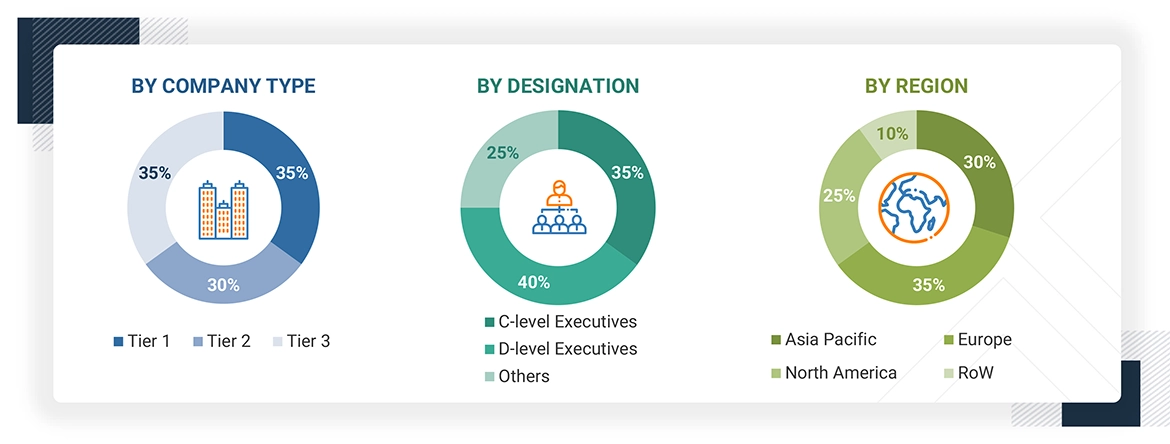
Notes: The three tiers of the companies have been defined based on their total/segmental revenue as of 2024: Tier 1 = >USD 1 billion, Tier 2 = USD 1 billion–USD 500 million, and Tier 3 = USD 500 million.
‘Others’ include sales, marketing, and product managers.
To know about the assumptions considered for the study, download the pdf brochure
Market Size Estimation
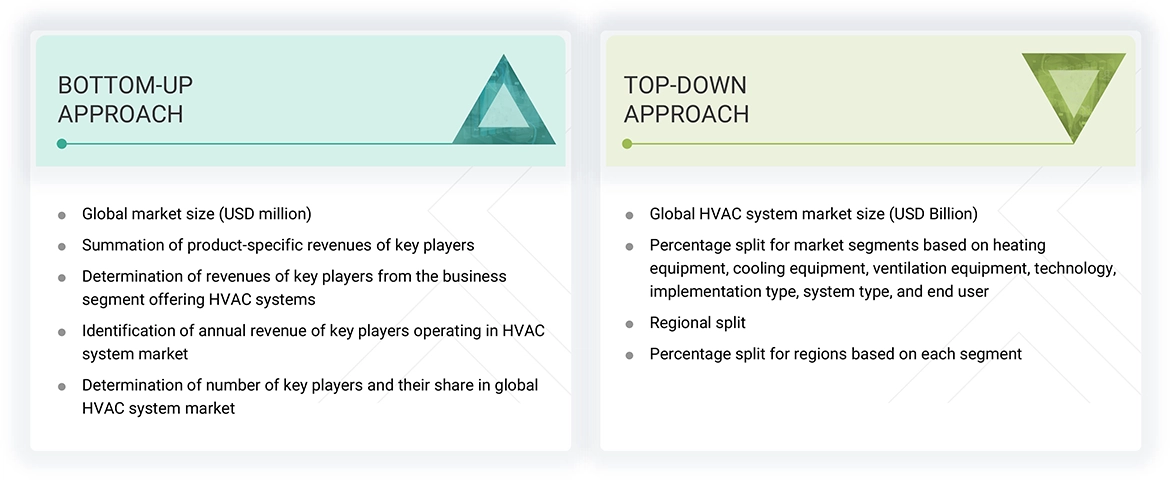
In the complete market engineering process, top-down and bottom-up approaches and several data triangulation methods were implemented to estimate and validate the size of the HVAC system market and various other dependent submarkets. Key players in the market were identified through secondary research, and their market share in the respective regions was determined through primary and secondary research. This entire research methodology included the study of annual and financial reports of the top players, as well as interviews with experts (such as CEOs, VPs, directors, and marketing executives) for key insights (quantitative and qualitative).
All percentage shares, splits, and breakdowns were determined using secondary sources and verified through primary sources. All the possible parameters that affect the markets covered in this research study were accounted for, viewed in detail, verified through primary research, and analyzed to obtain the final quantitative and qualitative data. This data was consolidated and supplemented with detailed inputs and analysis from MarketsandMarkets and presented in this report.
HVAC System Market : Top-Down and Bottom-Up Approach
Data Triangulation
After arriving at the overall market size from the estimation process explained above, the total market has been split into several segments and subsegments. To complete the overall market engineering process and arrive at the exact statistics for all segments and subsegments, market breakdown and data triangulation procedures have been employed, wherever applicable. The data have been triangulated by studying various factors and trends from the demand and supply sides. Along with this, the market has been validated using the top-down and bottom-up approaches.
Market Definition
HVAC system (Heating, ventilation, and air conditioning) is a set of technologies designed to regulate indoor temperature, humidity, and air quality for homes, businesses, or industrial spaces. It includes equipment that controls air circulation, adjusts temperatures via heating and cooling, and ensures adequate ventilation.
It includes various components such as air conditioners, heat pumps, furnaces, ventilation systems, and associated controls and technologies. These components work together to maintain comfortable and healthy indoor environments. Factors like energy efficiency, regulatory standards, climate considerations, and the demand for improved indoor air quality drive the HVAC system market.
Key Stakeholders
- Component Manufacturers
- Government and Research Organizations
- HVAC System Providers
- HVAC Software and Service Providers
- Maintenance and Service Providers
- Original Equipment Manufacturers (OEMs)
- Professional Services/Solution Providers
- Research Institutions and Organizations
- System Integrators
Report Objectives
- To estimate and forecast the size of the HVAC system market, in terms of value, based on cooling equipment, heating equipment, ventilation equipment, technology, implementation type, service type, end user, and region
- To describe and forecast the market size, in terms of volume, based on cooling equipment, heating equipment, ventilation equipment, and region.
- To describe and forecast the market size, in terms of value, for four major regions—North America, Europe, Asia Pacific, and RoW
- To provide detailed information regarding major factors such as drivers, restraints, opportunities, and challenges influencing the market growth
- To provide a detailed overview of the value chain of the HVAC system market
- To strategically analyze micromarkets with regard to individual market trends, growth prospects, and contributions to the total market
- To strategically profile key players and comprehensively analyze their market position in terms of ranking and core competencies, along with a detailed competitive landscape for the market leaders
- To analyze major growth strategies such as product launches, expansions, joint ventures, agreements, and acquisitions adopted by the key market players to enhance their position in the market
- To analyze the AI impact on the HVAC system market
- To analyze the US tariff impact on the HVAC system market
Customization Options
With the given market data, MarketsandMarkets offers customizations according to the company’s specific needs. The following customization options are available for the report::
Get the Full HVAC System Market Report
Full forecast, segment splits, and company analysis for all HVAC System Market.
- Africa HVAC System Market
- Australia HVAC System Market
- Canada HVAC System Market
- China HVAC System Market
- France HVAC System Market
- India HVAC System Market
- Indonesia HVAC System Market
- Italy HVAC System Market
- Japan HVAC System Market
- Malaysia HVAC System Market
- Mexico HVAC System Market
- Middle East HVAC System Market
- Nordics HVAC System Market
- Poland HVAC System Market
- Rest Of Asia Pacific HVAC System Market
- Rest Of Europe HVAC System Market
- South America HVAC System Market
- South Korea HVAC System Market
- Spain HVAC System Market
- Thailand HVAC System Market
- UK HVAC System Market
- US HVAC System Market
- Vietnam HVAC System Market
Need a Tailored Report?
Customize this report to your needs
Get 10% FREE Customization
Customize This Report