
North America HVAC System Market (2025-2030)

The North America HVAC System Market was valued at $63130 Million in 2025 and projected to reach to $85550 Million by 2030, representing a compound annual growth rate of 6.3%. North America's HVAC System Market is positioned for sustained growth through 2030, driven by aging infrastructure replacement cycles, stringent energy efficiency regulations, and rising consumer demand for smart climate control solutions.


| Market Size in | USD 26.32 MN |
| Market Forecast in | |
| CAGR | |
| Forecast Period | |
| Units Considered | Value (USD MN) |
North America HVAC System Market Trends and Insights
- North America maintains a significant share of the global HVAC market, driven by robust demand across residential, commercial, and industrial sectors.
- The region's mature infrastructure and emphasis on energy-efficient climate control solutions position North America as a key growth market within the semiconductor and electronics industry. Throughout the forecast period from 2025 to 2030, North America is expected to benefit from increasing adoption of smart HVAC technologies, stringent environmental regulations, and rising consumer awareness regarding energy consumption.
- North America's established supply chains and technological innovation capabilities further support sustained market expansion.
- The region's focus on retrofitting existing systems with advanced controls and IoT-enabled solutions continues to drive incremental revenue growth across the HVAC ecosystem..
Key Market Statistics
- CAGR (2025-2030) 6.3% CAGR
- Market Size, 2025 ~USD 63130 Million
- Forecast, 2030 ~USD 85550 Million
- Geography North America
North America HVAC System Market Overview
Market Valuation & Growth :
North America's HVAC System Market is valued at $63.13 billion in 2025 and projected to reach $85.55 billion by 2030, with a steady CAGR of 6.3%, reflecting strong regional demand and infrastructure investments.
US Market Dominance :
The United States leads North America with a market size of $12.98 billion, representing the largest segment within the region and driving innovation in energy-efficient HVAC technologies.
Energy Efficiency Focus :
North America's mature infrastructure and regulatory emphasis on energy-efficient HVAC systems are accelerating adoption of smart climate control solutions across residential, commercial, and industrial sectors.
Multi-Sector Demand :
Robust demand spans residential retrofits, commercial building upgrades, and industrial applications, supported by favorable economic conditions and increasing awareness of environmental sustainability.
North America HVAC System Market Dynamics
- The region's mature market supports premium product adoption and technological innovation, particularly in IoT-enabled systems and eco-friendly refrigerants.
- Residential and commercial sectors continue to invest in system upgrades to meet building codes and reduce operational costs. Key growth catalysts include increasing commercial real estate development, residential construction recovery, and government incentives for energy-efficient upgrades.
- The region's focus on decarbonization and net-zero building standards will further accelerate HVAC system modernization.
- Market consolidation among manufacturers and expanding service networks will enhance market penetration, while supply chain stabilization supports competitive pricing and product availability through the forecast period..
Market Ecosystem
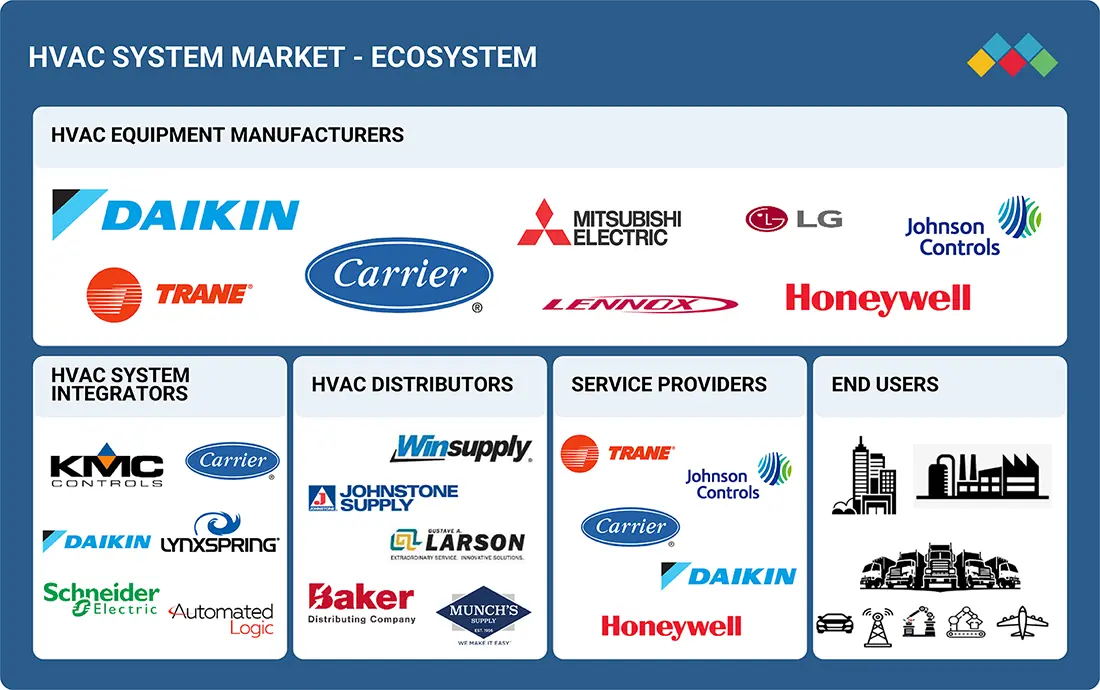
HVAC System Market Growth: COMMERCIAL USE CASES ACROSS INDUSTRIES
| COMPANY | USE CASE DESCRIPTION | BENEFITS |
|---|---|---|
 |
Installed a ductless mini-split system with three comfort zones to provide heating and cooling throughout the condo. | Ductless mini-splits provide humidity control and air filtration to improve the overall air quality in the home and provide energy-efficient heating and cooling. |
 |
AI-driven VRF (Variable Refrigerant Flow) solutions with advanced energy management, optimized temperature control, and real-time monitoring to enhance efficiency and reliability. | The AI-enabled VRF system significantly lowered energy consumption, improved sustainability, and delivered a smarter, more adaptive HVAC experience. |
 |
CITY MULTI VRF zoning systems, Heat2O Heat Pump Water Heater systems, and integrated controls were installed. | The hotel achieved passive house certification and became the first zero-emission hotel in the US, reducing carbon footprint and setting a benchmark for sustainable hospitality. |
 |
Replacement of condenser, air handler, and switch to R-410a refrigerant system. | Carrier comfort series AC proved cost-effective, durable, and sustainable, ensuring significant long-term savings compared to retrofitting. |
 |
Installation of 10 VRV systems, iTM, 1 D-AHU Modular R + DX Coil & ERQ250, 4 Mini SkyAir (7,315 m³/h airflow). | Daikin solution delivered reliable, energy-efficient cooling for railway control systems, reducing operational risks and costs. |
Logos and trademarks shown above are the property of their respective owners. Their use here is for informational and illustrative purposes only.
Related Ecosystem
Key Takeaways
- North America's HVAC System Market is valued at $63.13 billion in 2025 and will reach $85.55 billion by 2030, growing at a 6.3% CAGR.
- North America's market growth is driven by increasing demand for energy-efficient and smart HVAC technologies across residential and commercial segments.
- North America benefits from stringent environmental regulations and building codes that mandate advanced climate control solutions.
- North America's established infrastructure and technological capabilities position the region as a leader in HVAC innovation and market expansion.
HVAC System Market Report Scope
| Report Metric | Details |
|---|---|
| Base Year | 2025 |
| Fastest Growing Segment | SUSTAINABLE/GREEN HVAC SYSTEMS (Technology) |
| Forecast Period | 2025-2030 |
| Growth Rate | CAGR of 6.4% from 2025 to 2030 |
| Largest Segment | TRADITIONAL HVAC SYSTEMS (Technology) |
| Market Size Base Year (Billions) | ~USD 299.02 (2025) |
| Revenue Forecast (Billions) | ~USD 407.77 (2030) |
| Segments Covered | Cooling Equipment, End User, Heating Equipment, Ventilation Equipment, Technology, Implementation Type, Service Type, Type |
North America HVAC System Market Report Segmentation
8 segment dimensions are covered across the global market.
By Cooling Equipment
- Chillers
- Coolers
- Cooling Towers
- Room Air Conditioners
- Unitary Air Conditioners
- Vrf
- Vrf Systems
By End User
- Commercial
- Industrial
- Residential
By Heating Equipment
- Boilers
- Furnaces
- Heat Pumps
- Unitary Heaters
By Ventilation Equipment
- Ahus
- Air Filters
- Air Purifiers
- Air-Handling Units
- Dehumidifiers
- Humidifiers
- Ventilation Fans
By Technology
- Smart Hvac Systems
- Sustainable/Green Hvac Systems
- Traditional Hvac Systems
By Implementation Type
- New Construction Buildings
- Retrofit Buildings
By Service Type
- Consulting Services
- Installation Services
- Maintenance & Repair Services
- Upgradation/Replacement Services
By Type
- Airports
- Data Centers
- Education
- Governments
- Healthcare
- Manufacturing Facilities
- Offices
- Power Plants
- Retail
- Warehouses
Target Audience
- HVAC Manufacturers & OEMs : Develop regional product strategies, optimize production capacity, and identify market gaps in North America's $85.55B forecasted market by 2030.
- Commercial Real Estate Developers : Make informed decisions on HVAC system specifications, energy-efficient upgrades, and long-term operational cost planning for North American properties.
- HVAC Service & Installation Companies : Expand service offerings, identify growth markets within North America, and align capabilities with evolving customer demand for smart climate solutions.
- Investment & Private Equity Firms : Evaluate acquisition targets, assess market consolidation opportunities, and identify high-growth segments within North America's HVAC sector.
- Government & Policy Makers : Develop energy efficiency incentive programs, building standards, and sustainability initiatives aligned with North America's HVAC market growth trajectory.
Countries within North America - compare and drill down
| Country | 2025 size (native) |
|---|---|
| US | USD 12980 Million |
| Canada | USD 860 Million |
| Mexico | USD 2220 Million |
Country market size visualization
Reasons to Buy this Report
- Regional Market Segmentation : Detailed breakdown of North America's HVAC market by country (US, Canada, Mexico) with specific market sizes and growth trajectories to identify high-opportunity segments.
- Sector-Specific Insights : Comprehensive analysis of residential, commercial, and industrial HVAC demand patterns unique to North America, enabling targeted business strategy development.
- Competitive Landscape Intelligence : Understand market consolidation trends, key player positioning, and emerging competitors within North America's $63.13 billion HVAC ecosystem.
- Regulatory & Compliance Framework : Navigate energy efficiency standards, building codes, and environmental regulations driving HVAC adoption across North American markets through 2030.
- Investment & Growth Opportunities : Identify high-growth subsegments, emerging technologies, and geographic hotspots for capital allocation and market entry strategies in North America.
Frequently asked questions
What is the current size of North America's HVAC System Market?
North America's HVAC System Market is valued at $63.13 billion in 2025.
What is the projected market size for North America's HVAC System Market by 2030?
North America's HVAC System Market is projected to reach $85.55 billion by 2030.
What is the CAGR for North America's HVAC System Market from 2025 to 2030?
North America's HVAC System Market is expected to grow at a compound annual growth rate (CAGR) of 6.3% from 2025 to 2030.
What are the primary drivers of growth in North America's HVAC System Market?
North America's HVAC market growth is driven by smart technology adoption, energy efficiency regulations, building code compliance, and increased consumer awareness of sustainable climate control solutions.
Which sectors contribute most to North America's HVAC System Market?
North America's HVAC market is supported by residential, commercial, and industrial sectors, with significant demand from retrofit and new construction applications.
RESEARCH METHODOLOGY
The research process for this study included systematic gathering, recording, and analysis of data about customers and companies operating in the HVAC system market. This process involved the extensive use of secondary sources, directories, and databases (Factiva and Oanda) to identify and collect valuable information for the comprehensive, technical, market-oriented, and commercial study of the HVAC system market. In-depth interviews were conducted with primary respondents, including experts from core and related industries and preferred manufacturers, to obtain and verify critical qualitative and quantitative information and assess growth prospects. Key players in the HVAC system market were identified through secondary research, and their market rankings were determined through primary and secondary research. This research included studying annual reports of top players and interviewing key industry experts such as CEOs, directors, and marketing executives.
Secondary Research
Various sources were used in the secondary research process to identify and collect information important for this study. These include company annual reports, press releases, investor presentations, white papers, technology journals, certified publications, articles by recognized authors, directories, and databases.
Secondary research was mainly used to obtain key information about the industry’s value chain, the total pool of market players, the market classification according to industry trends to the bottom-most level, regional markets, and key developments from market and technology-oriented perspectives.
Primary Research
Primary research was also conducted to identify the segmentation types, key players, competitive landscape, and key market dynamics, such as drivers, restraints, opportunities, challenges, and industry trends, along with key strategies adopted by players operating in the HVAC system market. Extensive qualitative and quantitative analyses were performed on the complete market engineering process to list key information and insights throughout the report.
Extensive primary research has been conducted after acquiring knowledge about the HVAC system market scenarios through secondary research. Several primary interviews have been conducted with experts from the demand (end user and region) and supply side (heating equipment, cooling equipment, ventilation equipment, implementation type, system type, technology) across four major geographic regions: North America, Europe, Asia Pacific, and RoW. Approximately 60% and 40% of the primary interviews were conducted from the supply and demand sides, respectively. These primary data have been collected through questionnaires, emails, and telephonic interviews.
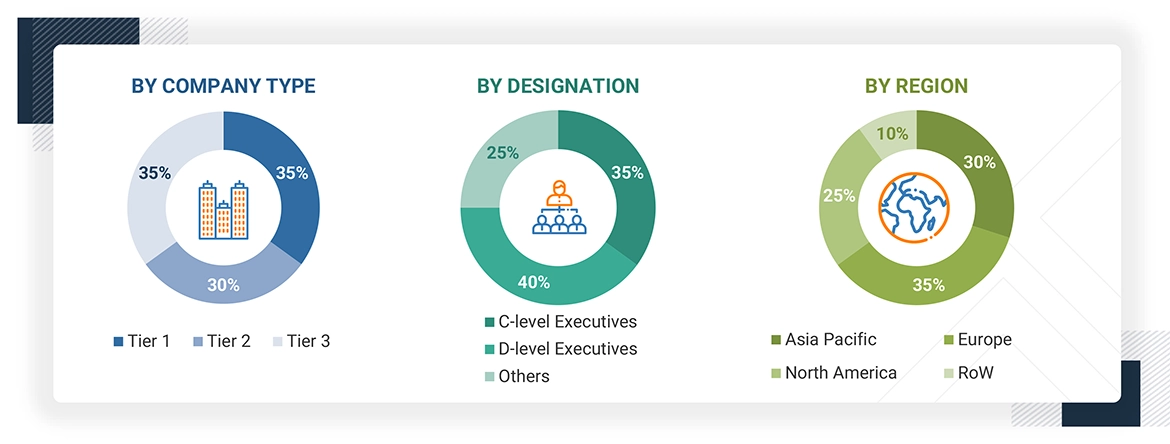
Notes: The three tiers of the companies have been defined based on their total/segmental revenue as of 2024: Tier 1 = >USD 1 billion, Tier 2 = USD 1 billion–USD 500 million, and Tier 3 = USD 500 million.
‘Others’ include sales, marketing, and product managers.
To know about the assumptions considered for the study, download the pdf brochure
Market Size Estimation
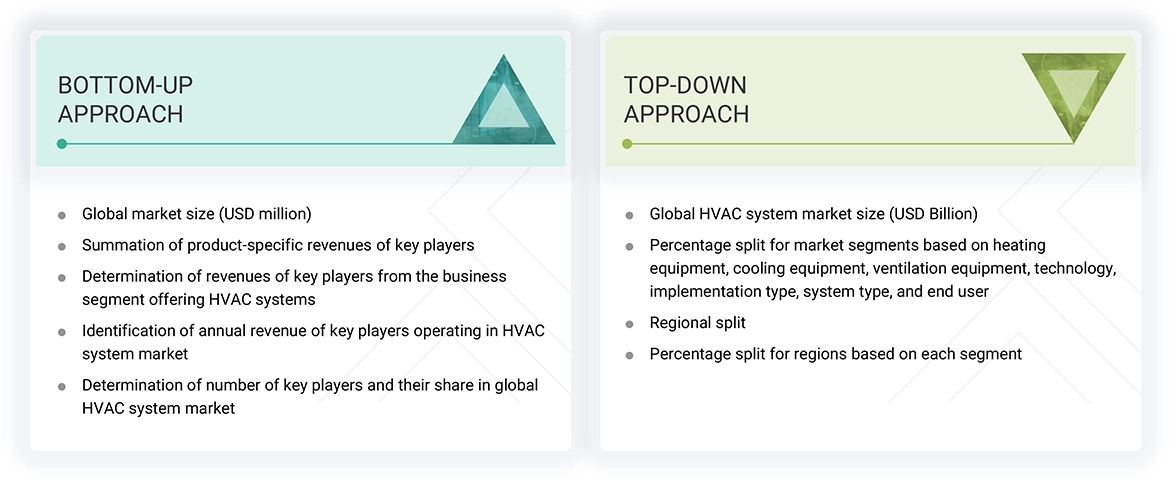
In the complete market engineering process, top-down and bottom-up approaches and several data triangulation methods were implemented to estimate and validate the size of the HVAC system market and various other dependent submarkets. Key players in the market were identified through secondary research, and their market share in the respective regions was determined through primary and secondary research. This entire research methodology included the study of annual and financial reports of the top players, as well as interviews with experts (such as CEOs, VPs, directors, and marketing executives) for key insights (quantitative and qualitative).
All percentage shares, splits, and breakdowns were determined using secondary sources and verified through primary sources. All the possible parameters that affect the markets covered in this research study were accounted for, viewed in detail, verified through primary research, and analyzed to obtain the final quantitative and qualitative data. This data was consolidated and supplemented with detailed inputs and analysis from MarketsandMarkets and presented in this report.
HVAC System Market : Top-Down and Bottom-Up Approach
Data Triangulation
After arriving at the overall market size from the estimation process explained above, the total market has been split into several segments and subsegments. To complete the overall market engineering process and arrive at the exact statistics for all segments and subsegments, market breakdown and data triangulation procedures have been employed, wherever applicable. The data have been triangulated by studying various factors and trends from the demand and supply sides. Along with this, the market has been validated using the top-down and bottom-up approaches.
Market Definition
HVAC system (Heating, ventilation, and air conditioning) is a set of technologies designed to regulate indoor temperature, humidity, and air quality for homes, businesses, or industrial spaces. It includes equipment that controls air circulation, adjusts temperatures via heating and cooling, and ensures adequate ventilation.
It includes various components such as air conditioners, heat pumps, furnaces, ventilation systems, and associated controls and technologies. These components work together to maintain comfortable and healthy indoor environments. Factors like energy efficiency, regulatory standards, climate considerations, and the demand for improved indoor air quality drive the HVAC system market.
Key Stakeholders
- Component Manufacturers
- Government and Research Organizations
- HVAC System Providers
- HVAC Software and Service Providers
- Maintenance and Service Providers
- Original Equipment Manufacturers (OEMs)
- Professional Services/Solution Providers
- Research Institutions and Organizations
- System Integrators
Report Objectives
- To estimate and forecast the size of the HVAC system market, in terms of value, based on cooling equipment, heating equipment, ventilation equipment, technology, implementation type, service type, end user, and region
- To describe and forecast the market size, in terms of volume, based on cooling equipment, heating equipment, ventilation equipment, and region.
- To describe and forecast the market size, in terms of value, for four major regions—North America, Europe, Asia Pacific, and RoW
- To provide detailed information regarding major factors such as drivers, restraints, opportunities, and challenges influencing the market growth
- To provide a detailed overview of the value chain of the HVAC system market
- To strategically analyze micromarkets with regard to individual market trends, growth prospects, and contributions to the total market
- To strategically profile key players and comprehensively analyze their market position in terms of ranking and core competencies, along with a detailed competitive landscape for the market leaders
- To analyze major growth strategies such as product launches, expansions, joint ventures, agreements, and acquisitions adopted by the key market players to enhance their position in the market
- To analyze the AI impact on the HVAC system market
- To analyze the US tariff impact on the HVAC system market
Customization Options
With the given market data, MarketsandMarkets offers customizations according to the company’s specific needs. The following customization options are available for the report::
Get the Full HVAC System Market Report
Full forecast, segment splits, and company analysis for all HVAC System Market.
Need a Tailored Report?
Customize this report to your needs
Get 10% FREE Customization
Customize This Report
