
Spain Hydrochloric Acid Market (2024-2029)

The Spain Hydrochloric Acid Market was valued at $44.5 Million in 2024 and projected to reach to $59.4 Million by 2029, representing a compound annual growth rate of CAGR 6.0%. Spain's hydrochloric acid market is poised for steady growth at a 6.0% CAGR through 2029, outpacing broader economic trends.


| Market Size in | USD 26.32 MN |
| Market Forecast in | |
| CAGR | |
| Forecast Period | |
| Units Considered | Value (USD MN) |
Spain Hydrochloric Acid Market Trends and Insights
- Spain's chemical sector, particularly its steel pickling, metal processing, and water treatment industries, drives steady demand for hydrochloric acid.
- The country's industrial base and integration within European supply chains position Spain as a key regional consumer of this essential chemical commodity. Growth in Spain's hydrochloric acid market is supported by expanding manufacturing activity, increased investment in infrastructure, and rising demand from the pharmaceutical and food processing sectors.
- Spain's commitment to industrial modernization and environmental compliance standards further stimulates consumption of high-purity hydrochloric acid.
- Between 2024 and 2029, Spain is expected to maintain moderate but consistent market expansion, driven by both domestic industrial recovery and cross-border trade within the European Union..
Key Market Statistics
- CAGR (2024-2029) CAGR 6.0%
- Market Size, 2024 ~USD 44.5 Million
- Forecast, 2029 ~USD 59.4 Million
- Country Spain
Spain Hydrochloric Acid Market Overview
Market Valuation :
Spain's hydrochloric acid market reached USD 44.5 million in 2024, with projections to grow to USD 59.4 million by 2029, driven by industrial demand across multiple sectors.
Steel Pickling Dominance :
Steel pickling remains the primary application for hydrochloric acid in Spain, supported by the country's robust metal processing and manufacturing industries.
Water Treatment Growth :
Spain's water treatment sector increasingly relies on hydrochloric acid for pH adjustment and mineral removal, contributing significantly to market expansion.
European Integration :
Spain's position within the European Union enables seamless supply chain integration and access to regional markets, strengthening its hydrochloric acid sector competitiveness.
Spain Hydrochloric Acid Market Dynamics
- The country's industrial base, particularly in steel production, metal processing, and water treatment, provides consistent demand drivers.
- Spain's chemical sector benefits from EU regulatory frameworks promoting sustainable industrial practices and water quality standards, which increase hydrochloric acid consumption.
- Integration with European supply chains and manufacturing hubs further supports market expansion.
- However, growth may be tempered by environmental regulations and the shift toward alternative pickling technologies.
- Strategic investments in production capacity and sustainable manufacturing practices will be critical for market participants seeking to capitalize on Spain's industrial recovery and infrastructure development initiatives..
Market Ecosystem
Related Ecosystem
Bulk Chemicals And Inorganics
- Corrosion Inhibitors
- Glycol Ethers
- Acetic Acid
- Acetone
- Ammonium Nitrate
- Basf se
- DOW CHEMICAL COMPANY
- Exxon Mobil Corporation
- AZELIS HOLDINGS SA
- Sinopec limited
Fandb Processing And Technology
- Dairy Products
- Bakery Products
- Filtration Equipment
- Heat Exchanger
- Acetic Acid
- Gea group
- John Bean Technologies Corporation
- Alfa Laval Corporate AB
- AZELIS HOLDINGS SA
- SPX FLOW INC
Industrial Equipment
- HVAC System
- Fiberglass
- Actuators
- Cartridge Filters
- Electrostatic Precipitators
- Siemens ag
- GRUNDFOS GROUP
- ABB India Limited
- SCHNEIDER ELECTRIC SE
- Eaton Corporation plc
Key Takeaways
- Spain's hydrochloric acid market is valued at USD 44.5 million in 2024 and will reach USD 59.4 million by 2029.
- Spain's market is projected to grow at a CAGR of 6.0% from 2024 to 2029, driven by industrial and manufacturing demand.
- Steel pickling, metal processing, and water treatment are primary end-use sectors fueling Spain's hydrochloric acid consumption.
- Spain's position within the EU supply chain and industrial modernization initiatives support sustained market growth through 2029.
Hydrochloric Acid Market Report Scope
| Report Metric | Details |
|---|---|
| Base Year | 2024 |
| Fastest Growing Segment | FOOD PROCESSING (Application) |
| Forecast Period | 2024-2029 |
| Growth Rate | CAGR of 6.5% from 2024 to 2029 |
| Largest Segment | BY-PRODUCT GRADE (Grade) |
| Market Size Base Year (Billions) | ~USD 2.19 (2024) |
| Revenue Forecast (Billions) | ~USD 3 (2029) |
| Segments Covered | Grade, Application, End-Use Industry |
Spain Hydrochloric Acid Market Report Segmentation
3 segment dimensions are covered across the global market.
By Grade
- Blow Molding
- By-Product Grade
- Cosmetic Grade
- Extrusion
- Injection Molding
- Synthetic Grade
- Technical Trade
- Thermoforming
By Application
- Biodiesel
- Bottles
- Calcium Chloride
- Films & Sheets
- Food Processing
- Household
- Industrial
- Oil Well Acidizing
- Ore Processing
- Other Applications
- Personal Care & Dermatology
- Pool Sanitation
- Rigid Thermoforms
- Steel Pickling
By End-Use Industry
- Agriculture
- Bio-Medical
- Chemical
- Consumer Goods
- Food & Beverage
- Oil & Gas
- Other End-Use Industries
- Packaging
- Pharmaceutical
- Steel
- Textile
SPAIN: HYDROCHLORIC ACID MARKET, BY END-USE INDUSTRY, 2020–2029
| Segment | 2020 | 2021 | 2022 | 2023 | 2024 | 2025 | 2026 | 2027 | 2028 | 2029 | CAGR (%) |
|---|---|---|---|---|---|---|---|---|---|---|---|
| CHEMICAL | 7.5 | 7.9 | 8 | 8.5 | 9 | 9.5 | 10 | 10.6 | 11.2 | 11.8 | 5.7 |
| FOOD & BEVERAGE | 11.5 | 12.2 | 12.4 | 13.2 | 14.1 | 15.1 | 16.1 | 17.2 | 18.3 | 19.5 | 6.7 |
| OIL & GAS | 6.3 | 6.7 | 6.8 | 7.1 | 7.5 | 7.9 | 8.3 | 8.8 | 9.2 | 9.7 | 5.3 |
| OTHER END-USE INDUSTRIES | 2.4 | 2.6 | 2.6 | 2.7 | 2.9 | 3 | 3.2 | 3.3 | 3.5 | 3.7 | 5 |
| PHARMACEUTICAL | 2.2 | 2.4 | 2.4 | 2.5 | 2.7 | 2.8 | 3 | 3.1 | 3.3 | 3.5 | 5.6 |
| STEEL | 5.9 | 6.3 | 6.4 | 6.8 | 7.2 | 7.6 | 8.1 | 8.6 | 9.1 | 9.7 | 6.2 |
| TEXTILE | 1 | 1 | 1 | 1.1 | 1.1 | 1.2 | 1.2 | 1.3 | 1.4 | 1.4 | 5.1 |
| TOTAL | 37 | 38.9 | 39.6 | 42 | 44.5 | 47.1 | 49.9 | 52.9 | 56 | 59.4 | 6 |
Target Audience
- Chemical Manufacturers : Spanish and European hydrochloric acid producers need market sizing and growth forecasts to optimize production capacity, pricing strategies, and distribution networks in Spain.
- Steel & Metal Processing Companies : Spanish steel mills and metal processors require demand insights and market trends to secure reliable HCl supply contracts and plan procurement budgets effectively.
- Water Treatment Operators : Municipal and industrial water treatment facilities in Spain need market data to forecast chemical costs, evaluate supplier options, and plan infrastructure investments.
- Investment & Private Equity Firms : Investors evaluating opportunities in Spain's chemical sector require detailed market analysis, growth projections, and competitive dynamics to assess investment viability.
- Business Consultants & Analysts : Strategy consultants and market analysts need Spain-specific hydrochloric acid data to support client advisory work, feasibility studies, and market entry assessments.
Reasons to Buy this Report
- Spain-Specific Market Sizing : Obtain precise market valuation data for Spain (USD 44.5M in 2024) with detailed 5-year forecasts, enabling accurate budgeting and investment planning for Spanish operations.
- Sector-Focused Demand Analysis : Understand Spain's key end-use industries—steel pickling, metal processing, and water treatment—with insights into growth drivers specific to Spanish industrial sectors.
- Competitive Landscape Intelligence : Identify market opportunities and competitive positioning within Spain's chemical sector, including supply chain dynamics and regional manufacturing trends.
- Regulatory & Compliance Insights : Navigate EU and Spanish environmental regulations affecting hydrochloric acid production, distribution, and usage with market-specific compliance guidance.
- Strategic Expansion Planning : Leverage Spain-focused market data to develop entry strategies, capacity expansion plans, and partnership opportunities within the Spanish and broader European markets.
Frequently asked questions
What is the current size of Spain's hydrochloric acid market?
Spain's hydrochloric acid market was valued at USD 44.5 million in 2024 and is expected to grow to USD 59.4 million by 2029.
What is the projected growth rate for Spain's hydrochloric acid market?
Spain's hydrochloric acid market is projected to grow at a CAGR of 6.0% between 2024 and 2029.
Which industries drive demand for hydrochloric acid in Spain?
Spain's primary end-use sectors include steel pickling, metal processing, water treatment, pharmaceuticals, and food processing industries.
How does Spain's market compare to the global hydrochloric acid market?
While the global market grows at 6.5% CAGR, Spain's market grows at 6.0% CAGR, reflecting regional industrial dynamics and EU market integration.
What factors support growth in Spain's hydrochloric acid market?
Industrial modernization, infrastructure investment, EU supply chain integration, environmental compliance standards, and expanding manufacturing activity support Spain's market growth.
RESEARCH METHODOLOGY
The study involved four major activities for estimating the current size of the global hydrochloric acid market. Exhaustive secondary research was carried out to collect information on the market, the peer product market, and the parent product group market. The next step was to validate these findings, assumptions, and sizes with the industry experts across the value chain of hydrochloric acid through primary research. Both the top-down and bottom-up approaches were employed to estimate the overall size of the hydrochloric acid market. After that, market breakdown and data triangulation procedures were used to determine the size of different segments and sub-segments of the market.
Secondary Research
In the secondary research process, various secondary sources such as Hoovers, Factiva, Bloomberg BusinessWeek, and Dun & Bradstreet were referred to, to identify and collect information for this study on the Hydrochloric acid market. These secondary sources included annual reports, press releases & investor presentations of companies; white papers; certified publications; articles by recognized authors; regulatory bodies, trade directories, and databases.
Primary Research
The hydrochloric acid market comprises several stakeholders in the supply chain, which include raw material suppliers, processors, end-product manufacturers, buyers, and regulatory organizations. Various primary sources from the supply and demand sides of the markets have been interviewed to obtain qualitative and quantitative information. The primary participants from the demand side include key opinion leaders, executives, vice presidents, and CEOs of companies in the Hydrochloric acid market. Primary sources from the supply side include associations and institutions involved in the hydrochloric acid industry, key opinion leaders, and processing players.
Following is the breakdown of primary respondents
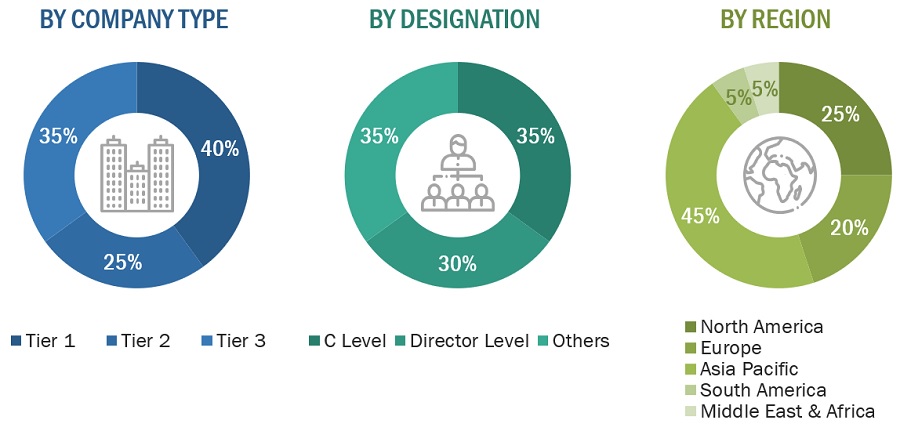
Notes: Other designations include product, sales, and marketing managers.
Tiers of the companies are classified based on their annual revenues as of 2022: Tier 1 = >USD 5 Billion, Tier 2 = USD 1 Billion to USD 5 Billion, and Tier 3= <USD 1 Billion.
To know about the assumptions considered for the study, download the pdf brochure
Market Size Estimation
Both the top-down and bottom-up approaches were used to estimate and validate the size of the global hydrochloric acid market. These approaches were also used extensively to estimate the size of various segments of the market. The research methodology used to estimate the market size included the following details:
- The key players in the industry were identified through extensive secondary research.
- The supply chain of the industry and market size, in terms of value and volume, were determined through primary and secondary research.
- All percentage share splits and breakdowns were determined using secondary sources and verified through primary sources.
- All possible parameters that affect the markets covered in this research study were accounted for, viewed in extensive detail, verified through primary research, and analyzed to obtain the final quantitative and qualitative data.
- The research includes the study of reports, reviews, and newsletters of key industry players, along with extensive interviews with key officials, such as directors and marketing executives.
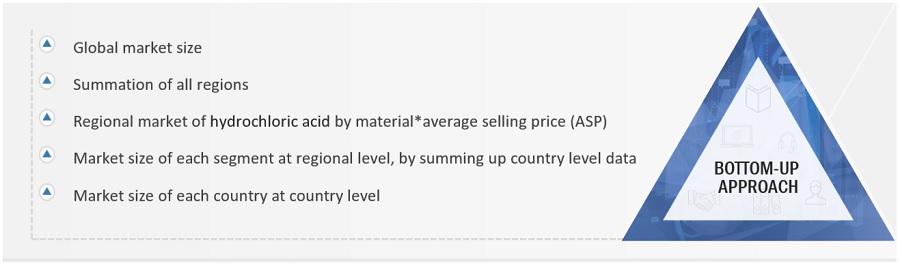
To know about the assumptions considered for the study, Request for Free Sample Report
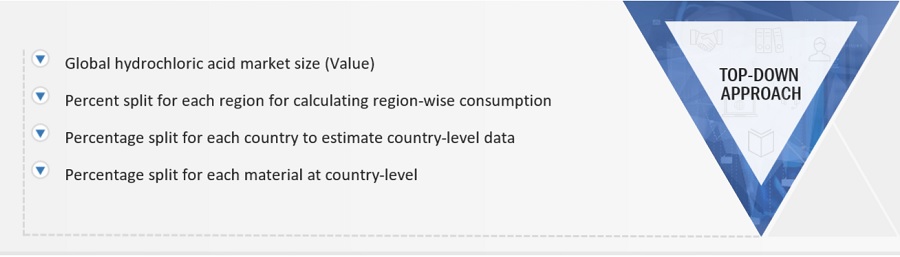
Data Triangulation
After arriving at the overall market size from the estimation process explained above, the total market was split into several segments and sub-segments. The data triangulation and market breakdown procedures were employed, wherever applicable, to complete the overall market engineering process and arrive at the exact statistics for all the segments and sub-segments of the hydrochloric acid market. The data was triangulated by studying various factors and trends from both the demand- and supply-side.
In addition, the market size was validated by using both the top-down and bottom-up approaches. Then, it was verified through primary interviews. Hence, for every data segment, there are three sources—top-down approach, bottom-up approach, and expert interviews. The data were assumed to be correct when the values arrived at from the three sources matched.
Market Definition
Hydrochloric acid (or muriatic acid) is a water-based solution of hydrogen chloride gas. This strong acid is highly corrosive and must be handled with appropriate safety precautions. Formed when hydrogen chloride gas dissolves in water, hydrochloric acid is essentially an odorless and colorless solution. Each molecule consists of a one-to-one ratio of hydrogen and chlorine. It is highly corrosive and can be toxic. Hydrochloric acid is a major component of gastric acid and is commonly used in chemical research laboratories and manufacturing plants. Its applications include the large-scale production of compounds such as vinyl chloride for polyvinyl chloride, removal of rust and scale from metals, petroleum production, and ore processing. On a smaller scale, it is used in the production of gelatin and other food ingredients, as well as in leather processing.
Key Stakeholders
- Hydrochloric acid producing companies
- Raw material suppliers and producers
- Regulatory bodies
- End-use industries of hydrochloric acid
- Associations and industrial bodies
- Local governments
- Market research and consulting firms
Report Objectives
- To define, analyze, and project the size of the hydrochloric acid market in terms of value based on grade, end-use industry, application and region.
- To project the size of the market and its segments with respect to the five main regions, namely, North America, Europe, Asia Pacific, Middle East & Africa, and South America
- To provide detailed information about the key factors, such as drivers, restraints, opportunities, and challenges, influencing the growth of the market
- To analyze the opportunities in the market for stakeholders and provide a detailed competitive landscape of the market leaders.
- To analyze the competitive developments, such as new product launches, expansions, and acquisitions, in the hydrochloric acid market
- To strategically profile the key players operating in the market and comprehensively analyze their market shares and core competencies.
Available Customizations
Along with the given market data, MarketsandMarkets offers customizations as per the specific needs of the companies. The following customization options are available for the report:
Product Analysis:
- Product Matrix which gives a detailed comparison of the product portfolio of each company
Regional Analysis:
- Further breakdown of the Rest of Asia Pacific market
- Further breakdown of Rest of Europe market
Company Information:
- Detailed analysis and profiling of additional market players (up to 5)
Get the Full Hydrochloric Acid Market Report
Full forecast, segment splits, and company analysis for all Hydrochloric Acid Market.
- China Hydrochloric Acid Market
- India Hydrochloric Acid Market
- Japan Hydrochloric Acid Market
- South Korea Hydrochloric Acid Market
- Germany Hydrochloric Acid Market
- France Hydrochloric Acid Market
- Italy Hydrochloric Acid Market
- UK Hydrochloric Acid Market
- South Africa Hydrochloric Acid Market
- Iran Hydrochloric Acid Market
- Canada Hydrochloric Acid Market
- Mexico Hydrochloric Acid Market
- US Hydrochloric Acid Market
- Brazil Hydrochloric Acid Market
- Argentina Hydrochloric Acid Market
- Rest Of Europe Hydrochloric Acid Market
- Rest Of Asia Pacific Hydrochloric Acid Market
- GCC Countries Hydrochloric Acid Market
- Morocco Hydrochloric Acid Market
- -Rest Of GCC Countries Hydrochloric Acid Market
- Rest Of South America Hydrochloric Acid Market
Need a Tailored Report?
Customize this report to your needs
Get 10% FREE Customization
Customize This Report
