
Netherlands Hydrogen Fueling Station Market (2025-2030)

The Netherlands Hydrogen Fueling Station Market was valued at $14.7 Million in 2025 and projected to reach to $62.1 Million by 2030, representing a compound annual growth rate of 15.5%. The Netherlands hydrogen fueling station market is poised for accelerated growth driven by the country's ambitious clean energy targets and strategic positioning within Europe's hydrogen economy.


| Market Size in | USD 26.32 MN |
| Market Forecast in | |
| CAGR | |
| Forecast Period | |
| Units Considered | Value (USD MN) |
Netherlands Hydrogen Fueling Station Market Trends and Insights
- Valued at USD 14.7 million in 2025, the Netherlands market is expected to expand significantly to USD 62.1 million by 2030, representing a compound annual growth rate (CAGR) of 15.5%.
- This robust expansion reflects the Netherlands' strategic commitment to hydrogen infrastructure development and its role as a European leader in sustainable mobility solutions. The Netherlands' hydrogen fueling station market growth is driven by supportive government policies, substantial investment in hydrogen production capacity, and increasing adoption of fuel cell vehicles across commercial and public transport sectors.
- By 2030, the Netherlands is anticipated to establish itself as a key hydrogen hub in Europe, with expanded fueling infrastructure supporting both domestic demand and regional connectivity.
- The country's geographic position and existing energy infrastructure provide competitive advantages for hydrogen station deployment and operational efficiency..
Key Market Statistics
- CAGR (2025-2030) 15.5% CAGR
- Market Size, 2025 ~USD 14.7 Million
- Forecast, 2030 ~USD 62.1 Million
- Country Netherlands
Netherlands Hydrogen Fueling Station Market Overview
Market Valuation & Growth :
The Netherlands hydrogen fueling station market is valued at USD 14.7 million in 2025 and is projected to reach USD 62.1 million by 2030, demonstrating a strong CAGR of 15.5%, significantly outpacing the global average of 10.6%.
Government Support & Policy :
The Dutch government's commitment to hydrogen infrastructure development through the National Hydrogen Strategy and EU Green Deal alignment is driving substantial investments in fueling station networks across the country.
Strategic Geographic Position :
The Netherlands' role as a European logistics hub and its proximity to major industrial centers positions it as a key hydrogen distribution corridor, accelerating fueling station deployment and adoption.
Industrial & Transport Adoption :
Growing adoption of hydrogen fuel cell vehicles in commercial transport and industrial applications, coupled with major OEM partnerships, is creating sustained demand for expanded fueling infrastructure across Dutch regions.
Netherlands Hydrogen Fueling Station Market Dynamics
- Government initiatives, including subsidies for hydrogen infrastructure and fleet conversion programs, are catalyzing private sector investments.
- The market will benefit from increasing adoption of fuel cell vehicles in logistics and public transport sectors, supported by major European hydrogen corridors passing through the Netherlands. By 2030, the market expansion to USD 62.1 million reflects growing collaboration between energy companies, automotive manufacturers, and government bodies.
- Infrastructure development will concentrate in major urban centers and industrial zones, with emerging opportunities in green hydrogen production facilities.
- The Netherlands' commitment to carbon neutrality and hydrogen as a key energy vector positions it as a leading European market for fueling station innovation and deployment..
Market Ecosystem
Related Ecosystem
Decarbonization
- Battery Electric Vehicle (BEV)
- Energy Management Systems
- Fuel Cell
- Fuel Cell Electric Vehicle (FCEV)
- Geographical Information System (GIS)
- TotalEnergies SE
- Siemens ag
- Mitsui & Co., Ltd.
- General Electric Company
- Thyssenkrupp ag
Key Takeaways
- The Netherlands hydrogen fueling station market will grow from USD 14.7 million in 2025 to USD 62.1 million by 2030, at a 15.5% CAGR.
- The Netherlands is emerging as a European hydrogen infrastructure leader, supported by government incentives and industrial investment.
- Commercial transport and public mobility sectors in the Netherlands are primary drivers of hydrogen fueling station demand.
- The Netherlands' strategic location and existing energy networks position it as a regional hydrogen distribution hub by 2030.
Hydrogen Fueling Station Market Report Scope
| Report Metric | Details |
|---|---|
| Base Year | 2025 |
| Fastest Growing Segment | EPC (Solution) |
| Forecast Period | 2025-2030 |
| Growth Rate | CAGR of 10.6% from 2025 to 2030 |
| Largest Segment | COMPONENTS (Solution) |
| Market Size Base Year (Billions) | ~USD 1.01 (2025) |
| Revenue Forecast (Billions) | ~USD 1.67 (2030) |
| Segments Covered | Solution, Type, Pressure, Station Size, Station Type, Supply Type |
Netherlands Hydrogen Fueling Station Market Report Segmentation
6 segment dimensions are covered across the global market.
By Solution
- Components
- Epc
By Type
- Commissioning
- Compressors
- Construction
- Dispensers
- Dispensing Chiller Systems
- Hydraulic Power Units & Controls
- Hydraulic Power Units And Controls
- Hydrogen Inlets
- Other Components
- Permitting
- Project Management & General Overhead
- Site Engineering & Design
- Storage Units
By Pressure
- High
- Low
By Station Size
- Large-Sized
- Mid-Sized
- Small-Sized
By Station Type
- Fixed
- Fixed Hydrogen Stations
- Mobile
- Mobile Hydrogen Stations
By Supply Type
- Off-Site
- On-Site
Target Audience
- Energy & Utility Companies : Dutch and European energy providers need market intelligence to develop hydrogen fueling station networks, optimize infrastructure investments, and capitalize on the 15.5% CAGR growth opportunity.
- Automotive & Fleet Operators : Commercial transport and fleet operators require detailed market data to plan hydrogen vehicle adoption strategies and identify fueling infrastructure availability across the Netherlands.
- Government & Policy Makers : Dutch government agencies and policymakers need comprehensive market analysis to design effective hydrogen infrastructure policies, allocate subsidies, and track progress toward clean energy targets.
- Infrastructure & Engineering Firms : Engineering and construction companies need market forecasts and regional deployment data to bid on hydrogen fueling station projects and plan resource allocation in the Netherlands.
- Investment & Financial Institutions : Investors and financial firms require detailed market sizing and growth projections for the Netherlands to evaluate hydrogen infrastructure investment opportunities and portfolio allocation decisions.
Reasons to Buy this Report
- Market-Specific Growth Projections : Access detailed forecasts showing the Netherlands market expanding from USD 14.7M to USD 62.1M by 2030, with country-specific CAGR of 15.5% to inform strategic planning and investment decisions.
- Competitive Landscape Analysis : Understand key players, market share distribution, and competitive positioning specific to the Dutch hydrogen fueling station sector, enabling informed market entry and partnership strategies.
- Regulatory & Policy Framework : Gain insights into Dutch government policies, subsidies, and regulatory requirements driving hydrogen infrastructure development, essential for compliance and opportunity identification.
- Regional Deployment Opportunities : Identify high-potential regions within the Netherlands for fueling station development, including urban centers, industrial zones, and logistics hubs with detailed demand analysis.
- Investment & Partnership Insights : Discover funding sources, government incentives, and strategic partnership opportunities specific to the Dutch market to accelerate project development and market penetration.
Frequently asked questions
What is the current size of the hydrogen fueling station market in the Netherlands?
The Netherlands hydrogen fueling station market was valued at USD 14.7 million in 2025 and is projected to reach USD 62.1 million by 2030.
What is the expected growth rate for the Netherlands hydrogen fueling station market?
The Netherlands hydrogen fueling station market is expected to grow at a compound annual growth rate (CAGR) of 15.5% from 2025 to 2030.
Which sectors are driving hydrogen fueling station adoption in the Netherlands?
Commercial transport, public transit, and heavy-duty logistics are the primary sectors driving hydrogen fueling station demand in the Netherlands.
Why is the Netherlands a strategic location for hydrogen infrastructure development?
The Netherlands benefits from existing energy infrastructure, supportive government policies, industrial hydrogen production capacity, and a central European location facilitating regional hydrogen distribution.
What role will the Netherlands play in Europe's hydrogen economy by 2030?
By 2030, the Netherlands is expected to function as a key hydrogen hub in Europe, supporting both domestic fuel cell vehicle adoption and cross-border hydrogen supply chains.
RESEARCH METHODOLOGY
The study involved major activities in estimating the current size of the hydrogen fueling station market. Exhaustive secondary research was done to collect information on the peer and parent markets. The next step was to validate these findings, assumptions, and sizing with industry experts across the value chain through primary research. The top-down and bottom-up approaches were employed to estimate the total market size. Thereafter, market breakdown and data triangulation techniques were used to estimate the market size of the segments and subsegments.
Secondary Research
This research study involved the use of extensive secondary sources, directories, and databases, such as Hoover’s, Bloomberg, Factiva, IRENA, International Energy Agency, and Statista Industry Journal, to collect and identify valuable information for a technical, market-oriented, and commercial study of the hydrogen fueling station. Other secondary sources included annual reports, press releases, and investor presentations of companies; white papers; certified publications; and articles by recognized authors, manufacturer associations, trade directories, and databases.
Primary Research
In the primary research process, various primary sources from the supply and demand sides were interviewed to obtain qualitative and quantitative information for this report. Primary sources from the supply side include industry experts such as chief executive officers (CEOs), vice presidents (VPs), marketing directors, and related key executives from various companies and organizations operating in the hydrogen fueling station market.
In the complete market engineering process, the top-down and bottom-up approaches, along with several data triangulation methods, were extensively used to perform the market size estimations and forecasts for all segments and subsegments listed in this report. Extensive qualitative and quantitative analyses were conducted to complete the market engineering process and list key information/insights throughout the report.
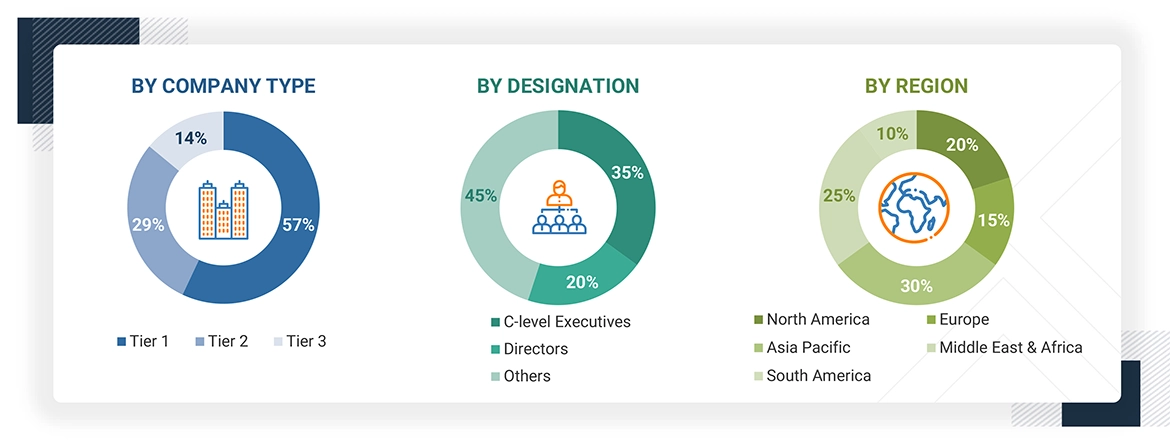
Note: The tiers of the companies are defined based on their total revenues as of 2024. Tier 1: > USD
1 billion, Tier 2: From USD 500 million to USD 1 billion, and Tier 3: < USD 500 million. Others include sales managers,
engineers, and regional managers.
To know about the assumptions considered for the study, download the pdf brochure
Market Size Estimation
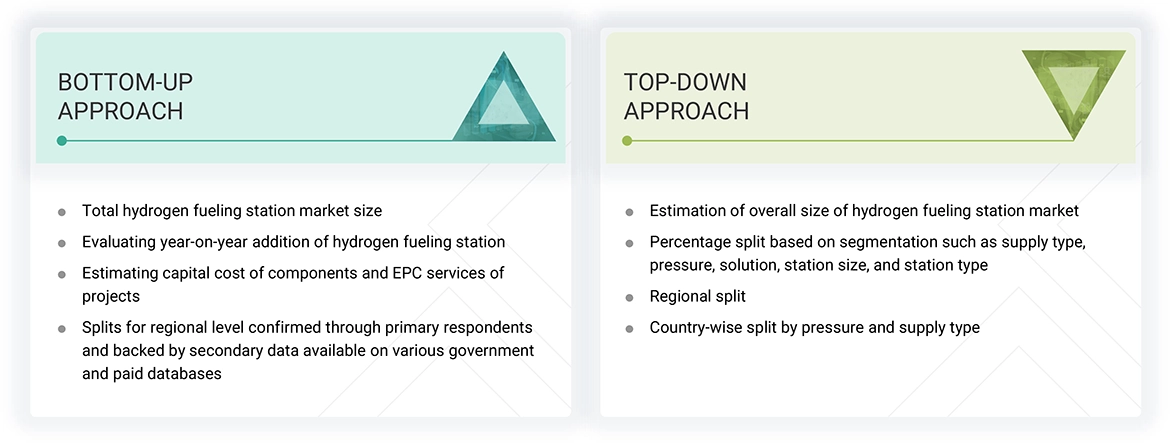
The top-down and bottom-up approaches were used to estimate and validate the total size of the hydrogen fueling station market. These methods were also used extensively to estimate the size of various subsegments of the market. The research methodology used to estimate the market size includes the following.
Hydrogen Fueling Station Market : Top-Down and Bottom-Up Approach
Data Triangulation
The total market was split into several segments and subsegments after arriving at the overall market size from the above estimation process. Data triangulation and market breakdown processes were employed to complete the overall market engineering process and arrive at the exact statistics for all the segments and subsegments, wherever applicable. The data was triangulated by studying various factors and trends from the demand and supply sides. In addition, the market size was validated using both the top-down and bottom-up approaches.
Market Definition
A hydrogen fueling station typically consists of a cooling system, a dispenser, and a nozzle. The storage tank may be elevated or buried. Compressors are used to decrease the volume of gaseous hydrogen as the hydrogen refueling process needs high pressure. It is intended to deliver highly pressurized hydrogen to the nozzle so that the car can be refueled with up to 700 bar or 300 bar. Hydrogen warms up as it spreads. Before it approaches the nozzle, the chiller brings the temperature of the hydrogen down to about -40º Celsius.
The hydrogen fueling station market comprises revenues of companies that offer engineering, procurement, and construction services for the hydrogen refueling station. The hydrogen fueling station market has been studied for five key regions: North America, Europe, the Middle East & Africa, South America, and Asia Pacific.
Stakeholders
- Hydrogen storage tanks and transportation dealers and suppliers
- Manufacturers of fuel cell electric vehicles
- Government and research organizations
- Operators and owners of hydrogen fueling stations
- Power and energy associations
- State and national regulatory authorities
- Research and consulting companies in the clean energy generation sector
- Organizations, forums, alliances, and associations
- Industrial authorities and associations
Report Objectives
- To define, describe, segment, and forecast the hydrogen fueling station market size, by station size, supply type, pressure, station type, and solution, in terms of value
- To forecast the market size across five key regions, namely, North America, Europe, Asia Pacific, the Middle East & Africa, and South America, along with the country-level market sizes, in terms of value and volume
- To provide detailed information about the key drivers, restraints, opportunities, and industry-specific challenges influencing the growth of the hydrogen fueling station market
- To strategically analyze the hydrogen fueling station market with respect to individual growth trends, prospects, and contributions of each segment to the market
- To provide information pertaining to the supply chain, trends/disruptions impacting customer business, ecosystem/market map, pricing of hydrogen fueling stations, and regulatory landscape pertaining to the hydrogen fueling station market
- To strategically analyze the micromarkets1 with respect to individual growth trends, upcoming expansions, and their contributions to the overall market
- To analyze opportunities for stakeholders in the hydrogen fueling station market and draw a competitive landscape for market players
- To benchmark players within the market using the company evaluation matrix, which analyzes market players on various parameters within the broad categories of business and product strategies
- To compare key market players with respect to the market share, product specifications, and applications
- To strategically profile key players and comprehensively analyze their market ranking and core competencies2
- To track and analyze competitive developments in the hydrogen fueling station market, such as contracts, agreements, investments, expansions, product launches, alliances, mergers, partnerships, joint ventures, collaborations, and acquisitions
Available Customizations
MarketsandMarkets offers customizations according to the specific needs of the companies using the given market data.
The following customization options are available for the report:
Product Analysis
- Product matrix, which gives a detailed comparison of the product portfolio of each company
Geographic Analysis as per Feasibility
- Further breakdown of the hydrogen fueling station market by country
Company Information
- Detailed analysis and profiling of additional market players (up to five)
Get the Full Hydrogen Fueling Station Market Report
Full forecast, segment splits, and company analysis for all Hydrogen Fueling Station Market.
- Switzerland Hydrogen Fueling Station Market
- UK Hydrogen Fueling Station Market
- Canada Hydrogen Fueling Station Market
- UAE Hydrogen Fueling Station Market
- Saudi Arabia Hydrogen Fueling Station Market
- Brazil Hydrogen Fueling Station Market
- US Hydrogen Fueling Station Market
- Rest Of Europe Hydrogen Fueling Station Market
- Rest Of Asia Pacific Hydrogen Fueling Station Market
- GCC Hydrogen Fueling Station Market
- Rest Of Middle East Hydrogen Fueling Station Market
- Rest Of South America Hydrogen Fueling Station Market
- China Hydrogen Fueling Station Market
- Japan Hydrogen Fueling Station Market
- South Korea Hydrogen Fueling Station Market
- New Zealand Hydrogen Fueling Station Market
- Australia Hydrogen Fueling Station Market
- Germany Hydrogen Fueling Station Market
- France Hydrogen Fueling Station Market
Need a Tailored Report?
Customize this report to your needs
Get 10% FREE Customization
Customize This Report
