
Mexico ICE & BEV Seatbelt Material Market (2025-2030)

The Mexico ICE & BEV Seatbelt Material Market was valued at $29155.2 Million in 2025 and projected to reach to $33115.9 Million by 2030, representing a compound annual growth rate of 1.8%. Mexico's ICE & BEV seatbelt material market is positioned as a stable, mature segment within the country's robust automotive manufacturing ecosystem.


| Market Size in | USD 26.32 MN |
| Market Forecast in | |
| CAGR | |
| Forecast Period | |
| Units Considered | Value (USD MN) |
Mexico ICE & BEV Seatbelt Material Market Trends and Insights
- This modest expansion reflects Mexico's established automotive manufacturing base and steady demand for both internal combustion engine and battery electric vehicle safety components.
- Mexico remains a critical hub for North American vehicle production, with seatbelt material demand driven by domestic assembly operations and export-oriented manufacturing. The growth trajectory in Mexico is characterized by gradual market maturation rather than rapid acceleration.
- Mexico's automotive sector continues to balance traditional ICE vehicle production with emerging BEV adoption, creating stable but incremental demand for seatbelt materials across both powertrains.
- Supply chain integration with regional OEMs and Tier-1 suppliers supports consistent material consumption throughout the forecast period. Mexico's market positioning within the Americas reflects its role as a manufacturing and export center, where seatbelt material specifications align with North American safety standards and OEM requirements.
- The 1.8% CAGR through 2030 underscores a market in steady consolidation rather than disruption, with established players maintaining competitive advantage through localized production and supply chain efficiency..
Key Market Statistics
- CAGR (2025-2030) 1.8% CAGR
- Market Size, 2025 ~USD 29155.2 Million
- Forecast, 2030 ~USD 33115.9 Million
- Country Mexico
Mexico ICE & BEV Seatbelt Material Market Overview
Established Manufacturing Hub :
Mexico's automotive sector is a critical global manufacturing center, producing over 4 million vehicles annually. This established infrastructure drives consistent demand for seatbelt materials across both ICE and emerging BEV platforms.
Modest Growth Trajectory :
With a CAGR of 1.8% from 2025 to 2030, Mexico's market reflects steady but conservative expansion, significantly lower than the global 14.5% CAGR, indicating a mature market with stable demand patterns.
Dual Powertrain Transition :
Mexico's seatbelt material market serves both traditional ICE vehicles and the growing BEV segment. This dual-market approach provides stability as the country gradually transitions toward electrification.
Market Valuation Growth :
The market is valued at USD 29,155.2 million in 2025 and is projected to grow to USD 33,115.9 million by 2030, representing approximately USD 3.96 billion in incremental value over the five-year period.
Mexico ICE & BEV Seatbelt Material Market Dynamics
- While growth remains modest at 1.8% CAGR compared to global benchmarks, the market benefits from Mexico's established OEM relationships and production capacity.
- The gradual shift toward BEV adoption will create incremental demand for specialized seatbelt materials designed for electric vehicle safety requirements. Looking ahead, Mexico's market will be shaped by nearshoring trends, supply chain resilience initiatives, and increasing regulatory focus on vehicle safety standards.
- Manufacturers investing in advanced material technologies and BEV-compatible solutions will capture growth opportunities.
- The market's steady expansion reflects Mexico's strategic importance in North American automotive supply chains and its role as a cost-competitive manufacturing destination..
Market Ecosystem
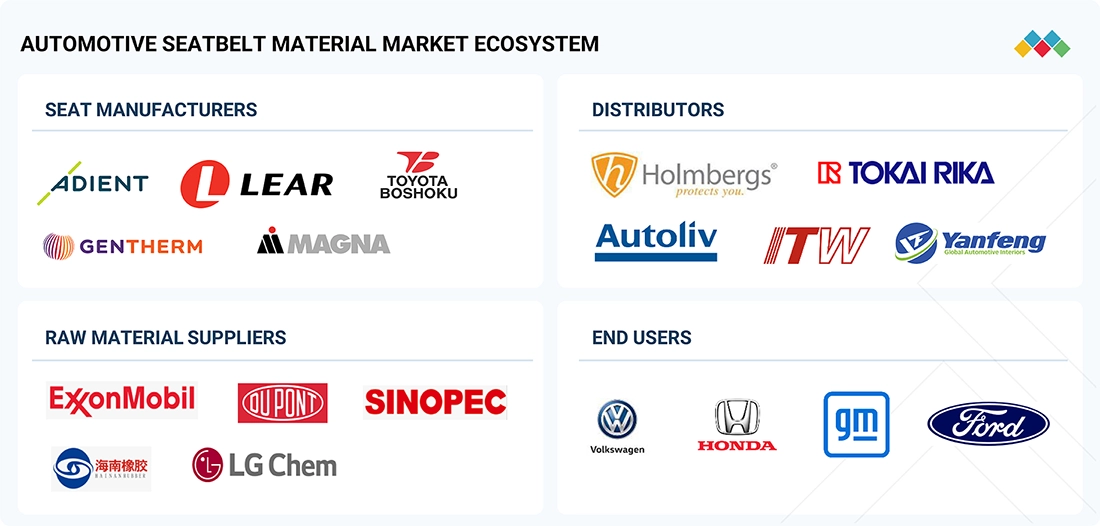
ICE & BEV SEATBELT MATERIAL MARKET SIZE, SHARE & ANALYSIS: COMMERCIAL USE CASES ACROSS INDUSTRIES
| COMPANY | USE CASE DESCRIPTION | BENEFITS |
|---|---|---|
 |
Manufactures advanced seatbelt materials and systems, including retractors, pretensioners, and load limiters for all vehicle types—ICE and EV. Focuses on sustainable production, offering fossil-free steel components and eco-friendly webbing. | Leading global safety supplier with broad OEM partnerships. Delivers high reliability, compliance with stringent safety regulations, and reduced carbon footprint through sustainable innovation. |
 |
Produces seatbelt materials and integrated passive safety systems for passenger and commercial vehicles; offers smart seatbelt technology and sensors. | Strong track record in digitalization and smart safety systems. Enhances occupant protection and enables advanced integration with vehicle electronics. |
 |
Develops seatbelt webs, retractors, and buckle assemblies using high-strength polyester, polypropylene, and nylon. Supplies to both OEMs and aftermarket (offline & online channels). | Wide material portfolio with innovative lightweight engineering for electric vehicles. Delivers durability, adaptability to new crash testing standards, and supply chain resilience. |
 |
Specializes in seatbelt material development and weaving for various seating configurations. Partners with global OEMs for custom component integration. | Provides tailored solutions for diverse vehicle models and local regulatory compliance, focusing on high-tensile strength and comfort. |
Logos and trademarks shown above are the property of their respective owners. Their use here is for informational and illustrative purposes only.
Related Ecosystem
Key Takeaways
- Mexico's seatbelt material market grows at 1.8% CAGR from 2025 to 2030, reaching USD 33.1 billion by forecast year.
- Mexico's automotive manufacturing dominance supports stable, incremental demand across both ICE and BEV platforms.
- North American supply chain integration and OEM localization drive consistent material consumption in Mexico.
- Mexico's market maturity reflects established production infrastructure with limited disruption from powertrain transition.
ICE & BEV Seatbelt Material Market Report Scope
| Report Metric | Details |
|---|---|
| Base Year | 2025 |
| Fastest Growing Segment | HEAVY COMMERCIAL VEHICLE (Vehicle Type) |
| Forecast Period | 2025–2030 |
| Growth Rate | CAGR of 14.5% from 2025 to 2030 |
| Largest Segment | PASSENGER CAR (Vehicle Type) |
| Market Size Base Year (Billions) | ~USD 0 (2025) |
| Segments Covered | Vehicle Type, Material, Component |
Mexico ICE & BEV Seatbelt Material Market Report Segmentation
3 segment dimensions are covered across the global market.
By Vehicle Type
- Heavy Commercial Vehicle
- Light Commercial Vehicle
- Passenger Car
By Material
- Nylon
- Polycarbonate
- Steel/Aluminum
By Component
- Anchor
- Buckle
- Retractor
Target Audience
- Automotive OEMs & Tier-1 Suppliers : Mexican and international manufacturers need market-specific data to optimize seatbelt material sourcing, negotiate supplier contracts, and align production capacity with projected demand through 2030.
- Material & Textile Manufacturers : Suppliers of seatbelt fabrics, webbing, and advanced materials require Mexico-focused insights to identify growth opportunities, develop BEV-compatible products, and expand market share in this established manufacturing hub.
- Investment & Private Equity Firms : Investors evaluating automotive supply chain opportunities in Mexico need precise market valuations and growth projections to assess portfolio companies, identify acquisition targets, and evaluate sector stability.
- Market Research & Consulting Firms : Research organizations serving automotive clients require granular Mexico market data to support client advisory work, competitive benchmarking, and strategic planning initiatives across North America.
- Government & Trade Organizations : Mexican economic development agencies and trade bodies need market intelligence to support industry promotion, policy development, and strategic initiatives aimed at strengthening the automotive sector.
Key Companies in the Mexico ICE & BEV Seatbelt Material Market
| Company | HQ | Ownership | Strongest segments |
|---|---|---|---|
| AUTOLIV | Sweden | Public Company | Retractor components (all materials, all vehicle types),Buckle components (all materials, all vehicle types),Anchor and mounting hardware, |
| JOYSON SAFETY SYSTEMS | United States | Private Company | Retractor – Steel/Aluminum intensive,Buckle & Anchor – Steel/Aluminum,Components with Polycarbonate structures, |
| ZF FRIEDRICHSHAFEN AG | Germany | Private Company | Retractor components and materials,Buckle assemblies and materials,Anchors and mounting hardware, |
| TOKAIRIKA, CO, LTD. | Japan | Public Company | Retractors,Buckles,Anchors and Hardware, |
| FAR EUROPE INC. | Retractor components (steel/aluminum dominant),Buckle components (steel/aluminum and polycarbonate),Anchors and mounting hardware (steel/aluminum), | ||
| ASHIMORI INDUSTRY CO., LTD. | Japan | Private Company | Retractor components (steel/aluminum structure, nylon webbing integration),Buckle and anchor hardware (steel/aluminum, polycarbonate housings),Webbing and other nylon-intensive elements (separation nets, tapes, belts), |
| SAMSONG INDUSTRIES, LTD | South Korea | Private Company | Retractor components (steel/aluminum and polycarbonate content),Buckle and anchor hardware (steel/aluminum),Nylon webbing and textile elements, |
| BEIJING SHIJIN AUTOMOTIVE COMPONENTS CO., LTD. | China | Retractor – Steel/Aluminum,Buckle – Steel/Aluminum,Anchor & Others – Steel/Aluminum, |
AUTOLIV
Autoliv is a Swedish public company founded in 1953 that employs 56,515 people. The company operates as a major player in the automotive safety industry.
JOYSON SAFETY SYSTEMS
Joyson Safety Systems is a private company based in the United States, founded in 1986 with 16,300 employees. The company operates in the automotive safety sector.
ZF FRIEDRICHSHAFEN AG
ZF Friedrichshafen AG is a German private company established in 1915 with 145,909 employees. The company is a major automotive supplier and technology provider.
TOKAIRIKA, CO, LTD.
Tokai Rika Co., Ltd. is a Japanese public company founded in 1948 with 19,381 employees. The company operates in the automotive components and safety systems industry.
FAR EUROPE INC.
Insufficient data provided for company description.
ASHIMORI INDUSTRY CO., LTD.
Ashimori Industry Co., Ltd. is a Japanese private company founded in 1878 with 2,358 employees. The company operates in the automotive safety and components industry.
SAMSONG INDUSTRIES, LTD
Samsong Industries, Ltd. is a South Korean private company founded in 1978 with 138 employees. The company operates in the automotive components sector.
BEIJING SHIJIN AUTOMOTIVE COMPONENTS CO., LTD.
Insufficient data provided for company description.
Reasons to Buy this Report
- Strategic Market Sizing : Obtain precise valuation data for Mexico's seatbelt material market (USD 29.2B in 2025), enabling accurate financial forecasting and investment allocation decisions specific to this critical manufacturing region.
- Competitive Positioning Intelligence : Understand Mexico's market dynamics relative to global trends (1.8% vs. 14.5% CAGR), identifying competitive advantages and market gaps for suppliers targeting Mexican OEMs and Tier-1 manufacturers.
- ICE-to-BEV Transition Roadmap : Gain insights into how Mexico's dual-powertrain market is evolving, helping suppliers develop product strategies that address both traditional and electric vehicle seatbelt material requirements.
- Supply Chain Optimization : Leverage Mexico-specific market data to optimize sourcing strategies, identify manufacturing opportunities, and strengthen partnerships within North America's automotive supply chain ecosystem.
- Five-Year Growth Projections : Access detailed forecasts through 2030 (USD 33.1B target), enabling long-term capacity planning, R&D investment decisions, and market entry strategies tailored to Mexico's automotive sector.
Frequently asked questions
What is the estimated market size of seatbelt materials in Mexico in 2025?
Mexico's ICE & BEV seatbelt material market is estimated at USD 29,155.2 million in 2025.
What is the projected market size for Mexico's seatbelt material market by 2030?
Mexico's seatbelt material market is forecast to reach USD 33,115.9 million by 2030.
What is the CAGR for Mexico's seatbelt material market from 2025 to 2030?
Mexico's seatbelt material market is projected to grow at a compound annual growth rate of 1.8% between 2025 and 2030.
Why is Mexico's seatbelt material market growth relatively modest compared to global trends?
Mexico's 1.8% CAGR reflects market maturity, established manufacturing infrastructure, and gradual rather than disruptive powertrain transition in the region.
How does Mexico's automotive sector influence seatbelt material demand?
Mexico's role as a major North American manufacturing and export hub drives consistent seatbelt material demand from OEM assembly operations and Tier-1 supplier integration.
RESEARCH METHODOLOGY
Various secondary sources, directories, and databases have been used to identify and collect information for an extensive seatbelt material market study. The study involved four main activities in estimating the current size of the seatbelt materials market: secondary research, validation through primary research, assumptions, and market analysis. Exhaustive secondary research was carried out to collect information on the market, such as different seatbelts offered in each row of vehicle body types, seatbelt material types, and upcoming technologies and trends. The next step was to validate these findings, assumptions, and market analysis with industry experts across the value chain through primary research. The top-down approach was employed to estimate the complete market size for different segments considered in this study.
Secondary Research
In the secondary research process, various secondary sources were used to identify and collect helpful information for an extensive commercial study of the seatbelt materials market. Secondary sources included company annual reports/presentations, press releases, industry association publications [such as publications on AMIA - The Mexican Association of the Automotive Industry Automotive Component Manufacturers Association of India (ACMA), Canadian Automobile Association (CAA), China Association of Automobile Manufacturers (CAAM), Databases such as Factiva and Bloomberg, European Automobile Manufacturers' Association (EAMA), Environmental Protection Agency (EPA), International Council on Clean Transportation (ICCT), International Organization of Motor Vehicle Manufacturers (OICA), Investor Presentations and Annual Reports of Key Market Players, Japan Automobile Manufacturers Association (JAMA), Korea Automobile Manufacturers Association (KAMA), National Association of Automobile Manufacturers of South Africa (NAAMSA), other component manufacturer associations, Society of Indian Automobile Manufacturers (SIAM), Corporate Filings (such as annual reports, investor presentations, and financial statements), trade, business, and related associations, International Organization for Standardization, automotive seatbelt manufacturers blogs/articles/magazines, key secondary sources to estimate the seatbelt material market size),seatbelt materials-related magazine articles, directories, technical handbooks, World Economic Outlook, trade websites, and technical articles. Additionally, secondary research and model mapping were carried out to understand the average volume of seatbelt materials, which come with different seatbelt components, and the historical sales of seatbelt components.
Primary Research
In the primary research process, various primary sources from both the supply and demand sides were interviewed to obtain qualitative and quantitative information on the market. The primary sources from the supply side included industry experts such as CXOs, vice presidents, directors from business development, marketing, product development/innovation teams, and related key executives from various key companies. Various system integrators, industry associations, independent consultants/industry veterans, and key opinion leaders were also interviewed.
In the primary research process, various sources from both the supply and demand sides were interviewed to obtain qualitative and quantitative information for this report. The primary sources from the supply side included industry experts such as research and development experts, CEOs, CTOs, COOs, vice presidents, marketing directors, technology and innovation directors, and related key executives from different vital companies operating in the seatbelt materials market.
After the complete market engineering, which included calculations for market statistics, market breakdown, market size estimations, market forecasting, and data triangulation, extensive primary research was conducted to gather information and verify and validate the critical numbers arrived at. Primary research has also been undertaken to identify and validate the segmentation, industry trends, key players, competitive landscape, and market dynamics, such as drivers, restraints, opportunities, challenges, and key strategies. Extensive qualitative and quantitative analyses were performed on the complete market engineering process to list key information/insights throughout the report.
After interacting with industry experts, brief sessions were conducted with highly experienced independent consultants to reinforce the findings from primaries. This, along with the opinions of in-house experts, led to the conclusions described in the remainder of this report.
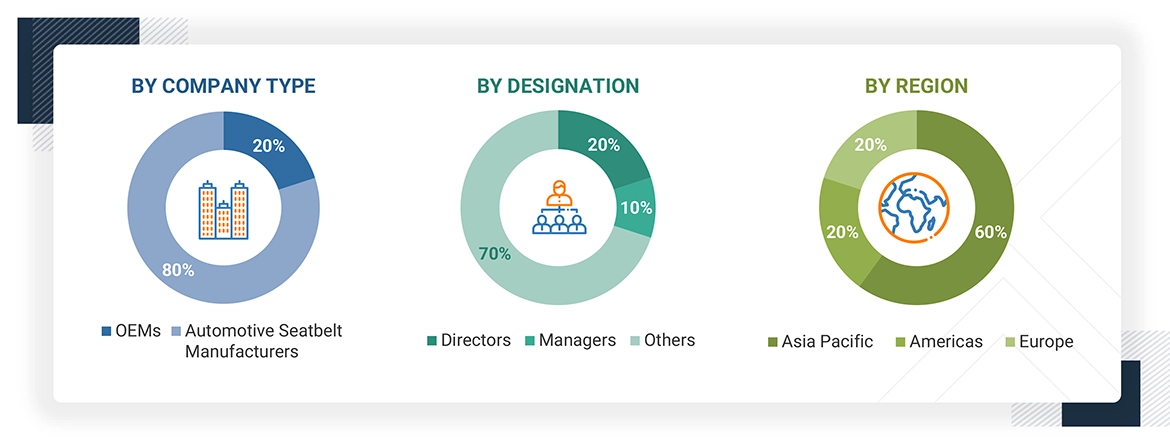
Note 1: Others include sales managers, marketing managers, and product managers.
Note 2: Tier 1 companies’ revenues are more than USD 10 billion; tier 2 companies’ revenues range between USD 1 and 10 billion; and tier 3 companies’ revenues range between USD 500 million and USD 1 billion.
Source: Industry Experts
To know about the assumptions considered for the study, download the pdf brochure
Market Size Estimation
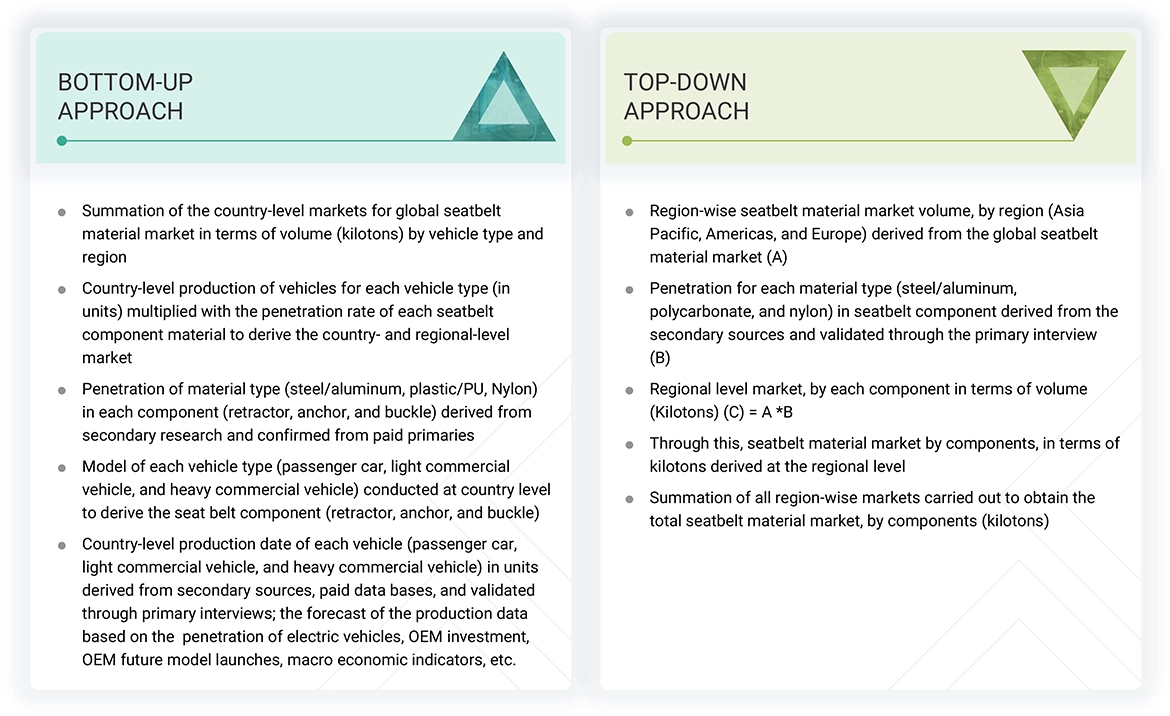
A detailed market estimation approach was followed to estimate and validate the volume side of the Seatbelt materials market and other dependent submarkets, as mentioned below:
- The bottom-up approach was used to estimate and validate the market size in terms of volume for the seatbelt material market.
- Various vehicle bodies (sedan, hatchback, SUV 5-seater, SUV 7-seater, trucks, and buses) were considered with different row arrangements according to body type.
- Accordingly, the model mapping was conducted for all the vehicles that were offered with a two or three-row seating arrangement option at the country level.
- Each vehicle type was then multiplied by each seatbelt component (retractor, buckle, anchor, and pillar loop) to obtain the regional-level market for the seatbelt market.
ICE & BEV Seatbelt Material Market : Top-Down and Bottom-Up Approach
Data Triangulation
After arriving at the overall market size of the global market through the methodology mentioned above, this market was split into several segments and subsegments. The data triangulation and market breakdown procedures were employed, wherever applicable, to complete the overall market engineering process and arrive at the exact data for the market by value for the key segments and subsegments. The extrapolated market data was triangulated by studying various macro indicators and regional trends from both the demand and supply-side participants.
Market Definition
Seatbelts: An automotive seatbelt, also known as a safety belt, is the primary restraint system (PRS) in vehicles designed to secure the driver or passenger and limit their movement during a collision or sudden stop, thereby reducing the risk of serious or fatal injury. Modern seatbelt webbing is typically made from high-tensile polyester with a strength of about 3,000–6,000 lb (1,400–2,700 kg) and is commonly 46 or 48 mm wide. Seatbelts are equipped with features like emergency locking retractors (ELR), pretensioners, and energy management loops to enhance occupant protection during crashes. Research shows that seatbelts can reduce the risk of fatal injuries for drivers by up to 50% and for front-seat passengers by 45%.
Retractor: The retractor is the male portion of the seatbelt where the actual seatbelt webbing material feeds out. The seatbelt retractor is made up of a spring, some gears, a sensor, a pyrotechnic explosive device, and a mechanism that is engineered to also lock up when a crash or accident occurs.
Buckle: A seatbelt buckle is a fastening device, typically metallic, that secures the seatbelt. It is designed to hold the buckle's tongue, which is attached to the seatbelt webbing, and allows for easy fastening and unfastening with minimal force. The buckle's primary function is to restrain occupants during sudden deceleration or collisions, minimizing the risk of injury.
Anchor: A seatbelt anchor, or latch plate, is the mechanism that connects the seatbelt webbing to the buckle, allowing the belt to be secured. It is a vital part of the seatbelt system, ensuring the belt stays fastened during travel and potentially during a collision. All vehicles are required to have a locking seatbelt feature, either at the retractor or the anchor plate, a requirement known as the lockability standard.
Stakeholders
- Automotive OEMs
- Seatbelt Manufacturers
- Tier 1 & Tier 2 Suppliers
- Regulatory Bodies
- Automotive Active Safety Technology Providers
- Aftermarket Suppliers
Report Objectives
- To define, describe, and forecast the seatbelt material market concerning individual growth trends and prospects and determine the contribution of each segment to the total market
- To forecast the market size by volume (kilotons)
- Market (ICE), By Component (Retractor, Buckle, Anchor, and Others)
- Seatbelt Retractor Market (ICE), By Material (Steel/Aluminum, Polycarbonate, and Nylon)
- Seatbelt Buckle Market (ICE), By Material (Steel/Aluminum, Polycarbonate, and Nylon)
- Seatbelt Anchor Market, By Material (Steel/Aluminum and Polycarbonate)
- Market, By Vehicle Type (Passenger Car, Light Commercial Vehicle, Heavy Commercial Vehicle)
- Market (BEV), By Components (Retractors, Buckle, and Anchor)
- Seatbelt Retractor Market (BEV), By Material (Steel/Aluminum, Polycarbonate, and Nylon)
- Seatbelt Buckle Market (BEV), By Material (Steel/Aluminum, Polycarbonate, and Nylon)
- Seatbelt Anchor Market, By Material (Steel/Aluminum and Polycarbonate)
- By Region - Asia Pacific (China, India, Japan, and South Korea), Europe (Germany, UK, France, Spain, and Italy), Americas (US, Canada, Mexico, Argentina, and Brazil)
- To provide detailed information regarding the major factors influencing the growth of the market (drivers, restraints, opportunities, and challenges)
- To understand the market dynamics (drivers, restraints, opportunities, and challenges) and conduct patent analysis, key buying criteria, trade analysis, technology analysis, case study analysis, supply chain analysis, regulatory analysis, key conferences and events, and investment scenario
- To analyze the market share of leading players in the seatbelt material market
- To understand the dynamics of the market players and distinguish them into stars, emerging leaders, pervasive players, and participants according to their product portfolio strength and business strategies
- To strategically analyze markets concerning individual growth trends, prospects, and contributions to the total market
- To analyze recent developments, such as partnerships, supply agreements, joint ventures/mergers and acquisitions, geographic expansions, and product developments of key players in the market
Available Customizations
Seatbelt Materials Market, By Pillar Loop
- Polycarbonate
- Steel/Aluminum
Seatbelt Materials Market, By Latch Plate
- Steel/Aluminum
- Others
Detailed Analysis and Profiling of Additional Market Players (Up to 3)
Get the Full ICE & BEV Seatbelt Material Market Report
Full forecast, segment splits, and company analysis for all ICE & BEV Seatbelt Material Market.
- China ICE & BEV Seatbelt Material Market
- Japan ICE & BEV Seatbelt Material Market
- India ICE & BEV Seatbelt Material Market
- South Korea ICE & BEV Seatbelt Material Market
- Germany ICE & BEV Seatbelt Material Market
- France ICE & BEV Seatbelt Material Market
- UK ICE & BEV Seatbelt Material Market
- Spain ICE & BEV Seatbelt Material Market
- Italy ICE & BEV Seatbelt Material Market
- US ICE & BEV Seatbelt Material Market
- Canada ICE & BEV Seatbelt Material Market
- Brazil ICE & BEV Seatbelt Material Market
- Argentina ICE & BEV Seatbelt Material Market
Need a Tailored Report?
Customize this report to your needs
Get 10% FREE Customization
Customize This Report
