
Middle East In-flight Entertainment & Connectivity Market (2024-2029)

The Middle East In-flight Entertainment & Connectivity Market was valued at $354.7 Million in 2024 and projected to reach to $458.6 Million by 2029, representing a compound annual growth rate of CAGR 5.3%. The Middle East in-flight entertainment and connectivity market is poised for steady expansion, driven by the region's strategic position as a global aviation hub and continuous modernization of airline fleets.


| Market Size in | USD 26.32 MN |
| Market Forecast in | |
| CAGR | |
| Forecast Period | |
| Units Considered | Value (USD MN) |
Middle East In-flight Entertainment & Connectivity Market Trends and Insights
- The Middle East's aviation sector is experiencing steady modernization, driven by major airline expansions and increased passenger traffic across the region's hub airports.
- In the Middle East, airlines are investing in advanced IFE systems and broadband connectivity to enhance passenger experience and maintain competitive advantage in a dynamic market. The Middle East market is characterized by strong demand from premium carriers operating long-haul routes, where in-flight entertainment and connectivity have become essential service differentiators.
- In the Middle East, the adoption of next-generation wireless systems and personalized content delivery is accelerating, supported by rising disposable incomes and business travel growth.
- Between 2024 and 2029, the Middle East will see increased integration of satellite and ground-based connectivity solutions, alongside deployment of AI-driven content recommendation engines tailored to regional preferences..
Key Market Statistics
- CAGR (2024-2029) CAGR 5.3%
- Market Size, 2024 ~USD 354.7 Million
- Forecast, 2029 ~USD 458.6 Million
- Geography Middle East
Middle East In-flight Entertainment & Connectivity Market Overview
Regional Market Valuation :
The Middle East in-flight entertainment and connectivity market is valued at USD 354.7 million in 2024, with projected growth to USD 458.6 million by 2029, demonstrating strong regional demand for advanced passenger experience solutions.
Hub Airport Expansion :
Major aviation hubs in the Middle East are driving market growth through significant infrastructure investments and modernization initiatives, positioning the region as a critical gateway for international air travel and connectivity upgrades.
Airline Fleet Modernization :
Regional carriers are actively upgrading their fleets with next-generation IFE and connectivity systems to enhance competitive positioning and meet rising passenger expectations for premium in-flight experiences across long-haul routes.
Passenger Traffic Growth :
Steady increases in passenger volumes across Middle Eastern airports are creating sustained demand for enhanced entertainment and connectivity solutions, supporting a 5.3% CAGR through 2029.
Middle East In-flight Entertainment & Connectivity Market Dynamics
- Major carriers operating from Dubai, Doha, and Riyadh are investing heavily in premium IFE systems and broadband connectivity to differentiate their offerings and capture market share on competitive long-haul routes.
- The region's growing middle class and increasing business travel demand further support market growth. Looking ahead to 2029, the market will benefit from technological advancements in wireless connectivity, personalized content delivery, and integrated passenger experience platforms.
- Government initiatives supporting aviation infrastructure development and the expansion of low-cost carriers in the region will create additional opportunities for IFE and connectivity providers.
- The 5.3% CAGR reflects a balanced growth trajectory as airlines balance premium service investments with operational efficiency considerations..
Market Ecosystem
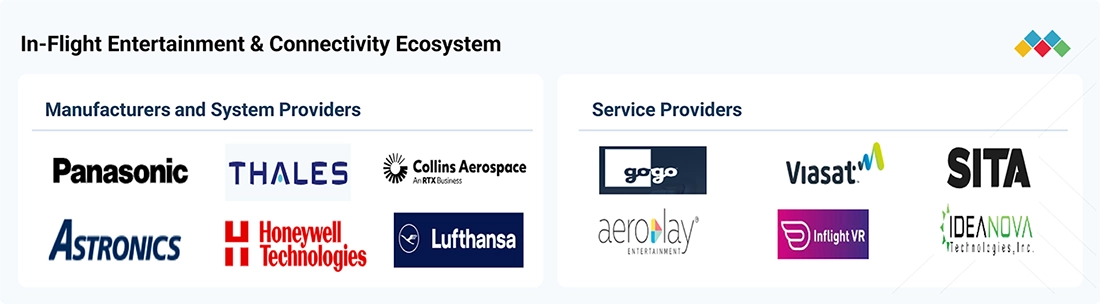
IN-FLIGHT ENTERTAINMENT & CONNECTIVITY MARKET: COMMERCIAL USE CASES ACROSS INDUSTRIES
| COMPANY | USE CASE DESCRIPTION | BENEFITS |
|---|---|---|
 |
Panasonic Avionics provides in-flight entertainment and connectivity solutions that combine seatback entertainment, onboard Wi-Fi, satellite connectivity, and digital passenger services. Its systems support multi-orbit connectivity using 5G, LEO, and GEO networks and allow airlines to manage content, connectivity packages, and onboard services. | Improves passenger connectivity | Supports high-speed onboard internet | Enables flexible content and service management | Supports personalized digital passenger experiences |
 |
Thales provides in-flight entertainment and connectivity systems that combine IFE, high-speed connectivity, content management, and passenger applications. Its FlyEDGE platform uses cloud-hosted architecture and onboard edge computing to support entertainment applications, remote fleet management, and passenger engagement data. | Enables connected passenger experiences | Supports flexible entertainment applications | Improves remote content and system management | Provides passenger engagement information |
 |
Safran developed RAVE In-Flight Entertainment and Connectivity solutions that support seatback and wireless entertainment, personal-device casting, cloud-based content distribution, and onboard edge computing. RAVE Cloud Services enables airlines to distribute content to aircraft through satellite, cellular, Wi-Fi, and other available pathways. | Supports personal-device entertainment | Enables faster content distribution | Reduces dependence on additional onboard hardware | Supports flexible and scalable IFEC services |
Logos and trademarks shown above are the property of their respective owners. Their use here is for informational and illustrative purposes only.
Related Ecosystem
Aviation
- Narrow Body Aircraft
- Wide Body Aircraft
- Military Helicopters
- Special Mission Aircraft
- Fighter Aircraft
- HONEYWELL INTERNATIONAL INC.
- COLLINS AEROSPACE
- Thales group
- Safran group
- HEICO Corporation
Key Takeaways
- The Middle East in-flight entertainment and connectivity market will expand from USD 354.7 million in 2024 to USD 458.6 million by 2029 at a 5.3% CAGR.
- Premium long-haul carriers in the Middle East are driving demand for advanced IFE systems and high-speed broadband connectivity as competitive differentiators.
- The Middle East market is increasingly adopting satellite and ground-based connectivity solutions integrated with AI-powered personalization engines.
- Rising business travel and passenger expectations in the Middle East are accelerating investment in next-generation wireless and content delivery technologies.
In-flight Entertainment & Connectivity Market Report Scope
| Report Metric | Details |
|---|---|
| Base Year | 2024 |
| Fastest Growing Segment | RETAIL (In-Flight Retail And Advertising) |
| Forecast Period | 2024-2029 |
| Growth Rate | CAGR of 6.3% from 2024 to 2029 |
| Largest Segment | IN-FLIGHT ENTERTAINMENT (Offering) |
| Market Size Base Year (Billions) | ~USD 8.62 (2024) |
| Revenue Forecast (Billions) | ~USD 11.7 (2029) |
| Segments Covered | Offering, Type, Product, In-Flight Content, In-Flight Retail And Advertising, Solution, In-Flight Internet, Class, End Use, Platform |
Middle East In-flight Entertainment & Connectivity Market Report Segmentation
10 segment dimensions are covered across the global market.
By Offering
- In-Flight Connectivity
- In-Flight Entertainment
By Type
- In-Flight Content
- In-Flight Internet
- In-Flight Retail And Advertising
- Product
- Solution
By Product
- Non-Portable Devices
- Portable Devices
By In-Flight Content
- Stored
- Streamed
By In-Flight Retail And Advertising
- Advertising
- Retail
By Solution
- Wired
- Wireless
By In-Flight Internet
- Air-To-Ground (Cellular-Based)
- Hybrid-Based
- Satellite-Based
By Class
- Business Class
- Economy Class
- First Class
- Premium Economy Class
By End Use
- Aftermarket
- OEM
By Platform
- Business Jet
- Narrow-Body Aircraft
- Wide-Body Aircraft
Target Audience
- Airline Operators : Middle Eastern and international carriers need this data to benchmark IFE investments, plan fleet upgrades, and understand regional passenger expectations for connectivity and entertainment services.
- IFE & Connectivity Suppliers : Equipment manufacturers and software providers require market intelligence to identify growth opportunities, assess competitive dynamics, and develop region-specific product strategies for Middle Eastern carriers.
- Aviation Investors : Private equity firms and institutional investors evaluating opportunities in Middle Eastern aviation need detailed market data to assess growth potential and identify acquisition targets in the IFE ecosystem.
- Airport Operators : Regional airport authorities planning infrastructure investments and passenger experience enhancements require market insights to align connectivity and entertainment offerings with airline modernization trends.
- Technology Consultants : Management consulting firms advising aviation clients need comprehensive regional market data to develop digital transformation strategies and in-flight experience optimization roadmaps for Middle Eastern operators.
Countries within Middle East - compare and drill down
| Country | 2025 size (native) |
|---|---|
| UAE | USD 54.5 Million |
| Saudi Arabia | USD 117 Million |
| Qatar | USD 114.2 Million |
Country market size visualization
Reasons to Buy this Report
- Market-Specific Growth Insights : Gain detailed understanding of the Middle East's 5.3% CAGR trajectory and identify high-growth opportunities within regional aviation hubs, enabling targeted investment and partnership strategies.
- Country-Level Intelligence : Access granular market data for UAE, Saudi Arabia, and Qatar—the region's leading aviation markets—to benchmark performance and identify emerging opportunities in secondary markets.
- Competitive Positioning : Understand how Middle Eastern carriers are differentiating through IFE and connectivity investments, providing competitive intelligence for suppliers and technology providers entering the region.
- Strategic Expansion Planning : Leverage regional forecasts through 2029 to develop go-to-market strategies, partnership frameworks, and product roadmaps tailored to Middle Eastern airline requirements and passenger preferences.
- Investment Decision Support : Make informed capital allocation decisions with comprehensive market sizing, growth drivers, and regional dynamics specific to Middle Eastern aviation and in-flight service modernization.
Frequently asked questions
What is the current market size of in-flight entertainment and connectivity in the Middle East?
The Middle East in-flight entertainment and connectivity market is valued at USD 354.7 million in 2024.
What is the projected market size for the Middle East by 2029?
The Middle East market is forecast to reach USD 458.6 million by 2029, growing at a 5.3% CAGR.
Which airlines are leading the adoption of advanced IFE systems in the Middle East?
Premium long-haul carriers operating from major Middle East hubs are leading adoption, driven by competitive pressures and passenger expectations for enhanced connectivity and entertainment.
What connectivity technologies are being deployed in the Middle East?
The Middle East is increasingly deploying satellite-based and ground-based broadband systems, often integrated with AI-driven content personalization to serve regional passenger preferences.
What factors are driving growth in the Middle East market?
Growth in the Middle East is driven by rising business travel, increased passenger traffic through regional hubs, airline modernization initiatives, and growing demand for premium passenger experiences.
RESEARCH METHODOLOGY
The study involved four major activities to estimate the current size of the in-flight entertainment and connectivity market. Exhaustive secondary research was conducted to gather information on the in-flight entertainment and connectivity market, its adjacent markets, and its parent market. The next step was to validate these findings, assumptions, and sizing with industry experts across the value chain through primary research. Demand-side analysis was conducted to estimate the overall market size. Thereafter, data triangulation procedures were employed to estimate the sizes of various segments and subsegments within the in-flight entertainment and connectivity market.
Secondary Research
During the secondary research process, various sources were consulted to identify and collect information for this study. The secondary sources included government sources, such as SIPRI; corporate filings, including annual reports, press releases, and investor presentations; white papers, journals, and certified publications; and articles from recognized authors, directories, and databases.
Primary Research
Extensive primary research was conducted after acquiring information on the in-flight entertainment and connectivity market through secondary research. Several primary interviews were conducted with market experts from the demand and supply sides across major countries of North America, Europe, Asia Pacific, the Middle East & Africa, and Latin America. Primary data was collected through questionnaires, emails, and telephonic interviews.
Breakdown of Primary Interviews
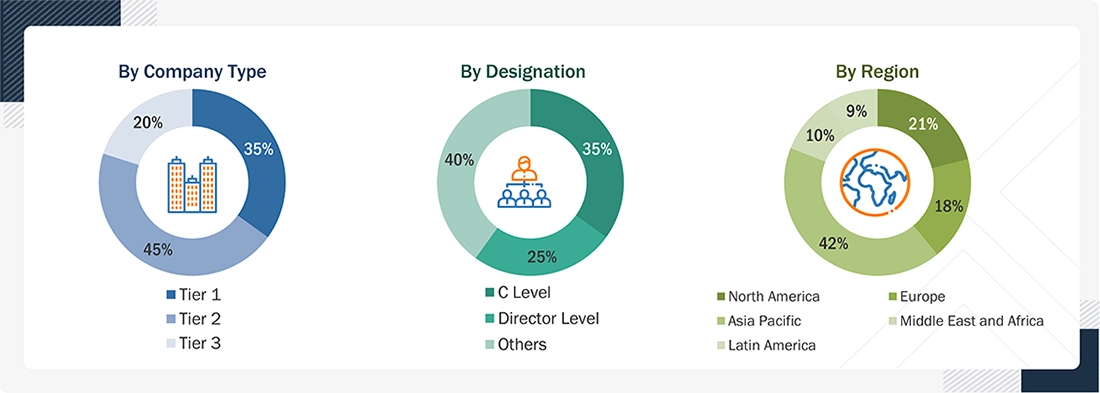
Note: The three tiers of companies are defined based on their total revenue in 2025: Tier 1 - revenue greater than or equal to USD 1 billion; Tier 2 - revenue between USD 100 million and USD 1 billion; and Tier 3 - revenue less than or equal to USD 100 million. Other designations include sales managers, marketing managers, and product managers.
To know about the assumptions considered for the study, download the pdf brochure
Market Size Estimation
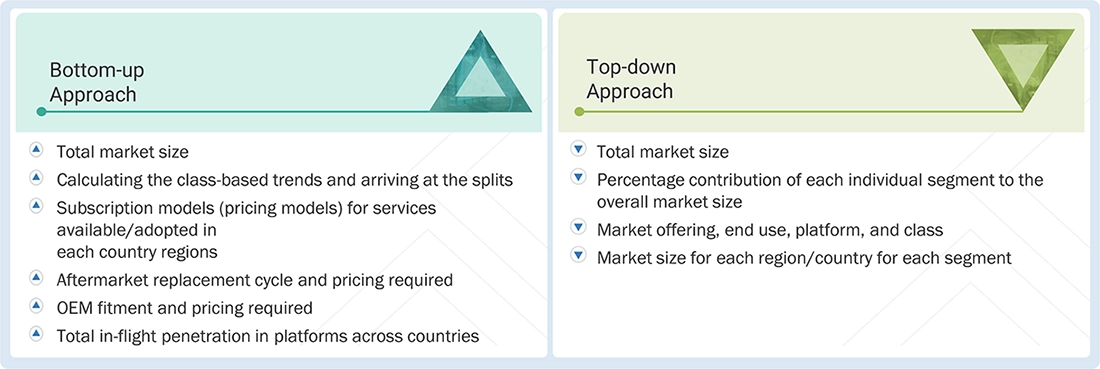
Top-down and bottom-up approaches were used to estimate and validate the size of the in-flight entertainment and connectivity market. The research methodology used to estimate the size of the market included the following details:
- Key players in the in-flight entertainment and connectivity market were identified through secondary research, and their market shares were determined through a combination of primary and secondary research. This included a study of the annual and financial reports of the top market players, as well as extensive interviews with leaders, including directors, engineers, marketing executives, and other key stakeholders of leading companies operating in the market.
- All percentage shares, splits, and breakdowns were determined using secondary sources and verified through primary sources.
- All possible parameters that affect the markets covered in this research study were accounted for, viewed in extensive detail, verified through primary research, and analyzed to obtain the final quantitative and qualitative data on the in-flight entertainment and connectivity market. This data was consolidated, enhanced with detailed input, analyzed by MarketsandMarkets, and presented in this report.
In-flight Entertainment & Connectivity Market : Top-Down and Bottom-Up Approach
Data Triangulation
After determining the overall market size, the total market was classified into several segments and subsegments. The data triangulation and market breakdown procedures explained below were implemented, wherever applicable, to complete the overall market engineering process and arrive at the estimated market numbers for the market segments and subsegments. The data were triangulated by examining various factors and trends on both the demand and supply sides. Additionally, the market size was validated using top-down and bottom-up approaches.
Market Definition
The in-flight entertainment and connectivity (IFEC) market encompasses a range of products and services designed to enhance passenger experiences on commercial flights, including audio and video on demand, live TV, games, moving maps, digital reading materials, and various connectivity options like Wi-Fi and mobile phone services. It involves hardware such as seat-back screens and connectivity equipment, as well as software for content management and user interfaces. Service providers include content suppliers, connectivity providers, and system integrators. Driven by technological advancements and passenger demand for enhanced experiences, the market is seeing trends like personalized content, hybrid systems combining seat-back screens with personal device streaming, and improved connectivity through advancements in satellite and 5G technology.
Key Stakeholders
- Aerostructure Manufacturers
- In-flight Entertainment and Connectivity Solution Developers
- In-flight Entertainment and Connectivity Service Providers
- Subcomponent Suppliers
- Technology Providers
- Airlines
- Government Agencies
- Investors and Financial Community Professionals
- Research Organizations
Report Objectives
- To define, describe, and forecast the in-flight entertainment and connectivity market based on offering, end use, platform, class, and region in terms of value
- To forecast the size of various segments of the market across North America, Europe, Asia Pacific, the Middle East & Africa, and Latin America in terms of value
- To identify and analyze the drivers, restraints, opportunities, and challenges influencing the growth of the market
- To identify industry trends, market trends, and technology trends currently prevailing in the market
- To analyze micromarkets with respect to growth trends, prospects, and their contribution to the overall market
- To analyze opportunities in the market for stakeholders by identifying key market trends
- To profile key market players and comprehensively analyze their market share and core competencies
- To evaluate the degree of competition in the market by analyzing recent developments, such as contracts, agreements, and acquisitions, adopted by leading market players
- To identify detailed financial positions, key products, and unique selling points of leading companies in the market
- To provide a detailed competitive landscape of the market, along with market share analysis and revenue analysis of key players
Available customizations:
MarketsandMarkets offers the following customizations for this market report:
- Additional country-level analysis of the in-flight entertainment and connectivity market
- Profiling of other market players (up to five)
Product Analysis
- Product matrix, which provides a detailed comparison of the product portfolios of each company in the in-flight entertainment and connectivity market
Get the Full In-flight Entertainment & Connectivity Market Report
Full forecast, segment splits, and company analysis for all In-flight Entertainment & Connectivity Market.
- Canada In-flight Entertainment & Connectivity Market
- US In-flight Entertainment & Connectivity Market
- UK In-flight Entertainment & Connectivity Market
- Germany In-flight Entertainment & Connectivity Market
- France In-flight Entertainment & Connectivity Market
- Spain In-flight Entertainment & Connectivity Market
- Italy In-flight Entertainment & Connectivity Market
- China In-flight Entertainment & Connectivity Market
- India In-flight Entertainment & Connectivity Market
- Japan In-flight Entertainment & Connectivity Market
- South Korea In-flight Entertainment & Connectivity Market
- Australia In-flight Entertainment & Connectivity Market
- UAE In-flight Entertainment & Connectivity Market
- Saudi Arabia In-flight Entertainment & Connectivity Market
- Qatar In-flight Entertainment & Connectivity Market
- Turkey In-flight Entertainment & Connectivity Market
- Brazil In-flight Entertainment & Connectivity Market
- Mexico In-flight Entertainment & Connectivity Market
- South Africa In-flight Entertainment & Connectivity Market
- Rest Of Europe In-flight Entertainment & Connectivity Market
- Rest Of Asia Pacific In-flight Entertainment & Connectivity Market
Need a Tailored Report?
Customize this report to your needs
Get 10% FREE Customization
Customize This Report
