
North America In-flight Entertainment & Connectivity Market (2024-2029)

The North America In-flight Entertainment & Connectivity Market was valued at $3695.1 Million in 2024 and projected to reach to $5105.4 Million by 2029, representing a compound annual growth rate of 6.7%. North America's in-flight entertainment and connectivity market is poised for sustained expansion through 2029, driven by increasing passenger demand for seamless digital experiences, rising airline investments in fleet modernization, and competitive differentiation through enhanced connectivity services.


| Market Size in | USD 26.32 MN |
| Market Forecast in | |
| CAGR | |
| Forecast Period | |
| Units Considered | Value (USD MN) |
North America In-flight Entertainment & Connectivity Market Trends and Insights
- This growth trajectory reflects North America's leadership in aviation technology adoption and passenger demand for seamless digital experiences during flight.
- North America continues to drive innovation in IFE systems, with major carriers investing heavily in next-generation connectivity solutions and personalized entertainment offerings. The North America market benefits from a mature aviation infrastructure, high disposable incomes, and strong competition among carriers to enhance passenger experience.
- North America's airlines are increasingly deploying satellite-based and air-to-ground connectivity systems to meet evolving consumer expectations.
- Between 2024 and 2029, North America is expected to maintain its position as a key growth engine, driven by fleet modernization, regulatory support for in-flight connectivity, and rising passenger preference for streaming and on-demand content during flights..
Key Market Statistics
- CAGR (2024-2029) 6.7% CAGR
- Market Size, 2024 ~USD 3695.1 Million
- Forecast, 2029 ~USD 5105.4 Million
- Geography North America
North America In-flight Entertainment & Connectivity Market Overview
Market Leadership Position :
North America commands the largest share of the global in-flight entertainment and connectivity market, driven by early adoption of advanced technologies and high passenger expectations for premium digital experiences during air travel.
Strong Growth Trajectory :
The region is projected to grow from $3,695.1 million in 2024 to $5,105.4 million by 2029, with a CAGR of 6.7%, outpacing the global average of 6.3% and reflecting robust investment in aviation technology infrastructure.
US Market Dominance :
The United States represents the largest market within North America at $4,809.7 million, accounting for the majority of regional demand driven by major carriers and competitive pressure to enhance passenger connectivity and entertainment offerings.
Technology Adoption Leadership :
North American airlines lead in deploying next-generation IFE systems, high-speed connectivity solutions, and personalized content delivery, setting industry standards that influence global aviation technology trends.
North America In-flight Entertainment & Connectivity Market Dynamics
- Major carriers are prioritizing broadband connectivity upgrades and personalized content platforms to improve customer satisfaction and loyalty.
- The region's mature aviation infrastructure and high disposable incomes support premium IFE system adoption across both domestic and international routes. Key growth drivers include the proliferation of BYOD (Bring Your Own Device) trends, integration of 5G technologies, and partnerships between airlines and technology providers to deliver streaming-quality entertainment.
- Additionally, post-pandemic recovery and increased business travel demand are accelerating investments in premium cabin connectivity solutions.
- North America's regulatory environment and technological ecosystem position it as a testing ground for innovative IFE solutions that subsequently expand globally..
Market Ecosystem
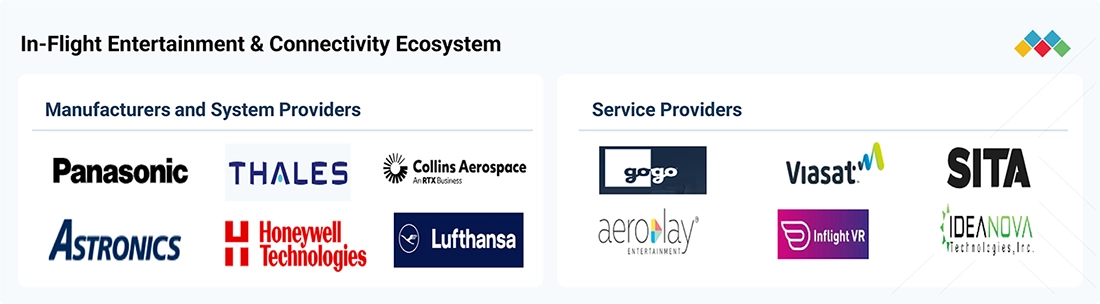
IN-FLIGHT ENTERTAINMENT & CONNECTIVITY MARKET: COMMERCIAL USE CASES ACROSS INDUSTRIES
| COMPANY | USE CASE DESCRIPTION | BENEFITS |
|---|---|---|
 |
Panasonic Avionics provides in-flight entertainment and connectivity solutions that combine seatback entertainment, onboard Wi-Fi, satellite connectivity, and digital passenger services. Its systems support multi-orbit connectivity using 5G, LEO, and GEO networks and allow airlines to manage content, connectivity packages, and onboard services. | Improves passenger connectivity | Supports high-speed onboard internet | Enables flexible content and service management | Supports personalized digital passenger experiences |
 |
Thales provides in-flight entertainment and connectivity systems that combine IFE, high-speed connectivity, content management, and passenger applications. Its FlyEDGE platform uses cloud-hosted architecture and onboard edge computing to support entertainment applications, remote fleet management, and passenger engagement data. | Enables connected passenger experiences | Supports flexible entertainment applications | Improves remote content and system management | Provides passenger engagement information |
 |
Safran developed RAVE In-Flight Entertainment and Connectivity solutions that support seatback and wireless entertainment, personal-device casting, cloud-based content distribution, and onboard edge computing. RAVE Cloud Services enables airlines to distribute content to aircraft through satellite, cellular, Wi-Fi, and other available pathways. | Supports personal-device entertainment | Enables faster content distribution | Reduces dependence on additional onboard hardware | Supports flexible and scalable IFEC services |
Logos and trademarks shown above are the property of their respective owners. Their use here is for informational and illustrative purposes only.
Related Ecosystem
Aviation
- Narrow Body Aircraft
- Wide Body Aircraft
- Military Helicopters
- Special Mission Aircraft
- Fighter Aircraft
- HONEYWELL INTERNATIONAL INC.
- COLLINS AEROSPACE
- Thales group
- Safran group
- HEICO Corporation
Key Takeaways
- North America's in-flight entertainment and connectivity market is valued at $3,695.1 million in 2024 and will reach $5,105.4 million by 2029.
- North America is experiencing a 6.7% CAGR, outpacing the global average of 6.3%, driven by premium carrier investments and passenger expectations.
- North America's market growth is fueled by fleet modernization, satellite connectivity expansion, and demand for streaming services at altitude.
- North America's competitive landscape features major carriers and technology providers prioritizing seamless connectivity and personalized entertainment experiences.
In-flight Entertainment & Connectivity Market Report Scope
| Report Metric | Details |
|---|---|
| Base Year | 2024 |
| Fastest Growing Segment | RETAIL (In-Flight Retail And Advertising) |
| Forecast Period | 2024-2029 |
| Growth Rate | CAGR of 6.3% from 2024 to 2029 |
| Largest Segment | IN-FLIGHT ENTERTAINMENT (Offering) |
| Market Size Base Year (Billions) | ~USD 8.62 (2024) |
| Revenue Forecast (Billions) | ~USD 11.7 (2029) |
| Segments Covered | Offering, Type, Product, In-Flight Content, In-Flight Retail And Advertising, Solution, In-Flight Internet, Class, End Use, Platform |
North America In-flight Entertainment & Connectivity Market Report Segmentation
10 segment dimensions are covered across the global market.
By Offering
- In-Flight Connectivity
- In-Flight Entertainment
By Type
- In-Flight Content
- In-Flight Internet
- In-Flight Retail And Advertising
- Product
- Solution
By Product
- Non-Portable Devices
- Portable Devices
By In-Flight Content
- Stored
- Streamed
By In-Flight Retail And Advertising
- Advertising
- Retail
By Solution
- Wired
- Wireless
By In-Flight Internet
- Air-To-Ground (Cellular-Based)
- Hybrid-Based
- Satellite-Based
By Class
- Business Class
- Economy Class
- First Class
- Premium Economy Class
By End Use
- Aftermarket
- OEM
By Platform
- Business Jet
- Narrow-Body Aircraft
- Wide-Body Aircraft
Target Audience
- Airline Operators & Fleet Managers : Need detailed North American market data to justify IFE and connectivity system upgrades, evaluate vendor solutions, and plan fleet modernization investments aligned with regional passenger expectations and competitive pressures.
- Technology & Equipment Manufacturers : Require market sizing and growth forecasts for North America to guide R&D investments, production capacity planning, and product development roadmaps targeting the region's premium aviation segment.
- Connectivity Service Providers : Need insights into North American airline demand for broadband, streaming, and personalized content delivery to develop service offerings, pricing strategies, and partnership opportunities with major carriers.
- Investment & Private Equity Firms : Seek comprehensive North American market analysis to evaluate acquisition targets, assess growth potential of aviation technology companies, and identify emerging opportunities in the IFE and connectivity sector.
- Consulting & Strategy Firms : Require region-specific market intelligence and forecasts to support client advisory work on aviation technology strategy, competitive positioning, and market entry decisions in North America.
Countries within North America - compare and drill down
| Country | 2025 size (native) |
|---|---|
| US | USD 4809.7 Million |
| Canada | USD 295.7 Million |
Country market size visualization
Reasons to Buy this Report
- Market Size & Growth Data : Access precise market valuations for North America ($3.7B in 2024) and country-level breakdowns for the US and Canada, enabling accurate financial forecasting and investment planning for the 2024-2029 period.
- Competitive Landscape Intelligence : Understand North American airline strategies, technology partnerships, and differentiation tactics in IFE and connectivity offerings to benchmark against competitors and identify market opportunities.
- Regional Growth Drivers : Identify key factors accelerating North America's 6.7% CAGR, including passenger demand trends, regulatory developments, and technology adoption patterns specific to US and Canadian markets.
- Investment & Expansion Strategy : Leverage detailed North American market insights to prioritize resource allocation, identify high-growth segments, and develop targeted go-to-market strategies for aviation technology providers and service suppliers.
- Forecast Accuracy : Utilize region-specific projections through 2029 to support business planning, capital allocation decisions, and long-term strategic initiatives with confidence in North American market trajectory data.
Frequently asked questions
What is the current size of North America's in-flight entertainment and connectivity market?
North America's in-flight entertainment and connectivity market is valued at $3,695.1 million in 2024, with expectations to grow to $5,105.4 million by 2029.
What is the projected growth rate for North America's IFE and connectivity market?
North America's market is projected to grow at a compound annual growth rate of 6.7% from 2024 to 2029, exceeding the global CAGR of 6.3%.
What are the primary drivers of growth in North America's in-flight entertainment market?
North America's growth is driven by fleet modernization, increasing adoption of satellite and air-to-ground connectivity, rising passenger demand for streaming services, and competitive differentiation among carriers.
How does North America's market performance compare to global trends?
North America outperforms global averages with a 6.7% CAGR versus the global 6.3%, reflecting the region's mature aviation infrastructure, high passenger spending, and technology adoption rates.
What technologies are shaping North America's in-flight entertainment landscape?
North America's market is shaped by satellite-based connectivity, air-to-ground systems, personalized content delivery, streaming integration, and advanced IFE hardware platforms deployed across modern aircraft fleets.
RESEARCH METHODOLOGY
The study involved four major activities to estimate the current size of the in-flight entertainment and connectivity market. Exhaustive secondary research was conducted to gather information on the in-flight entertainment and connectivity market, its adjacent markets, and its parent market. The next step was to validate these findings, assumptions, and sizing with industry experts across the value chain through primary research. Demand-side analysis was conducted to estimate the overall market size. Thereafter, data triangulation procedures were employed to estimate the sizes of various segments and subsegments within the in-flight entertainment and connectivity market.
Secondary Research
During the secondary research process, various sources were consulted to identify and collect information for this study. The secondary sources included government sources, such as SIPRI; corporate filings, including annual reports, press releases, and investor presentations; white papers, journals, and certified publications; and articles from recognized authors, directories, and databases.
Primary Research
Extensive primary research was conducted after acquiring information on the in-flight entertainment and connectivity market through secondary research. Several primary interviews were conducted with market experts from the demand and supply sides across major countries of North America, Europe, Asia Pacific, the Middle East & Africa, and Latin America. Primary data was collected through questionnaires, emails, and telephonic interviews.
Breakdown of Primary Interviews
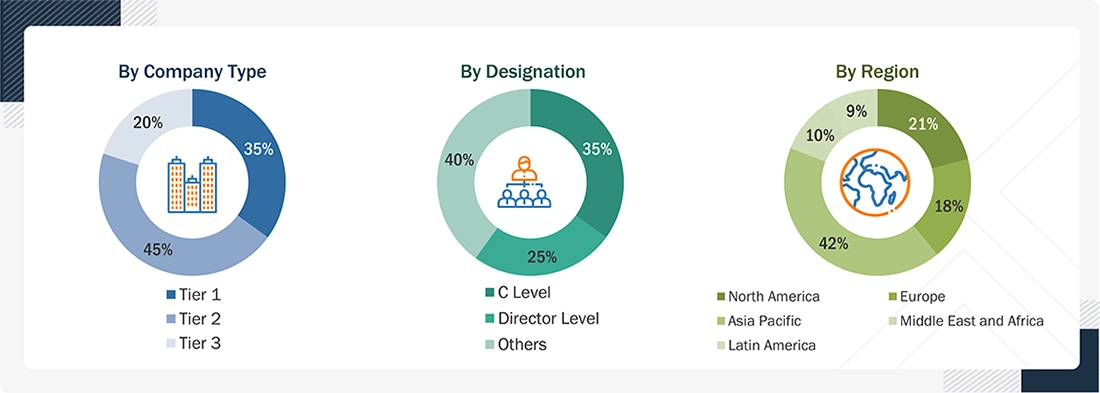
Note: The three tiers of companies are defined based on their total revenue in 2025: Tier 1 - revenue greater than or equal to USD 1 billion; Tier 2 - revenue between USD 100 million and USD 1 billion; and Tier 3 - revenue less than or equal to USD 100 million. Other designations include sales managers, marketing managers, and product managers.
To know about the assumptions considered for the study, download the pdf brochure
Market Size Estimation
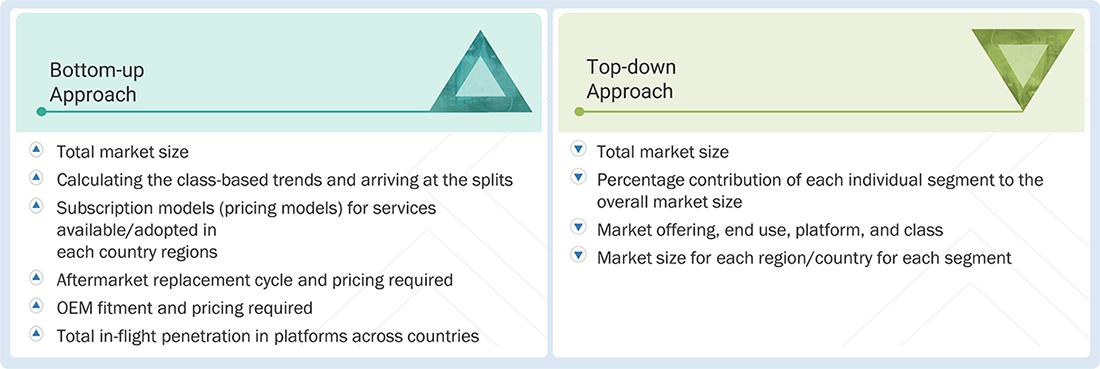
Top-down and bottom-up approaches were used to estimate and validate the size of the in-flight entertainment and connectivity market. The research methodology used to estimate the size of the market included the following details:
- Key players in the in-flight entertainment and connectivity market were identified through secondary research, and their market shares were determined through a combination of primary and secondary research. This included a study of the annual and financial reports of the top market players, as well as extensive interviews with leaders, including directors, engineers, marketing executives, and other key stakeholders of leading companies operating in the market.
- All percentage shares, splits, and breakdowns were determined using secondary sources and verified through primary sources.
- All possible parameters that affect the markets covered in this research study were accounted for, viewed in extensive detail, verified through primary research, and analyzed to obtain the final quantitative and qualitative data on the in-flight entertainment and connectivity market. This data was consolidated, enhanced with detailed input, analyzed by MarketsandMarkets, and presented in this report.
In-flight Entertainment & Connectivity Market : Top-Down and Bottom-Up Approach
Data Triangulation
After determining the overall market size, the total market was classified into several segments and subsegments. The data triangulation and market breakdown procedures explained below were implemented, wherever applicable, to complete the overall market engineering process and arrive at the estimated market numbers for the market segments and subsegments. The data were triangulated by examining various factors and trends on both the demand and supply sides. Additionally, the market size was validated using top-down and bottom-up approaches.
Market Definition
The in-flight entertainment and connectivity (IFEC) market encompasses a range of products and services designed to enhance passenger experiences on commercial flights, including audio and video on demand, live TV, games, moving maps, digital reading materials, and various connectivity options like Wi-Fi and mobile phone services. It involves hardware such as seat-back screens and connectivity equipment, as well as software for content management and user interfaces. Service providers include content suppliers, connectivity providers, and system integrators. Driven by technological advancements and passenger demand for enhanced experiences, the market is seeing trends like personalized content, hybrid systems combining seat-back screens with personal device streaming, and improved connectivity through advancements in satellite and 5G technology.
Key Stakeholders
- Aerostructure Manufacturers
- In-flight Entertainment and Connectivity Solution Developers
- In-flight Entertainment and Connectivity Service Providers
- Subcomponent Suppliers
- Technology Providers
- Airlines
- Government Agencies
- Investors and Financial Community Professionals
- Research Organizations
Report Objectives
- To define, describe, and forecast the in-flight entertainment and connectivity market based on offering, end use, platform, class, and region in terms of value
- To forecast the size of various segments of the market across North America, Europe, Asia Pacific, the Middle East & Africa, and Latin America in terms of value
- To identify and analyze the drivers, restraints, opportunities, and challenges influencing the growth of the market
- To identify industry trends, market trends, and technology trends currently prevailing in the market
- To analyze micromarkets with respect to growth trends, prospects, and their contribution to the overall market
- To analyze opportunities in the market for stakeholders by identifying key market trends
- To profile key market players and comprehensively analyze their market share and core competencies
- To evaluate the degree of competition in the market by analyzing recent developments, such as contracts, agreements, and acquisitions, adopted by leading market players
- To identify detailed financial positions, key products, and unique selling points of leading companies in the market
- To provide a detailed competitive landscape of the market, along with market share analysis and revenue analysis of key players
Available customizations:
MarketsandMarkets offers the following customizations for this market report:
- Additional country-level analysis of the in-flight entertainment and connectivity market
- Profiling of other market players (up to five)
Product Analysis
- Product matrix, which provides a detailed comparison of the product portfolios of each company in the in-flight entertainment and connectivity market
Get the Full In-flight Entertainment & Connectivity Market Report
Full forecast, segment splits, and company analysis for all In-flight Entertainment & Connectivity Market.
- Australia In-flight Entertainment & Connectivity Market
- UAE In-flight Entertainment & Connectivity Market
- Saudi Arabia In-flight Entertainment & Connectivity Market
- Qatar In-flight Entertainment & Connectivity Market
- Turkey In-flight Entertainment & Connectivity Market
- Brazil In-flight Entertainment & Connectivity Market
- Mexico In-flight Entertainment & Connectivity Market
- South Africa In-flight Entertainment & Connectivity Market
- Rest Of Europe In-flight Entertainment & Connectivity Market
- Rest Of Asia Pacific In-flight Entertainment & Connectivity Market
- Canada In-flight Entertainment & Connectivity Market
- US In-flight Entertainment & Connectivity Market
- UK In-flight Entertainment & Connectivity Market
- Germany In-flight Entertainment & Connectivity Market
- France In-flight Entertainment & Connectivity Market
- Spain In-flight Entertainment & Connectivity Market
- Italy In-flight Entertainment & Connectivity Market
- China In-flight Entertainment & Connectivity Market
- India In-flight Entertainment & Connectivity Market
- Japan In-flight Entertainment & Connectivity Market
- South Korea In-flight Entertainment & Connectivity Market
Need a Tailored Report?
Customize this report to your needs
Get 10% FREE Customization
Customize This Report
