
Europe In Vitro Fertilization Market (2024-2029)

The Europe In Vitro Fertilization Market was valued at $290.5 Million in 2024 and projected to reach to $504.7 Million by 2029, representing a compound annual growth rate of 11.7%. Europe's In Vitro Fertilization market is positioned for sustained expansion through 2029, driven by advanced healthcare infrastructure, rising infertility prevalence, and increasing patient acceptance of assisted reproductive technologies.


| Market Size in | USD 26.32 MN |
| Market Forecast in | |
| CAGR | |
| Forecast Period | |
| Units Considered | Value (USD MN) |
Europe In Vitro Fertilization Market Trends and Insights
- This growth trajectory reflects Europe's advanced healthcare infrastructure, increasing prevalence of infertility, and rising acceptance of assisted reproductive technologies across the region.
- Europe maintains a mature and well-regulated IVF landscape, with strong reimbursement policies in several countries driving market penetration. The European IVF market is propelled by demographic shifts, delayed childbearing, lifestyle factors, and improved treatment success rates.
- Europe's emphasis on quality standards and patient safety has established it as a leader in reproductive medicine innovation.
- Between 2024 and 2029, Europe is expected to see accelerated adoption driven by technological advancements, expanded clinic networks, and growing awareness among fertility-conscious populations seeking assisted reproduction solutions..
Key Market Statistics
- CAGR (2024-2029) 11.7% CAGR
- Market Size, 2024 ~USD 290.5 Million
- Forecast, 2029 ~USD 504.7 Million
- Geography Europe
Europe In Vitro Fertilization Market Overview
Market Valuation & Growth :
Europe's IVF market is valued at USD 290.5 million in 2024, with a robust 11.7% CAGR projected through 2029, reaching USD 504.7 million. This growth reflects strong demand across the region's mature healthcare systems.
Advanced Healthcare Infrastructure :
Europe benefits from well-established medical facilities, stringent regulatory frameworks, and high-quality assisted reproductive technology services. This infrastructure supports consistent market expansion and patient confidence in IVF treatments.
Rising Infertility Prevalence :
Increasing infertility rates across Europe, driven by delayed childbearing, lifestyle factors, and aging populations, are driving demand for IVF solutions. This demographic trend supports sustained market growth throughout the forecast period.
Growing Technology Acceptance :
European patients and healthcare providers demonstrate increasing acceptance of assisted reproductive technologies. Cultural shifts, improved success rates, and insurance coverage expansion are accelerating IVF adoption across the region.
Europe In Vitro Fertilization Market Dynamics
- The region's mature regulatory environment and strong reimbursement policies create favorable conditions for market growth.
- Key European markets including the UK, Germany, Spain, and France are leading contributors to this expansion. The forecast period will see continued innovation in IVF techniques, improved success rates, and broader insurance coverage across European nations.
- Demographic trends, including delayed parenthood and lifestyle factors, will maintain strong demand for fertility treatments.
- Strategic investments in reproductive medicine and expanding clinic networks will further support market penetration and accessibility across the region..
Market Ecosystem
Related Ecosystem
In Vitro Diagnostics
- Polymerase Chain Reaction (PCR)
- Enzyme-Linked Immunosorbent Assay (ELISA)
- Dna Microarrays
- Assay Kits
- Microarrays
- ROCHE HOLDINGS AG
- Thermo Fisher Scientific Inc.
- Danaher Corporation
- Abbott Laboratories
- Biomerieux s.a.
Medical Devices
- Polymerase Chain Reaction (PCR)
- Magnetic Resonance Imaging (MRI)
- Disposable Autoinjectors
- Pulse Oximeters
- Blood Pressure Monitors
- Medtronic plc
- Abbott Laboratories
- Stryker Corporation
- Becton, Dickinson and Company
- CONMED Corporation
Key Takeaways
- Europe's IVF market is valued at USD 290.5 million in 2024 and will grow to USD 504.7 million by 2029, representing a 11.7% CAGR.
- Europe benefits from advanced healthcare infrastructure and strong regulatory frameworks that support high-quality IVF service delivery.
- Demographic trends including delayed childbearing and increased infertility awareness are key growth drivers across Europe.
- Europe's mature market position and emphasis on innovation position it as a global leader in assisted reproductive technology adoption.
In Vitro Fertilization Market Report Scope
| Report Metric | Details |
|---|---|
| Base Year | 2024 |
| Fastest Growing Segment | FROZEN NON-DONORS (Type) |
| Forecast Period | 2024-2029 |
| Growth Rate | CAGR of 11.7% from 2024 to 2029 |
| Largest Segment | EQUIPMENT (Product) |
| Market Size Base Year (Billions) | ~USD 0.95 (2024) |
| Revenue Forecast (Billions) | ~USD 1.65 (2029) |
| Segments Covered | Product, Type, Type Of Cycle, Procedure, End User |
Europe In Vitro Fertilization Market Report Segmentation
5 segment dimensions are covered across the global market.
By Product
- Accessories
- Anti-Vibration Tables
- Cabinets
- Cryosystems
- Equipment
- Gas Analyzers
- Imaging Systems
- Incubators
- Laser Systems
- Micromanipulator Systems
- Microscopes
- Other Equipment
- Ovum Aspiration Pumps
- Reagents & Media
- Sperm Analyzer Systems
- Sperm Separation Systems
- Witness Systems
By Type
- Anti-Vibration Tables
- Cabinets
- Cryopreservation Media
- Cryosystems
- Embryo Culture Media
- Gas Analyzers
- Imaging Systems
- Incubators
- Laser Systems
- Micromanipulator Systems
- Microscopes
- Other Equipment
- Other Incubators
- Ovum Aspiration Pumps
- Ovum Processing Media
- Sperm Analyzer Systems
- Sperm Processing Media
- Sperm Separation Systems
- Time-Lapse Incubators
- Witness Systems
By Type Of Cycle
- Fresh Donors
- Fresh Non-Donors
- Frozen Donors
- Frozen Non-Donors
By Procedure
- Conventional Ivf
- Ivf With Donar Eggs
- Ivf With Icsi
- Minimal Ivf
- Other Procedures
By End User
- Cryobanks
- Fertility Clinics & Ivf Centers
- Hospitals & Surgical Centers
- Hospitals & Surgical Clinics
- Research Institutes
EUROPE: IN VITRO FERTILIZATION MARKET, BY END USER, 2022–2029
| Segment | 2022 | 2023 | 2024 | 2025 | 2026 | 2027 | 2028 | 2029 | CAGR (%) |
|---|---|---|---|---|---|---|---|---|---|
| CRYOBANKS | 24.7 | 29.73 | 32.07 | 34.67 | 37.58 | 40.84 | 44.48 | 48.56 | 8.7 |
| FERTILITY CLINICS & IVF CENTERS | 119.45 | 148.93 | 166.38 | 186.34 | 209.22 | 235.49 | 265.72 | 300.57 | 12.6 |
| HOSPITALS & SURGICAL CLINICS | 59.11 | 73.12 | 81.04 | 90.05 | 100.31 | 112.03 | 125.42 | 140.76 | 11.7 |
| RESEARCH INSTITUTES | 8.94 | 10.5 | 11.05 | 11.66 | 12.34 | 13.08 | 13.9 | 14.81 | 6 |
| TOTAL | 212.2 | 262.29 | 290.54 | 322.73 | 359.45 | 401.43 | 449.52 | 504.7 | 11.7 |
Target Audience
- Fertility Clinic Operators : Clinic owners and managers need regional market data to optimize service offerings, identify expansion locations, and benchmark operational performance against European competitors. Market insights support strategic growth planning and investment decisions.
- Medical Device & Pharmaceutical Companies : Manufacturers of IVF equipment, medications, and consumables require detailed market analysis to guide product development, regulatory strategy, and market entry decisions across diverse European healthcare systems.
- Healthcare Investors & PE Firms : Investment professionals evaluating fertility sector opportunities need comprehensive market sizing, growth forecasts, and competitive dynamics to assess investment returns and identify acquisition targets in Europe's IVF market.
- Healthcare Policy & Insurance Providers : Policymakers and insurance companies need market intelligence to design reimbursement policies, assess healthcare budget implications, and understand IVF service demand across European populations.
- Market Research & Consulting Firms : Research organizations and consultants require granular European market data to support client advisory services, competitive analysis, and strategic recommendations in the reproductive medicine sector.
Countries within Europe - compare and drill down
| Country | 2025 size (native) |
|---|---|
| Germany | USD 62.58 Million |
| UK | USD 91.1 Million |
| France | USD 49.46 Million |
| Italy | USD 45.93 Million |
| Spain | USD 112.3 Million |
| Rest Of Europe | USD 143.34 Million |
Country market size visualization
Reasons to Buy this Report
- Regional Market Segmentation : Gain detailed insights into Europe's IVF market with country-level breakdowns including UK, Germany, Spain, France, Italy, and Rest of Europe data. Understand regional variations in market size, growth rates, and adoption patterns.
- Competitive Landscape Analysis : Identify leading IVF providers, clinic networks, and technology suppliers across European markets. Benchmark your position against competitors and understand market consolidation trends specific to the region.
- Regulatory & Reimbursement Insights : Navigate Europe's complex regulatory environment with country-specific compliance requirements, insurance coverage policies, and reimbursement mechanisms that impact market dynamics and business strategy.
- Growth Opportunity Identification : Discover high-growth segments, emerging markets within Europe, and underserved patient populations. Identify expansion opportunities in countries with rising infertility rates and improving healthcare access.
- Strategic Planning & Forecasting : Leverage 5-year market projections (2024-2029) to inform investment decisions, product development timelines, and market entry strategies. Plan resource allocation based on regional growth trajectories and market maturity levels.
Frequently asked questions
What is the current size of Europe's IVF market?
Europe's In Vitro Fertilization market was valued at USD 290.5 million in 2024.
What is the projected market size for Europe's IVF market by 2029?
Europe's IVF market is forecasted to reach USD 504.7 million by 2029.
What is the growth rate of Europe's IVF market?
Europe's IVF market is expected to grow at a compound annual growth rate (CAGR) of 11.7% from 2024 to 2029.
What factors are driving growth in Europe's IVF market?
Key drivers include demographic shifts toward delayed childbearing, rising infertility rates, improved treatment success rates, strong healthcare infrastructure, and increased awareness of assisted reproductive technologies across Europe.
Why is Europe a significant market for IVF services?
Europe is significant due to its advanced healthcare systems, robust regulatory frameworks, strong reimbursement policies in many countries, high patient awareness, and established networks of specialized fertility clinics.
RESEARCH METHODOLOGY
In this research, the utilization of both primary and secondary sources was done to a great extent. This included studying the factors affecting the industry to find out the segmentation types, industry trends, key players, competitive landscape, key market dynamics, and strategies by key players.
Secondary Research
The secondary research process involves methods using directories, databases such as D&B Hoovers, Bloomberg Businessweek, Factiva, white papers, annual reports, company filings, investor presentations, and SEC filings, and collation of the database of industry leaders. This would help in fleshing out basic information on key players and market segmentation based upon the trends of the industry at various levels, major developments in the market, and technological perspectives pertaining to the in vitro fertilization market.
Primary Research
Primary research for this report featured interviews with a cross-section of sources from both the supply and demand sides to generate qualitative and quantitative data. On the supply side, there were primary sources from industries represented by CEOs, vice presidents, marketing and sales directors, regional sales managers, technology and innovation directors, and other key executives from leading companies and organizations in product therapy markets. Primary sources on the demand side included but were not limited to: embryologists, clinicians, procurement managers, purchase managers, department heads, and professionals from hospitals, fertility clinics, in vitro fertilization centers, and reference labs, among others. This primary research was hoped to validate market segmentation, identify key market players, and get an overview of the key trends and dynamics of the industry.
A breakdown of the primary respondents is provided below:
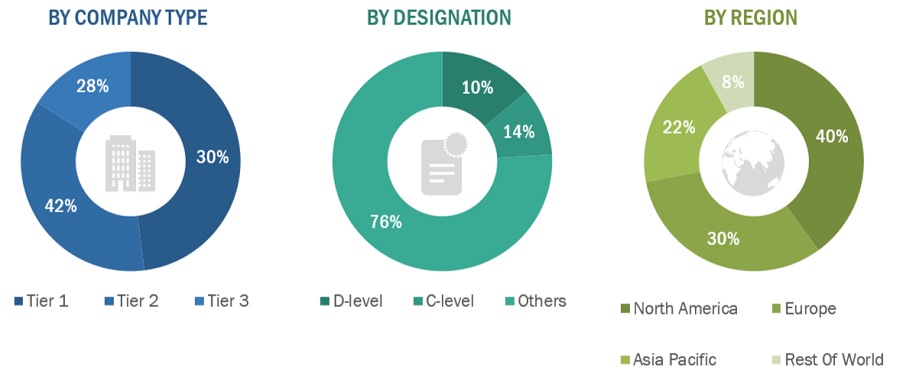
To know about the assumptions considered for the study, download the pdf brochure
*Others include sales managers, marketing managers, business development managers, product managers, distributors, and suppliers.
Note: Companies are classified into tiers based on their total revenue. As of 2023, Tier 1 = >USD 1 billion, Tier 2 = <USD 500 million, and Tier 3 = <USD 100 million.
Market Estimation Methodology
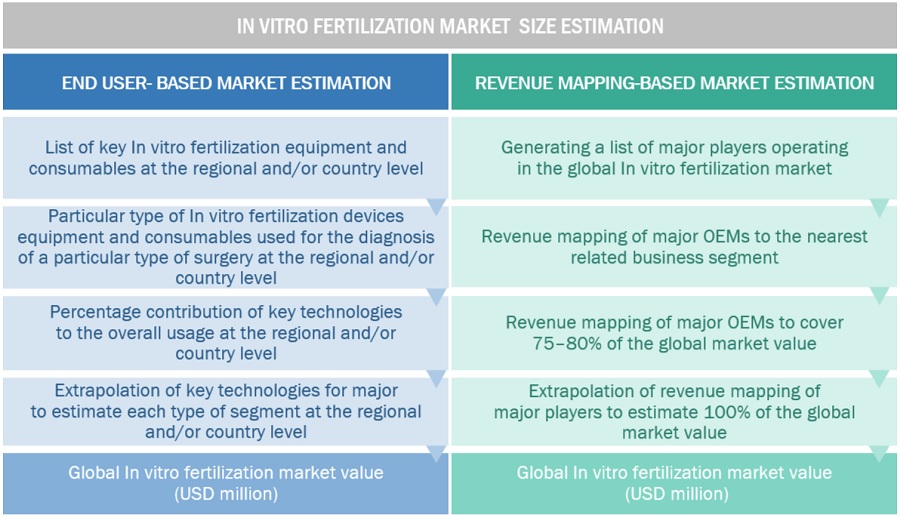
This report also presents the key players' revenue share analysis for the size of the in vitro fertilization market. The identification of key market participants and insights about their revenues in the in vitro fertilization sector are gathered through phases of primary and secondary research. The secondary research process relied heavily on top players' annual and financial reports, while primary research involved highly exhaustive interviews with key opinion leaders, viz., CEOs, directors, and senior marketing executives.
The methodology adopted to calculate the global market value was on a segment basis. These segmental revenues were then sourced through the revenue data of major solution and service providers. The steps involved in the process are
- Draw up a list of key global players operating in the in vitro fertilization market. Map the annual revenues accrued by players from the in vitro fertilization market or nearest reported business unit/ product category.
- It represents the current major share of the global market as of 2022, using revenue mapping of the key players.
Extrapolation to the global value for the in vitro fertilization market. Global In vitro fertilization Market: Bottom-Up Approach
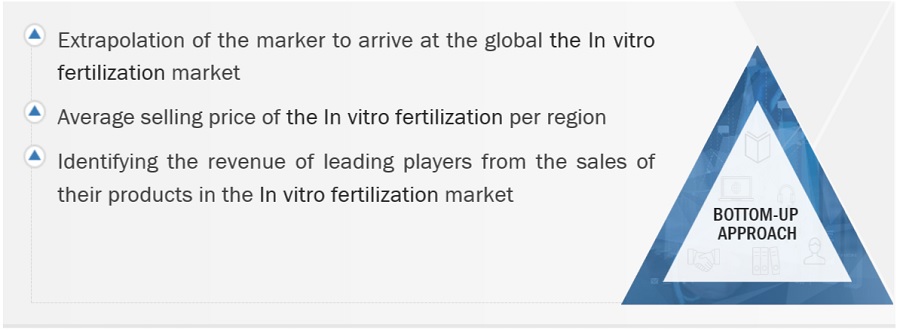
To know about the assumptions considered for the study, Request for Free Sample Report
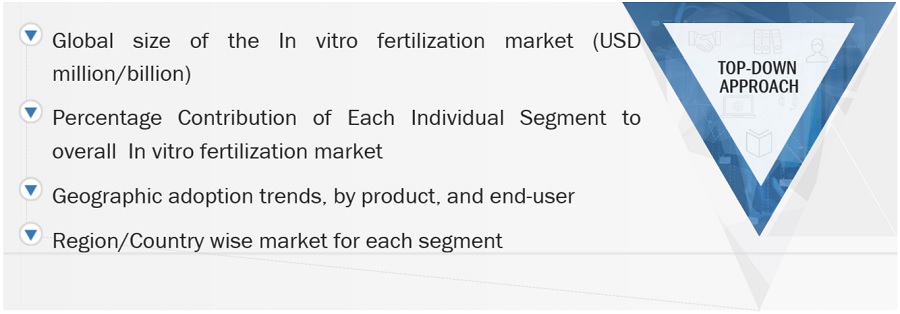
Global In vitro fertilization Market : Top-Down Approach
Data Triangulation
The in vitro fertilization market was segmented under various categories and subcategories using the above-mentioned methodology. Thereafter, proper data triangulation and the market segmentation process are carried out to further increase the accuracy of the data for each segment. Factors and trends from both the demand and supply sides were studied. Rigorous employment of both top-down and bottom-up approaches provided the result of the analysis of the in vitro fertilization market.
Market Definition
The in vitro fertilization market refers to the global landscape of Assisted Reproductive Technologies services and products that help a person or a couple conceive. It is a market that represents fertility clinics, hospitals, and even research institutions that provide in vitro fertilization treatments and related services, including medical devices, laboratory equipment, drugs, and consumables used for in vitro fertilization procedures. It also includes the diagnostic tests carried out prior to and in the course of in vitro fertilization, genetic screening technologies, and cryopreservation services. In vitro fertilization market has been used as a generic term describing the portfolio of diverse technologies, services, and products relating to the alleviation of infertility and the promotion of reproductive health.
Key Stakeholders
- Manufacturers and distributors of In vitro fertilization devices
- Healthcare institutions (Hospitals and clinics)
- Surgical centers
- Healthcare institutions (hospitals and cardiac centers)
- Research institutions
- Clinical research organizations
- Academic Medical Centers and Universities
- Reference labs
- Clinical research organizations
- Accountable Care Organizations (ACOs)
- Research and consulting firms
- Contract research organizations (CROs) and contract manufacturing organizations (CMOs)
- Academic medical centers and universities
- Market research and consulting firms
- Surgery Centers
- Group Purchasing Organizations (GPOs)
- Medical Research Laboratories
- Academic Medical Centers and Universities
Objectives of the Study
- Define, describe, and forecast the In vitro fertilization market on Product, cycle, procedure, end user and region.
- Analyze opportunities in the market for stakeholders and details of the competitive landscape for market leaders.
- Detailed information regarding major factors influencing the market growth.
- Analysis of the micro markets with respect to individual growth trends, prospects, and contribution to the total market.
- Tracking and analysis of competitive developments such as new product launches and approvals, agreements, partnerships, expansions, acquisitions, and collaborations in the in vitro fertilization market.
- Description of key companies operating in the market along with their market share analysis and core competencies
Available Customizations
With the given market data, MarketsandMarkets offers customizations as per the company’s specific needs. The following customization options are available for the present global In vitro fertilization market
Product Analysis
- Product matrix, which gives a detailed comparison of the product portfolios of the top 5 companies.
Company Information
- Detailed analysis and profiling of additional market players (up to 5)
Geographic Analysis
- Further breakdown of the Rest of Europe's In vitro fertilization market: Russia, Belgium, the Netherlands, Switzerland, Austria, Finland, Sweden, Poland, and Portugal among other
- Further breakdown of the Rest of Asia Pacific In vitro fertilization market Singapore, Taiwan, New Zealand, Philippines, Malaysia, and other APAC countries
- Further breakdown of the Rest of the world In vitro fertilization market: Latin America, MEA, and Africa
Get the Full In Vitro Fertilization Market Report
Full forecast, segment splits, and company analysis for all In Vitro Fertilization Market.
- China In Vitro Fertilization Market
- Japan In Vitro Fertilization Market
- India In Vitro Fertilization Market
- Australia In Vitro Fertilization Market
- South Korea In Vitro Fertilization Market
- Germany In Vitro Fertilization Market
- UK In Vitro Fertilization Market
- France In Vitro Fertilization Market
- Italy In Vitro Fertilization Market
- Spain In Vitro Fertilization Market
- Canada In Vitro Fertilization Market
- US In Vitro Fertilization Market
- Brazil In Vitro Fertilization Market
- Mexico In Vitro Fertilization Market
- Rest Of Europe In Vitro Fertilization Market
- Rest Of Asia Pacific In Vitro Fertilization Market
- Rest Of Latin America In Vitro Fertilization Market
Need a Tailored Report?
Customize this report to your needs
Get 10% FREE Customization
Customize This Report
