
Rest Of GCC Countries In Vitro Toxicology Testing Market (2026-2031)

The Rest Of GCC Countries In Vitro Toxicology Testing Market was valued at $14.7 Million in 2026 and projected to reach to $19.2 Million by 2031, representing a compound annual growth rate of CAGR 5.5%. Rest Of GCC Countries' in vitro toxicology testing market is poised for steady expansion through 2031, supported by growing pharmaceutical manufacturing capabilities and increased chemical industry activities across the region.


| Market Size in | USD 26.32 MN |
| Market Forecast in | |
| CAGR | |
| Forecast Period | |
| Units Considered | Value (USD MN) |
Rest Of GCC Countries In Vitro Toxicology Testing Market Trends and Insights
- Rest Of GCC Countries is positioned as a developing market within the broader GCC region, driven by increasing pharmaceutical and chemical industry expansion.
- By 2031, Rest Of GCC Countries is projected to reach a market valuation of $19.2 million, reflecting a compound annual growth rate of 5.5%. Rest Of GCC Countries benefits from growing regulatory compliance requirements and rising investments in research and development infrastructure.
- The market in Rest Of GCC Countries is supported by heightened awareness of alternative testing methods and the adoption of in vitro technologies to replace traditional animal testing.
- Rest Of GCC Countries continues to attract pharmaceutical manufacturers and contract research organizations seeking cost-effective toxicology solutions. Rest Of GCC Countries represents a strategic opportunity for market participants, with moderate but consistent expansion anticipated through 2031.
- The trajectory for Rest Of GCC Countries reflects regional economic diversification efforts and increased focus on healthcare innovation and safety standards..
Key Market Statistics
- CAGR (2026-2031) CAGR 5.5%
- Market Size, 2026 ~USD 14.7 Million
- Forecast, 2031 ~USD 19.2 Million
- Country Rest Of GCC Countries
Rest Of GCC Countries In Vitro Toxicology Testing Market Overview
Steady Regional Growth :
Rest Of GCC Countries' in vitro toxicology testing market is expanding at a CAGR of 5.5%, demonstrating consistent demand despite being a developing market within the GCC region.
Market Valuation Trajectory :
The market is estimated at $14.7 million in 2026 and projected to reach $19.2 million by 2031, representing a 30.6% increase over the five-year forecast period.
Pharmaceutical & Chemical Drivers :
Growth in Rest Of GCC Countries is primarily driven by expanding pharmaceutical and chemical industries, increasing regulatory compliance requirements, and rising investments in R&D activities.
Developing Market Positioning :
Rest Of GCC Countries represents an emerging opportunity within the broader GCC region, with lower market penetration and significant potential for market expansion and adoption of advanced testing technologies.
Rest Of GCC Countries In Vitro Toxicology Testing Market Dynamics
- The market's 5.5% CAGR reflects moderate but consistent demand as local industries prioritize safety testing and regulatory compliance.
- Investments in healthcare infrastructure and R&D facilities are expected to accelerate market adoption. The forecast period will likely see increased adoption of alternative testing methods and automation technologies in Rest Of GCC Countries.
- Rising awareness of animal welfare concerns and stringent international regulatory standards will drive demand for in vitro testing solutions.
- Strategic partnerships with global testing providers and local capacity building initiatives will further support market growth and position Rest Of GCC Countries as an emerging hub for toxicology testing services..
Market Ecosystem
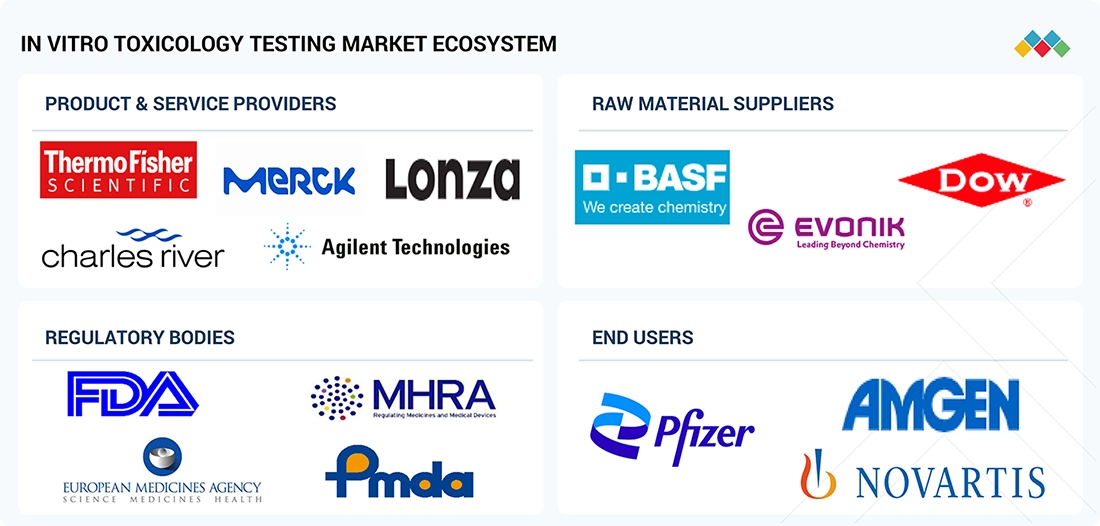
IN VITRO TOXICOLOGY TESTING MARKET: COMMERCIAL USE CASES ACROSS INDUSTRIES
| COMPANY | USE CASE DESCRIPTION | BENEFITS |
|---|---|---|
 |
Offers cytotoxicity and cell-viability products, such as LIVE/DEAD assays, LDH assays, alamarBlue, and ROS detection kits for compound toxicity screening | Supports rapid cell damage, viability, oxidative stress, and drug-discovery toxicity assessment |
 |
Provides CellTiter-Glo 3D assay for viability testing in 3D microtissue/spheroid toxicity models | Improves cytotoxicity readouts in 3D cultures and supports high-throughput screening |
Logos and trademarks shown above are the property of their respective owners. Their use here is for informational and illustrative purposes only.
Related Ecosystem
Biotechnology
Key Takeaways
- Rest Of GCC Countries market valued at $14.7 million in 2026, growing to $19.2 million by 2031 at 5.5% CAGR
- Rest Of GCC Countries is driven by regulatory compliance and pharmaceutical industry expansion across the region
- Rest Of GCC Countries shows increasing adoption of alternative in vitro testing methods over traditional animal testing
- Rest Of GCC Countries presents moderate but consistent growth opportunities for contract research organizations and pharmaceutical manufacturers
In Vitro Toxicology Testing Market Report Scope
| Report Metric | Details |
|---|---|
| Base Year | 2026 |
| Fastest Growing Segment | SERVICES (Offering) |
| Forecast Period | 2026–2031 |
| Growth Rate | CAGR of 10.6% from 2026 to 2031 |
| Largest Segment | PRODUCTS (Offering) |
| Market Size Base Year (Billions) | ~USD 12.67 (2026) |
| Revenue Forecast (Billions) | ~USD 20.97 (2031) |
| Segments Covered | Offering, Type |
Rest Of GCC Countries In Vitro Toxicology Testing Market Report Segmentation
2 segment dimensions are covered across the global market.
By Offering
- Products
- Services
By Type
- Assay Kits
- Equipment
- Reagents & Consumables
- Software & Informatics
Target Audience
- Pharmaceutical Manufacturers : Pharmaceutical companies operating in Rest Of GCC Countries need market insights to plan toxicology testing investments, understand regulatory requirements, and identify local testing service providers for drug development and safety compliance.
- Chemical Industry Players : Chemical manufacturers and distributors in Rest Of GCC Countries require detailed market data to assess testing service availability, plan compliance strategies, and evaluate opportunities for establishing in-house or outsourced toxicology testing capabilities.
- Contract Research Organizations (CROs) : CROs and testing service providers targeting Rest Of GCC Countries need market sizing and growth forecasts to identify expansion opportunities, assess market demand, and develop service offerings tailored to regional pharmaceutical and chemical sectors.
- Healthcare & Regulatory Bodies : Government agencies and regulatory authorities in Rest Of GCC Countries use market intelligence to develop policies, establish testing standards, and ensure compliance frameworks align with industry growth and international best practices.
- Investment & Business Development Teams : Investors, consultants, and business development professionals evaluating opportunities in Rest Of GCC Countries' healthcare sector need accurate market data to assess viability, identify partnerships, and make informed decisions on market entry strategies.
Key Companies in the Rest Of GCC Countries In Vitro Toxicology Testing Market
| Company | HQ | Ownership | Strongest segments |
|---|---|---|---|
| MAXCYTE, INC | United States | Public Company | ExPERT instruments (ATx, STx, GTx, VLx),Disposable processing assemblies (PAs),Accessories, buffers, and software protocols, |
| GE HEALTHCARE | United States | Public Company | Imaging,Advanced Visualization Solutions (AVS),Patient Care Solutions (PCS), |
| THERMO FISHER SCIENTIFIC INC. | United States | Public Company | Life Sciences Solutions,Analytical Instruments,Specialty Diagnostics, |
| MEDICILON | China | Public Company | Drug Discovery and Pharmaceutical Research,Preclinical Research and IND-Enabling,Advanced Technology and Specialized Platforms, |
| ARAGEN LIFE SCIENCES LTD. | India | Private Company | Discovery and gene-to-protein services,Biologics development and manufacturing,Small-molecule development and manufacturing, |
| ENZO BIOCHEM INC. | United States | Private Company | Labels, dyes, and genomic probes,Antibodies and immunoassays,Biochemicals, proteins, and other reagents, |
| VIMTA LABS LTD. | India | Public Company | Pharma and Biopharma CRO (preclinical, clinical, analytical, biologics/biosimilars),Food, Nutraceuticals, Water and Beverages Testing,Agrochemicals and Specialty Chemicals Testing, |
MAXCYTE, INC
MaxCyte, Inc is a public biotechnology company founded in 1998 in the United States with 91 employees. The company develops cell engineering technologies and platforms.
GE HEALTHCARE
GE Healthcare is a public healthcare company founded in 2022 in the United States with 54,000 employees. The company provides medical imaging, diagnostics, and healthcare IT solutions.
THERMO FISHER SCIENTIFIC INC.
Thermo Fisher Scientific Inc. is a public life sciences company founded in 1956 in the United States with 125,000 employees. The company is a global leader in serving science with laboratory equipment, reagents, and analytical instruments.
MEDICILON
Medicilon is a public pharmaceutical research and development company founded in 2004 in China with 2,504 employees. The company provides drug discovery and development services.
ARAGEN LIFE SCIENCES LTD.
Aragen Life Sciences Ltd. is a private contract research organization founded in 2000 in India with 4,000 employees. The company provides drug discovery, development, and manufacturing services.
ENZO BIOCHEM INC.
Enzo Biochem Inc. is a private biotechnology company founded in 1976 in the United States with 131 employees. The company develops and manufactures molecular diagnostic and research products.
VIMTA LABS LTD.
Vimta Labs Ltd. is a public contract research organization founded in 1984 in India with 1,384 employees. The company provides preclinical and clinical research services.
Reasons to Buy this Report
- Regional Market Specificity : Gain detailed insights exclusive to Rest Of GCC Countries' market dynamics, avoiding generic regional data. Understand local market drivers, regulatory landscape, and industry-specific growth factors unique to this developing market segment.
- Accurate Growth Projections : Access precise forecasts showing Rest Of GCC Countries' market growth from $14.7M (2026) to $19.2M (2031). Make informed investment and expansion decisions based on region-specific CAGR of 5.5% and market trajectory analysis.
- Competitive Positioning Strategy : Identify market entry opportunities and competitive advantages in Rest Of GCC Countries' developing toxicology testing sector. Benchmark against regional growth rates and understand market maturity levels compared to other GCC nations.
- Pharmaceutical & Chemical Industry Insights : Understand how pharmaceutical and chemical industry expansion in Rest Of GCC Countries drives toxicology testing demand. Align product offerings and services with sector-specific requirements and growth opportunities in this emerging market.
- Strategic Investment Planning : Support capital allocation decisions with comprehensive market data for Rest Of GCC Countries. Evaluate market potential, growth sustainability, and ROI prospects for establishing testing facilities or partnerships in this developing region.
Frequently asked questions
What is the current market size of in vitro toxicology testing in Rest Of GCC Countries?
Rest Of GCC Countries in vitro toxicology testing market is estimated at $14.7 million in 2026.
What is the projected market size for Rest Of GCC Countries by 2031?
Rest Of GCC Countries is projected to reach $19.2 million by 2031, representing a 5.5% CAGR.
What factors are driving growth in Rest Of GCC Countries?
Rest Of GCC Countries growth is driven by regulatory compliance requirements, pharmaceutical industry expansion, and adoption of alternative testing methods.
How does Rest Of GCC Countries compare to the global market?
Rest Of GCC Countries grows at 5.5% CAGR, which is below the global average of 10.6%, reflecting a more mature regional market.
Who are the primary end-users in Rest Of GCC Countries?
Rest Of GCC Countries primary end-users include pharmaceutical manufacturers, contract research organizations, and chemical companies requiring toxicology testing services.
RESEARCH METHODOLOGY
This research study involved the extensive use of secondary sources, directories, and databases to identify and collect valuable information for the analysis of the global in vitro toxicology testing market. In-depth interviews were conducted with various primary respondents, including key industry participants, subject-matter experts (SMEs), C-level executives of key market players, and industry consultants, to obtain and verify critical qualitative and quantitative information and assess the growth prospects of the market. The global market size estimated through secondary research was then triangulated with inputs from primary research to arrive at the final market size.
Secondary Research
Secondary research was used mainly to identify and collect information for the extensive, technical, market-oriented, and commercial study of the in vitro toxicology testing market. Secondary sources used for this study include World Health Organization (WHO), Organisation for Economic Co-operation and Development (OECD), The Lens, American Society for Testing and Materials (ASTM), Center for Alternatives to Animal Testing (CAAT), European Union Reference Laboratory for Alternatives to Animal Testing (EURL ECVAM), National Institute of Environmental Health Sciences (NIEHS), Scientific Group on Methodologies for the Safety Evaluation of Chemicals (SGOMSEC), United States Environmental Protection Agency (USEPA), US Food and Drug Administration (US FDA), US Census Bureau, Eurostat, Statista, and Factiva. The Scientist Magazine, ScienceDirect, research journals, corporate filings such as annual reports, SEC filings, investor presentations, and financial statements, press releases, trade, business, professional associations and others. These sources were also used to obtain key information about major players, market classification, and segmentation according to industry trends, regional/country-level markets, market developments, and technology perspectives.
Primary Research
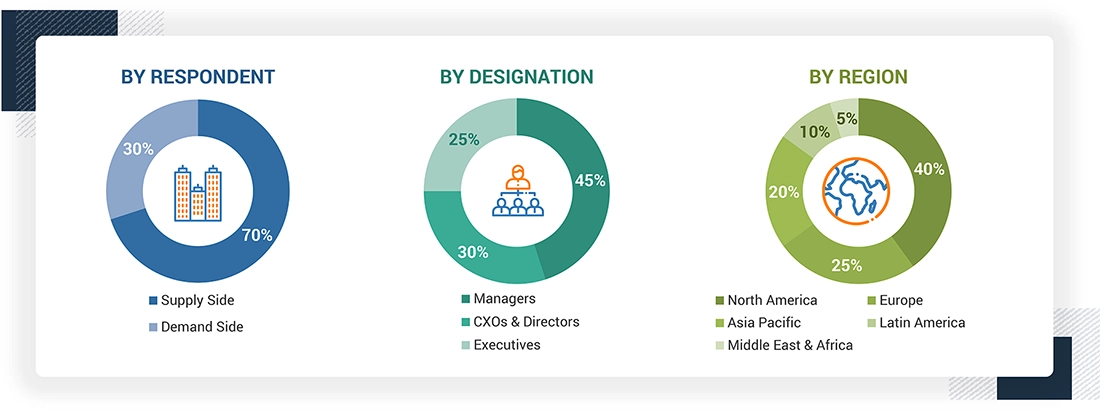
In-depth interviews were conducted with primary respondents, including key industry participants, subject-matter experts (SMEs), C-level executives of key market players, and industry consultants, among others, to obtain and verify critical qualitative and quantitative information and assess market prospects. Various primary sources from both the supply and demand sides of the market were interviewed to obtain qualitative and quantitative information.
To know about the assumptions considered for the study, download the pdf brochure
Market Size Estimation
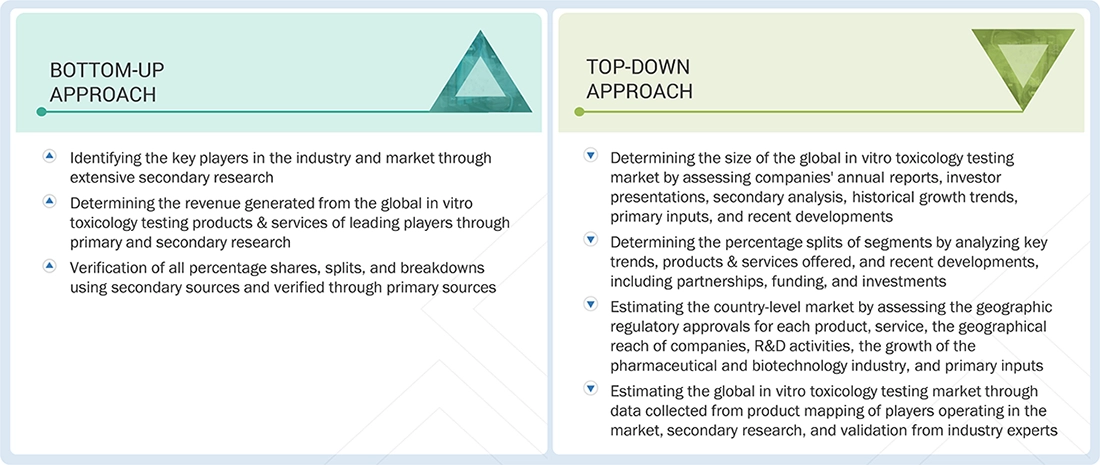
The global size of the in vitro toxicology testing market was estimated through multiple approaches. A detailed market estimation approach was used to estimate and validate the market value and other dependent submarkets. These methods were also used extensively to estimate the size of various subsegments in the market.
Data Triangulation
After estimating the overall market size from the market size estimation process, the total market was split into several segments. To complete the overall market engineering process and arrive at the exact statistics for all segments, the data triangulation procedure was employed; it involved studying various factors and trends from both the demand and supply sides.
Market Definition
Toxicology/Toxicity testing is required to evaluate compounds to identify their potential adverse effects to assure safety for human and environmental use. In vitro toxicology testing is ideally suited for the investigation of molecular, cellular, and physiological mechanisms of chemically induced toxicity, which cannot readily be studied in vivo. In vitro toxicology testing is widely used by pharmaceutical and biopharmaceutical, consumer care, food, and other industries.
Key Stakeholders
- Academic Research Institutes
- Biotechnology Companies
- Pharmaceutical & Biopharmaceutical Companies
- Chemical Companies
- Medical Device Companies
- Food & Beverage Manufacturers
- Contract Research Organizations (CROs)
- Market Research & Consulting Firms
- Venture Capitalists & Investors
- Government Associations
Report Objectives
- To define, describe, and forecast the in vitro toxicology testing market by offering, product type, toxicity end point and test, technology, method, end user, service type, method, end user, and region
- To provide detailed information regarding the major factors (such as drivers, restraints, opportunities, and challenges) influencing the market growth
- To analyze the micromarkets with respect to individual growth trends, prospects, and contributions to the overall in vitro toxicology testing market
- To analyze the opportunities for stakeholders and provide details of the competitive landscape for market leaders
- To forecast the size of the market segments with respect to six regions: North America (US and Canada), Europe (Germany, France, the UK, Italy, Spain, and the Rest of Europe), Asia Pacific (China, Japan, India, South Korea, Australia, and the Rest of Asia Pacific), Latin America (Brazil, Mexico, Argentina, and the Rest of Latin America), Middle East [GCC (Saudi Arabia, United Arab Emirates, and the Rest of GCC) and the Rest of Middle East], and Africa
- To profile the key players and analyze their market shares and core competencies
- To track and analyze competitive developments, such as product/ service launches, partnerships, agreements, acquisitions, collaborations, and expansions
- To benchmark players within the market using the proprietary “Company Evaluation Matrix” framework, which analyzes market players on various parameters within the broad categories of business and product excellence strategy.
Available customizations:
With the given market data, MarketsandMarkets offers customizations as per the company’s specific needs. The following customization options are available for the report:
Geographical Analysis
- Further breakdown of the Rest of Europe in vitro toxicology testing market, by country
- Further breakdown of the Rest of Asia Pacific in vitro toxicology testing market, by country
Company Information
- Detailed analysis and profiling of additional market players (up to five)
Segment Analysis
- Cross-segment analysis
Get the Full In Vitro Toxicology Testing Market Report
Full forecast, segment splits, and company analysis for all In Vitro Toxicology Testing Market.
- Australia In Vitro Toxicology Testing Market
- Brazil In Vitro Toxicology Testing Market
- Canada In Vitro Toxicology Testing Market
- China In Vitro Toxicology Testing Market
- France In Vitro Toxicology Testing Market
- Germany In Vitro Toxicology Testing Market
- India In Vitro Toxicology Testing Market
- Italy In Vitro Toxicology Testing Market
- Japan In Vitro Toxicology Testing Market
- Mexico In Vitro Toxicology Testing Market
- Rest Of Asia Pacific In Vitro Toxicology Testing Market
- Rest Of Europe In Vitro Toxicology Testing Market
- Rest Of Latin America In Vitro Toxicology Testing Market
- Saudi Arabia In Vitro Toxicology Testing Market
- South Korea In Vitro Toxicology Testing Market
- Spain In Vitro Toxicology Testing Market
- UAE In Vitro Toxicology Testing Market
- UK In Vitro Toxicology Testing Market
- US In Vitro Toxicology Testing Market
Need a Tailored Report?
Customize this report to your needs
Get 10% FREE Customization
Customize This Report