
Rest Of Asia Pacific Incontinence Care Products Market (2025-2030)

The Rest Of Asia Pacific Incontinence Care Products Market was valued at $420.8 Million in 2025 and projected to reach to $594.6 Million by 2030, representing a compound annual growth rate of 7.2%. The Rest Of Asia Pacific incontinence care products market is positioned for sustained growth through 2030, driven by demographic shifts and socioeconomic improvements.


| Market Size in | USD 26.32 MN |
| Market Forecast in | |
| CAGR | |
| Forecast Period | |
| Units Considered | Value (USD MN) |
Rest Of Asia Pacific Incontinence Care Products Market Trends and Insights
- Rest Of Asia Pacific is experiencing significant growth driven by aging populations, increasing healthcare awareness, and rising disposable incomes across emerging economies.
- The region's market expansion reflects growing demand for adult diapers, protective undergarments, and related hygiene solutions as healthcare infrastructure improves. Rest Of Asia Pacific's incontinence care products market benefits from demographic shifts and improved access to healthcare products in developing nations.
- Between 2025 and 2030, Rest Of Asia Pacific is expected to see accelerated adoption of premium and specialized incontinence products.
- The region's market growth is supported by expanding retail distribution networks, e-commerce penetration, and increasing consumer education about incontinence management solutions..
Key Market Statistics
- CAGR (2025-2030) 7.2% CAGR
- Market Size, 2025 ~USD 420.8 Million
- Forecast, 2030 ~USD 594.6 Million
- Country Rest Of Asia Pacific
Rest Of Asia Pacific Incontinence Care Products Market Overview
Rapid Market Expansion :
Rest Of Asia Pacific incontinence care products market is growing at 7.2% CAGR, reaching USD 594.6 million by 2030 from USD 420.8 million in 2025, outpacing global growth of 7.1%.
Aging Population Dynamics :
Emerging economies across Rest Of Asia Pacific are experiencing accelerated aging demographics, driving increased demand for adult incontinence products and specialized care solutions.
Rising Healthcare Awareness :
Growing consumer education and reduced stigma around incontinence management in Rest Of Asia Pacific countries are expanding market penetration and product adoption rates.
Increasing Disposable Incomes :
Rising middle-class populations and improved purchasing power across Rest Of Asia Pacific emerging economies are enabling greater spending on premium incontinence care products.
Rest Of Asia Pacific Incontinence Care Products Market Dynamics
- Aging populations across countries like Vietnam, Thailand, and Indonesia are creating substantial demand for adult diapers, protective undergarments, and related care products.
- Healthcare infrastructure improvements and government initiatives promoting elderly care are further accelerating market expansion.
- Rising disposable incomes enable consumers to transition toward premium and branded products, enhancing market value beyond volume growth.
- Digital health platforms and e-commerce channels are improving product accessibility in underserved regions, unlocking new customer segments and distribution opportunities..
Market Ecosystem
Related Ecosystem
Medical Devices
- Polymerase Chain Reaction (PCR)
- Magnetic Resonance Imaging (MRI)
- Disposable Autoinjectors
- Pulse Oximeters
- Blood Pressure Monitors
- Medtronic plc
- Abbott Laboratories
- Stryker Corporation
- Becton, Dickinson and Company
- JOHNSON & JOHNSON
Key Takeaways
- Rest Of Asia Pacific's incontinence care products market is valued at USD 420.8 million in 2025 and will reach USD 594.6 million by 2030.
- Rest Of Asia Pacific is growing at a 7.2% CAGR, driven by aging demographics and rising healthcare awareness.
- Rest Of Asia Pacific's market expansion is supported by improving e-commerce infrastructure and retail distribution networks.
- Rest Of Asia Pacific shows strong demand for premium incontinence products as consumer purchasing power increases.
Incontinence Care Products Market Report Scope
| Report Metric | Details |
|---|---|
| Base Year | 2025 |
| Fastest Growing Segment | PADS & GUARDS (Type) |
| Forecast Period | 2025-2030 |
| Growth Rate | CAGR of 7.1% from 2025 to 2030 |
| Largest Segment | DISPOSABLE (Usage) |
| Market Size Base Year (Billions) | ~USD 14.8 (2025) |
| Revenue Forecast (Billions) | ~USD 20.85 (2030) |
| Segments Covered | Product, Type, Usage, Gender, End User |
Rest Of Asia Pacific Incontinence Care Products Market Report Segmentation
5 segment dimensions are covered across the global market.
By Product
- Absorbents
- Non-Absorbents
- Non-Absorbents
By Type
- Bed Protectors
- Catheters
- Drainage Bags
- External Catheters
- Fecal Incontinence
- Indwelling Catheters
- Intermittent Catheters
- Other Absorbents
- Other Non-Absorbents
- Pads & Guards
- Stimulation Devices
- Underwear & Briefs
- Urinary Incontinence
By Usage
- Disposable
- Reusable
By Gender
- Female
- Male
By End User
- Home Care
- Hospitals & Ambulatory Surgery Centers (Ascs)
- Hospitals & Ascs
- Other End Users
Target Audience
- Medical Device Manufacturers : Incontinence product manufacturers need Rest Of Asia Pacific market data to identify growth opportunities, assess regional demand, and develop localized product strategies for emerging economies.
- Healthcare Investors & PE Firms : Investment professionals require detailed Rest Of Asia Pacific market forecasts and growth drivers to evaluate portfolio opportunities and assess returns in high-growth incontinence care segments.
- Distribution & Retail Partners : Distributors and retailers need Rest Of Asia Pacific market insights to understand demand patterns, optimize inventory, and identify underserved regions for expansion and partnership development.
- Government & Healthcare Policymakers : Policy officials and healthcare administrators require Rest Of Asia Pacific market analysis to inform elderly care initiatives, healthcare infrastructure planning, and regulatory framework development.
- Market Research & Consulting Firms : Research organizations need comprehensive Rest Of Asia Pacific data to support client advisory services, competitive benchmarking, and strategic recommendations in incontinence care markets.
Reasons to Buy this Report
- Regional Market Sizing & Forecasts : Obtain precise market valuations for Rest Of Asia Pacific (USD 420.8M in 2025, USD 594.6M in 2030) with detailed CAGR analysis to support strategic planning and investment decisions.
- Demographic & Growth Driver Analysis : Understand aging population trends, healthcare awareness expansion, and disposable income growth specific to Rest Of Asia Pacific emerging economies driving incontinence product demand.
- Competitive Landscape Intelligence : Identify market opportunities, competitive positioning, and emerging players within Rest Of Asia Pacific to develop targeted go-to-market strategies and partnership approaches.
- Country-Level Market Insights : Access granular data on individual Rest Of Asia Pacific markets including Vietnam, Thailand, Indonesia, and others to prioritize expansion and resource allocation decisions.
- Distribution & Channel Strategy : Leverage insights on e-commerce penetration, retail channels, and healthcare distribution networks specific to Rest Of Asia Pacific to optimize market entry and scaling strategies.
Frequently asked questions
What is the market size of incontinence care products in Rest Of Asia Pacific in 2025?
Rest Of Asia Pacific's incontinence care products market is valued at USD 420.8 million in 2025.
What is the projected market size for Rest Of Asia Pacific by 2030?
Rest Of Asia Pacific's incontinence care products market is projected to reach USD 594.6 million by 2030.
What is the CAGR for Rest Of Asia Pacific's incontinence care products market?
Rest Of Asia Pacific's incontinence care products market is growing at a CAGR of 7.2% from 2025 to 2030.
What factors are driving growth in Rest Of Asia Pacific's incontinence care market?
Rest Of Asia Pacific's market growth is driven by aging populations, increasing healthcare awareness, rising disposable incomes, and expanding e-commerce and retail distribution networks.
Which product types are most in demand in Rest Of Asia Pacific?
Rest Of Asia Pacific shows strong demand for adult diapers, protective undergarments, and specialized incontinence management solutions, with growing preference for premium products.
RESEARCH METHODOLOGY
This study involved the extensive use of both primary & secondary sources. A comprehensive study was conducted using secondary research methods to gather data about the market, its parent market, and its peer markets. The next stage involved conducting primary research to confirm these conclusions and assumptions and sizing with industry experts throughout the value chain. A combination of top-down and bottom-up methods was used to assess the overall market size. The market sizes of segments and subsegments were then estimated using data triangulation techniques and market breakdown.
Secondary Research
The secondary research process involves the widespread use of secondary sources, directories, databases (such as Bloomberg Businessweek, Factiva, and D&B Hoovers), white papers, annual reports, investor presentations; SEC filings of companies & publications from government sources such as National Institutes of Health (NIH), the US FDA, US Census Bureau, World Health Organization (WHO), International Trade Administration (ITA), Association for Continence Advice (ACA), The American Urological Association (AUA), The International Continence Society (ICS), and World Federation of Incontinence and Pelvic Problems (WFIPP) were referred to identify & collect information for the global incontinence care products market study. It was also used to obtain important information about the key players and market classification & segmentation according to industry trends, to the bottom-most level, and key developments related to market and technology perspectives. A database of the key industry leaders was also prepared using secondary research.
Primary Research
In the primary research process, various sources from the supply and demand sides were interviewed to obtain qualitative and quantitative information for this report. The primary sources from the supply side include industry experts such as CEOs, vice presidents, marketing and sales directors, technology & innovation directors, and related key executives from various key companies and organizations in the incontinence care products market. The primary sources from the demand side include home care, hospitals & ASCs, and other end users. Primary research was conducted to validate the market segmentation, identify key players, and gather insights on key industry trends & key market dynamics.
A breakdown of the primary respondents is provided below:
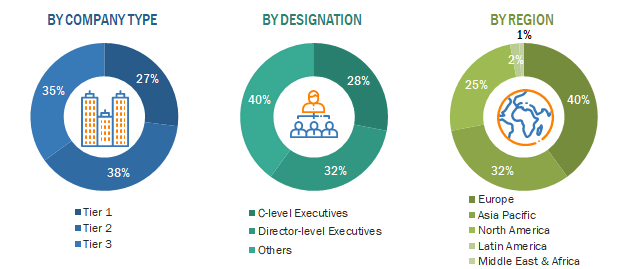
Note 1: C-level primaries include CEOs, CFOs, COOs, and VPs.
Note 2: Other designations include sales managers, marketing managers, business development managers, product managers, distributors, and suppliers.
Note 3: Tiers are defined based on a company’s total revenue. As of 2024, Tier 1= >USD 10 billion, Tier 2 = USD 1 billion to USD 10 billion, and Tier 3 = < USD 1 billion.
To know about the assumptions considered for the study, download the pdf brochure
Market Size Estimation
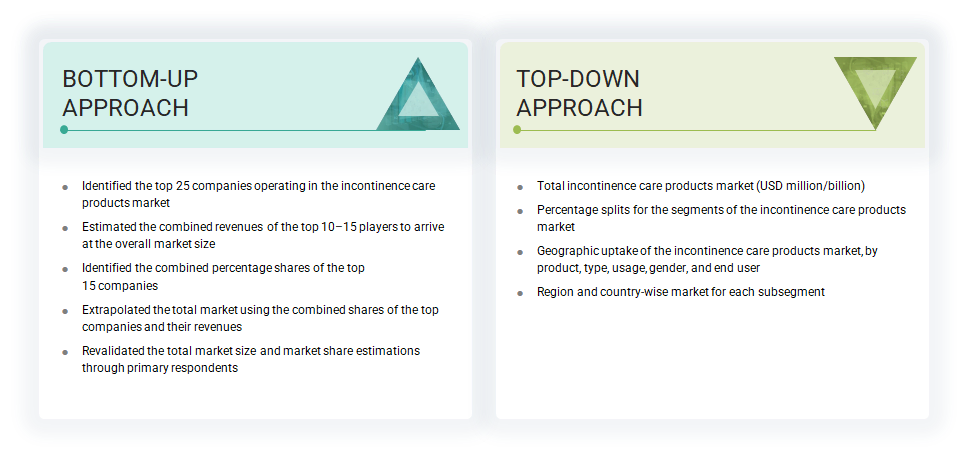
For the global market value, annual revenues were calculated based on the revenue mapping of major product manufacturers and OEMs active in the global incontinence care products market. All the major product manufacturers were identified at the global and/or country/regional level. Revenue mapping for the respective business segments/subsegments was done for the major players. The global incontinence care products market was split into various segments and subsegments based on:
- List of major players operating in the incontinence care products market at the regional and/or country level.
- Product mapping of various manufacturers of incontinence care products at the regional and/or country level.
- Mapping of annual revenue generated by listed major players from incontinence care products (or the nearest reported business unit/product category).
- Extrapolation of the revenue mapping of the listed players to derive the global market value of the respective segments/subsegments.
- Summation of the market value of all segments/subsegments to arrive at the global incontinence care products market.
The above data was consolidated and added with detailed inputs and analysis from MarketsandMarkets and presented in this report.
Market Size Estimation (Bottom-up Approach & Top-down Approach)
Data Triangulation
After arriving at the global incontinence care products market's overall size through the methodology mentioned above, this market was split into several segments and subsegments. Where applicable, the data triangulation and market breakdown procedures were employed to complete the overall market engineering process and arrive at the exact market value data for the key segments and subsegments. Examining several macro-variables and regional trends from demand- and supply-side players helped triangulate the extrapolated market data.
Market Definition
Incontinence refers to an involuntary loss of urine or feces due to problems with the muscles and nerves of the bladder or bowel. Urinary incontinence is defined as the loss of urine from the bladder, while fecal incontinence refers to the involuntary loss of feces from the bowel. Stress, urge, mixed, overflow, and functional incontinence are some of the most commonly occurring types of urinary and bowel incontinence, observed usually in the elderly population or in patients with certain illnesses. Absorbent products such as underwear and briefs (diapers), pads, and bed protectors are used to manage incontinence. Non-absorbent products such as catheters are also used in some cases.
Stakeholders
- Manufacturers & vendors of incontinence products
- Research associations involved in incontinence care
- Research & consulting firms
- Distributors of incontinence products
- Healthcare institutions
- Government bodies/municipal corporations
- Regulatory bodies
- Business research & consulting service providers
- Venture capitalists
- Market research & consulting firms
Report Objectives
- To define, describe, and forecast the incontinence care products market based on product, type, usage, gender, end user, and region
- To provide detailed information regarding the major factors influencing market growth (such as drivers, restraints, opportunities, and industry-specific challenges)
- To assess the incontinence care products market concerning Porter’s Five Forces, regulatory landscape, the value chain, the supply chain, patent analysis, pricing analysis, key stakeholders, and buying criteria
- To strategically analyze micromarkets concerning individual growth trends, prospects, and contributions to the overall incontinence care products market
- To analyze the opportunities in the incontinence care products market for stakeholders and provide details of the competitive landscape for market leaders
- To forecast the size of the incontinence care products market in five regions (along with countries): North America, Europe, the Asia Pacific, Latin America, and the Middle East & Africa
- To profile the key players operating in the incontinence care products market and comprehensively analyze their core competencies and market shares
- To track & analyze competitive developments such as partnerships, agreements, acquisitions, expansions, and product developments.
- To benchmark players within the incontinence care products market using the Company Evaluation Matrix framework, which analyzes market players on various parameters within categories of business strategies, market share, and product offerings
- To understand the impact of AI/generative AI on the market
Get the Full Incontinence Care Products Market Report
Full forecast, segment splits, and company analysis for all Incontinence Care Products Market.
- Germany Incontinence Care Products Market
- UK Incontinence Care Products Market
- France Incontinence Care Products Market
- Italy Incontinence Care Products Market
- Spain Incontinence Care Products Market
- Canada Incontinence Care Products Market
- US Incontinence Care Products Market
- China Incontinence Care Products Market
- Japan Incontinence Care Products Market
- India Incontinence Care Products Market
- South Korea Incontinence Care Products Market
- Brazil Incontinence Care Products Market
- Mexico Incontinence Care Products Market
- Rest Of Europe Incontinence Care Products Market
- Rest Of Latin America Incontinence Care Products Market
Need a Tailored Report?
Customize this report to your needs
Get 10% FREE Customization
Customize This Report
