
South Korea Industrial Sensors Market (2024-2029)

The South Korea Industrial Sensors Market was valued at $559.7 Million in 2024 and projected to reach to $843.7 Million by 2029, representing a compound annual growth rate of 8.6%. South Korea's industrial sensors market is poised for sustained expansion, driven by the country's commitment to advanced manufacturing and digital transformation initiatives.


| Market Size in | USD 26.32 MN |
| Market Forecast in | |
| CAGR | |
| Forecast Period | |
| Units Considered | Value (USD MN) |
South Korea Industrial Sensors Market Trends and Insights
- This expansion reflects South Korea's position as a global manufacturing and technology hub, where advanced automation and Industry 4.0 adoption drive demand for sophisticated sensor solutions across automotive, electronics, and chemical processing sectors.
- South Korea's strong semiconductor ecosystem and export-oriented economy create favorable conditions for industrial sensor deployment. The 8.6% compound annual growth rate (CAGR) through 2029 underscores South Korea's commitment to digital transformation and smart factory initiatives.
- South Korea's government support for manufacturing innovation, coupled with the presence of major conglomerates investing in automation, accelerates sensor adoption.
- South Korea's competitive advantage in precision manufacturing and IoT integration positions the country as a key market for both domestic and international sensor manufacturers seeking to serve Asia Pacific's industrial base..
Key Market Statistics
- CAGR (2024-2029) 8.6% CAGR
- Market Size, 2024 ~USD 559.7 Million
- Forecast, 2029 ~USD 843.7 Million
- Country South Korea
South Korea Industrial Sensors Market Overview
Manufacturing Excellence Hub :
South Korea's dominance in automotive and electronics manufacturing drives consistent demand for advanced industrial sensors, with major OEMs requiring cutting-edge automation solutions.
Industry 4.0 Adoption :
Rapid digital transformation across South Korean factories accelerates sensor deployment for real-time monitoring, predictive maintenance, and smart factory implementations.
Strong CAGR Performance :
At 8.6% CAGR (2024-2029), South Korea's market growth slightly outpaces the global average of 8.5%, reflecting regional technological advancement and industrial investment.
Semiconductor & Electronics Focus :
South Korea's world-leading semiconductor and electronics sectors create substantial demand for precision sensors in manufacturing processes and quality control applications.
South Korea Industrial Sensors Market Dynamics
- The market's growth trajectory reflects increasing investments in automation technologies across automotive, semiconductor, and chemical processing industries, where sensor integration is critical for operational efficiency and product quality.
- Government support for smart factory initiatives and Industry 4.0 adoption further accelerates market penetration. Looking ahead to 2029, South Korea's industrial sensors market will benefit from rising labor costs incentivizing automation, growing IoT integration in manufacturing facilities, and heightened focus on predictive maintenance solutions.
- The competitive landscape will intensify as both domestic and international sensor manufacturers target South Korea's premium manufacturing sector, driving innovation and technological advancement across the region..
Market Ecosystem
Related Ecosystem
Industrial Automation
- Sensors
- Image Sensors
- Manufacturing Execution System (MES)
- Actuators
- Flow Sensors
- Siemens ag
- ABB India Limited
- Emerson Electric Co.
- HONEYWELL INTERNATIONAL INC.
- SCHNEIDER ELECTRIC SE
Industrial Iot
- Sensors
- Pressure Sensors
- Flow Sensors
- Gas Sensors
- Image Sensors
- Siemens ag
- ABB India Limited
- HONEYWELL INTERNATIONAL INC.
- Emerson Electric Co.
- SCHNEIDER ELECTRIC SE
Sensors And Control
- Sensors
- Temperature Sensors
- Image Sensors
- Pressure Sensors
- Flow Sensors
- BAUMER ELECTRIC AG
- HONEYWELL INTERNATIONAL INC.
- Stmicroelectronics
- Lenovo
- Texas Instruments Incorporated
Key Takeaways
- South Korea's industrial sensors market will grow from USD 559.7M (2024) to USD 843.7M (2029), representing a 50.7% increase over five years.
- South Korea's 8.6% CAGR reflects strong demand driven by automotive, semiconductor, and smart manufacturing sectors.
- South Korea's government initiatives and chaebol investments in Industry 4.0 accelerate sensor technology adoption.
- South Korea's advanced manufacturing ecosystem positions it as a critical hub for industrial sensor innovation and deployment in Asia Pacific.
Industrial Sensors Market Report Scope
| Report Metric | Details |
|---|---|
| Base Year | 2024 |
| Fastest Growing Segment | IMAGE SENSORS (Sensor Type) |
| Forecast Period | 2024-2029 |
| Growth Rate | CAGR of 8.5% from 2024 to 2029 |
| Largest Segment | CONTACT SENSORS (Type) |
| Market Size Base Year (Billions) | ~USD 28 (2024) |
| Revenue Forecast (Billions) | ~USD 42.1 (2029) |
| Segments Covered | Sensor Type, Type, End-User Industry, Position Sensor Type |
South Korea Industrial Sensors Market Report Segmentation
4 segment dimensions are covered across the global market.
By Sensor Type
- Flow Sensors
- Force Sensors
- Gas Sensors
- Humidity & Moisture Sensors
- Image Sensors
- Level Sensors
- Position Sensors
- Pressure Sensors
- Temperature Sensors
By Type
- Contact Sensors
- Non-Contact Sensors
By End-User Industry
- Chemicals
- Energy & Power
- Energy And Power
- Manufacturing
- Mining
- Oil & Gas
- Pharmaceuticals
By Position Sensor Type
- Linear Position Sensors
- Rotary Position Sensors
Target Audience
- Sensor Manufacturers & Suppliers : Develop market entry strategies and product portfolios tailored to South Korea's premium manufacturing sector and advanced automation requirements.
- Automotive & Electronics OEMs : Evaluate sensor technology trends and supplier landscapes in South Korea to optimize supply chain decisions and manufacturing automation investments.
- Industrial Automation Integrators : Understand South Korea's smart factory adoption trajectory and sensor integration opportunities to design comprehensive automation solutions for local manufacturers.
- Investment & Private Equity Firms : Assess market growth potential and investment opportunities in South Korea's industrial sensors sector and related automation technology companies.
- Government & Policy Makers : Leverage market data to inform industrial policy, manufacturing competitiveness initiatives, and technology adoption programs supporting South Korea's manufacturing sector.
Reasons to Buy this Report
- Localized Market Intelligence : Gain deep insights specific to South Korea's manufacturing ecosystem, including regional adoption patterns, competitive dynamics, and technology preferences unique to Korean industrial sectors.
- Strategic Investment Planning : Make informed decisions about market entry, expansion, or partnership opportunities in South Korea with accurate sizing data and growth projections through 2029.
- Competitive Benchmarking : Understand South Korea's market performance relative to global trends, identify regional growth drivers, and assess competitive positioning within Asia's leading manufacturing economy.
- Sector-Specific Opportunities : Identify high-growth applications across South Korea's automotive, electronics, and chemical processing industries where sensor demand is accelerating fastest.
- Technology Adoption Insights : Understand Industry 4.0 and smart factory adoption rates in South Korea, enabling targeted product development and marketing strategies for automation-focused customers.
Frequently asked questions
What is the current size of South Korea's industrial sensors market?
South Korea's industrial sensors market was valued at USD 559.7 million in 2024 and is projected to reach USD 843.7 million by 2029.
What is the expected growth rate for South Korea's industrial sensors market?
South Korea's industrial sensors market is expected to grow at a compound annual growth rate (CAGR) of 8.6% from 2024 to 2029.
Which industries drive demand for industrial sensors in South Korea?
South Korea's automotive, semiconductor manufacturing, electronics, and chemical processing industries are primary drivers of industrial sensor demand.
Why is South Korea a significant market for industrial sensors?
South Korea's advanced manufacturing base, strong semiconductor ecosystem, government support for Industry 4.0, and presence of major technology conglomerates make it a critical market for industrial sensor adoption.
What factors support growth in South Korea's industrial sensors market through 2029?
South Korea's digital transformation initiatives, smart factory investments, export-oriented manufacturing economy, and IoT integration drive sustained growth in the industrial sensors market.
RESEARCH METHODOLOGY
The research process for this study included systematic gathering, recording, and analysis of data about customers and companies operating in the industrial sensor market. This process involved the extensive use of secondary sources, directories, and databases (Factiva, Oanda, and OneSource) for identifying and collecting valuable information for the comprehensive, technical, market-oriented, and commercial study of the industrial sensor market. In-depth interviews were conducted with primary respondents, including experts from core and related industries and preferred manufacturers, to obtain and verify critical qualitative and quantitative information as well as to assess growth prospects. Key players in the industrial sensor market were identified through secondary research, and their market rankings were determined through primary and secondary research. This research included studying annual reports of top players and interviewing key industry experts such as CEOs, directors, and marketing executives.
Secondary Research
In the secondary research process, various sources were used to identify and collect information important for this study. These include annual reports, press releases & investor presentations of companies, white papers, technology journals, certified publications, articles by recognized authors, directories, and databases.
Secondary research was mainly used to obtain key information about the industry's supply chain, the total pool of market players, the classification of the market according to industry trends to the bottom-most level, regional markets, and key developments from the market and technology-oriented perspectives.
Primary Research
Primary research was also conducted to identify the segmentation types, key players, competitive landscape, and key market dynamics, such as drivers, restraints, opportunities, challenges, and industry trends, along with key strategies adopted by players operating in the industrial sensor market. Extensive qualitative and quantitative analyses were performed on the complete market engineering process to list key information and insights throughout the report.
Extensive primary research has been conducted after acquiring knowledge about the industrial sensor market scenario through secondary research. Several primary interviews have been conducted with experts from both demand (end users) and supply side (industrial sensor manufacturers/providers) across four major geographic regions: North America, Europe, Asia Pacific, and RoW. Approximately 80% and 20% of the primary interviews were conducted from the supply and demand side, respectively. These primary data have been collected through questionnaires, emails, and telephonic interviews.
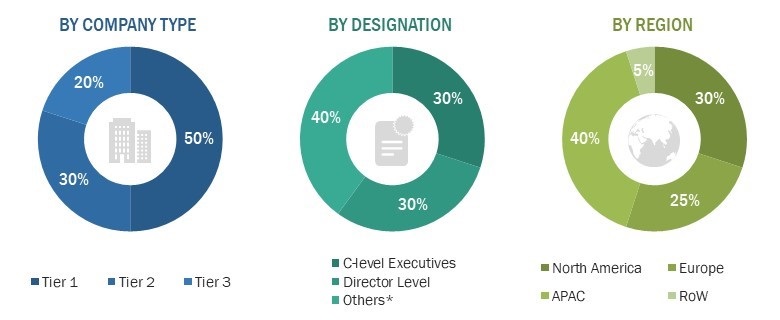
To know about the assumptions considered for the study, download the pdf brochure
Market Size Estimation
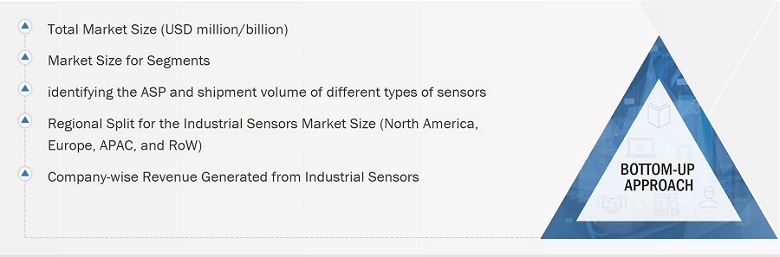
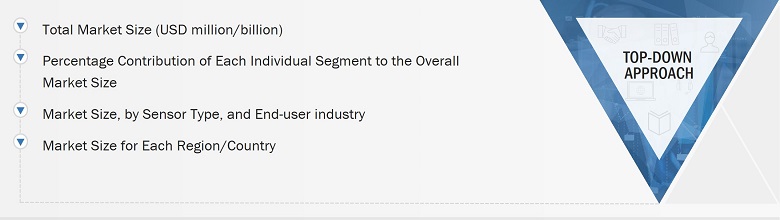
In the complete market engineering process, both top-down and bottom-up approaches were implemented, along with several data triangulation methods, to estimate and validate the size of the industrial sensor market and various other dependent submarkets. Key players in the market were identified through secondary research, and their market share in the respective regions was determined through primary and secondary research. This entire research methodology included the study of annual and financial reports of the top players, as well as interviews with experts (such as CEOs, VPs, directors, and marketing executives) for key insights (quantitative and qualitative).
All percentage shares, splits, and breakdowns were determined using secondary sources and verified through primary sources. All the possible parameters that affect the markets covered in this research study were accounted for, viewed in detail, verified through primary research, and analyzed to obtain the final quantitative and qualitative data. This data was consolidated and supplemented with detailed inputs and analysis from MarketsandMarkets and presented in this report.
Industrial Sensor Market: Bottom-Up Approach
Industrial Sensor Market: Top-down Approach
Data Triangulation
After arriving at the overall market size from the market size estimation process, as explained above, the total market has been split into several segments and subsegments. To complete the overall market engineering process and arrive at the exact statistics for all segments and subsegments, market breakdown and data triangulation procedures have been employed, wherever applicable. The data have been triangulated by studying various factors and trends from both the demand and supply sides. Along with this, the market has been validated using top-down and bottom-up approaches.
Market Definition
Industrial sensors are tiny devices that detect and measure physical changes in their environment, such as temperature, pressure, movement, and levels of liquids and solids. This information is then sent to computers or other systems, where it is used to control machines, monitor processes, and ensure safety and quality. These are specifically designed for industrial applications in several end-use industries such as manufacturing, oil & gas, chemicals, mining, and energy & power. A sensor is a device that detects and responds to specific inputs, e.g., pressure, position, level, gas, temperature, image humidity, flow, motion, and force, received from the physical environment.
Key Stakeholders
- Raw material suppliers
- Component manufacturers and providers
- Sensor manufacturers and providers
- Original equipment manufacturers (OEMs)
- Technology solution providers
- Application providers
- System integrators
- Middleware providers
- Assembly, testing, and packaging vendors
- Market research and consulting firms
- Associations, organizations, forums, and alliances related to the industrial sensors industry
- Technology investors
- Governments, regulatory bodies, and financial institutions
- Venture capitalists, private equity firms, and start-ups
- End Users
Report Objectives
- To describe, segment, and forecast the industrial sensor market, in terms of value, based on sensor type, type, and end user.
- To describe and forecast the market for four key regions: North America, Europe, Asia Pacific, and the Rest of the World (RoW), in terms of value.
- To provide detailed information regarding drivers, restraints, opportunities, and challenges influencing the growth of the industrial sensor market
- To provide a detailed overview of the supply chain and ecosystem pertaining to the industrial sensor market, along with the average selling prices of components of the industrial sensor market.
- To strategically analyze the ecosystem, tariffs and regulations, patent landscape, trade landscape, and case studies pertaining to the market under study
- To strategically analyze micro markets with regard to individual growth trends, prospects, and contributions to the overall market
- To analyze opportunities in the market for stakeholders and provide a competitive landscape of the market
- To analyze competitive developments such as product launches and developments, expansions, partnerships, collaborations, and acquisitions in the industrial sensor market
- To strategically profile the key players in the industrial sensor market and comprehensively analyze their market ranking and core competencies
Available Customizations
With the given market data, MarketsandMarkets offers customizations according to the company’s specific needs. The following customization options are available for the report:
Company Information
- Detailed analysis and profiling of additional market players (up to 5)
Get the Full Industrial Sensors Market Report
Full forecast, segment splits, and company analysis for all Industrial Sensors Market.
- US Industrial Sensors Market
- Canada Industrial Sensors Market
- Mexico Industrial Sensors Market
- UK Industrial Sensors Market
- Germany Industrial Sensors Market
- France Industrial Sensors Market
- China Industrial Sensors Market
- Japan Industrial Sensors Market
- India Industrial Sensors Market
- Rest Of Europe Industrial Sensors Market
- Rest Of Asia Pacific Industrial Sensors Market
Need a Tailored Report?
Customize this report to your needs
Get 10% FREE Customization
Customize This Report
