
Japan Infrared Detector Market (2025-2030)

The Japan Infrared Detector Market was valued at $22.2 Million in 2025 and projected to reach to $36.6 Million by 2030, representing a compound annual growth rate of 10.5%. Japan's infrared detector market is positioned for sustained expansion through 2030, driven by the country's leadership in automotive technology and semiconductor manufacturing.


| Market Size in | USD 26.32 MN |
| Market Forecast in | |
| CAGR | |
| Forecast Period | |
| Units Considered | Value (USD MN) |
Japan Infrared Detector Market Trends and Insights
- Japan's advanced manufacturing capabilities and strong semiconductor ecosystem position the country as a key player in infrared detection technology development.
- The market in Japan is driven by increasing demand from automotive thermal imaging, industrial automation, and consumer electronics applications, where Japanese manufacturers maintain significant competitive advantages. The 10.5% compound annual growth rate in Japan reflects the country's commitment to innovation in sensor technologies and rising adoption of infrared solutions across multiple sectors.
- Japan's investment in research and development, coupled with its established supply chain networks, supports sustained market expansion through 2030.
- Strategic partnerships between Japanese electronics firms and global technology leaders are accelerating the commercialization of next-generation infrared detector solutions within Japan's market..
Key Market Statistics
- CAGR (2025-2030) 10.5% CAGR
- Market Size, 2025 ~USD 22.2 Million
- Forecast, 2030 ~USD 36.6 Million
- Country Japan
Japan Infrared Detector Market Overview
Market Valuation Growth :
Japan's infrared detector market is valued at USD 22.2 million in 2025, with a projected CAGR of 10.5%, reaching USD 36.6 million by 2030, outpacing the global average of 9.6%.
Advanced Manufacturing Ecosystem :
Japan's world-class semiconductor manufacturing infrastructure and precision engineering capabilities provide a competitive advantage in developing cutting-edge infrared detection technologies.
Automotive Thermal Imaging Demand :
The Japanese automotive sector's adoption of thermal imaging systems for advanced driver assistance systems (ADAS) and autonomous vehicle development is a primary growth driver for infrared detectors.
Technology Innovation Hub :
Japan's leading electronics manufacturers and research institutions are driving innovation in infrared sensor miniaturization, sensitivity enhancement, and cost reduction for consumer and industrial applications.
Japan Infrared Detector Market Dynamics
- The integration of thermal imaging in next-generation vehicles, coupled with increasing adoption in industrial automation and surveillance systems, creates significant growth opportunities.
- Japan's commitment to technological advancement and quality manufacturing ensures its continued prominence in the global infrared detection landscape. The market will benefit from rising investments in autonomous vehicle development, IoT applications, and smart building technologies.
- Japanese manufacturers' focus on miniaturization and cost efficiency will enable broader market penetration across consumer electronics and industrial sectors, solidifying Japan's position as a key regional hub for infrared detector innovation and production..
Market Ecosystem
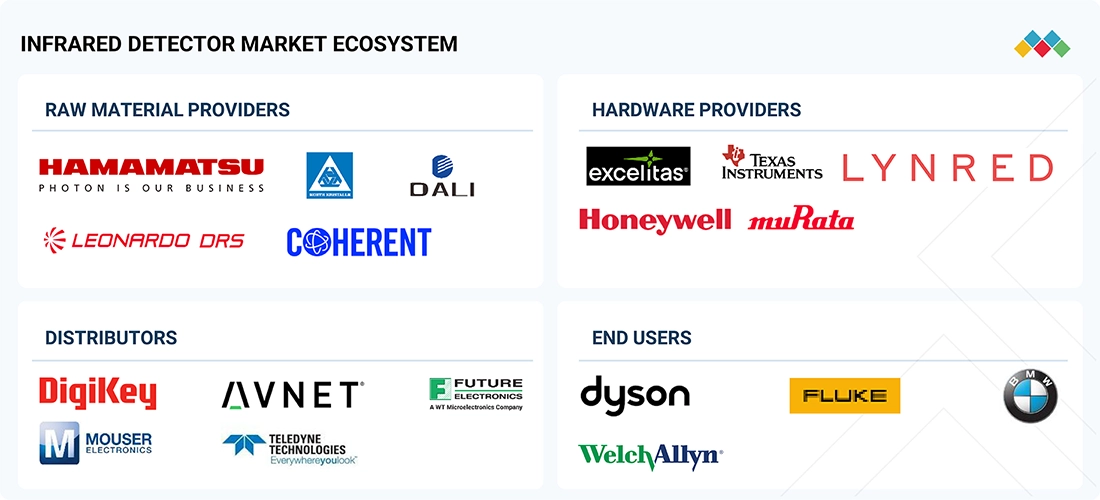
Infrared Detector Market: COMMERCIAL USE CASES ACROSS INDUSTRIES
| COMPANY | USE CASE DESCRIPTION | BENEFITS |
|---|---|---|
 |
Deployed infrared detectors for continuous monitoring of blast furnaces and rolling mills to detect hotspots, surface defects, and equipment overheating | Improved safety, reduced downtime, early fault detection in high-temperature processes, and enhanced product quality in steel manufacturing |
 |
Research-led deployment of infrared thermography for building energy efficiency studies, insulation defect detection, and predictive maintenance of lab equipment | Reduced energy consumption, improved sustainability, data-driven facility management, and enhanced research outcomes in applied thermography |
 |
Integrated IR detector systems with AI-based analytics to accelerate soil and groundwater contamination remediation by identifying pollutant signatures | Reduced remediation timelines from decades to years, lower environmental impact, higher remediation accuracy, and significant cost savings in environmental projects |
 |
Incorporated pyroelectric IR detectors into portable FTIR spectrometers for hazardous chemical identification in defense and emergency response | Increased field safety, faster chemical threat detection, improved compliance with safety protocols, and reliable detection of unknown substances |
 |
Embedded IR detectors in its fuel and oil analyzers (ERASPEC) to precisely measure chemical composition and properties of petroleum products | Optimized fuel quality testing, regulatory compliance, faster lab results, and reliable performance in petrochemical and refining sectors |
Logos and trademarks shown above are the property of their respective owners. Their use here is for informational and illustrative purposes only.
Related Ecosystem
Application Security
- Cloud Security
- Security Analytics
- Network Testing
- Web Application Security
- Biometric Security and Authentication System
- International Business Machines Corporation
- MICROSOFT CORPORATION
- Cisco Systems, Inc.
- PALO ALTO NETWORKS, INC
- Fortinet, Inc.
Electronics System And Components
- Sensors
- Temperature Sensors
- Pressure Sensors
- Actuators
- Image Sensors
- Lenovo
- Samsung
- Texas Instruments Incorporated
- HONEYWELL INTERNATIONAL INC.
- Teledyne Technologies Incorporated
Key Takeaways
- Japan's infrared detector market is valued at USD 22.2 million in 2025 and will reach USD 36.6 million by 2030, representing a 10.5% CAGR.
- Japan's advanced semiconductor manufacturing and R&D capabilities provide competitive advantages in infrared detector technology development and commercialization.
- Automotive thermal imaging, industrial automation, and consumer electronics are primary growth drivers for infrared detector adoption in Japan.
- Japan's established supply chain networks and strategic technology partnerships support accelerated market expansion through 2030.
Infrared Detector Market Report Scope
| Report Metric | Details |
|---|---|
| Base Year | 2025 |
| Fastest Growing Segment | NIR (Wavelength) |
| Forecast Period | 2025–2030 |
| Growth Rate | CAGR of 9.6% from 2025 to 2030 |
| Largest Segment | THERMAL DETECTORS (Type) |
| Market Size Base Year (Billions) | ~USD 0.64 (2025) |
| Revenue Forecast (Billions) | ~USD 1.02 (2030) |
| Segments Covered | Application, Technology, Type, Wavelength, Vertical |
Japan Infrared Detector Market Report Segmentation
5 segment dimensions are covered across the global market.
By Application
- Gas & Fire Detection
- Other Applications
- People & Motion Sensing
- Security & Surveillance
- Spectroscopy & Biomedical Imaging
- Temperature Measurement
By Technology
- Cooled
- Uncooled
By Type
- Aerospace
- Automotive
- Indium Gallium Arsenide (Ingaas)
- Medical
- Mercury Cadmium Telluride (Mct)
- Microbolometer
- Military & Defense
- Oil & Gas
- Other Industrial Verticals
- Other Photodetectors
- Photodetectors
- Pyroelectric
- Residential & Commercial
- Scientific Research
- Semiconductor & Electronics
- Thermal Detectors
- Thermopile
By Wavelength
- Lwir
- Mwir
- Nir
- Swir
By Vertical
- Industrial
- Non-Industrial
Target Audience
- Japanese Semiconductor Manufacturers : Need market sizing and growth forecasts to guide R&D investments, production capacity planning, and product roadmap development for infrared detector technologies in Japan's competitive landscape.
- Automotive OEMs & Suppliers : Require detailed market analysis to assess thermal imaging adoption rates, identify component sourcing opportunities, and plan integration strategies for ADAS and autonomous vehicle platforms.
- International Market Entrants : Seek Japan-specific market intelligence to evaluate entry feasibility, competitive positioning, regulatory requirements, and partnership opportunities with local manufacturers and distributors.
- Investment & Private Equity Firms : Need comprehensive market data and growth projections to identify investment opportunities in Japanese infrared detector companies and assess portfolio company performance against regional benchmarks.
- Technology & Electronics Distributors : Require market forecasts and application trends to optimize inventory management, identify emerging customer segments, and develop targeted sales strategies for infrared detector products in Japan.
Key Companies in the Japan Infrared Detector Market
| Company | HQ | Ownership | Strongest segments |
|---|---|---|---|
| SHARP CORPORATION | Japan | Public Company | Smart Life & Energy (appliances, air, solar, storage),Smart Office (MFPs, displays, POS, PCs, solutions),Universal Network (TVs, AV, mobile, tablets, routers, automotive wireless), |
| TT ELECTRONICS | United Kingdom | Public Company | Power conversion and electromagnetics,Sensors and passive components,Microelectronics (power modules, RF MOSFETs, semiconductors), |
| TELEDYNE TECHNOLOGIES INCORPORATED | United States | Public Company | Digital Imaging,Instrumentation,Aerospace and Defense Electronics, |
| TEXAS INSTRUMENTS INCORPORATED | United States | Public Company | Analog – Power Management,Analog – Signal Chain,Embedded Processing (MCUs, processors, connectivity, radar), |
| MURATA MANUFACTURING CO., LTD. | Japan | Public Company | Capacitors and Inductors,High Frequency Devices & Communication Modules,Sensors and Acoustic / Timing Devices, |
| HONEYWELL INTERNATIONAL INC. | United States | Public Company | Industrial Automation,Building Automation,Energy and Sustainability Solutions (UOP and related), |
| HAMAMATSU PHOTONICS K.K. | Japan | Public Company | Electron Tube (including photomultiplier tubes and phototubes),Opto-Semiconductor (photodiodes, APDs, SPADs, MPPCs, sensors),Imaging and Measurement Instruments (cameras, spectrometers, systems, software), |
| NIPPON CERAMIC CO., LTD. | Japan | Public Company | Pyroelectric and thermopile IR sensors,Ultrasonic sensors (closed and open type),Automotive and industrial current sensors, |
| OMRON CORPORATION | Japan | Public Company | Industrial Automation (sensors, safety, motion, drives, robotics, automation systems),Device and Module Solutions (relays, switches, connectors, sensors for OEMs),Social Systems and Power (station systems, ticketing, traffic control, payment, UPS, power storage), |
| TE CONNECTIVITY | Ireland | Public Company | Transportation Solutions (automotive, commercial and industrial vehicles, e-mobility, autosport, rail),Industrial Solutions (automation and control, industrial machinery, intelligent buildings, energy, oil and gas/marine, rail infrastructure),Communications, data, and IoT (5G and wireless, data centers and AI, IoT connectivity, connected home, personal electronics, space/defense), |
| DRäGERWERK AG & CO. KGAA | Germany | Public Company | Acute-care therapy (ventilators, anaesthesia, ICU devices),Patient monitoring and IT,Perinatal and neonatal care, |
| VIGO PHOTONICS S.A. | Poland | Public Company | Infrared detection modules,Infrared detectors (discrete),Epi-wafers and semiconductor materials, |
SHARP CORPORATION
Sharp Corporation is a Japanese public company founded in 1912 with 34,549 employees, operating as a diversified electronics manufacturer.
TT ELECTRONICS
TT Electronics is a United Kingdom-based public company established in 1906 with 3,516 employees, specializing in electronics and engineering solutions.
TELEDYNE TECHNOLOGIES INCORPORATED
Teledyne Technologies Incorporated is a United States public company founded in 1960 with 15,800 employees, operating as a diversified technology conglomerate.
TEXAS INSTRUMENTS INCORPORATED
Texas Instruments Incorporated is a United States public company established in 1930 with 33,000 employees, specializing in semiconductor design and manufacturing.
MURATA MANUFACTURING CO., LTD.
Murata Manufacturing Co., Ltd. is a Japanese public company founded in 1944 with 74,302 employees, specializing in electronic components and modules.
HONEYWELL INTERNATIONAL INC.
Honeywell International Inc. is a United States public company founded in 1885 with 101,000 employees, operating as a diversified technology and manufacturing conglomerate.
HAMAMATSU PHOTONICS K.K.
Hamamatsu Photonics K.K. is a Japanese public company founded in 1953 with 6,601 employees, specializing in photonic devices and systems.
NIPPON CERAMIC CO., LTD.
Nippon Ceramic Co., Ltd. is a Japanese public company founded in 1975 with 1,377 employees, manufacturing ceramic and electronic components.
OMRON CORPORATION
Omron Corporation is a Japanese public company established in 1933 with 26,050 employees, specializing in automation and sensing technology.
TE CONNECTIVITY
TE Connectivity is an Ireland-based public company founded in 1941 with 80,000 employees, providing connectivity and sensor solutions globally.
DRäGERWERK AG & CO. KGAA
Drägerwerk AG & Co. KGaA is a German public company founded in 1889 with 16,033 employees, specializing in medical and safety technology.
VIGO PHOTONICS S.A.
Vigo Photonics S.A. is a Polish public company founded in 1987 with 21 employees, specializing in infrared detector technology.
Reasons to Buy this Report
- Japan-Specific Market Sizing : Access precise valuation data for Japan's infrared detector market with verified 2025 baseline (USD 22.2M) and 2030 forecast (USD 36.6M), enabling accurate regional business planning and investment decisions.
- Competitive Landscape Intelligence : Understand Japan's unique competitive dynamics, including local manufacturer strategies, technology differentiation, and market positioning relative to global players in the infrared detection sector.
- Automotive Sector Insights : Gain detailed analysis of thermal imaging adoption in Japan's automotive industry, including ADAS integration trends, OEM partnerships, and supply chain opportunities specific to Japanese manufacturers.
- Growth Driver Analysis : Identify Japan-specific growth catalysts including industrial automation expansion, surveillance system upgrades, and consumer electronics integration driving the 10.5% CAGR through 2030.
- Strategic Market Entry : Develop targeted go-to-market strategies for Japan with insights into regional regulatory requirements, distribution channels, technology preferences, and partnership opportunities with established Japanese electronics firms.
Frequently asked questions
What is the current size of Japan's infrared detector market?
Japan's infrared detector market is valued at USD 22.2 million in 2025 and is expected to grow to USD 36.6 million by 2030.
What is the projected growth rate for infrared detectors in Japan?
Japan's infrared detector market is projected to grow at a compound annual growth rate (CAGR) of 10.5% from 2025 to 2030.
Which industries are driving infrared detector demand in Japan?
Key demand drivers in Japan include automotive thermal imaging systems, industrial automation and monitoring, and consumer electronics applications.
Why is Japan a significant market for infrared detectors?
Japan's advanced semiconductor manufacturing capabilities, strong R&D infrastructure, and established electronics supply chains position it as a leader in infrared detector innovation and production.
What factors support Japan's infrared detector market growth through 2030?
Japan's market growth is supported by continuous innovation in sensor technology, rising adoption across multiple sectors, and strategic partnerships between domestic and global technology firms.
RESEARCH METHODOLOGY
The study involved four major activities in estimating the current size of the infrared detector market. Exhaustive secondary research was conducted to gather information on the market, adjacent markets, and the infrared detector landscape. These findings, assumptions, and projections were validated through primary research involving interviews with industry experts and key stakeholders across the value chain. Both top-down and bottom-up approaches were utilized to estimate the overall market size. Subsequently, market breakdown and data triangulation techniques were applied to determine the sizes of various segments and subsegments. Two key sources, secondary and primary, were leveraged to conduct a comprehensive technical and commercial assessment of the infrared detector market.
Secondary Research
The secondary research process involved various secondary sources to identify and collect necessary information for this study. These sources included annual reports, press releases, and investor presentations of companies; white papers; journals and certified publications; and articles from recognized authors, websites, directories, and databases. Secondary research was conducted to obtain key information about the industry’s supply chain, the market’s value chain, the total pool of key players, market segmentation according to the industry trends (to the bottom-most level), regional markets, and key developments from market- and technology-oriented perspectives. The secondary data was collected and analyzed to determine the overall market size, which was further validated through primary research.
Primary Research
Extensive primary research was conducted after gaining knowledge about the current scenario of the infrared detector market through secondary research. Several primary interviews were conducted with experts from the demand and supply sides across four major regions—North America, Europe, Asia Pacific, and RoW. This primary data was collected through questionnaires, emails, and telephonic interviews.
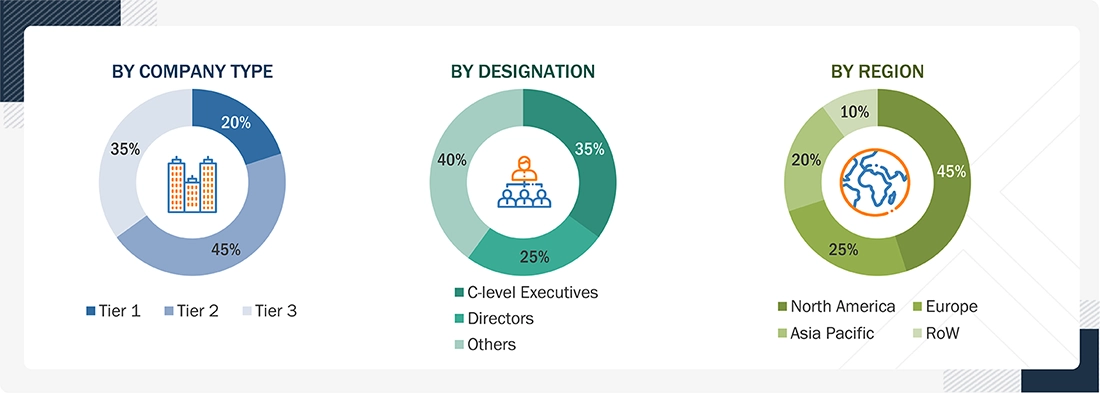
The three tiers of companies have been defined based on their total revenue as of 2024. The categorization given below has been applied: Tier 1: > USD 1 billion; tier 2: USD 250 million–USD 1 billion; and tier 3: < USD 250 million
Others include Sales Managers, Marketing Managers, and Product Managers.
To know about the assumptions considered for the study, download the pdf brochure
Market Size Estimation
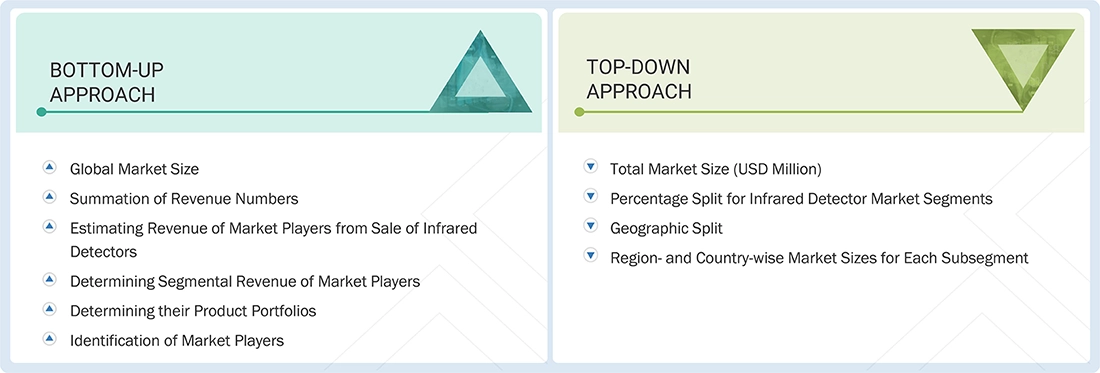
Both top-down and bottom-up approaches were used to estimate and validate the total size of the infrared detector market. These methods were used to calculate the size of various subsegments in the market.
These approaches involved the following steps:
- Identifying products currently provided or expected to be offered by providers
- Tracking major infrared detector manufacturers
- Estimating the size of the infrared detector market based on demand
- Tracking ongoing and upcoming product launches by companies and forecasting the market based on these developments and other critical parameters
- Conducting multiple discussions with key opinion leaders to understand the demand for infrared detectors and analyzing the breakdown of the scope of work carried out by each major company
- Arriving at market estimates by analyzing revenues generated by manufacturers based on their locations (countries), and then combining country-based data to get a market estimate based on region
- Assigning a percentage to the overall revenue or, in a few cases, to each company’s segmental revenues to derive their revenues from the sales of infrared detectors. This percentage for each company has been assigned based on its product portfolio and target application
- Verify and cross-check estimates at every level through discussions with key opinion leaders, including CXOs, directors, operation managers, and domain experts at MarketsandMarkets
Infrared Detector Market : Top-Down and Bottom-Up Approach
Data Triangulation
After arriving at the overall size of the infrared detector market using the market size estimation process explained above, the total market was split into several segments and subsegments. Data triangulation and market breakdown procedures were employed, wherever applicable, to complete the overall market engineering process and arrive at the exact statistics for all segments and subsegments of the market. The data was triangulated by studying various factors and trends from the demand and supply sides. The market size was also validated using both the top-down and bottom-up approaches.
Market Definition
An infrared (IR) detector is a sensor device that identifies and measures infrared radiation (heat energy) emitted by objects. Infrared radiation lies just beyond the visible spectrum of light (wavelengths from about 0.7 µm to 14 µm) and is invisible to the human eye.
These detectors convert incoming IR radiation into an electrical signal, which can then be processed to produce images, detect motion, measure temperature, or analyze material properties.
Key Stakeholders
- Raw material and manufacturing equipment suppliers
- Semiconductor wafer vendors
- Fabless players
- Foundry players
- Original equipment manufacturers (OEMs)
- Original design manufacturers (ODMs)
- Networking solution providers
- Distributors and retailers
- Research organizations
- Technology standard organizations, forums, alliances, and associations
- Technology investors
- Value-added resellers (VARs)
Report Objectives
- To describe and forecast the size of the infrared detector market by type, technology, vertical, wavelength, application, and region in terms of value
- To describe and forecast the market size of various segments across four key regions—North America, Europe, Asia Pacific, and Rest of the World (RoW), in terms of value
- To forecast the size of the infrared detector market by type, in terms of volume
- To provide detailed information regarding the drivers, restraints, opportunities, and challenges influencing the growth of the infrared detector market
- To analyze the infrared detector value chain and ecosystem, along with the average selling price of thermal detector types
- To strategically analyze the regulatory landscape, tariffs, standards, patents, Porter’s five forces, import and export scenarios, impact of AI/Gen AI, trade values, US 2025 Tariff, and case studies pertaining to the market
- To strategically analyze micromarkets1 with regard to individual growth trends, prospects, and contributions to the overall market
- To analyze opportunities in the market for stakeholders by identifying high-growth segments
- To provide details of the competitive landscape for market leaders
- To provide details of the macroeconomic outlook for regions
- To analyze strategies, such as product launches, collaborations, and acquisitions, adopted by players in the infrared detector market
- To profile key players in the infrared detector market and comprehensively analyze their market ranking based on their revenue, market share, and core competencies2
Customization Options
With the given market data, MarketsandMarkets offers customizations according to the company’s specific needs. The following customization options are available for the report:
Company Information:
- Detailed analysis and profiling of additional market players (up to five)
Get the Full Infrared Detector Market Report
Full forecast, segment splits, and company analysis for all Infrared Detector Market.
- US Infrared Detector Market
- Canada Infrared Detector Market
- Mexico Infrared Detector Market
- Germany Infrared Detector Market
- UK Infrared Detector Market
- France Infrared Detector Market
- Italy Infrared Detector Market
- Netherlands Infrared Detector Market
- Poland Infrared Detector Market
- Nordic Countries Infrared Detector Market
- Rest Of Europe Infrared Detector Market
- China Infrared Detector Market
- India Infrared Detector Market
- South Korea Infrared Detector Market
- Australia Infrared Detector Market
- Taiwan Infrared Detector Market
- Thailand Infrared Detector Market
- Vietnam Infrared Detector Market
- Indonesia Infrared Detector Market
- Malaysia Infrared Detector Market
- Rest Of Asia Pacific Infrared Detector Market
Need a Tailored Report?
Customize this report to your needs
Get 10% FREE Customization
Customize This Report
