
Germany IR Spectroscopy Market (2024-2029)

The Germany IR Spectroscopy Market was valued at $105 Million in 2024 and projected to reach to $142.4 Million by 2029, representing a compound annual growth rate of 6.3%. Germany's IR Spectroscopy market is poised for steady growth, supported by the country's leading position in precision manufacturing and semiconductor production.


| Market Size in | USD 26.32 MN |
| Market Forecast in | |
| CAGR | |
| Forecast Period | |
| Units Considered | Value (USD MN) |
Germany IR Spectroscopy Market Trends and Insights
- Germany's strong semiconductor and electronics manufacturing base drives demand for advanced analytical instrumentation, with IR spectroscopy playing a critical role in quality control, material characterization, and process optimization across industrial applications.
- The market in Germany benefits from the country's leadership in precision engineering and its commitment to Industry 4.0 initiatives, which emphasize automation and real-time monitoring in manufacturing environments. Germany's IR Spectroscopy market is supported by robust R&D investments from both established industrial players and emerging technology firms focused on enhancing spectroscopic capabilities.
- The forecast period (2024-2029) reflects steady expansion driven by increasing adoption in pharmaceutical, chemical, and materials science sectors within Germany.
- Germany's regulatory environment and emphasis on product quality and compliance further accelerate the integration of IR spectroscopy systems into production workflows, positioning the country as a key market within the European semiconductor and electronics landscape..
Key Market Statistics
- CAGR (2024-2029) 6.3% CAGR
- Market Size, 2024 ~USD 105 Million
- Forecast, 2029 ~USD 142.4 Million
- Country Germany
Germany IR Spectroscopy Market Overview
Market Valuation :
Germany's IR Spectroscopy market is valued at USD 105.0 million in 2024, reflecting strong demand from the country's robust semiconductor and electronics manufacturing sector.
Growth Trajectory :
The market is projected to reach USD 142.4 million by 2029, with a CAGR of 6.3%, outpacing many European counterparts due to Germany's industrial excellence and R&D investments.
Manufacturing Excellence :
Germany's world-class semiconductor and electronics production facilities drive consistent demand for advanced IR spectroscopy instruments for quality assurance and material analysis.
Application Diversity :
IR spectroscopy is critical across German industries for polymer characterization, pharmaceutical analysis, chemical composition verification, and semiconductor material quality control.
Germany IR Spectroscopy Market Dynamics
- The 6.3% CAGR reflects increasing adoption of advanced analytical instrumentation across automotive, chemical, pharmaceutical, and electronics sectors.
- Germany's commitment to Industry 4.0 and digital transformation initiatives further accelerates demand for sophisticated quality control and material characterization solutions. The market benefits from strong government support for R&D, a skilled workforce, and established relationships between equipment manufacturers and end-users.
- As German industries increasingly focus on sustainability and process optimization, IR spectroscopy instruments are becoming essential tools for compliance, efficiency, and innovation.
- Investment in next-generation analytical technologies and integration with automated production systems will continue to drive market expansion through 2029..
Market Ecosystem
Related Ecosystem
Electronics System And Components
- Sensors
- Temperature Sensors
- Pressure Sensors
- Actuators
- Image Sensors
- Lenovo
- Samsung
- Texas Instruments Incorporated
- HONEYWELL INTERNATIONAL INC.
- Teledyne Technologies Incorporated
Security And Surveillance
- Face Recognition
- Video Surveillance as A Service (VSaaS)
- Voice Recognition
- Fingerprint Recognition
- IRIS Recognition
- HONEYWELL INTERNATIONAL INC.
- Thales group
- HID-GLOBAL
- Lenovo
- AXIS COMMUNICATIONS
Testing Inspection And Certification
- Eddy Current Testing (ECT)
- Safety Testing
- Signal Generators
- Acoustic Emission Testing (AET)
- Automated Test Equipment
- Sgs s.a.
- Intertek Group plc
- Bureau veritas s.a.
- TUV RHEINLAND AG
- TUV SUD AG
Key Takeaways
- Germany's IR Spectroscopy market is valued at USD 105.0 million in 2024 and is expected to reach USD 142.4 million by 2029.
- Germany's market will grow at a CAGR of 6.3% during the forecast period, driven by strong semiconductor and electronics manufacturing demand.
- Germany's commitment to Industry 4.0 and precision engineering accelerates adoption of advanced IR spectroscopy systems for quality control and process optimization.
- Germany's regulatory focus on product quality and compliance strengthens market expansion across pharmaceutical, chemical, and materials science sectors.
IR Spectroscopy Market Report Scope
| Report Metric | Details |
|---|---|
| Base Year | 2024 |
| Fastest Growing Segment | FAR-INFRARED SPECTROSCOPY (Type) |
| Forecast Period | 2024-2029 |
| Growth Rate | CAGR of 6.5% from 2024 to 2029 |
| Largest Segment | FOURIER TRANSFORM INFRARED SPECTROSCOPY (Technology) |
| Market Size Base Year (Billions) | ~USD 1.17 (2024) |
| Revenue Forecast (Billions) | ~USD 1.6 (2029) |
| Segments Covered | Technology, Product Type, Type, End User |
Germany IR Spectroscopy Market Report Segmentation
4 segment dimensions are covered across the global market.
By Technology
- Dispersive Infrared Spectroscopy
- Fourier Transform Infrared Spectroscopy
By Product Type
- Benchtop Spectroscopes
- Hyphenated Spectroscopes
- Micro Spectroscopes
- Portable Spectroscopes
By Type
- Far-Infrared Spectroscopy
- Mid-Infrared Spectroscopy
- Near-Infrared Spectroscopy
By End User
- Biomedical Research & Biomaterials
- Chemicals
- Consumer Electronics
- Environmental
- Food & Beverages
- Healthcare & Pharmaceuticals
Target Audience
- Equipment Manufacturers : IR spectroscopy instrument manufacturers need Germany-specific market data to optimize product development, pricing strategies, and distribution channels in Europe's largest industrial economy.
- Semiconductor & Electronics Companies : German and international semiconductor firms require detailed market insights to evaluate IR spectroscopy adoption rates, competitive offerings, and quality control technology investments.
- Investment & Private Equity Firms : Investors seeking opportunities in analytical instrumentation need comprehensive Germany market analysis to assess growth potential, market dynamics, and acquisition targets.
- Pharmaceutical & Chemical Manufacturers : German pharmaceutical and chemical companies use market intelligence to benchmark IR spectroscopy adoption, identify technology upgrades, and optimize material characterization processes.
- Market Research & Consulting Professionals : Analysts and consultants require Germany-specific market data to support client advisory services, competitive analysis, and strategic planning in the analytical instrumentation sector.
Reasons to Buy this Report
- Localized Market Intelligence : Gain Germany-specific insights into market size, growth rates, and forecasts tailored to the country's unique industrial landscape and manufacturing capabilities.
- Competitive Positioning : Understand how German manufacturers and suppliers are positioned within the IR spectroscopy market to identify partnership and investment opportunities.
- Sector-Specific Applications : Access detailed analysis of IR spectroscopy applications across Germany's key industries including semiconductors, pharmaceuticals, chemicals, and automotive sectors.
- Strategic Market Entry : Develop informed market entry strategies with comprehensive data on Germany's regulatory environment, customer preferences, and growth drivers through 2029.
- Investment Decision Support : Make confident investment and expansion decisions backed by reliable forecasts, market trends, and Germany-specific growth projections for the analytical instrumentation sector.
Frequently asked questions
What is the current size of Germany's IR Spectroscopy market?
Germany's IR Spectroscopy market is valued at USD 105.0 million in 2024.
What is the projected market size for Germany's IR Spectroscopy market by 2029?
Germany's IR Spectroscopy market is projected to reach USD 142.4 million by 2029.
What is the CAGR for Germany's IR Spectroscopy market?
Germany's IR Spectroscopy market is expected to grow at a CAGR of 6.3% from 2024 to 2029.
Which industries drive demand for IR Spectroscopy in Germany?
Germany's semiconductor, electronics, pharmaceutical, chemical, and materials science sectors are primary drivers of IR Spectroscopy demand.
How does Germany's Industry 4.0 initiative impact the IR Spectroscopy market?
Germany's Industry 4.0 commitment promotes automation and real-time monitoring, accelerating adoption of advanced IR spectroscopy systems in manufacturing.
RESEARCH METHODOLOGY
The study involved four major activities in estimating the size of the IR spectroscopy market. Exhaustive secondary research has been carried out to collect information on the market, the peer markets, and the parent market. Both top-down and bottom-up approaches have been employed to estimate the total market size. Market breakdown and data triangulation methods have also been used to estimate the market for segments and subsegments.
Secondary Research
Revenues of companies offering IR spectroscopy systems have been obtained from the secondary data available through paid and unpaid sources. The revenues have also been derived by analyzing the product portfolio of key companies, and these companies have been rated according to the performance and quality of their products.
In the secondary research process, various sources have been referred to for identifying and collecting information for this study on the IR spectroscopy market. Secondary sources considered for this research study include government sources, corporate filings, and trade, business, and professional associations. Secondary data has been collected and analyzed to arrive at the overall market size, which has been further validated through primary research.
Secondary research has been mainly used to obtain key information about the supply chain of IR spectroscopy systems to identify key players based on their products and prevailing industry trends in the IR spectroscopy market by technology, type, product type, end-user industry, and region. Secondary research also helped obtain market information- and technology-oriented key developments undertaken by market players to expand their presence and increase their market share.
Primary Research
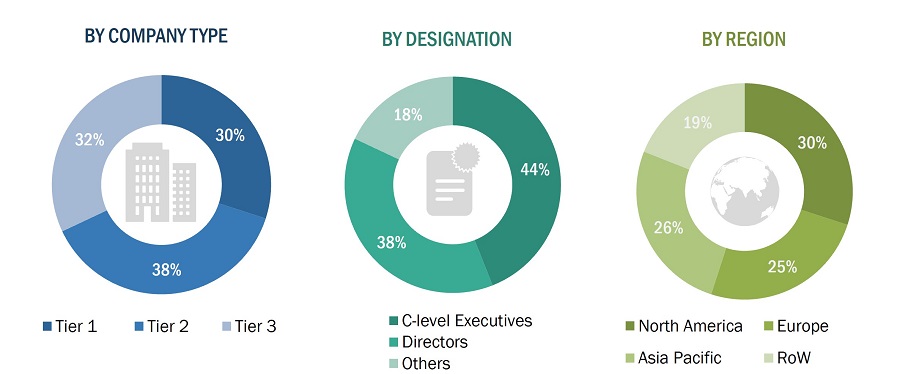
Extensive primary research has been conducted after understanding and analyzing the current scenario of the IR spectroscopy market through secondary research. Several primary interviews have been conducted with the key opinion leaders from the demand and supply sides across four main regions—North America, Europe, Asia Pacific, and the Rest of Europe. Approximately 25% of the primary interviews were conducted with the demand-side respondents, while approximately 75% were conducted with the supply-side respondents. The primary data has been collected through questionnaires, emails, and telephone interviews.
After interacting with industry experts, brief sessions were conducted with highly experienced independent consultants to reinforce the findings from our primary. This, along with the in-house subject matter experts’ opinions, has led us to the findings as described in the remainder of this report. The breakdown of primary respondents is as follows:
To know about the assumptions considered for the study, download the pdf brochure
Market Size Estimation
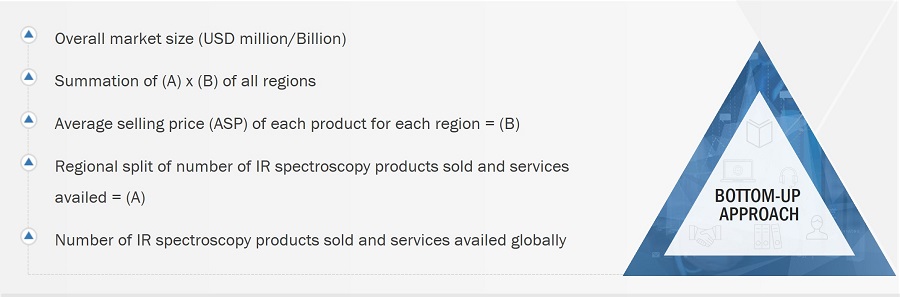
The bottom-up procedure has been employed to arrive at the overall size of the IR spectroscopy market.
- Identifying end-use industries wherein IR spectroscopy systems are deployed or are expected to use
- Analyzing major providers of IR spectroscopy equipment’s and original equipment manufacturers (OEMs), as well as studying their portfolios and understanding different technologies used
- Analyzing the average selling price of IR spectroscopy systems powered by different technologies
- Arriving at the market estimates by analyzing the revenue of companies and then combining these figures to arrive at the market size
- Studying various paid and unpaid sources, such as annual reports, press releases, white papers, and databases, to gather the required information
- Tracking the ongoing developments and identifying the upcoming developments in the market that include investments, research and development activities, product launches, contracts, collaborations, and partnerships undertaken, and forecasting the market size based on these developments
- Carrying out multiple discussions with key opinion leaders to understand the types of IR spectroscopy products, services, and software designed and developed, thereby analyzing the break-up of the scope of work carried out by the major companies in the IR spectroscopy market
- Arriving at the market estimates by analyzing the revenue generated by key companies providing IR spectroscopy products on the basis of their locations (countries) and then combining the market size for each country to get the market estimate by region
- Verifying and crosschecking the estimates at every level by discussing with key opinion leaders, including CXOs, directors, and operation managers, and then finally with the domain experts at MarketsandMarkets
- Studying various paid and unpaid sources of information, such as annual reports, press releases, white papers, and databases
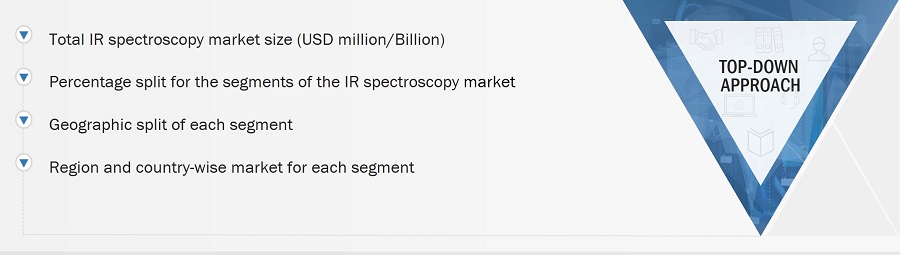
The top-down approach has been used to estimate and validate the total size of the IR spectroscopy market.
- Focusing on top-line investments and expenditures being made in the ecosystems of various applications
- Calculating the market size, considering revenues from major players through the cost of IR spectroscopy systems
- Segmenting each application of the IR spectroscopy system in each region and deriving the global market size based on the region
- Acquiring and analyzing information related to revenues generated by players through their crucial product offerings
- Conducting multiple on-field discussions with key opinion leaders involved in developing various IR spectroscopy solutions
- Estimating geographical splits by using secondary sources on the basis of various factors, such as the number of players in a specific country and region, types of IR spectroscopy products/solutions, and levels of services offered across several end-user industries
Data Triangulation
After arriving at the overall market size-using the market size estimation processes as explained above-the market has been split into several segments and subsegments. To complete the entire market engineering process and arrive at the exact statistics of each market segment and subsegment, data triangulation and market breakdown procedures have been employed, wherever applicable. The data has been triangulated by studying various factors and trends from the demand and supply sides in the IR spectroscopy market.
Market Definition
IR spectroscopes operate in the IR region of the electromagnetic spectrum used for the study and identification of chemical compounds in a sample, which can be either be in the gaseous, liquid, or solid form. In IR spectroscopy, IR light interacts with matter to identify the composition of the materials using three ways of measurement: reflection, emission, and absorption, for quality control and other applications. IR spectroscopy is used in various verticals, such as biological research, healthcare & pharmaceuticals, and food & beverages, to study and check the quality of materials produced during the manufacturing process. The instruments used for IR spectroscopy include IR spectrometers or spectrophotometers. IR spectroscopy works in the IR spectrum, which can be further divided into near-infrared (NIR), mid-infrared (MIR), and far-infrared (FIR).
Key Stakeholders
- Raw material and manufacturing equipment suppliers
- Semiconductor wafer vendors
- Original equipment manufacturers (OEMs)
- Original design manufacturers (ODMs) and OEM technology solution providers
- Networking solutions providers
- Distributors and retailers
- Research organizations
- Technology standards organizations, forums, alliances, and associations
- End users
- Technical universities
- Government/private research institutes
- Market research and consulting firms
Report Objectives
- To describe and forecast the size of the IR spectroscopy market, by type, technology, product type, end-user industry, and region, in terms of value
- To describe and forecast the market size of various segments across four key regions—North America, Europe, Asia Pacific, and Rest of the World (RoW), in terms of value
- To forecast the size of the IR spectroscopy market by product type, in terms of volume
- To provide detailed information regarding the drivers, restraints, opportunities, and challenges influencing the growth of the IR spectroscopy market
- To analyze the IR spectroscopy value chain and ecosystem, along with the average selling price of IR spectroscopy systems
- To strategically analyze the regulatory landscape, tariff, standards, patents, Porter’s five forces, import and export scenarios, trade values, and case studies pertaining to the market under study
- To strategically analyze micromarkets1 with regard to individual growth trends, prospects, and contributions to the overall market
- To analyze opportunities in the market for stakeholders by identifying high-growth segments
- To provide details of the competitive landscape for market leaders
- To analyze strategies such as product launches, expansion, collaborations, acquisitions, partnerships, and expansions adopted by players in the IR spectroscopy market
- To profile key players in the IR spectroscopy market and comprehensively analyze their market ranking based on their revenue, market share, and core competencies2
Available customizations:
With the given market data, MarketsandMarkets offers customizations according to the specific requirements of companies. The following customization options are available for the report:
- Detailed analysis and profiling of additional market players based on various blocks of the supply chain
Get the Full IR Spectroscopy Market Report
Full forecast, segment splits, and company analysis for all IR Spectroscopy Market.
- US IR Spectroscopy Market
- Canada IR Spectroscopy Market
- Mexico IR Spectroscopy Market
- UK IR Spectroscopy Market
- France IR Spectroscopy Market
- Italy IR Spectroscopy Market
- Rest Of Europe IR Spectroscopy Market
- China IR Spectroscopy Market
- Japan IR Spectroscopy Market
- India IR Spectroscopy Market
- South Korea IR Spectroscopy Market
- Rest Of Asia Pacific IR Spectroscopy Market
Need a Tailored Report?
Customize this report to your needs
Get 10% FREE Customization
Customize This Report
