
Germany Knowledge Graph Market (2026-2031)

The Germany Knowledge Graph Market was valued at $98.1 Million in 2026 and projected to reach to $487.95 Million by 2031, representing a compound annual growth rate of 30.7%. Germany's Knowledge Graph Market is poised for substantial growth through 2031, driven by the country's leadership in artificial intelligence research and enterprise digitalization.


| Market Size in | USD 26.32 MN |
| Market Forecast in | |
| CAGR | |
| Forecast Period | |
| Units Considered | Value (USD MN) |
Germany Knowledge Graph Market Trends and Insights
- This represents a compound annual growth rate of 30.7%, reflecting Germany's strong position as a technology leader in Europe.
- Germany's investment in artificial intelligence, enterprise data management, and semantic search capabilities is driving adoption across financial services, manufacturing, and healthcare sectors. The German market benefits from the country's advanced digital infrastructure and emphasis on Industry 4.0 initiatives.
- Germany's enterprises are increasingly leveraging knowledge graphs to enhance data interoperability, improve decision-making processes, and optimize supply chain operations.
- By 2031, Germany is expected to capture significant market share within the European knowledge graph ecosystem, supported by growing demand from mid-market and large enterprises seeking competitive advantages through intelligent data organization and retrieval systems..
Key Market Statistics
- CAGR (2026-2031) 30.7% CAGR
- Market Size, 2026 ~USD 98.1 Million
- Forecast, 2031 ~USD 487.95 Million
- Country Germany
Germany Knowledge Graph Market Overview
Market Valuation Growth :
Germany's Knowledge Graph Market is valued at $98.1 million in 2026 and is projected to reach $487.95 million by 2031, representing a 30.7% CAGR and demonstrating exceptional market expansion.
Technology Leadership Position :
Germany maintains a strong position as Europe's technology leader, with significant investments in AI infrastructure and enterprise data management driving Knowledge Graph adoption across industries.
Enterprise Data Management Focus :
German enterprises are increasingly prioritizing semantic search capabilities and intelligent data organization, positioning Knowledge Graphs as critical infrastructure for digital transformation initiatives.
AI Integration Momentum :
Germany's robust AI ecosystem and commitment to Industry 4.0 standards are accelerating Knowledge Graph implementation in manufacturing, automotive, and financial services sectors.
Germany Knowledge Graph Market Dynamics
- German organizations are increasingly recognizing Knowledge Graphs as essential for managing complex data ecosystems and enabling intelligent automation across sectors.
- The market's 30.7% CAGR reflects strong demand from mid-market and enterprise organizations seeking competitive advantages through advanced data intelligence. Key growth catalysts include Germany's Industry 4.0 initiatives, regulatory compliance requirements under GDPR, and the need for sophisticated data governance frameworks.
- Investment in AI talent, government support for digital innovation, and partnerships between technology providers and German enterprises will continue to fuel market expansion.
- By 2031, Knowledge Graphs will become standard infrastructure for data-driven decision-making across German industries..
Market Ecosystem

KNOWLEDGE GRAPH MARKET: COMMERCIAL USE CASES ACROSS INDUSTRIES
| COMPANY | USE CASE DESCRIPTION | BENEFITS |
|---|---|---|
 |
Neo4j supported UBS in implementing a knowledge graph platform to enhance fraud detection and customer data analysis. The solution connected transaction data, customer profiles, and behavioral patterns, enabling real-time detection of suspicious activities and improved risk assessment across financial operations. | Reduced fraud risk | Real-time anomaly detection | Improved customer insights | Enhanced regulatory compliance |
 |
TigerGraph collaborated with Intuit to develop a knowledge graph-based fraud detection system for its financial services platform. The implementation enabled the integration of large-scale transactional and user data, allowing faster identification of fraud patterns and improving decision-making accuracy. | Faster fraud detection | Scalable data processing | Improved decision accuracy | Reduced financial loss |
 |
AWS supported Zalando by implementing a knowledge graph using Amazon Neptune to power product recommendations and personalization. The system connected product data, user behavior, and inventory information to deliver more accurate and context-aware recommendations. | Improved recommendation accuracy | Enhanced customer experience | Increased conversion rates | Scalable infrastructure |
Logos and trademarks shown above are the property of their respective owners. Their use here is for informational and illustrative purposes only.
Related Ecosystem
Analytics
- Natural Language Processing (NLP)
- Machine Learning
- Supply Chain Management
- Predictive Analytics
- Image Sensors
- International Business Machines Corporation
- MICROSOFT CORPORATION
- Oracle Corporation
- SAP SE
Software And Services
- Natural Language Processing (NLP)
- Machine Learning
- Supply Chain Management
- Predictive Analytics
- Image Sensors
- International Business Machines Corporation
- MICROSOFT CORPORATION
- Oracle Corporation
- SAP SE
- Amazon.com, Inc.
Key Takeaways
- Germany's Knowledge Graph Market will nearly quintuple from $98.1M (2026) to $487.95M (2031) at a 30.7% CAGR.
- Germany's manufacturing and automotive sectors are primary drivers of knowledge graph adoption for supply chain optimization.
- Germany's regulatory environment and data privacy standards are shaping enterprise knowledge graph implementations.
- Germany's mid-market enterprises represent the fastest-growing segment for knowledge graph solutions through 2031.
Knowledge Graph Market Report Scope
| Report Metric | Details |
|---|---|
| Base Year | 2026 |
| Fastest Growing Segment | OTHER MODEL TYPE (Model Type) |
| Forecast Period | 2026–2031 |
| Growth Rate | CAGR of 31.6% from 2026 to 2031 |
| Largest Segment | SOLUTIONS (Offering) |
| Market Size Base Year (Billions) | ~USD 1.9 (2026) |
| Revenue Forecast (Billions) | ~USD 7.51 (2031) |
| Segments Covered | Offering, Solution, Service, Model Type, Application, Vertical |
Germany Knowledge Graph Market Report Segmentation
6 segment dimensions are covered across the global market.
By Offering
- Services
- Solutions
By Solution
- Enterprise Knowledge Graph Platform
- Enterprise Knowledge Graph Platforms
- Graph Database Engine
- Graph Database Engines
- Knowledge Management Toolset
- Knowledge Management Toolsets
By Service
- Managed Services
- Professional Services
By Model Type
- Labeled Property Graph
- Labeled Property Graph (Lpg)
- Other Model Type
- Other Model Types
- Resource Description Framework (Rdf) Triple Stores
By Application
- Data Analytics & Business Intelligence
- Data Governance & Master Data Management
- Infrastructure & Asset Management
- Knowledge & Content Management
- Market & Customer Intelligence And Sales Optimization
- Other Applications
- Process Optimization & Resource Management
- Product & Configuration Management
- Risk Management, Compliance, And Regulatory Reporting
- Virtual Assistants, Self-Service Data, And Digital Asset Discovery
By Vertical
- Banking, Financial Services, And Insurance (Bfsi)
- Energy, Utilities, And Infrastructure
- Government
- Healthcare, Life Sciences, And Pharmaceuticals
- Manufacturing & Automotive
- Media & Entertainment
- Other Verticals
- Retail & Ecommerce
- Telecom & Technology
- Transportation & Logistics
- Travel & Hospitality
Target Audience
- German Enterprise Technology Leaders : CIOs and digital transformation officers in German corporations need market intelligence to justify Knowledge Graph investments and benchmark against industry peers.
- Technology Solution Providers : Software vendors and AI solution companies targeting Germany require localized market data to develop go-to-market strategies and identify customer acquisition opportunities.
- Management Consulting Firms : Consultants advising German enterprises on digital transformation need credible market data to support recommendations and validate Knowledge Graph implementation business cases.
- Investment & Private Equity Firms : Investors evaluating German tech companies and market opportunities require detailed market sizing and growth projections to assess portfolio companies and acquisition targets.
- Government & Policy Organizations : German government agencies and industry associations need market intelligence to inform AI policy, digital infrastructure investments, and technology competitiveness initiatives.
Key Companies in the Germany Knowledge Graph Market
| Company | HQ | Ownership | Strongest segments |
|---|---|---|---|
| IBM | United States | Public Company | Software (Hybrid Cloud and AI Platforms),Consulting,Infrastructure, |
| MICROSOFT | United States | Public Company | Productivity and Business Processes,Intelligent Cloud (Azure, Server, GitHub, Nuance),Personal Computing (Windows, Devices, Gaming, Ads), |
| SAP | Germany | Public Company | SAP S/4HANA and core ERP finance/supply chain,Human Experience Management (SAP SuccessFactors and payroll/time),Business Technology Platform and integration/automation, |
| ORACLE | United States | Public Company | Cloud applications (Fusion ERP/EPM/SCM/HCM, NetSuite, Oracle Health, CX),Database and middleware (Oracle Database, MySQL, Java, middleware tools),Cloud infrastructure (compute, storage, networking, AI/ML, IoT, blockchain), |
| FRANZ INC. | Germany | Private Investment Firm | Health and well-being,Recycling and environmental protection services,Climate-neutral energy production & renewable energies, |
| ALTAIR | United States | Private Company | CAE and Multidisciplinary Simulation (HyperWorks and related),Data Analytics and AI (Altair RapidMiner and services),HPC, Cloud, and Altair One Platform, |
| PROGRESS SOFTWARE CORPORATION | United States | Public Company | Application Development & Digital Experience (OpenEdge, Sitefinity, Developer Tools),Managed & Secure File Transfer (MOVEit, Automate MFT, ShareFile),Data Connectivity & Agility (DataDirect, MarkLogic, Semaphore), |
IBM
IBM is a public company founded in 1911 in the United States with 264,300 employees.
MICROSOFT
Microsoft is a public company founded in 1975 in the United States with 228,000 employees.
SAP
SAP is a public company founded in 1972 in Germany with 111,038 employees.
ORACLE
Oracle is a public company founded in 1977 in the United States with 141,000 employees.
FRANZ INC.
Franz Inc. is a private investment firm founded in 1756 in Germany with 21,685 employees.
ALTAIR
Altair is a private company founded in 1985 in the United States with 3,500 employees.
PROGRESS SOFTWARE CORPORATION
Progress Software Corporation is a public company founded in 1981 in the United States with 2,801 employees.
Reasons to Buy this Report
- Market-Specific Sizing & Forecasts : Access precise valuation data for Germany's Knowledge Graph Market with detailed 2026-2031 projections, enabling accurate budget allocation and investment planning specific to the German market.
- Competitive Landscape Intelligence : Understand Germany's unique competitive dynamics, key players, and market positioning within Europe's technology sector to identify partnership and expansion opportunities.
- Sector-Specific Adoption Insights : Gain detailed analysis of Knowledge Graph adoption across German industries including manufacturing, automotive, finance, and healthcare to target high-potential customer segments.
- Regulatory & Compliance Context : Understand how GDPR, German data protection standards, and Industry 4.0 requirements shape Knowledge Graph implementation strategies and create market opportunities.
- Growth Driver Analysis : Identify the specific factors driving Germany's 30.7% CAGR including AI investment trends, enterprise digitalization initiatives, and technology infrastructure development.
Frequently asked questions
What is the current size of Germany's Knowledge Graph Market?
Germany's Knowledge Graph Market is valued at $98.1 million in 2026 and is expected to grow to $487.95 million by 2031.
What is the growth rate of Germany's Knowledge Graph Market?
Germany's Knowledge Graph Market is growing at a compound annual growth rate (CAGR) of 30.7% from 2026 to 2031.
Which industries are driving Germany's Knowledge Graph Market growth?
Germany's financial services, manufacturing, automotive, and healthcare sectors are primary drivers of knowledge graph adoption and market expansion.
How does Germany's market compare to other European countries?
Germany represents one of Europe's largest knowledge graph markets, driven by its advanced digital infrastructure, Industry 4.0 initiatives, and strong enterprise technology investment.
What factors are influencing Germany's Knowledge Graph Market adoption?
Germany's adoption is influenced by Industry 4.0 transformation, data privacy regulations (GDPR), enterprise AI investments, and the need for improved data interoperability across complex supply chains.
RESEARCH METHODOLOGY
This research study involved the extensive use of secondary sources, directories, and databases, such as Dun & Bradstreet (D&B), Hoovers, and Bloomberg BusinessWeek, to identify and collect information useful for a technical, market-oriented, and commercial study of the Knowledge graph market. The primary sources have been mainly industry experts from the core and related industries and preferred suppliers, manufacturers, distributors, service providers, technology developers, alliances, and organizations related to all segments of the value chain of this market. In-depth interviews have been conducted with various primary respondents, including key industry participants, subject matter experts, C-level executives of key market players, and industry consultants, to obtain and verify critical qualitative and quantitative information.
Secondary Research
The market for companies offering knowledge graph solutions and services to different end users has been estimated and projected based on the secondary data made available through paid and unpaid sources, and by analyzing their product portfolios in the ecosystem of the knowledge graph market. In the secondary research process, various sources such as JAX Magazine, International Journal of Electrical and Computer Engineering (IJECE), and Frontiers have been referred to for identifying and collecting information for this study on the Knowledge graph market. The secondary sources included annual reports, press releases, investor presentations of companies, white papers, journals, certified publications, and articles by recognized authors, directories, and databases. Secondary research has been mainly used to obtain essential information about the supply chain of the market, the total pool of key players, market classification, segmentation according to industry trends to the bottommost level, regional markets, and key developments from both market- and technology-oriented perspectives that primary sources have further validated.
Primary Research
In the primary research process, various primary sources from both the supply and demand sides were interviewed to obtain qualitative and quantitative information on the market. The primary sources from the supply side included various industry experts, including Chief Experience Officers (CXOs); Vice Presidents (VPs); directors from business development, marketing, and product development/innovation teams; related critical executives from Knowledge graph service vendors, system Integrators, professional service providers, and industry associations; and key opinion leaders. Primary interviews were conducted to gather insights, such as market statistics, revenue data collected from services, market breakups, market size estimations, market forecasts, and data triangulation. Primary research also helped in understanding various trends related to technologies, applications, deployments, and regions. Stakeholders from the demand side, such as Chief Information Officers (CIOs), Chief Technology Officers (CTOs), Chief Strategy Officers (CSOs), and end users using knowledge graph services, were interviewed to understand the buyer’s perspective on suppliers, products, service providers, and their current usage of Knowledge graph services, which would impact the overall knowledge graph market.
BREAKDOWN OF PRIMARIES
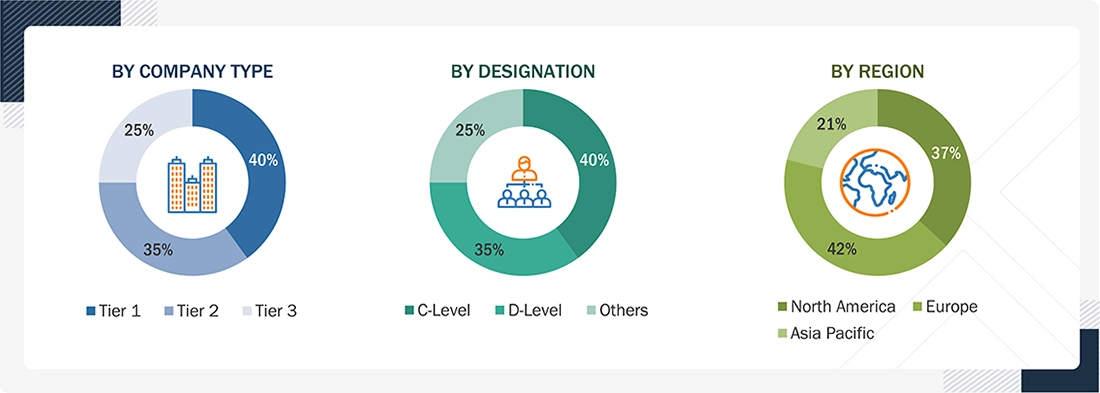
Note: Others include sales managers, marketing managers, and product managers.
To know about the assumptions considered for the study, download the pdf brochure
Market Size Estimation
Multiple approaches were adopted to estimate and forecast the size of the knowledge graph market. The first approach involves estimating market size by summing up the revenue generated by companies through the sale of the knowledge graph solution and services.
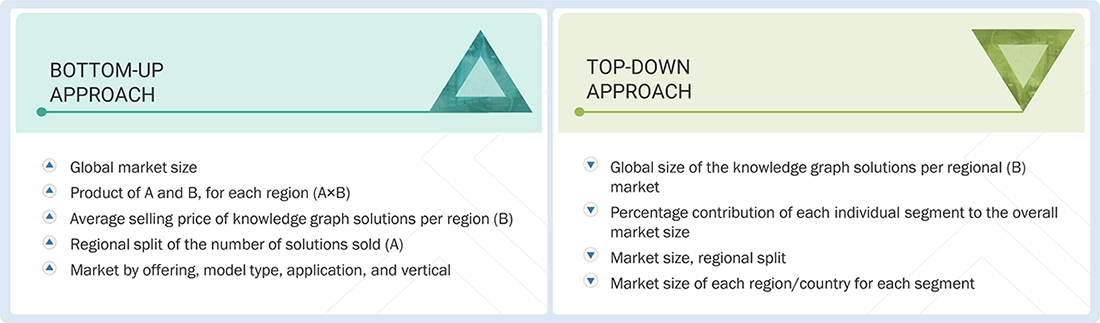
Both top-down and bottom-up approaches were used to estimate and validate the total size of the Knowledge graph market. These methods were extensively used to estimate the size of various segments in the market. The research methodology used to estimate the market size includes the following:
- Key players in the market have been identified through extensive secondary research.
- In terms of value, the industry’s supply chain and market size have been determined through primary and secondary research processes.
- All percentage shares, splits, and breakups have been determined using secondary sources and verified through primary sources.
- After arriving at the overall market size, the knowledge graph market was divided into several segments and subsegments.
Data Triangulation
After arriving at the overall market size, the knowledge graph market was divided into several segments and subsegments.
The data was triangulated by studying various factors and trends from the demand and supply sides. Along with data triangulation and market breakdown, the market size was validated by the top-down and bottom-up approaches.
Market Definition
A knowledge graph is a type of database designed to store, query, and manage data in the form of nodes, edges, and properties. Nodes represent entities, edges capture relationships between them, and properties provide additional details. This structure enables efficient analysis of complex, interconnected data. It is widely used in scenarios like social networks, recommendation systems, and fraud detection.
Key Stakeholders
- Solution providers
- Technology vendors
- Enterprise buyers
- System integrators
- Consulting firms and sis
- Open-source communities
- Regulatory bodies
- Industry alliances
Report Objectives
- To determine, segment, and forecast the knowledge graph market based on offerings, type, application, vertical, and region in terms of value
- To forecast the size of the market segments with respect to five main regions: North America, Europe, Asia Pacific, the Middle East & Africa, and Latin America
- To provide detailed information about the major factors (drivers, restraints, opportunities, and challenges) influencing the growth of the market
- To study the complete value chain and related industry segments, and perform a value chain analysis of the market landscape
- To strategically analyze the macro and micromarkets with respect to individual growth trends, prospects, and contributions to the total market
- To analyze the industry trends, pricing data, patents, and innovations related to the market
- To analyze the opportunities for stakeholders by identifying the high-growth segments of the market
- To profile the key players in the market and comprehensively analyze their market share/ranking and core competencies
- To track and analyze competitive developments, such as mergers & acquisitions, product launches & developments, partnerships, agreements, collaborations, business expansions, and R&D activities.
Available customizations:
With the given market data, MarketsandMarkets offers customizations as per the company’s specific needs. The following customization options are available for the report:
- Country-wise information
- Analysis for additional countries (up to five)
Company Information
- Detailed analysis and profiling of additional market players (up to five)
Get the Full Knowledge Graph Market Report
Full forecast, segment splits, and company analysis for all Knowledge Graph Market.
- Rest Of Asia Pacific Knowledge Graph Market
- South Korea Knowledge Graph Market
- Canada Knowledge Graph Market
- US Knowledge Graph Market
- UK Knowledge Graph Market
- Italy Knowledge Graph Market
- China Knowledge Graph Market
- India Knowledge Graph Market
- UAE Knowledge Graph Market
- Brazil Knowledge Graph Market
- France Knowledge Graph Market
- Rest Of Europe Knowledge Graph Market
- Spain Knowledge Graph Market
- Japan Knowledge Graph Market
Need a Tailored Report?
Customize this report to your needs
Get 10% FREE Customization
Customize This Report
