
Brazil Lab Automation Market (2026-2031)

The Brazil Lab Automation Market was valued at $180.9 Million in 2026 and projected to reach to $256.4 Million by 2031, representing a compound annual growth rate of 9.0%. Brazil's lab automation market is positioned for sustained expansion through 2031, driven by increasing healthcare investments and the modernization of diagnostic infrastructure across both public and private sectors.


| Market Size in | USD 26.32 MN |
| Market Forecast in | |
| CAGR | |
| Forecast Period | |
| Units Considered | Value (USD MN) |
Brazil Lab Automation Market Trends and Insights
- This 9.0% compound annual growth rate significantly outpaces the global average of 6.6%, reflecting Brazil's accelerating adoption of automated laboratory solutions across healthcare and diagnostic sectors.
- Brazil's market expansion is driven by increasing healthcare infrastructure investments, rising demand for diagnostic accuracy, and growing laboratory efficiency requirements in both public and private institutions. The Brazilian lab automation sector benefits from the country's large population base and expanding middle class, which drives demand for advanced diagnostic services.
- Brazil's healthcare modernization initiatives and regulatory emphasis on laboratory quality standards are compelling laboratories to adopt automation technologies.
- Between 2026 and 2031, Brazil is expected to capture significant market share within Latin America, positioning itself as a key growth engine for lab automation solutions in the region..
Key Market Statistics
- CAGR (2026-2031) 9.0% CAGR
- Market Size, 2026 ~USD 180.9 Million
- Forecast, 2031 ~USD 256.4 Million
- Country Brazil
Brazil Lab Automation Market Overview
Strong CAGR Outperformance :
Brazil's lab automation market grows at 9.0% CAGR (2026-2031), significantly exceeding the global average of 6.6%, indicating accelerated market maturation and technology adoption in the region.
Substantial Market Valuation :
The Brazilian market is valued at $180.9 million in 2026 and is projected to reach $256.4 million by 2031, representing a $75.5 million increase over the five-year forecast period.
Healthcare Sector Expansion :
Brazil's healthcare and diagnostic sectors are increasingly investing in automated laboratory solutions to improve efficiency, reduce operational costs, and enhance diagnostic accuracy across public and private institutions.
Regional Growth Catalyst :
Rising healthcare expenditure, modernization of laboratory infrastructure, and growing demand for high-throughput diagnostic capabilities are driving robust adoption of lab automation technologies throughout Brazil.
Brazil Lab Automation Market Dynamics
- The 9.0% CAGR reflects growing recognition of automation's role in improving laboratory efficiency, reducing turnaround times, and enhancing diagnostic accuracy.
- Healthcare institutions are prioritizing technology upgrades to meet rising patient demand and regulatory standards. The market outlook remains positive as Brazil continues to strengthen its healthcare capabilities and laboratory services.
- Investments in research institutions, hospital networks, and diagnostic centers are expected to accelerate adoption of automated solutions.
- Additionally, the competitive landscape is intensifying with both international and local vendors expanding their presence, offering tailored solutions for Brazil's unique healthcare environment and creating opportunities for market participants..
Market Ecosystem

LAB AUTOMATION MARKET: COMMERCIAL USE CASES ACROSS INDUSTRIES
| COMPANY | USE CASE DESCRIPTION | BENEFITS |
|---|---|---|
 |
Provides a wide range of laboratory automation products, such as robotic equipment, automated liquid dispensers, incubators, and other workflow automation instruments for research and diagnostic laboratories. | Assures high-throughput capacity, accuracy, minimal manual errors, and scalability of laboratory operations. |
 |
Delivers robotic liquid handlers, automation modules, and detection devices that are extensively used in genomics, drug development, and diagnostic testing. | Improves accuracy, reproducibility, and adaptability of laboratory processes. |
 |
Provides complete solutions for laboratory automation, sample preparation automation, and bioprocessing automation within its life sciences and diagnostics product line. | Provides quick turnaround, efficiency, and minimizes manual labor in laboratories. |
 |
Logos and trademarks shown above are the property of their respective owners. Their use here is for informational and illustrative purposes only.
Related Ecosystem
Analytical And Scientific Instrumentation
- Environmental Testing
- Gas Chromatography
- Polymerase Chain Reaction (PCR)
- Automated Liquid Handling Systems
- Flow Cytometry
- Thermo Fisher Scientific Inc.
- Danaher Corporation
- Agilent Technologies, Inc.
- Merck KGaA
- Shimadzu Corporation
Drug Delivery Devices
- Disposable Autoinjectors
- Reusable Autoinjectors
- Insulin Pumps
- Pen Injectors
- Transdermal Patches
- Becton, Dickinson and Company
- Novo nordisk a/s
- Terumo Corporation
- Nipro Corporation
- Medtronic plc
In Vitro Diagnostics
- Polymerase Chain Reaction (PCR)
- Enzyme-Linked Immunosorbent Assay (ELISA)
- Dna Microarrays
- Assay Kits
- Microarrays
- ROCHE HOLDINGS AG
- Thermo Fisher Scientific Inc.
- Danaher Corporation
- Abbott Laboratories
- Biomerieux s.a.
Key Takeaways
- Brazil's lab automation market is projected to grow from $180.9M (2026) to $256.4M (2031) at a 9.0% CAGR, outpacing global growth rates.
- Brazil's healthcare modernization and regulatory quality standards are primary drivers accelerating laboratory automation adoption.
- Brazil's large population and expanding middle class create sustained demand for advanced diagnostic and laboratory services.
- Brazil is positioned as Latin America's fastest-growing lab automation market, attracting significant regional and global investment.
Lab Automation Market Report Scope
| Report Metric | Details |
|---|---|
| Base Year | 2026 |
| Fastest Growing Segment | SOFTWARE (Product) |
| Forecast Period | 2026–2031 |
| Growth Rate | CAGR of 6.6% from 2026 to 2031 |
| Largest Segment | AUTOMATED WORKSTATIONS (Product) |
| Market Size Base Year (Billions) | ~USD 6.26 (2026) |
| Revenue Forecast (Billions) | ~USD 8.62 (2031) |
| Segments Covered | Application, Type, Product, End User |
Brazil Lab Automation Market Report Segmentation
4 segment dimensions are covered across the global market.
By Application
- Diagnostics
- Drug Discovery
- Genomic Solutions
- Microbiology
- Other Applications
- Proteomics Solutions
By Type
- Absorbance
- Absorbance Readers
- Adme Screening
- Automated Elisa Systems
- Automated Integrated Workstations
- Automated Liquid Handling Systems
- Automated Nucleic Acid Purification Systems
- Collaborative Robotics
- Collaborative Robots
- Compound Management
- Compound Weighing & Dissolution
- Eia
- Eln
- Filter-Based
- Filter-Based Readers
- Fluorescence
- Fluorescence Readers
- High Throughput Screening
- High-Throughput Screening
- Hybrid
- Hybrid Readers
- Les
- Lims
- Luminescence
- Luminescence Readers
- Microplate Readers
- Microplate Washer
- Microplate Washers
- Mobile Robots
- Monochromator-Based
- Monochromator-Based Readers
- Multi-Mode Microplate Readers
- Other Drug Discovery Application
- Other Drug Discovery Applications
- Pipetting Systems
- Post-Analytical Automation
- Pre-Analytical Automation
- Pre-Analytics/ Sample Preparation
- Pre-Analytics/Sample Preparation
- Reagent Dispensers
- Robotic Arm
- Robotic Arms
- Sample Distribution, Splitting, And Archiving
- Sdms
- Single-Mode Microplate Readers
- Total Lab Automation
- Track Robots
By Product
- Automated Elisa Systems
- Automated Liquid Handling Systems
- Automated Nucleic Acid Purification Systems
- Automated Storage Retrieval Systems
- Automated Workstations
- Microplate Readers
- Off-The-Shelf Automated Workcells
- Other Lab Automation Equipment
- Robotic Systems
- Software
By End User
- Biotechnology & Pharmaceutical Companies
- Biotechnology And Pharmaceutical Companies
- Environmental & Testing Laboratories
- Environmental And Testing Laboratories
- Food & Beverage Industry
- Food And Beverage Industry
- Forensic Laboratories
- Hospital & Diagnostic Laboratories
- Hospital And Diagnostic Laboratories
- Other End Users
- Research & Academic Institutes
- Research And Academic Institutes
Target Audience
- Healthcare Institution Executives : Hospital administrators and laboratory directors in Brazil need market data to justify automation investments, benchmark against peers, and plan capital expenditure for modernizing diagnostic capabilities.
- Lab Automation Vendors : Equipment manufacturers and software providers require Brazil-specific market intelligence to assess market opportunity, identify growth segments, and develop localized sales and marketing strategies for the region.
- Investment & Private Equity Firms : Investors evaluating opportunities in Brazil's healthcare sector need comprehensive market sizing and growth forecasts to assess portfolio companies, identify acquisition targets, and evaluate market entry strategies.
- Healthcare Consultants & Analysts : Management consultants and industry analysts serving Brazilian healthcare clients require detailed market data and forecasts to support strategic recommendations, competitive analysis, and market assessments.
- Government & Policy Makers : Brazilian healthcare ministry officials and policy makers need market intelligence to inform healthcare modernization initiatives, infrastructure investments, and regulatory frameworks supporting lab automation adoption.
Reasons to Buy this Report
- Market Size & Growth Data : Access precise valuation figures for Brazil's lab automation market ($180.9M in 2026, $256.4M in 2031) with detailed CAGR analysis to support investment decisions and business planning in this high-growth region.
- Competitive Positioning Intelligence : Understand Brazil's market dynamics relative to global trends, with the 9.0% CAGR outperforming the 6.6% global average, enabling strategic positioning and market entry planning for vendors and investors.
- Sector-Specific Insights : Gain detailed understanding of lab automation adoption across Brazil's healthcare and diagnostic sectors, including key drivers, adoption barriers, and opportunities specific to the Brazilian market landscape.
- Forecast-Driven Strategy : Leverage five-year projections through 2031 to develop long-term business strategies, product roadmaps, and market expansion plans tailored to Brazil's accelerating automation adoption trajectory.
- Regional Market Differentiation : Identify Brazil-specific growth catalysts and market characteristics that distinguish it from other Latin American markets, enabling targeted go-to-market strategies and localized solution development.
Frequently asked questions
What is the current size of Brazil's lab automation market?
Brazil's lab automation market was valued at $180.9 million in 2026 and is expected to reach $256.4 million by 2031.
What is the growth rate for lab automation in Brazil?
Brazil's lab automation market is growing at a 9.0% compound annual growth rate (CAGR) from 2026 to 2031, significantly higher than the global average of 6.6%.
What factors are driving lab automation adoption in Brazil?
Key drivers include healthcare infrastructure modernization, regulatory emphasis on laboratory quality standards, rising diagnostic demand, and the need for improved laboratory efficiency in both public and private sectors.
How does Brazil's market growth compare to global trends?
Brazil's 9.0% CAGR outpaces the global lab automation market CAGR of 6.6%, making Brazil one of the fastest-growing markets in the sector.
What is Brazil's role in the Latin American lab automation market?
Brazil is positioned as the primary growth engine for lab automation in Latin America, with the highest growth rate and largest market expansion in the region.
RESEARCH METHODOLOGY
Four primary studies have been undertaken to size the lab automation market. Secondary research has been used to obtain preliminary data for the lab automation market and peer and parent markets. Data were collected from 3–5 secondary sources and validated by primary sources for assumptions and market sizing. Through top-down and bottom-up approaches, the overall market size was informed and further broken down, and data was triangulated for segment and subsegment sizing.
Secondary Research
These included directories, Factiva, white papers, Bloomberg Businessweek, annual reports, SEC filings, business filings, and investor presentations, among others. Through these sources, one can gain critical data about market leaders, how the industry is divided into sectors, and how technology varies from one industry level to another within lab automation.
Primary Research
Primary research consisted of interviews with supply- and demand-side stakeholders to obtain quantitative and qualitative insights. On the demand side, primary sources involved in the study included physicians, researchers, department heads, staff from diagnostic centers, hospital staff, and those attached to the research institutes, while on the supply side, it involved CEOs, area sales managers, territory and regional sales managers, and various other top executives of relevant companies. These direct meetings with people in key leadership positions helped validate assumptions arising from secondary research and bring them face-to-face so that any assumptions could also be directly questioned.
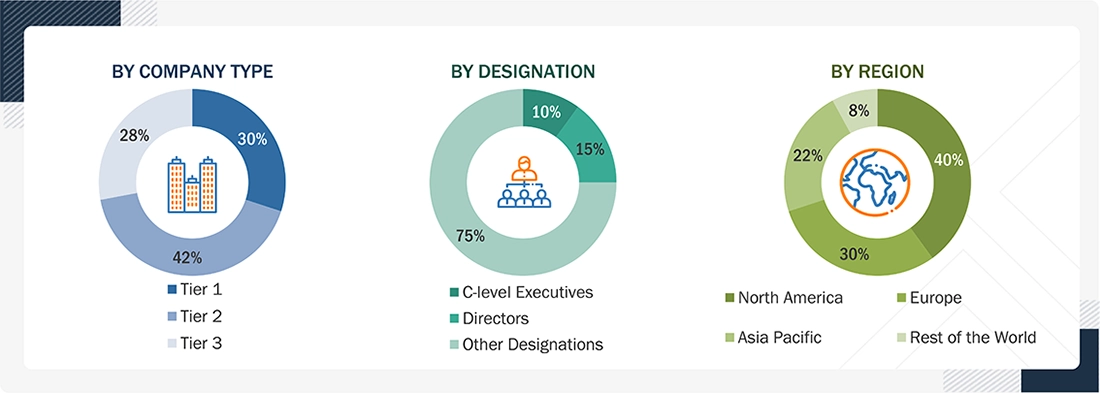
Note 1: Other designations include sales managers, marketing managers, business development managers, product managers, distributors, and suppliers.
Note 2: Companies are classified into tiers based on their total revenue. As of 2025, Tier 1 = >USD 1 billion, Tier 2 = <USD 500 million, and Tier 3 = <USD 100 million.
To know about the assumptions considered for the study, download the pdf brochure
Market Size Estimation
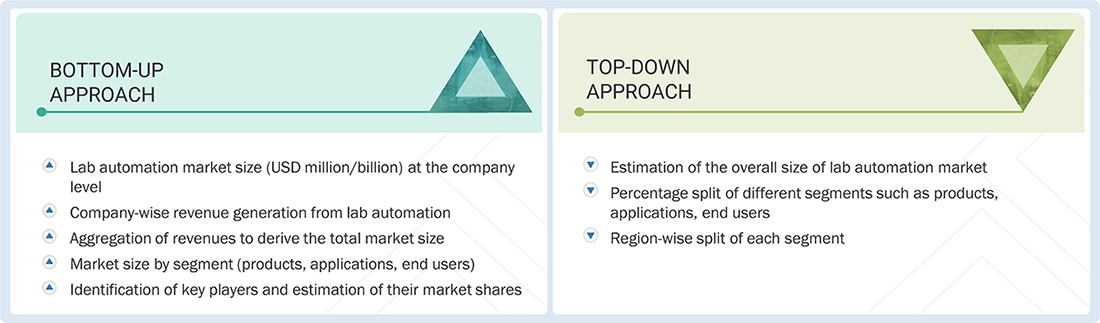
This report used revenue-share analyses of major companies to determine the size of the global lab automation market. This was accomplished by identifying the major market participants and calculating their lab automation revenue using information gathered during the primary and secondary research stages. Examining the annual and financial reports of the leading market participants was one aspect of secondary research. On the other hand, primary research involved in-depth interviews with important thought leaders, including directors, CEOs, and important marketing executives.
Segmental revenues were computed using the revenue mapping of the leading solution/service providers to determine the worldwide market value. The following steps were engaged in this process
- Making a list of the leading international companies in the lab automation industry
- Charting the annual profits made by the leading companies in the lab automation sector (or the closest stated business unit/product category)
- As of 2025, revenue mapping of leading companies to cover a significant portion of the global market
- Calculating the lab automation industry's global value
Data Triangulation
The above process has divided the lab automation market into several segments and subsegments. Then, data triangulation and the market segmentation process are conducted to confirm the accuracy of the data for each segment. Both factors and trends from the demand and supply sides were researched. Top-down and bottom-up approaches yield the outcome from the analysis of the Lab Automation market.
Market Definition
The lab automation market includes automated workstations, off-the-shelf automated work cells, robotics, automated storage & retrieval systems, and software that automates laboratory procedures to boost efficiency, productivity, and accuracy. It is integrated with devices to aid in complex operations, data collection, and repetitive procedures across life sciences, academic institutes, diagnostics, pharmaceutical research, and other labs. Drug discovery, diagnostics, proteomics, genomics, and microbiology are some of the most critical applications of lab automation solutions.
Key Stakeholders
- Lab automation solution manufacturers, suppliers, and providers
- Lab automation equipment and software solution providers
- Lab automation integrated solution providers
- Academic institutions and private research institutions
- Environmental testing laboratories
- Food & beverage testing centers
- Hospitals and diagnostic centers
- Forensic laboratories
- CROs and CDMOs
- Pharmaceutical & biopharmaceutical companies
- Consulting firms
Report Objectives
-
To define, describe, and forecast the lab automation market based on product, application,
end user, and region - To provide detailed information regarding the major factors influencing the growth of the market (drivers, restraints, opportunities, and industry-specific challenges)
- To strategically analyze micromarkets with respect to individual growth trends, prospects, and contributions to the total market
- To analyze opportunities in the market for stakeholders and provide details of the competitive landscape for market leaders
- To forecast the revenue of the market segments with respect to five regions: North America, Europe, the Asia Pacific, Latin America, and the Middle East & Africa
- To profile the key players and comprehensively analyze their market ranking and core competencies
- To benchmark players within the market using a proprietary competitive leadership mapping framework, which analyzes market players on various parameters within the broad categories of business strategy excellence and strength of product portfolio
- To track and analyze competitive developments such as product launches, agreements, expansions, collaborations, and acquisitions in the lab automation market
Available customizations:
-
Using market data, MarketsandMarkets offers customization according to the company's requirements. Here are the available customization options for the global Lab Automation market
Product Analysis
Company Information
Geographic Analysis
-
Product matrix that provides a comparison of product portfolios of the top 5 companies.
- In-depth profiling of additional market players (up to 5)
- Further breakdown of the Rest of Europe lab automation market into Russia, Belgium, the Netherlands, Switzerland, Austria, Finland, Sweden, Poland, and Portugal, among others.
- Further breakdown of the Rest of Asia Pacific lab automation market into Singapore, Taiwan, New Zealand, the Philippines, Malaysia, and other APAC countries.
- Further breakdown of the Rest of Latin America lab automation market into Argentina, Chile, Colombia, and others.
-
Product matrix that provides a comparison of product portfolios of the top 5 companies.
Get the Full Lab Automation Market Report
Full forecast, segment splits, and company analysis for all Lab Automation Market.
- US Lab Automation Market
- Canada Lab Automation Market
- Germany Lab Automation Market
- France Lab Automation Market
- UK Lab Automation Market
- Italy Lab Automation Market
- Switzerland Lab Automation Market
- Netherlands Lab Automation Market
- China Lab Automation Market
- Japan Lab Automation Market
- India Lab Automation Market
- Australia Lab Automation Market
- South Korea Lab Automation Market
- Mexico Lab Automation Market
- Rest Of Europe Lab Automation Market
- Rest Of Asia Lab Automation Market
Need a Tailored Report?
Customize this report to your needs
Get 10% FREE Customization
Customize This Report
