
Asia Pacific Label Free Detection Market (2024-2029)

The Asia Pacific Label Free Detection Market was valued at $76.4 Million in 2024 and projected to reach to $113.6 Million by 2029, representing a compound annual growth rate of 8.3%. The Asia Pacific label free detection market is poised for sustained expansion driven by healthcare modernization across the region.


| Market Size in | USD 26.32 MN |
| Market Forecast in | |
| CAGR | |
| Forecast Period | |
| Units Considered | Value (USD MN) |
Asia Pacific Label Free Detection Market Trends and Insights
- Asia Pacific's healthcare sector is increasingly adopting label free detection technologies due to rising demand for rapid diagnostic solutions and point-of-care testing across the region.
- The market growth in Asia Pacific is driven by expanding healthcare infrastructure, growing pharmaceutical R&D investments, and increasing prevalence of chronic diseases requiring advanced diagnostic capabilities. Asia Pacific's label free detection market benefits from strong government support for healthcare modernization and significant investments in biotechnology research.
- The region's emerging economies are witnessing accelerated adoption of innovative detection technologies in clinical laboratories and research institutions.
- Asia Pacific's competitive landscape includes both established global players and regional manufacturers developing cost-effective solutions tailored to local market needs..
Key Market Statistics
- CAGR (2024-2029) 8.3% CAGR
- Market Size, 2024 ~USD 76.4 Million
- Forecast, 2029 ~USD 113.6 Million
- Geography Asia Pacific
Asia Pacific Label Free Detection Market Overview
Market Valuation & Growth :
Asia Pacific's label free detection market is valued at $76.4 million in 2024, with a robust CAGR of 8.3% projected through 2029, reaching $113.6 million. This outpaces the global CAGR of 7.7%, positioning Asia Pacific as a high-growth region.
Point-of-Care Testing Expansion :
Rising demand for rapid diagnostic solutions and point-of-care testing across Asia Pacific is driving adoption of label free detection technologies. Healthcare providers are increasingly deploying these solutions to improve diagnostic speed and accessibility in both urban and emerging markets.
China's Market Leadership :
China dominates the Asia Pacific region with a market size of $41.9 million, representing over 54% of the regional market. The country's advanced healthcare infrastructure and investment in diagnostic technologies fuel significant growth opportunities.
Emerging Market Opportunities :
India ($19.3M) and Japan ($25.7M) represent substantial growth opportunities within Asia Pacific. Increasing healthcare expenditure, government initiatives for diagnostic accessibility, and growing awareness of label free detection technologies are accelerating market penetration in these nations.
Asia Pacific Label Free Detection Market Dynamics
- Governments are investing in diagnostic infrastructure, and hospitals are adopting advanced detection technologies to meet rising patient demand for faster, more accurate results.
- The region's growing middle class and increasing healthcare spending create favorable conditions for market growth. Key drivers include the shift toward personalized medicine, expansion of clinical laboratories, and integration of label free detection in research institutions.
- Countries like China, Japan, and India are leading adoption through government healthcare initiatives and private sector innovation.
- By 2029, Asia Pacific is expected to capture an increasingly significant share of the global label free detection market, supported by technological advancements and regulatory support for diagnostic innovation..
Market Ecosystem
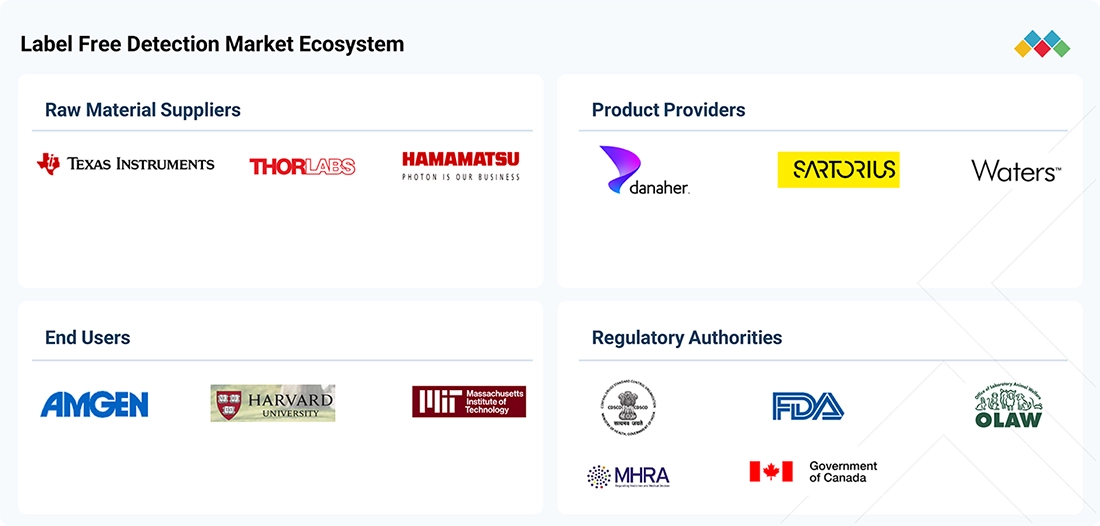
LABEL FREE DETECTION MARKET: GROWTH, SIZE, SHARE, AND TRENDS: COMMERCIAL USE CASES ACROSS INDUSTRIES
| COMPANY | USE CASE DESCRIPTION | BENEFITS |
|---|---|---|
 |
Eurofins demonstrated the use of Biacore SPR and Octet BLI platforms for therapeutic monoclonal antibody potency assessment under quality control and Good Manufacturing Practice (GMP) workflows. The study compared binding performance using reference standards and different analyte concentrations. | Improved potency assessment and batch comparability | Reproducible binding measurements | Supports GMP-compliant biologics quality control |
 |
Quality Assistance documented the use of SPR-based Biacore technology for adalimumab receptor-binding analysis, pembrolizumab potency testing, and influenza hemagglutinin quantification. These applications support biotherapeutic characterization and analytical quality control. | Accurate affinity and potency assessment | Improved batch comparability | Supports biotherapeutic quality evaluation |
Logos and trademarks shown above are the property of their respective owners. Their use here is for informational and illustrative purposes only.
Related Ecosystem
Biotechnology
- Reagents
- Polymerase Chain Reaction (PCR)
- Stem Cells
- Assay Kits
- Flow Cytometers
- Thermo Fisher Scientific Inc.
- Merck KGaA
- Danaher Corporation
- Agilent Technologies, Inc.
- Bio-Rad Laboratories, Inc.
Key Takeaways
- Asia Pacific label free detection market is valued at $76.4 million in 2024 with projected growth to $113.6 million by 2029, representing an 8.3% CAGR.
- Asia Pacific's healthcare modernization initiatives and increased R&D spending are primary drivers of label free detection technology adoption across the region.
- Asia Pacific emerging markets are rapidly deploying label free detection solutions in clinical diagnostics and pharmaceutical research applications.
- Asia Pacific's competitive environment features both multinational corporations and regional innovators developing region-specific label free detection solutions.
Label Free Detection Market Report Scope
| Report Metric | Details |
|---|---|
| Base Year | 2024 |
| Fastest Growing Segment | BIOSENSOR CHIPS (Type) |
| Forecast Period | 2024–2029 |
| Growth Rate | CAGR of 7.7% from 2024 to 2029 |
| Largest Segment | SURFACE PLASMON RESONANCE (Technology) |
| Market Size Base Year (Billions) | ~USD 0.52 (2024) |
| Revenue Forecast (Billions) | ~USD 0.75 (2029) |
| Segments Covered | Offering, Type, Technology, Application, End User |
Asia Pacific Label Free Detection Market Report Segmentation
5 segment dimensions are covered across the global market.
By Offering
- Consumables
- Instruments
- Software & Services
By Type
- Biosensor Chips
- Microplates
- Reagents & Kits
By Technology
- Bio-Layer Interferometry
- Differential Scanning Calorimetry
- Isothermal Titration Calorimetry
- Other Technologies
- Surface Plasmon Resonance
By Application
- Binding Kinetics
- Binding Thermodynamics
- Endogenous Receptor Detection
- Hit Confirmation
- Lead Generation
- Other Applications
By End User
- Academic & Research Institutes
- Contract Research Organization
- Contract Research Organizations
- Other End Users
- Pharmaceutical & Biotechnology Companies
Target Audience
- Diagnostic Equipment Manufacturers : Manufacturers need Asia Pacific market intelligence to identify growth opportunities, understand regional demand for label free detection systems, and develop localized product strategies for China, Japan, and India's expanding healthcare sectors.
- Healthcare Providers & Hospital Networks : Hospital administrators and diagnostic center operators require market data to evaluate label free detection technology adoption, benchmark against regional peers, and plan capital investments in diagnostic infrastructure across Asia Pacific.
- Research & Development Organizations : R&D institutions and biotech companies need insights into Asia Pacific's research funding landscape, adoption of label free detection in academic settings, and collaboration opportunities with regional research centers and universities.
- Investment & Private Equity Firms : Investors evaluating opportunities in Asia Pacific's healthcare diagnostics sector require detailed market sizing, growth projections, and competitive analysis to identify promising companies and market segments for capital deployment.
- Healthcare Policy & Government Agencies : Government health ministries and regulatory bodies need market intelligence to inform healthcare policy, diagnostic infrastructure planning, and technology adoption initiatives across Asia Pacific nations.
Key Companies in the Asia Pacific Label Free Detection Market
| Company | HQ | Ownership | Strongest segments |
|---|---|---|---|
| INSPLORION AB | Sweden | Public Company | NPS-P2 hydrogen detector (industrial and energy safety),NPS-P1 metal hydride detection and process monitoring,Remote and distributed optical detection solutions, |
| REVVITY, INC. | United States | Public Company | Diagnostics (prenatal, neonatal, autoimmune, infectious disease),Life-science reagents, antibodies, and assay platforms,Instruments, imaging, software, and services, |
| DANAHER CORPORATION | United States | Public Company | Biotechnology (bioprocessing and related solutions),Life Sciences (instruments and research consumables),Diagnostics (clinical instruments and consumables), |
| SARTORIUS AG | Germany | Public Company | Bioprocess solutions (bioreactors, cell culture, filtration, fluid management, process chromatography),Lab products and services (lab filtration, weighing, pipettes, microbiological testing, lab water, OEM),Advanced analytics and cell analysis (BLI, cytometry screening, PAT, data analytics, live-cell imaging, SPR), |
| AGILENT TECHNOLOGIES, INC. | United States | Public Company | Life Sciences and Diagnostics Markets,Agilent CrossLab,Applied Markets, |
| WATERS CORPORATION | United States | Public Company | Liquid Chromatography Systems and Columns,Mass Spectrometry Systems,Thermal Analysis, Rheometry, and Calorimetry (TA segment), |
| CORNING INCORPORATED | United States | Public Company | Optical communications (fiber, cable, hardware, connectivity),Display glass substrates (LCD and OLED),Specialty materials (mobile device glass, semiconductor optics, radiation shielding, sunglasses), |
| AMETEK, INC. | United States | Public Company | Process, analytical, and industrial instruments (EIG),Aerospace and defense electronics and sensors,Electromechanical and motion products (EMG), |
| HORIBA, LTD. | Japan | Public Company | Mobility, Powertrain & Emissions Testing,Energy & Environment (Water, Process, Energy Analytics),Bio & Healthcare (IVD and Life Science Instrumentation), |
| SPECTRIS | United Kingdom | Private Company | Spectris Scientific (advanced measurement and materials characterization),Spectris Scientific (monitoring solutions for ultra-clean manufacturers),Spectris Dynamics (sensing and data acquisition), |
| SHIMADZU CORPORATION | Japan | Public Company | Analytical and Measuring Instruments,Medical Systems,Vacuum and Industrial Machinery, |
| HITACHI HIGH-TECH CORPORATION | Japan | Private Company | Nano-Technology Solutions (electron/ion microscopes, CD-SEM, dry etch, inspection),Analytical & Medical Solutions (clinical analyzers, chromatography, spectroscopy),Industrial Solutions (industrial infrastructure, energy, control systems), |
| ATTANA AB | Sweden | Public Company | Contract research & virus analytics services,Analytical instruments,In vitro diagnostic tools & related solutions, |
| BRUKER | United States | Public Company | BSI BioSpin (NMR, EPR, preclinical imaging),BSI CALID (mass spectrometry, molecular diagnostics, automation),BSI Nano (X-ray, AFM, electron microscopy tools, nanometrology), |
| BIO-RAD LABORATORIES, INC. | United States | Public Company | Clinical Diagnostics,Life Science Research & Bioprocess, |
INSPLORION AB
Insplorion AB is a public company founded in 2010 and based in Sweden with 8 employees.
REVVITY, INC.
Revvity, Inc. is a public company founded in 1937 and based in the United States with 11,000 employees.
DANAHER CORPORATION
Danaher Corporation is a public company founded in 1969 and based in the United States with 59,000 employees.
SARTORIUS AG
Sartorius AG is a public company founded in 1870 and based in Germany with 14,242 employees.
AGILENT TECHNOLOGIES, INC.
Agilent Technologies, Inc. is a public company founded in 1999 and based in the United States with 18,000 employees.
WATERS CORPORATION
Waters Corporation is a public company founded in 1958 and based in the United States with 7,900 employees.
CORNING INCORPORATED
Corning Incorporated is a public company founded in 1851 and based in the United States with 67,200 employees.
AMETEK, INC.
AMETEK, Inc. is a public company founded in 1930 and based in the United States with 22,500 employees.
HORIBA, LTD.
Horiba, Ltd. is a public company founded in 1945 and based in Japan with 9,101 employees.
SPECTRIS
Spectris is a private company founded in 1986 and based in the United Kingdom with 7,400 employees.
SHIMADZU CORPORATION
Shimadzu Corporation is a public company founded in 1875 and based in Japan with 14,649 employees.
HITACHI HIGH-TECH CORPORATION
Hitachi High-Tech Corporation is a private company founded in 1947 and based in Japan with 11,482 employees.
ATTANA AB
Attana AB is a public company founded in 2002 and based in Sweden with 6 employees.
BRUKER
Bruker is a public company founded in 1960 and based in the United States with 11,085 employees.
BIO-RAD LABORATORIES, INC.
Bio-Rad Laboratories, Inc. is a public company founded in 1952 and based in the United States with 7,450 employees.
Countries within Asia Pacific - compare and drill down
| Country | 2025 size (native) |
|---|---|
| China | USD 41.9 Million |
| Japan | USD 25.7 Million |
| India | USD 19.3 Million |
| Australia | USD 8 Million |
| South Korea | USD 5.6 Million |
| Rest Of Asia Pacific | USD 13.1 Million |
Country market size visualization
Reasons to Buy this Report
- Regional Market Segmentation : Gain detailed insights into Asia Pacific's label free detection market with country-level breakdowns for China, Japan, India, Australia, and South Korea. Understand market dynamics specific to each nation's healthcare landscape and regulatory environment.
- Growth Opportunity Identification : Identify high-growth segments and emerging opportunities within Asia Pacific. With an 8.3% CAGR outpacing global growth, discover which countries and applications offer the strongest ROI for market entry or expansion strategies.
- Competitive Landscape Analysis : Understand competitive positioning across Asia Pacific's diverse markets. Analyze how regional players and global competitors are capturing market share in different countries, enabling informed strategic planning.
- Investment & Expansion Strategy : Make data-driven decisions for market entry, partnerships, or acquisitions in Asia Pacific. Detailed market sizing and forecasts through 2029 provide the foundation for confident investment planning in this high-growth region.
- Technology Adoption Trends : Track adoption patterns of label free detection technologies across Asia Pacific healthcare systems. Understand how point-of-care testing, research applications, and clinical diagnostics are evolving in the region's diverse markets.
Frequently asked questions
What is the current market size of label free detection in Asia Pacific?
The Asia Pacific label free detection market was valued at $76.4 million in 2024 and is expected to grow to $113.6 million by 2029.
What is the projected growth rate for Asia Pacific's label free detection market?
Asia Pacific's label free detection market is projected to grow at a compound annual growth rate (CAGR) of 8.3% from 2024 to 2029.
What factors are driving growth in Asia Pacific's label free detection market?
Key drivers in Asia Pacific include expanding healthcare infrastructure, increased pharmaceutical R&D investments, growing chronic disease prevalence, and government support for healthcare modernization.
Which applications are most prevalent for label free detection in Asia Pacific?
Asia Pacific's label free detection technologies are primarily used in clinical diagnostics, point-of-care testing, pharmaceutical research, and biomarker discovery applications.
Who are the major players in Asia Pacific's label free detection market?
Asia Pacific's label free detection market includes both global multinational corporations and regional manufacturers developing cost-effective solutions tailored to local healthcare needs.
RESEARCH METHODOLOGY
This study used secondary sources, directories, and databases to identify and collect information for analyzing the global label free detection market. In-depth interviews were conducted with various primary respondents, including key industry participants, subject-matter experts (SMEs), C-level executives of key market players, and industry consultants, to obtain and verify critical qualitative & quantitative information and assess the growth prospects of the market. The global market size estimated through secondary research was triangulated with primary research inputs to determine the final market size.
Secondary Research
Secondary research was primarily used to identify and collect information for the comprehensive technical, market-oriented, and commercial study of the label free detection market. The secondary sources used for this study include World Health Organization (WHO), National Center for Biotechnology Information (NCBI), National Institutes of Health (NIH), US Food and Drug Administration (US FDA), International Molecular Exchange Consortium (IMEx), Biomolecular Interaction Network Database, Nature (Journal), Genome Medicine, PubMed, European Federation of Pharmaceutical Industries and Associations (EFPIA), European Lead Factory (ELF), India Brand Equity Foundation (IBEF), UK Research Partnership Investment Fund (UKRPIF), and Pharmaceutical Research and Manufacturers of America (PhRMA), corporate filings such as annual reports, SEC filings, investor presentations, and financial statements; research journals; press releases; and trade, business, and professional associations, among others. These sources were also used to obtain key information about major players, market classification, and segmentation according to industry trends, regional/country-level markets, market developments, and technology perspectives.
Primary Research
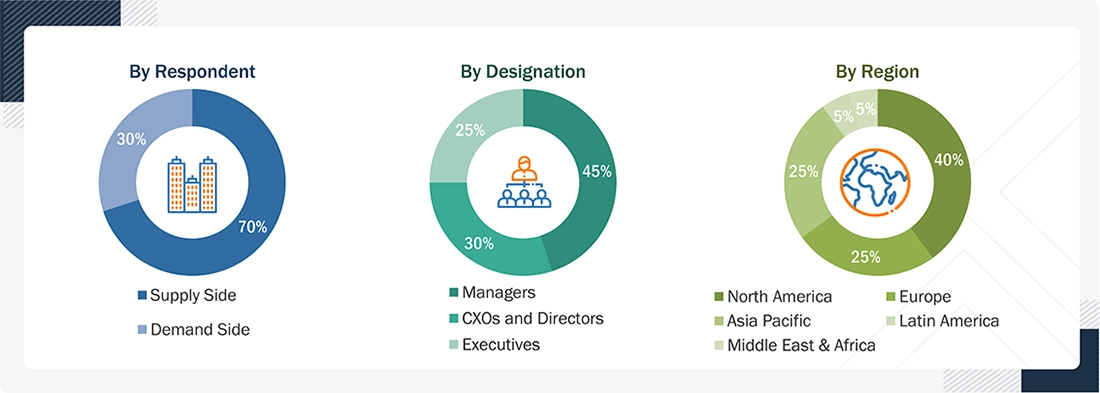
In-depth interviews were conducted with various primary respondents, including key industry participants, subject-matter experts (SMEs), C-level executives of key market players, and industry consultants, to obtain and verify critical qualitative & quantitative information and assess the market’s prospects. Various primary sources from the supply & demand sides of the market were interviewed to obtain qualitative and quantitative information.
To know about the assumptions considered for the study, download the pdf brochure
Market Size Estimation
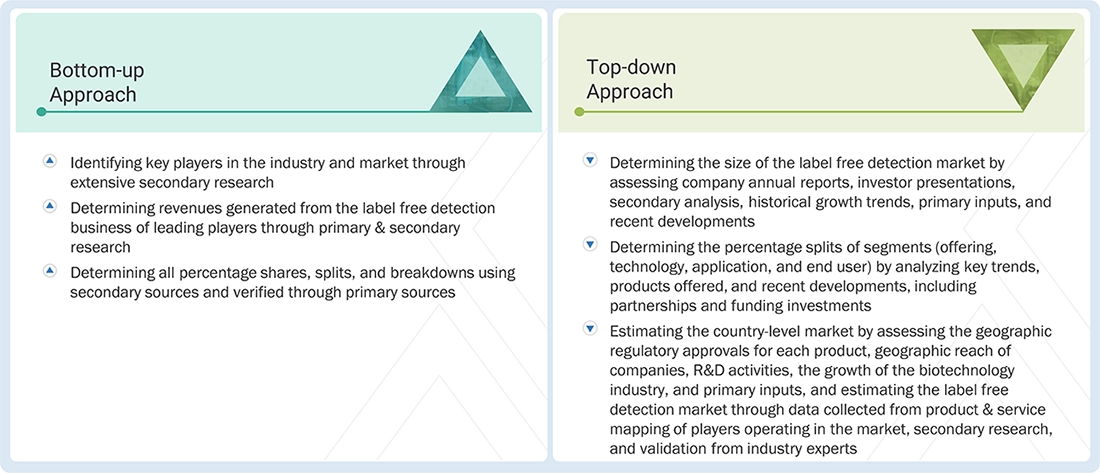
The top-down and bottom-up approaches were used to estimate & validate the total size of the label free detection market. These methods were also used extensively to estimate the size of various market segments.
Data Triangulation
After evaluating the overall market size through the market size estimation process, the total market was divided into several segments and subsegments. Data triangulation and market breakdown procedures were used, whenever applicable, to complete the overall market engineering process and obtain precise statistics for all segments and subsegments. The data were triangulated by analyzing various factors and trends from the demand and supply sides.
Market Definition
The label free detection market focuses on label free detection offerings (instruments, consumables, and software & services) used for analyzing molecular interactions and cellular responses without fluorescent, radioactive, or enzymatic labels. These technologies enable real-time measurement of binding kinetics, affinity, molecular stability, and cellular activity. Label free detection products and services are widely used in drug discovery, biologics development, screening, and life sciences research.
The report provides a comprehensive analysis of the label free detection market, covering a wide range of offerings, including instruments, consumables, and software & services.
Key Stakeholders
- Pharmaceutical & Biotechnology Companies
- Label free Equipment Manufacturers and Vendors
- Life Sciences Companies
- Academic & Research Institutes
- Pathology Laboratories
- Forensic Laboratories
- Contract Research Organizations (CROs)
- Research & Development (R&D) Companies
- Venture Capitalists and Investors
Report Objectives
- To define, describe, and forecast the label free detection market based on offerings, technologies, applications, and end users
- To provide detailed information regarding the major factors influencing the market growth (such as drivers, restraints, opportunities, and challenges)
- To strategically analyze micromarkets concerning individual growth trends, prospects, and contributions to the overall label free detection market
- To analyze the opportunities in the market for stakeholders and provide details of the competitive landscape for market leaders
- To forecast the size of the market segments concerning six main regions, namely, North America, Europe, the Asia Pacific, Latin America, the Middle East, and Africa
- To strategically profile the key players in the label free detection market and comprehensively analyze their core competencies and market rankings
- To track and analyze competitive developments such as product launches, acquisitions, expansions, agreements, partnerships, and collaborations in the label free detection market
- To benchmark players within the label free detection market using the ‘Company Evaluation Matrix’ framework, which analyzes market players based on various parameters within the broad categories of business and product/service strategy.
Available customizations:
Based on the market data, MarketsandMarkets offers customizations to meet the company’s specific needs. The following customization options are available for this report:
Geographical Analysis
- Further breakdown of the Rest of Europe market, by country
- Further breakdown of the Rest of Asia Pacific market, by country
- Further breakdown of the Rest of Latin America market, by country
- Further breakdown of the Rest of Middle East market, by country
Company Information
- Detailed analysis and profiling of additional market players (up to five)
Get the Full Label Free Detection Market Report
Full forecast, segment splits, and company analysis for all Label Free Detection Market.
- Other GCC Countries Label Free Detection Market
- GCC Countries Label Free Detection Market
- Rest Of Middle East Label Free Detection Market
- Canada Label Free Detection Market
- US Label Free Detection Market
- Germany Label Free Detection Market
- UK Label Free Detection Market
- France Label Free Detection Market
- Italy Label Free Detection Market
- Spain Label Free Detection Market
- China Label Free Detection Market
- Japan Label Free Detection Market
- India Label Free Detection Market
- Australia Label Free Detection Market
- South Korea Label Free Detection Market
- Brazil Label Free Detection Market
- Mexico Label Free Detection Market
- Saudi Arabia Label Free Detection Market
- UAE Label Free Detection Market
- Africa Label Free Detection Market
- Middle East Label Free Detection Market
- Rest Of Europe Label Free Detection Market
- Rest Of Asia Pacific Label Free Detection Market
- Rest Of Latin America Label Free Detection Market
Need a Tailored Report?
Customize this report to your needs
Get 10% FREE Customization
Customize This Report
