
Rest Of Europe Label Free Detection Market (2024-2029)

The Rest Of Europe Label Free Detection Market was valued at $20.3 Million in 2024 and projected to reach to $27.1 Million by 2029, representing a compound annual growth rate of 5.9%. Rest Of Europe's label free detection market is positioned for consistent growth as healthcare institutions prioritize cost-efficient diagnostic solutions without compromising analytical performance.


| Market Size in | USD 26.32 MN |
| Market Forecast in | |
| CAGR | |
| Forecast Period | |
| Units Considered | Value (USD MN) |
Rest Of Europe Label Free Detection Market Trends and Insights
- Rest Of Europe's healthcare sector is increasingly adopting label free detection technologies due to their cost-effectiveness and real-time analytical capabilities.
- The region's growing emphasis on precision medicine and diagnostic innovation is driving demand across pharmaceutical, biotechnology, and clinical research applications in Rest Of Europe. Rest Of Europe's market growth is supported by rising investments in healthcare infrastructure and regulatory support for advanced diagnostic solutions.
- The 5.9% compound annual growth rate reflects Rest Of Europe's moderate but consistent adoption of label free detection platforms.
- Rest Of Europe's pharmaceutical and research institutions are leveraging these technologies to accelerate drug development and improve patient outcomes, positioning the region as a key contributor to the broader European healthcare innovation landscape..
Key Market Statistics
- CAGR (2024-2029) 5.9% CAGR
- Market Size, 2024 ~USD 20.3 Million
- Forecast, 2029 ~USD 27.1 Million
- Country Rest Of Europe
Rest Of Europe Label Free Detection Market Overview
Market Valuation :
Rest Of Europe's label free detection market is valued at $20.3 million in 2024, with a steady CAGR of 5.9% through 2029, reaching $27.1 million by forecast end.
Cost-Effectiveness Adoption :
European healthcare providers are increasingly adopting label free detection technologies for their cost-effectiveness and ability to reduce operational expenses while maintaining diagnostic accuracy.
Real-Time Analytical Capabilities :
Rest Of Europe's healthcare sector is leveraging real-time analytical capabilities of label free detection systems to accelerate clinical decision-making and improve patient outcomes.
Precision Medicine Integration :
Growing emphasis on precision medicine and diagnostic innovation across Rest Of Europe is driving adoption of advanced label free detection technologies in clinical and research settings.
Rest Of Europe Label Free Detection Market Dynamics
- The region's commitment to precision medicine and diagnostic innovation creates a favorable environment for technology adoption.
- Healthcare providers are increasingly recognizing the operational advantages of label free detection systems, particularly in reducing time-to-result and minimizing reagent costs.
- Regulatory support for advanced diagnostics and growing investment in healthcare infrastructure further strengthen market expansion prospects.
- By 2029, the market is expected to reach $27.1 million, reflecting sustained demand from hospitals, diagnostic laboratories, and research institutions across Rest Of Europe..
Market Ecosystem
Related Ecosystem
Biotechnology
- Reagents
- Polymerase Chain Reaction (PCR)
- Stem Cells
- Assay Kits
- Flow Cytometers
- Thermo Fisher Scientific Inc.
- Merck KGaA
- Danaher Corporation
- Agilent Technologies, Inc.
- Bio-Rad Laboratories, Inc.
Key Takeaways
- Rest Of Europe's label free detection market is valued at $20.3 million in 2024 and is forecast to reach $27.1 million by 2029.
- Rest Of Europe demonstrates a 5.9% CAGR, reflecting steady adoption of label free detection technologies in healthcare and research sectors.
- Rest Of Europe's growth is driven by increased investment in precision medicine, diagnostic innovation, and pharmaceutical research infrastructure.
- Rest Of Europe's market expansion is supported by regulatory frameworks and institutional demand from pharmaceutical and biotechnology organizations.
Label Free Detection Market Report Scope
| Report Metric | Details |
|---|---|
| Base Year | 2024 |
| Fastest Growing Segment | BIOSENSOR CHIPS (Type) |
| Forecast Period | 2024–2029 |
| Growth Rate | CAGR of 7.7% from 2024 to 2029 |
| Largest Segment | SURFACE PLASMON RESONANCE (Technology) |
| Market Size Base Year (Billions) | ~USD 0.52 (2024) |
| Revenue Forecast (Billions) | ~USD 0.75 (2029) |
| Segments Covered | Offering, Type, Technology, Application, End User |
Rest Of Europe Label Free Detection Market Report Segmentation
5 segment dimensions are covered across the global market.
By Offering
- Consumables
- Instruments
- Software & Services
By Type
- Biosensor Chips
- Microplates
- Reagents & Kits
By Technology
- Bio-Layer Interferometry
- Differential Scanning Calorimetry
- Isothermal Titration Calorimetry
- Other Technologies
- Surface Plasmon Resonance
By Application
- Binding Kinetics
- Binding Thermodynamics
- Endogenous Receptor Detection
- Hit Confirmation
- Lead Generation
- Other Applications
By End User
- Academic & Research Institutes
- Contract Research Organization
- Contract Research Organizations
- Other End Users
- Pharmaceutical & Biotechnology Companies
Target Audience
- Healthcare Technology Providers : Manufacturers and vendors of label free detection systems need Rest Of Europe market data to identify expansion opportunities, tailor product offerings, and develop region-specific go-to-market strategies.
- Diagnostic Laboratory Operators : Laboratory managers and operators require market insights to evaluate technology investments, understand competitive positioning, and optimize diagnostic capabilities for precision medicine applications.
- Healthcare Investment Firms : Private equity and venture capital investors need comprehensive Rest Of Europe market analysis to assess investment opportunities, evaluate portfolio companies, and identify emerging growth segments.
- Clinical Research Organizations : CROs and research institutions require regional market intelligence to understand technology adoption trends, benchmark against peers, and plan research infrastructure investments.
- Healthcare Policy Makers : Government health agencies and regulatory bodies need market data to inform healthcare policy, support diagnostic innovation initiatives, and allocate resources for precision medicine advancement.
Key Companies in the Rest Of Europe Label Free Detection Market
| Company | HQ | Ownership | Strongest segments |
|---|---|---|---|
| INSPLORION AB | Sweden | Public Company | NPS-P2 hydrogen detector (industrial and energy safety),NPS-P1 metal hydride detection and process monitoring,Remote and distributed optical detection solutions, |
| REVVITY, INC. | United States | Public Company | Diagnostics (prenatal, neonatal, autoimmune, infectious disease),Life-science reagents, antibodies, and assay platforms,Instruments, imaging, software, and services, |
| DANAHER CORPORATION | United States | Public Company | Biotechnology (bioprocessing and related solutions),Life Sciences (instruments and research consumables),Diagnostics (clinical instruments and consumables), |
| SARTORIUS AG | Germany | Public Company | Bioprocess solutions (bioreactors, cell culture, filtration, fluid management, process chromatography),Lab products and services (lab filtration, weighing, pipettes, microbiological testing, lab water, OEM),Advanced analytics and cell analysis (BLI, cytometry screening, PAT, data analytics, live-cell imaging, SPR), |
| AGILENT TECHNOLOGIES, INC. | United States | Public Company | Life Sciences and Diagnostics Markets,Agilent CrossLab,Applied Markets, |
| WATERS CORPORATION | United States | Public Company | Liquid Chromatography Systems and Columns,Mass Spectrometry Systems,Thermal Analysis, Rheometry, and Calorimetry (TA segment), |
| CORNING INCORPORATED | United States | Public Company | Optical communications (fiber, cable, hardware, connectivity),Display glass substrates (LCD and OLED),Specialty materials (mobile device glass, semiconductor optics, radiation shielding, sunglasses), |
| AMETEK, INC. | United States | Public Company | Process, analytical, and industrial instruments (EIG),Aerospace and defense electronics and sensors,Electromechanical and motion products (EMG), |
| HORIBA, LTD. | Japan | Public Company | Mobility, Powertrain & Emissions Testing,Energy & Environment (Water, Process, Energy Analytics),Bio & Healthcare (IVD and Life Science Instrumentation), |
| SPECTRIS | United Kingdom | Private Company | Spectris Scientific (advanced measurement and materials characterization),Spectris Scientific (monitoring solutions for ultra-clean manufacturers),Spectris Dynamics (sensing and data acquisition), |
| SHIMADZU CORPORATION | Japan | Public Company | Analytical and Measuring Instruments,Medical Systems,Vacuum and Industrial Machinery, |
| HITACHI HIGH-TECH CORPORATION | Japan | Private Company | Nano-Technology Solutions (electron/ion microscopes, CD-SEM, dry etch, inspection),Analytical & Medical Solutions (clinical analyzers, chromatography, spectroscopy),Industrial Solutions (industrial infrastructure, energy, control systems), |
| ATTANA AB | Sweden | Public Company | Contract research & virus analytics services,Analytical instruments,In vitro diagnostic tools & related solutions, |
| BRUKER | United States | Public Company | BSI BioSpin (NMR, EPR, preclinical imaging),BSI CALID (mass spectrometry, molecular diagnostics, automation),BSI Nano (X-ray, AFM, electron microscopy tools, nanometrology), |
| BIO-RAD LABORATORIES, INC. | United States | Public Company | Clinical Diagnostics,Life Science Research & Bioprocess, |
INSPLORION AB
Insplorion AB is a public company founded in 2010 and based in Sweden with 8 employees.
REVVITY, INC.
Revvity, Inc. is a public company founded in 1937 and based in the United States with 11,000 employees.
DANAHER CORPORATION
Danaher Corporation is a public company founded in 1969 and based in the United States with 59,000 employees.
SARTORIUS AG
Sartorius AG is a public company founded in 1870 and based in Germany with 14,242 employees.
AGILENT TECHNOLOGIES, INC.
Agilent Technologies, Inc. is a public company founded in 1999 and based in the United States with 18,000 employees.
WATERS CORPORATION
Waters Corporation is a public company founded in 1958 and based in the United States with 7,900 employees.
CORNING INCORPORATED
Corning Incorporated is a public company founded in 1851 and based in the United States with 67,200 employees.
AMETEK, INC.
AMETEK, Inc. is a public company founded in 1930 and based in the United States with 22,500 employees.
HORIBA, LTD.
Horiba, Ltd. is a public company founded in 1945 and based in Japan with 9,101 employees.
SPECTRIS
Spectris is a private company founded in 1986 and based in the United Kingdom with 7,400 employees.
SHIMADZU CORPORATION
Shimadzu Corporation is a public company founded in 1875 and based in Japan with 14,649 employees.
HITACHI HIGH-TECH CORPORATION
Hitachi High-Tech Corporation is a private company founded in 1947 and based in Japan with 11,482 employees.
ATTANA AB
Attana AB is a public company founded in 2002 and based in Sweden with 6 employees.
BRUKER
Bruker is a public company founded in 1960 and based in the United States with 11,085 employees.
BIO-RAD LABORATORIES, INC.
Bio-Rad Laboratories, Inc. is a public company founded in 1952 and based in the United States with 7,450 employees.
Reasons to Buy this Report
- Regional Market Sizing : Obtain precise market valuation data specific to Rest Of Europe, including 2024 baseline ($20.3M) and 2029 forecast ($27.1M), enabling accurate budget allocation and investment planning.
- Growth Trajectory Analysis : Understand Rest Of Europe's 5.9% CAGR performance relative to global 7.7% growth, identifying regional opportunities and competitive positioning within the European healthcare landscape.
- Adoption Drivers : Gain insights into cost-effectiveness and real-time analytical capabilities driving adoption across Rest Of Europe's healthcare sector, informing product development and market entry strategies.
- Precision Medicine Trends : Access detailed analysis of precision medicine and diagnostic innovation trends specific to Rest Of Europe, supporting strategic planning for healthcare technology providers and investors.
- Competitive Intelligence : Benchmark your organization against regional market dynamics and identify growth opportunities within Rest Of Europe's healthcare institutions, diagnostic labs, and research facilities.
Frequently asked questions
What is the current market size of label free detection in Rest Of Europe?
Rest Of Europe's label free detection market was valued at $20.3 million in 2024 and is expected to grow to $27.1 million by 2029.
What is the projected growth rate for label free detection in Rest Of Europe?
Rest Of Europe's label free detection market is projected to grow at a compound annual growth rate (CAGR) of 5.9% from 2024 to 2029.
Which sectors are driving demand for label free detection in Rest Of Europe?
Rest Of Europe's demand for label free detection is primarily driven by pharmaceutical companies, biotechnology firms, clinical research organizations, and academic institutions focused on precision medicine and drug development.
What factors are contributing to market growth in Rest Of Europe?
Rest Of Europe's market growth is supported by increased healthcare investments, regulatory support for advanced diagnostics, rising adoption of precision medicine, and growing demand for real-time analytical solutions in research and clinical settings.
How does Rest Of Europe's market compare to the global label free detection market?
Rest Of Europe's 5.9% CAGR is slightly lower than the global market CAGR of 7.7%, indicating that Rest Of Europe is experiencing steady but more moderate growth compared to other regions.
RESEARCH METHODOLOGY
This research study involved the extensive use of secondary sources, directories, and databases to identify and collect valuable information for the analysis of the global label-free detection market. In-depth interviews were conducted with various primary respondents, including key industry participants, subject-matter experts (SMEs), C-level executives of key market players, and industry consultants, to obtain and verify critical qualitative and quantitative information and assess the growth prospects of the market. The global market size estimated through secondary research was then triangulated with inputs from primary research to arrive at the final market size.
Secondary Research
Secondary research was used mainly to identify and collect information for the extensive, technical, market-oriented, and commercial study of the label-free detection market. The secondary sources used for this study include World Health Organization (WHO), National Center for Biotechnology Information (NCBI), National Institutes of Health (NIH), US Food and Drug Administration (US FDA), International Molecular Exchange Consortium (IMEx), Biomolecular Interaction Network Database, Nature (Journal), Genome Medicine, PubMed, European Federation of Pharmaceutical Industries and Associations (EFPIA), European Lead Factory (ELF), India Brand Equity Foundation (IBEF), UK Research Partnership Investment Fund (UKRPIF), Pharmaceutical Research and Manufacturers of America (PhRMA), Eurostat, and Factiva, research journals; corporate filings such as annual reports, SEC filings, investor presentations, and financial statements; press releases; trade, business, professional associations and among others. These sources were also used to obtain key information about major players, market classification, and segmentation according to industry trends, regional/country-level markets, market developments, and technology perspectives.
Primary Research
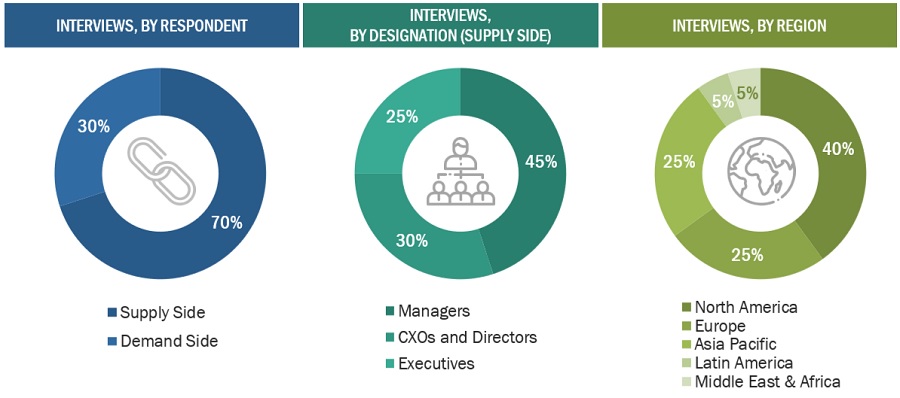
Extensive primary research was conducted after acquiring basic knowledge about the global label-free detection market scenario through secondary research. Several primary interviews were conducted with market experts from the demand side, such as pharmaceutical and biotechnology companies, CROs, CMOs, and academic & research institutes, and experts from the supply side, such as C-level and D-level executives, product managers, marketing & sales managers of key manufacturers, distributors, and channel partners. These interviews were conducted across six major regions, including the Asia Pacific, North America, Europe, Latin America, Middle East and Africa. Approximately 70% and 30% of the primary interviews were conducted with supply-side and demand-side participants, respectively. This primary data was collected through questionnaires, e-mails, online surveys, personal interviews, and telephonic interviews.
The following is a breakdown of the primary respondents:
To know about the assumptions considered for the study, download the pdf brochure
Market Size Estimation
Both top-down and bottom-up approaches were used to estimate and validate the total size of the label-free detection market. These methods were also used extensively to estimate the size of various subsegments in the market. The research methodology used to estimate the market size includes the following:
Bottom-up Approach
- The key players in the market have been identified through extensive secondary research.
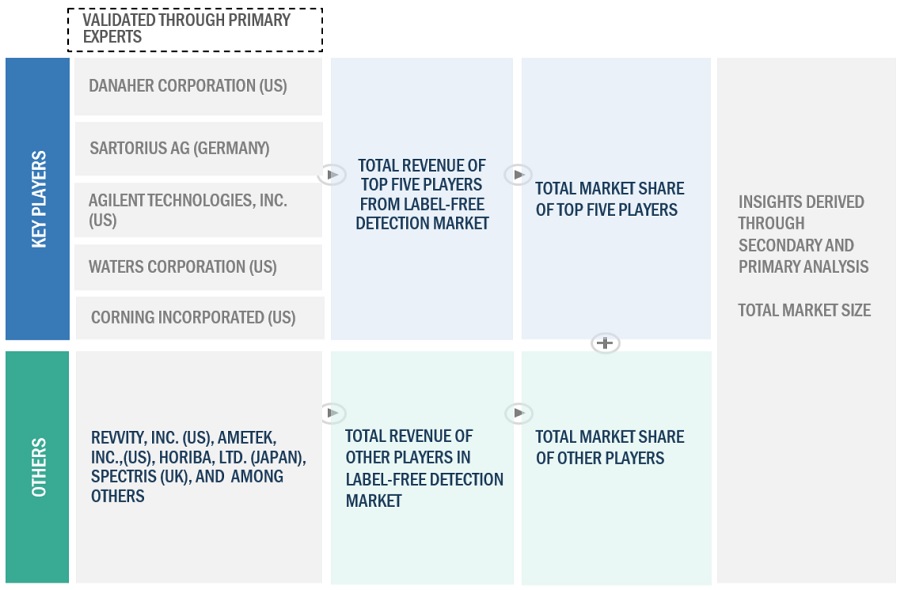
- The revenues generated from the label-free detection business of leading players have been determined through primary and secondary research to arrive at the overall label-free detection market.
- All percentage shares, splits, and breakdowns have been determined using secondary sources and verified through primary sources.
- Additionally, to arrive at the label-free detection market for offering segments, the label-free detection business shares of leading players for separate product category (wherever available) were also gathered from secondary sources. In some instances, the shares of label-free detection product businesses were ascertained through a detailed analysis of various parameters, including product portfolios, market positioning and primary insights.
- All assumptions, approaches and individual shares/revenue estimates were validated through expert interviews.
To know about the assumptions considered for the study, Request for Free Sample Report
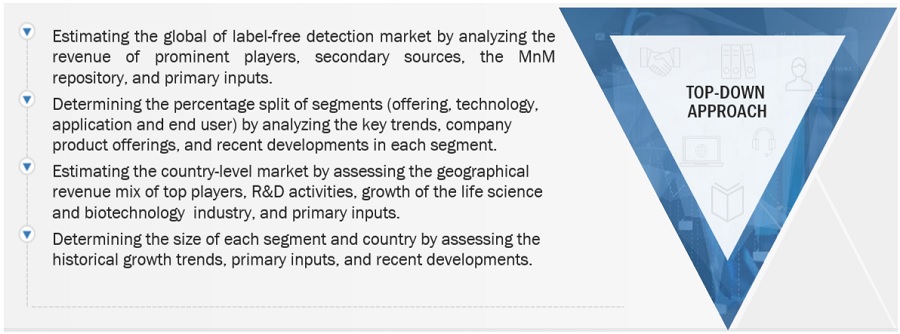
Top-down Approach
After arriving at the overall market size from the market size estimation process, the total market was split into several segments and subsegments.
Data Triangulation
After arriving at the market size from the market size estimation process explained above, the total market was divided into several segments and subsegments. To complete the overall market engineering process and arrive at the exact statistics for all segments and subsegments, data triangulation and market breakdown procedures were employed, wherever applicable. The data was triangulated by studying various factors and trends from both the demand and supply sides.
Market Definition
Label-free detection is gaining widespread acceptance as an important research and development tool in academic research institutes and biotechnology and pharmaceutical industries. It helps in the investigation of molecule-molecule interactions without using additional isotope or fluorescent labels that usually cause spatial interference or quenching.
Stakeholders
- Pharmaceutical and biotechnology research associations
- Label-free equipment manufacturers and vendors
- Research and consulting firms
- Pathologists and pathology laboratories
- Distributors of label-free detection equipment
- Research institutes
- Contract research organizations (CROs)
- Venture capitalists
- Government associations
- CROs & CDMOs
- Forensic laboratories
- Market research and consulting firms
- Government & independent regulatory authorities
Report Objectives
- To define, describe, and forecast the label-free detection market based on offering, technology, application, end user, and region
- To provide detailed information regarding the major factors influencing market growth (such as drivers, restraints, opportunities, and challenges)
- To strategically analyze micro-markets with respect to individual growth trends, prospects, and contributions to the overall label-free detection market
- To analyze opportunities in the market for stakeholders and provide details of the competitive landscape for market leaders
- To forecast the size of the market segments with respect to six main regions: North America, Europe, the Asia Pacific, Latin America, the Middle East, and Africa
- To profile the key players in the label-free detection market and comprehensively analyze their product portfolios, market positions, and core competencies
- To track and analyze competitive developments in the label-free detection market, such as acquisitions, product launches, expansions, agreements, partnerships, and collaborations
- To benchmark players within the label-free detection market using the ‘Company Evaluation Matrix' framework, which analyzes market players based on various parameters within the broad categories of business strategy and product strategy
Available Customizations
With the given market data, MarketsandMarkets offers customizations as per the company’s specific needs. The following customization options are available for this report:
Portfolio Assessment
- Product Matrix, which gives a detailed comparison of the product portfolios of the top three companies.
Company Information
- Detailed analysis and profiling of additional market players (up to three).
Geographical Analysis
- A further breakdown of the Rest of Asia Pacific Label-free detection market into countries
- A further breakdown of the Rest of European Label-free detection market into countries
- A further breakdown of the Rest of Latin American Label-free detection market into countries
Get the Full Label Free Detection Market Report
Full forecast, segment splits, and company analysis for all Label Free Detection Market.
- Other GCC Countries Label Free Detection Market
- GCC Countries Label Free Detection Market
- Rest Of Middle East Label Free Detection Market
- Canada Label Free Detection Market
- US Label Free Detection Market
- Germany Label Free Detection Market
- UK Label Free Detection Market
- France Label Free Detection Market
- Italy Label Free Detection Market
- Spain Label Free Detection Market
- China Label Free Detection Market
- Japan Label Free Detection Market
- India Label Free Detection Market
- Australia Label Free Detection Market
- South Korea Label Free Detection Market
- Brazil Label Free Detection Market
- Mexico Label Free Detection Market
- Saudi Arabia Label Free Detection Market
- UAE Label Free Detection Market
- Africa Label Free Detection Market
- Middle East Label Free Detection Market
- Rest Of Asia Pacific Label Free Detection Market
- Rest Of Latin America Label Free Detection Market
Need a Tailored Report?
Customize this report to your needs
Get 10% FREE Customization
Customize This Report
