
US Laser Technology Market (2024-2029)

The US Laser Technology Market was valued at $2552.4 Million in 2024 and projected to reach to $3613.6 Million by 2029, representing a compound annual growth rate of 7.2%. The US laser technology market is positioned for sustained expansion through 2029, driven by accelerating adoption in precision manufacturing, minimally invasive medical procedures, and 5G/6G telecommunications infrastructure development.


| Market Size in | USD 26.32 MN |
| Market Forecast in | |
| CAGR | |
| Forecast Period | |
| Units Considered | Value (USD MN) |
US Laser Technology Market Trends and Insights
- The US market is expected to expand significantly, reaching $3,613.6 million by 2029, driven by increasing demand across industrial manufacturing, medical devices, and telecommunications applications.
- The US maintains a leadership position in laser innovation and adoption, supported by strong R&D investments and a mature technology ecosystem. Growth in the US laser technology market is fueled by advancements in fiber laser systems, solid-state lasers, and semiconductor lasers.
- The US benefits from a robust supply chain and early adoption of cutting-edge laser solutions in precision manufacturing and healthcare sectors.
- Between 2024 and 2029, the US market will experience steady expansion as enterprises modernize production capabilities and integrate laser-based automation. The US competitive landscape features both established players and emerging innovators focused on cost reduction and performance enhancement.
- Market consolidation and strategic partnerships are reshaping the US industry, while regulatory compliance and sustainability initiatives continue to influence product development and market positioning..
Key Market Statistics
- CAGR (2024-2029) 7.2% CAGR
- Market Size, 2024 ~USD 2552.4 Million
- Forecast, 2029 ~USD 3613.6 Million
- Country US
US Laser Technology Market Overview
Market Valuation :
The US laser technology market is valued at $2,552.4 million in 2024, representing a significant portion of the global semiconductor and electronics sector with strong year-over-year growth momentum.
Robust Growth Trajectory :
With a CAGR of 7.2% through 2029, the US market is projected to reach $3,613.6 million, outpacing many other technology segments and reflecting sustained investment in advanced manufacturing and innovation.
Diverse Application Base :
US demand spans industrial manufacturing, medical device production, telecommunications infrastructure, and consumer electronics, creating multiple revenue streams and reducing market concentration risk.
Innovation Leadership :
The US maintains a global leadership position in laser technology development, hosting major R&D centers and attracting significant venture capital investment in next-generation laser applications and systems.
US Laser Technology Market Dynamics
- Industrial automation trends and the reshoring of semiconductor manufacturing to the US are creating substantial demand for advanced laser systems.
- Key growth catalysts include increased investment in quantum computing applications, autonomous vehicle LiDAR systems, and fiber-optic communication networks.
- The market will benefit from technological advancements reducing system costs while improving performance capabilities, making laser solutions accessible to mid-market manufacturers and healthcare providers..
Market Ecosystem
Related Ecosystem
Smart Lighting
- Fiber Laser
- Fluorescent Lighting
- Gas Lasers
- Sensors
- 3D Sensors
- Zumtobel group ag
- Nedap n.v.
- Acuity Brands, Inc.
- OSRAM Licht AG
- Philips
Defence Platforms And Systems
- Sensors
- Unmanned Ground Vehicles (UGV)
- Fighter Aircraft
- Special Mission Aircraft
- Antennas
- BAE Systems plc
- Thales group
- LOCKHEED MARTIN CORPORATION
- Northrop Grumman Corporation
- L3Harris Technologies, Inc.
Automotive Electronics And Electrical Equipment
- Battery Electric Vehicle (BEV)
- Light Commercial Vehicles (LCVs)
- Fuel Cell Electric Vehicle (FCEV)
- Sensors
- Hybrid Electric Vehicle (HEV)
- BOSCH LIMITED
- DENSO Corporation
- Continental ag
- Panasonic Holdings Corporation
- Texas Instruments Incorporated
Key Takeaways
- The US laser technology market will grow from $2,552.4M in 2024 to $3,613.6M by 2029, representing a 7.2% CAGR.
- The US market is driven by industrial automation, medical device manufacturing, and telecommunications infrastructure investments.
- The US maintains technological leadership through continuous innovation in fiber, solid-state, and semiconductor laser systems.
- Strategic consolidation and partnerships are reshaping the competitive dynamics of the US laser technology sector.
Laser Technology Market Report Scope
| Report Metric | Details |
|---|---|
| Base Year | 2024 |
| Fastest Growing Segment | GLASSES (Fiber Type) |
| Forecast Period | 2024-2029 |
| Growth Rate | CAGR of 8% from 2024 to 2029 |
| Largest Segment | SOLID LASERS (Laser Type) |
| Market Size Base Year (Billions) | ~USD 20.08 (2024) |
| Revenue Forecast (Billions) | ~USD 29.5 (2029) |
| Segments Covered | Laser Type, Type, Configuration, Application, Vertical, Fiber Type |
US Laser Technology Market Report Segmentation
6 segment dimensions are covered across the global market.
By Laser Type
- Gas Lasers
- Liquid Lasers
- Other Laser Types
- Solid Lasers
By Type
- Argon Lasers
- Chemical Lasers
- Co2 Lasers
- Excimer Lasers
- Fiber Lasers
- Gas Lasers
- Helium-Neon Lasers
- Liquid Lasers
- Other Laser Types
- Ruby Lasers
- Semiconductor Lasers
- Solid Lasers
- Thin Disk Lasers
- Yttrium Aluminum Garnet Lasers
By Configuration
- Fixed Beam
- Hybrid Beam
- Moving Beam
By Application
- Laser Processing
- Optical Communications
- Optoelectronic Devices
- Other Applications
By Vertical
- Aerospace
- Automotive
- Commercial
- Industrial
- Medical
- Other Verticals
- Research
- Semiconductor & Electronics
- Telecommunications
By Fiber Type
- Glasses
- Plastics
Target Audience
- Laser Equipment Manufacturers : US-based and international laser system manufacturers need precise market sizing and growth forecasts to optimize production capacity, plan R&D investments, and develop competitive strategies for the American market.
- Industrial Automation Companies : Manufacturers integrating laser technology into production systems require detailed US market data to identify customer segments, assess adoption rates, and forecast demand for laser-enabled automation solutions.
- Medical Device Developers : Companies developing laser-based medical devices need US-specific market intelligence to understand regulatory landscape, competitive dynamics, and growth opportunities in surgical and diagnostic applications.
- Telecommunications Infrastructure Providers : Telecom companies deploying fiber-optic and 5G networks require market data on laser technology adoption to plan infrastructure investments and evaluate supplier capabilities in the US market.
- Investment & Private Equity Firms : Investors evaluating opportunities in the US laser technology sector need comprehensive market analysis, growth projections, and competitive landscape data to support acquisition and funding decisions.
Reasons to Buy this Report
- Strategic Market Sizing : Obtain precise valuation data for the US laser market with detailed CAGR analysis, enabling accurate budget allocation and investment decisions specific to the American market landscape.
- Competitive Positioning : Understand US market dynamics, growth drivers, and application segments to benchmark your company's performance against regional competitors and identify market share opportunities.
- Forecast-Driven Planning : Leverage 5-year projections through 2029 to develop long-term product roadmaps, capacity planning, and go-to-market strategies aligned with anticipated US demand patterns.
- Sector-Specific Insights : Access detailed analysis of US demand across industrial manufacturing, medical devices, and telecommunications sectors to prioritize sales efforts and product development initiatives.
- Risk Mitigation : Make informed decisions about market entry, expansion, or investment in the US laser technology sector with comprehensive data reducing uncertainty and supporting stakeholder confidence.
Frequently asked questions
What is the current size of the US laser technology market?
The US laser technology market was valued at $2,552.4 million in 2024 and is projected to reach $3,613.6 million by 2029.
What is the expected growth rate for the US laser technology market?
The US laser technology market is expected to grow at a compound annual growth rate (CAGR) of 7.2% from 2024 to 2029.
Which industries drive demand in the US laser technology market?
The US laser technology market is primarily driven by industrial manufacturing, medical device production, telecommunications, and precision cutting applications.
What types of lasers are most prevalent in the US market?
Fiber lasers, solid-state lasers, and semiconductor lasers are the dominant laser types in the US market, each serving distinct industrial and commercial applications.
What factors are influencing the US laser technology market growth?
Key factors include increasing automation in manufacturing, rising demand for precision medical devices, telecommunications infrastructure expansion, and ongoing technological innovations in laser systems.
RESEARCH METHODOLOGY
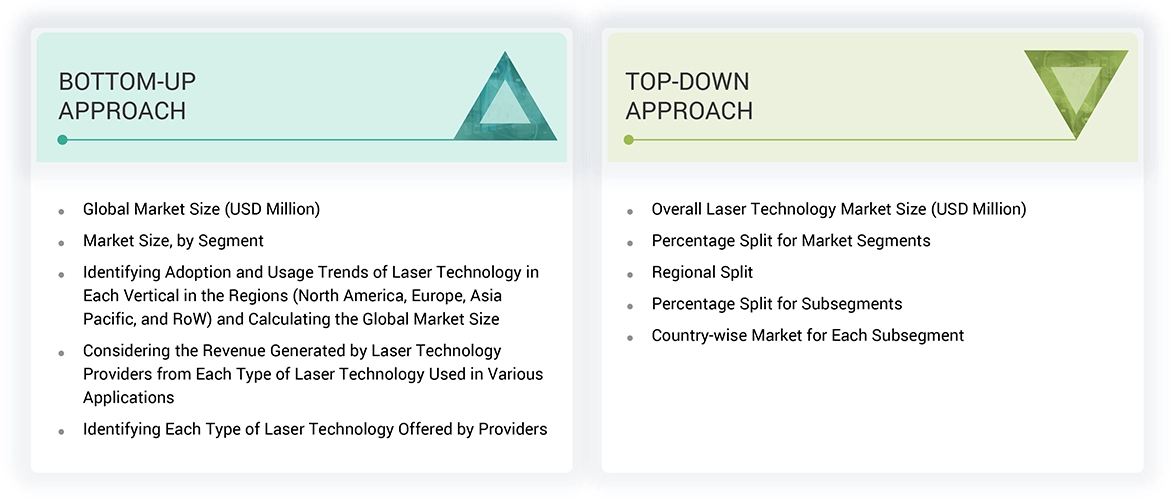
The study involves four major activities that estimate the size of the laser technology market. Exhaustive secondary research was conducted to collect information related to the market. Following this was validating these findings, assumptions, and sizing with the industry experts across the value chain through primary research. Both top-down and bottom-up approaches were employed to estimate the overall size of the laser market. Subsequently, market breakdown and data triangulation procedures were used to determine the extent of different segments and subsegments of the market.
Secondary Research
Secondary sources in this research study include corporate filings (such as annual reports, investor presentations, and financial statements); trade, business, and professional associations; white papers, certified publications, articles from recognized authors; directories; and databases. The secondary data were collected and analyzed to estimate the overall market size, further validated by primary research. The relevant data is collected from various secondary sources, it is analyzed to extract insights and information relevant to the market research objectives. This analysis has involved summarizing the data, identifying trends, and drawing conclusions based on the available information.
Primary Research
In the primary research process, numerous sources from both the supply and demand sides were interviewed to obtain qualitative and quantitative information about this report. The primary sources from the supply side included various industry experts such as Chief X Officers (CXOs), Vice Presidents (VPs), and Directors from business development, marketing, product development/innovation teams, and related key executives from laser technology providers, (such as Coherent, Trumpf, Han’s Laser Technology Industry Group Co., Ltd, IPG Photonics and Jenoptik AG) research organizations, distributors, professional and managed service providers, industry associations, and key opinion leaders. Approximately 25% of the primary interviews were conducted with the demand side and 75% with the supply side. These data were collected mainly through questionnaires, emails, and telephonic interviews, accounting for 80% of the primary interviews.
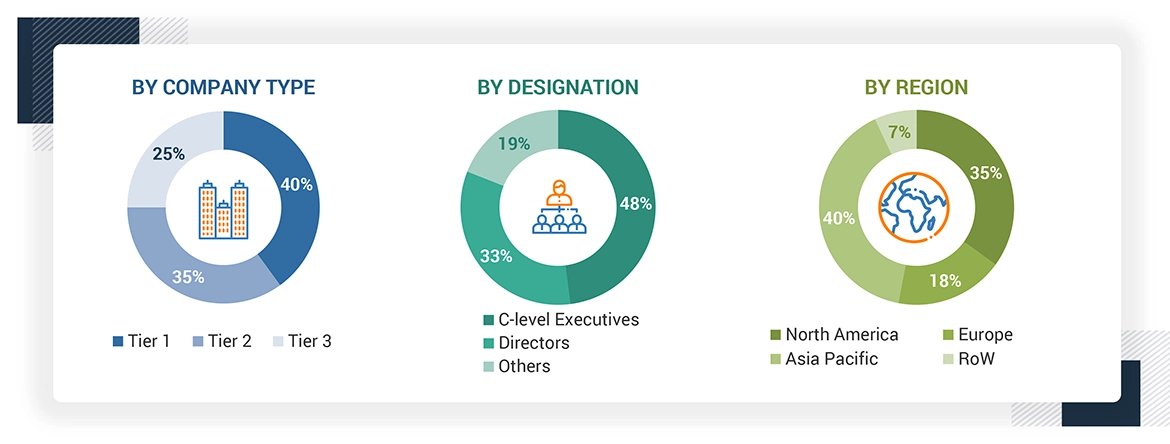
Note: Other designations include sales, marketing, and product managers.
The three tiers of the companies have been defined based on their total revenue as of 2022; tier 1: revenue greater than USD 20 million, tier 2: revenue between USD 20 million and USD 10 million, and tier 3: revenue less than USD 10 million.
To know about the assumptions considered for the study, download the pdf brochure
Market Size Estimation
In the market engineering process, both top-down and bottom-up approaches were implemented, along with several data triangulation methods, to estimate and validate the size of the laser market and other dependent submarkets listed in this report.
Data Triangulation
After estimating the overall market size, the total market was split into several segments. The market breakdown and data triangulation procedures were employed wherever applicable to complete the overall market engineering process and gauge exact statistics for all segments. The data were triangulated by studying various factors and trends from both the demand and supply sides. The market was also validated using both top-down and bottom-up approaches.
Market Definition
Laser stands for light amplification by stimulated emission of radiation (LASER). Laser technology-based devices generate a beam of light, which is coherent, monochromatic, and aligned. They generate light through optical amplification based on the stimulated emission of electromagnetic radiation. The wavelength of laser light is purer compared to other light sources. Unlike other light sources, all the photons that develop the laser beam have a fixed-phase relationship. The light beam generated from a laser source has low divergence. Laser technology-based systems find applications in optical communication, cutting, drilling, printing, and marking and engraving. The verticals that use laser technology include commercial, telecommunications, research, aerospace & defense, healthcare, automotive, semiconductor & electronics, industrial, and others (oil & gas, iron & steel, tobacco, glass, wood, retail, and plastics).
Stakeholders
- End users
- Government bodies, venture capitalists, and private equity firms
- Laser technology manufacturers
- Laser technology distributors
- Laser technology industry associations
- Professional service/solution providers
- Research institutions and organizations
- Standards organizations and regulatory authorities related to the laser market
- System integrators
- Technology consultants
Report Objectives
- To define, describe, and project the size of the global laser technology market, in terms of value, segmented based on laser type, application, product, vertical and region
- To forecast the market size for various segments with respect to four main regions—North America, Europe, Asia Pacific, and Rest of the World (RoW)s
- To provide detailed information regarding the major factors (drivers, restraints, opportunities, and industry-specific challenges) influencing the growth of the market
- To analyze the micro markets with respect to individual growth trends, prospects, and contributions to the total market
- To profile the key market players, and comprehensively analyze their market ranking and core competencies.
- To analyze competitive developments, such as joint ventures, mergers & acquisitions, product launches, and research & development (R&D) activities, in the laser market
- To provide the leadership mapping based on company profiles and key player strategies such as product launches and development, collaborations, expansions, and acquisitions
- To analyze the opportunities in the market for stakeholders and provide a detailed competitive landscape of the market
- To provide ecosystem analysis, case study analysis, patent analysis, pricing analysis, Porter’s five forces analysis, key stakeholders & buying criteria, key conferences and events, and regulatory bodies, government agencies, and regulations pertaining to the market under study
Get the Full Laser Technology Market Report
Full forecast, segment splits, and company analysis for all Laser Technology Market.
- Canada Laser Technology Market
- Mexico Laser Technology Market
- Germany Laser Technology Market
- UK Laser Technology Market
- France Laser Technology Market
- Rest Of Europe Laser Technology Market
- China Laser Technology Market
- Japan Laser Technology Market
- South Korea Laser Technology Market
- India Laser Technology Market
- Rest Of Asia Pacific Laser Technology Market
Need a Tailored Report?
Customize this report to your needs
Get 10% FREE Customization
Customize This Report
