
Europe LiDAR Simulation Market (2025-2030)

The Europe LiDAR Simulation Market was valued at $410.5 Million in 2025 and projected to reach to $1479.3 Million by 2030, representing a compound annual growth rate of 20.1%. Europe's LiDAR simulation market is poised for sustained expansion driven by the region's commitment to autonomous vehicle safety standards and the EU's regulatory framework for connected and autonomous mobility.


| Market Size in | USD 26.32 MN |
| Market Forecast in | |
| CAGR | |
| Forecast Period | |
| Units Considered | Value (USD MN) |
Europe LiDAR Simulation Market Trends and Insights
- This expansion reflects Europe's leadership in autonomous vehicle development and stringent regulatory requirements for safety validation across the region.
- Europe's automotive manufacturers and technology firms are increasingly adopting LiDAR simulation to reduce development costs and accelerate time-to-market for autonomous driving systems. The 20.1% compound annual growth rate in Europe underscores the region's commitment to advanced mobility solutions and digital transformation in transportation.
- Europe's investment in simulation infrastructure is driven by major automotive hubs in Germany, France, and Sweden, where OEMs and Tier-1 suppliers leverage LiDAR simulation for sensor validation and perception algorithm testing.
- By 2030, Europe is expected to solidify its position as a critical market for LiDAR simulation technologies, supporting the continent's vision for safe and efficient autonomous mobility..
Key Market Statistics
- CAGR (2025-2030) 20.1% CAGR
- Market Size, 2025 ~USD 410.5 Million
- Forecast, 2030 ~USD 1479.3 Million
- Geography Europe
Europe LiDAR Simulation Market Overview
Market Valuation Growth :
Europe's LiDAR simulation market is valued at $410.5 million in 2025, with a projected CAGR of 20.1% through 2030, reaching $1,479.3 million by forecast end.
Regulatory Compliance Driver :
Stringent EU safety regulations and autonomous vehicle validation requirements are accelerating adoption of LiDAR simulation solutions across European automotive manufacturers.
Regional Leadership Position :
Europe maintains a competitive edge in autonomous vehicle development, with major OEMs and Tier-1 suppliers investing heavily in simulation technologies for vehicle testing and certification.
Technology Integration Trend :
European automotive firms are increasingly integrating LiDAR simulation into their development pipelines to reduce physical testing costs and accelerate time-to-market for autonomous systems.
Europe LiDAR Simulation Market Dynamics
- Major automotive hubs in Germany, France, and Sweden are spearheading investments in simulation infrastructure to validate sensor performance and reduce development cycles.
- The market benefits from strong collaboration between OEMs, technology providers, and research institutions across the continent. Looking ahead, European manufacturers will increasingly leverage LiDAR simulation to meet evolving safety directives and reduce physical testing expenses.
- The convergence of AI-driven simulation platforms, cloud-based solutions, and standardized validation protocols will further accelerate market penetration.
- By 2030, simulation will become a critical component of the autonomous vehicle development lifecycle across Europe's automotive ecosystem..
Market Ecosystem
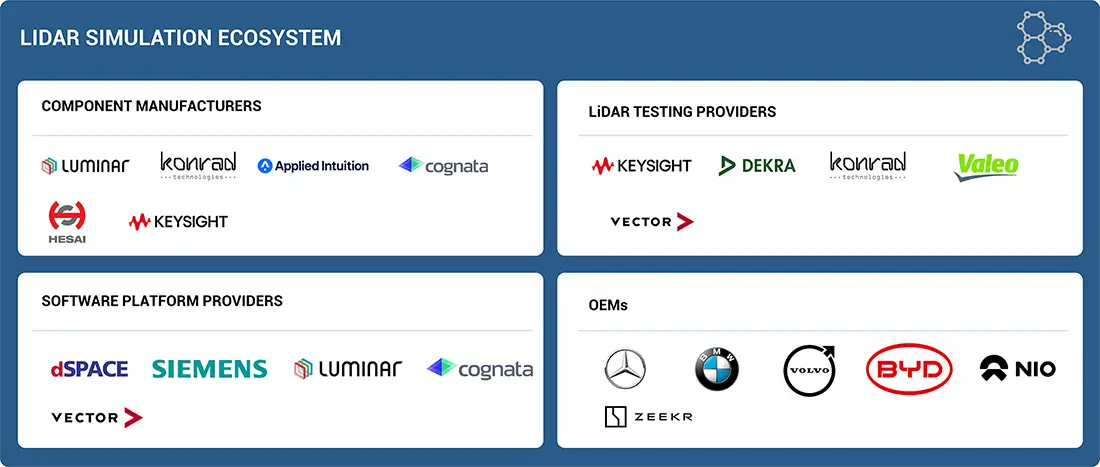
LiDAR Simulation Market: COMMERCIAL USE CASES ACROSS INDUSTRIES
| COMPANY | USE CASE DESCRIPTION | BENEFITS |
|---|---|---|
 |
Uses LiDAR simulation and validation services for ADAS and autonomous vehicle testing, including safety certification and compliance checks under real-world and virtual scenarios | Ensures vehicles meet regulatory standards, reduces physical testing costs, and accelerates homologation for global markets |
 |
Supplies high-performance long-range LiDAR (Iris, Hydra) and perception software for OEM integration, supported by virtual validation and OTA simulation for safety-critical applications | Delivers industry-leading range and resolution for highway autonomy, enables scalable deployment in production vehicles, and strengthens OEM trust in advanced autonomy programs |
 |
Provides LiDAR-in-the-loop (LiL) and LiDAR OTA simulation platforms for OEMs to validate perception algorithms, sensor fusion, and system safety in virtual environments | Cuts down development time, improves accuracy of ADAS features, and enables cost-efficient testing of edge cases not possible on-road |
 |
Develops automotive-grade solid-state LiDAR sensors (Valeo SCALA) and integrates them with simulation environments for ADAS and autonomous driving applications | Enables mass production of reliable LiDAR, enhances detection for safety systems, and strengthens Valeo’s role as a Tier-1 supplier for OEMs |
 |
Offers LiDAR sensors and perception software, integrated with digital twin and simulation platforms to validate autonomous driving under diverse traffic and weather conditions. Provides high-resolution, cost-effective LiDAR, accelerates adoption in EVs and robotaxis, and supports continuous OTA updates for perception improvement | Provides high-resolution, cost-effective LiDAR, accelerates adoption in EVs and robotaxis, and supports continuous OTA updates for perception improvement |
Logos and trademarks shown above are the property of their respective owners. Their use here is for informational and illustrative purposes only.
Related Ecosystem
Automotive Electronics And Electrical Equipment
- Battery Electric Vehicle (BEV)
- Light Commercial Vehicles (LCVs)
- Fuel Cell Electric Vehicle (FCEV)
- Sensors
- Hybrid Electric Vehicle (HEV)
- BOSCH LIMITED
- Continental ag
- DENSO Corporation
- Panasonic Holdings Corporation
- Texas Instruments Incorporated
Semi Autonomous And Autonomous Vehicle
- Light Commercial Vehicles (LCVs)
- Battery Electric Vehicle (BEV)
- Fuel Cell Electric Vehicle (FCEV)
- Internal Combustion Engine (ICE)
- Fuel Cell
- BOSCH LIMITED
- Visteon Corporation
- Continental ag
- DENSO Corporation
- Infineon technologies ag
Key Takeaways
- Europe's LiDAR simulation market will grow from $410.5M (2025) to $1,479.3M (2030), representing a 20.1% CAGR driven by autonomous vehicle adoption.
- Europe's stringent safety and regulatory standards mandate comprehensive sensor simulation, accelerating LiDAR simulation adoption across the region.
- Europe's automotive OEMs and Tier-1 suppliers are investing heavily in simulation to validate perception systems and reduce physical testing costs.
- Europe's competitive advantage in autonomous mobility positions the region as a key growth market for LiDAR simulation technologies through 2030.
LiDAR Simulation Market Report Scope
| Report Metric | Details |
|---|---|
| Base Year | 2025 |
| Fastest Growing Segment | LEVEL 4/5 (Level Of Autonomy) |
| Forecast Period | 2025-2030 |
| Growth Rate | CAGR of 23.1% from 2025 to 2030 |
| Largest Segment | PASSENGER CARS (Vehicle Type) |
| Market Size Base Year (Billions) | ~USD 0.94 (2025) |
| Revenue Forecast (Billions) | ~USD 2.65 (2030) |
| Segments Covered | Level Of Autonomy, Method, Laser Wavelength, Lidar Type, Vehicle Type |
Europe LiDAR Simulation Market Report Segmentation
5 segment dimensions are covered across the global market.
By Level Of Autonomy
- Level 2/2.5
- Level 3
- Level 4/5
By Method
- Simulation Method
- Testing Method
By Laser Wavelength
- Long Wave Infrared Spectrum
- Short Wave Infrared Spectrum
By Lidar Type
- Mechanical Lidar
- Solid-State Lidar
By Vehicle Type
- Commercial Vehicles
- Passenger Cars
Target Audience
- Automotive OEMs : European car manufacturers need market insights to optimize LiDAR simulation investments, benchmark against competitors, and align development strategies with regulatory requirements.
- Tier-1 Suppliers : Automotive suppliers require detailed market data to identify growth opportunities, develop competitive simulation solutions, and strengthen partnerships with European OEMs.
- Technology Providers : Software and simulation platform vendors need regional market intelligence to refine product offerings, target European customers, and understand adoption barriers and opportunities.
- Investment & Strategy Teams : Corporate development and venture capital firms require comprehensive market analysis to identify acquisition targets, investment opportunities, and emerging technology trends in European automotive.
- Regulatory & Compliance Officers : Compliance professionals need market insights to understand how LiDAR simulation supports EU safety validation, certification pathways, and autonomous vehicle regulatory frameworks.
Countries within Europe - compare and drill down
| Country | 2025 size (native) |
|---|
Country market size visualization
Reasons to Buy this Report
- Regulatory Compliance Intelligence : Understand how EU safety directives and certification requirements are shaping LiDAR simulation adoption across European OEMs and suppliers, enabling compliant product development strategies.
- Competitive Landscape Analysis : Identify key European and international players dominating the LiDAR simulation space, their market positioning, and strategic partnerships within the region's automotive ecosystem.
- Investment Opportunity Assessment : Evaluate market growth potential and funding trends across European automotive hubs, supporting informed decisions for venture capital, M&A, and technology partnerships.
- Technology Adoption Roadmap : Access detailed insights into simulation platform adoption rates, cloud-based solution penetration, and integration trends specific to European manufacturers and development centers.
- Regional Market Segmentation : Gain country-level and segment-specific data for Germany, France, UK, Sweden, and other key European markets to tailor go-to-market strategies and resource allocation.
Frequently asked questions
What is the current size of Europe's LiDAR simulation market?
Europe's LiDAR simulation market was valued at $410.5 million in 2025 and is projected to reach $1,479.3 million by 2030.
What is the growth rate for LiDAR simulation in Europe?
Europe's LiDAR simulation market is expected to grow at a compound annual growth rate (CAGR) of 20.1% from 2025 to 2030.
Why is Europe a key market for LiDAR simulation?
Europe leads in autonomous vehicle development, has stringent regulatory requirements for safety validation, and hosts major automotive manufacturing hubs that drive demand for advanced simulation technologies.
Which countries in Europe are driving LiDAR simulation adoption?
Germany, France, and Sweden are primary drivers of Europe's LiDAR simulation market, home to leading OEMs and Tier-1 suppliers investing in autonomous mobility solutions.
How much will Europe's LiDAR simulation market grow by 2030?
Europe's LiDAR simulation market is expected to grow by approximately $1,068.8 million from 2025 to 2030, representing a 260% increase in absolute value.
RESEARCH METHODOLOGY
The research study uses extensive secondary sources, such as company annual reports/presentations, industry association publications, magazine articles, directories, technical handbooks, World Economic Outlook, trade websites, technical articles, and databases, to identify and collect information on the LiDAR simulation market. Primary sources, such as experts from related industries, OEMs, and suppliers, were interviewed to obtain and verify critical information and assess the growth prospects and market estimations.
Secondary Research
Secondary sources for this research study included corporate filings, such as annual reports, investor presentations, and financial statements; trade, business, and professional associations; whitepapers and autonomous vehicles and ADAS-related journals; certified publications; articles by recognized authors; directories; and databases. Secondary data has been collected and analyzed to determine the overall market size, further validated by primary research.
Primary Research
After understanding the LiDAR simulation market scenario through secondary research, extensive primary research was conducted. Primary interviews were conducted with market experts from both the demand and supply sides across North America, Europe, and Asia Pacific. Approximately 20% of interviews were conducted from the demand side, while 80% of primary interviews were conducted from the supply side. The primary data was collected through questionnaires, emails, and telephone interviews.
In the canvassing of primaries, various departments within organizations, such as sales and operations, were covered to provide a holistic viewpoint in this report. Primary sources from the supply side included various industry experts, such as CXOs, vice presidents, directors from business development, marketing, product development/innovation teams, and related key executives from various key companies. Various system integrators, industry associations, independent consultants/industry veterans, and key opinion leaders were also interviewed.
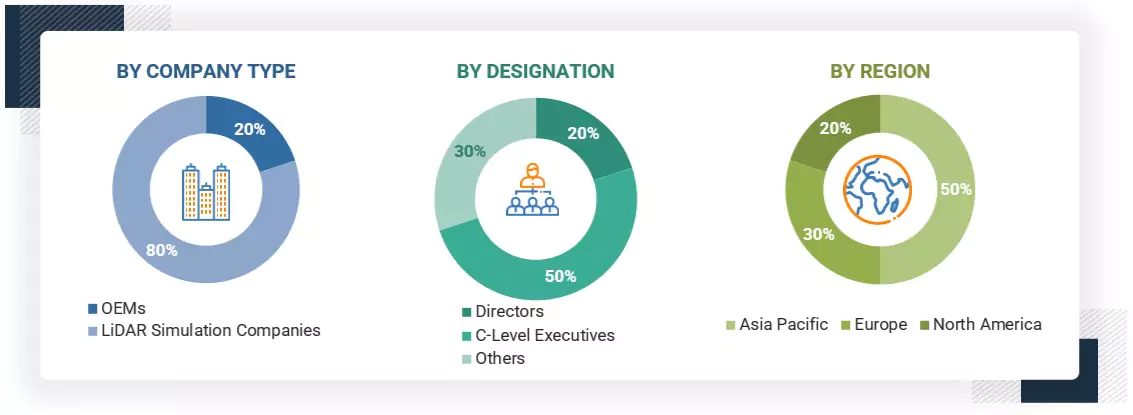
Note: Others include sales, managers, and product managers.
To know about the assumptions considered for the study, download the pdf brochure
Market Size Estimation
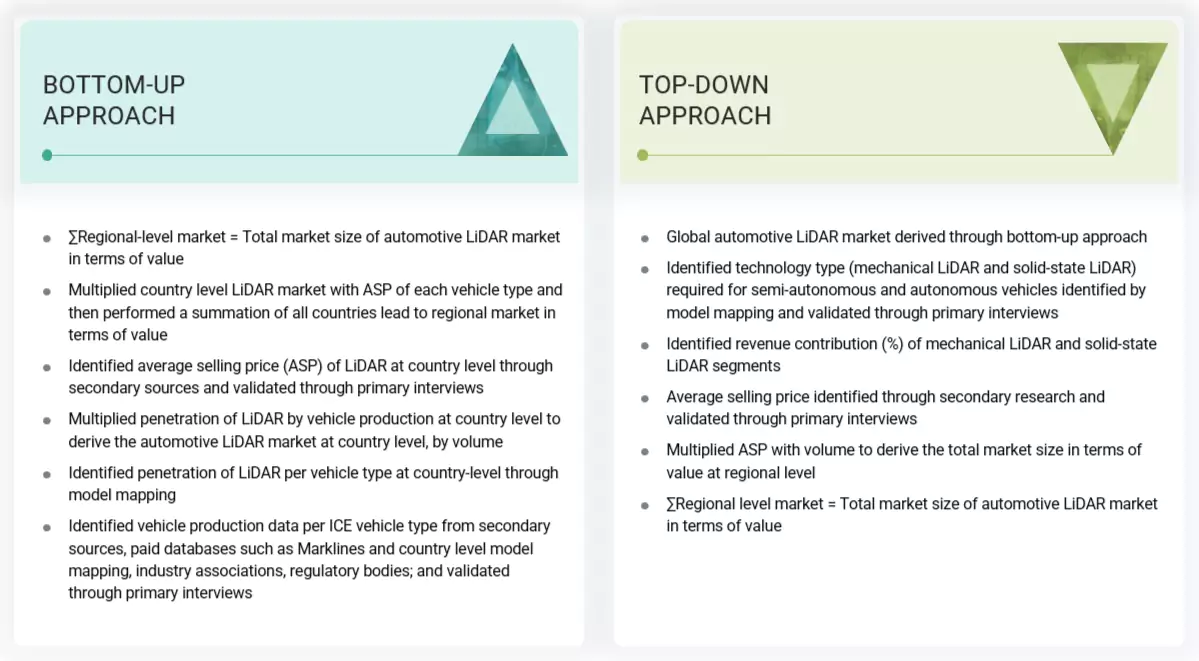
The top-down approach has been used to estimate and validate the LiDAR simulation market size. The LiDAR simulation market size, by region, was derived by mapping the key players from each region with their business segment’s revenue. The revenue of each key player from each region was mapped considering their test and simulation segment from their annual report and product portfolio (mechanical LiDAR and solid-state LiDAR) in terms of value (USD million). After this, all revenue from each region was summed to obtain the global market for LiDAR simulation. The industry experts then validated the revenue generated from each region. Additionally, the revenue forecast for testing and simulation was made considering different LiDAR types (mechanical and solid-state LiDAR), based on factors such as country-wise macroeconomic indicators, automotive industry growth, GDP growth, safety regulation, price of LiDAR components, future LiDAR adoption, and offerings in ADAS systems by the automakers, considering the regional mandates for safety.
The market size for LiDAR offered in each vehicle type was derived by mapping the LiDAR type offered in each vehicle type (passenger cars and commercial vehicles). To forecast the market’s revenue for the LiDAR type, the demand for LiDAR (mechanical and solid-state LiDAR) was derived considering the demand in vehicles, cost, maintenance, and technological advancements. Then, the market revenue split for different LiDAR types was derived and forecasted, which was then validated from the primaries. The segmental revenue for each LiDAR type was then derived by the summation of revenue from each LiDAR type. A similar approach was used for other segments, such as level of autonomy, method, and by vehicle type.
LiDAR Simulation Market : Top-Down and Bottom-Up Approach
Data Triangulation
After arriving at the overall market size of the global market through the methodology mentioned above, this market was split into several segments and subsegments. The data triangulation and market breakdown procedures were employed to complete the overall market engineering process and arrive at the exact market value data for key segments and sub-segments, wherever applicable. The extrapolated market data was triangulated by studying various macro indicators and regional trends from both the demand and supply-side participants.
Market Definition
According to Texas Instruments, LiDAR is a sensing technology that detects objects and maps their distances. The technology works by illuminating a target with an optical pulse and measuring the characteristics of the reflected return signal.
Stakeholders
- ADAS System Manufacturers
- Automobile Original Equipment Manufacturers (OEMs)
- Automotive Part Manufacturers’ Association (APMA)
- Automotive Component Manufacturers
- Governments, Financial Institutions, and Investment Communities
- European Automobile Manufacturers Association (ACEA)
- LiDAR Hardware Suppliers
- LiDAR Software Suppliers
- LiDAR System Integrators
- Manufacturers of Automotive LiDAR Microprocessors
- Original Device Manufacturer (ODM) and OEM Technology Solution Providers
- National Highway Traffic Safety Administration (NHTSA)
- Raw Material and Manufacturing Equipment Suppliers
- Research Institutes and Organizations
- Semiconductor Foundries
- Technology Investors
- Technology Standards Organizations, Forums, Alliances, and Associations
- Vehicle Safety Regulatory Bodies
Report Objectives
- To analyze and forecast the LiDAR simulation market in terms of value (USD Million) from 2025 to 2032
-
To analyze the LiDAR simulation market based on the following:
- By LiDAR Type (Mechanical LiDAR and Solid-state LiDAR)
- By Vehicle Type (Passenger Cars and Commercial Vehicles)
- By Level of Autonomy (Level 2/2.5, Level 3, and Level 4/5)
- By Method (Testing Method and Simulation Method)
- By Laser Wavelength (Short Wave Infrared Spectrum and Long Wave Infrared Spectrum)
- By Application (Intelligent Park Assist, Night Vision, Traffic Jam, Road Mapping & Localization, and Others)
- By Region (North America, Europe, and Asia Pacific)
- To identify and analyze key drivers, challenges, restraints, and opportunities influencing the market growth
- To strategically analyze the market for individual growth trends, prospects, and contributions to the total market
-
To study the following with respect to the market:
- Investment and Funding Scenario
- Supply Chain Analysis
- Ecosystem Analysis
- Technology Analysis
- Case Study Analysis
- Patent Analysis
- Regulatory Landscape
- Key Stakeholders and Buying Criteria
- Key Conferences and Events
- To strategically profile the key players and comprehensively analyze their market share and core competencies
- To analyze the impact of AI on the market
- To track and analyze competitive developments, such as deals, product launches/developments, expansions, and other activities undertaken by the key industry participants
Available Customizations
With the given market data, MarketsandMarkets offers customizations in accordance with the company’s specific needs. The following customization options are available:
- Additional Company Profiles (Up to 5)
- Global LiDAR Simulation Market, By Level of Autonomy, at the Country Level
- Global LiDAR Simulation Market, By Vehicle Type, ICE and Electric
- Global LiDAR Simulation Market, By Testing Method, By Country
Get the Full LiDAR Simulation Market Report
Full forecast, segment splits, and company analysis for all LiDAR Simulation Market.
Need a Tailored Report?
Customize this report to your needs
Get 10% FREE Customization
Customize This Report
