South Africa Liquid-applied Membrane Market (2026-2031)

The South Africa Liquid-applied Membrane Market was valued at $439 Million in 2026 and projected to reach to $568.1 Million by 2031, representing a compound annual growth rate of 5.3%. South Africa's liquid-applied membrane market is poised for steady growth through 2031, driven by accelerating infrastructure investments and urban development initiatives across major metropolitan areas.


| Market Size in | USD 26.32 MN |
| Market Forecast in | |
| CAGR | |
| Forecast Period | |
| Units Considered | Value (USD MN) |
South Africa Liquid-applied Membrane Market Trends and Insights
- This steady expansion in South Africa reflects increasing demand for waterproofing solutions across construction, infrastructure, and industrial applications.
- South Africa's market growth is driven by rising urbanization, infrastructure development projects, and heightened awareness of building durability and moisture protection standards. The liquid-applied membrane sector in South Africa benefits from the country's expanding construction activity and renovation projects in both commercial and residential segments.
- South Africa's adoption of advanced coating technologies and sustainable building practices is accelerating market penetration.
- By 2031, South Africa is expected to consolidate its position as a key market within the Middle East Africa region, supported by ongoing investments in water management infrastructure and climate-resilient construction methods..
Key Market Statistics
- CAGR (2026-2031) 5.3% CAGR
- Market Size, 2026 ~USD 439 Million
- Forecast, 2031 ~USD 568.1 Million
- Country South Africa
South Africa Liquid-applied Membrane Market Overview
Market Size & Growth :
South Africa's liquid-applied membrane market is valued at USD 439.0 million in 2026, expanding to USD 568.1 million by 2031, with a CAGR of 5.3%, outpacing broader economic growth trends.
Construction Sector Demand :
Rising infrastructure development and commercial construction projects across South Africa are driving increased adoption of liquid-applied membranes for waterproofing and durability applications.
Industrial & Commercial Applications :
Growing demand from mining, manufacturing, and industrial facilities in South Africa is creating new opportunities for protective membrane solutions in harsh operating environments.
Regional Market Dynamics :
South Africa's 5.3% CAGR reflects steady market maturation, with increasing awareness of long-term cost savings and performance benefits driving adoption among local contractors and developers.
South Africa Liquid-applied Membrane Market Dynamics
- The construction sector's recovery and expansion of commercial real estate projects are creating sustained demand for advanced waterproofing solutions.
- Additionally, South Africa's industrial and mining sectors are increasingly prioritizing protective coatings to extend asset longevity and reduce maintenance costs.
- Government infrastructure programs and private sector investments in renewable energy facilities further support market expansion.
- The market's 5.3% CAGR reflects a maturing, resilient sector with growing recognition of liquid-applied membranes' superior performance characteristics compared to traditional alternatives..
Market Ecosystem
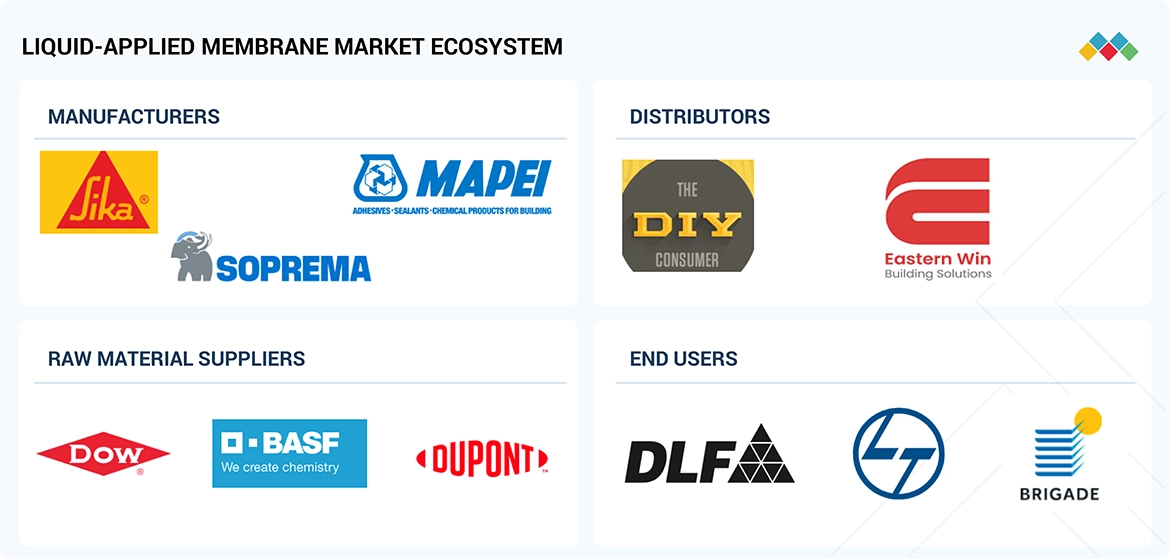
LIQUID-APPLIED MEMBRANE MARKET: COMMERCIAL USE CASES ACROSS INDUSTRIES
| COMPANY | USE CASE DESCRIPTION | BENEFITS |
|---|---|---|
 |
The company offers a broad range of membrane systems including liquid-applied waterproofing systems such as polyurethane, acrylic and hybrid membranes that are suitable for roofing applications, basements, podium decks, tunneling, water holding structures, and general infrastructure applications. The products offered by the firm are widely used in both commercial and industrial settings. | These solutions exhibit superior crack bridging properties, seamless waterproofing ability, and high substrate bonding strength, thus ensuring greater durability of the structures and minimizing the risk of water seepage. Moreover, they enhance overall lifecycle performance, minimize maintenance efforts, and contribute to sustainable development owing to their eco-friendly nature and energy efficiency. |
 |
The company provides an extensive range of innovative liquid-applied waterproofing systems in various forms such as cementitious, polyurethane, and acrylic membranes. The waterproofing range of the company is widely employed for application on terraces, bathrooms, balconies, basements, tunnels, and water retention structures. | These systems provide waterproof barriers that have great durability and are highly flexible, chemical resistant, and adherent. These systems offer improved structural integrity, minimized leakage and repair costs, efficient installations, and environmentally friendly and energy efficient building practices. |
Logos and trademarks shown above are the property of their respective owners. Their use here is for informational and illustrative purposes only.
Related Ecosystem
Membranes
- Reverse Osmosis
- Acetone
- Bioremediation
- Cartridge Filters
- Granular Activated Carbon
- Veolia
- Toray Industries, Inc.
- PALL CORPORATION
- DuPont de Nemours, Inc.
- Pentair plc
Water Purification
- Corrosion Inhibitors
- Cartridge Filters
- Fiberglass
- Reverse Osmosis
- Acetone
- Veolia
- SOLENIS
- Kemira oyj
- CALGON CARBON CORPORATION
- Basf se
Key Takeaways
- South Africa's liquid-applied membrane market is valued at USD 439.0 million in 2026 and will reach USD 568.1 million by 2031.
- South Africa is experiencing a 5.3% CAGR, driven by construction growth and infrastructure modernization initiatives.
- South Africa's market expansion is supported by increased demand for waterproofing and moisture protection in commercial and residential sectors.
- South Africa's adoption of sustainable building practices and climate-resilient construction is accelerating liquid-applied membrane adoption.
Liquid-applied Membrane Market Report Scope
| Report Metric | Details |
|---|---|
| Base Year | 2026 |
| Fastest Growing Segment | –ACRYLIC MEMBRANE (Type) |
| Forecast Period | 2026–2031 |
| Growth Rate | CAGR of 5.9% from 2026 to 2031 |
| Largest Segment | NEW CONSTRUCTION (Usage) |
| Market Size Base Year (Billions) | ~USD 26.63 (2026) |
| Revenue Forecast (Billions) | ~USD 35.47 (2031) |
| Segments Covered | Application, End-Use Industry, Type, Usage |
South Africa Liquid-applied Membrane Market Report Segmentation
4 segment dimensions are covered across the global market.
By Application
- Building Structures
- Other Applications
- Roadways
- Roofing
- Walls
By End-Use Industry
- Commercial Construction
- Public Infrastructure
- Residential Construction
By Type
- Bituminous Membranes
- Cementitious Membranes
- Elastomeric Membranes
- –Acrylic Membrane
- –One Component (1K)
- –Pmma
- –Polyurethane Waterproofing
- –Solvent-Based
- –Two Component (2K)
- –Water-Based
By Usage
- New Construction
- Refurbishment
Target Audience
- Construction & Real Estate Developers : Need market insights to forecast demand for waterproofing solutions in commercial, residential, and infrastructure projects across South Africa's growing construction sector.
- Chemical & Coating Manufacturers : Require South Africa-specific market data to evaluate expansion opportunities, competitive positioning, and product development priorities in this regional market.
- Industrial & Mining Companies : Seek detailed market intelligence on protective membrane solutions to optimize procurement strategies and identify cost-effective waterproofing options for operational facilities.
- Distributors & Trade Contractors : Need regional market forecasts and growth drivers to plan inventory, sales strategies, and service offerings aligned with South Africa's construction and industrial demand.
- Investment & Strategy Consultants : Require comprehensive South Africa market data to support due diligence, investment decisions, and strategic recommendations for clients in the chemicals and construction sectors.
Key Companies in the South Africa Liquid-applied Membrane Market
| Company | HQ | Ownership | Strongest segments |
|---|---|---|---|
| SOLVAY SA | Belgium | Public Company | Soda ash and sodium bicarbonate (glass, detergents, flue gas, food/feed),Hydrogen peroxide (pulp and paper, textile, water, food, semiconductors, batteries),Silica (precipitated and highly dispersible for tires, home and personal care, food/feed), |
| USG CORPORATION | United States | Private Company | Drywall (Sheetrock) and Wallboard,Ceiling Systems and Mineral Fiber Boards,Specialty Gypsum and Industrial Products, |
| SIKA AG | Switzerland | Public Company | Concrete admixtures and additives,Waterproofing systems (SikaProof and related),Roofing systems (Sika Sarnafil and accessories), |
| MAPEI S.P.A. | Italy | Private Company | Ceramic, stone, and resilient flooring systems,Waterproofing and building-envelope solutions,Concrete admixtures and cement additives, |
| SAINT-GOBAIN | France | Public Company | Gypsum and plaster-based systems (Placo, Rigips, Gyproc),Insulation solutions (Isover, CertainTeed, Izocam),Mortars and construction chemicals (Weber, Chryso, GCP), |
| H.B. FULLER | United States | Public Company | Hygiene, Health and Consumable Adhesives,Engineering Adhesives,Building Adhesive Solutions, |
| WACKER CHEMIE AG | Germany | Public Company | Silicones,Polymers,Polysilicon, |
| JOHNS MANVILLE | United States | Private Company | Building and mechanical insulation,Commercial roofing systems and accessories,Glass fibers and nonwovens for construction, automotive, filtration, specialty, |
| GCP APPLIED TECHNOLOGIES INC. | United States | Private Company | Waterproofing membranes and building envelope systems,Concrete admixtures and cement additives (including CO2ST Reducers),Specialty and industrial fireproofing solutions, |
| CARLISLE COMPANIES INC. | United States | Public Company | Single-ply roofing membranes (EPDM, TPO, PVC),Polyiso and EPS insulation,Waterproofing, air/vapor barriers, and underlayments, |
| PIDILITE INDUSTRIES LTD | India | Public Company | Consumer & Bazaar – Adhesives and Sealants (Fevicol, Fevikwik, Fevicol MR, Fevibond, Fevistick, Fevigum, steelgrip, fevitite, HOLDTITE LEAKGUARD),Consumer & Bazaar – Construction and Paint Chemicals (Dr. Fixit, Roff, UNITINT, Piditint, WUDFIN, Haisha Paints),Consumer & Bazaar – Art, Craft, and Hobby (Fevicryl, Rangeela, BLUECOAT), |
SOLVAY SA
Solvay SA is a Belgian chemical company founded in 1863 that operates as a public company with 8,400 employees. The company specializes in advanced materials and specialty chemicals for various industrial applications.
USG CORPORATION
USG Corporation is a United States-based private company founded in 1902 with 7,300 employees. The company is a leading manufacturer of building materials and construction products.
SIKA AG
Sika AG is a Swiss public company founded in 1910 with 30,629 employees. The company specializes in specialty chemicals and building materials for construction and industrial applications.
MAPEI S.P.A.
Mapei S.p.A. is an Italian private company founded in 1937 with 13,252 employees. The company manufactures adhesives, sealants, and chemical products for the construction and building materials industries.
SAINT-GOBAIN
Saint-Gobain is a French public company founded in 1665 with 158,616 employees, making it one of the world's largest building materials manufacturers. The company produces a wide range of construction and high-performance materials.
H.B. FULLER
H.B. Fuller is a United States-based public company founded in 1887 with 7,100 employees. The company manufactures adhesives, sealants, and other specialty chemical products for industrial and construction applications.
WACKER CHEMIE AG
Wacker Chemie AG is a German public company founded in 1914 with 16,196 employees. The company produces specialty chemicals and polymers for construction, automotive, and industrial markets.
JOHNS MANVILLE
Johns Manville is a United States-based private company founded in 1858 with 9,740 employees. The company manufactures insulation, roofing, and engineered products for the building and construction industries.
GCP APPLIED TECHNOLOGIES INC.
GCP Applied Technologies Inc. is a United States-based private company founded in 2015 with 1,800 employees. The company provides specialty construction chemicals and building materials solutions.
CARLISLE COMPANIES INC.
Carlisle Companies Inc. is a United States-based public company founded in 1917 with 5,900 employees. The company manufactures construction materials, roofing products, and specialty materials.
PIDILITE INDUSTRIES LTD
Pidilite Industries Ltd is an Indian public company founded in 1959 with 8,835 employees. The company manufactures adhesives, sealants, and specialty chemical products for construction and industrial applications.
Reasons to Buy this Report
- Market-Specific Sizing & Forecasts : Access precise valuation data for South Africa's liquid-applied membrane market with detailed 2026-2031 projections, enabling accurate budgeting and investment planning for regional operations.
- Competitive Landscape Intelligence : Understand South Africa's unique competitive dynamics, local player strategies, and market consolidation trends to identify partnership and acquisition opportunities in this growing segment.
- Sector-Specific Growth Drivers : Gain insights into construction, mining, and industrial demand patterns specific to South Africa, including infrastructure projects and regulatory requirements shaping market expansion.
- Regional Risk & Opportunity Assessment : Evaluate South Africa-specific market risks, supply chain considerations, and emerging opportunities to develop targeted go-to-market strategies and risk mitigation approaches.
- Strategic Decision Support : Leverage country-level data to support market entry decisions, capacity planning, pricing strategies, and resource allocation for South African operations and regional expansion.
Frequently asked questions
What is the current size of South Africa's liquid-applied membrane market?
South Africa's liquid-applied membrane market is estimated at USD 439.0 million in 2026.
What is the projected market size for South Africa by 2031?
South Africa's liquid-applied membrane market is forecast to reach USD 568.1 million by 2031.
What is the CAGR for South Africa's liquid-applied membrane market?
South Africa's liquid-applied membrane market is growing at a compound annual growth rate of 5.3% from 2026 to 2031.
What are the primary drivers of growth in South Africa's market?
South Africa's market growth is driven by urbanization, infrastructure development, increased construction activity, and rising demand for waterproofing solutions in commercial and residential applications.
Which sectors are driving demand for liquid-applied membranes in South Africa?
South Africa's construction, infrastructure, commercial real estate, and residential renovation sectors are the primary drivers of liquid-applied membrane demand.
RESEARCH METHODOLOGY
The study involved four major activities to estimate the current size of the global liquid-applied membrane market. Exhaustive secondary research was conducted to collect information on the market, the peer product market, and the parent product group market. The next step was to validate these findings, assumptions, and sizes with industry experts across the liquid-applied membrane value chain through primary research. The top-down and bottom-up approaches were employed to estimate the overall size of the liquid-applied membrane market. After that, market breakdown and data triangulation procedures were used to determine the size of different segments and subsegments of the market.
Secondary Research
The market for companies offering liquid-applied membranes was estimated using secondary data from paid and unpaid sources, analyzing the product portfolios of major companies in the ecosystem, and rating companies by their performance and quality. Secondary sources such as Business Standard, Bloomberg, World Bank, and Factiva were consulted to identify and collect information for this study on the liquid-applied membrane market. These sources included annual reports, press releases, and investor presentations from door vendors, forums, certified publications, and white papers. The secondary research was used to obtain critical information on the industry’s value chain, the total pool of key players, market classification, and segmentation from both market and technology-oriented perspectives.
Primary Research
In the primary research process, various primary sources from both the supply and demand sides were interviewed to obtain qualitative and quantitative information for this report. The primary sources from the supply side included industry experts, such as Chief Executive Officers (CEOs), Vice Presidents (VPs), marketing directors, technology and innovation directors, and related key executives from several key companies and organizations operating in the liquid-applied membrane market. After the complete market engineering (calculations for market statistics, market breakdown, market size estimates, market forecasting, and data triangulation), extensive primary research was conducted to gather information and verify and validate the critical numbers arrived at. Primary research was also conducted to identify segmentation types, industry trends, the competitive landscape of liquid-applied membrane offered by various market players, and key market dynamics, such as drivers, restraints, opportunities, challenges, and key player strategies. In the complete market engineering process, the top-down and bottom-up approaches and several data triangulation methods were extensively used to perform market estimation and market forecasting for the overall market segments and subsegments listed in this report. Extensive qualitative and quantitative analysis was performed throughout the complete market engineering process to list the key information/insights throughout the report.
To know about the assumptions considered for the study, download the pdf brochure
Market Size Estimation
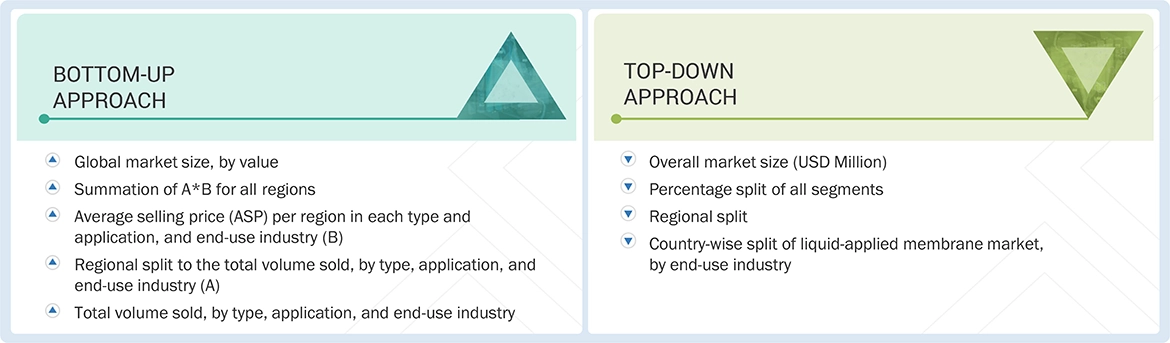
The top-down and bottom-up approaches were used to estimate and validate the size of the global liquid-applied membranes market. These approaches were also used extensively to estimate the sizes of various dependent market segments. The research methodology used to estimate the market size included the following:
Liquid-applied Membrane Market: Top-Down and Bottom-Up Approach
Data Triangulation
After determining the overall market size using market size estimation processes, the market was segmented into several segments and subsegments. Data triangulation and market breakup procedures were employed, wherever applicable, to complete the overall market engineering process and arrive at the exact statistics for each market segment and subsegment. The data was triangulated by analyzing various factors and trends from both the demand and supply sides.
Market Definition
Liquid-applied membranes are high-performance waterproofing materials commonly used in both building and infrastructure applications. Beyond preventing water infiltration, these membranes protect structures against weather, UV degradation, and thermal stress. They exhibit high flexibility, elasticity, and thermal stability, and are UV-stable to safeguard building structures. Smart, carefully controlled mixes and blends during production enable a seamless, continuous membrane that performs consistently over a long service life. Manufacturers of liquid-applied membranes typically rely on blends of bituminous compounds, elastomeric polymers, and cementitious binders. They also add performance-enhancing additives to boost flexibility, crack-bridging capacity, and waterproofing performance. Liquid-applied membranes can be used for both new construction and renovations, with different types of applications tailored to project needs. Applications include roofing, waterproofing of foundations and basements, wet areas, bridges, tunnels, and other infrastructure elements exposed to moisture and harsh environmental conditions. Various end-use industries, such as residential, commercial, and public infrastructure, can rely on liquid-applied membranes for surface waterproofing, protective coatings, and systems that enhance structural durability.
Key Stakeholders
- Liquid-applied membrane manufacturers
- Raw material suppliers
- Contractors and installation service providers
- Construction companies and infrastructure developers
- Architects, consultants, and structural engineers
- Industry associations and regulatory bodies
- R&D institutions
Report Objectives
- To define, describe, and forecast the size of the global liquid-applied membrane market, based on type, application, usage, end-use industry, and region in terms of value
- To provide detailed information on the significant drivers, restraints, opportunities, and challenges influencing the market
- To strategically analyze micromarkets concerning individual growth trends, prospects, and their contribution to the market
- To assess the growth opportunities in the market for stakeholders and provide details on the competitive landscape for market leaders
- To forecast the market size of segments and subsegments for North America, Europe, Asia Pacific, South America, and the Middle East & Africa
- To strategically profile key players and comprehensively analyze their market share and core competencies
- To analyze competitive developments such as product launches, acquisitions, expansions, partnerships, and agreements in the liquid-applied membrane market
- To provide the impact of AI/Gen AI on the market
Available customizations:
With the given market data, MarketsandMarkets offers customizations according to client-specific needs.
The following customization options are available for liquid-applied membrane market report:
Product Analysis
-
A product matrix that gives a detailed comparison of the product portfolio of each company
Regional Analysis
-
A further breakdown of the liquid-applied membrane market for additional countries
Company Information
-
Detailed analysis and profiling of additional market players (up to five)
Get the Full Liquid-applied Membrane Market Report
Full forecast, segment splits, and company analysis for all Liquid-applied Membrane Market.
- Argentina Liquid-applied Membrane Market
- Australia Liquid-applied Membrane Market
- Brazil Liquid-applied Membrane Market
- Canada Liquid-applied Membrane Market
- China Liquid-applied Membrane Market
- France Liquid-applied Membrane Market
- Germany Liquid-applied Membrane Market
- India Liquid-applied Membrane Market
- Indonesia Liquid-applied Membrane Market
- Italy Liquid-applied Membrane Market
- Japan Liquid-applied Membrane Market
- Mexico Liquid-applied Membrane Market
- Russia Liquid-applied Membrane Market
- South Korea Liquid-applied Membrane Market
- Spain Liquid-applied Membrane Market
- Thailand Liquid-applied Membrane Market
- UK Liquid-applied Membrane Market
- US Liquid-applied Membrane Market
Need a Tailored Report?
Customize this report to your needs
Get 10% FREE Customization
Customize This Report
