South Korea Liquid-applied Membrane Market (2026-2031)

The South Korea Liquid-applied Membrane Market was valued at $608.3 Million in 2026 and projected to reach to $884.3 Million by 2031, representing a compound annual growth rate of 7.8%. South Korea's liquid-applied membrane market is poised for sustained growth through 2031, driven by the nation's commitment to infrastructure modernization and green building standards.


| Market Size in | USD 26.32 MN |
| Market Forecast in | |
| CAGR | |
| Forecast Period | |
| Units Considered | Value (USD MN) |
South Korea Liquid-applied Membrane Market Trends and Insights
- This represents a compound annual growth rate of 7.8%, outpacing global averages and reflecting strong demand across construction, infrastructure, and waterproofing applications.
- South Korea's advanced manufacturing capabilities and stringent building codes are driving adoption of high-performance membrane solutions. The South Korea market benefits from rapid urbanization, renovation of aging infrastructure, and increased investment in commercial and residential construction.
- South Korea's emphasis on sustainable building practices and energy-efficient solutions is accelerating the shift toward premium liquid-applied membranes.
- Between 2026 and 2031, South Korea is expected to see heightened competition among regional and international suppliers, with innovation in eco-friendly formulations becoming a key differentiator. South Korea's strategic position in Asia Pacific positions it as a critical hub for membrane technology development and export.
- The country's strong regulatory framework and quality standards ensure consistent market growth, making South Korea an attractive market for both established players and emerging manufacturers seeking regional expansion..
Key Market Statistics
- CAGR (2026-2031) 7.8% CAGR
- Market Size, 2026 ~USD 608.3 Million
- Forecast, 2031 ~USD 884.3 Million
- Country South Korea
South Korea Liquid-applied Membrane Market Overview
Strong CAGR Outperformance :
South Korea's liquid-applied membrane market grows at 7.8% CAGR (2026-2031), significantly exceeding the global rate of 5.9%, driven by rapid urbanization and infrastructure modernization initiatives.
Substantial Market Valuation :
The market is valued at USD 608.3 million in 2026 and is projected to expand to USD 884.3 million by 2031, representing a USD 276 million increase over the five-year forecast period.
Advanced Manufacturing Ecosystem :
South Korea's sophisticated manufacturing capabilities and technological expertise position it as a regional hub for high-performance liquid-applied membrane production and innovation.
Diverse Application Demand :
Strong demand spans construction, infrastructure development, and waterproofing applications, supported by South Korea's active building sector and climate resilience requirements.
South Korea Liquid-applied Membrane Market Dynamics
- The country's advanced construction sector and emphasis on durable waterproofing solutions create favorable conditions for market expansion.
- Government initiatives promoting sustainable building practices and climate adaptation further bolster demand for high-performance membrane technologies. The competitive landscape in South Korea is characterized by strong local manufacturers leveraging technological innovation and quality standards.
- Rising investments in commercial real estate, residential development, and industrial facilities will continue to fuel market growth.
- Additionally, South Korea's export-oriented manufacturing base positions domestic producers to capture regional demand across Asia-Pacific, enhancing overall market dynamics and profitability..
Market Ecosystem
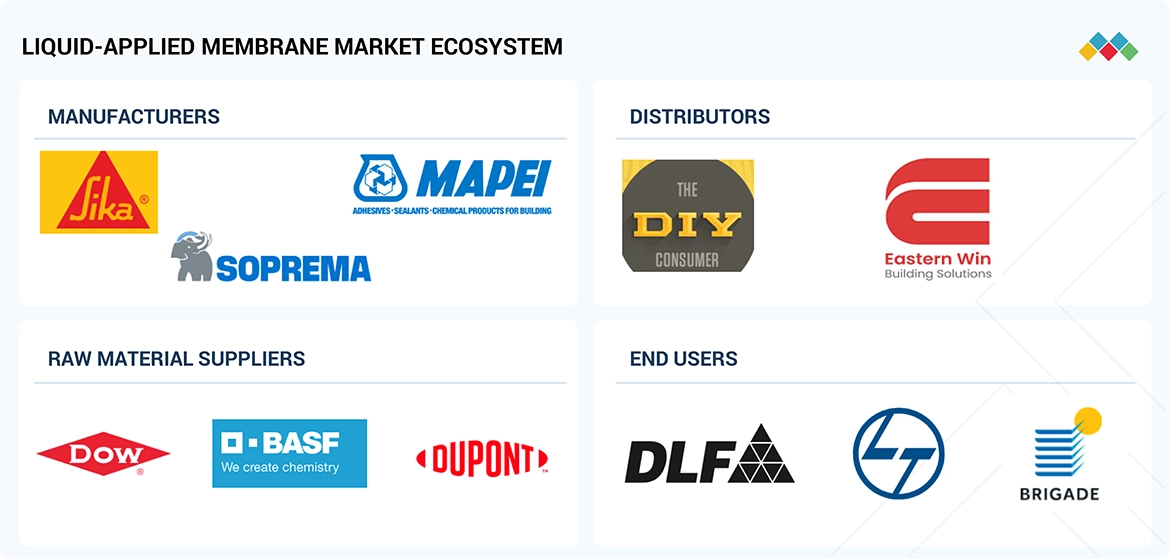
LIQUID-APPLIED MEMBRANE MARKET: COMMERCIAL USE CASES ACROSS INDUSTRIES
| COMPANY | USE CASE DESCRIPTION | BENEFITS |
|---|---|---|
 |
The company offers a broad range of membrane systems including liquid-applied waterproofing systems such as polyurethane, acrylic and hybrid membranes that are suitable for roofing applications, basements, podium decks, tunneling, water holding structures, and general infrastructure applications. The products offered by the firm are widely used in both commercial and industrial settings. | These solutions exhibit superior crack bridging properties, seamless waterproofing ability, and high substrate bonding strength, thus ensuring greater durability of the structures and minimizing the risk of water seepage. Moreover, they enhance overall lifecycle performance, minimize maintenance efforts, and contribute to sustainable development owing to their eco-friendly nature and energy efficiency. |
 |
The company provides an extensive range of innovative liquid-applied waterproofing systems in various forms such as cementitious, polyurethane, and acrylic membranes. The waterproofing range of the company is widely employed for application on terraces, bathrooms, balconies, basements, tunnels, and water retention structures. | These systems provide waterproof barriers that have great durability and are highly flexible, chemical resistant, and adherent. These systems offer improved structural integrity, minimized leakage and repair costs, efficient installations, and environmentally friendly and energy efficient building practices. |
Logos and trademarks shown above are the property of their respective owners. Their use here is for informational and illustrative purposes only.
Related Ecosystem
Membranes
- Reverse Osmosis
- Acetone
- Bioremediation
- Cartridge Filters
- Granular Activated Carbon
- Veolia
- Toray Industries, Inc.
- PALL CORPORATION
- DuPont de Nemours, Inc.
- Pentair plc
Water Purification
- Corrosion Inhibitors
- Cartridge Filters
- Fiberglass
- Reverse Osmosis
- Acetone
- Veolia
- SOLENIS
- Kemira oyj
- CALGON CARBON CORPORATION
- Basf se
Key Takeaways
- South Korea's liquid-applied membrane market is valued at USD 608.3 million in 2026, with a projected CAGR of 7.8% through 2031.
- South Korea's market is expected to grow to USD 884.3 million by 2031, driven by construction activity and infrastructure modernization.
- South Korea's stringent building codes and sustainability focus are accelerating demand for premium, eco-friendly membrane solutions.
- South Korea's advanced manufacturing base and regional position make it a key growth hub within the Asia Pacific liquid-applied membrane market.
Liquid-applied Membrane Market Report Scope
| Report Metric | Details |
|---|---|
| Base Year | 2026 |
| Fastest Growing Segment | –ACRYLIC MEMBRANE (Type) |
| Forecast Period | 2026–2031 |
| Growth Rate | CAGR of 5.9% from 2026 to 2031 |
| Largest Segment | NEW CONSTRUCTION (Usage) |
| Market Size Base Year (Billions) | ~USD 26.63 (2026) |
| Revenue Forecast (Billions) | ~USD 35.47 (2031) |
| Segments Covered | Application, End-Use Industry, Type, Usage |
South Korea Liquid-applied Membrane Market Report Segmentation
4 segment dimensions are covered across the global market.
By Application
- Building Structures
- Other Applications
- Roadways
- Roofing
- Walls
By End-Use Industry
- Commercial Construction
- Public Infrastructure
- Residential Construction
By Type
- Bituminous Membranes
- Cementitious Membranes
- Elastomeric Membranes
- –Acrylic Membrane
- –One Component (1K)
- –Pmma
- –Polyurethane Waterproofing
- –Solvent-Based
- –Two Component (2K)
- –Water-Based
By Usage
- New Construction
- Refurbishment
Target Audience
- Construction & Real Estate Developers : South Korea-focused developers need market data to understand waterproofing membrane demand trends, specification requirements, and supplier capabilities for residential and commercial projects.
- Chemical & Material Manufacturers : Producers seeking to enter or expand in South Korea require competitive intelligence, market sizing, and growth forecasts to justify investment in manufacturing facilities and R&D initiatives.
- Infrastructure & Engineering Firms : Engineering consultants and infrastructure contractors need South Korea-specific market insights to specify appropriate membrane solutions and advise clients on material selection and cost optimization.
- Distributors & Supply Chain Partners : Regional distributors and logistics providers require market growth data and application insights to optimize inventory, identify high-demand segments, and plan distribution network expansion in South Korea.
- Investment & Private Equity Firms : Investors evaluating opportunities in South Korea's chemicals and materials sector need detailed market analysis, growth projections, and competitive dynamics to assess acquisition and portfolio targets.
Key Companies in the South Korea Liquid-applied Membrane Market
| Company | HQ | Ownership | Strongest segments |
|---|---|---|---|
| SOLVAY SA | Belgium | Public Company | Soda ash and sodium bicarbonate (glass, detergents, flue gas, food/feed),Hydrogen peroxide (pulp and paper, textile, water, food, semiconductors, batteries),Silica (precipitated and highly dispersible for tires, home and personal care, food/feed), |
| USG CORPORATION | United States | Private Company | Drywall (Sheetrock) and Wallboard,Ceiling Systems and Mineral Fiber Boards,Specialty Gypsum and Industrial Products, |
| SIKA AG | Switzerland | Public Company | Concrete admixtures and additives,Waterproofing systems (SikaProof and related),Roofing systems (Sika Sarnafil and accessories), |
| MAPEI S.P.A. | Italy | Private Company | Ceramic, stone, and resilient flooring systems,Waterproofing and building-envelope solutions,Concrete admixtures and cement additives, |
| SAINT-GOBAIN | France | Public Company | Gypsum and plaster-based systems (Placo, Rigips, Gyproc),Insulation solutions (Isover, CertainTeed, Izocam),Mortars and construction chemicals (Weber, Chryso, GCP), |
| H.B. FULLER | United States | Public Company | Hygiene, Health and Consumable Adhesives,Engineering Adhesives,Building Adhesive Solutions, |
| WACKER CHEMIE AG | Germany | Public Company | Silicones,Polymers,Polysilicon, |
| JOHNS MANVILLE | United States | Private Company | Building and mechanical insulation,Commercial roofing systems and accessories,Glass fibers and nonwovens for construction, automotive, filtration, specialty, |
| GCP APPLIED TECHNOLOGIES INC. | United States | Private Company | Waterproofing membranes and building envelope systems,Concrete admixtures and cement additives (including CO2ST Reducers),Specialty and industrial fireproofing solutions, |
| CARLISLE COMPANIES INC. | United States | Public Company | Single-ply roofing membranes (EPDM, TPO, PVC),Polyiso and EPS insulation,Waterproofing, air/vapor barriers, and underlayments, |
| PIDILITE INDUSTRIES LTD | India | Public Company | Consumer & Bazaar – Adhesives and Sealants (Fevicol, Fevikwik, Fevicol MR, Fevibond, Fevistick, Fevigum, steelgrip, fevitite, HOLDTITE LEAKGUARD),Consumer & Bazaar – Construction and Paint Chemicals (Dr. Fixit, Roff, UNITINT, Piditint, WUDFIN, Haisha Paints),Consumer & Bazaar – Art, Craft, and Hobby (Fevicryl, Rangeela, BLUECOAT), |
SOLVAY SA
Solvay SA is a Belgian chemical company founded in 1863 that operates as a public company with 8,400 employees. The company specializes in advanced materials and specialty chemicals for various industrial applications.
USG CORPORATION
USG Corporation is a United States-based private company founded in 1902 with 7,300 employees. The company is a leading manufacturer of building materials and construction products.
SIKA AG
Sika AG is a Swiss public company founded in 1910 with 30,629 employees. The company specializes in specialty chemicals and building materials for construction and industrial applications.
MAPEI S.P.A.
Mapei S.p.A. is an Italian private company founded in 1937 with 13,252 employees. The company manufactures adhesives, sealants, and chemical products for the construction and building materials industries.
SAINT-GOBAIN
Saint-Gobain is a French public company founded in 1665 with 158,616 employees, making it one of the world's largest building materials manufacturers. The company produces a wide range of construction and high-performance materials.
H.B. FULLER
H.B. Fuller is a United States-based public company founded in 1887 with 7,100 employees. The company manufactures adhesives, sealants, and other specialty chemical products for industrial and construction applications.
WACKER CHEMIE AG
Wacker Chemie AG is a German public company founded in 1914 with 16,196 employees. The company produces specialty chemicals and polymers for construction, automotive, and industrial markets.
JOHNS MANVILLE
Johns Manville is a United States-based private company founded in 1858 with 9,740 employees. The company manufactures insulation, roofing, and engineered products for the building and construction industries.
GCP APPLIED TECHNOLOGIES INC.
GCP Applied Technologies Inc. is a United States-based private company founded in 2015 with 1,800 employees. The company provides specialty construction chemicals and building materials solutions.
CARLISLE COMPANIES INC.
Carlisle Companies Inc. is a United States-based public company founded in 1917 with 5,900 employees. The company manufactures construction materials, roofing products, and specialty materials.
PIDILITE INDUSTRIES LTD
Pidilite Industries Ltd is an Indian public company founded in 1959 with 8,835 employees. The company manufactures adhesives, sealants, and specialty chemical products for construction and industrial applications.
Reasons to Buy this Report
- Market-Specific Growth Intelligence : Gain detailed insights into South Korea's 7.8% CAGR trajectory, enabling precise forecasting and strategic planning tailored to this high-growth regional market distinct from global averages.
- Competitive Landscape Analysis : Understand South Korea's advanced manufacturing ecosystem, local competitor positioning, and technological capabilities to identify partnership and investment opportunities in the region.
- Application-Specific Demand Drivers : Access granular data on construction, infrastructure, and waterproofing applications specific to South Korea's market dynamics, regulatory environment, and customer preferences.
- Investment & Expansion Strategy : Leverage market valuation data (USD 608.3M to USD 884.3M) and growth projections to support capital allocation decisions, facility planning, and market entry strategies in South Korea.
- Regional Export Potential : Identify opportunities to leverage South Korea's manufacturing excellence and regional influence to capture broader Asia-Pacific demand and establish export-driven business models.
Frequently asked questions
What is the current market size of liquid-applied membranes in South Korea?
South Korea's liquid-applied membrane market was valued at USD 608.3 million in 2026 and is projected to reach USD 884.3 million by 2031.
What is the expected growth rate for South Korea's liquid-applied membrane market?
South Korea's liquid-applied membrane market is expected to grow at a compound annual growth rate (CAGR) of 7.8% from 2026 to 2031.
What factors are driving growth in South Korea's liquid-applied membrane market?
South Korea's market growth is driven by rapid urbanization, infrastructure renovation, stringent building codes, and increasing demand for sustainable, energy-efficient construction solutions.
Which applications dominate South Korea's liquid-applied membrane market?
South Korea's liquid-applied membrane market is primarily driven by waterproofing applications in commercial and residential construction, as well as infrastructure protection and maintenance projects.
How does South Korea's market compare to global trends?
South Korea's liquid-applied membrane market is growing at 7.8% CAGR, which exceeds the global average of 5.9%, reflecting stronger regional demand and construction activity.
RESEARCH METHODOLOGY
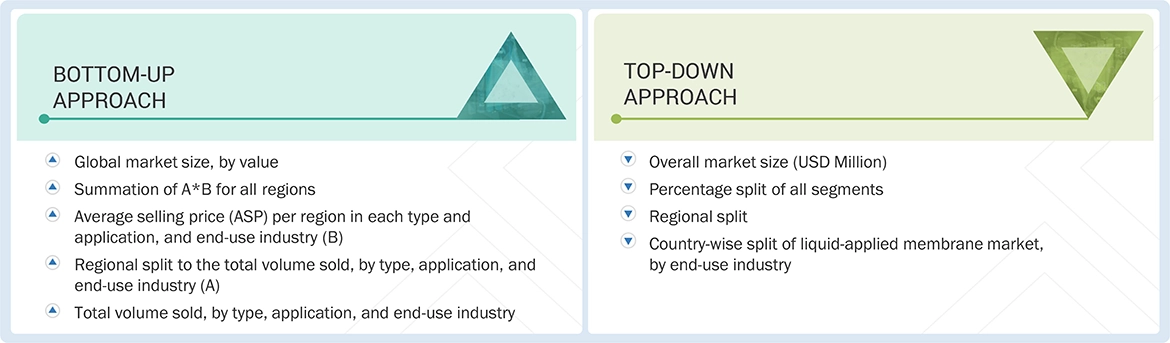
The study involved four major activities to estimate the current size of the global liquid-applied membrane market. Exhaustive secondary research was conducted to collect information on the market, the peer product market, and the parent product group market. The next step was to validate these findings, assumptions, and sizes with industry experts across the liquid-applied membrane value chain through primary research. The top-down and bottom-up approaches were employed to estimate the overall size of the liquid-applied membrane market. After that, market breakdown and data triangulation procedures were used to determine the size of different segments and subsegments of the market.
Secondary Research
The market for companies offering liquid-applied membranes was estimated using secondary data from paid and unpaid sources, analyzing the product portfolios of major companies in the ecosystem, and rating companies by their performance and quality. Secondary sources such as Business Standard, Bloomberg, World Bank, and Factiva were consulted to identify and collect information for this study on the liquid-applied membrane market. These sources included annual reports, press releases, and investor presentations from door vendors, forums, certified publications, and white papers. The secondary research was used to obtain critical information on the industry’s value chain, the total pool of key players, market classification, and segmentation from both market and technology-oriented perspectives.
Primary Research
In the primary research process, various primary sources from both the supply and demand sides were interviewed to obtain qualitative and quantitative information for this report. The primary sources from the supply side included industry experts, such as Chief Executive Officers (CEOs), Vice Presidents (VPs), marketing directors, technology and innovation directors, and related key executives from several key companies and organizations operating in the liquid-applied membrane market. After the complete market engineering (calculations for market statistics, market breakdown, market size estimates, market forecasting, and data triangulation), extensive primary research was conducted to gather information and verify and validate the critical numbers arrived at. Primary research was also conducted to identify segmentation types, industry trends, the competitive landscape of liquid-applied membrane offered by various market players, and key market dynamics, such as drivers, restraints, opportunities, challenges, and key player strategies. In the complete market engineering process, the top-down and bottom-up approaches and several data triangulation methods were extensively used to perform market estimation and market forecasting for the overall market segments and subsegments listed in this report. Extensive qualitative and quantitative analysis was performed throughout the complete market engineering process to list the key information/insights throughout the report.
To know about the assumptions considered for the study, download the pdf brochure
Market Size Estimation
The top-down and bottom-up approaches were used to estimate and validate the size of the global liquid-applied membranes market. These approaches were also used extensively to estimate the sizes of various dependent market segments. The research methodology used to estimate the market size included the following:
Liquid-applied Membrane Market: Top-Down and Bottom-Up Approach
Data Triangulation
After determining the overall market size using market size estimation processes, the market was segmented into several segments and subsegments. Data triangulation and market breakup procedures were employed, wherever applicable, to complete the overall market engineering process and arrive at the exact statistics for each market segment and subsegment. The data was triangulated by analyzing various factors and trends from both the demand and supply sides.
Market Definition
Liquid-applied membranes are high-performance waterproofing materials commonly used in both building and infrastructure applications. Beyond preventing water infiltration, these membranes protect structures against weather, UV degradation, and thermal stress. They exhibit high flexibility, elasticity, and thermal stability, and are UV-stable to safeguard building structures. Smart, carefully controlled mixes and blends during production enable a seamless, continuous membrane that performs consistently over a long service life. Manufacturers of liquid-applied membranes typically rely on blends of bituminous compounds, elastomeric polymers, and cementitious binders. They also add performance-enhancing additives to boost flexibility, crack-bridging capacity, and waterproofing performance. Liquid-applied membranes can be used for both new construction and renovations, with different types of applications tailored to project needs. Applications include roofing, waterproofing of foundations and basements, wet areas, bridges, tunnels, and other infrastructure elements exposed to moisture and harsh environmental conditions. Various end-use industries, such as residential, commercial, and public infrastructure, can rely on liquid-applied membranes for surface waterproofing, protective coatings, and systems that enhance structural durability.
Key Stakeholders
- Liquid-applied membrane manufacturers
- Raw material suppliers
- Contractors and installation service providers
- Construction companies and infrastructure developers
- Architects, consultants, and structural engineers
- Industry associations and regulatory bodies
- R&D institutions
Report Objectives
- To define, describe, and forecast the size of the global liquid-applied membrane market, based on type, application, usage, end-use industry, and region in terms of value
- To provide detailed information on the significant drivers, restraints, opportunities, and challenges influencing the market
- To strategically analyze micromarkets concerning individual growth trends, prospects, and their contribution to the market
- To assess the growth opportunities in the market for stakeholders and provide details on the competitive landscape for market leaders
- To forecast the market size of segments and subsegments for North America, Europe, Asia Pacific, South America, and the Middle East & Africa
- To strategically profile key players and comprehensively analyze their market share and core competencies
- To analyze competitive developments such as product launches, acquisitions, expansions, partnerships, and agreements in the liquid-applied membrane market
- To provide the impact of AI/Gen AI on the market
Available customizations:
With the given market data, MarketsandMarkets offers customizations according to client-specific needs.
The following customization options are available for liquid-applied membrane market report:
Product Analysis
-
A product matrix that gives a detailed comparison of the product portfolio of each company
Regional Analysis
-
A further breakdown of the liquid-applied membrane market for additional countries
Company Information
-
Detailed analysis and profiling of additional market players (up to five)
Get the Full Liquid-applied Membrane Market Report
Full forecast, segment splits, and company analysis for all Liquid-applied Membrane Market.
- Argentina Liquid-applied Membrane Market
- Australia Liquid-applied Membrane Market
- Brazil Liquid-applied Membrane Market
- Canada Liquid-applied Membrane Market
- China Liquid-applied Membrane Market
- France Liquid-applied Membrane Market
- Germany Liquid-applied Membrane Market
- India Liquid-applied Membrane Market
- Indonesia Liquid-applied Membrane Market
- Italy Liquid-applied Membrane Market
- Japan Liquid-applied Membrane Market
- Mexico Liquid-applied Membrane Market
- Russia Liquid-applied Membrane Market
- South Africa Liquid-applied Membrane Market
- Spain Liquid-applied Membrane Market
- Thailand Liquid-applied Membrane Market
- UK Liquid-applied Membrane Market
- US Liquid-applied Membrane Market
Need a Tailored Report?
Customize this report to your needs
Get 10% FREE Customization
Customize This Report