
US Liquid-applied Membrane Market (2026-2031)

The US Liquid-applied Membrane Market was valued at $6700.2 Million in 2026 and projected to reach to $8109.3 Million by 2031, representing a compound annual growth rate of 4.8%. The US liquid-applied membrane market demonstrates steady growth momentum, supported by robust construction activity and infrastructure modernization initiatives.


| Market Size in | USD 26.32 MN |
| Market Forecast in | |
| CAGR | |
| Forecast Period | |
| Units Considered | Value (USD MN) |
US Liquid-applied Membrane Market Trends and Insights
- This steady expansion reflects Canada's robust construction and infrastructure sectors, where liquid-applied membranes are critical for waterproofing, roofing, and protective coating applications.
- Canada's market growth is driven by increasing demand for durable, cost-effective sealing solutions in both residential and commercial building projects. The Canadian market benefits from stringent building codes and environmental regulations that mandate high-performance waterproofing systems.
- Canada's climate—characterized by freeze-thaw cycles and heavy precipitation—creates sustained demand for reliable membrane solutions that protect structures from moisture infiltration and degradation.
- Between 2026 and 2031, Canada's market will be shaped by infrastructure modernization initiatives, green building certifications, and the adoption of advanced polymer-based membrane technologies that enhance durability and sustainability..
Key Market Statistics
- CAGR (2026-2031) 4.8% CAGR
- Market Size, 2026 ~USD 6700.2 Million
- Forecast, 2031 ~USD 8109.3 Million
- Country US
US Liquid-applied Membrane Market Overview
Market Size & Growth :
The US liquid-applied membrane market is valued at USD 6,700.2 million in 2026 and is projected to reach USD 8,109.3 million by 2031, growing at a CAGR of 4.8%, driven by strong demand in construction and infrastructure sectors.
Construction Sector Demand :
Rising commercial and residential construction activities across the US, coupled with increased focus on building durability and weather resistance, are driving adoption of liquid-applied membranes for waterproofing and protective applications.
Infrastructure Investment :
Government infrastructure spending and renovation projects in the US are accelerating the use of liquid-applied membranes in roofing, bridge protection, and structural waterproofing applications, supporting sustained market growth.
Regional Performance vs Global :
The US market grows at 4.8% CAGR, slightly below the global average of 5.9%, reflecting mature market dynamics while maintaining steady expansion through technological innovation and sustainability initiatives.
US Liquid-applied Membrane Market Dynamics
- Key drivers include increasing adoption in commercial roofing, waterproofing applications, and protective coatings across residential and industrial sectors.
- The market benefits from technological advancements in membrane formulations and growing awareness of long-term durability benefits. Looking ahead to 2031, the US market is expected to maintain consistent expansion as building codes become more stringent and sustainability requirements drive demand for high-performance membranes.
- Strategic investments in R&D, coupled with rising renovation activities in aging infrastructure, will continue to support market growth.
- Competition among manufacturers will intensify, fostering innovation in eco-friendly and cost-effective solutions tailored to US market preferences..
Market Ecosystem
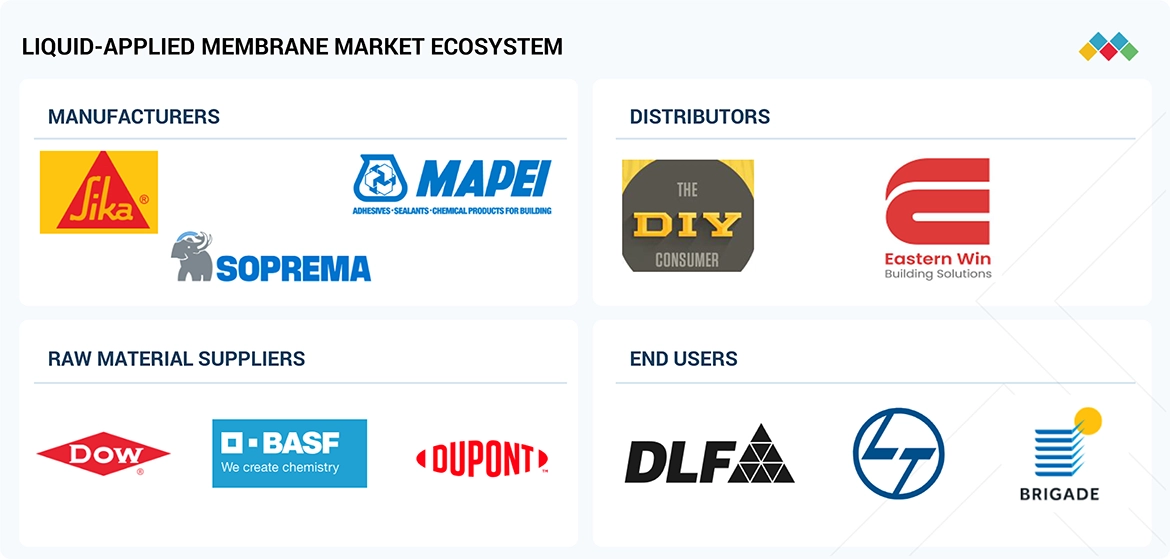
LIQUID-APPLIED MEMBRANE MARKET: COMMERCIAL USE CASES ACROSS INDUSTRIES
| COMPANY | USE CASE DESCRIPTION | BENEFITS |
|---|---|---|
 |
The company offers a broad range of membrane systems including liquid-applied waterproofing systems such as polyurethane, acrylic and hybrid membranes that are suitable for roofing applications, basements, podium decks, tunneling, water holding structures, and general infrastructure applications. The products offered by the firm are widely used in both commercial and industrial settings. | These solutions exhibit superior crack bridging properties, seamless waterproofing ability, and high substrate bonding strength, thus ensuring greater durability of the structures and minimizing the risk of water seepage. Moreover, they enhance overall lifecycle performance, minimize maintenance efforts, and contribute to sustainable development owing to their eco-friendly nature and energy efficiency. |
 |
The company provides an extensive range of innovative liquid-applied waterproofing systems in various forms such as cementitious, polyurethane, and acrylic membranes. The waterproofing range of the company is widely employed for application on terraces, bathrooms, balconies, basements, tunnels, and water retention structures. | These systems provide waterproof barriers that have great durability and are highly flexible, chemical resistant, and adherent. These systems offer improved structural integrity, minimized leakage and repair costs, efficient installations, and environmentally friendly and energy efficient building practices. |
Logos and trademarks shown above are the property of their respective owners. Their use here is for informational and illustrative purposes only.
Related Ecosystem
Membranes
- Reverse Osmosis
- Acetone
- Bioremediation
- Cartridge Filters
- Granular Activated Carbon
- Veolia
- Toray Industries, Inc.
- PALL CORPORATION
- DuPont de Nemours, Inc.
- Pentair plc
Water Purification
- Corrosion Inhibitors
- Cartridge Filters
- Fiberglass
- Reverse Osmosis
- Acetone
- Veolia
- Kemira oyj
- SOLENIS
- Basf se
- CALGON CARBON CORPORATION
Key Takeaways
- Canada's liquid-applied membrane market will grow from USD 6.7B (2026) to USD 8.1B (2031) at a 4.8% CAGR.
- Canada's harsh climate and strict building codes drive consistent demand for high-performance waterproofing solutions.
- Infrastructure modernization and green building initiatives are key growth catalysts for Canada's market through 2031.
- Advanced polymer-based membranes and sustainable formulations are reshaping Canada's competitive landscape.
Liquid-applied Membrane Market Report Scope
| Report Metric | Details |
|---|---|
| Base Year | 2026 |
| Fastest Growing Segment | ASIA PACIFIC (End-Use Industry) |
| Forecast Period | 2026–2031 |
| Growth Rate | CAGR of 5.9% from 2026 to 2031 |
| Largest Segment | NEW CONSTRUCTION (Application) |
| Market Size Base Year (Billions) | ~USD 26.63 (2026) |
| Revenue Forecast (Billions) | ~USD 35.47 (2031) |
| Segments Covered | Application, Usage, End-Use Industry, Type |
US Liquid-applied Membrane Market Report Segmentation
4 segment dimensions are covered across the global market.
By Application
- Building Structures
- Other Applications
- Roadways
- Roofing
- Walls
By Usage
- New Construction
- Refurbishment
By End-Use Industry
- Commercial Construction
- Public Infrastructure
- Residential Construction
By Type
- Bituminous Membranes
- Cementitious Membranes
- Elastomeric Membranes
- –Acrylic Membrane
- –Acrylic Membranes
- –One Component (1K)
- –Pmma
- –Polyurethane Waterproofing
- –Solvent-Based
- –Two Component (2K)
- –Water-Based
US: LIQUID-APPLIED MEMBRANE MARKET, BY END-USE INDUSTRY, 2026–2031
| Segment | 2026 | 2027 | 2028 | 2029 | 2030 | 2031 | CAGR (%) |
|---|---|---|---|---|---|---|---|
| COMMERCIAL CONSTRUCTION | 1176.8 | 1228.6 | 1283.3 | 1341 | 1408.4 | 1472.9 | 4.6 |
| PUBLIC INFRASTRUCTURE | 910 | 951.9 | 996.2 | 1043 | 1097.4 | 1149.7 | 4.8 |
| RESIDENTIAL CONSTRUCTION | 1561.3 | 1644.8 | 1733.5 | 1827.8 | 1937.1 | 2044.1 | 5.5 |
| TOTAL | 3648.1 | 3825.3 | 4012.9 | 4211.8 | 4442.8 | 4666.7 | 5 |
Target Audience
- Construction & Real Estate Developers : Need US market data to understand demand for liquid-applied membranes in commercial and residential projects, optimize material sourcing, and align procurement strategies with market growth trends.
- Membrane Manufacturers & Suppliers : Require detailed US market insights to assess market size, identify growth opportunities, benchmark against competitors, and develop targeted marketing and distribution strategies for American customers.
- Roofing & Waterproofing Contractors : Need market forecasts to plan service offerings, invest in training and equipment, and position their businesses to capitalize on growing demand for liquid-applied membrane solutions across US regions.
- Investment & Private Equity Firms : Seek US market data for due diligence on membrane companies, portfolio companies, and investment opportunities, requiring accurate valuations and growth projections for financial modeling and exit strategies.
- Building Material Distributors & Retailers : Need US-specific market intelligence to forecast inventory requirements, negotiate supplier contracts, identify emerging product categories, and optimize distribution networks for liquid-applied membranes.
Key Companies in the US Liquid-applied Membrane Market
| Company | HQ | Ownership | Strongest segments |
|---|---|---|---|
| SOLVAY SA | Belgium | Public Company | Soda ash and sodium bicarbonate (glass, detergents, flue gas, food/feed),Hydrogen peroxide (pulp and paper, textile, water, food, semiconductors, batteries),Silica (precipitated and highly dispersible for tires, home and personal care, food/feed), |
| USG CORPORATION | United States | Private Company | Drywall (Sheetrock) and Wallboard,Ceiling Systems and Mineral Fiber Boards,Specialty Gypsum and Industrial Products, |
| SIKA AG | Switzerland | Public Company | Concrete admixtures and additives,Waterproofing systems (SikaProof and related),Roofing systems (Sika Sarnafil and accessories), |
| MAPEI S.P.A. | Italy | Private Company | Ceramic, stone, and resilient flooring systems,Waterproofing and building-envelope solutions,Concrete admixtures and cement additives, |
| SAINT-GOBAIN | France | Public Company | Gypsum and plaster-based systems (Placo, Rigips, Gyproc),Insulation solutions (Isover, CertainTeed, Izocam),Mortars and construction chemicals (Weber, Chryso, GCP), |
| H.B. FULLER | United States | Public Company | Hygiene, Health and Consumable Adhesives,Engineering Adhesives,Building Adhesive Solutions, |
| WACKER CHEMIE AG | Germany | Public Company | Silicones,Polymers,Polysilicon, |
| JOHNS MANVILLE | United States | Private Company | Building and mechanical insulation,Commercial roofing systems and accessories,Glass fibers and nonwovens for construction, automotive, filtration, specialty, |
| GCP APPLIED TECHNOLOGIES INC. | United States | Private Company | Waterproofing membranes and building envelope systems,Concrete admixtures and cement additives (including CO2ST Reducers),Specialty and industrial fireproofing solutions, |
| CARLISLE COMPANIES INC. | United States | Public Company | Single-ply roofing membranes (EPDM, TPO, PVC),Polyiso and EPS insulation,Waterproofing, air/vapor barriers, and underlayments, |
| PIDILITE INDUSTRIES LTD | India | Public Company | Consumer & Bazaar – Adhesives and Sealants (Fevicol, Fevikwik, Fevicol MR, Fevibond, Fevistick, Fevigum, steelgrip, fevitite, HOLDTITE LEAKGUARD),Consumer & Bazaar – Construction and Paint Chemicals (Dr. Fixit, Roff, UNITINT, Piditint, WUDFIN, Haisha Paints),Consumer & Bazaar – Art, Craft, and Hobby (Fevicryl, Rangeela, BLUECOAT), |
SOLVAY SA
Solvay SA is a Belgian chemical company founded in 1863 that operates as a public company with 8,400 employees. The company specializes in advanced materials and specialty chemicals for various industrial applications.
USG CORPORATION
USG Corporation is a United States-based private company founded in 1902 with 7,300 employees. The company is a leading manufacturer of building materials and construction products.
SIKA AG
Sika AG is a Swiss public company founded in 1910 with 30,629 employees. The company specializes in specialty chemicals and building materials for construction and industrial applications.
MAPEI S.P.A.
Mapei S.p.A. is an Italian private company founded in 1937 with 13,252 employees. The company manufactures adhesives, sealants, and chemical products for the construction and building materials industries.
SAINT-GOBAIN
Saint-Gobain is a French public company founded in 1665 with 158,616 employees, making it one of the world's largest building materials manufacturers. The company produces a wide range of construction and high-performance materials.
H.B. FULLER
H.B. Fuller is a United States-based public company founded in 1887 with 7,100 employees. The company manufactures adhesives, sealants, and other specialty chemical products for industrial and construction applications.
WACKER CHEMIE AG
Wacker Chemie AG is a German public company founded in 1914 with 16,196 employees. The company produces specialty chemicals and polymers for construction, automotive, and industrial markets.
JOHNS MANVILLE
Johns Manville is a United States-based private company founded in 1858 with 9,740 employees. The company manufactures insulation, roofing, and engineered products for the building and construction industries.
GCP APPLIED TECHNOLOGIES INC.
GCP Applied Technologies Inc. is a United States-based private company founded in 2015 with 1,800 employees. The company provides specialty construction chemicals and building materials solutions.
CARLISLE COMPANIES INC.
Carlisle Companies Inc. is a United States-based public company founded in 1917 with 5,900 employees. The company manufactures construction materials, roofing products, and specialty materials.
PIDILITE INDUSTRIES LTD
Pidilite Industries Ltd is an Indian public company founded in 1959 with 8,835 employees. The company manufactures adhesives, sealants, and specialty chemical products for construction and industrial applications.
Reasons to Buy this Report
- Market Size & Valuation Data : Access precise market valuation for the US at USD 6,700.2 million (2026) and USD 8,109.3 million (2031), enabling accurate financial forecasting and investment decision-making specific to the American market.
- Growth Trajectory & CAGR Analysis : Understand the 4.8% CAGR for the US market and benchmark it against global performance (5.9%), helping identify regional opportunities and competitive positioning within the North American landscape.
- Sector-Specific Insights : Gain detailed intelligence on US construction, roofing, and infrastructure applications driving membrane demand, enabling targeted product development and market entry strategies for specific end-use segments.
- Competitive Landscape Intelligence : Leverage US-focused market data to identify key competitors, market gaps, and differentiation opportunities in waterproofing and protective coating applications across commercial and residential sectors.
- Strategic Planning & Forecasting : Utilize comprehensive US market projections through 2031 to develop long-term business strategies, resource allocation plans, and expansion roadmaps with confidence in region-specific demand drivers.
Frequently asked questions
What is the current size of Canada's liquid-applied membrane market?
Canada's liquid-applied membrane market is valued at USD 6,700.2 million in 2026.
What is the projected market size for Canada by 2031?
Canada's liquid-applied membrane market is forecast to reach USD 8,109.3 million by 2031.
What is the CAGR for Canada's liquid-applied membrane market?
Canada's liquid-applied membrane market is expected to grow at a CAGR of 4.8% from 2026 to 2031.
What factors drive growth in Canada's liquid-applied membrane market?
Growth in Canada is driven by harsh climate conditions, stringent building codes, infrastructure modernization, and increased adoption of green building certifications.
Which applications dominate Canada's liquid-applied membrane market?
Waterproofing, roofing, and protective coating applications are the primary segments driving demand in Canada's market.
RESEARCH METHODOLOGY
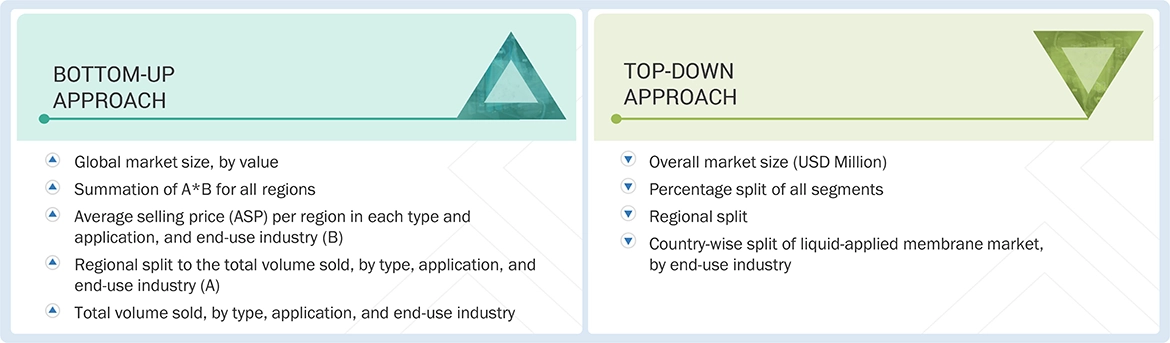
The study involved four major activities to estimate the current size of the global liquid-applied membrane market. Exhaustive secondary research was conducted to collect information on the market, the peer product market, and the parent product group market. The next step was to validate these findings, assumptions, and sizes with industry experts across the liquid-applied membrane value chain through primary research. The top-down and bottom-up approaches were employed to estimate the overall size of the liquid-applied membrane market. After that, market breakdown and data triangulation procedures were used to determine the size of different segments and subsegments of the market.
Secondary Research
The market for companies offering liquid-applied membranes was estimated using secondary data from paid and unpaid sources, analyzing the product portfolios of major companies in the ecosystem, and rating companies by their performance and quality. Secondary sources such as Business Standard, Bloomberg, World Bank, and Factiva were consulted to identify and collect information for this study on the liquid-applied membrane market. These sources included annual reports, press releases, and investor presentations from door vendors, forums, certified publications, and white papers. The secondary research was used to obtain critical information on the industry’s value chain, the total pool of key players, market classification, and segmentation from both market and technology-oriented perspectives.
Primary Research
In the primary research process, various primary sources from both the supply and demand sides were interviewed to obtain qualitative and quantitative information for this report. The primary sources from the supply side included industry experts, such as Chief Executive Officers (CEOs), Vice Presidents (VPs), marketing directors, technology and innovation directors, and related key executives from several key companies and organizations operating in the liquid-applied membrane market. After the complete market engineering (calculations for market statistics, market breakdown, market size estimates, market forecasting, and data triangulation), extensive primary research was conducted to gather information and verify and validate the critical numbers arrived at. Primary research was also conducted to identify segmentation types, industry trends, the competitive landscape of liquid-applied membrane offered by various market players, and key market dynamics, such as drivers, restraints, opportunities, challenges, and key player strategies. In the complete market engineering process, the top-down and bottom-up approaches and several data triangulation methods were extensively used to perform market estimation and market forecasting for the overall market segments and subsegments listed in this report. Extensive qualitative and quantitative analysis was performed throughout the complete market engineering process to list the key information/insights throughout the report.
To know about the assumptions considered for the study, download the pdf brochure
Market Size Estimation
The top-down and bottom-up approaches were used to estimate and validate the size of the global liquid-applied membranes market. These approaches were also used extensively to estimate the sizes of various dependent market segments. The research methodology used to estimate the market size included the following:
Liquid-applied Membrane Market: Top-Down and Bottom-Up Approach
Data Triangulation
After determining the overall market size using market size estimation processes, the market was segmented into several segments and subsegments. Data triangulation and market breakup procedures were employed, wherever applicable, to complete the overall market engineering process and arrive at the exact statistics for each market segment and subsegment. The data was triangulated by analyzing various factors and trends from both the demand and supply sides.
Market Definition
Liquid-applied membranes are high-performance waterproofing materials commonly used in both building and infrastructure applications. Beyond preventing water infiltration, these membranes protect structures against weather, UV degradation, and thermal stress. They exhibit high flexibility, elasticity, and thermal stability, and are UV-stable to safeguard building structures. Smart, carefully controlled mixes and blends during production enable a seamless, continuous membrane that performs consistently over a long service life. Manufacturers of liquid-applied membranes typically rely on blends of bituminous compounds, elastomeric polymers, and cementitious binders. They also add performance-enhancing additives to boost flexibility, crack-bridging capacity, and waterproofing performance. Liquid-applied membranes can be used for both new construction and renovations, with different types of applications tailored to project needs. Applications include roofing, waterproofing of foundations and basements, wet areas, bridges, tunnels, and other infrastructure elements exposed to moisture and harsh environmental conditions. Various end-use industries, such as residential, commercial, and public infrastructure, can rely on liquid-applied membranes for surface waterproofing, protective coatings, and systems that enhance structural durability.
Key Stakeholders
- Liquid-applied membrane manufacturers
- Raw material suppliers
- Contractors and installation service providers
- Construction companies and infrastructure developers
- Architects, consultants, and structural engineers
- Industry associations and regulatory bodies
- R&D institutions
Report Objectives
- To define, describe, and forecast the size of the global liquid-applied membrane market, based on type, application, usage, end-use industry, and region in terms of value
- To provide detailed information on the significant drivers, restraints, opportunities, and challenges influencing the market
- To strategically analyze micromarkets concerning individual growth trends, prospects, and their contribution to the market
- To assess the growth opportunities in the market for stakeholders and provide details on the competitive landscape for market leaders
- To forecast the market size of segments and subsegments for North America, Europe, Asia Pacific, South America, and the Middle East & Africa
- To strategically profile key players and comprehensively analyze their market share and core competencies
- To analyze competitive developments such as product launches, acquisitions, expansions, partnerships, and agreements in the liquid-applied membrane market
- To provide the impact of AI/Gen AI on the market
Available customizations:
With the given market data, MarketsandMarkets offers customizations according to client-specific needs.
The following customization options are available for liquid-applied membrane market report:
Product Analysis
-
A product matrix that gives a detailed comparison of the product portfolio of each company
Regional Analysis
-
A further breakdown of the liquid-applied membrane market for additional countries
Company Information
-
Detailed analysis and profiling of additional market players (up to five)
Get the Full Liquid-applied Membrane Market Report
Full forecast, segment splits, and company analysis for all Liquid-applied Membrane Market.
Need a Tailored Report?
Customize this report to your needs
Get 10% FREE Customization
Customize This Report
