
Japan Lithium-ion Battery Market (2025-2030)

The Japan Lithium-ion Battery Market was valued at $7090 Million in 2025 and projected to reach to $15030 Million by 2030, representing a compound annual growth rate of 9.8%. Japan's lithium-ion battery market is experiencing robust expansion driven by aggressive automotive electrification targets and renewable energy infrastructure investments.


| Market Size in | USD 26.32 MN |
| Market Forecast in | |
| CAGR | |
| Forecast Period | |
| Units Considered | Value (USD MN) |
Japan Lithium-ion Battery Market Trends and Insights
- Valued at USD 7,090 million in 2025, Japan's market is expected to expand to USD 15,030 million by 2030, reflecting a compound annual growth rate of 9.8%.
- This growth trajectory underscores Japan's strategic importance in automotive electrification, renewable energy integration, and consumer electronics innovation. Japan's lithium-ion battery sector is driven by the nation's leadership in electric vehicle manufacturing, grid-scale energy storage deployment, and advanced battery technology development.
- Major Japanese automotive and electronics manufacturers are investing heavily in battery production capacity and R&D to maintain competitive advantage.
- Japan's commitment to carbon neutrality and renewable energy targets further accelerates demand for high-performance lithium-ion solutions across industrial and residential applications. The market dynamics in Japan reflect both domestic consumption and export-oriented manufacturing.
- Japan's established supply chain infrastructure, technological expertise, and regulatory framework position the country as a key player in the global lithium-ion battery value chain through 2030..
Key Market Statistics
- CAGR (2025-2030) 9.8% CAGR
- Market Size, 2025 ~USD 7090 Million
- Forecast, 2030 ~USD 15030 Million
- Country Japan
Japan Lithium-ion Battery Market Overview
Market Valuation & Growth :
Japan's lithium-ion battery market reached USD 7,090 million in 2025 and is projected to grow to USD 15,030 million by 2030, representing a 9.8% CAGR, slightly below the global average of 10.3%.
Automotive Electrification Leadership :
Japan's automotive sector, led by Toyota, Honda, and Nissan, drives significant demand for lithium-ion batteries as EV adoption accelerates and battery technology becomes increasingly competitive in the domestic market.
Renewable Energy Integration :
Post-Fukushima energy policies have accelerated Japan's renewable energy transition, creating substantial demand for stationary energy storage solutions and grid-scale lithium-ion battery systems.
Manufacturing & Supply Chain Hub :
Japan hosts major battery manufacturers including Panasonic, AESC, and Sony, positioning the country as a critical production and innovation center within the Asia Pacific lithium-ion battery ecosystem.
Japan Lithium-ion Battery Market Dynamics
- The government's commitment to carbon neutrality by 2050 and the growing adoption of battery electric vehicles (BEVs) among Japanese consumers are primary growth catalysts.
- Additionally, Japan's established manufacturing capabilities and technological expertise provide competitive advantages in battery production and innovation. Looking ahead to 2030, Japan's market will benefit from declining battery costs, improved energy density, and expanding applications beyond automotive into stationary storage and grid stabilization.
- However, competition from South Korea and China, coupled with supply chain vulnerabilities for raw materials, may moderate growth rates.
- Strategic investments in domestic lithium and cobalt sourcing, along with next-generation solid-state battery development, will be critical for sustaining Japan's market leadership in the Asia Pacific region..
Market Ecosystem
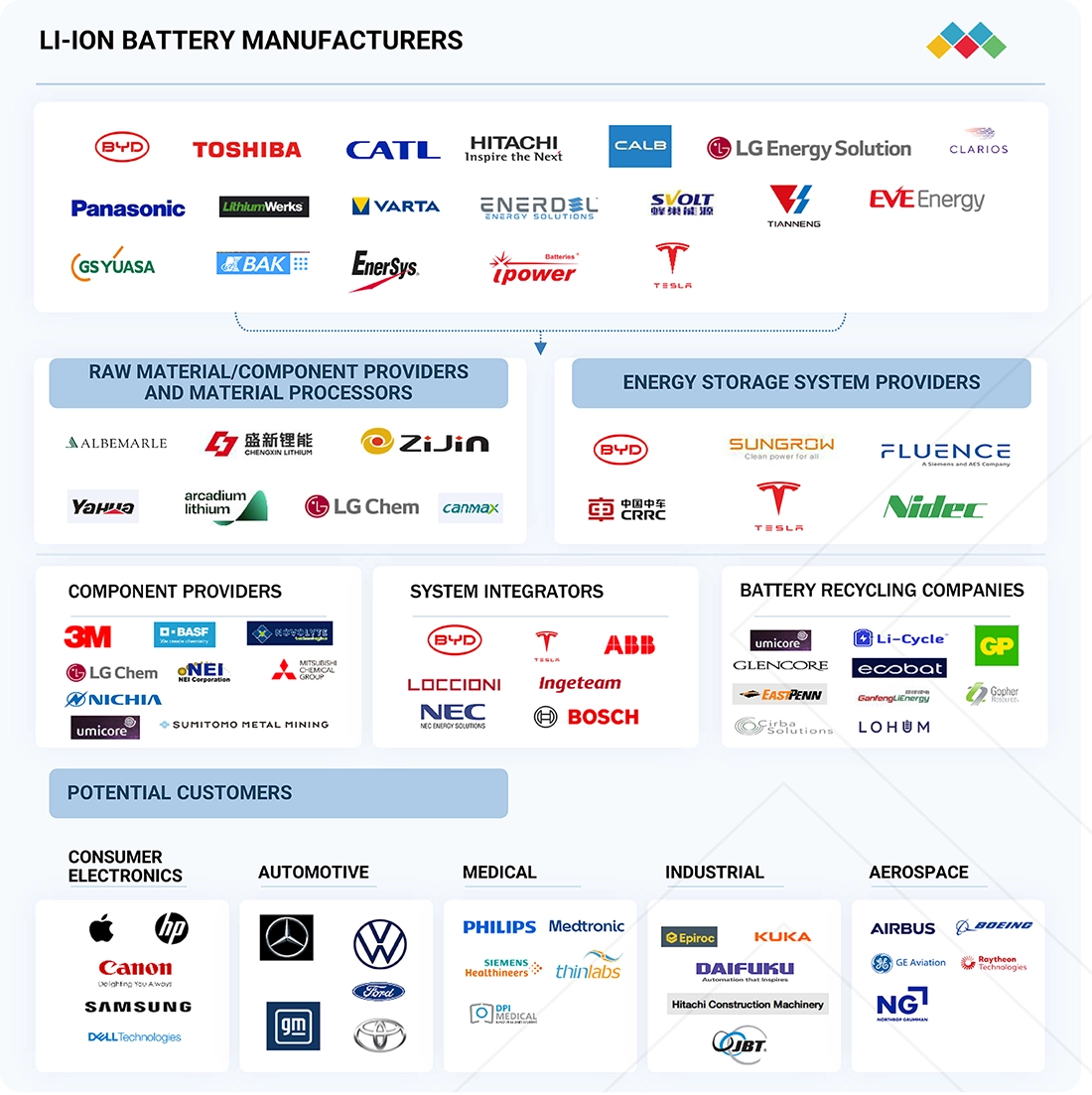
LITHIUM-ION BATTERY MARKET SIZE, SHARE & GROWTH, 2033: COMMERCIAL USE CASES ACROSS INDUSTRIES
| COMPANY | USE CASE DESCRIPTION | BENEFITS |
|---|---|---|
 |
Advanced lithium-ion batteries for EVs and grid-scale storage; advancing cell-to-pack integration for greater efficiency | Higher energy density, faster charging, strong temperature adaptability, cost efficiency |
 |
Lithium-ion batteries for electric vehicles, energy storage, and consumer electronics | Extended driving range, stable performance, improved energy efficiency |
 |
Proprietary Blade Battery technology for electric cars, buses, and commercial fleets | Enhanced safety with minimized thermal runaway risk, long service life, and optimized design for space utilization |
 |
Cylindrical and prismatic lithium-ion cells for EVs and hybrid vehicles; key supplier to leading automakers | High energy density, reliable lifecycle performance, and proven scalability for mass-market electric mobility |
 |
Lithium-ion batteries for EVs, energy storage systems, and portable electronics | High energy density, improved safety, long lifespan, and compact form factor for diverse applications |
Logos and trademarks shown above are the property of their respective owners. Their use here is for informational and illustrative purposes only.
Related Ecosystem
Aviation
- Narrow Body Aircraft
- Wide Body Aircraft
- Military Helicopters
- Special Mission Aircraft
- Fighter Aircraft
- HONEYWELL INTERNATIONAL INC.
- COLLINS AEROSPACE
- Thales group
- Safran group
- HEICO Corporation
Automotive Electronics And Electrical Equipment
- Battery Electric Vehicle (BEV)
- Light Commercial Vehicles (LCVs)
- Fuel Cell Electric Vehicle (FCEV)
- Sensors
- Hybrid Electric Vehicle (HEV)
- BOSCH LIMITED
- DENSO Corporation
- Continental ag
- Panasonic Holdings Corporation
- Texas Instruments Incorporated
Energy Storage
- Energy Harvesting
- HVAC System
- Applicant Tracking System
- Battery Electric Vehicle (BEV)
- Carboxymethyl Cellulose (CMC)
- MOMENTIVE PERFORMANCE MATERIALS INC.
- Panasonic Holdings Corporation
- Lg corp
- ABB India Limited
- FDK Corporation
Key Takeaways
- Japan's lithium-ion battery market will more than double from USD 7,090M (2025) to USD 15,030M (2030) at a 9.8% CAGR.
- Japan leads Asia Pacific in battery technology innovation, driven by major automotive OEMs and electronics manufacturers.
- Electric vehicle adoption and renewable energy storage are primary growth catalysts for Japan's lithium-ion battery demand.
- Japan's established manufacturing infrastructure and supply chain position it as a critical export hub for global battery markets.
Lithium-ion Battery Market Report Scope
| Report Metric | Details |
|---|---|
| Base Year | 2025 |
| Fastest Growing Segment | ENERGY STORAGE (Application) |
| Forecast Period | 2025–2030 |
| Growth Rate | CAGR of 10.3% from 2025 to 2030 |
| Largest Segment | EVS (Application) |
| Market Size Base Year (Billions) | ~USD 194.62 (2025) |
| Revenue Forecast (Billions) | ~USD 317.73 (2030) |
| Segments Covered | Battery Type, Application, Installed Capacity, Battery Capacity, Battery Form, Vehicle Type, Connection Type, End Use, Product Type |
Japan Lithium-ion Battery Market Report Segmentation
9 segment dimensions are covered across the global market.
By Battery Type
- Lco
- Lfp
- Lmo
- Lto
- Nca
- Nmc
By Application
- Consumer Electronics
- Energy Storage
- Evs
- Industrial
- Medical
- Other Applications
By Installed Capacity
- Installed Capacity
By Battery Capacity
- 10 – 30 Wh
- 10–30 Wh
- 10–50 Wh
- 30 Kwh–10 Mwh
- 50–100 Kwh
- Above 10 Mwh
- Above 100 Kwh
- Above 30 Wh
- Above 50 Wh
- Below 10 Wh
- Below 30 Kwh
- Below 50 Kwh
By Battery Form
- Cylindrical
- Pouch
- Prismatic
By Vehicle Type
- Buses
- Medium & Heavy Trucks
- Off-Highway Vehicles
- Passenger Cars
- Vans/Light Trucks
By Connection Type
- Off-Grid
- On-Grid
By End Use
- Commercial & Industrial
- Residential
- Utilities
By Product Type
- Laptops & Tablets
- Smartphones
- Wearables
Target Audience
- Automotive OEMs & Suppliers : Japanese and international automakers need Japan-specific battery market data to optimize EV platform development, negotiate supplier contracts, and align production capacity with domestic and export demand.
- Battery Manufacturers & Suppliers : Panasonic, AESC, Sony, and emerging battery producers require detailed market intelligence to guide capacity expansion, technology investments, and competitive positioning within Japan's dynamic battery ecosystem.
- Energy & Utility Companies : Japanese utilities and renewable energy developers need market forecasts and segment analysis to plan grid-scale battery storage deployments and evaluate investment returns in stationary energy storage solutions.
- Investment & Private Equity Firms : Investors targeting Japan's clean energy and automotive sectors require validated market sizing, growth projections, and competitive dynamics to identify acquisition targets and assess portfolio company valuations.
- Government & Policy Makers : Japanese government agencies and policy bodies need market intelligence to design effective incentive programs, set realistic EV adoption targets, and allocate resources for battery manufacturing and recycling infrastructure.
Key Companies in the Japan Lithium-ion Battery Market
| Company | HQ | Ownership | Strongest segments |
|---|---|---|---|
| SOJITZ CORPORATION | Japan | Public Company | Automotive, Industrial Machinery & Transportation (incl. aircraft, ships),Energy, Power & Infrastructure (oil, gas, LNG, IPP/IWPP, electricity retail),Metals, Minerals & Resource Recycling, |
| HALDOR TOPSOE A/S | Denmark | Private Company | Refinery and petrochemical catalysts,Ammonia, hydrogen, and syngas catalysts,Clean fuels, SAF, and e-fuels technologies, |
| GODREJ GROUP | India | Private Company | Home appliances (refrigerators, washing machines, ACs, small appliances),Locks, architectural hardware, and home/institutional security products,Industrial and process equipment (hydro-turbines, steel plant equipment, catalyst baskets, etc.), |
| NITTO DENKO CORPORATION | Japan | Public Company | Industrial and electronic adhesive tapes,Surface protection, packaging, and construction materials,Fluoroplastic and porous functional materials (NITOFLON, TEMISH, breathable sheets), |
| HIMADRI CHEMICALS & INDUSTRIES LTD. | India | Public Company | Carbon black (tyre, MRG, plastics, inks, coatings),Coal tar pitch and specialty oils,Battery materials (anode, LFP cathode, recycling), |
| FDK CORPORATION | Japan | Public Company | Alkaline and carbon-zinc batteries,Ni-MH rechargeable batteries,Lithium batteries, |
| SIMPLO TECHNOLOGY CO., LTD. | Taiwan | Public Company | Lithium battery modules (mobile devices and fit accessories),LEV and EV battery modules,Household appliance power modules, |
| LG ENERGY SOLUTION | South Korea | Public Company | Automotive batteries (EV traction),Energy storage systems (grid, C&I, residential),Mobility and IT batteries, |
| SAMSUNG SDI | Korea, South | Public Company | Automotive batteries (EV/HEV/PHEV),Energy Storage Systems (residential, C&I, utility, UPS, BTS),Small-sized lithium-ion (IT, power tools, micromobility, ignition), |
| PANASONIC HOLDINGS CORPORATION | Japan | Public Company | HVAC & CC (air-conditioners, heat pump water heaters, ventilation, commercial refrigeration),Energy (cylindrical lithium-ion, batteries, storage systems),Smart Life (consumer appliances, AV, personal care, TVs, bicycles), |
| BYD COMPANY LTD. | China | Public Company | Automobiles and Related Products,Automobile Power Batteries and Lithium-ion Batteries,Mobile Handset Components, Assembly Service and Other Products, |
| CONTEMPORARY AMPEREX TECHNOLOGY CO., LIMITED | China | Public Company | Power battery systems for passenger vehicles,Power battery systems for commercial and special vehicles,Energy storage battery systems, |
| CALB | Japan | Public Company | Potato-based snacks (Potato Chips, JagaRico, Jagabee, Sapporo Potato),Corn- and bean-based snacks (Harvest Snaps, Sayaendo, Kappa Ebisen),Flour-based and other snacks, |
| ENERSYS | United States | Public Company | Network & Infrastructure Solutions,Industrial Mobility Solutions,Precision Power Solutions, |
| EVE ENERGY CO., LTD. | China | Public Company | Power batteries (prismatic LFP, prismatic/pouch NCM, EV-cylindrical, modules, BMS),Consumer lithium-ion and cylindrical cells,Lithium primary batteries (incl. Li-SOCl2, Li-CFx, battery capacitors, composite power supply ES), |
| GOTION | China | Public Company | Power battery systems (EV and hybrid),Energy storage battery systems,Battery materials and cells (standalone), |
| GS YUASA CORPORATION | Japan | Public Company | Car Battery,Industrial Battery Power Supply,Automotive, Aviation, Space, and Marine Development Lithium-Ion Battery, |
| MITSUBISHI ELECTRIC CORPORATION | Japan | Public Company | Infrastructure, Energy, Defense & Space Systems,Factory Automation & Industrial Systems,Building Systems (Elevators, Escalators, BMS), |
| SK INNOVATION CO., LTD. | South Korea | Public Company | Energy & Chemicals (refining, petrochemicals, base oils, lubricants),Battery & Materials (cells, separators, lithium battery evaluation and services),E&S, Power, City Gas, LNG, District Energy, Renewables, Hydrogen, |
| TESLA | United States | Public Company | Battery Electric Vehicles (new),Energy Generation and Storage,Software, Services, and Regulatory Credits, |
SOJITZ CORPORATION
Sojitz Corporation is a Japanese public company founded in 1862 with 26,789 employees. It operates as a diversified trading and investment company with global operations.
HALDOR TOPSOE A/S
Haldor Topsoe A/S is a Danish private company established in 1940 with 2,739 employees. It specializes in catalysts and chemical technologies for industrial applications.
GODREJ GROUP
Godrej Group is an Indian private company founded in 1897 with 13,316 employees. It operates across multiple sectors including consumer goods, real estate, and industrial products.
NITTO DENKO CORPORATION
Nitto Denko Corporation is a Japanese public company established in 1918 with 26,477 employees. It manufactures and supplies advanced materials and chemical products globally.
HIMADRI CHEMICALS & INDUSTRIES LTD.
Himadri Chemicals & Industries Ltd. is an Indian public company established in 1987 with 1,161 employees. It produces specialty chemicals and carbon-based materials.
FDK CORPORATION
FDK Corporation is a Japanese public company founded in 1950 with 2,420 employees. It manufactures electronic components and battery products.
SIMPLO TECHNOLOGY CO., LTD.
Simplo Technology Co., Ltd. is a Taiwanese public company established in 1981 with 449 employees. It produces electronic components and related products.
LG ENERGY SOLUTION
LG Energy Solution is a South Korean public company founded in 2020 with 12,461 employees. It specializes in battery and energy storage solutions.
SAMSUNG SDI
Samsung SDI is a South Korean public company established in 1970 with 13,073 employees. It manufactures advanced materials, batteries, and electronic components.
PANASONIC HOLDINGS CORPORATION
Panasonic Holdings Corporation is a Japanese public company founded in 1918 with 183,685 employees. It is a diversified electronics manufacturer with global operations across multiple industries.
BYD COMPANY LTD.
BYD Company Ltd. is a Chinese public company established in 1994 with 869,600 employees. It is a major manufacturer of batteries, electric vehicles, and renewable energy products.
CONTEMPORARY AMPEREX TECHNOLOGY CO., LIMITED
Contemporary Amperex Technology Co., Limited is a Chinese public company founded in 2011 with 185,839 employees. It is a leading global manufacturer of lithium-ion batteries and energy storage systems.
CALB
CALB is a Japanese public company founded in 1949 with 6,974 employees. It manufactures batteries and energy storage solutions.
ENERSYS
EnerSys is a United States public company founded in 1991 with 9,682 employees. It manufactures and distributes energy storage and power conversion solutions.
EVE ENERGY CO., LTD.
EVE Energy Co., Ltd. is a Chinese public company established in 2001 with 31,213 employees. It specializes in lithium-ion battery manufacturing and energy storage products.
GOTION
Gotion is a Chinese public company founded in 1995 with 33,087 employees. It manufactures lithium-ion batteries and energy storage systems.
GS YUASA CORPORATION
GS Yuasa Corporation is a Japanese public company established in 2004 with 12,562 employees. It produces batteries and power supply systems for various applications.
MITSUBISHI ELECTRIC CORPORATION
Mitsubishi Electric Corporation is a Japanese public company founded in 1921 with 150,386 employees. It manufactures electrical equipment, electronics, and industrial automation products globally.
SK INNOVATION CO., LTD.
SK Innovation Co., Ltd. is a South Korean public company established in 1962 with 1,505 employees. It operates in energy and chemical industries.
TESLA
Tesla is a United States public company founded in 2003 with 134,785 employees. It designs and manufactures electric vehicles, energy storage systems, and renewable energy products.
Reasons to Buy this Report
- Precise Market Sizing for Japan : Access validated market valuations specific to Japan (USD 7,090M in 2025) with accurate forecasts through 2030, enabling precise budget allocation and investment decisions in the Japanese lithium-ion battery sector.
- Automotive & EV Strategy Insights : Understand Japan's unique EV adoption landscape, OEM battery sourcing strategies, and competitive positioning of domestic manufacturers like Panasonic and AESC to inform product development and partnership decisions.
- Renewable Energy & Grid Storage Opportunities : Identify high-growth segments in Japan's stationary energy storage and grid-scale battery applications driven by renewable energy policies, enabling market entry and expansion strategies in this emerging segment.
- Supply Chain & Manufacturing Intelligence : Gain detailed insights into Japan's battery manufacturing ecosystem, raw material sourcing challenges, and production capacity trends to optimize supply chain strategies and identify partnership opportunities.
- Competitive Landscape Analysis : Benchmark against Japanese and international competitors, understand market consolidation trends, and identify white-space opportunities in Japan's lithium-ion battery value chain through comprehensive competitive analysis.
Frequently asked questions
What is the current size of Japan's lithium-ion battery market?
Japan's lithium-ion battery market is valued at USD 7,090 million in 2025 and is projected to reach USD 15,030 million by 2030.
What is the expected growth rate for Japan's lithium-ion battery market?
Japan's lithium-ion battery market is expected to grow at a compound annual growth rate (CAGR) of 9.8% from 2025 to 2030.
What are the primary drivers of growth in Japan's lithium-ion battery market?
Key growth drivers in Japan include electric vehicle electrification, renewable energy storage deployment, carbon neutrality commitments, and advanced battery technology development by major manufacturers.
Which industries are the largest consumers of lithium-ion batteries in Japan?
Japan's automotive sector, consumer electronics industry, and renewable energy storage systems are the largest consumers of lithium-ion batteries.
How does Japan's lithium-ion battery market compare to other Asia Pacific countries?
Japan is a leading technology innovator and manufacturer in Asia Pacific's lithium-ion battery market, with significant export capabilities and established supply chain infrastructure supporting regional and global demand.
RESEARCH METHODOLOGY
The study involved four major activities in estimating the current size of the lithium-ion battery market. Exhaustive secondary research has been conducted to gather information on the market, adjacent markets, and the overall lithium-ion battery landscape. These findings, along with assumptions and projections, were validated through primary research involving interviews with industry experts and key stakeholders across the value chain. Both top-down and bottom-up approaches were utilized to estimate the overall market size. Subsequently, market breakdown and data triangulation techniques were applied to determine the sizes of various segments and subsegments. Two key sources, secondary and primary, were leveraged to conduct a comprehensive technical and commercial assessment of the market.
Secondary Research
Various secondary sources have been referred to in the secondary research process to identify and collect important information for this study. The secondary sources include annual reports, press releases, and investor presentations of companies; white papers; journals and certified publications; and articles from recognized authors, websites, directories, and databases. Secondary research has been conducted to obtain key information about the industry’s supply chain, the market’s value chain, the total pool of key players, market segmentation according to the industry trends (to the bottom-most level), regional markets, and key developments from market- and technology-oriented perspectives. The secondary data has been collected and analyzed to determine the overall market size, further validated by primary research.
Primary Research
Extensive primary research was conducted after gaining knowledge about the current scenario of the market through secondary research. Several primary interviews were conducted with experts from the demand and supply sides across four major regions: North America, Europe, Asia Pacific, and RoW. This primary data was collected through questionnaires, emails, and telephone interviews.
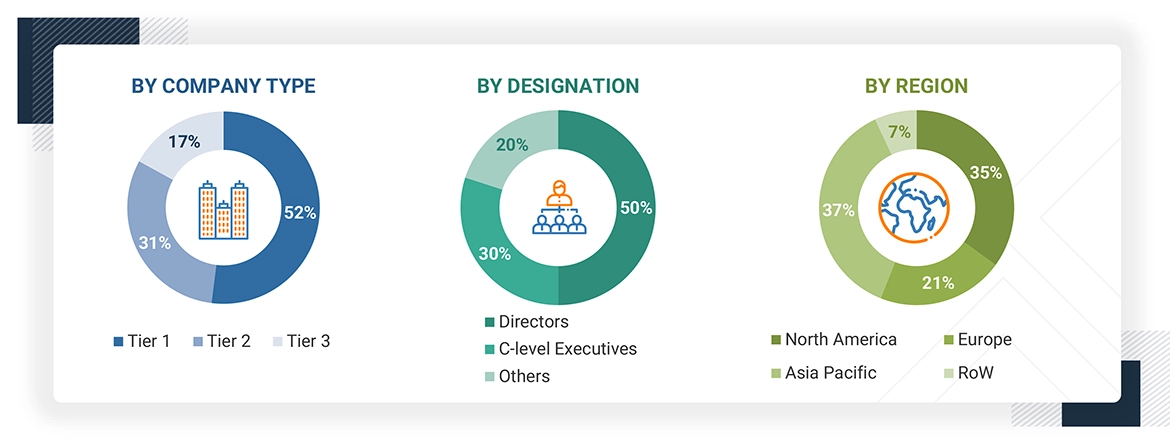
Note: Three tiers of companies are defined based on their total revenue as of 2024: tier 3 = revenue less than USD 500 million; tier 2 = revenue between USD 500 million and USD 5 billion; and tier 1 = revenue more than USD 5 billion. Other designations include sales, marketing, and product managers.
To know about the assumptions considered for the study, download the pdf brochure
Market Size Estimation
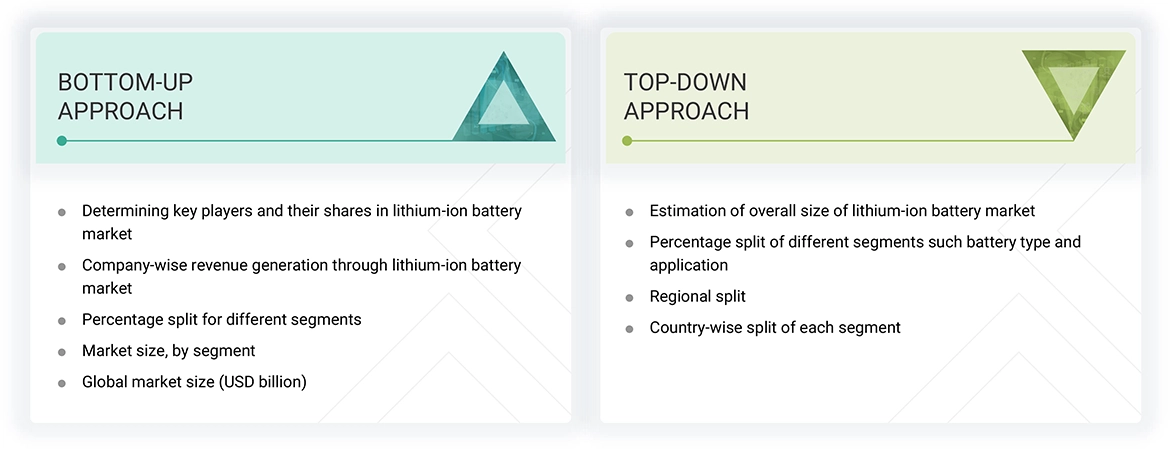
Both top-down and bottom-up approaches have been used to estimate and validate the total size of the lithium-ion battery market. These methods have also been used extensively to estimate the size of various subsegments in the market. The following research methodology has been used to estimate the market size:
- Major players in the industry and markets were identified through extensive secondary research.
- The industry’s value chain and market size (in terms of value) were determined through primary and secondary research processes.
- All percentage shares, splits, and breakdowns were determined using secondary sources and verified through primary sources.
Lithium-ion Battery Market : Top-Down and Bottom-Up Approach
Data Triangulation
After arriving at the overall size of the lithium-ion battery market from the market size estimation process explained above, the total market has been split into several segments and subsegments. Data triangulation and market breakdown procedures have been employed, wherever applicable, to complete the overall market engineering process and arrive at the exact statistics for all segments and subsegments of the market. The data has been triangulated by studying various factors and trends from the demand and supply sides. Additionally, the market size has been validated using top-down and bottom-up approaches.
Market Definition
The lithium-ion battery market includes a broad range of rechargeable battery technologies that use lithium ions as the core component for energy transfer. These batteries are widely used in applications such as electric vehicles (EVs), energy storage, consumer electronics, industrial machinery, and medical equipment. The market covers several chemistries, such as lithium iron phosphate (LFP), nickel manganese cobalt (NMC), lithium nickel cobalt aluminum oxide (NCA), lithium titanate oxide (LTO), lithium cobalt oxide (LCO) and lithium manganese oxide (LMO), each selected based on specific performance, safety, and cost requirements. Li-ion batteries are known for their high energy density, long service life, fast charging capability, and low maintenance. Market growth is primarily driven by the rising adoption of EVs, expanding renewable energy infrastructure, and increasing demand for compact and efficient power storage solutions across residential, commercial, and industrial sectors.
Key Stakeholders
- Lithium-ion battery manufacturers
- Government bodies and policymakers
- Standards organizations, forums, alliances, and associations
- Market research and consulting firms
- Raw material suppliers and distributors
- Research institutes and organizations
- Material and technology providers
- Battery cell and battery pack manufacturers
- Consumer electronics manufacturers
- Testing, inspection, and certification providers
- Distributors and resellers
Report Objectives
- To define, describe, and forecast the lithium-ion battery market in terms of battery type, application, and region
- To forecast the lithium ion battery market, based on installed capacity (GWh)
- To describe and forecast the market, in terms of value, with regard to four main regions: North America, Europe, Asia Pacific, and Rest of the World (RoW), along with their respective countries
- To provide detailed information regarding major factors influencing the market growth (drivers, restraints, opportunities, and challenges)
- To provide a detailed overview of the value chain of the market.
- To strategically analyze micromarkets with respect to individual growth trends, prospects, and contributions to the market
- To analyze opportunities in the market for stakeholders by identifying high-growth segments of the lithium ion battery market.
- To strategically profile key players and comprehensively analyze their market position in terms of ranking and core competencies, along with detailing the competitive landscape for market leaders
- To analyze competitive strategies, such as product launches, expansions, mergers and acquisitions, adopted by key market players in the market.
Available customizations:
With the given market data, MarketsandMarkets offers customizations according to the company’s specific needs. The following customization options are available for the report:
Company Information:
- Detailed analysis and profiling of additional market players (up to 5)
Get the Full Lithium-ion Battery Market Report
Full forecast, segment splits, and company analysis for all Lithium-ion Battery Market.
- Canada Lithium-ion Battery Market
- Mexico Lithium-ion Battery Market
- US Lithium-ion Battery Market
- France Lithium-ion Battery Market
- Germany Lithium-ion Battery Market
- Italy Lithium-ion Battery Market
- Rest Of Europe Lithium-ion Battery Market
- Spain Lithium-ion Battery Market
- The UK Lithium-ion Battery Market
- Australia Lithium-ion Battery Market
- China Lithium-ion Battery Market
- India Lithium-ion Battery Market
- Rest Of Asia Pacific Lithium-ion Battery Market
- South Korea Lithium-ion Battery Market
Need a Tailored Report?
Customize this report to your needs
Get 10% FREE Customization
Customize This Report
