
Sweden LNG Station Market (2025-2030)

The Sweden LNG Station Market was valued at $15.4 Million in 2025 and projected to reach to $29.9 Million by 2030, representing a compound annual growth rate of 14.2%. Sweden's LNG station market is poised for sustained growth through 2030, driven by stringent EU emissions regulations, national climate neutrality targets, and increasing adoption of LNG as a transitional fuel for heavy transport and maritime sectors.


| Market Size in | USD 26.32 MN |
| Market Forecast in | |
| CAGR | |
| Forecast Period | |
| Units Considered | Value (USD MN) |
Sweden LNG Station Market Trends and Insights
- This 14.2% compound annual growth rate significantly outpaces the global average, reflecting Sweden's strategic commitment to alternative fuel infrastructure and decarbonization initiatives.
- Sweden's investment in LNG stations aligns with the nation's broader energy transition goals and growing demand for cleaner maritime and heavy-transport fuel solutions. The Swedish LNG station sector is driven by regulatory support, environmental mandates, and increasing adoption of liquefied natural gas across transportation and industrial sectors.
- Sweden's position as a Nordic leader in sustainability creates favorable conditions for LNG infrastructure development.
- Between 2025 and 2030, Sweden is expected to strengthen its LNG station network to support regional supply chains and cross-border energy trade, positioning the country as a key LNG hub in Northern Europe..
Key Market Statistics
- CAGR (2025-2030) 14.2% CAGR
- Market Size, 2025 ~USD 15.4 Million
- Forecast, 2030 ~USD 29.9 Million
- Country Sweden
Sweden LNG Station Market Overview
Exceptional Growth Trajectory :
Sweden's LNG station market is expanding at 14.2% CAGR, significantly outpacing the global average of 9%, driven by aggressive decarbonization policies and renewable energy integration targets.
Market Valuation Surge :
The Swedish market is projected to nearly double from $15.4 million in 2025 to $29.9 million by 2030, reflecting strong government backing and private sector investment in alternative fuel infrastructure.
Strategic Infrastructure Investment :
Sweden's commitment to alternative fuels positions LNG stations as critical components of the nation's energy transition strategy, supported by EU regulations and national climate commitments.
Regional Leadership in Sustainability :
Sweden leverages its advanced environmental standards and existing energy infrastructure to establish itself as a Nordic leader in LNG station deployment and operational efficiency.
Sweden LNG Station Market Dynamics
- Government incentives, combined with private investment in refueling infrastructure, are accelerating market expansion across major urban centers and logistics hubs. The market will benefit from Sweden's existing expertise in energy infrastructure management and its commitment to sustainable transportation solutions.
- Strategic partnerships between energy providers and logistics companies, alongside technological advancements in LNG distribution, will further strengthen market dynamics and position Sweden as a competitive hub for alternative fuel adoption in Northern Europe..
Market Ecosystem
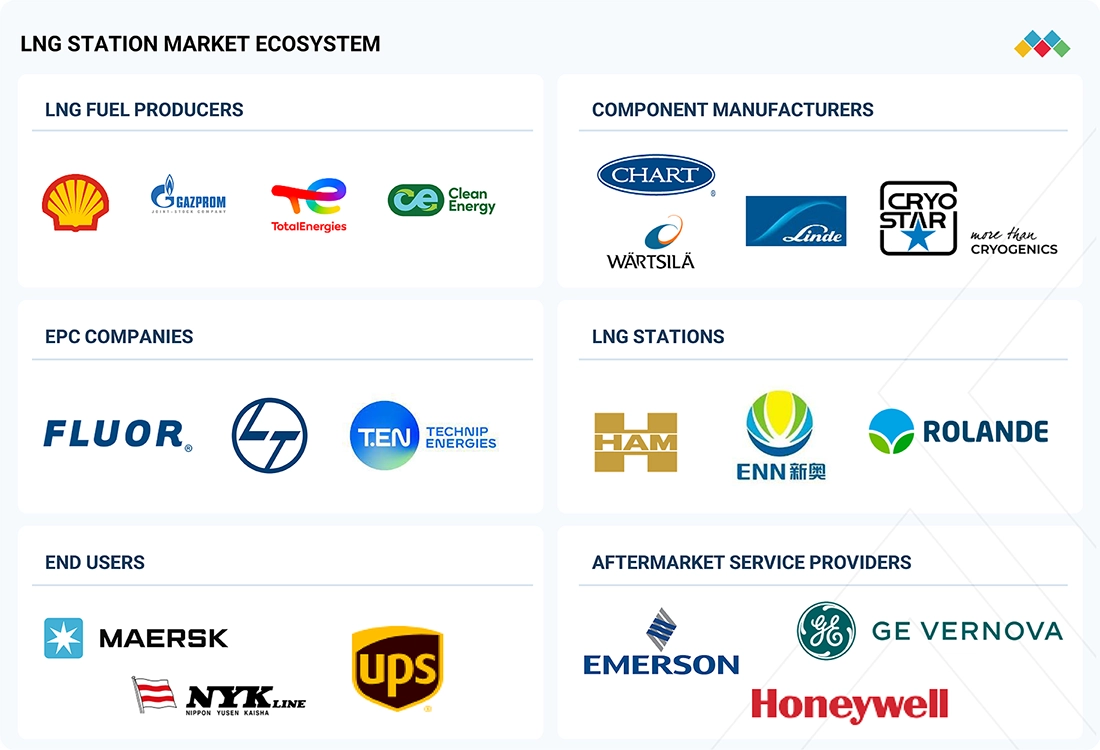
LNG Station Market: COMMERCIAL USE CASES ACROSS INDUSTRIES
| COMPANY | USE CASE DESCRIPTION | BENEFITS |
|---|---|---|
 |
A Major Energy Company wanted to design and build selective LNG fueling stations across the US. To mitigate risk and ensure profitability for the venture, they needed a way to distribute and dispense LNG in the most reliable and cost-effective manner, which could be easily replicated at new fueling station sites as needed, with a low-maintenance piping system. | The partnership between the energy company and Chart Inc. brought significant benefits in operations, economics, and the environment. Vacuum-insulated piping (VIP) systems improved thermal efficiency, cut heat loss by nearly 90%, and extended infrastructure lifespan up to ten times, lowering maintenance and downtime, reducing lifecycle costs, and boosting reliability. Each LNG station now supports up to 150 trucks daily, ensuring scalability and steady performance. Overall, the project created a sustainable, cost-effective fueling network, supporting long-term profitability and promoting cleaner, energy-efficient transportation across the US. |
 |
Cryostar SAS, a pioneer in cryogenic equipment, faced challenges in maintaining high-quality project deliverables, streamlining modification processes, and integrating components like process, piping, instrumentation, and structure in power and gas liquefaction projects. The company aimed to improve time management, support 3D piping models, and enhance engineering coordination. To stay a leader in clean energy and cryogenics, Cryostar required a fully integrated engineering and data management solution to improve accuracy and reduce costly rework. | The adoption of integrated engineering and data management solutions gave LNG station operators operational advantages by enabling real-time coordination, automation, and standardized data flow, which minimized errors, reduced manual work, lowered rework and costs, and improved project efficiency and asset performance. These benefits enhanced project delivery, resource use, and competitiveness. |
Logos and trademarks shown above are the property of their respective owners. Their use here is for informational and illustrative purposes only.
Related Ecosystem
Energy Storage
- Energy Harvesting
- HVAC System
- Applicant Tracking System
- Battery Electric Vehicle (BEV)
- Carboxymethyl Cellulose (CMC)
- MOMENTIVE PERFORMANCE MATERIALS INC.
- Panasonic Holdings Corporation
- ABB India Limited
- Lg corp
- FDK Corporation
Power Infrastructure
- Geographical Information System (GIS)
- Cogeneration
- Battery Electric Vehicle (BEV)
- Cellular Network
- Fuel Cell
- Siemens ag
- ABB India Limited
- SCHNEIDER ELECTRIC SE
- General Electric Company
- Eaton Corporation plc
Key Takeaways
- Sweden's LNG station market is valued at $15.4 million in 2025 and is forecast to reach $29.9 million by 2030, representing a 14.2% CAGR.
- Sweden's growth rate substantially exceeds the global LNG station market CAGR of 9%, driven by strong environmental policies and infrastructure investment.
- Sweden's LNG infrastructure expansion supports the nation's decarbonization targets and positions it as a regional energy transition leader.
- Sweden's strategic location and regulatory framework make it an attractive market for LNG station operators and alternative fuel adoption.
LNG Station Market Report Scope
| Report Metric | Details |
|---|---|
| Base Year | 2025 |
| Fastest Growing Segment | MARINE (Application) |
| Forecast Period | 2025–2030 |
| Growth Rate | CAGR of 9% from 2025 to 2030 |
| Largest Segment | HEAVY-DUTY VEHICLES (Application) |
| Market Size Base Year (Billions) | ~USD 1.01 (2025) |
| Revenue Forecast (Billions) | ~USD 1.56 (2030) |
| Segments Covered | Station Type, Solution, Capacity, Application |
Sweden LNG Station Market Report Segmentation
4 segment dimensions are covered across the global market.
By Station Type
- Bunkering Lng Station
- Fixed Lng Station
- Mobile Lng Station
By Solution
- Components
- Engineering, Procurement, And Construction (Epc)
- Epc
By Capacity
- Large Scale
- Medium Scale
- Small Scale
By Application
- Heavy-Duty Vehicle
- Heavy-Duty Vehicles
- Light-Duty Vehicle
- Light-Duty Vehicles
- Marine
SWEDEN: LNG STATION MARKET, BY APPLICATION, 2025–2030
| Segment | 2025 | 2026 | 2027 | 2028 | 2029 | 2030 | CAGR (%) |
|---|---|---|---|---|---|---|---|
| HEAVY-DUTY VEHICLES | 12.51 | 13.9 | 15.69 | 17.92 | 20.58 | 23.85 | 13.8 |
| LIGHT-DUTY VEHICLES | 1.56 | 1.73 | 1.96 | 2.24 | 2.57 | 2.99 | 13.9 |
| MARINE | 1.31 | 1.52 | 1.78 | 2.11 | 2.52 | 3.02 | 18.1 |
| TOTAL | 15.38 | 17.15 | 19.43 | 22.27 | 25.67 | 29.85 | 14.2 |
Target Audience
- Energy & Utility Companies : Swedish and international energy providers need market intelligence to plan LNG station investments, assess competitive positioning, and capitalize on Sweden's 14.2% growth opportunity.
- Transportation & Logistics Operators : Fleet operators and logistics companies require data on LNG refueling infrastructure expansion to optimize supply chain operations and meet Sweden's decarbonization mandates.
- Government & Policy Makers : Swedish government agencies and regional authorities need market insights to inform infrastructure planning, allocate resources, and evaluate progress toward climate neutrality targets.
- Investment & Financial Institutions : Private equity firms, venture capital, and institutional investors seek Sweden-specific market data to identify high-growth investment opportunities in the alternative fuel sector.
- Technology & Equipment Providers : LNG equipment manufacturers and technology vendors need market forecasts and infrastructure development plans to align product offerings with Sweden's expanding station network.
Key Companies in the Sweden LNG Station Market
| Company | HQ | Ownership | Strongest segments |
|---|---|---|---|
| CNPC | China | Private Company | Upstream oil and gas production,Refining and petrochemicals,Natural gas marketing and pipelines, |
| SHELL PLC | United Kingdom | Public Company | Integrated Gas (including LNG and GTL),Upstream (oil, gas, NGLs),Marketing (mobility, lubricants, commercial fuels, EV charging), |
| CHART INDUSTRIES | United States | Public Company | Cryo Tank Solutions (bulk, microbulk, mobile, LNG virtual pipeline, large storage),Heat Transfer Systems (brazed aluminum, cold boxes, air-cooled exchangers),Specialty Products (hydrogen, water treatment, niche process equipment), |
| GRUPO HAM | Spain | Private Company | LNG Refuelling Stations (Design, Build, Operate),CNG/Bio-CNG Stations and Equipment,Small-Scale LNG & Industrial Gas Solutions, |
| CLEAN ENERGY FUELS | United States | Public Company | RNG fuel and environmental credits,CNG/LNG fuel (non-RNG),Station design, build, operate, and maintenance services, |
| INDIAN OIL CORPORATION LTD | India | Public Company | Sale of Petroleum Products,Sale of Gas,Sale of Petrochemicals, |
| INOX INDIA LIMITED | India | Public Company | Standard cryogenic storage and transport tanks (industrial gas, LNG, LCNG),Cryogenic systems, vaporizers, piping, and turnkey project execution,Specialty cryogenic equipment (bio-series, low-pressure tanks, cylinders), |
| BHARAT PETROLEUM CORPORATION LIMITED | India | Public Company | Retail motor fuels (MS, HSD, blended fuels, CNG/LNG, AutoLPG),LPG (Bharatgas – domestic, commercial, metal cutting),Lubricants (MAK automotive and industrial), |
CNPC
CNPC is a private Chinese oil and gas company founded in 1955 with 30,173 employees. It operates as one of China's major energy enterprises.
SHELL PLC
Shell PLC is a public multinational energy company headquartered in the United Kingdom, founded in 1897 with 84,000 employees. It is a leading global oil and gas producer.
CHART INDUSTRIES
Chart Industries is a public American company founded in 1859 with 11,777 employees. It specializes in industrial equipment and cryogenic technology.
GRUPO HAM
Grupo HAM is a private Spanish company founded in 1980. It operates in the energy sector.
CLEAN ENERGY FUELS
Clean Energy Fuels is a public American company founded in 2001 with 503 employees. It provides alternative fuel solutions and infrastructure.
INDIAN OIL CORPORATION LTD
Indian Oil Corporation Ltd is a public Indian company founded in 1959 with 29,941 employees. It is a major integrated energy company in India.
INOX INDIA LIMITED
Inox India Limited is a public Indian company founded in 1976 with 752 employees. It operates in the energy and industrial equipment sector.
BHARAT PETROLEUM CORPORATION LIMITED
Bharat Petroleum Corporation Limited is a public Indian company founded in 1952 with 8,747 employees. It is a major petroleum and energy company in India.
Reasons to Buy this Report
- Market-Specific Growth Data : Access detailed projections showing Sweden's LNG market expanding from $15.4M to $29.9M by 2030, with country-specific CAGR analysis that outperforms global benchmarks.
- Regulatory & Policy Landscape : Understand Sweden's unique regulatory framework, EU compliance requirements, and national climate policies driving LNG station investments and infrastructure development decisions.
- Competitive Positioning Strategy : Identify key market players, investment opportunities, and competitive dynamics specific to Sweden's LNG sector to inform market entry and expansion strategies.
- Infrastructure Development Roadmap : Gain insights into planned LNG station locations, capacity expansions, and logistics corridor developments across Sweden's major transportation and industrial regions.
- Investment & Partnership Opportunities : Discover funding mechanisms, government incentives, and strategic partnership opportunities tailored to Sweden's energy transition priorities and infrastructure modernization goals.
Frequently asked questions
What is the current size of Sweden's LNG station market?
Sweden's LNG station market was valued at $15.4 million in 2025 and is expected to grow to $29.9 million by 2030.
What is the projected growth rate for Sweden's LNG station market?
Sweden's LNG station market is projected to grow at a compound annual growth rate (CAGR) of 14.2% from 2025 to 2030.
How does Sweden's LNG market growth compare to global trends?
Sweden's 14.2% CAGR significantly outpaces the global LNG station market CAGR of 9%, reflecting stronger regional demand and policy support.
What factors are driving growth in Sweden's LNG station market?
Sweden's LNG market growth is driven by environmental regulations, decarbonization commitments, increased adoption in maritime and transport sectors, and strategic infrastructure investment.
Why is Sweden an important market for LNG stations?
Sweden's commitment to sustainability, Nordic leadership in energy transition, and strategic geographic position make it a key hub for LNG infrastructure development in Northern Europe.
RESEARCH METHODOLOGY
The study involved major activities in estimating the current size of the LNG station market. Exhaustive secondary research was done to collect information on the peer and parent markets. The next step was to validate these findings, assumptions, and sizing with industry experts across the value chain through primary research. Both top-down and bottom-up approaches were employed to estimate the complete market size. Thereafter, market breakdown and data triangulation were used to estimate the market size of the segments and subsegments.
Secondary Research
The secondary sources referred to for this research study include annual reports, press releases, investor presentations of companies, white papers, certified publications, articles from recognized authors, and databases of various companies and associations. Secondary research was mainly used to obtain key information about the industry’s supply chain, the market’s monetary chain, the total pool of key players, market classification and segmentation according to industry trends to the bottom-most level, regional markets, and key developments from both market- and technology-oriented perspectives.
Primary Research
In the primary research process, various primary sources from both the supply and demand sides were interviewed to obtain qualitative and quantitative information for this report. Primary sources from the supply side include industry experts, such as CEOs, vice presidents, marketing directors, technology & innovation directors, and related key executives from various companies and organizations operating in the LNG station market.
In the complete market engineering process, both top-down and bottom-up approaches were extensively used, along with several data triangulation methods, to perform market estimation and market forecasts for the overall market segments and subsegments listed in this report. Extensive qualitative and quantitative analysis was conducted on the complete market engineering process to list key information/insights throughout the report.
The following is the breakdown of primary respondents:
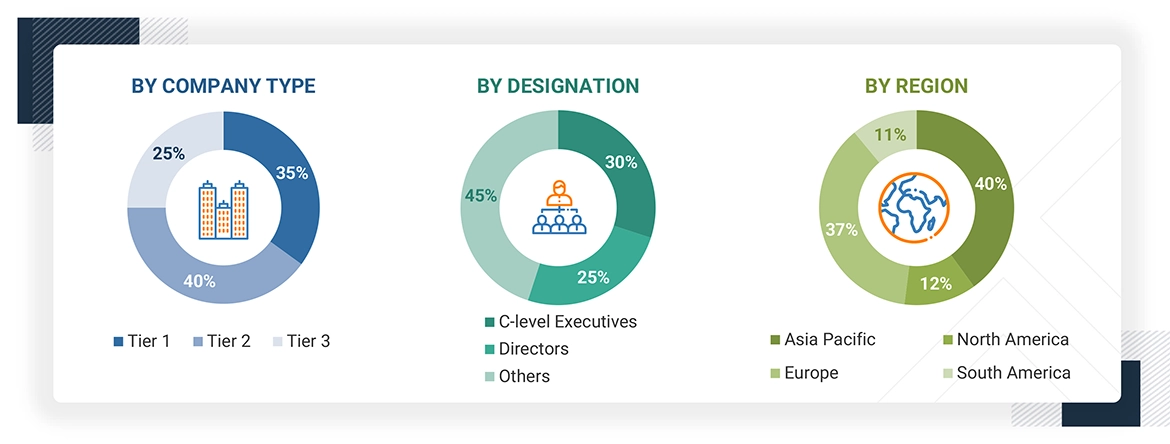
Note 1: Others include sales managers, marketing managers, and product managers.
Note 2: Tier 1 companies’ revenues are more than USD 10 billion; tier 2 companies’ revenues range between USD 1 and 10 billion; and tier 3 companies’ revenues range between USD 500 million and USD 1 billion.
Source: Industry Experts
To know about the assumptions considered for the study, download the pdf brochure
Market Size Estimation
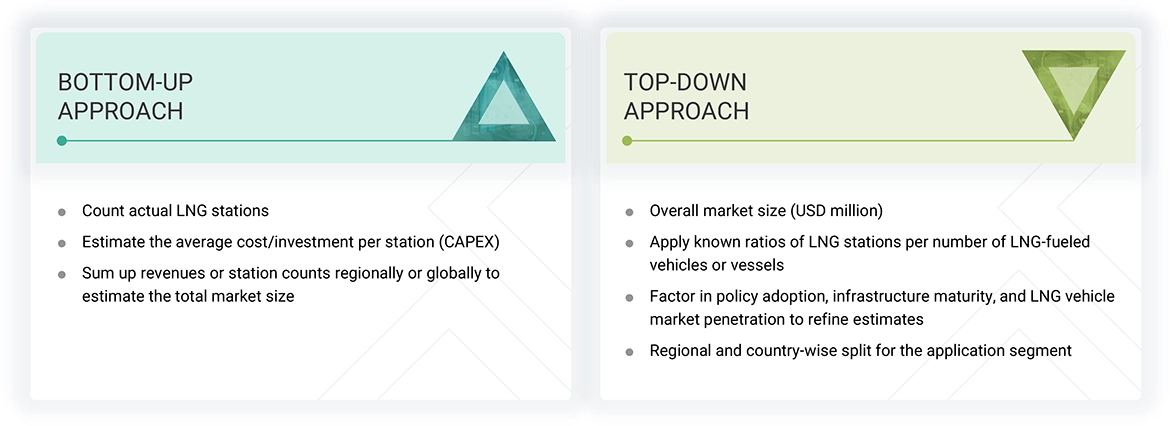
The top-down and bottom-up approaches were used to estimate and validate the size of the global LNG station market and to evaluate the sizes of various other dependent submarkets. The key players in the market were identified through secondary research, and their shares in the respective regions were determined through primary and secondary research. This entire procedure included the study of annual and financial reports of top market players and extensive interviews for key insights with industry leaders such as CEOs, VPs, directors, and marketing executives. All percentage shares, splits, and breakdowns were determined using secondary sources and verified through primary sources. All possible parameters that affect the markets covered in this research study were accounted for, viewed in extensive detail, verified through primary research, and analyzed to get the final quantitative and qualitative data.
LNG Station Market : Top-Down and Bottom-Up Approach
Data Triangulation
After arriving at the overall market size from the estimation process explained below, the total market was split into several segments and subsegments. Wherever applicable, the data triangulation and market breakdown procedures were employed to complete the overall market engineering process and arrive at the exact statistics for all the segments and subsegments. The data was triangulated by studying various factors and trends from both the demand and supply sides.
Market Definition
An LNG station is a facility that stores and dispenses liquefied natural gas, which is natural gas cooled to approximately -260°F (-162°C) to convert it into a liquid state. This liquefaction process reduces the gas's volume by about 600 times, facilitating easier storage and transportation. LNG stations are integral in supplying fuel for vehicles and ships equipped to run on LNG, contributing to reduced greenhouse gas emissions compared to conventional fuels.
The LNG station market is defined as the sum of revenues generated by the year-on-year installation of LNG stations across three regions.
Stakeholders
- LNG terminal operators
- Engineering, procurement, and construction (EPC) companies
- National and regional governments/Regulators
- LNG suppliers/Producers
- Shipping and logistics companies
- National oil and gas companies
- Consulting companies in the oil & gas industry
- Oil and gas associations
Report Objectives
- To define, describe, segment, and forecast the LNG station market by station type, application, solution, and capacity in terms of value
- To define, describe, segment, and forecast the LNG station market, by station type and region, in terms of volume
- To forecast the market sizes for three major regions, namely North America, Europe, and Asia Pacific, along with their key countries, in terms of value, whereas the rest of the world region will provide qualitative insights
- To provide detailed information regarding key drivers, restraints, opportunities, and challenges influencing the growth of the LNG station market
- To provide the supply chain analysis, trends/disruptions impacting customer business, ecosystem analysis, regulatory landscape, patent analysis, case study analysis, technology analysis, key conferences & events, the impact of AI/Gen AI, macroeconomic outlook, pricing analysis, Porter’s five forces analysis, regulatory analysis, and the impact of the 2025 US tariff on the market
- To analyze opportunities for stakeholders in the LNG station market and draw a competitive landscape of the market
- To benchmark market players using the company evaluation matrix, which analyzes market players on broad categories of business and product strategies adopted by them
- To compare key market players for the market share, product specifications, and applications
- To strategically profile key players and comprehensively analyze their market ranking and core competencies
- To analyze competitive developments, such as contracts, agreements, partnerships, and joint ventures, in the LNG station market
Available Customizations
MarketsandMarkets offers customizations according to the specific needs of the companies with the given market data.
The following customization options are available for the report:
Product Analysis
- Product matrix, which gives a detailed comparison of the product portfolio of each company
Geographic Analysis as per Feasibility
- Further breakdown of the LNG station market, by country, for Europe, Asia Pacific, and North America
Company Information
- Detailed analysis and profiling of additional market players (up to five)
Get the Full LNG Station Market Report
Full forecast, segment splits, and company analysis for all LNG Station Market.
- US LNG Station Market
- Canada LNG Station Market
- Germany LNG Station Market
- France LNG Station Market
- UK LNG Station Market
- Spain LNG Station Market
- Italy LNG Station Market
- Netherlands LNG Station Market
- Poland LNG Station Market
- Finland LNG Station Market
- Belgium LNG Station Market
- Norway LNG Station Market
- Portugal LNG Station Market
- China LNG Station Market
- Japan LNG Station Market
- India LNG Station Market
- Rest Of Europe LNG Station Market
Need a Tailored Report?
Customize this report to your needs
Get 10% FREE Customization
Customize This Report
