
US LNG Terminals Market (2025-2030)

The US LNG Terminals Market was valued at $750.5 Million in 2025 and projected to reach to $1265.9 Million by 2030, representing a compound annual growth rate of 11.0%. The US LNG Terminals Market is poised for sustained growth through 2030, driven by increasing global demand for liquefied natural gas and the nation's competitive advantages in production and export infrastructure.


| Market Size in | USD 26.32 MN |
| Market Forecast in | |
| CAGR | |
| Forecast Period | |
| Units Considered | Value (USD MN) |
US LNG Terminals Market Trends and Insights
- The US has emerged as a critical hub for liquefied natural gas infrastructure, driven by rising global demand for cleaner energy and strategic energy security initiatives.
- In 2025, the US LNG terminal sector benefits from established export capacity and ongoing investments in regasification and liquefaction facilities. By 2030, the US market is expected to capture significant value through capacity expansions and new terminal developments.
- The US continues to strengthen its position as a leading LNG exporter, supported by abundant domestic natural gas reserves and favorable regulatory frameworks.
- Growth in the US LNG Terminals Market reflects increasing international demand, particularly from Asia-Pacific and European markets seeking reliable LNG supply sources.
- The US infrastructure modernization and technological advancements in terminal operations are key factors sustaining this upward trajectory through the forecast period..
Key Market Statistics
- CAGR (2025-2030) 11.0% CAGR
- Market Size, 2025 ~USD 750.5 Million
- Forecast, 2030 ~USD 1265.9 Million
- Country US
US LNG Terminals Market Overview
Market Valuation & Growth :
The US LNG Terminals Market is valued at $750.5 million in 2025 and is projected to reach $1,265.9 million by 2030, demonstrating an 11% CAGR. This growth trajectory reflects the US's strategic position as a global LNG export leader and increasing domestic infrastructure investments.
Global Energy Security Driver :
The US has become a critical hub for liquefied natural gas infrastructure, supporting global energy security initiatives. American LNG terminals are essential for meeting international demand, particularly from European and Asian markets seeking alternatives to traditional energy sources.
Cleaner Energy Transition :
Rising global demand for cleaner energy solutions is propelling US LNG terminal expansion. Natural gas serves as a bridge fuel in the energy transition, with US terminals positioned to capitalize on the shift away from coal and toward lower-carbon energy sources.
Strategic Infrastructure Development :
US LNG terminal capacity expansion is driven by strategic energy security initiatives and geopolitical considerations. New terminal projects and capacity upgrades are underway to enhance export capabilities and strengthen America's energy independence and global influence.
US LNG Terminals Market Dynamics
- Strategic investments in terminal capacity, coupled with favorable regulatory environments and technological advancements, will support market expansion.
- The US is expected to maintain its position as a leading LNG exporter, benefiting from geopolitical shifts and energy security concerns worldwide. Future growth will be underpinned by rising LNG consumption in Asia-Pacific and Europe, as well as domestic demand for natural gas infrastructure modernization.
- Emerging opportunities in small-scale LNG terminals and regasification facilities will diversify revenue streams.
- However, market dynamics will be influenced by commodity price fluctuations, regulatory changes, and competition from other global LNG suppliers, requiring continuous innovation and operational efficiency improvements..
Market Ecosystem
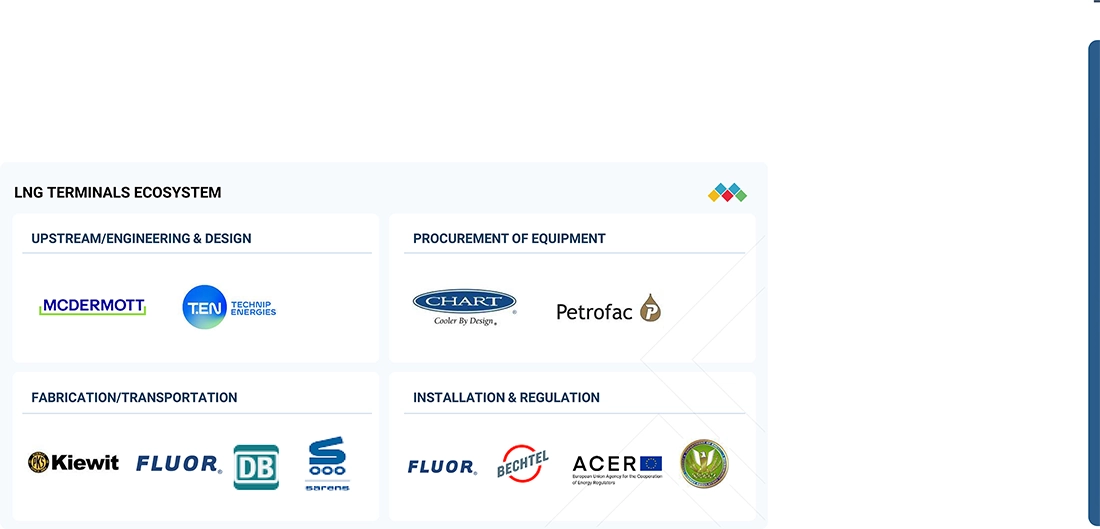
LNG Terminals Market: COMMERCIAL USE CASES ACROSS INDUSTRIES
| COMPANY | USE CASE DESCRIPTION | BENEFITS |
|---|---|---|
 |
The Yamal LNG project (16.5 MTPA) in the Arctic faced challenges such as sub-zero temperatures, unstable permafrost, and difficult logistics. Technip Energies used modular construction, Arctic-class vessels, and advanced ground stabilization to overcome these hurdles. | The project achieved zero safety incidents, adhered to strict environmental standards, and was delivered ahead of schedule. It set new benchmarks for Arctic LNG development and engineering excellence. |
 |
Petronet LNG expanded the Dahej Terminal from 5 to 17.5 MMTPA to meet India’s surging gas demand, addressing infrastructure bottlenecks and efficiency challenges. Upgrades included new storage tanks, a second jetty, and improved connectivity. | The expansion enhanced operational efficiency, safety, and supply reliability, supporting India’s clean energy goals and ensuring LNG import resilience in the growing natural gas market. |
Logos and trademarks shown above are the property of their respective owners. Their use here is for informational and illustrative purposes only.
Related Ecosystem
Decarbonization
- Battery Electric Vehicle (BEV)
- Energy Management Systems
- Fuel Cell
- Fuel Cell Electric Vehicle (FCEV)
- Geographical Information System (GIS)
- TotalEnergies SE
- Siemens ag
- Mitsui & Co., Ltd.
- General Electric Company
- Thyssenkrupp ag
Key Takeaways
- The US LNG Terminals Market is valued at $750.5 million in 2025 and is projected to reach $1,265.9 million by 2030, growing at an 11.0% CAGR.
- The US maintains a dominant position as a global LNG exporter, leveraging abundant natural gas reserves and advanced terminal infrastructure.
- Increasing international demand from Asia-Pacific and Europe is driving expansion of US LNG terminal capacity and investment.
- The US LNG Terminals Market growth is supported by regulatory support, technological innovation, and strategic energy security priorities.
LNG Terminals Market Report Scope
| Report Metric | Details |
|---|---|
| Base Year | 2025 |
| Fastest Growing Segment | IMPORT (Function) |
| Forecast Period | 2025–2030 |
| Growth Rate | CAGR of 10.9% from 2025 to 2030 |
| Largest Segment | EXPORT (Function) |
| Market Size Base Year (Billions) | ~USD 7.84 (2025) |
| Revenue Forecast (Billions) | ~USD 13.15 (2030) |
| Segments Covered | Terminal Type, Capacity, Technology, Function, Technology Type, Application |
US LNG Terminals Market Report Segmentation
6 segment dimensions are covered across the global market.
By Terminal Type
- Floating
- Onshore
By Capacity
- Large Scale Terminals (>5 Mtpa)
- Large-Scale (>5 Mtpa)
- Medium Scale Terminals (1–5 Mtpa)
- Medium-Scale (1–5 Mtpa)
- Small Scale Terminals (<1 Mtpa)
- Small-Scale (<1 Mtpa)
By Technology
- Liquefaction
- Regasification
By Function
- Bifunctional
- Export
- Import
By Technology Type
- Air-Cooled
- Hybrid
- Liquefaction
- Regasification
- Seawater-Cooled
By Application
- Floating
- Onshore
Target Audience
- Energy Infrastructure Investors : Investment firms and private equity groups evaluating LNG terminal projects in the US require detailed market sizing, growth forecasts, and ROI analysis to make informed capital allocation decisions and identify high-value investment opportunities.
- LNG Terminal Operators & Developers : Existing and prospective LNG terminal operators need competitive intelligence, capacity utilization benchmarks, and market trend analysis to optimize operations, plan expansions, and maintain competitive advantage in the US market.
- Energy & Utilities Companies : Major energy corporations and utility providers require US LNG market data to inform supply chain strategies, procurement decisions, and long-term energy portfolio planning aligned with global demand trends.
- Government & Policy Makers : Federal and state government agencies, energy departments, and regulatory bodies need market intelligence to develop energy security policies, infrastructure development strategies, and regulatory frameworks supporting US LNG sector growth.
- Technology & Service Providers : Equipment manufacturers, engineering firms, and service providers serving the LNG sector need market insights to identify growth opportunities, develop targeted solutions, and align product development with US terminal infrastructure requirements.
Key Companies in the US LNG Terminals Market
| Company | HQ | Ownership | Strongest segments |
|---|---|---|---|
| TECHNIP ENERGIES N.V. | France | Public Company | Liquefaction Technology and Export Terminals,Regasification and Import Terminals,Bifunctional and iLNGP-type Integrated Terminals, |
| SAMSUNG C&T CORPORATION | South Korea | Public Company | Liquefaction Technology,Regasification Technology,Import Function Terminals, |
| JGC HOLDINGS CORPORATION | Japan | Public Company | Liquefaction Technology – Export Onshore (Medium & Large-scale),Regasification – Import Onshore (Small & Medium-scale),Bifunctional / Integrated LNG Hubs, |
| SAIPEM SPA | Italy | Public Company | Liquefaction Technology – Export Terminals (Onshore, Large-scale),Regasification – Import Terminals (Onshore, Medium/Large-scale),Floating Terminals (FSRU, FLNG-related scopes), |
| CTCI | Taiwan | Public Company | Onshore Regasification / Import Terminals,Onshore Liquefaction / Export Terminals,Floating Terminals (FSRU/FLNG-related scopes), |
| KBR INC. | United States | Public Company | Liquefaction Technology and Engineering,Regasification and Import Terminal Services,Onshore Terminal Project Delivery and Optimization, |
| VINCI | France | Public Company | Liquefaction Technology / Export Terminals,Regasification / Import Terminals,Floating LNG and FSRU-related Infrastructure, |
| WORLEY | Australia | Public Company | Liquefaction terminal services,Regasification terminal services,Onshore terminals, |
| CHIYODA CORPORATION | Japan | Public Company | Liquefaction Technology / Export Terminals,Regasification / Import Terminals,Floating LNG / FSRU-related scopes, |
| HYUNDAI E&C | South Korea | Public Company | Onshore Regasification Terminals (Import/Bifunctional),Onshore Liquefaction and Export-Linked Infrastructure,Floating LNG/FSRU-Linked Works, |
| FLUOR CORPORATION | United States | Public Company | Liquefaction Technology,Regasification Technology,Onshore Terminals, |
| AKER SOLUTIONS | Norway | Public Company | Liquefaction Technology & EPC Scope,Regasification & Receiving Facilities,Onshore Import Terminals, |
| JOHN WOOD GROUP PLC | United Kingdom | Private Company | Liquefaction Technology,Regasification Technology,Onshore Terminals, |
| IHI CORPORATION | Japan | Public Company | Regasification terminals (onshore import and bifunctional),Liquefaction-related export terminal infrastructure,Onshore terminal EPC and tanks, |
TECHNIP ENERGIES N.V.
TECHNIP ENERGIES N.V. is a French public company founded in 2019 with 18,000 employees, specializing in engineering and project delivery services.
SAMSUNG C&T CORPORATION
SAMSUNG C&T CORPORATION is a South Korean public company established in 1938 with 7,891 employees, operating across construction, trading, and engineering sectors.
JGC HOLDINGS CORPORATION
JGC HOLDINGS CORPORATION is a Japanese public company founded in 1928 with 8,154 employees, engaged in engineering, procurement, and construction activities.
SAIPEM SPA
SAIPEM SPA is an Italian public company established in 1957 with 30,000 employees, specializing in offshore drilling, engineering, and construction services.
CTCI
CTCI is a Taiwanese public company founded in 1979 with 7,060 employees, providing engineering and construction services.
KBR INC.
KBR INC. is a U.S. public company founded in 1901 with 36,000 employees, offering engineering, procurement, construction, and government services.
VINCI
VINCI is a French public company established in 1899 with 292,101 employees, operating as a major player in construction, concessions, and related services.
WORLEY
WORLEY is an Australian public company founded in 1971 with 38,224 employees, providing engineering and project delivery services globally.
CHIYODA CORPORATION
CHIYODA CORPORATION is a Japanese public company established in 1948 with 3,489 employees, specializing in engineering and construction services.
HYUNDAI E&C
HYUNDAI E&C is a South Korean public company founded in 1947 with 4,654 employees, engaged in engineering and construction activities.
FLUOR CORPORATION
FLUOR CORPORATION is a U.S. public company established in 1912 with 22,995 employees, providing engineering, procurement, construction, and maintenance services.
AKER SOLUTIONS
AKER SOLUTIONS is a Norwegian public company founded in 1841 with 11,731 employees, offering engineering and technology solutions.
JOHN WOOD GROUP PLC
JOHN WOOD GROUP PLC is a privately held U.K. company founded in 1961 with 35,000 employees, providing engineering and professional services.
IHI CORPORATION
IHI CORPORATION is a Japanese public company established in 1853 with 26,224 employees, operating in engineering, construction, and industrial sectors.
Reasons to Buy this Report
- Market Size & Growth Validation : Obtain precise valuation data for the US LNG Terminals Market ($750.5M in 2025) with verified 11% CAGR projections through 2030. Validate investment decisions and strategic planning with authoritative market sizing and forecasting specific to the American LNG sector.
- Competitive Landscape Intelligence : Gain comprehensive insights into US LNG terminal operators, capacity utilization rates, and competitive positioning. Understand market share distribution, emerging players, and strategic partnerships shaping the US LNG infrastructure landscape.
- Investment & Expansion Opportunities : Identify high-potential investment opportunities in US LNG terminal development, capacity expansion, and modernization projects. Access detailed analysis of capital requirements, ROI projections, and risk assessments for terminal infrastructure investments.
- Regulatory & Policy Framework : Navigate US regulatory requirements, permitting processes, and policy drivers affecting LNG terminal operations. Understand federal and state-level regulations, environmental compliance standards, and strategic energy policies influencing market dynamics.
- Strategic Market Positioning : Benchmark your organization against US market trends and competitor strategies. Develop data-driven market entry, expansion, or partnership strategies based on comprehensive analysis of US LNG terminal market dynamics and growth drivers.
Frequently asked questions
What is the current size of the US LNG Terminals Market in 2025?
The US LNG Terminals Market is valued at $750.5 million in 2025, reflecting the established infrastructure and export capacity within the country.
What is the projected market size for the US LNG Terminals Market by 2030?
The US LNG Terminals Market is forecast to reach $1,265.9 million by 2030, representing significant growth over the five-year period.
What is the CAGR for the US LNG Terminals Market?
The US LNG Terminals Market is expected to grow at a compound annual growth rate of 11.0% from 2025 to 2030.
What factors are driving growth in the US LNG Terminals Market?
Growth in the US LNG Terminals Market is driven by rising global LNG demand, abundant domestic natural gas reserves, regulatory support, and technological advancements in terminal operations.
Which regions are the primary export destinations for US LNG?
The US LNG Terminals Market serves major export destinations including Asia-Pacific and European markets, which are seeking reliable and diversified LNG supply sources.
RESEARCH METHODOLOGY
The study involved major activities in estimating the current size of the LNG terminals market. Exhaustive secondary research was done to collect information on the peer and parent markets. The next step was to validate these findings, assumptions, and sizing with industry experts across the value chain through primary research. The top-down and bottom-up approaches were employed to estimate the total market size. Thereafter, market breakdown and data triangulation techniques were used to estimate the market size of the segments and subsegments.
Secondary Research
This research study on the LNG terminal market involved the use of extensive secondary sources, directories, and databases, such as Hoover’s, Bloomberg, Factiva, IRENA, International Energy Agency, and Statista Industry Journal, to collect and identify valuable information for a technical, market-oriented, and commercial study of the market. The other secondary sources included annual reports, press releases, and investor presentations of companies; white papers; certified publications; and articles by recognized authors, manufacturer associations, trade directories, and databases.
Primary Research
The LNG market comprises several stakeholders, such as engineering and design providers, equipment procurement providers, and transportation and logistics providers in the supply chain. The rising demand for onshore and floating LNG terminal types characterizes the demand side of this market. The supply side is characterized by prominent players' increasing focus on securing contracts from industrial players. Various primary sources from the supply and demand sides of the market were interviewed to obtain qualitative and quantitative information. The following is the breakdown of primary respondents.
In the complete market engineering process, the top-down and bottom-up approaches and several data triangulation methods were extensively used to perform the market size estimations and forecasts for all segments and subsegments listed in this report. Extensive qualitative and quantitative analyses were conducted to complete the market engineering process and list key information/insights throughout the report.
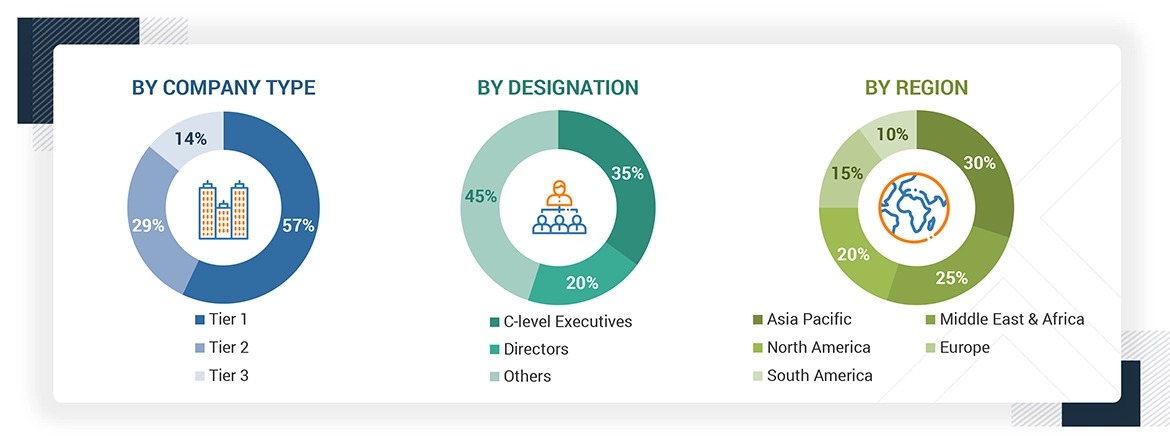
Note: The tiers of the companies are defined based on their total revenues as of 2024. Tier 1: >
USD 1 billion, Tier 2: USD 500 million to USD 1 billion, and Tier 3: < USD 500 million. Others include
sales managers, engineers, and regional managers.
To know about the assumptions considered for the study, download the pdf brochure
Market Size Estimation
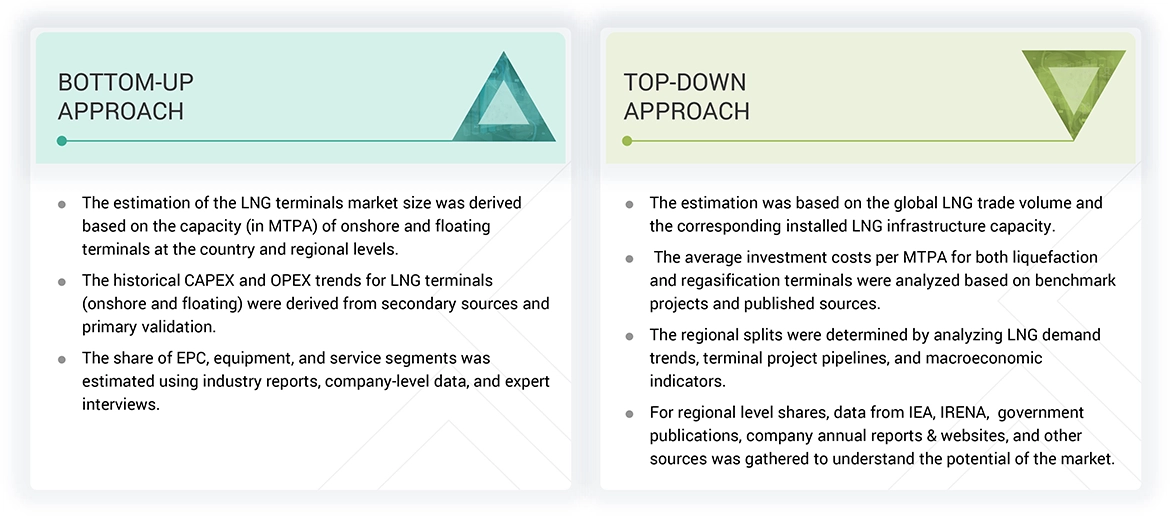
The top-down and bottom-up approaches were used to estimate and validate the total size of the LNG terminal market. These methods were also used extensively to estimate the size of various subsegments in the market. The research methodology used to estimate the market size includes the following.
LNG Terminals Market : Top-Down and Bottom-Up Approach
Data Triangulation
The total market was split into several segments and subsegments after arriving at the overall market size from the above estimation process. Data triangulation and market breakdown processes were employed to complete the overall market engineering process and arrive at the exact statistics for all the segments and subsegments, wherever applicable. The data was triangulated by studying various factors and trends from the demand and supply sides. In addition, the market size was validated using both the top-down and bottom-up approaches.
Market Definition
The LNG terminals market encompasses the global industry involved in planning, developing, constructing, operating, and commercializing liquefied natural gas (LNG) infrastructure used for import and export purposes. LNG terminals are critical components of the LNG supply chain, enabling the efficient transportation and distribution of natural gas by facilitating its liquefaction for shipment and regasification for end use. Export terminals convert natural gas into its liquid form for easier storage and transport, while import terminals revert LNG to its gaseous state for distribution into domestic pipelines and consumption markets.
Stakeholders
- LNG terminal operators
- Engineering, procurement, and construction (EPC) companies
- National and regional governments/regulators
- LNG suppliers/producers
- Shipping and logistics companies
- National oil & gas companies
- Consulting companies of oil & gas industry
- Oil & gas associations
- Government and research organizations
- State and national regulatory authorities
Report Objectives
- To define, describe, and forecast the LNG terminals market based on technology, terminal type, function, capacity, and region, in terms of value
- To define, describe, and forecast the market based on function, in terms of volume
- To forecast the market size across five key regions, namely, North America, Europe, Asia Pacific, the Middle East & Africa, and South America, in terms of value
- To provide detailed information about the key drivers, restraints, opportunities, and industry-specific challenges influencing the growth of the market
- To strategically analyze the LNG terminal market with respect to individual growth trends, prospects, and contributions of each segment to the market
- To provide information pertaining to the supply chain, trends/disruptions impacting customer business, and the regulatory landscape related to the market
- To strategically analyze the micromarkets with respect to individual growth trends, upcoming expansions, and their contributions to the overall market
- To analyze opportunities for stakeholders in the LNG terminal market and draw a competitive landscape for market players
- To benchmark players within the market using the company evaluation quadrant, which analyzes market players on various parameters within the broad categories of business and product strategies
- To strategically profile key players and comprehensively analyze their market ranking and core competencies
- To analyze competitive developments in the market, such as contracts and agreements
Available Customizations
MarketsandMarkets offers customizations according to the specific needs of the companies using the given market data.
The following customization options are available for the report:
Product Analysis
- Product matrix, which gives a detailed comparison of the product portfolio of each company
Geographic Analysis as per Feasibility
- Further breakdown of the LNG terminal market, by country
Company Information
- Detailed analysis and profiling of additional market players (up to five)
Get the Full LNG Terminals Market Report
Full forecast, segment splits, and company analysis for all LNG Terminals Market.
- India LNG Terminals Market
- Australia LNG Terminals Market
- Canada LNG Terminals Market
- Mexico LNG Terminals Market
- Germany LNG Terminals Market
- UK LNG Terminals Market
- France LNG Terminals Market
- Italy LNG Terminals Market
- Qatar LNG Terminals Market
- UAE LNG Terminals Market
- Israel LNG Terminals Market
- South Africa LNG Terminals Market
- Brazil LNG Terminals Market
- Argentina LNG Terminals Market
- Rest Of Europe LNG Terminals Market
- Rest Of Asia Pacific LNG Terminals Market
- GCC Countries LNG Terminals Market
- Rest Of GCC LNG Terminals Market
- Rest Of South America LNG Terminals Market
- China LNG Terminals Market
- Japan LNG Terminals Market
Need a Tailored Report?
Customize this report to your needs
Get 10% FREE Customization
Customize This Report
