
Asia Pacific Loitering Munition Market (2025-2030)

The Asia Pacific Loitering Munition Market was valued at $821.4 Million in 2025 and projected to reach to $2213.5 Million by 2030, representing a compound annual growth rate of 21.9%. The Asia Pacific loitering munition market is positioned for exceptional growth, expanding from USD 821.4 million in 2025 to USD 2,213.5 million by 2030.


| Market Size in | USD 26.32 MN |
| Market Forecast in | |
| CAGR | |
| Forecast Period | |
| Units Considered | Value (USD MN) |
Asia Pacific Loitering Munition Market Trends and Insights
- Asia Pacific's 21.9% compound annual growth rate significantly outpaces global trends, driven by escalating regional tensions, modernization of defense capabilities, and increased investment in autonomous weapon systems across key economies.
- Asia Pacific nations are rapidly adopting loitering munition technologies to enhance tactical flexibility and operational efficiency in contemporary conflict scenarios. Asia Pacific's strategic importance in global defense procurement is reshaping the loitering munition landscape.
- Major regional powers are prioritizing indigenous development and procurement of these systems, supported by government defense budgets and technology partnerships.
- Asia Pacific's geographic diversity, spanning multiple conflict zones and maritime disputes, creates sustained demand for advanced loitering munition platforms.
- The forecast period through 2030 will see Asia Pacific consolidate its position as a critical growth engine for the global loitering munition market..
Key Market Statistics
- CAGR (2025-2030) 21.9% CAGR
- Market Size, 2025 ~USD 821.4 Million
- Forecast, 2030 ~USD 2213.5 Million
- Geography Asia Pacific
Asia Pacific Loitering Munition Market Overview
Exceptional Growth Trajectory :
Asia Pacific's loitering munition market is expanding at 21.9% CAGR, significantly outpacing the global rate of 19.9%, reflecting accelerated defense modernization across the region.
India's Market Leadership :
India dominates Asia Pacific with USD 1,037.5 million in market size, driven by border security concerns, indigenous defense development initiatives, and increased military procurement budgets.
Regional Geopolitical Drivers :
Escalating tensions in the South China Sea, India-Pakistan dynamics, and cross-strait concerns are catalyzing substantial investments in autonomous weapon systems and unmanned strike capabilities.
Emerging Market Opportunities :
Australia (USD 363.2M) and Japan (USD 225.6M) represent high-growth markets with advanced defense ecosystems, while Rest of Asia Pacific (USD 587.3M) offers untapped expansion potential.
Asia Pacific Loitering Munition Market Dynamics
- This 21.9% CAGR reflects intensifying regional security challenges, modernization imperatives among defense forces, and growing adoption of autonomous systems across military applications.
- India's substantial market presence, coupled with Australia and Japan's advanced procurement capabilities, establishes a robust foundation for sustained expansion. Key growth catalysts include border security requirements, naval modernization programs, and technological advancement in unmanned systems.
- Strategic partnerships between regional defense manufacturers and international suppliers are accelerating market penetration.
- Investment in indigenous production capabilities and R&D initiatives across Asia Pacific nations will further drive market dynamics, positioning the region as a critical growth engine for the global loitering munition sector through 2030..
Market Ecosystem
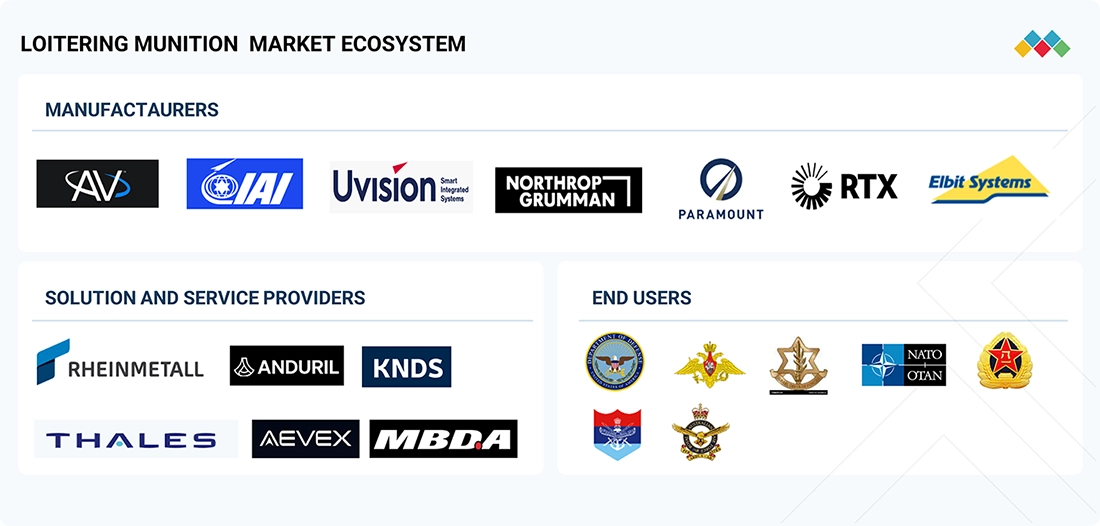
LOITERING MUNITION (KAMIKAZE AND SUICIDE DRONES) MARKET SIZE, SHARE AND GROWTH: COMMERCIAL USE CASES ACROSS INDUSTRIES
| COMPANY | USE CASE DESCRIPTION | BENEFITS |
|---|---|---|
 |
AI-enabled Target Recognition & Loitering Path Optimization for SkyStriker Loitering Munitions | Enhances target accuracy | Reduces strike time | Optimizes mission endurance | Improves lethality effectiveness |
 |
Autonomous Navigation & GNSS-Denied Strike Capability in HAROP and Mini-Harpy Loitering Munitions | Enables precision strikes in electronic warfare environments | Improves survivability | Expands operational flexibility |
 |
Digital Twin-Based Simulation for HERO-series Loitering Munitions to Test Aerodynamics, Payload Efficiency, and AI Strike Algorithms | Reduces testing costs| Improves payload performance | Accelerates product validation | Enhances mission reliability |
 |
Swarm-Based Loitering Munition Coordination for Collaborative Surveillance and Multi-target Engagement | Enables synchronized attacks | Enhances battlefield intelligence | Reduces reaction time | Improves mission success rates |
 |
Real-Time Damage Assessment & Sensor-Fused Battle Monitoring in Switchblade Loitering Drones | Provides live situational awareness | Enables surgical strike decisions | Minimizes collateral damage | Enhances operational precision |
Logos and trademarks shown above are the property of their respective owners. Their use here is for informational and illustrative purposes only.
Related Ecosystem
Key Takeaways
- Asia Pacific loitering munition market valued at USD 821.4 million in 2025, expanding to USD 2,213.5 million by 2030 at 21.9% CAGR
- Asia Pacific's growth rate of 21.9% significantly exceeds the global CAGR of 19.9%, positioning the region as the fastest-growing market segment
- Regional geopolitical tensions and defense modernization initiatives across Asia Pacific are primary catalysts for sustained market expansion through 2030
- Asia Pacific nations are increasingly investing in indigenous loitering munition development and procurement to strengthen autonomous defense capabilities
Loitering Munition Market Report Scope
| Report Metric | Details |
|---|---|
| Base Year | 2025 |
| Fastest Growing Segment | THERMOBARIC WARHEAD (Warhead Type) |
| Forecast Period | 2025–2030 |
| Growth Rate | CAGR of 19.9% from 2025 to 2030 |
| Largest Segment | HIGH-EXPLOSIVE WARHEAD (Warhead Type) |
| Market Size Base Year (Billions) | ~USD 5.35 (2025) |
| Revenue Forecast (Billions) | ~USD 13.26 (2030) |
| Segments Covered | Type, Range, Air Time, Warhead Type, Navsensor, Launch Mode, End User |
Asia Pacific Loitering Munition Market Report Segmentation
7 segment dimensions are covered across the global market.
By Type
- Expendable
- Recoverable
By Range
- Long Range
- Medium Range
- Short Range
By Air Time
- Long Endurance
- Medium Endurance
- Short Endurance
By Warhead Type
- Anti-Armor/Shape-Charged Warhead
- Anti-Radiation Warhead
- Fragmentation Warhead
- High-Explosive Warhead
- Thermobaric Warhead
By Navsensor
- Eo
- Gps/Gnss
- Ins
- Ir/Thermal
- Rf-Based
By Launch Mode
- Air-Launched
- Canister-Launched
- Catapult-Launched
- Hand-Launched
- Vertical Take-Off
By End User
- Air Force
- Army
- Navy
Target Audience
- Defense Contractors & OEMs : Require detailed Asia Pacific market intelligence to identify procurement opportunities, establish regional partnerships, and develop localized product strategies for loitering munition systems and components.
- Government & Military Agencies : Need comprehensive market analysis to benchmark defense spending, evaluate technology options, and inform procurement decisions for autonomous weapon systems across Asia Pacific nations.
- Investment & Private Equity Firms : Seek Asia Pacific market data to identify high-growth defense technology investments, evaluate portfolio companies' competitive positioning, and assess regional expansion opportunities in the loitering munition sector.
- Technology & Component Suppliers : Require market insights to understand regional demand for subsystems, materials, and technologies used in loitering munitions, enabling targeted product development and supply chain optimization.
- Strategic Consultants & Analysts : Need Asia Pacific-specific market data to advise clients on defense sector trends, competitive dynamics, and growth opportunities in the rapidly expanding autonomous weapon systems market.
Key Companies in the Asia Pacific Loitering Munition Market
| Company | HQ | Ownership | Strongest segments |
|---|---|---|---|
| AEROVIRONMENT, INC. | United States | Public Company | Expendable loitering munitions,Recoverable loitering / armed UAS configurations,Counter-UAS and electronic warfare tied to loitering missions, |
| ELBIT SYSTEMS LTD. | Israel | Public Company | Expendable loitering munitions,Recoverable loitering / armed UAS-like systems,Air-launched effects, |
| RHEINMETALL AG | Germany | Public Company | Expendable loitering munitions,Recoverable loitering systems,Ground-launched (catapult, canister, hand-launched), |
| ISRAEL AEROSPACE INDUSTRIES | Israel | Private Company | Expendable loitering munitions,Recoverable loitering/loiter-capable UAS,Launch solutions (canister, catapult, VTOL, ALE kits), |
| THALES | France | Public Company | Expendable loitering munitions,Recoverable loitering / reusable UAV-based concepts,Air Launched Effect loitering systems, |
| NORTHROP GRUMMAN | United States | Public Company | Expendable loitering munitions,Recoverable loitering systems,Air Launched Effect, |
| WB GROUP | Poland | Private Company | Expendable Loitering Munitions,Recoverable / Training Loitering Systems,Air-Launched Effects, |
| STM | Germany | Public Company | Gas springs and dampers for launchers and airframes,Electromechanical opening and actuation systems,Vibration isolation for sensors and guidance units, |
| PARAMOUNT GROUP | United States | Private Investment Firm | Recoverable Loitering Munitions,Expendable Loitering Munitions,Air Launched Effect, |
AEROVIRONMENT, INC.
AeroVironment, Inc. is a United States-based public company founded in 1971 with 4,041 employees. The company operates in the aerospace and defense sector.
ELBIT SYSTEMS LTD.
Elbit Systems Ltd. is an Israeli public company established in 1966 with 20,000 employees. The company operates in the defense and aerospace industries.
RHEINMETALL AG
Rheinmetall AG is a German public company founded in 1889 with 28,815 employees. The company operates in the defense and automotive sectors.
ISRAEL AEROSPACE INDUSTRIES
Israel Aerospace Industries is a privately held Israeli company founded in 1953 with 15,151 employees. The company operates in the aerospace and defense sectors.
THALES
Thales is a French public company founded in 1893 with 82,111 employees. The company operates in the aerospace, defense, and security sectors.
NORTHROP GRUMMAN
Northrop Grumman is a United States-based public company founded in 1939 with 95,000 employees. The company operates in the aerospace and defense sectors.
WB GROUP
WB Group is a Polish private company founded in 1997 with 2,415 employees. The company operates in the defense sector.
STM
STM is a German public company founded in 1934 with 7,314 employees. The company operates in the defense sector.
PARAMOUNT GROUP
Paramount Group is a United States-based private investment firm founded in 1978 with 316 employees. The firm operates in the aerospace and defense sectors.
Countries within Asia Pacific - compare and drill down
| Country | 2025 size (native) |
|---|---|
| India | USD 1037.5 Million |
| Japan | USD 225.6 Million |
| Australia | USD 363.2 Million |
| Rest Of Asia Pacific | USD 587.3 Million |
Country market size visualization
Reasons to Buy this Report
- Regional Market Segmentation : Gain detailed insights into Asia Pacific's loitering munition market dynamics, including country-level analysis of India, Australia, Japan, and emerging markets with specific growth drivers and competitive landscapes.
- Strategic Investment Guidance : Identify high-growth opportunities across Asia Pacific with market size projections through 2030, enabling informed capital allocation decisions and market entry strategies in the fastest-expanding defense technology sector.
- Competitive Intelligence : Understand regional competitive positioning, supplier ecosystems, and technology adoption patterns specific to Asia Pacific nations, critical for defense contractors and technology providers targeting this high-growth market.
- Geopolitical Risk Assessment : Analyze how regional tensions, border security concerns, and military modernization initiatives drive loitering munition demand across Asia Pacific, informing strategic business planning and risk mitigation.
- Technology Adoption Trends : Track autonomous weapon system adoption, indigenous production capabilities, and R&D investments across Asia Pacific, essential for suppliers of components, systems, and related defense technologies.
Frequently asked questions
What is the current market size of loitering munitions in Asia Pacific?
The Asia Pacific loitering munition market is valued at USD 821.4 million in 2025, representing significant regional demand for autonomous weapon systems.
What is the projected market size for Asia Pacific loitering munitions by 2030?
Asia Pacific's loitering munition market is forecast to reach USD 2,213.5 million by 2030, reflecting a 21.9% compound annual growth rate.
How does Asia Pacific's growth rate compare to global trends?
Asia Pacific's 21.9% CAGR outpaces the global market CAGR of 19.9%, making the region the fastest-growing segment for loitering munitions.
What factors are driving loitering munition demand in Asia Pacific?
Key drivers include regional geopolitical tensions, defense modernization programs, increased military budgets, and the strategic importance of autonomous weapon systems in Asia Pacific.
Which Asia Pacific countries are leading loitering munition adoption?
Major regional powers with significant defense capabilities and ongoing modernization initiatives are spearheading loitering munition procurement and indigenous development in Asia Pacific.
RESEARCH METHODOLOGY
This research study involved the extensive use of secondary sources, directories, and databases, such as D&B Hoovers, Bloomberg Businessweek, and Factiva, to identify and collect information relevant to the Loitering Munition market. Primary sources included industry experts from the core and related industries, as well as preferred suppliers, manufacturers, solution providers, technology developers, alliances, and organizations related to all the segments of this industry’s value chain. All primary sources were interviewed to obtain and verify critical qualitative and quantitative information and assess prospects for market growth during the forecast period.
Secondary Research
The ranking analysis of companies in the loitering munition market was determined using secondary data from paid and unpaid sources and by analyzing major companies’ product portfolios and service offerings. These companies were rated based on the performance and quality of their products. These data points were further validated by primary sources.
Secondary sources referred for this research study on the loitering munition market included financial statements of companies offering loitering munition, along with various trade, business, and professional associations, among others. The secondary data was collected and analyzed to arrive at the overall size of the loitering munition market, which was validated by primary respondents.
In addition, the secondary research was used to obtain key information about the industry’s value chain and supply chain to identify key players operating in the market, market classifications and segmentation according to offerings of major players; and industry trends related to type, end user, launch mode, range and regions as well as key developments in the market.
Primary Research
Extensive primary research was conducted after obtaining information about the current scenario of the loitering munition market through secondary research. Several primary interviews were conducted with market experts from both the demand and supply sides across five regions: North America, Europe, Asia Pacific, Latin America, and Africa. This primary data was collected through questionnaires, emails, and telephonic interviews.
These interviews were conducted to gather insights such as market statistics, data on revenue collected from the products and services, market breakdowns, market size estimations, market size forecasting, and data triangulation. It also helped analyze the type, end user, launch mode, and range segments of the market for five key regions.
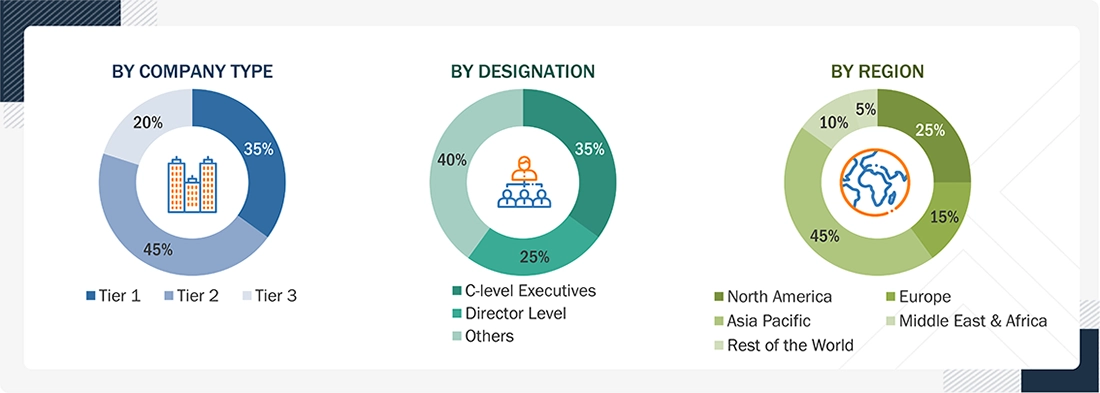
Note: C-level Executives include the CEO, COO, and CTO, among others.
Others include Sales Managers, Marketing Managers, and Product Managers. The tiers of the companies have been defined based on their total revenue as of 2022. Tier 1 = > USD 1 billion, Tier 2 = USD 100 million to USD 1 billion, and Tier 3 = < USD 100 million
To know about the assumptions considered for the study, download the pdf brochure
Market Size Estimation
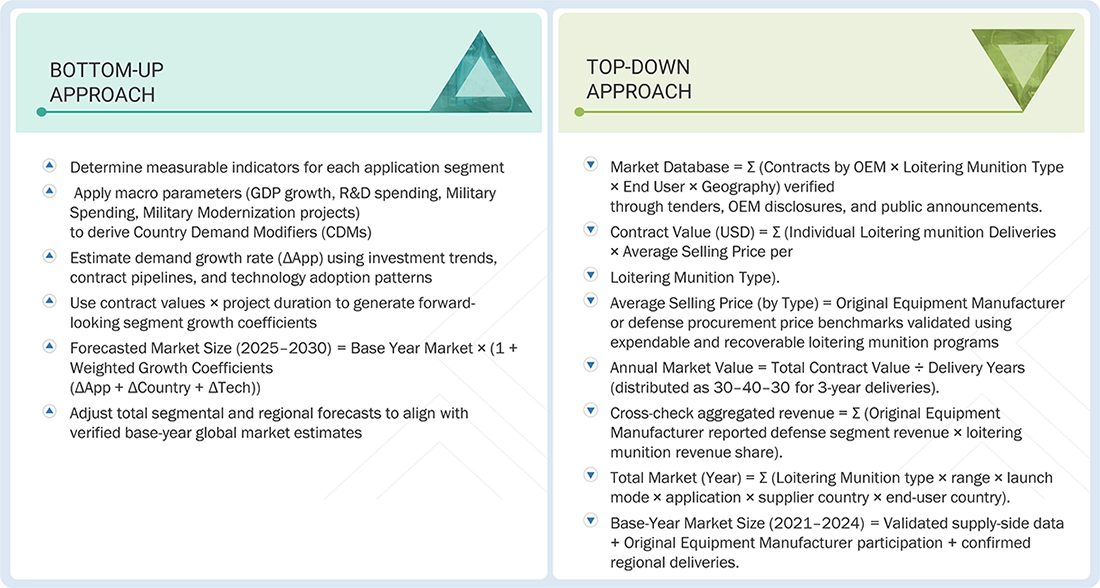
Both top-down and bottom-up approaches were used to estimate and validate the size of the Loitering Munition market. The research methodology used to estimate the market size includes the following details:
- Key players were identified through secondary research, and their market ranking was determined through primary and secondary research. This included a study of annual and financial reports of the top market players and extensive interviews of leaders, including CEOs, directors, and marketing executives.
- All percentage shares, splits, and breakdowns were determined using secondary sources and verified through primary sources. All possible parameters that affect the markets covered in this research study were accounted for, viewed in extensive detail, verified through primary research, and analyzed to obtain the final quantitative and qualitative data. This data was consolidated, enhanced with detailed inputs, analyzed by MarketsandMarkets, and presented in this report.
Loitering Munition Market : Top-Down and Bottom-Up Approach
Data Triangulation
After arriving at the overall size of the loitering munition market from the market size estimation process explained above, the total market was split into several segments and subsegments. To complete the overall market engineering process and arrive at the exact statistics for various market segments and subsegments, data triangulation and market breakdown procedures explained below were implemented, wherever applicable. The data was triangulated by studying various factors and trends from both the demand and supply sides. Along with this, the market size was validated using both top-down and bottom-up approaches.
Market Definition
Loitering Munition refers to advanced aerial weapons, also known as suicide drones, kamikaze drones, or exploding drones. The purpose of these munitions is intended for precise and responsive engagement. Munitions, built with warheads, can spend a long time in a target area until they identify an enemy presence, and then directly impacting it. The loitering munition market encompasses a variety of application, end user, launch mode and range tailored for specific operational needs. Range includes short-range, medium- range, long- range, which can determine mission requirements. Type as recoverable and expendable for mission flexibility. The market is segmented by end user, including army, navy, and air force, and by launching mode, such as air-launched, vertical take-off, catapult, canister and hand-launched mechanisms.
Kamikaze drones, also referred to as suicide drones or loitering munitions, are designed to circle over a chosen area until a target is identified, after which they dive into it carrying an explosive payload. Unlike conventional missiles, they can linger in the air, providing surveillance and target information before being directed to strike. In some cases, operators can call off an attack and redirect the drone if circumstances change. These systems have become an important part of warfare today, with countries such as Russia, Ukraine, India, and Pakistan actively using or developing models like the Shahed-136, the Switchblade 300 and 600, and homegrown Indian variants.
Key Stakeholders
Various stakeholders of the market are listed below:
- Loitering Munition System Component Suppliers
- Loitering Munition System Manufacturers
- Loitering Munition System Pilot Training Institutes
- Technology Support Providers for Loitering Munition Systems
- Loitering Munition Software/Hardware/Service and Solution Providers
- Government and Defense Regulatory Bodies
- Loitering Munition System Consultants
- Defense Forces (Army, Navy, Airforce)
- Research and Development Institutions, Testing and Certification Agencies
- Integrated Defense Systems Providers for Loitering Munition Systems
Report Objectives
- To define, describe, segment, and forecast the size of the Loitering munition market based on type, launch mode, end-user, range, and region
- To forecast the size of market segments based on five regions: North America, Europe, Asia Pacific, Middle East, and Rest of the World, along with key countries in each region
- To identify and analyze key drivers, restraints, opportunities, and challenges influencing the growth of the market
- To identify industry trends, market trends, and technology trends prevailing in the market
- To analyze micromarkets1 with respect to individual technological trends, prospects, and their contribution to the overall market
- To strategically profile key market players and comprehensively analyze their market ranking and core competencies2
- To provide a detailed competitive landscape of the market and analyze competitive growth strategies, such as product developments, contracts, partnerships, MOU’s, agreements, and collaborations adopted by key players in the market
- To identify the detailed financial position, key products, unique selling points, and key developments of leading companies in the market
- 1 Micromarkets are referred to as the segments and subsegments of the Loitering munition market included in the report.
- 2 Core competencies of companies were captured in terms of their key developments and key strategies adopted to sustain their positions in the market.
Available Customizations
Along with the market data, MarketsandMarkets offers customizations according to the specific requirements of companies. The following customization options are available for the report:
Product Analysis
- Product matrix, which gives a detailed comparison of the product portfolio of each company.
Regional Analysis
- Further breakdown of the market segments at the country level
Company Information
- Detailed analysis and profiling of additional market players (up to 5)
Get the Full Loitering Munition Market Report
Full forecast, segment splits, and company analysis for all Loitering Munition Market.
- Canada Loitering Munition Market
- US Loitering Munition Market
- France Loitering Munition Market
- Germany Loitering Munition Market
- UK Loitering Munition Market
- Italy Loitering Munition Market
- India Loitering Munition Market
- Japan Loitering Munition Market
- Australia Loitering Munition Market
- Saudi Arabia Loitering Munition Market
- Israel Loitering Munition Market
- Turkey Loitering Munition Market
- Rest Of Europe Loitering Munition Market
- Rest Of Asia Pacific Loitering Munition Market
Need a Tailored Report?
Customize this report to your needs
Get 10% FREE Customization
Customize This Report
