
US Material Testing Market (2025-2030)

The US Material Testing Market was valued at $203.6 Million in 2025 and projected to reach to $246.2 Million by 2030, representing a compound annual growth rate of 3.9%. The US Material Testing Market is positioned for steady growth through 2030, driven by continued investment in aerospace and automotive manufacturing, where material integrity is mission-critical.


| Market Size in | USD 26.32 MN |
| Market Forecast in | |
| CAGR | |
| Forecast Period | |
| Units Considered | Value (USD MN) |
US Material Testing Market Trends and Insights
- The US market benefits from robust demand across aerospace, automotive, construction, and manufacturing sectors, where rigorous material quality assurance and regulatory compliance drive testing requirements.
- In 2025, the US represents a mature yet expanding market supported by advanced infrastructure, stringent quality standards, and significant investment in R&D. Growth in the US Material Testing Market through 2030 is underpinned by increasing adoption of non-destructive testing (NDT) technologies, digital transformation in laboratory operations, and heightened focus on sustainability and material performance optimization.
- The US market's steady 3.9% CAGR reflects consistent demand from industries modernizing their testing capabilities and expanding production capacity.
- By 2030, the US market will continue to lead North America, driven by technological innovation, regulatory pressures, and the need for enhanced material durability and safety verification across critical applications..
Key Market Statistics
- CAGR (2025-2030) 3.9% CAGR
- Market Size, 2025 ~USD 203.6 Million
- Forecast, 2030 ~USD 246.2 Million
- Country US
US Material Testing Market Overview
Market Size & Growth :
The US Material Testing Market is valued at $203.6 million in 2025 and is projected to reach $246.2 million by 2030, representing a steady CAGR of 3.9% over the forecast period.
Key Driving Sectors :
Aerospace, automotive, construction, and manufacturing sectors drive robust demand for material testing services in the US, fueled by stringent regulatory compliance and quality assurance requirements.
Regulatory Compliance Focus :
US material testing demand is significantly bolstered by federal and industry-specific regulations that mandate rigorous quality testing across critical applications and supply chains.
Market Maturity :
The US market demonstrates relative maturity with established testing infrastructure, advanced laboratory capabilities, and high adoption of standardized testing methodologies across industries.
US Material Testing Market Dynamics
- Regulatory pressures from agencies such as the FAA, NHTSA, and EPA will sustain demand for comprehensive testing services.
- The market will benefit from technological advancements in non-destructive testing and digital quality assurance solutions.
- Additionally, reshoring initiatives and domestic supply chain strengthening will increase testing requirements for locally-sourced materials.
- However, growth will remain moderate compared to global markets due to market saturation and established testing infrastructure already in place across major US industrial hubs..
Market Ecosystem
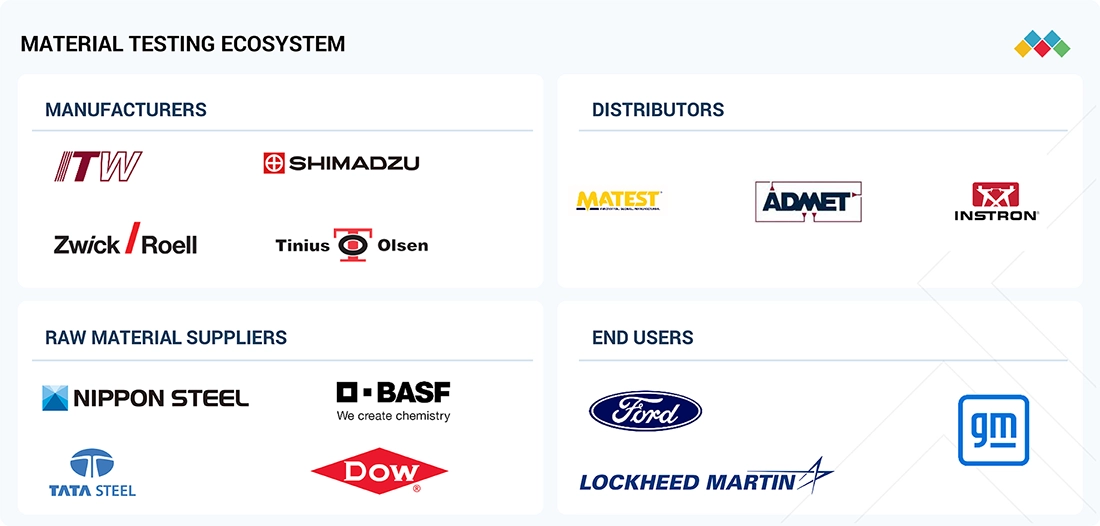
MATERIAL TESTING MARKET: COMMERCIAL USE CASES ACROSS INDUSTRIES
| COMPANY | USE CASE DESCRIPTION | BENEFITS |
|---|---|---|
 |
Fatigue testing of aluminum alloys to predict lifetime under cyclic loads in automotive and aerospace applications | Enabled lifetime prediction of aluminum alloys under cyclic loads for automotive and aerospace sectors |
 |
Visualization of strain distribution and multi-channel strain measurement for composite mechanical properties evaluation | Delivered comprehensive tensile and compression testing solutions widely used for quality assurance across industries |
 |
Accurate simulation verification of composite materials using CAE analysis integrated with Shimadzu testing data | Developed servo-hydraulic and electromechanical testing systems for fatigue and material durability testing |
|
|
High-speed tensile and compression testing with digital imaging to analyze failure mechanisms in composites | High-speed testing with digital imaging for failure mechanisms in composites and lightweight metals |
 |
Collaborative development with Laboratory Testing Inc. to optimize materials testing workflows and innovate testing systems | Enhances testing accuracy and reduces human error through integrated data analysis and automation |
Logos and trademarks shown above are the property of their respective owners. Their use here is for informational and illustrative purposes only.
Related Ecosystem
Equipment Machine And Tooling
- Wastewater Treatment
- Air Cooled Heat Exchangers
- Diaphragm Pumps
- Fiberglass
- HVAC System
- Alfa Laval Corporate AB
- Veolia
- Johnson Controls International plc
- Daikin Industries,Ltd.
- Parker-Hannifin Corporation
Key Takeaways
- The US Material Testing Market is valued at $203.6 million in 2025 and will reach $246.2 million by 2030 at a 3.9% CAGR.
- The US market is driven by stringent regulatory compliance, aerospace and automotive sector demand, and advanced quality assurance requirements.
- Digital transformation and non-destructive testing (NDT) technologies are key growth enablers in the US market through 2030.
- The US maintains a mature, stable market position with consistent investment in testing infrastructure and R&D capabilities.
Material Testing Market Report Scope
| Report Metric | Details |
|---|---|
| Base Year | 2025 |
| Fastest Growing Segment | CERAMIC & COMPOSITE (Material) |
| Forecast Period | 2025-2030 |
| Growth Rate | CAGR of 4.2% from 2025 to 2030 |
| Largest Segment | UNIVERSAL TESTING MACHINE (Type) |
| Market Size Base Year (Billions) | ~USD 0.87 (2025) |
| Revenue Forecast (Billions) | ~USD 1.07 (2030) |
| Segments Covered | Type, Material, End User |
US Material Testing Market Report Segmentation
3 segment dimensions are covered across the global market.
By Type
- Hardness Testing Equipment
- Impact Testing Equipment
- Other Types
- Servohydraulic Testing Machines
- Universal Testing Machine
- Universal Testing Machines
By Material
- Ceramic & Composite
- Metal
- Other Materials
- Plastic
- Rubber & Elastomer
By End User
- Aerospace & Defense Industry
- Automotive Industry
- Construction Industry
- Educational Institutions
- Medical Device Industry
- Other End Users
- Power Industry
US: MATERIAL TESTING MARKET, BY END USER, 2025–2030
| Segment | 2025 | 2026 | 2027 | 2028 | 2029 | 2030 | CAGR (%) |
|---|---|---|---|---|---|---|---|
| AEROSPACE & DEFENSE INDUSTRY | 35.2 | 36.7 | 38.3 | 39.9 | 41.5 | 43.2 | 4.2 |
| AUTOMOTIVE INDUSTRY | 56 | 58.6 | 61.2 | 64 | 66.8 | 69.7 | 4.5 |
| CONSTRUCTION INDUSTRY | 43.7 | 45.3 | 46.8 | 48.4 | 50.1 | 51.7 | 3.4 |
| EDUCATIONAL INSTITUTIONS | 29.2 | 30.2 | 31.2 | 32.2 | 33.3 | 34.4 | 3.3 |
| MEDICAL DEVICE INDUSTRY | 17.2 | 17.8 | 18.5 | 19.2 | 19.9 | 20.6 | 3.8 |
| OTHER END USERS | 9.1 | 9.4 | 9.7 | 10 | 10.3 | 10.6 | 3.2 |
| POWER INDUSTRY | 13.3 | 13.8 | 14.3 | 14.8 | 15.3 | 15.8 | 3.6 |
| TOTAL | 203.6 | 211.8 | 220 | 228.5 | 237.3 | 246.2 | 3.9 |
Target Audience
- Material Testing Service Providers : Testing laboratories and service companies need US-specific market data to benchmark performance, identify growth opportunities, and develop targeted sales strategies for aerospace, automotive, and manufacturing clients.
- Testing Equipment Manufacturers : Equipment suppliers require detailed US market insights to forecast demand for testing instruments, plan product development roadmaps, and identify high-growth customer segments and applications.
- Aerospace & Automotive OEMs : Original equipment manufacturers need market intelligence on testing capabilities, service provider landscape, and regulatory trends to optimize supply chain quality assurance and material sourcing strategies.
- Investment & Private Equity Firms : Investors evaluating acquisition targets or market entry opportunities in the US material testing sector require accurate market sizing, growth forecasts, and competitive dynamics to inform investment decisions.
- Construction & Manufacturing Companies : End-user organizations in construction and manufacturing need market insights to understand testing service availability, pricing trends, and compliance requirements for material quality assurance programs.
Reasons to Buy this Report
- Sector-Specific Insights : Gain detailed understanding of material testing demand across US aerospace, automotive, construction, and manufacturing sectors with quantified market sizing and growth projections specific to each vertical.
- Regulatory Landscape Analysis : Understand how federal regulations and industry standards (FAA, NHTSA, ASTM) shape testing requirements and create sustained market opportunities for service providers and equipment manufacturers in the US.
- Competitive Positioning : Identify market gaps and competitive dynamics within the US material testing landscape to inform strategic expansion, partnership, or acquisition decisions for established and emerging players.
- Investment & Growth Strategy : Leverage accurate 2025-2030 forecasts and CAGR data to support capital allocation decisions, business case development, and market entry strategies tailored to the US market opportunity.
- Supply Chain Resilience : Understand how US reshoring initiatives and domestic supply chain strengthening are creating incremental testing demand, enabling suppliers to capitalize on emerging opportunities in material validation.
Frequently asked questions
What is the size of the US Material Testing Market in 2025?
The US Material Testing Market is valued at $203.6 million in 2025, representing a mature and well-established market within North America.
What is the projected size of the US Material Testing Market by 2030?
The US Material Testing Market is projected to reach $246.2 million by 2030, reflecting steady growth over the forecast period.
What is the CAGR for the US Material Testing Market?
The US Material Testing Market is expected to grow at a compound annual growth rate of 3.9% from 2025 to 2030.
Which industries drive demand in the US Material Testing Market?
The US market is primarily driven by aerospace, automotive, construction, manufacturing, and energy sectors requiring rigorous material quality assurance and regulatory compliance.
What technologies are shaping the US Material Testing Market?
Non-destructive testing (NDT), digital laboratory management systems, automation, and advanced analytical instruments are key technologies transforming the US market through 2030.
RESEARCH METHODOLOGY
The study involved four major activities in estimating the market size of the material testing market. Exhaustive secondary research was done to collect information on the market, the peer market, and the parent market. The next step was to validate these findings, assumptions, and sizing with industry experts across the value chain through primary research. Both top-down and bottom-up approaches were employed to estimate the complete market size. Thereafter, the market breakdown and data triangulation procedures were used to estimate the market size of the segments and subsegments.
Secondary Research
In the secondary research process, various secondary sources were referred to to identify and collect information for this study. These secondary sources include annual reports, press releases, investor presentations of companies, white papers, certified publications, trade directories, articles from recognized authors, gold standard and silver standard websites, and databases. Secondary research has been used to obtain key information about the value chain of the industry, monetary chain of the market, the total pool of key players, market classification and segmentation according to industry trends to the bottom-most level, and regional markets. It was also used to obtain information about the key developments from a market-oriented perspective.
Primary Research
The material testing market comprises several stakeholders in the value chain, which include manufacturers and end users. Various primary sources from the supply and demand sides of the material testing market have been interviewed to obtain qualitative and quantitative information. The primary interviewees from the demand side include key opinion leaders in industrial sectors. The primary sources from the supply side include manufacturers, associations, and institutions involved in the material testing industry. Primary interviews were conducted to gather insights such as market statistics, revenue data collected from the products and services, market breakdowns, market size estimations, market forecasting, and data triangulation. Primary research also helped in understanding the various trends related to type, material, end user, and region. Stakeholders from the demand side, such as CIOs, CTOs, and CSOs, were interviewed to understand the buyer’s perspective on the suppliers, products, and their current usage of material testing and outlook of their business, which will affect the overall market.
The breakdown of profiles of the primary interviewees is illustrated in the figure below:
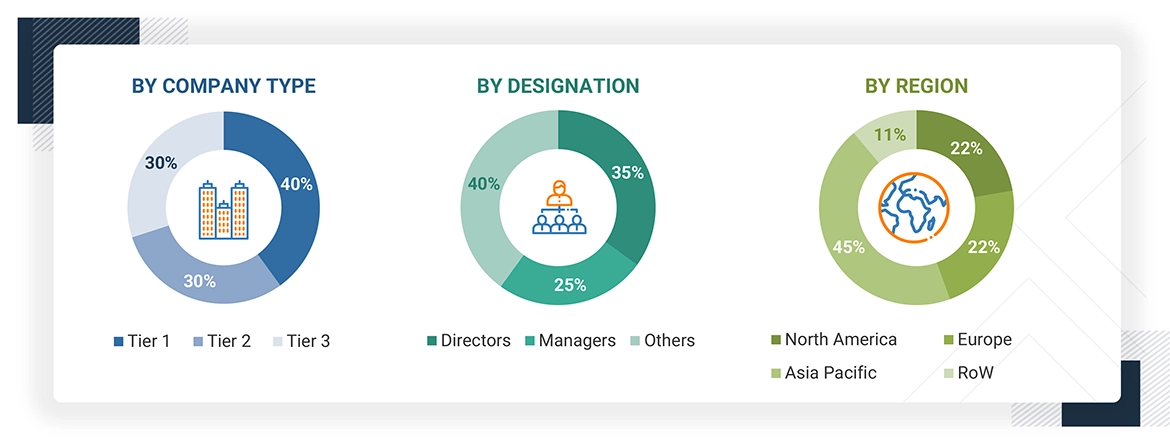
Note: Tier 1, Tier 2, and Tier 3 companies are classified based on their market revenue in 2024 available in the public domain, product portfolios, and geographical presence.
Other designations include consultants and sales, marketing, and procurement managers.
To know about the assumptions considered for the study, download the pdf brochure
Market Size Estimation
The top-down and bottom-up approaches have been used to estimate and validate the size of the material testing market.
- The key players in the industry have been identified through extensive secondary research
- The supply chain of the industry has been determined through primary and secondary research
- All percentage shares, splits, and breakdowns have been determined using secondary sources and verified through primary sources
- All possible parameters that affect the markets covered in this research study have been accounted for, viewed in extensive detail, verified through primary research, and analyzed to obtain the final quantitative and qualitative data
- The research includes the study of reports, reviews, and newsletters of the key market players, along with extensive interviews for opinions with leaders such as directors and marketing executives
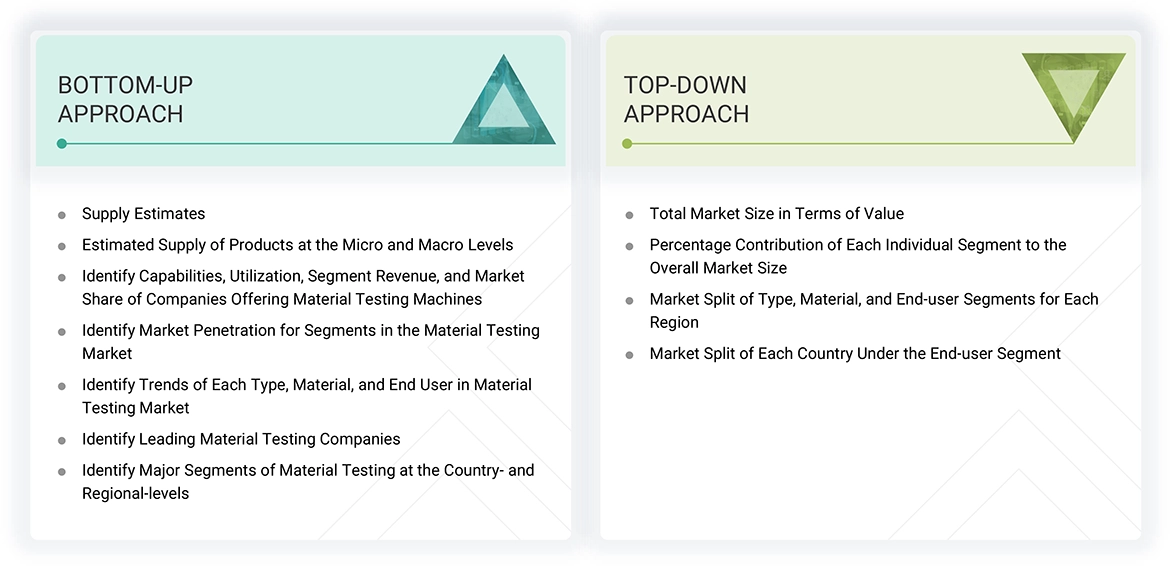
Data Triangulation
After arriving at the total market size from the estimation process, the overall market has been split into several segments and subsegments. To complete the overall market engineering process and arrive at the exact statistics for all the segments and subsegments, the data triangulation and market breakdown procedures have been employed, wherever applicable. The data has been triangulated by studying various factors and trends from both the demand and supply sides. Along with this, the market size has been validated by using both the top-down and bottom-up approaches and primary interviews. Hence, for every data segment, there have been three sources—top-down approach, bottom-up approach, and expert interviews. The data was assumed correct when the values arrived from the three sources matched.
Market Definition
The material testing is an industry that has equipment, systems, and services that test mechanical, physical, and chemical properties of materials - metals, polymers, composites, and ceramics. Testing of these characteristics is critical in determining product safety and quality as well as compliance with premises relating to internationally regulated and global industry standards in a variety of industries: automotive, aerospace, construction, energy, and healthcare. The material testing market involves destructive testing and is ultimately enabling innovations, validating performance, and establishing reliability in production and R&D processes around the world.
Stakeholders
- Senior Management
- End Users
- Finance/Procurement Department
- R&D Department
- Manufacturers
- Raw Material Suppliers
Report Objectives
- To define, describe, and forecast the size of the material testing market, in terms of value and volume
- To provide detailed information regarding the major factors (drivers, opportunities, restraints, and challenges) influencing the growth of the market
- To estimate and forecast the market size based on type, material, end-user and region
- To forecast the size of the market with respect to major regions, namely, Europe, North America, Asia Pacific, Middle East & Africa, and South America, along with their key countries
- To strategically analyze micromarkets with respect to individual growth trends, prospects, and their contribution to the overall market
- To analyze opportunities in the market for stakeholders and provide a competitive landscape of market leaders
- To track and analyze recent developments such as expansions, product launches, partnerships, agreements, and acquisitions in the market
- To strategically profile the key market players and comprehensively analyze their core competencies
Get the Full Material Testing Market Report
Full forecast, segment splits, and company analysis for all Material Testing Market.
- Turkey Material Testing Market
- Brazil Material Testing Market
- Argentina Material Testing Market
- Rest Of Europe Material Testing Market
- Rest Of Asia Pacific Material Testing Market
- GCC Countries Material Testing Market
- -Rest Of GCC Countries Material Testing Market
- Rest Of South America Material Testing Market
- Canada Material Testing Market
- Mexico Material Testing Market
- Germany Material Testing Market
- UK Material Testing Market
- France Material Testing Market
- Italy Material Testing Market
- Spain Material Testing Market
- China Material Testing Market
- Japan Material Testing Market
- India Material Testing Market
- South Korea Material Testing Market
- Indonesia Material Testing Market
- Thailand Material Testing Market
- Vietnam Material Testing Market
- Philippines Material Testing Market
- South Africa Material Testing Market
Need a Tailored Report?
Customize this report to your needs
Get 10% FREE Customization
Customize This Report
