
GCC Countries Medical Aesthetics Market (2025-2031)

The GCC Countries Medical Aesthetics Market was valued at $460.07 Million in 2025 and projected to reach to $713.94 Million by 2031, representing a compound annual growth rate of 7.0%. The GCC Countries medical aesthetics market is poised for sustained growth, expanding from $460.07 million in 2025 to $713.94 million by 2031 at a 7% CAGR.


| Market Size in | USD 26.32 MN |
| Market Forecast in | |
| CAGR | |
| Forecast Period | |
| Units Considered | Value (USD MN) |
GCC Countries Medical Aesthetics Market Trends and Insights
- GCC Countries' affluent consumer base, high disposable income, and growing awareness of aesthetic procedures are driving demand across minimally invasive treatments, injectables, and laser-based therapies.
- The region's luxury healthcare infrastructure and medical tourism appeal further strengthen GCC Countries' position as a key market for premium aesthetic services. GCC Countries demonstrates robust market fundamentals supported by increasing adoption of non-surgical cosmetic procedures among both residents and international visitors.
- The forecast period through 2031 reflects GCC Countries' commitment to healthcare innovation and the region's cultural shift toward aesthetic enhancement.
- Market growth in GCC Countries is underpinned by rising middle-class expansion, enhanced clinic availability, and competitive pricing relative to Western markets, positioning GCC Countries as an attractive destination for medical aesthetics investment and consumer spending..
Key Market Statistics
- CAGR (2025-2031) 7.0% CAGR
- Market Size, 2025 ~USD 460.07 Million
- Forecast, 2031 ~USD 713.94 Million
- Country GCC Countries
GCC Countries Medical Aesthetics Market Overview
High Disposable Income Driving Growth :
GCC Countries' wealthy consumer base with significant purchasing power is fueling demand for premium aesthetic procedures, positioning the region as a lucrative market for medical aesthetics providers and suppliers.
Minimally Invasive Procedures Dominate :
Injectables, dermal fillers, and non-surgical treatments are leading the GCC market, reflecting consumer preference for quick recovery times and natural-looking results among affluent demographics.
Medical Tourism Hub Expansion :
GCC Countries are emerging as regional medical tourism destinations, attracting patients from neighboring Middle Eastern and Asian markets seeking world-class aesthetic treatments and advanced facilities.
Rising Aesthetic Awareness Among Youth :
Growing social media influence and celebrity culture in GCC Countries is increasing aesthetic procedure awareness among younger populations, expanding the addressable market beyond traditional demographics.
GCC Countries Medical Aesthetics Market Dynamics
- This steady expansion is underpinned by the region's affluent consumer base, high disposable incomes, and increasing cultural acceptance of aesthetic procedures.
- The market benefits from advanced healthcare infrastructure, premium clinic establishments, and growing investment in aesthetic facilities across major cities. Key growth drivers include rising awareness of minimally invasive treatments, increasing participation from international aesthetic brands, and the region's positioning as a medical tourism destination.
- However, the GCC market grows at a slower pace than the global 13% CAGR, reflecting market maturity and regulatory considerations.
- Strategic opportunities exist in emerging aesthetic technologies, personalized treatment offerings, and expansion into secondary markets within the GCC region..
Market Ecosystem

MEDICAL AESTHETICS MARKET: COMMERCIAL USE CASES ACROSS INDUSTRIES
| COMPANY | USE CASE DESCRIPTION | BENEFITS |
|---|---|---|
 |
Supports dermatology clinics and medical aesthetic centers across the US with injectable treatments for facial rejuvenation, anti-aging, contouring, and skin quality improvement | Enables clinics to drive higher patient acquisition and retention through a trusted, clinically validated brand | Supports premium service positioning | Generates recurring revenue through repeat maintenance treatments |
 |
Provides minimally invasive aesthetic solutions focused on facial volume restoration, wrinkle reduction, and skin health enhancement | Offers effective non-surgical alternatives that reduce dependence on invasive procedures | Improves patient satisfaction and confidence | Strengthens clinic credibility through science-backed products designed for long-term aesthetic and dermatological care |
 |
Integrates medical aesthetic injectables and neuromodulators into dermatology clinics and aesthetic practices, often complementing spa-style services and advanced skincare offerings | Aligns strongly with the US’s growing demand for natural-looking, minimally invasive enhancements | Supports cross-selling of medical-grade skincare and cosmeceuticals | Enables clinics to expand service offerings |
 |
Delivers energy-based, non-invasive aesthetic device solutions for skin rejuvenation, body contouring, and vascular treatments | Enhances clinic differentiation through advanced device-based treatments | Strengthens brand visibility and patient trust | Supports high utilization rates due to repeat treatment protocols |
Logos and trademarks shown above are the property of their respective owners. Their use here is for informational and illustrative purposes only.
Related Ecosystem
Key Takeaways
- GCC Countries medical aesthetics market valued at $460.07 million in 2025, expanding to $713.94 million by 2031 at 7.0% CAGR
- GCC Countries' high disposable income and luxury healthcare infrastructure drive strong demand for premium aesthetic procedures
- Medical tourism and international patient influx significantly contribute to GCC Countries market growth trajectory
- GCC Countries' non-surgical procedure adoption and clinic expansion support sustained market expansion through 2031
Medical Aesthetics Market Report Scope
| Report Metric | Details |
|---|---|
| Base Year | 2025 |
| Fastest Growing Segment | HOME CARE SETTINGS (End User) |
| Forecast Period | 2025–2039 |
| Growth Rate | CAGR of 13% from 2025 to 2039 |
| Largest Segment | DERMATOLOGY CLINICS, HOSPITALS, AND MEDICAL SPAS (End User) |
| Market Size Base Year (Billions) | ~USD 19.55 (2025) |
| Revenue Forecast (Billions) | ~USD 40.7 (2039) |
| Segments Covered | Product, Type, Product Type, Procedure, End User |
GCC Countries Medical Aesthetics Market Report Segmentation
5 segment dimensions are covered across the global market.
By Product
- Body Contouring Devices
- Cosmetic Implants
- Facial Aesthetic Products
- Hair Removal Devices
- Nail Treatment Laser Devices
- Physician-Dispensed Cosmeceuticals And Skin Lighteners
- Physician-Dispensed Eyelash Products
- Skin Aesthetic Devices
- Sskin Aesthetic Devices
- Tattoo Removal Devices
- Thread Lift Products
By Type
- Anti-Aging And Skin Rejuvenation
- Botulinum Toxin
- Breast Implants
- Cellulite Reduction Devices
- Chemical Peels
- Dermal Fillers
- Facelift & Body Lift Procedures
- Facelift And Body Lift Procedures
- Facial Implants
- Hair Removal
- Ipl Hair Removal Devices
- Laser Hair Removal Devices
- Laser Resurfacing Devices
- Laser Skin Resurfacing Devices
- Light Therapy Devices
- Liposuction
- Liposuction Devices
- Microdermabrasion
- Microneedling Products
- Natural
- Natural Dermal Fillers
- Non-Surgical Fat Reduction Devices
- Non-Surgical Skin Tightening Devices
- Other Cosmetic Implants
- Other Implants
- Other Non-Surgical Procedures
- Other Surgical Procedures
- Saline
- Saline Breast Implants
- Silicone
- Silicone Breast Implants
- Synthetic
- Synthetic Dermal Fillers
- Tattoo Removal
By Product Type
- At-Home/Self-Use Devices
- Multimodal Devices
- Standalone Devices
By Procedure
- Non-Surgical
- Non-Surgical Procedures
- Surgical
- Surgical Procedures
By End User
- Beauty Centers
- Clinics, Hospitals, And Medical Spas
- Dermatology Clinics, Hospitals, And Medical Spas
- Home Care Settings
Target Audience
- Medical Aesthetics Providers & Clinics : Clinic operators and aesthetic practitioners in GCC Countries need market data to benchmark performance, identify growth opportunities, and optimize service offerings for the region's affluent clientele.
- Medical Device & Pharmaceutical Companies : Manufacturers of aesthetic devices, injectables, and dermal fillers require GCC-specific market intelligence to guide product launches, distribution strategies, and regional expansion planning.
- Private Equity & Investment Firms : Investors evaluating aesthetic clinic chains, medical tourism platforms, and aesthetic technology companies in GCC Countries need accurate market sizing and growth forecasts for investment decisions.
- Healthcare Consultants & Strategy Firms : Consultants advising healthcare organizations, hospital groups, and aesthetic service providers in GCC Countries require detailed market data to develop competitive strategies and business cases.
- Market Research & Business Intelligence Teams : Corporate strategy, product management, and business development teams need GCC-specific aesthetic market insights to inform competitive positioning, market entry, and portfolio expansion decisions.
Key Companies in the GCC Countries Medical Aesthetics Market
| Company | HQ | Ownership | Strongest segments |
|---|---|---|---|
| ALLERGAN PLC | Ireland | Private Company | Botox,Filler,Liposuction, |
| SIENTRA, INC. | United States | Private Company | Silicone Gel Breast Implants,Body Contouring Products,Scar Management Products, |
| ABBVIE INC. | United States | Public Company | Botox Cosmetic,Juvederm Collection,Body Contouring, |
| GALDERMA | Switzerland | Public Company | Dermal Fillers,Botox,Laser Resurfacing, |
| JOHNSON & JOHNSON | United States | Public Company | Fillers,Laser Resurfacing,Botox, |
| BAUSCH HEALTH COMPANIES INC. | Canada | Public Company | Laser Resurfacing,RF,Fillers, |
| CUTERA, INC. | United States | Private Company | Laser Resurfacing,RF Microneedling,Hair Removal, |
| LUMENIS BE LTD. | Israel | Private Company | Laser Hair Removal,Skin Treatment,RF and Phototherapy, |
| CANDELA MEDICAL | United States | Private Company | Laser Resurfacing,Hair Removal,RF and Phototherapy, |
| INMODE LTD. | Israel | Public Company | RF Technology,Laser Resurfacing,Hair Removal, |
ALLERGAN PLC
Allergan PLC is an Irish private company founded in 1983 with 17,400 employees. The company operates in the pharmaceutical and medical aesthetics sectors.
SIENTRA, INC.
Sientra, Inc. is a United States-based private company founded in 2003 with 304 employees. The company focuses on medical device manufacturing and aesthetics.
ABBVIE INC.
AbbVie Inc. is a publicly traded United States company founded in 2012 with 57,000 employees. The company operates as a global pharmaceutical and healthcare company.
GALDERMA
Galderma is a Swiss public company founded in 1981 with 7,676 employees. The company specializes in dermatology and aesthetic medicine products.
JOHNSON & JOHNSON
Johnson & Johnson is a publicly traded United States company founded in 1886 with 138,200 employees. The company is a diversified healthcare conglomerate operating in pharmaceuticals, medical devices, and consumer health.
BAUSCH HEALTH COMPANIES INC.
Bausch Health Companies Inc. is a Canadian public company with 20,300 employees. The company operates across pharmaceuticals, medical devices, and eye care sectors.
CUTERA, INC.
Cutera, Inc. is a United States-based private company founded in 1998 with 430 employees. The company develops and manufactures laser and light source-based aesthetic systems.
LUMENIS BE LTD.
Lumenis Be Ltd. is an Israeli private company founded in 1991 with 954 employees. The company specializes in laser and light-based medical and aesthetic devices.
CANDELA MEDICAL
Candela Medical is a United States-based private company founded in 1970 with 363 employees. The company manufactures laser and light-based medical aesthetic devices.
INMODE LTD.
InMode Ltd. is an Israeli public company founded in 2008 with 660 employees. The company develops and markets minimally invasive aesthetic medical devices.
Reasons to Buy this Report
- Market-Specific Sizing & Forecasts : Access precise valuation data for GCC Countries ($460.07M in 2025, $713.94M in 2031) with 7% CAGR projections, enabling accurate business planning and investment decisions tailored to this high-value region.
- Competitive Landscape Intelligence : Understand GCC-specific market dynamics, key players, and competitive positioning within the region's affluent aesthetic market, helping identify partnership and expansion opportunities.
- Consumer Behavior & Demand Insights : Gain deep insights into GCC consumer preferences for minimally invasive treatments, injectables, and premium aesthetic services, informing product development and marketing strategies for regional success.
- Medical Tourism Opportunity Analysis : Leverage data on GCC Countries' emerging role as a regional medical tourism hub, identifying opportunities to capture cross-border patient flows and establish premium aesthetic service offerings.
- Regulatory & Market Entry Guidance : Understand GCC-specific regulatory environment, healthcare infrastructure, and market entry requirements, reducing risks and accelerating go-to-market strategies for aesthetic companies and investors.
Frequently asked questions
What is the current market size of medical aesthetics in GCC Countries?
The medical aesthetics market in GCC Countries is valued at $460.07 million in 2025 and is projected to reach $713.94 million by 2031.
What is the expected growth rate for medical aesthetics in GCC Countries?
GCC Countries medical aesthetics market is expected to grow at a compound annual growth rate (CAGR) of 7.0% from 2025 to 2031.
What factors are driving growth in GCC Countries medical aesthetics market?
Growth in GCC Countries is driven by high disposable income, luxury healthcare infrastructure, medical tourism, increasing non-surgical procedure adoption, and expanding clinic availability.
Which procedures are most popular in GCC Countries medical aesthetics market?
GCC Countries shows strong demand for minimally invasive treatments, injectables, and laser-based therapies, reflecting consumer preference for non-surgical aesthetic solutions.
How does GCC Countries compare to global medical aesthetics market trends?
While the global medical aesthetics market grows at 13% CAGR, GCC Countries grows at 7.0% CAGR, reflecting the region's mature but steady market with premium positioning and medical tourism appeal.
RESEARCH METHODOLOGY
Four primary studies have been undertaken to size the medical aesthetics market. Secondary research has been used to obtain preliminary data for the medical aesthetics market and peer and parent markets. Data were collected from 3–5 secondary sources and validated by primary sources for assumptions and market sizing. Through top-down and bottom-up approaches, the overall market size was informed and further broken down, and data was triangulated for segment and subsegment sizing.
Secondary Research
Secondary research included directories, Factiva, white papers, Bloomberg Businessweek, annual reports, SEC filings, business filings, and investor presentations, among others. Through these sources, one can gain critical data about market leaders, how the industry is divided into sectors, and how technology varies from one industry level to another within medical aesthetics.
Primary Research
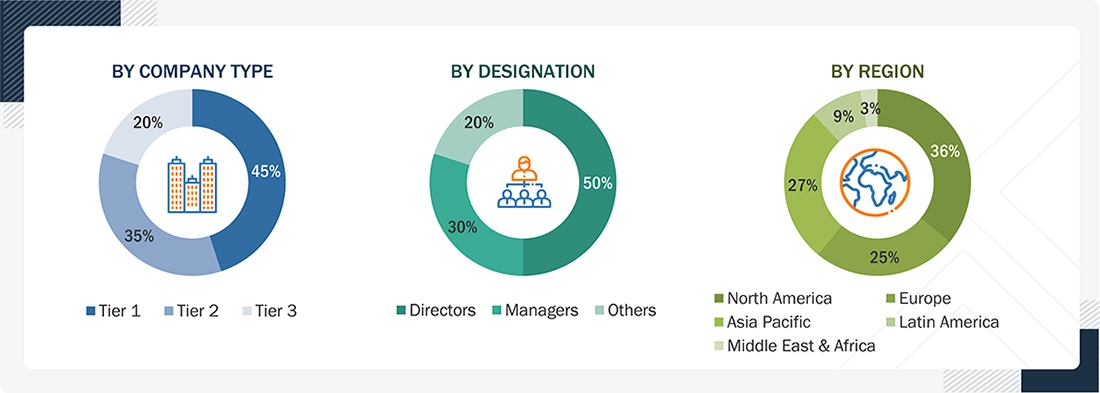
Primary research included interviewing people from the supply side of the business and the demand side to get quantitative and qualitative insights. On the demand side, primary sources involved in the study included physicians, researchers, department heads, staff from diagnostic centers, hospital staff, and those attached to the research institutes. On the supply side, these sources involved CEOs, area sales managers, territory and regional sales managers, and various other top executives of relevant companies. These direct meetings with people in key leadership positions helped validate assumptions arising from secondary research and bring them face-to-face so that any assumptions could also be directly questioned.
A breakdown of the primary respondents is provided below:
Notes:
*Others include Sales Managers, Marketing Managers, Business Development Managers, Product Managers, Distributors, and Suppliers.
Companies are classified into tiers based on their total revenue. As of 2025, the following tiers have been used:
Tier 1 = > USD 1 billion, Tier 2 = < USD 500 million, and Tier 3 = < USD 100 million
To know about the assumptions considered for the study, download the pdf brochure
Market Size Estimation
The revenue share analysis of major companies was used in this report to determine the size of the global medical aesthetics market. This was accomplished by identifying the major market participants and calculating their medical aesthetics business revenues using a variety of information acquired throughout the primary and secondary research stages. Examining the annual and financial reports of the leading market participants was one aspect of secondary research. On the other hand, primary research involved in-depth interviews with important thought leaders, including directors, CEOs, and important marketing executives. Segmental revenues were computed using the revenue mapping of the leading solution/service providers to determine the worldwide market value.
The following steps were involved in this process:
- Making a list of the leading international companies in the medical aesthetics industry
- Charting the annual profits made by the leading companies in the medical aesthetics sector (or the closest stated business unit/product category)
- Calculating the medical aesthetics industry’s global value
- As of 2025, revenue mapping of leading companies is expected to cover a significant portion of the global market.
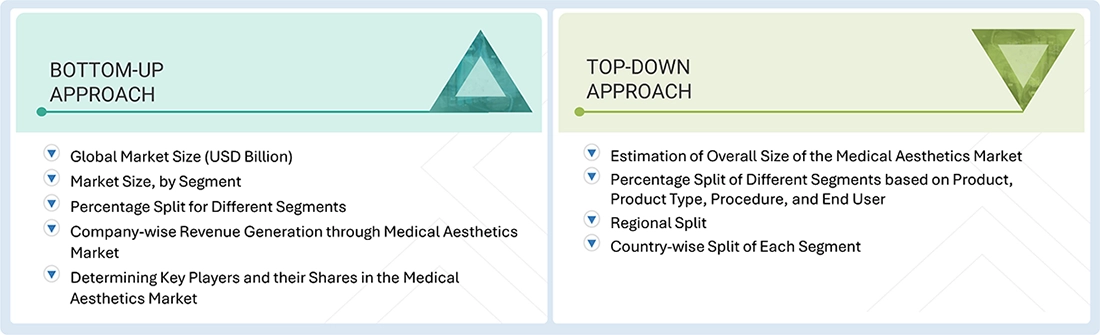
Medical Aesthetics Market : Top-Down and Bottom-Up Approach
Data Triangulation
After determining the overall market size through the process of estimation as discussed above, the global medical aesthetics market has been segmented and subsegmented. Data triangulation and market breakdown methods have been used to refine the accuracy of these estimates. This process is based on the analysis of multiple factors and trends from the demand and supply perspectives. The medical aesthetics market has been validated through the top-down and bottom-up approaches, ensuring the accuracy of the segment and subsegment statistics.
Market Definition
The medical aesthetics market comprises products and procedures designed to enhance aesthetic appearance through non-surgical or surgical interventions targeting facial, skin, body, hair, and nail cosmetic concerns. The market includes facial aesthetic products, body contouring devices, cosmetic implants, skin aesthetic devices, physician-dispensed eyelash products, hair removal devices, tattoo removal devices, thread lift products, nail treatment laser devices, and home care aesthetic devices. The market serves end users, including clinics, hospitals, medical spas, beauty centers, and home care settings.
Key Stakeholders
- Medical Aesthetic Clinics
- Healthcare Providers
- Distributors and Suppliers
- Regulatory Authorities
- Cosmetologists and Plastic Surgeons
- Investors and Private Equity Firms
- Media and Influencers
- Market Research and Consulting Firms
Report Objectives
- To define, describe, and forecast the medical aesthetics market based on product, product type, procedure, end user, and region
- To provide detailed information regarding the major factors (such as drivers, restraints, opportunities, and challenges) influencing the market growth
- To analyze the micro markets for individual growth trends, prospects, and contributions to the overall medical aesthetics market
- To analyze the opportunities for stakeholders and provide details of the competitive landscape for market leaders
- To forecast the size of the market segments for five regions: North America, Europe, the Asia Pacific, Latin America, and the Middle East & Africa
- To profile the key players and analyze their market shares and core competencies
- To track and analyze competitive developments, such as product launches, funding and grants, partnerships, agreements, collaborations, expansions, strategic alliances, and acquisitions
- To benchmark players within the market using the proprietary “Company Evaluation Matrix” framework to analyze players on various parameters within the broad categories of business and product excellence strategy
Available customizations:
- Using market data, MarketsandMarkets provides customization as per the company's requirements. The following customization options are available:
Product Analysis
- Product matrix, which offers a comparison of the product offerings of the top 5 companies
Regional Analysis
- Further breakdown of the Rest of Europe medical aesthetics market into Russia, Belgium, the Netherlands, Switzerland, Austria, Finland, Sweden, Poland, and Portugal, among others
- Further breakdown of the Rest of Asia Pacific medical aesthetics market into Singapore, Taiwan, New Zealand, the Philippines, Malaysia, and other Asia Pacific countries
- Further breakdown of the Rest of Latin America medical aesthetics market into Argentina, Chile, Colombia, and others
Company Information
- Detailed description and profiling of additional market players (up to 5)
Get the Full Medical Aesthetics Market Report
Full forecast, segment splits, and company analysis for all Medical Aesthetics Market.
- US Medical Aesthetics Market
- Canada Medical Aesthetics Market
- Germany Medical Aesthetics Market
- UK Medical Aesthetics Market
- France Medical Aesthetics Market
- Italy Medical Aesthetics Market
- Spain Medical Aesthetics Market
- Japan Medical Aesthetics Market
- China Medical Aesthetics Market
- India Medical Aesthetics Market
- Australia Medical Aesthetics Market
- South Korea Medical Aesthetics Market
- Brazil Medical Aesthetics Market
- Mexico Medical Aesthetics Market
- Rest Of Europe Medical Aesthetics Market
- Rest Of Asia Pacific Medical Aesthetics Market
- Rest Of Latin America Medical Aesthetics Market
Need a Tailored Report?
Customize this report to your needs
Get 10% FREE Customization
Customize This Report
