
UK Medical Polymer Market (2025-2030)

The UK Medical Polymer Market was valued at $1416.1 Million in 2025 and projected to reach to $1902.1 Million by 2030, representing a compound annual growth rate of 6.1%. The UK medical polymer market is positioned for steady growth driven by an aging population, increasing prevalence of chronic diseases, and rising demand for minimally invasive medical devices.


| Market Size in | USD 26.32 MN |
| Market Forecast in | |
| CAGR | |
| Forecast Period | |
| Units Considered | Value (USD MN) |
UK Medical Polymer Market Trends and Insights
- The UK's advanced healthcare infrastructure and strong regulatory framework position it as a key market for medical-grade polymers used in devices, implants, and pharmaceutical delivery systems.
- The UK market benefits from significant investment in healthcare innovation and a robust manufacturing base supporting both domestic demand and European exports. Driving growth in the UK medical polymer sector are increasing demand for minimally invasive surgical devices, rising prevalence of chronic diseases, and accelerating adoption of biocompatible and biodegradable polymers.
- The UK's emphasis on precision medicine and personalized healthcare solutions is spurring development of specialized polymer formulations.
- Between 2025 and 2030, the UK market will be shaped by regulatory harmonization post-Brexit, technological advancements in polymer processing, and growing sustainability requirements from healthcare providers and patients alike..
Key Market Statistics
- CAGR (2025-2030) 6.1% CAGR
- Market Size, 2025 ~USD 1416.1 Million
- Forecast, 2030 ~USD 1902.1 Million
- Country UK
UK Medical Polymer Market Overview
Market Valuation :
The UK medical polymer market is valued at USD 1,416.1 million in 2025, with projected growth to USD 1,902.1 million by 2030, demonstrating strong market expansion opportunities.
Growth Rate :
The UK market is growing at a CAGR of 6.1% through 2030, outpacing many mature European markets and reflecting increasing demand for advanced medical-grade polymers in healthcare applications.
Regulatory Excellence :
The UK's stringent regulatory framework and MHRA oversight ensure high-quality medical polymer standards, making it an attractive market for premium medical device manufacturers and suppliers.
Healthcare Infrastructure :
The UK's advanced NHS infrastructure and private healthcare sector drive consistent demand for innovative polymer-based medical devices, implants, and pharmaceutical delivery systems.
UK Medical Polymer Market Dynamics
- The UK's commitment to healthcare innovation and strong manufacturing capabilities support market expansion across orthopedic implants, cardiovascular devices, and drug delivery systems.
- Regulatory harmonization post-Brexit and investment in advanced polymer technologies will further enhance market competitiveness.
- The market is expected to benefit from growing adoption of biocompatible and biodegradable polymers, particularly in surgical applications and long-term implantable devices.
- Strategic partnerships between UK manufacturers and global healthcare companies will accelerate product development and market penetration through 2030..
Market Ecosystem
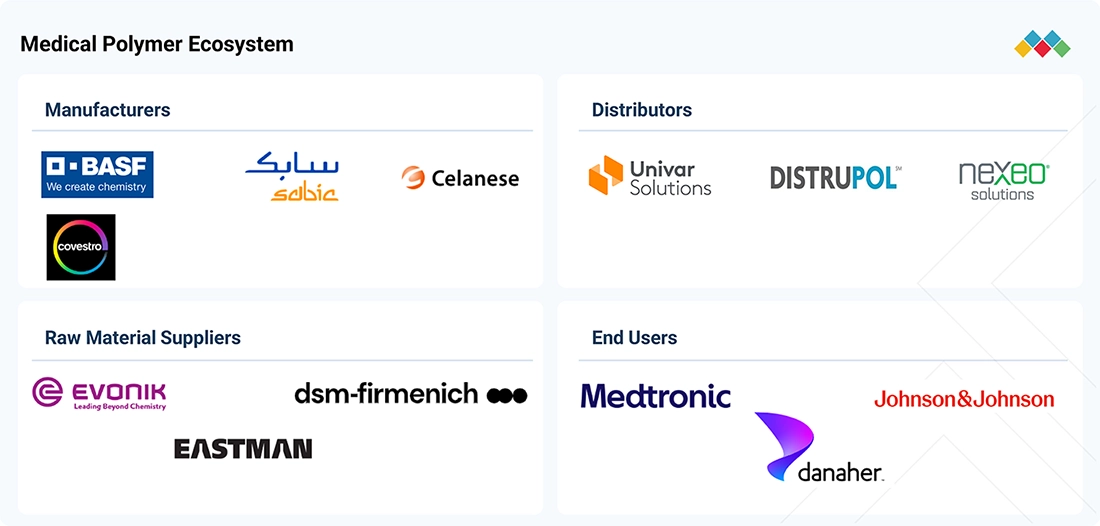
MEDICAL POLYMER MARKET: COMMERCIAL USE CASES ACROSS INDUSTRIES
| COMPANY | USE CASE DESCRIPTION | BENEFITS |
|---|---|---|
 |
BASF supplies Ultrason polyarylsulfone (PSU, PPSU, PESU) grades for healthcare applications, including respiratory devices, fluid collection containers, sterilization trays, diagnostic equipment, and orthopedic sizing components. It also offers custom-colored, USP Class V/VI and ISO 10993-compliant Ultrason grades, developed with partner Techmer PM, to remove the in-house color-blending step for device makers. | High-temperature resistance | Repeated steam/EtO sterilization tolerance | Custom-colorable, biocompatible grades reduce development cycles | Transparency retained after repeated sterilization | Chemical resistance exceeding polyamide/PC/POM/PBT |
 |
SABIC's LNP portfolio (ELCRES/ELCRIN CRX copolymers, EXL copolymers, LUBRILOY, SLX, ULTEM HU, SILTEM HU) serves device housings, insulin pumps, diagnostic imaging equipment, drug-delivery autoinjectors, surgical robot components, and medical tubing. The company backs this with a Healthcare Product Policy, management-of-change processes, and Centers of Excellence for OEM co-development. | High chemical resistance to aggressive disinfectants | Thin-wall, miniaturized device design enablement | Non-PFAS/non-fluorine compliant options | Biocompatible per ISO 10993 | Reduced carbon footprint on bio-based grades |
 |
Covestro provides Makrolon and Makroblend polycarbonate resins, Baymedix polyurethane adhesives/foams, Platilon TPU films, and Texin Rx TPU resins for drug-delivery devices, IV/luer components, on-body devices, wound care, and surgical instruments. It supports customers with design and material-selection guidance through final regulatory approval. | Biocompatibility per ISO 10993-1/USP Class IV | Gamma/e-Beam/ETO sterilization compatibility | High-flow grades for thin-wall, intricate designs | Chemical and oncology-drug resistance to prevent cracking | Renewable-content grades lower carbon footprint |
 |
Celanese supplies Hostaform/Celcon POM, Zytel nylon, GUR UHMW-PE, VitalDose EVA, and Vectra LCP for drug-delivery devices (inhalers, insulin pens, auto-injectors), orthopedic implants (hips/knees), and ventilator/respirator components. Its Hostaform MT SlideX grade is formulated specifically for low-friction mechanical drug-delivery devices. | Low friction/wear for patient comfort in wearables | Gold-standard biocompatibility for load-bearing implants | Vitamin E-stabilized grades resist implant oxidation | High impact and dimensional stability | Expanded portfolio via 2022 DuPont M&M acquisition |
Logos and trademarks shown above are the property of their respective owners. Their use here is for informational and illustrative purposes only.
Related Ecosystem
Resins And Polymers
- Polycarbonate
- Acrylonitrile Butadiene Styrene (ABS)
- Epoxy Resin
- Light Commercial Vehicles (LCVs)
- Polypropylene (PP)
- Basf se
- DOW CHEMICAL COMPANY
- Solvay sa
- Saudi arabia basic industries corporation (sabic)
- DuPont de Nemours, Inc.
Packaging
- Ampoules
- Gravure Process
- Rigid Packaging
- Aerosols
- Aseptic Filling and Sealing Equipment
- Amcor plc
- Essentra plc
- Berry Global Group, Inc.
- Mondi plc
- SEALED AIR CORPORATION
Key Takeaways
- The UK medical polymer market will expand from USD 1,416.1M (2025) to USD 1,902.1M (2030) at a 6.1% CAGR.
- The UK's advanced healthcare system and regulatory expertise drive demand for high-performance biocompatible polymers.
- Post-Brexit regulatory frameworks in the UK are reshaping supply chains and creating opportunities for domestic polymer manufacturers.
- Sustainability and circular economy principles are increasingly influencing UK medical polymer procurement and product development.
Medical Polymer Market Report Scope
| Report Metric | Details |
|---|---|
| Base Year | 2025 |
| Fastest Growing Segment | -PP (Type) |
| Forecast Period | 2025-2030 |
| Growth Rate | CAGR of 8.2% from 2025 to 2030 |
| Largest Segment | MEDICAL PLASTICS (Type) |
| Market Size Base Year (Billions) | ~USD 44.7 (2025) |
| Revenue Forecast (Billions) | ~USD 66.29 (2030) |
| Segments Covered | Type, Manufacturing Technology, Application |
UK Medical Polymer Market Report Segmentation
3 segment dimensions are covered across the global market.
By Type
- Medical Elastomers
- Medical Plastics
- -Engineering & High-Performance Plastics
- -Other Medical Elastomers
- -Other Medical Plastics
- -Pe
- -Pp
- -Ps
- -Pvc
- -Silicone
- -Thermoplastic Elastomers
- --Abs
- --Other Engineering & High-Performance Plastics
- --Pa
- --Pc
- --Peek
- --Pmma
- --Ppsu
- --Psu
- --Tpc-Et
- --Tps
- --Tpu
- --Tpv
- ---Sbc, Tpo, & Other Tps
- ---Sbs
- ---Sebs
By Manufacturing Technology
- Compression Molding
- Extrusion Tubing
- Injection Molding
- Other Manufacturing Technologies
By Application
- Diagnostic Instruments & Tools
- Medical Disposables
- Medical Instruments & Devices
- Other Applications
- Prosthetics
- -Catheters
- -Dental Tools
- -Drug Delivery
- -Drug Delivery Instruments
- -Gloves
- -Implants
- -Limb Prosthetics
- -Medical Bags
- -Medical Tube
- -Medical Tubes
- -Other Diagnostic Instruments & Tools
- -Other Medical Disposables
- -Other Medical Instruments & Devices
- -Other Prosthetics
- -Surgical Instruments
- -Syringes
UK: MEDICAL POLYMER MARKET, BY APPLICATION, 2025–2030
| Segment | 2025 | 2026 | 2027 | 2028 | 2029 | 2030 | CAGR (%) |
|---|---|---|---|---|---|---|---|
| DIAGNOSTIC INSTRUMENTS & TOOLS | 157.5 | 164.9 | 172.8 | 180.7 | 189.1 | 199.8 | 4.9 |
| MEDICAL DISPOSABLES | 430.8 | 458.2 | 487.8 | 518.2 | 551 | 591.1 | 6.5 |
| MEDICAL INSTRUMENTS & DEVICES | 508.8 | 541.8 | 577.5 | 614.3 | 654.2 | 703 | 6.7 |
| OTHER APPLICATIONS | 57.2 | 59.4 | 61.7 | 63.9 | 66.3 | 69.5 | 4 |
| PROSTHETICS | 261.8 | 275.1 | 289.4 | 303.8 | 319.2 | 338.6 | 5.3 |
| –CATHETERS | 160.9 | 171.5 | 183 | 194.9 | 207.7 | 223.4 | 6.8 |
| –DENTAL TOOLS | 59.2 | 61.4 | 63.6 | 65.8 | 68 | 71 | 3.7 |
| –DRUG DELIVERY | 62.7 | 65.9 | 69.4 | 73 | 76.7 | 81.5 | 5.4 |
| –GLOVES | 131.4 | 140 | 149.4 | 159 | 169.3 | 181.9 | 6.7 |
| –IMPLANTS | 123.9 | 131.1 | 138.8 | 146.6 | 155.1 | 165.5 | 6 |
| –LIMB PROSTHETICS | 91.2 | 95.4 | 99.8 | 104.3 | 109.1 | 115.2 | 4.8 |
| –MEDICAL BAGS | 94.6 | 99.6 | 105 | 110.4 | 116.2 | 123.4 | 5.5 |
| –MEDICAL TUBES | 210.4 | 226.9 | 244.8 | 263.6 | 283.9 | 308.5 | 8 |
| –OTHER DIAGNOSTIC INSTRUMENTS & TOOLS | 29.7 | 30.8 | 32.1 | 33.3 | 34.6 | 36.3 | 4.1 |
| –OTHER MEDICAL DISPOSABLES | 63 | 67.1 | 71.5 | 76.1 | 81 | 87.1 | 6.7 |
| –OTHER MEDICAL INSTRUMENTS & DEVICES | 74.8 | 77.4 | 80.2 | 82.9 | 85.8 | 89.6 | 3.7 |
| –OTHER PROSTHETICS | 46.7 | 48.7 | 50.8 | 52.8 | 55 | 57.9 | 4.4 |
| –SURGICAL INSTRUMENTS | 68.6 | 72.7 | 77.1 | 81.6 | 86.5 | 92.5 | 6.2 |
| –SYRINGES | 141.8 | 151.5 | 161.9 | 172.7 | 184.4 | 198.7 | 7 |
| TOTAL | 1416.1 | 1499.4 | 1589 | 1681 | 1779.8 | 1902.1 | 6.1 |
Target Audience
- Medical Device Manufacturers : UK and international device manufacturers need market intelligence to develop compliant products, identify growth segments, and establish distribution partnerships within the UK healthcare system.
- Polymer Suppliers & Producers : Raw material suppliers require UK-specific demand forecasts, application trends, and customer requirements to optimize production capacity and develop tailored medical-grade polymer solutions.
- Healthcare Investors & PE Firms : Investment professionals need comprehensive UK market data, growth projections, and competitive dynamics to evaluate acquisition targets and fund allocation decisions in the medical polymer sector.
- NHS & Healthcare Procurement : NHS trusts and healthcare procurement teams use market insights to understand supplier capabilities, pricing trends, and innovation in medical polymers for strategic sourcing decisions.
- Consultants & Strategy Advisors : Business consultants advising UK healthcare and materials companies require detailed market analysis, regulatory guidance, and competitive intelligence to develop effective market entry and expansion strategies.
Reasons to Buy this Report
- Market Size & Growth Data : Access precise UK market valuation (USD 1,416.1M in 2025) and 5-year forecast with 6.1% CAGR to inform investment decisions and competitive positioning in the UK medical polymer sector.
- Regulatory & Compliance Insights : Understand UK-specific regulatory requirements, MHRA standards, and post-Brexit compliance frameworks essential for launching and scaling medical polymer products in the British market.
- Competitive Landscape Analysis : Identify key UK and international players, market share distribution, and competitive strategies specific to the UK medical polymer market to benchmark your business performance.
- Segment & Application Breakdown : Gain detailed insights into UK demand across medical devices, orthopedic implants, cardiovascular applications, and drug delivery systems to prioritize product development and marketing efforts.
- Strategic Growth Opportunities : Discover emerging trends in biocompatible and biodegradable polymers, NHS procurement opportunities, and partnership potential with UK healthcare providers and manufacturers.
Frequently asked questions
What is the current size of the UK medical polymer market?
The UK medical polymer market is valued at USD 1,416.1 million in 2025 and is expected to reach USD 1,902.1 million by 2030.
What is the growth rate of the UK medical polymer market?
The UK medical polymer market is projected to grow at a compound annual growth rate (CAGR) of 6.1% from 2025 to 2030.
Which applications drive demand for medical polymers in the UK?
Key applications in the UK include surgical devices, orthopedic implants, cardiovascular devices, drug delivery systems, and diagnostic equipment, all requiring biocompatible and durable polymer materials.
How has Brexit impacted the UK medical polymer market?
Post-Brexit, the UK has developed independent regulatory pathways and is strengthening domestic manufacturing capabilities, creating new opportunities for UK-based polymer suppliers while requiring supply chain adjustments.
What regulatory standards govern medical polymers in the UK?
The UK follows stringent standards including ISO 10993 for biocompatibility, MHRA regulations for medical devices, and increasingly, sustainability and environmental compliance requirements aligned with UK environmental policy.
RESEARCH METHODOLOGY
The study involved four major activities for estimating the current size of the global medical polymer market. Exhaustive secondary research was conducted to collect information on the market, the peer product market, and the parent product group market. The next step was to validate these findings, assumptions, and sizes with industry experts across the value chain of medical polymers through primary research. Both the top-down and bottom-up approaches were employed to estimate the overall size of the medical polymer market. After that, market breakdown and data triangulation procedures were used to determine the size of different segments and sub-segments of the market.
Secondary Research
In the secondary research process, various secondary sources such as Hoovers, Factiva, Bloomberg BusinessWeek, and Dun & Bradstreet were referred to identify and collect information for this study on the medical polymer market. These secondary sources included annual reports, press releases & investor presentations of companies; white papers; certified publications; articles by recognized authors; regulatory bodies, trade directories, and databases.
Primary Research
The medical polymer market comprises several stakeholders in the supply chain, which include raw material suppliers, distributors, end-product manufacturers, buyers, and regulatory organizations. Various primary sources from the supply and demand sides of the market have been interviewed to obtain qualitative and quantitative information. The primary participants from the demand side include key opinion leaders, executives, vice presidents, and CEOs of companies in the medical polymer market. Primary sources from the supply side include associations and institutions involved in the medical polymer market, key opinion leaders, and processing players.
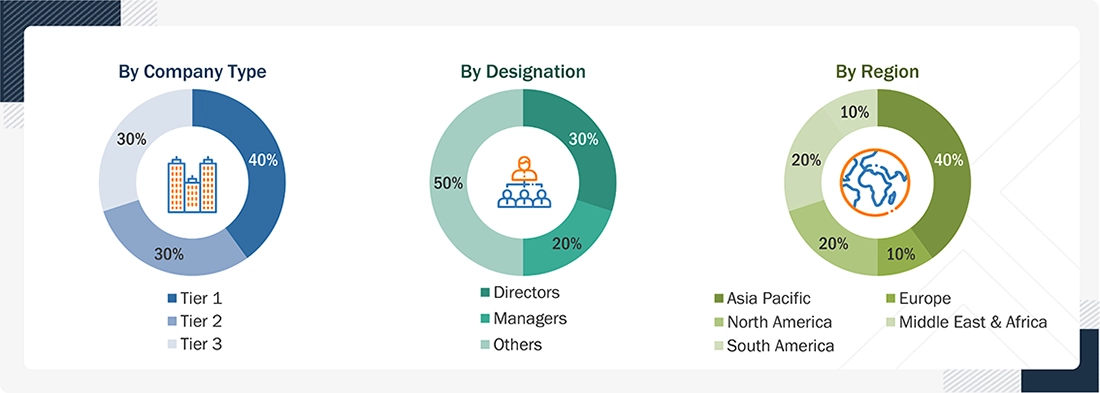
To know about the assumptions considered for the study, download the pdf brochure
Market Size Estimation
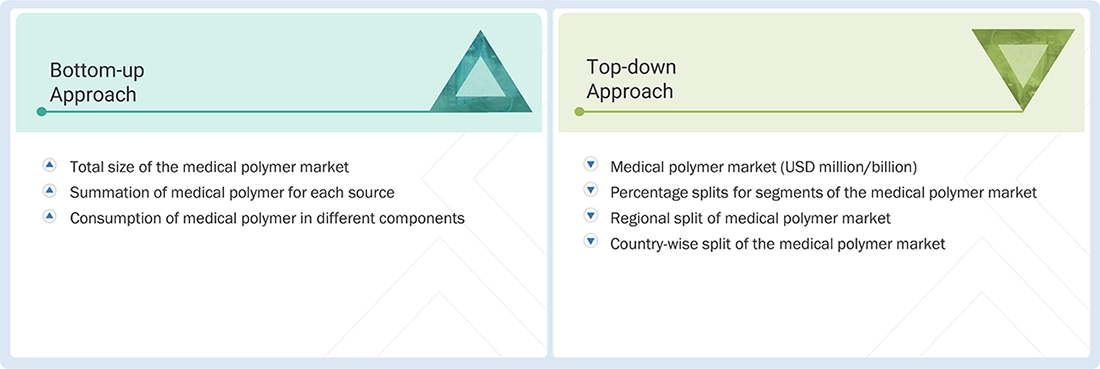
The bottom-up and top-down approaches have been used to estimate the medical polymer market by type, application, manufacturing technology, and region. The research methodology used to calculate the market size includes the following steps:
- The key players in the industry were identified through extensive secondary research.
- In terms of value, the industry’s supply chain and market size were determined through primary and secondary research processes.
- All percentage shares, splits, and breakdowns were determined using secondary sources and verified through primary sources.
- All possible parameters that affect the markets covered in this research study were accounted for, viewed in extensive detail, verified through primary research, and analyzed to obtain the final quantitative and qualitative data.
- The research included studying reports, reviews, and newsletters of top market players and extensive interviews with leaders such as directors and marketing executives to obtain opinions.
The following figure illustrates the overall market size estimation process employed for this study.
Data Triangulation
After arriving at the overall size of the medical polymer market from the estimation process explained above, the total market was split into several segments and sub-segments. The data triangulation and market breakdown procedures were employed, wherever applicable, to complete the overall market engineering process and arrive at the exact statistics for all segments and subsegments. The data was triangulated by studying various factors and trends from both the demand and supply sides. Along with this, the market size was validated using both the top-down and bottom-up approaches.
Market Definition
The medical polymer market represents the industry that develops and implements polymer materials intended for medical and healthcare purposes. In the medical sector, these polymers must adhere to strict specifications related to biocompatibility, durability, elasticity and sterilization or aseptic requirements. Various medical products, like surgical instruments, implants, diagnostic devices, drug delivery systems, and disposables, including syringes and gloves, use medical polymers. The market includes many different types of polymers, including medical plastics, elastomer polymers, and biodegradable polymers. The medical polymer market is an important institutional component in the advancement of modern health care through affordable, safe, efficient medical solutions.
Key Stakeholders
- Medical Polymer Manufacturers
- Raw Material Suppliers
- Regulatory Bodies and Government Agencies
- Distributors and Suppliers
- End-Use Industries
- Associations and Industrial Bodies
- Market Research and Consulting Firms
Report Objectives
- To define, describe, and forecast the size of the medical polymer market in terms of value and volume
- To provide detailed information regarding the key factors influencing the growth of the market (drivers, restraints, opportunities, and challenges)
- To forecast the market size based on type, application, manufacturing technology, and region
- To forecast the market size for the five main regions—North America, Europe, Asia Pacific (APAC), South America, and the Middle East & Africa (MEA)—along with their key countries
- To strategically analyze micro markets with respect to individual growth trends, prospects, and contributions to the total market
- To analyze the opportunities in the market for stakeholders and provide details of the competitive landscape for the market leaders
- To strategically profile leading players and comprehensively analyze their key developments such as new product launches, expansions, and deals in the medical polymer market
- To strategically profile key players and comprehensively analyze their market shares and core competencies
- To study the impact of AI/Gen AI on the market under study, along with the macroeconomic outlook
Available customizations:
With the given market data, MarketsandMarkets offers customizations per the specific needs of companies.
The following customization options are available for the report:
PRODUCT ANALYSIS
- Product matrix, which provides a detailed comparison of the market for different sources of medical polymer.
REGIONAL ANALYSIS
- Further breakdown of a country with respect to the medical polymer market.
COMPANY INFORMATION
- Detailed analysis and profiling of additional market players
Get the Full Medical Polymer Market Report
Full forecast, segment splits, and company analysis for all Medical Polymer Market.
- US Medical Polymer Market
- Canada Medical Polymer Market
- Mexico Medical Polymer Market
- Germany Medical Polymer Market
- France Medical Polymer Market
- Italy Medical Polymer Market
- Spain Medical Polymer Market
- China Medical Polymer Market
- Japan Medical Polymer Market
- India Medical Polymer Market
- South Korea Medical Polymer Market
- Australia Medical Polymer Market
- South Africa Medical Polymer Market
- Brazil Medical Polymer Market
- Argentina Medical Polymer Market
- Rest Of Europe Medical Polymer Market
- Rest Of Asia Pacific Medical Polymer Market
- GCC Medical Polymer Market
- -Rest Of GCC Medical Polymer Market
- Rest Of South America Medical Polymer Market
Need a Tailored Report?
Customize this report to your needs
Get 10% FREE Customization
Customize This Report
