
BRAZIL Medical Tubing Market (2025-2030)

The BRAZIL Medical Tubing Market was valued at $138.5 Million in 2025 and projected to reach to $192.8 Million by 2030, representing a compound annual growth rate of 6.8%. Brazil's medical tubing market is poised for sustained expansion driven by healthcare sector modernization and increased investment in medical infrastructure.


| Market Size in | USD 26.32 MN |
| Market Forecast in | |
| CAGR | |
| Forecast Period | |
| Units Considered | Value (USD MN) |
BRAZIL Medical Tubing Market Trends and Insights
- This expansion reflects Brazil's increasing healthcare infrastructure investments and rising demand for advanced medical devices across hospitals, diagnostic centers, and home care settings.
- The market in Brazil is driven by growing patient populations, improved access to healthcare services, and the adoption of minimally invasive surgical procedures that rely heavily on specialized tubing solutions. The 6.8% compound annual growth rate (CAGR) positions Brazil as a significant player in the South American medical tubing sector.
- Brazil's market growth is supported by regulatory improvements, local manufacturing capabilities, and partnerships between domestic and international medical device manufacturers.
- Between 2025 and 2030, Brazil is expected to see increased demand for silicone, PVC, and polyurethane tubing variants used in cardiovascular, respiratory, and urological applications. Brazil's competitive landscape includes both multinational corporations and emerging local manufacturers, creating opportunities for innovation and market consolidation.
- The country's strategic importance in Latin America makes it a key focus for medical device companies seeking to expand their regional presence and capitalize on growing healthcare spending..
Key Market Statistics
- CAGR (2025-2030) 6.8% CAGR
- Market Size, 2025 ~USD 138.5 Million
- Forecast, 2030 ~USD 192.8 Million
- Country BRAZIL
BRAZIL Medical Tubing Market Overview
Market Valuation Growth :
Brazil's medical tubing market is valued at USD 138.5 million in 2025, with a projected CAGR of 6.8% through 2030, reaching USD 192.8 million. This steady growth trajectory reflects increasing healthcare modernization across the country.
Healthcare Infrastructure Expansion :
Brazil is investing significantly in healthcare infrastructure development, particularly in hospitals, diagnostic centers, and home care facilities. These investments are driving demand for high-quality medical tubing solutions across multiple healthcare settings.
Rising Patient Population Demand :
Growing patient populations and increased prevalence of chronic diseases in Brazil are creating sustained demand for advanced medical devices and tubing solutions. This demographic shift is a key growth driver for the market.
Regional Market Positioning :
Brazil represents a significant opportunity within Latin America's medical device sector. The country's market growth rate of 6.8% demonstrates strong potential compared to global CAGR of 8%, indicating localized market maturity and opportunity.
BRAZIL Medical Tubing Market Dynamics
- The country's growing patient population and rising prevalence of chronic conditions are creating consistent demand for advanced tubing solutions across hospitals, diagnostic centers, and home care settings.
- Government healthcare initiatives and private sector investments are strengthening the market foundation. Looking ahead to 2030, Brazil's medical tubing market will benefit from technological advancements in medical device manufacturing and increasing adoption of minimally invasive procedures.
- The projected growth to USD 192.8 million reflects confidence in Brazil's healthcare sector development and the country's strategic importance as a regional medical device hub in Latin America..
Market Ecosystem
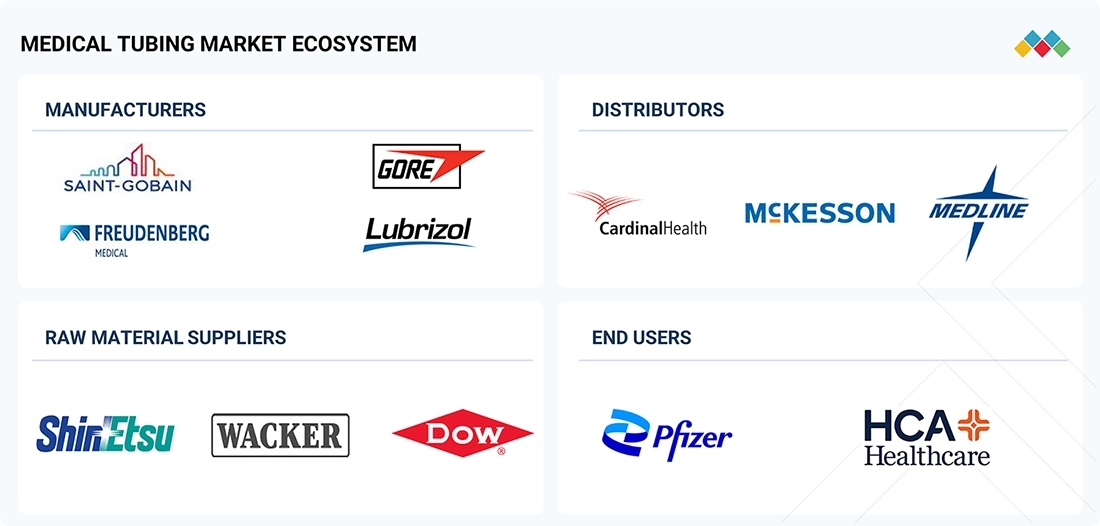
MEDICAL TUBING MARKET: COMMERCIAL USE CASES ACROSS INDUSTRIES
| COMPANY | USE CASE DESCRIPTION | BENEFITS |
|---|---|---|
 |
Saint-Gobain manufactures a broad portfolio of medical-grade tubing, including silicone, thermoplastic elastomer (TPE), PVC, and specialty polymer tubing used in IV infusion systems, peristaltic pumps, catheters, biopharmaceutical processing, and surgical drainage applications. | Its medical tubing offers excellent chemical compatibility with common drug formulations, low extractables and leachables profiles, consistent dimensional tolerances for leak-free connections, and kink resistance critical for uninterrupted fluid delivery in clinical settings. |
 |
Freudenberg Medical specializes in silicone, PEEK, polyurethane, multi-lumen, and micro-extruded tubing for catheter systems, implantable devices, biopharmaceutical fluid transfer, and minimally invasive procedures. | Its tubing solutions withstand high burst pressures without deformation, maintain dimensional stability across sterilization cycles (including EtO and gamma irradiation), exhibit low protein adsorption for drug-contact lumens, and offer custom multi-lumen configurations that reduce device assembly complexity. |
 |
Lubrizol provides provides medical-grade thermoplastic polyurethane (TPU) materials used in catheter shafts, vascular access devices, drug delivery systems, and minimally invasive medical devices. | Lubrizol's tubing materials are inherently biocompatible and hemocompatible for blood-contacting applications, resistant to kinking and permanent deformation, bondable with standard medical adhesives, sterilization-compatible, and capable of being co-extruded with radiopaque fillers or drug-eluting compounds for advanced catheter functionality. |
 |
W. L. Gore & Associates manufactures ePTFE and fluoropolymer-based tubing used in bioprocessing fluid transfer lines, minimally invasive surgical tubing, and high-purity pharmaceutical fluid pathways. | Gore's tubing provides exceptional resistance to a wide range of aggressive pharmaceutical solvents and sterilants, ultra-smooth inner bore surfaces that minimize particulate shedding and bacterial adhesion, stable flow performance under pressure fluctuations, and compliance with FDA 21 CFR and USP standards for use in drug manufacturing and delivery environments. |
Logos and trademarks shown above are the property of their respective owners. Their use here is for informational and illustrative purposes only.
Related Ecosystem
Resins And Polymers
- Polycarbonate
- Acrylonitrile Butadiene Styrene (ABS)
- Epoxy Resin
- Light Commercial Vehicles (LCVs)
- Polypropylene (PP)
- Basf se
- DOW CHEMICAL COMPANY
- Solvay sa
- Saudi arabia basic industries corporation (sabic)
- DuPont de Nemours, Inc.
Medical Devices
- Polymerase Chain Reaction (PCR)
- Magnetic Resonance Imaging (MRI)
- Disposable Autoinjectors
- Pulse Oximeters
- Blood Pressure Monitors
- Medtronic plc
- Abbott Laboratories
- Stryker Corporation
- Becton, Dickinson and Company
- CONMED Corporation
Packaging
- Ampoules
- Gravure Process
- Rigid Packaging
- Aerosols
- Aseptic Filling and Sealing Equipment
- Amcor plc
- Essentra plc
- Berry Global Group, Inc.
- Mondi plc
- SEALED AIR CORPORATION
Key Takeaways
- Brazil's medical tubing market will grow from USD 138.5 million (2025) to USD 192.8 million (2030) at a 6.8% CAGR.
- Brazil's healthcare infrastructure expansion and minimally invasive procedure adoption are primary growth catalysts.
- Silicone, PVC, and polyurethane tubing dominate Brazil's market across cardiovascular, respiratory, and urological applications.
- Brazil attracts both multinational and local manufacturers, fostering competitive innovation and regional market consolidation.
Medical Tubing Market Report Scope
| Report Metric | Details |
|---|---|
| Base Year | 2025 |
| Fastest Growing Segment | SPECIALTY POLYMERS (Material) |
| Forecast Period | 2025–2030 |
| Growth Rate | CAGR of 8% from 2025 to 2030 |
| Largest Segment | MULTI-LUMEN (Structure) |
| Market Size Base Year (Billions) | ~USD 12.53 (2025) |
| Revenue Forecast (Billions) | ~USD 18.41 (2030) |
| Segments Covered | Application, Material, Structure |
BRAZIL Medical Tubing Market Report Segmentation
3 segment dimensions are covered across the global market.
By Application
- Bulk Disposable Tubing
- Catheters & Cannulas
- Drug Delivery Systems
- Other Applications
By Material
- Other Materials
- Plastics
- Rubbers
- Specialty Polymers
By Structure
- Braided Tubing
- Co-Extruded
- Multi-Lumen
- Single-Lumen
- Tapered Or Bump Tubing
BRAZIL: MEDICAL TUBING MARKET, BY APPLICATION, 2025–2030
| Segment | 2025 | 2026 | 2027 | 2028 | 2029 | 2030 | CAGR (%) |
|---|---|---|---|---|---|---|---|
| BULK DISPOSABLE TUBING | 150.8 | 164.4 | 179.2 | 195.2 | 206.5 | 220.7 | 7.9 |
| CATHETERS & CANNULAS | 198.5 | 216.6 | 236.4 | 257.7 | 272.6 | 291.4 | 8 |
| DRUG DELIVERY SYSTEMS | 36.8 | 40.2 | 44 | 48.1 | 50.9 | 54.4 | 8.1 |
| OTHER APPLICATIONS | 26.9 | 29.2 | 31.8 | 34.5 | 36.5 | 39.1 | 7.8 |
| TOTAL | 413 | 450.4 | 491.4 | 535.5 | 566.6 | 605.6 | 8 |
Target Audience
- Medical Device Manufacturers : Manufacturers need Brazil-specific market data to develop localized product strategies, assess manufacturing opportunities, and identify distribution channels in this growing Latin American market.
- Healthcare Providers & Hospitals : Hospital administrators and procurement teams require market insights to understand tubing supply trends, pricing dynamics, and supplier availability to optimize procurement decisions and budget planning.
- Investment & Private Equity Firms : Investors evaluating opportunities in Brazil's healthcare sector need detailed market analysis to assess growth potential, competitive landscape, and risk factors for medical device companies operating in the region.
- Market Consultants & Analysts : Consulting firms and research analysts require Brazil-specific data to support client advisory services, competitive intelligence reports, and strategic recommendations for healthcare and medical device sectors.
- Distributors & Supply Chain Partners : Medical device distributors and logistics providers need market forecasts and demand projections to optimize inventory management, distribution networks, and partnership strategies in Brazil's healthcare market.
Key Companies in the BRAZIL Medical Tubing Market
| Company | HQ | Ownership | Strongest segments |
|---|---|---|---|
| WANHUA CHEMICAL GROUP CO., LTD | China | Public Company | Polyurethane (isocyanates and polyether polyols),Petrochemical (olefin derivatives, ethylene, chlorine products),Fine Chemicals and New Materials, |
| MERIT MEDICAL | United States | Public Company | Cardiovascular (cardiac access, angiography, electrophysiology support, fluid management, hemodynamic monitoring, hemostasis, intervention),Peripheral Intervention & Oncology (angiography, drainage, delivery systems, embolotherapy, soft tissue biopsy),Endoscopy (gastroenterology and pulmonary: stents, cryoballoon devices, balloon dilators, kits), |
| MOL GROUP | Hungary | Public Company | Refined fuels (gasoline, diesel, heating oil, bunker, JET A-1, LPG/autogas),Petrochemicals and black products (bitumen, HFO, petrolcoke, residues),Retail convenience and mobility services (Fresh Corner, e-mobility, car/bike sharing, fleet), |
| BOREALIS AG | United States | Private Company | Polyethylene solutions,Polypropylene solutions,Recycled and circular polyolefin materials, |
| APTARGROUP, INC. | United States | Public Company | Pharma (drug delivery and elastomeric components),Beauty (fragrance, skincare, color cosmetics dispensing),Closures and Home/Food Dispensing, |
| SAINT-GOBAIN | France | Public Company | Plasterboard, ceilings, and interior systems,Insulation solutions,Mortars and construction chemicals, |
| THE LUBRIZOL CORPORATION | United States | Private Company | Lubricant additives (engine oils, driveline, industrial lubricants),Fuel additives and transportation-related fluids,Specialty polymers, CPVC piping systems, and engineered polymers, |
| NORDSON CORPORATION | United States | Public Company | Industrial Precision Solutions,Medical and Fluid Solutions,Advanced Technology Solutions, |
| TE CONNECTIVITY | Ireland | Public Company | Transportation Solutions (automotive, e-mobility, commercial vehicles, autosport, rail),Industrial Solutions (automation, machinery, energy, intelligent buildings, rail, aerospace/defense, oil and gas/marine),Communications & Devices (5G, wireless, data centers, personal electronics, connected home, IoT), |
| ELKEM ASA | Norway | Public Company | Silicones,Silicon Products,Carbon Solutions, |
| TRELLEBORG AB | Sweden | Public Company | Industrial sealing and profiles (bearings, bushings, pipe and tunnel seals, flat gaskets),Antivibration, noise and vibration damping (automotive, rail, industrial equipment),Marine and infrastructure (ship and port fenders, docking, mooring, bridge expansion joints, embedded rail), |
| ZEUS COMPANY LLC | United States | Private Company | Carbon and coated sheet, plate, and coil,Stainless steel sheet, plate, bar, and coil,Aluminum sheet, plate, and coil, |
WANHUA CHEMICAL GROUP CO., LTD
Wanhua Chemical Group Co., Ltd is a Chinese public company founded in 1978 that employs 30,772 people and operates in the chemical industry.
MERIT MEDICAL
Merit Medical is a United States-based public company founded in 1987 with 7,500 employees, operating in the medical device sector.
MOL GROUP
MOL Group is a Hungarian public company founded in 1991 with 24,744 employees, operating primarily in the oil and gas industry.
BOREALIS AG
Borealis AG is a United States-based private company founded in 1994 with 5,887 employees, operating in the chemical and plastics industry.
APTARGROUP, INC.
AptarGroup, Inc. is a United States public company founded in 1992 with 14,000 employees, specializing in dispensing and sealing solutions.
SAINT-GOBAIN
Saint-Gobain is a French public company founded in 1665 with 158,616 employees, operating as a global leader in building materials and high-performance solutions.
THE LUBRIZOL CORPORATION
The Lubrizol Corporation is a United States-based private company founded in 1928 with 7,000 employees, producing specialty chemicals and lubricants.
NORDSON CORPORATION
Nordson Corporation is a United States public company founded in 1909 with 8,200 employees, specializing in precision dispensing and coating equipment.
TE CONNECTIVITY
TE Connectivity is an Ireland-based public company founded in 1941 with 80,000 employees, operating as a global leader in connectivity and sensor solutions.
ELKEM ASA
Elkem ASA is a Norwegian public company founded in 1904 with 7,000 employees, producing specialty materials and silicones for various industries.
TRELLEBORG AB
Trelleborg AB is a Swedish public company founded in 1905 with 15,756 employees, specializing in engineered polymer solutions and sealing systems.
ZEUS COMPANY LLC
Zeus Company LLC is a United States-based private company founded in 1954 with 2,181 employees, manufacturing specialty tubing and medical device components.
Reasons to Buy this Report
- Localized Market Intelligence : Gain Brazil-specific insights on market size, growth rates, and forecast projections. Understand the unique dynamics driving the 6.8% CAGR and identify opportunities specific to the Brazilian healthcare landscape.
- Strategic Investment Planning : Make informed decisions about market entry, expansion, or partnership opportunities in Brazil. Leverage detailed market valuation data (USD 138.5M to USD 192.8M) to assess ROI potential and competitive positioning.
- Healthcare Sector Trends : Understand Brazil's healthcare infrastructure investments and their impact on medical tubing demand. Identify growth drivers across hospitals, diagnostic centers, and home care settings specific to the Brazilian market.
- Competitive Benchmarking : Compare Brazil's market performance against global trends (8% global CAGR vs. 6.8% Brazil CAGR). Identify market gaps and competitive advantages for product positioning and market penetration strategies.
- Demand Forecasting : Access reliable 2025-2030 forecast data to plan production capacity, supply chain logistics, and distribution networks. Align business strategies with projected market expansion and patient population growth in Brazil.
Frequently asked questions
What is the current size of Brazil's medical tubing market?
Brazil's medical tubing market is valued at USD 138.5 million in 2025 and is expected to reach USD 192.8 million by 2030.
What is the projected growth rate for Brazil's medical tubing market?
Brazil's medical tubing market is projected to grow at a compound annual growth rate (CAGR) of 6.8% from 2025 to 2030.
Which material types dominate Brazil's medical tubing market?
Silicone, PVC, and polyurethane are the dominant material types in Brazil's medical tubing market, used across cardiovascular, respiratory, and urological applications.
What factors are driving growth in Brazil's medical tubing market?
Key growth drivers in Brazil include expanding healthcare infrastructure, rising patient populations, improved healthcare access, and increased adoption of minimally invasive surgical procedures.
Who are the main competitors in Brazil's medical tubing market?
Brazil's medical tubing market includes both multinational medical device corporations and emerging local manufacturers competing for market share.
RESEARCH METHODOLOGY
The study involved four major activities to estimate the current size of the global medical tubing market. Exhaustive secondary research was conducted to gather information on the market, the peer product market, and the parent product group market. The next step was to validate these findings, assumptions, and sizes with industry experts across the medical tubing value chain through primary research. The top-down and bottom-up approaches were employed to estimate the overall size of the medical tubing market. After that, market breakdown and data triangulation procedures were used to determine the sizes of the market's different segments and subsegments.
Secondary Research
The market for companies offering medical tubing is arrived at by secondary data available through paid and unpaid sources, analyzing the product portfolios of the major companies in the ecosystem, and rating the companies by their performance and quality. Various secondary sources, such as Business Standard, Bloomberg, World Bank, and Factiva, were referred to identify and collect information for this study on the medical tubing market. In the secondary research process, various secondary sources were referred to identify and collect information related to the study. Secondary sources included annual reports, press releases, and investor presentations of door vendors, forums, certified publications, and whitepapers. Secondary research was used to obtain critical information on the industry’s value chain, key players, market classification, and segmentation from market- and technology-oriented perspectives.
Primary Research
In the primary research process, various primary sources from both the supply and demand sides were interviewed to obtain qualitative and quantitative information for this report. The primary sources from the supply side included industry experts, such as Chief Executive Officers (CEOs), Vice Presidents (VPs), marketing directors, technology and innovation directors, and related key executives from several key companies and organizations operating in the medical tubing market. After the complete market engineering (calculations for market statistics, market breakdown, market size estimates, market forecasting, and data triangulation), extensive primary research was conducted to gather information and verify and validate the critical numbers derived. Primary research was also conducted to identify segmentation types, industry trends, the competitive landscape of medical tubing among various market players, and key market dynamics, including drivers, restraints, opportunities, challenges, and key players' strategies. In the complete market engineering process, the top-down and bottom-up approaches and several data triangulation methods were extensively used to perform the market estimation and market forecasting for the overall market segments and subsegments listed in this report. Extensive qualitative and quantitative analyses were conducted on the complete market engineering process to identify key information/insights throughout the report.
The following is the breakdown of primary respondents:
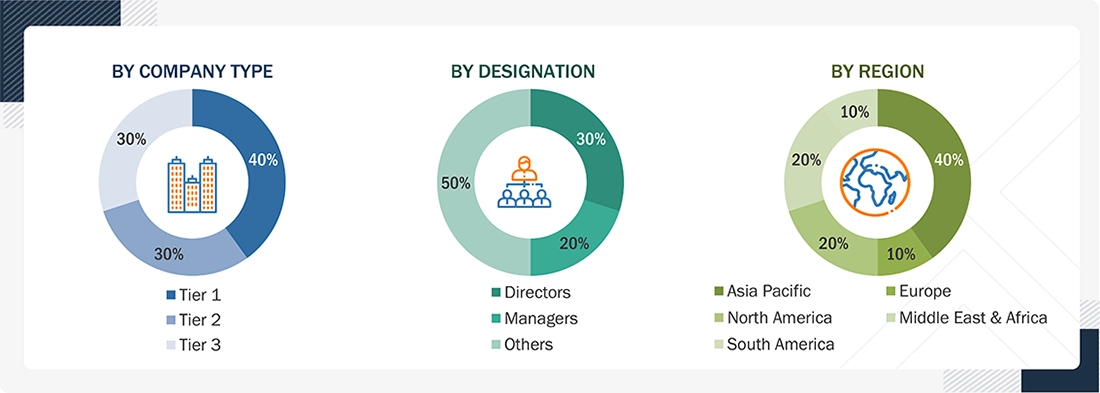
Note 1: Others include sales, marketing, and product managers.
Note 2: Tier 1: >USD 1 Billion; Tier 2: USD 500 million–1 Billion; and Tier 3: <USD 500 million.
To know about the assumptions considered for the study, download the pdf brochure
Market Size Estimation
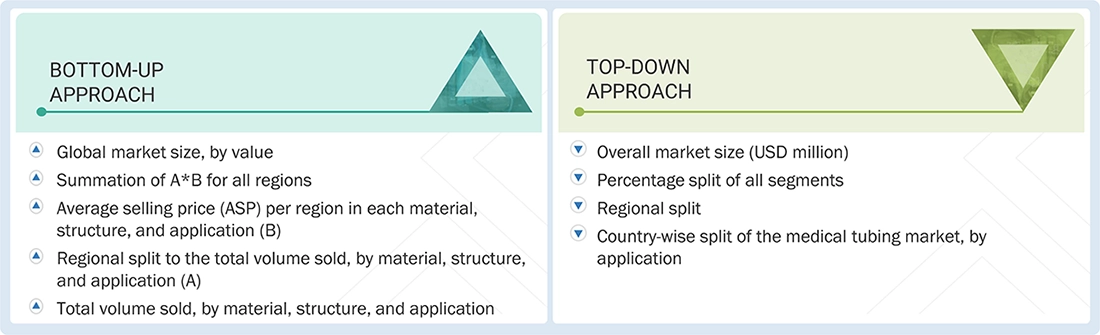
The top-down and bottom-up approaches were used to estimate and validate the size of the global medical tubing market. These approaches were also used extensively to estimate the size of various dependent market segments. The research methodology used to estimate the market size included the following:
Medical Tubing Market : Top-Down and Bottom-Up Approach
Data Triangulation
After arriving at the overall market size using the market size estimation processes, the market was split into several segments and subsegments. The data triangulation and market breakup procedures were employed, where applicable, to complete the overall market engineering process and derive the exact statistics for each market segment and subsegment. The data was triangulated by studying various factors and trends from both the demand and supply sides.
Market Definition
Medical tubing consists of high-quality tubes primarily used in medical devices and hospital systems to safely transport gases, liquids, and other medically important materials. To achieve the best biological compatibility, flexibility, chemical resistance, and sterilizability, medical-grade materials are chosen. Manufacturing techniques such as accurate extrusion, co-extrusion, braiding, and other quality production processes result in tubing with very precise sizes and mechanical properties that are simply superior.
Medical tubing manufacturers predominantly rely on plastics, rubber, and various specialty polymers as raw materials for their products. Medical tubing can be available in several forms, such as single-lumen, multi-lumen, co-extruded, and braided configurations, to meet the requirements of various medical devices. Medical tubing can deliver fluids and gases in a safe and reliable manner, and so it can find several uses in bulk disposable tubing, catheters & cannulas, drug delivery systems, and other medical applications where it is a necessity. Medical tubing is one of the main materials for devices and pharmaceuticals, biotechnology, diagnostics, and healthcare areas, in which its applications span across infusion, dialysis, progressive ventilators, surgical operations through minimal incisions, different laboratory equipment, and other healthcare systems that require very precise levels of purity and that meet regulatory compliance standards.
Key Stakeholders
- Medical tubing manufacturers
- Medical-grade material suppliers
- Medical device manufacturers
- Pharmaceutical and biotechnology companies
- Healthcare providers (hospitals, clinics, and ambulatory surgical centers)
- Regulatory bodies and industry associations
- Research institutes and diagnostic laboratories
Report Objectives
- To define, describe, and forecast the size of the global medical tubing market, based on material, structure, application, and region in terms of value.
- To provide detailed information on the significant drivers, restraints, opportunities, and challenges influencing the market
- To strategically analyze micromarkets concerning individual growth trends, prospects, and their contribution to the market
- To assess the growth opportunities in the market for stakeholders and provide details on the competitive landscape for market leaders
- To forecast the market size of segments and subsegments for North America, Europe, Asia Pacific, South America, and the Middle East & Africa
- To strategically profile key players and comprehensively analyze their market shares and core competencies
- To analyze competitive developments such as product launches, acquisitions, expansions, partnerships, and agreements in the medical tubing market
- To provide the impact of AI/Gen AI on the market
Available customizations:
With the given market data, MarketsandMarkets offers customizations according to client-specific needs.
The following customization options are available for the medical tubing market report:
Product analysis
-
A product matrix that gives a detailed comparison of the product portfolio of each company
Geographic analysis
-
A further breakdown of the medical tubing market for additional countries
Company information
-
Detailed analysis and profiling of additional market players (up to five)
Get the Full Medical Tubing Market Report
Full forecast, segment splits, and company analysis for all Medical Tubing Market.
- US Medical Tubing Market
- CANADA Medical Tubing Market
- MEXICO Medical Tubing Market
- GERMANY Medical Tubing Market
- FRANCE Medical Tubing Market
- UK Medical Tubing Market
- SPAIN Medical Tubing Market
- ITALY Medical Tubing Market
- The Netherlands Medical Tubing Market
- CHINA Medical Tubing Market
- JAPAN Medical Tubing Market
- INDIA Medical Tubing Market
- SOUTH KOREA Medical Tubing Market
- Saudi Arabia Medical Tubing Market
- UAE Medical Tubing Market
- SOUTH AFRICA Medical Tubing Market
- EGYPT Medical Tubing Market
- ARGENTINA Medical Tubing Market
- South America Medical Tubing Market
- Rest Of Europe Medical Tubing Market
- Rest Of Asia Pacific Medical Tubing Market
- GCC Countries Medical Tubing Market
Need a Tailored Report?
Customize this report to your needs
Get 10% FREE Customization
Customize This Report
