
Rest Of Asia Pacific Micro-Electro-Mechanical System (MEMS) Market (2025-2030)

The Rest Of Asia Pacific Micro-Electro-Mechanical System (MEMS) Market was valued at $401.8 Million in 2025 and projected to reach to $525 Million by 2030, representing a compound annual growth rate of 5.5%. Rest Of Asia Pacific is poised for sustained MEMS market expansion driven by increasing digitalization, IoT proliferation, and automotive electrification across emerging economies.


| Market Size in | USD 26.32 MN |
| Market Forecast in | |
| CAGR | |
| Forecast Period | |
| Units Considered | Value (USD MN) |
Rest Of Asia Pacific Micro-Electro-Mechanical System (MEMS) Market Trends and Insights
- The region's market was valued at USD 401.8 million in 2025 and is forecast to expand to USD 525.0 million by 2030, driven by rising demand for consumer electronics, automotive sensors, and industrial automation.
- Rest Of Asia Pacific's 5.5% compound annual growth rate outpaces the global average, reflecting accelerating semiconductor adoption and manufacturing expansion across emerging economies in the region. Rest Of Asia Pacific benefits from a diverse industrial base spanning telecommunications, healthcare devices, and IoT applications.
- The region's competitive cost structure and growing investment in semiconductor fabrication facilities position Rest Of Asia Pacific as an attractive hub for MEMS production and innovation.
- Rest Of Asia Pacific's trajectory through 2030 underscores the region's pivotal role in global MEMS supply chains and technology advancement..
Key Market Statistics
- CAGR (2025-2030) 5.5% CAGR
- Market Size, 2025 ~USD 401.8 Million
- Forecast, 2030 ~USD 525 Million
- Country Rest Of Asia Pacific
Rest Of Asia Pacific Micro-Electro-Mechanical System (MEMS) Market Overview
Market Valuation Growth :
Rest Of Asia Pacific MEMS market valued at USD 401.8 million in 2025, expanding to USD 525.0 million by 2030, representing robust regional expansion opportunities.
Regional CAGR Outperformance :
Rest Of Asia Pacific's 5.5% CAGR significantly outpaces the global MEMS market growth rate of 4.6%, positioning the region as a high-growth investment corridor.
Key Growth Drivers :
Rising demand for consumer electronics, automotive sensors, and industrial automation applications are primary catalysts fueling Rest Of Asia Pacific's accelerated MEMS adoption and market penetration.
Strategic Market Position :
Rest Of Asia Pacific represents a significant growth corridor within the broader Asia Pacific MEMS ecosystem, offering untapped potential for manufacturers and technology providers.
Rest Of Asia Pacific Micro-Electro-Mechanical System (MEMS) Market Dynamics
- The region's 5.5% CAGR reflects strong demand from consumer electronics manufacturers seeking advanced sensor solutions and industrial automation upgrades.
- Government initiatives supporting semiconductor manufacturing and rising disposable incomes are accelerating MEMS adoption in smartphones, wearables, and smart home devices. The forecast period through 2030 will witness intensified competition among regional and global MEMS suppliers targeting Rest Of Asia Pacific's growing middle class and industrial sectors.
- Investment in local manufacturing capabilities, strategic partnerships with OEMs, and development of cost-effective sensor solutions will be critical success factors.
- The region's expanding automotive and healthcare sectors present significant opportunities for pressure sensors, accelerometers, and gyroscopes..
Market Ecosystem
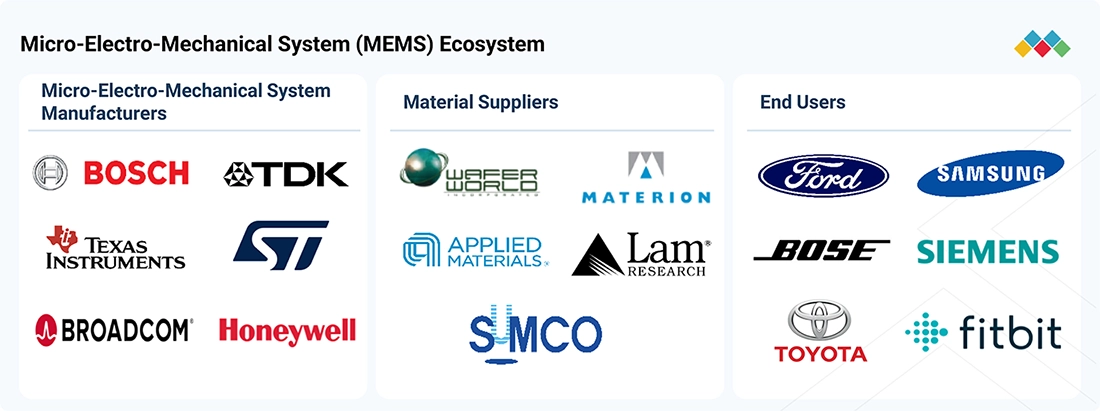
MICRO-ELECTRO-MECHANICAL SYSTEM (MEMS) MARKET SIZE, SHARE AND TRENDS: COMMERCIAL USE CASES ACROSS INDUSTRIES
| COMPANY | USE CASE DESCRIPTION | BENEFITS |
|---|---|---|
 |
Robert Bosch develops MEMS sensors and related sensing solutions for automotive, consumer electronics, and industrial applications, including accelerometers, gyroscopes, pressure sensors, environmental sensors, and inertial sensor combinations. | Enables precise motion and pressure sensing | Supports ADAS, vehicle safety, and navigation applications | Improves device miniaturization and energy efficiency | Enables reliable sensing across automotive and consumer applications |
 |
Broadcom develops MEMS-based and microelectromechanical solutions for sensing, communications, and industrial applications, with capabilities spanning motion sensing, optical MEMS, and specialized sensing technologies. | Enables precise sensing and signal control | Supports compact system architectures | Improves sensing and communication performance | Enables integration into advanced electronic and industrial systems |
 |
STMicroelectronics develops MEMS sensors including accelerometers, gyroscopes, inertial modules, pressure sensors, microphones, and environmental sensors for automotive, industrial, consumer, and personal electronics applications. | Enables accurate motion, pressure, and environmental sensing | Supports context-aware and smart devices | Improves system integration and power efficiency | Enables advanced automotive, industrial, and consumer applications |
 |
Texas Instruments develops MEMS-based sensing and signal-processing solutions, including digital micromirror devices (DMDs) and support technologies for sensing, imaging, industrial, automotive, and consumer applications. | Enables precise optical control and imaging | Supports advanced projection and sensing systems | Improves system-level integration | Enables compact and high-performance optical applications |
 |
TDK develops MEMS sensors and sensor modules, including accelerometers, gyroscopes, inertial sensors, pressure sensors, and microphones, for automotive, industrial, consumer electronics, and IoT applications. | Enables precise motion and environmental sensing | Supports vehicle safety and navigation | Improves compact device integration and power efficiency | Enables sensing solutions for IoT, industrial, and consumer applications |
Logos and trademarks shown above are the property of their respective owners. Their use here is for informational and illustrative purposes only.
Related Ecosystem
Automotive Systems
- Light Commercial Vehicles (LCVs)
- Battery Electric Vehicle (BEV)
- Hybrid Electric Vehicle (HEV)
- Agricultural Tractors
- Fuel Cell Electric Vehicle (FCEV)
- BOSCH LIMITED
- DENSO Corporation
- Continental ag
- ZF FRIEDRICHSHAFEN AG
- TENNECO
Industrial Iot
- Sensors
- Pressure Sensors
- Flow Sensors
- Gas Sensors
- Image Sensors
- Siemens ag
- ABB India Limited
- HONEYWELL INTERNATIONAL INC.
- Emerson Electric Co.
- SCHNEIDER ELECTRIC SE
Sensors And Control
- Sensors
- Temperature Sensors
- Image Sensors
- Pressure Sensors
- Flow Sensors
- BAUMER ELECTRIC AG
- HONEYWELL INTERNATIONAL INC.
- Stmicroelectronics
- Lenovo
- Texas Instruments Incorporated
Key Takeaways
- Rest Of Asia Pacific MEMS market valued at USD 401.8 million in 2025, expanding to USD 525.0 million by 2030.
- Rest Of Asia Pacific demonstrates a 5.5% CAGR, outperforming the global growth rate of 4.6%.
- Rest Of Asia Pacific's growth is fueled by rising consumer electronics demand, automotive sensor adoption, and industrial IoT expansion.
- Rest Of Asia Pacific's competitive manufacturing ecosystem and emerging economies position the region as a critical MEMS production and innovation hub.
Micro-Electro-Mechanical System (MEMS) Market Report Scope
| Report Metric | Details |
|---|---|
| Base Year | 2025 |
| Fastest Growing Segment | MICROSPEAKERS (Sensor Type) |
| Forecast Period | 2025-2030 |
| Growth Rate | CAGR of 4.6% from 2025 to 2030 |
| Largest Segment | SENSOR (Type) |
| Market Size Base Year (Billions) | ~USD 17.56 (2025) |
| Revenue Forecast (Billions) | ~USD 21.99 (2030) |
| Segments Covered | Type, Sensor Type, Vertical, Vertical 2021-2024, Actuator Type, Actuator Type 2021-2024 |
Rest Of Asia Pacific Micro-Electro-Mechanical System (MEMS) Market Report Segmentation
6 segment dimensions are covered across the global market.
By Type
- Accelerometer
- Actuator
- Combo Sensor
- Gyroscope
- Magnetometer
- Microbolometer
- Passive Infrared & Thermophile
- Sensor
By Sensor Type
- Environmental Sensors
- Inertial Sensors
- Microphones
- Microspeakers
- Optical Sensors
- Pressure Sensors
By Vertical
- Aerospace
- Automotive
- Consumer Electronics
- Defense
- Healthcare
- Industrial
- Telecom
By Vertical 2021-2024
- Aerospace
- Automotive
- Consumer Electronics
- Defense
- Healthcare
- Industrial
By Actuator Type
- Filter
- Inkjet Head
- Microfluidics
- Optical
- Oscillator
- Radio Frequency
- Switch
By Actuator Type 2021-2024
- Filter
- Oscillator
- Switch
Target Audience
- MEMS Manufacturers & Suppliers : Need Rest Of Asia Pacific-specific market data to identify growth opportunities, benchmark competitive positioning, and develop targeted go-to-market strategies for regional expansion.
- Automotive & Sensor OEMs : Require detailed Rest Of Asia Pacific demand forecasts for automotive sensors and MEMS components to optimize supply chain planning and production capacity allocation.
- Investment & Private Equity Firms : Seek regional market intelligence on Rest Of Asia Pacific's 5.5% CAGR and growth drivers to evaluate acquisition targets, portfolio companies, and investment opportunities in MEMS sector.
- Technology & Strategy Consultants : Need Rest Of Asia Pacific market segmentation and competitive analysis to advise clients on market entry strategies, partnership opportunities, and long-term positioning in the region.
- Government & Trade Organizations : Require Rest Of Asia Pacific MEMS market data for policy development, industry promotion initiatives, and understanding regional semiconductor ecosystem growth potential.
Reasons to Buy this Report
- Regional Market Sizing & Forecasts : Obtain precise market valuation data specific to Rest Of Asia Pacific (USD 401.8M in 2025, USD 525M by 2030) with detailed year-by-year projections to support strategic planning and investment decisions.
- Competitive Advantage Analysis : Understand Rest Of Asia Pacific's 5.5% CAGR outperformance versus global 4.6% growth, identifying regional competitive dynamics and market share opportunities for MEMS manufacturers and suppliers.
- Segment & Application Insights : Access detailed breakdowns of consumer electronics, automotive sensors, and industrial automation demand patterns unique to Rest Of Asia Pacific's market structure and growth trajectories.
- Investment & Expansion Strategy : Leverage region-specific market intelligence to evaluate expansion opportunities, identify high-growth sub-segments, and prioritize resource allocation across Rest Of Asia Pacific territories.
- Risk Mitigation & Market Entry : Reduce market entry risks with comprehensive Rest Of Asia Pacific analysis covering regulatory environments, supply chain dynamics, and localization requirements for MEMS product launches.
Frequently asked questions
What is the current market size of MEMS in Rest Of Asia Pacific?
Rest Of Asia Pacific's MEMS market was valued at USD 401.8 million in 2025 and is projected to reach USD 525.0 million by 2030.
What is the growth rate for MEMS in Rest Of Asia Pacific?
Rest Of Asia Pacific's MEMS market is expected to grow at a compound annual growth rate (CAGR) of 5.5% from 2025 to 2030.
What are the primary drivers of MEMS demand in Rest Of Asia Pacific?
Rest Of Asia Pacific's MEMS demand is driven by expanding consumer electronics, automotive sensor integration, industrial automation, and IoT device proliferation across emerging economies.
How does Rest Of Asia Pacific's MEMS growth compare to global trends?
Rest Of Asia Pacific's 5.5% CAGR exceeds the global MEMS market CAGR of 4.6%, indicating the region's accelerating adoption and manufacturing capacity expansion.
What industries are driving MEMS adoption in Rest Of Asia Pacific?
Rest Of Asia Pacific's MEMS adoption is strongest in telecommunications, automotive, healthcare devices, consumer electronics, and industrial IoT applications.
RESEARCH METHODOLOGY
The study involved four major activities in estimating the current size of the micro-electro-mechanical system (MEMS) market. Extensive secondary research was conducted to gather information on the market, adjacent industries, and the broader semiconductor, sensor, microfabrication, MEMS manufacturing, advanced packaging, and electronic component ecosystem. This was followed by primary research with industry stakeholders across the value chain, including MEMS manufacturers, semiconductor companies, sensor suppliers, wafer and material suppliers, foundries, equipment providers, system integrators, distributors, technology developers, and end users across automotive, consumer electronics, healthcare, industrial, telecommunications, aerospace, and defense applications, to validate assumptions and market sizing.
Both top-down and bottom-up approaches were used to estimate the overall market size. Market breakdowns and data triangulation techniques were then applied to derive the size of individual segments and subsegments. Secondary and primary sources were jointly used to support a comprehensive technical and commercial analysis of the micro-electro-mechanical system (MEMS) market.
Secondary Research
Various secondary sources were referred to during the secondary research process to identify and collect information relevant to the micro-electro-mechanical system (MEMS) market. These sources included annual reports, press releases, investor presentations of key companies, product catalogs, technical datasheets, white papers, industry journals, certified publications, patents, industry associations, company websites, trade directories, government databases, and semiconductor, sensor, and MEMS industry sources.
Secondary research was conducted to obtain key insights into the market’s supply chain, value chain, competitive landscape, and segmentation across sensor type, actuator type, vertical, and region. It also helped analyze industry trends and adoption of inertial sensors, pressure sensors, microphones, microspeakers, environmental sensors, optical sensors, and radio frequency MEMS, along with their applications in automotive, consumer electronics, healthcare, industrial, telecommunications, aerospace, and defense sectors. The collected data was further analyzed to estimate the overall market size and validate findings, which were subsequently refined through primary research with industry experts and key stakeholders.
Primary Research
Extensive primary research was conducted after gaining knowledge about the current scenario of the micro-electro-mechanical system (MEMS) market through secondary research. Several primary interviews were conducted with experts from the demand and supply sides across four major regions: North America, Europe, Asia Pacific, and RoW. This primary data was collected through questionnaires, emails, and telephonic interviews.
Breakdown of Primary Interviews
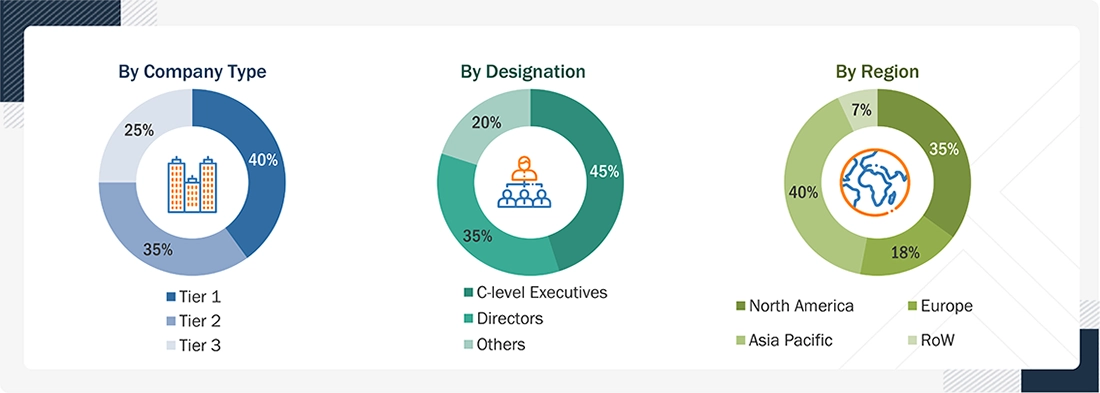
Note: The three tiers of the companies are defined based on their total revenue in 2025: Tier 1 - revenue greater than or equal to USD 1 billion; Tier 2 - revenue between USD 100 million and USD 1 billion; and Tier 3 revenue less than or equal to USD 100 million. Other designations include sales managers, marketing managers, and product managers.
To know about the assumptions considered for the study, download the pdf brochure
Market Size Estimation
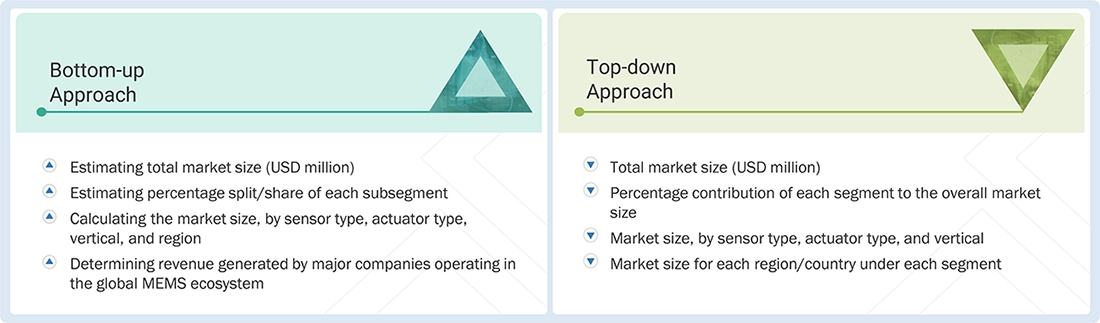
Both top-down and bottom-up approaches were used to estimate and validate the total size of the micro-electro-mechanical system (MEMS) market. These methods have also been used extensively to estimate the size of various subsegments in the market. The following research methodology was used to estimate the market size:
- Major players in the micro-electro-mechanical system (MEMS) market and related markets were identified through extensive secondary research.
- The industry’s value chain and market size (in terms of value) were determined through primary and secondary research processes.
- All percentage shares, splits, and segment-level breakdowns were determined using secondary sources and verified through primary sources.
Micro-Electro-Mechanical System Market : Top-Down and Bottom-Up Approach
Data Triangulation
After arriving at the overall size of the micro-electro-mechanical system (MEMS) market from the market size estimation process explained above, the total market was split into several segments and subsegments. Data triangulation and market breakdown procedures were employed, wherever applicable, to complete the overall market engineering process and arrive at the statistics for all segments and subsegments of the market. The data was triangulated by studying various factors and trends from both the demand and supply sides, including sensor type, actuator type, vertical, and regional developments. Along with this, the market size was validated using top-down and bottom-up approaches, with findings cross-checked against company-level revenues, product portfolios, application adoption, and industry-level developments.
Market Definition
Micro-electro-mechanical systems (MEMS) are miniaturized devices that integrate mechanical structures with electrical and electronic components to sense, measure, or actuate physical phenomena. MEMS technologies use microfabrication processes, primarily derived from semiconductor manufacturing, to produce compact devices with precise mechanical and electrical functions. The market covers inertial sensors, pressure sensors, microphones, microspeakers, environmental sensors, optical sensors, and MEMS actuators, including optical, microfluidic, inkjet, and RF actuators. These devices are used across automotive, consumer electronics, defense, aerospace, industrial, healthcare, and telecommunications applications.
MEMS play a critical role in applications requiring miniaturization, low power consumption, fast response, high sensitivity, and reliable sensing or actuation. They are widely integrated into smartphones, wearables, hearables, vehicles, ADAS, navigation systems, medical devices, industrial equipment, robotics, communication infrastructure, and aerospace systems. MEMS devices convert physical inputs such as acceleration, angular motion, pressure, sound, temperature, light, and electromagnetic signals into measurable electrical outputs, while MEMS actuators perform controlled mechanical or physical actions. A typical MEMS device consists of microscale mechanical structures, sensing or actuating elements, electrodes, and associated electronics, with designs varying according to the sensing principle, actuation mechanism, material, fabrication process, performance requirements, application, and operating environment.
Key Stakeholders
- Raw material and manufacturing equipment suppliers
- Electronic design automation (EDA) and design tool vendors
- Wafer manufacturers
- Government bodies, venture capitalists, and private equity firms
- Integrated device manufacturers (IDMs)
- Owners of intellectual property (related to MEMS components)
- MEMS technology platform developers
- MEMS component manufacturers
- Maintenance and service providers
- Distributors and traders
- Research organizations
- Semiconductor foundry service providers
- Organizations, forums, alliances, and associations
- End users from verticals such as aerospace, defense, industrial, and consumer electronics
Report Objectives
- To describe and forecast the micro-electro-mechanical system (MEMS) market size, by sensor type, actuator type, and vertical, in terms of value
- To describe and forecast the market for various segments across four main regions, namely North America, Europe, Asia Pacific, and RoW, in terms of value
- To describe and forecast the market for MEMS sensors and actuators in terms of volume
- To strategically analyze micromarkets with regard to individual growth trends, prospects, and contribution to the market
- To provide detailed information regarding drivers, restraints, opportunities, and challenges influencing the growth of the market
- To analyze opportunities for stakeholders by identifying high-growth segments in the market
- To provide a detailed overview of the value chain of the market
- To strategically analyze key MEMS technologies, average selling price by key players, trends impacting customers, ecosystem, regulatory landscape, patent landscape, Porter’s Five Forces, import and export scenarios, trade landscape, and case studies pertaining to the market
- To strategically profile key players in the market and comprehensively analyze their market share and core competencies
- To analyze competitive developments such as partnerships, acquisitions, expansions, collaborations, contracts, and product launches, along with R&D in the market
Available customizations:
With the given market data, MarketsandMarkets offers customizations according to the company’s specific needs. The following customization options are available for the report:
Company Information
-
Detailed analysis and profiling of additional market players (up to 5)
Get the Full Micro-Electro-Mechanical System (MEMS) Market Report
Full forecast, segment splits, and company analysis for all Micro-Electro-Mechanical System (MEMS) Market.
- US Micro-Electro-Mechanical System (MEMS) Market
- Canada Micro-Electro-Mechanical System (MEMS) Market
- Mexico Micro-Electro-Mechanical System (MEMS) Market
- Germany Micro-Electro-Mechanical System (MEMS) Market
- UK Micro-Electro-Mechanical System (MEMS) Market
- France Micro-Electro-Mechanical System (MEMS) Market
- Italy Micro-Electro-Mechanical System (MEMS) Market
- Spain Micro-Electro-Mechanical System (MEMS) Market
- Netherlands Micro-Electro-Mechanical System (MEMS) Market
- Nordics Micro-Electro-Mechanical System (MEMS) Market
- Rest Of Europe Micro-Electro-Mechanical System (MEMS) Market
- China Micro-Electro-Mechanical System (MEMS) Market
- Japan Micro-Electro-Mechanical System (MEMS) Market
- India Micro-Electro-Mechanical System (MEMS) Market
- South Korea Micro-Electro-Mechanical System (MEMS) Market
- Australia Micro-Electro-Mechanical System (MEMS) Market
- Vietnam Micro-Electro-Mechanical System (MEMS) Market
- Thailand Micro-Electro-Mechanical System (MEMS) Market
- Indonesia Micro-Electro-Mechanical System (MEMS) Market
- Malaysia Micro-Electro-Mechanical System (MEMS) Market
- Saudi Arabia Micro-Electro-Mechanical System (MEMS) Market
- UAE Micro-Electro-Mechanical System (MEMS) Market
- Qatar Micro-Electro-Mechanical System (MEMS) Market
- Kuwait Micro-Electro-Mechanical System (MEMS) Market
- Bahrain Micro-Electro-Mechanical System (MEMS) Market
- Oman Micro-Electro-Mechanical System (MEMS) Market
- Rest Of Middle East Micro-Electro-Mechanical System (MEMS) Market
- Africa Micro-Electro-Mechanical System (MEMS) Market
- South America Micro-Electro-Mechanical System (MEMS) Market
- Middle East Micro-Electro-Mechanical System (MEMS) Market
Need a Tailored Report?
Customize this report to your needs
Get 10% FREE Customization
Customize This Report
