
South Africa Metal Recycling Market (2024-2029)

The South Africa Metal Recycling Market was valued at $3587.4 Million in 2024 and projected to reach to $4477.2 Million by 2029, representing a compound annual growth rate of 4.5%. South Africa's metal recycling market is positioned for steady expansion as industrial sectors increasingly adopt sustainable practices and circular economy models.


| Market Size in | USD 26.32 MN |
| Market Forecast in | |
| CAGR | |
| Forecast Period | |
| Units Considered | Value (USD MN) |
South Africa Metal Recycling Market Trends and Insights
- This steady growth reflects South Africa's strengthening commitment to circular economy principles and sustainable resource management across packaging, construction, mining, and industrial gas sectors.
- South Africa's robust mining heritage and manufacturing base position the country as a significant player in metal recovery and secondary material processing. The metal recycling sector in South Africa is driven by increasing regulatory pressure, rising raw material costs, and growing demand from downstream industries seeking cost-effective and environmentally responsible sourcing.
- South Africa's strategic location and established infrastructure support both domestic consumption and regional export opportunities.
- Between 2024 and 2029, South Africa is expected to see accelerated adoption of advanced recycling technologies and expanded collection networks, particularly in urban centers and industrial zones. South Africa's market growth is underpinned by the country's transition toward a low-carbon economy and the rising participation of both formal and informal recycling operators.
- South Africa's competitive advantage in metal recycling stems from its abundant scrap feedstock, skilled workforce, and integration with global supply chains, positioning the nation for sustained expansion through 2029..
Key Market Statistics
- CAGR (2024-2029) 4.5% CAGR
- Market Size, 2024 ~USD 3587.4 Million
- Forecast, 2029 ~USD 4477.2 Million
- Country South Africa
South Africa Metal Recycling Market Overview
Market Valuation & Growth :
South Africa's metal recycling market is valued at USD 3,587.4 million in 2024, with a projected CAGR of 4.5% through 2029, reaching USD 4,477.2 million. This growth outpaces many emerging markets and reflects increasing industrial demand.
Circular Economy Adoption :
South Africa is strengthening its commitment to circular economy principles, driven by regulatory frameworks and corporate sustainability mandates. The packaging, construction, and mining sectors are leading the transition toward resource recovery and waste minimization.
Mining Sector Contribution :
South Africa's robust mining industry generates significant metal scrap volumes, particularly from copper, aluminum, and steel operations. This abundant feedstock supports a mature recycling infrastructure and attracts both domestic and international recyclers.
Infrastructure & Investment :
Growing investments in recycling facilities and collection networks across South Africa are improving processing capacity and material recovery rates. Urban centers like Johannesburg and Cape Town are emerging as recycling hubs with advanced sorting and refining technologies.
South Africa Metal Recycling Market Dynamics
- The construction boom and ongoing mining operations provide consistent feedstock, while regulatory pressures and corporate ESG commitments drive demand for recycled metals.
- Government initiatives supporting waste management infrastructure and green manufacturing will further accelerate market growth through 2029. The market faces opportunities in technology adoption, including AI-powered sorting systems and advanced refining processes.
- However, competition from informal recycling sectors and fluctuating commodity prices present challenges.
- Strategic partnerships between formal recyclers, manufacturers, and logistics providers will be critical for capturing market share and improving operational efficiency in South Africa's evolving metal recycling landscape..
Market Ecosystem
Related Ecosystem
Mining Minerals And Metals
- Wastewater Treatment
- Fiberglass
- Light Commercial Vehicles (LCVs)
- Nitrogen
- Acetic Acid
- LHOIST S.A
- SEVERSTAL JSC
- ArcelorMittal S.A.
- TW METALS, INC.
- Linde plc
Automotive Materials
- Light Commercial Vehicles (LCVs)
- Battery Electric Vehicle (BEV)
- Hybrid Electric Vehicle (HEV)
- Fuel Cell Electric Vehicle (FCEV)
- Agricultural Tractors
- AISIN CORPORATION
- GORKOVSKY AVTOMOBILNY ZAVOD
- Continental ag
- Basf se
- BOSCH LIMITED
Key Takeaways
- South Africa's metal recycling market will expand from USD 3,587.4M (2024) to USD 4,477.2M (2029) at a 4.5% CAGR.
- South Africa's mining and construction sectors are primary drivers of metal scrap generation and recycling demand.
- South Africa is leveraging circular economy policies and regulatory frameworks to strengthen formal recycling infrastructure.
- South Africa's regional position and export capabilities enable participation in broader African and global metal recycling supply chains.
Metal Recycling Market Report Scope
| Report Metric | Details |
|---|---|
| Base Year | 2024 |
| Fastest Growing Segment | MECHANICAL (Process) |
| Forecast Period | 2024-2029 |
| Growth Rate | CAGR of 6.8% from 2024 to 2029 |
| Largest Segment | FERROUS METALS (Type) |
| Market Size Base Year (Billions) | ~USD 552.65 (2024) |
| Revenue Forecast (Billions) | ~USD 767.9 (2029) |
| Segments Covered | Scrap Type, Type, End-Use Industry, Process, Material, Shelf Life, Application, Source, Technology |
South Africa Metal Recycling Market Report Segmentation
9 segment dimensions are covered across the global market.
By Scrap Type
- New Scrap
- Old Scrap
By Type
- Ferrous Metals
- Monocrystalline
- Non-Ferrous Metals
- Other Types
- Polycrystalline
- Thin Film
By End-Use Industry
- Automotive
- Building & Construction
- Consumer Applications
- Equipment Manufacturing
- Other End-Use Industries
- Packaging
- Shipbuilding
By Process
- Chemical
- Combination
- Laser
- Mechanical
- Other Processes
- Thermal
By Material
- Glass
- Metal
- Other Materials
- Plastic
- Silicon
By Shelf Life
- Early Loss
- Normal Loss
By Application
- Alloy
- Catalyst
- Ceramics
- Glass
- Hydrogen Storage Alloys
- Permanent Magnets
- Phosphor
- Polishing Materials
By Source
- Batteries
- Fcc
- Fluorescent Lamps
- Industrial Process
- Magnets
By Technology
- Hydrometallurgical
- Pyrometallurgical
Target Audience
- Recycling Operators & Processors : Facility managers and recycling companies need South Africa-specific market data to optimize collection routes, upgrade processing technology, and forecast feedstock availability. This report enables capacity planning and competitive benchmarking.
- Mining & Construction Companies : Large industrial operators in South Africa's mining and construction sectors require insights into metal scrap recovery economics and circular supply chain opportunities. Data supports sustainability reporting and cost reduction initiatives.
- Equipment & Technology Providers : Manufacturers of sorting, shredding, and refining equipment need South Africa market intelligence to identify growth segments and customer needs. This report validates demand for advanced recycling technologies in the region.
- Private Equity & Investors : Investment firms evaluating opportunities in South Africa's waste management and circular economy sectors require reliable market sizing and growth projections. This data supports due diligence and portfolio strategy decisions.
- Government & Policy Makers : South African regulatory bodies and development agencies use market research to design circular economy policies, infrastructure investments, and sustainability targets. This report informs evidence-based decision-making for waste management frameworks.
Reasons to Buy this Report
- Country-Specific Market Sizing : Access precise valuation data for South Africa's metal recycling market with verified 2024 baseline (USD 3,587.4M) and 2029 forecasts. Make informed investment and expansion decisions based on localized market intelligence rather than global averages.
- Sector-Level Insights : Understand growth drivers across packaging, construction, mining, and industrial gas sectors specific to South Africa. Identify which industries offer the highest recycling volumes and profitability potential in your target market.
- Competitive Positioning : Benchmark your operations against South Africa's market dynamics, including infrastructure maturity, regulatory environment, and informal sector competition. Develop targeted strategies to capture market share in this 4.5% CAGR growth environment.
- Investment & Expansion Planning : Leverage South Africa-specific forecasts to justify capital investments in recycling facilities, collection networks, and technology upgrades. Quantify growth opportunities and timeline for ROI in Africa's largest recycling market.
- Regulatory & Sustainability Compliance : Stay ahead of South Africa's evolving circular economy policies and ESG requirements. Understand how local regulations shape market demand and identify compliance opportunities that drive competitive advantage.
Frequently asked questions
What is the current size of South Africa's metal recycling market?
South Africa's metal recycling market is valued at USD 3,587.4 million in 2024 and is expected to reach USD 4,477.2 million by 2029.
What is the projected growth rate for South Africa's metal recycling market?
South Africa's metal recycling market is projected to grow at a compound annual growth rate (CAGR) of 4.5% from 2024 to 2029.
Which industries drive metal recycling demand in South Africa?
South Africa's metal recycling demand is primarily driven by the packaging, construction, mining, and industrial gases sectors, which generate significant volumes of recyclable metal scrap.
What factors are supporting growth in South Africa's metal recycling market?
South Africa's market growth is supported by circular economy policies, rising raw material costs, regulatory compliance requirements, and increasing demand from manufacturers seeking sustainable sourcing solutions.
How does South Africa's metal recycling market compare regionally?
South Africa is a leading metal recycling hub in the Middle East Africa region, leveraging its mining heritage, established infrastructure, and strategic geographic position to serve both domestic and export markets.
RESEARCH METHODOLOGY
The study involved four major activities for estimating the current size of the global Metal recycling market. Exhaustive secondary research was carried out to collect information on the market, the peer product market, and the parent product group market. The next step was to validate these findings, assumptions, and sizes with the industry experts across the value chain of Metal recycling through primary research. Both the top-down and bottom-up approaches were employed to estimate the overall size of the Metal recycling market. After that, market breakdown and data triangulation procedures were used to determine the size of different segments and sub-segments of the market.
Secondary Research
In the secondary research process, various secondary sources such as Hoovers, Factiva, Bloomberg BusinessWeek, and Dun & Bradstreet were referred to, to identify and collect information for this study on the Metal recycling market. These secondary sources included annual reports, press releases & investor presentations of companies; white papers; certified publications; articles by recognized authors; regulatory bodies, trade directories, and databases.
Primary Research
The Metal recycling market comprises several stakeholders in the supply chain, which include raw material suppliers, processors, end-product manufacturers, buyers, and regulatory organizations. Various primary sources from the supply and demand sides of the markets have been interviewed to obtain qualitative and quantitative information. The primary participants from the demand side include key opinion leaders, executives, vice presidents, and CEOs of companies in the Metal recycling market. Primary sources from the supply side include associations and institutions involved in the Metal recycling industry, key opinion leaders, and processing players.
Following is the breakdown of primary respondents
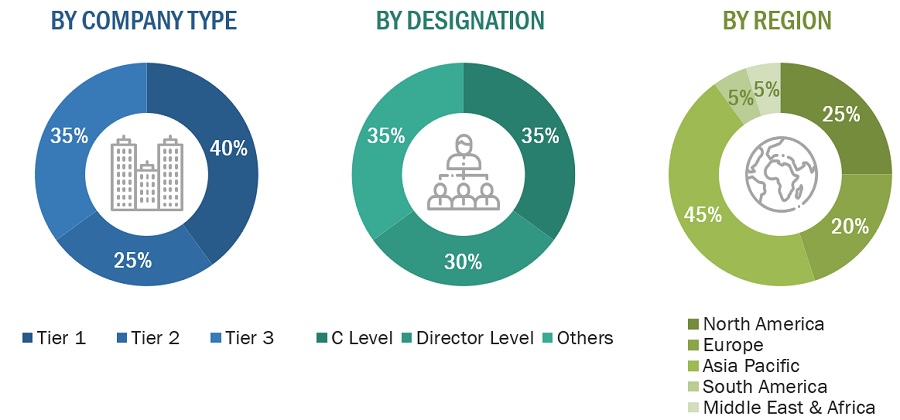
Notes: Other designations include product, sales, and marketing managers.
Tiers of the companies are classified based on their annual revenues as of 2022: Tier 1 = >USD 5 Billion, Tier 2 = USD 1 Billion to USD 5 Billion, and Tier 3= <USD 1 Billion.
To know about the assumptions considered for the study, download the pdf brochure
Market Size Estimation
Both the top-down and bottom-up approaches were used to estimate and validate the size of the global metal recycling market. These approaches were also used extensively to estimate the size of various segments of the market. The research methodology used to estimate the market size included the following details:
- The key players in the industry were identified through extensive secondary research.
- The supply chain of the industry and market size, in terms of value and volume, were determined through primary and secondary research.
- All percentage share splits and breakdowns were determined using secondary sources and verified through primary sources.
- All possible parameters that affect the markets covered in this research study were accounted for, viewed in extensive detail, verified through primary research, and analyzed to obtain the final quantitative and qualitative data.
- The research includes the study of reports, reviews, and newsletters of key industry players, along with extensive interviews with key officials, such as directors and marketing executives.
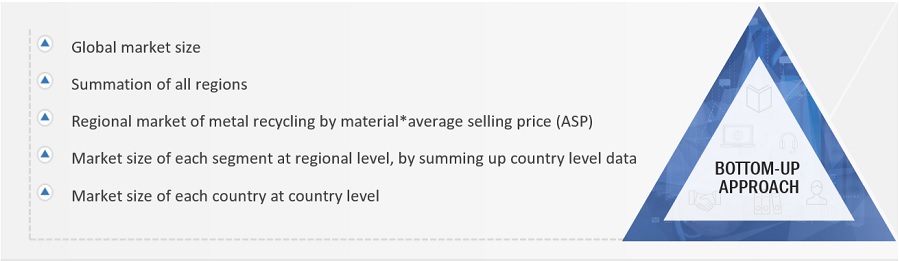
To know about the assumptions considered for the study, Request for Free Sample Report
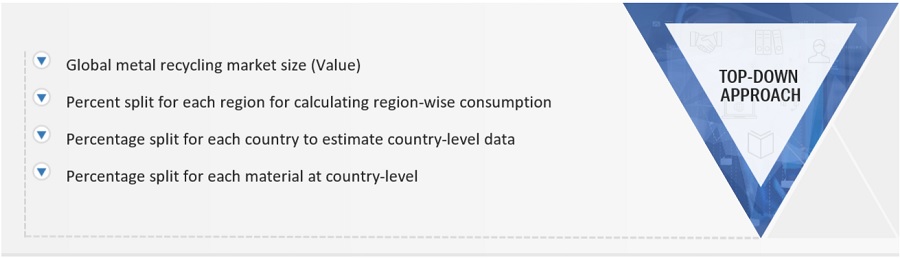
Data Triangulation
After arriving at the overall market size from the estimation process explained above, the total market was split into several segments and sub-segments. The data triangulation and market breakdown procedures were employed, wherever applicable, to complete the overall market engineering process and arrive at the exact statistics for all the segments and sub-segments of the metal recycling market. The data was triangulated by studying various factors and trends from both the demand- and supply-side.
In addition, the market size was validated by using both the top-down and bottom-up approaches. Then, it was verified through primary interviews. Hence, for every data segment, there are three sources—top-down approach, bottom-up approach, and expert interviews. The data were assumed to be correct when the values arrived at from the three sources matched.
Market Definition
Metal recycling involves recovering ferrous and non-ferrous scrap metal from unused products, structures, and manufacturing processes, then converting it into new metal materials. The process encompasses several crucial stages: collecting scrap metal from sources such as old vehicles, appliances, construction debris, and electronic devices; sorting and separating different metal types; processing the metals through shredding, melting, and purifying to remove contaminants; and finally, forming the purified metal into new products or raw materials for manufacturing. Recycled metal can be used to create new products, which can themselves be recycled at the end of their lifecycle. This approach conserves natural resources by reducing the need for raw material extraction and saves energy, as recycling metals typically requires less energy than producing new metals from ore. Additionally, metal recycling helps reduce greenhouse gas emissions and environmental pollution, promoting more sustainable and eco-friendly industrial practices. Recycled metals are widely used in various end-use sectors, including building and construction, automotive, shipbuilding, packaging, equipment manufacturing, consumer appliances, aerospace and defense, and industrial and commercial furniture and utensils.
Key Stakeholders
- Metal producing & recycling companies
- Environmental service providers
- Government and regulatory bodies
- Market research and consulting firms
- Commercial R&D institutions
- Associations and industry bodies
- Conservation professionals
- Municipalities and local & regional authorities
- Other end users (materials recovery facilities, processors, sorters, metal recycling plants, and manufacturers).
Report Objectives
- To define, analyze, and project the size of the metal recycling market in terms of value based on type, scrap type, equipment used, end-use industry, and region.
- To project the size of the market and its segments with respect to the five main regions, namely, North America, Europe, Asia Pacific, Middle East & Africa, and South America
- To provide detailed information about the key factors, such as drivers, restraints, opportunities, and challenges, influencing the growth of the market
- To analyze the opportunities in the market for stakeholders and provide a detailed competitive landscape of the market leaders.
- To analyze the competitive developments, such as new product launches, expansions, and acquisitions, in the metal recycling market
- To strategically profile the key players operating in the market and comprehensively analyze their market shares and core competencies.
Available Customizations
Along with the given market data, MarketsandMarkets offers customizations as per the specific needs of the companies. The following customization options are available for the report:
Product Analysis:
- Product Matrix which gives a detailed comparison of the product portfolio of each company
Regional Analysis:
- Further breakdown of the Rest of Asia Pacific market
- Further breakdown of Rest of Europe market
Company Information:
- Detailed analysis and profiling of additional market players (up to 5)
Get the Full Metal Recycling Market Report
Full forecast, segment splits, and company analysis for all Metal Recycling Market.
- China Metal Recycling Market
- India Metal Recycling Market
- Japan Metal Recycling Market
- Australia Metal Recycling Market
- South Korea Metal Recycling Market
- Canada Metal Recycling Market
- Mexico Metal Recycling Market
- US Metal Recycling Market
- Germany Metal Recycling Market
- UK Metal Recycling Market
- France Metal Recycling Market
- Italy Metal Recycling Market
- Russia Metal Recycling Market
- Spain Metal Recycling Market
- Turkey Metal Recycling Market
- Brazil Metal Recycling Market
- Argentina Metal Recycling Market
- Rest Of Europe Metal Recycling Market
- Rest Of Asia Pacific Metal Recycling Market
- GCC Countries Metal Recycling Market
- -Rest Of GCC Countries Metal Recycling Market
- Rest Of South America Metal Recycling Market
Need a Tailored Report?
Customize this report to your needs
Get 10% FREE Customization
Customize This Report
