
China Microdisplay Market (2025-2030)

The China Microdisplay Market was valued at $232.8 Million in 2025 and projected to reach to $1016 Million by 2030, representing a compound annual growth rate of 34.3%. China's microdisplay market is poised for transformative growth, driven by the convergence of consumer electronics innovation, AR/VR adoption, and government-backed semiconductor advancement.


| Market Size in | USD 26.32 MN |
| Market Forecast in | |
| CAGR | |
| Forecast Period | |
| Units Considered | Value (USD MN) |
China Microdisplay Market Trends and Insights
- This represents a compound annual growth rate of 34.3%, significantly outpacing global trends driven by China's leadership in consumer electronics, augmented reality applications, and advanced display technologies.
- China's robust semiconductor manufacturing ecosystem and substantial investments in next-generation display innovation are positioning the country as a critical hub for microdisplay development and commercialization. The expansion of China's microdisplay market is fueled by rising demand from consumer electronics manufacturers, military and defense applications, and emerging virtual reality and augmented reality sectors.
- China's dominance in smartphone and wearable device production creates substantial opportunities for microdisplay integration across consumer segments.
- Between 2025 and 2030, China is expected to capture an increasingly larger share of global microdisplay revenues as local manufacturers scale production capabilities and reduce costs through economies of scale..
Key Market Statistics
- CAGR (2025-2030) 34.3% CAGR
- Market Size, 2025 ~USD 232.8 Million
- Forecast, 2030 ~USD 1016 Million
- Country China
China Microdisplay Market Overview
Explosive Growth Trajectory :
China's microdisplay market is projected to grow from $232.8 million in 2025 to $1,016 million by 2030, representing a 34.3% CAGR—significantly exceeding the global growth rate of 26.4%.
AR & Consumer Electronics Leadership :
China's dominance in consumer electronics manufacturing and rapid adoption of augmented reality applications are driving unprecedented demand for advanced microdisplay technologies across smartphones, wearables, and industrial devices.
Semiconductor Manufacturing Advantage :
China's robust semiconductor manufacturing ecosystem and vertical integration capabilities enable cost-effective production of microdisplays, positioning local manufacturers as key global suppliers.
Strategic Technology Investment :
Government initiatives and substantial R&D investments in display technologies are accelerating innovation in OLED, LCoS, and DLP microdisplay solutions tailored for Chinese market demands.
China Microdisplay Market Dynamics
- The 34.3% CAGR reflects strong demand from smartphone manufacturers integrating advanced display solutions and emerging applications in smart glasses and industrial AR devices.
- China's competitive manufacturing costs and technological capabilities position it as both a major consumer market and global production hub. By 2030, the market's expansion to $1,016 million will be sustained by increasing penetration of microdisplays in mainstream consumer products, enterprise AR solutions, and next-generation wearables.
- Strategic partnerships between Chinese tech giants and display manufacturers, combined with supportive government policies, will further accelerate market maturation and technological differentiation..
Market Ecosystem
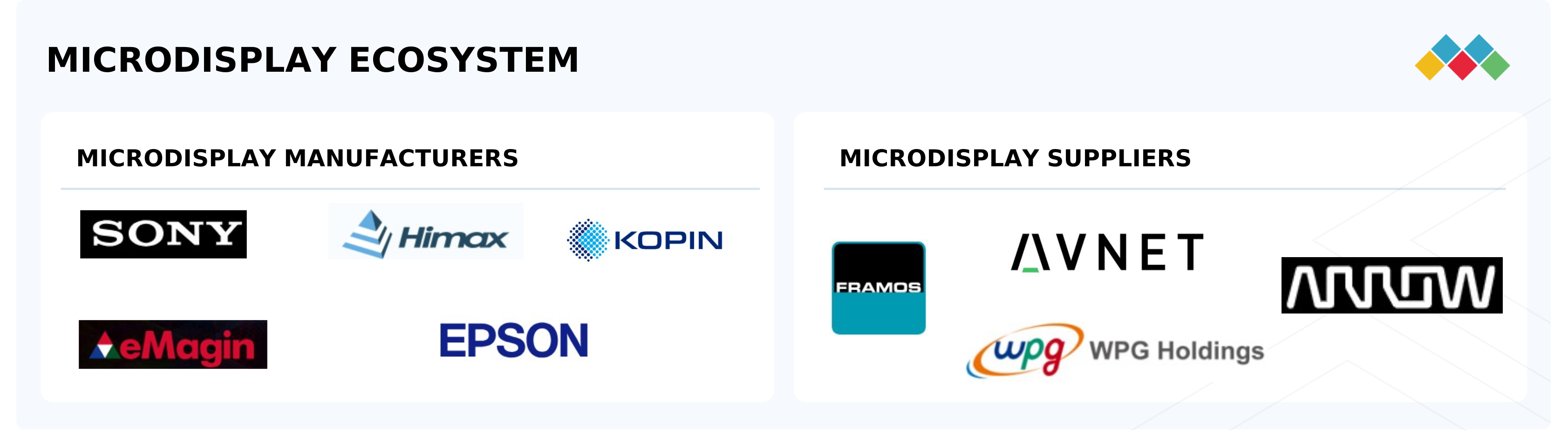
Microdisplay Marke: COMMERCIAL USE CASES ACROSS INDUSTRIES
| COMPANY | USE CASE DESCRIPTION | BENEFITS |
|---|---|---|
 |
Flexible microdisplay technology, developed by researchers at the University of California, San Diego (US), and Massachusetts General Hospital (US), demonstrates a transformative application in neurosurgery. The innovation integrates a platinum nanorod electrode grid (PtNRGrid) with Gallium Nitride (GaN) micro-LEDs on a thin, flexible film. Each micro-LED mirrors neuronal activity in real time, translating complex brain signals into intuitive, color-coded visual feedback directly within the surgical field. This enables neurosurgeons to monitor seizure onset, functional brain boundaries, and tissue differentiation without relying on external mapping teams or traditional tissue diagrams. | The technology offers multiple benefits, including enhanced surgical precision by reducing the safety buffer zone from several millimeters to less than one millimeter, improved visualization through intuitive color-coded signals, and faster operative workflows by eliminating delays from manual mapping methods. These advancements not only shorten surgery times but also lower the risk of neurological damage, thereby improving patient outcomes. Furthermore, the flexible and scalable design makes it adaptable for various neurosurgical interventions, including epilepsy treatments and tumor resections. |
 |
Sony Group Corporation (Japan) enhanced the development of augmented reality (AR) glasses by introducing its LMX-001 microdisplay module, addressing critical challenges of bulkiness, limited transparency, and poor adaptability. The module integrates a microdisplay, driver chip, optical engine, collimator, and an ultra-thin holographic waveguide that maintains over 85% see-through transmittance while delivering up to 2,000 nits of brightness. This advancement enables AR glasses to remain lightweight, slim, and comfortable, making them well-suited for industrial environments such as logistics, remote assistance, and production monitoring, where workers require high-clarity displays without compromising visibility. | The use of Sony’s microdisplay technology in AR glasses delivers multiple benefits, including improved comfort and usability through slim and lightweight designs, superior visual clarity with high brightness and transparency, and reduced visual obstruction for safer and more efficient operations. By offering development kits and production-ready modules, Sony also empowers enterprises to design customized solutions tailored to specific industrial workflows, thereby accelerating the adoption of AR technology across diverse applications and enhancing operational productivity.. |
Logos and trademarks shown above are the property of their respective owners. Their use here is for informational and illustrative purposes only.
Related Ecosystem
Automotive Electronics And Electrical Equipment
- Battery Electric Vehicle (BEV)
- Light Commercial Vehicles (LCVs)
- Fuel Cell Electric Vehicle (FCEV)
- Sensors
- Hybrid Electric Vehicle (HEV)
- BOSCH LIMITED
- DENSO Corporation
- Continental ag
- Panasonic Holdings Corporation
- Texas Instruments Incorporated
Display Technology
- Augmented Reality
- Liquid Crystal Display (LCD)
- Sensors
- Virtual Reality Devices
- Liquid Crystal on Silicon (LCOS)
- VIVITEK CORPORATION
- Samsung
- Lenovo
- Panasonic Holdings Corporation
- Lg corp
Key Takeaways
- China's microdisplay market will grow from $232.8M (2025) to $1,016M (2030) at a 34.3% CAGR, outpacing global growth rates.
- China's advanced semiconductor manufacturing base and consumer electronics dominance are primary drivers of microdisplay market expansion.
- Rising adoption of AR/VR technologies and wearable devices in China is accelerating microdisplay demand across multiple end-use segments.
- China's cost-competitive production capabilities position local manufacturers to capture significant global market share by 2030.
Microdisplay Market Report Scope
| Report Metric | Details |
|---|---|
| Base Year | 2025 |
| Fastest Growing Segment | MICRO-LED (Technology) |
| Forecast Period | 2025-2030 |
| Growth Rate | CAGR of 26.4% from 2025 to 2030 |
| Largest Segment | NTE DEVICES (Product) |
| Market Size Base Year (Billions) | ~USD 1.65 (2025) |
| Revenue Forecast (Billions) | ~USD 5.33 (2030) |
| Segments Covered | Product, Near-To-Eye Device Type, Vertical, Technology, Head-Mounted Display Type, Projector Type, Resolution, Size |
China Microdisplay Market Report Segmentation
8 segment dimensions are covered across the global market.
By Product
- Head-Up Displays
- Head-Up Displays (Huds)
- Near-To-Eye Devices
- Nte Devices
- Projectors
By Near-To-Eye Device Type
- Cameras/Electronics Viewfinders (Evfs)
- Head-Mounted Displays (Hmds)
By Vertical
- Automotive
- Consumer
- Education
- Industrial & Enterprise
- Medical
- Military, Defense, And Aerospace
- Other Verticals
- Retail & Hospitality
- Sports & Entertainment
By Technology
- Digital Light Processing (Dpl)
- Dlp
- Liquid Crystal Display (Lcd)
- Liquid Crystal On Silicon (Lcos)
- Micro-Led
- Organic Light Emitting Diode (Oled)
By Head-Mounted Display Type
- Ar
- Vr
By Projector Type
- Data Projectors
- Pico Projectors
By Resolution
- Fhd
- Hd
- Higher Than Fhd
- Less Than Hd
By Size
- 0.5-1.0 Inch
- 1.0-2.0 Inch
- Less Than 0.5 Inch
Target Audience
- Display Technology Manufacturers : Manufacturers of OLED, LCoS, and DLP microdisplays need China-specific market data to identify growth opportunities, optimize production capacity, and develop localized product strategies.
- Consumer Electronics OEMs : Chinese smartphone, wearable, and AR device manufacturers require detailed market insights to integrate advanced microdisplays competitively and meet evolving consumer demands.
- Investment & Private Equity Firms : Investors targeting China's semiconductor and display sectors need comprehensive market analysis to identify high-growth opportunities and assess portfolio company potential.
- Government & Policy Makers : Chinese government agencies and industrial planners use market intelligence to guide technology policy, R&D funding, and strategic initiatives supporting domestic microdisplay innovation.
- International Market Entrants : Global companies seeking to enter or expand in China's microdisplay market require localized competitive intelligence, regulatory insights, and market sizing to minimize risk and maximize ROI.
Reasons to Buy this Report
- Market-Specific Growth Intelligence : Gain detailed insights into China's 34.3% CAGR trajectory and understand the unique drivers differentiating it from global trends, enabling precise market entry and expansion strategies.
- Competitive Landscape Analysis : Identify key Chinese manufacturers, emerging players, and competitive positioning within the rapidly evolving microdisplay ecosystem to inform partnership and investment decisions.
- Technology & Application Trends : Understand which microdisplay technologies (OLED, LCoS, DLP) are gaining traction in China's AR, smartphone, and industrial segments to align product development roadmaps.
- Supply Chain & Manufacturing Insights : Access critical data on China's semiconductor manufacturing advantages, cost structures, and production capabilities to optimize sourcing and manufacturing strategies.
- Investment & Opportunity Assessment : Evaluate market sizing, forecast accuracy, and growth catalysts specific to China to make informed investment, M&A, and market expansion decisions through 2030.
Frequently asked questions
What is the projected size of China's microdisplay market in 2030?
China's microdisplay market is projected to reach $1,016 million by 2030, growing from $232.8 million in 2025.
What is the CAGR for China's microdisplay market?
China's microdisplay market is expected to grow at a compound annual growth rate of 34.3% between 2025 and 2030.
What are the primary drivers of growth in China's microdisplay market?
Key drivers include China's leadership in consumer electronics manufacturing, increasing AR/VR adoption, wearable device proliferation, and advanced semiconductor capabilities.
Which applications are fueling demand for microdisplays in China?
Primary applications include augmented reality devices, virtual reality headsets, military and defense systems, smartphones, and wearable electronics.
How does China's microdisplay market growth compare to global trends?
China's 34.3% CAGR significantly exceeds the global microdisplay market CAGR of 26.4%, reflecting China's accelerated technology adoption and manufacturing scale.
RESEARCH METHODOLOGY
The study involved major activities in estimating the current size of the microdisplay market. Exhaustive secondary research has been done to collect information on the market, peer market, and parent market. The next step was to validate these findings, assumptions, and sizing with industry experts across the supply chain through primary research. Both top-down and bottom-up approaches have been employed to estimate the complete market size. After that, market breakdown and data triangulation methods have been used to estimate the market size of segments and subsegments. Secondary and primary sources have been used to identify and collect information for an extensive technical and commercial study of the microdisplay market.
Secondary Research
Secondary research for this study involved gathering information from various credible sources such as company reports, white papers, journals, and industry publications. This process helped in understanding the supply and value chains, identifying key players, analyzing market segmentation and regional trends, and tracking major market and technology developments. The data collected was used to estimate the overall market size, which was later validated through primary research.
Primary Research
Extensive primary research was conducted after gaining knowledge about the current scenario of the microdisplay market through secondary research. Several primary interviews were conducted with experts from the demand and supply sides across four major regions: North America, Europe, Asia Pacific, and RoW. This primary data was collected through questionnaires, emails, and telephone interviews.
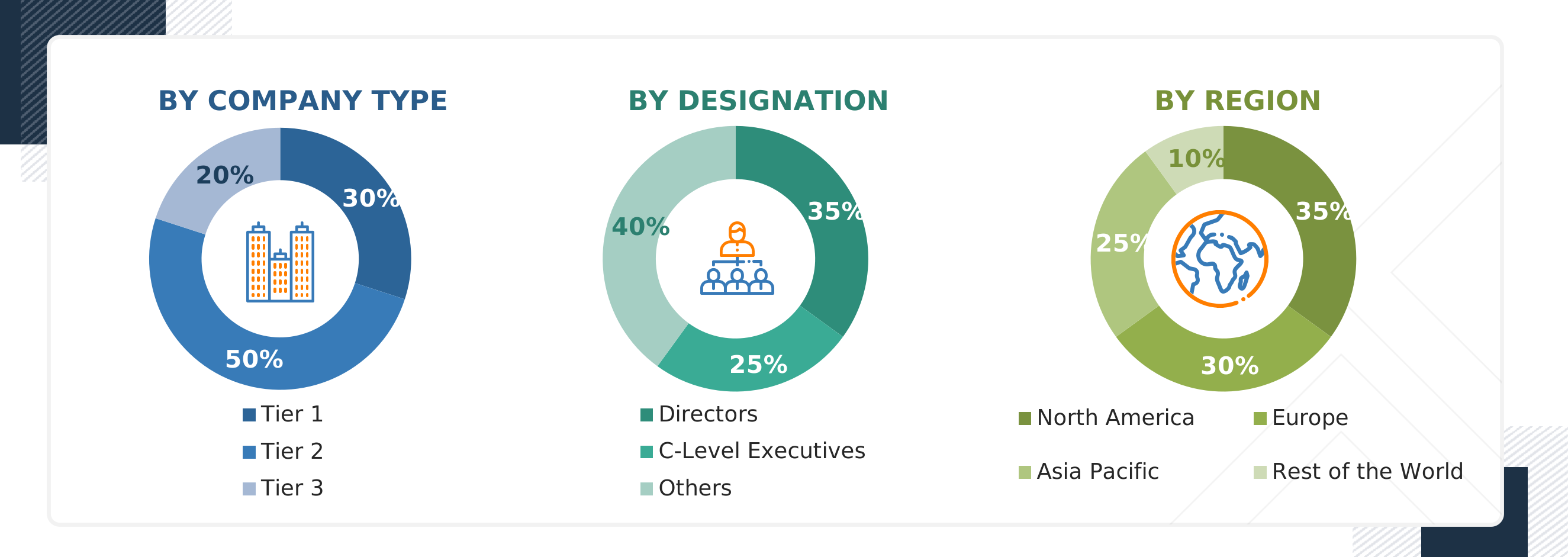
Notes: RoW mainly comprises the Middle East, Africa, and South America.
Other designations include product managers, sales managers, and marketing managers.
Three tiers of companies have been defined based on their total revenue as of 2024; tier 3: revenue less than USD 500 million; tier 2: revenue between USD 500 million and 1 billion; and tier 1: revenue more than USD 1 billion.
To know about the assumptions considered for the study, download the pdf brochure
Market Size Estimation
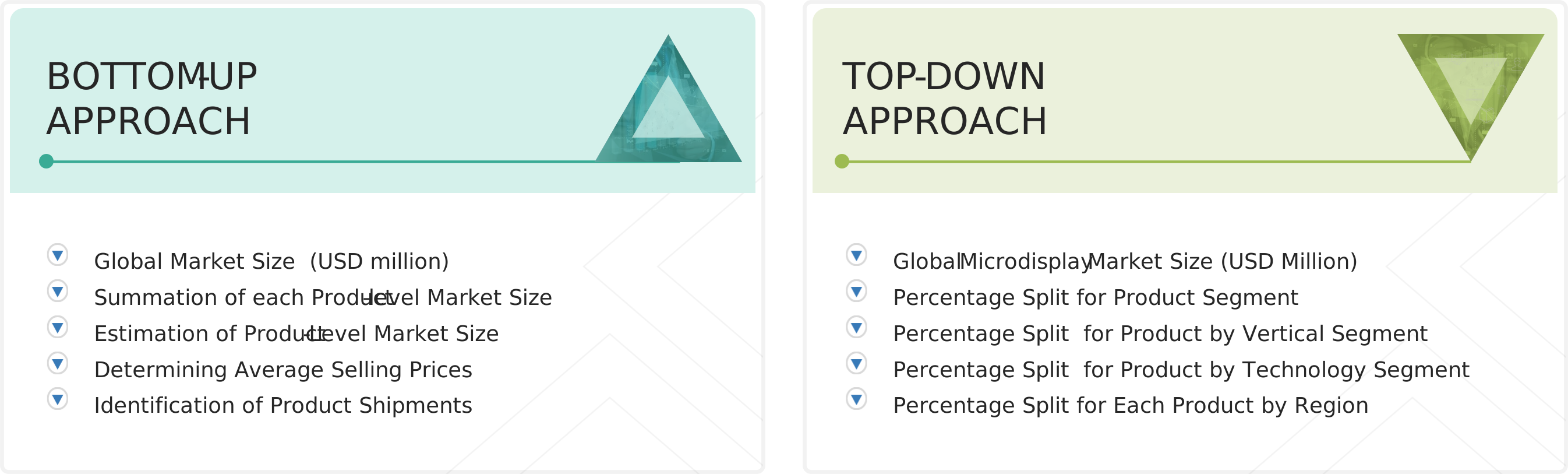
In the market engineering process, both top-down and bottom-up approaches, along with data triangulation methods, have been used to estimate and validate the size of the microdisplay market and other dependent submarkets. The research methodology used to estimate the market sizes includes the following:
Approach to arrive at market size using bottom-up analysis (demand side):
- Extracted shipment data for each product category within the microdisplay market, which included near-to-eye devices, head-up devices, projectors, and other applications. This step allowed us to establish a clear understanding of the volume contribution of each segment.
- The average selling price (ASP) corresponding to each product category was identified. This ensured that price variations across different products and technologies were adequately reflected in our calculations.
- The ASPs were then multiplied by shipment volumes for each product category to derive the market size at the product level.
- Once the product-level market sizes were determined, they were aggregated across all categories to arrive at the overall global market size for microdisplays.
- To cross-verify the market sizing, the revenues of the key players in the microdisplay ecosystem were identified.
- The segmental revenue of each key player was then analyzed by understanding their contributions specific to microdisplay technologies and products within the scope of the study.
- Finally, the segmental revenues of these players were summed, which provided a secondary estimate of the global market size. The figure obtained through both processes was then finalized and re-verified through secondary sources and primary respondents.
- The figures are verified and cross-checked at every level through discussions with key opinion leaders, such as CXOs, directors, and operations managers, and finally with domain experts in MarketsandMarkets.
Approach to arrive at market size using top-down analysis (supply side)
- The overall market size for each major product category in the microdisplay market was identified through shipments.
- From this product-level data, the figures were further divided into verticals, capturing the demand contribution across key industries such as consumer, automotive, industrial & enterprise, military, defense & aerospace, retail & hospitality, medical, sports & entertainment education, and other verticals.
- The product-level market size was then further divided into technology categories, such as OLED, LCOS, LCD, DLP, and micro-LED, to capture adoption trends and pricing variations by technology type.
- The product-level data was further broken down by geographic regions, reflecting adoption trends, presence of key players, and demand patterns across North America, Europe, Asia Pacific, and RoW.
- By applying this top-down methodology, this research indicates a comprehensive view of the global microdisplay market, linking each product segment with its respective vertical, technology, and regional distribution.
Microdisplay Market: Top-Down and Bottom-Up Approach
Data Triangulation
After arriving at the overall market size using the market size estimation processes as explained above, the market has been split into several segments and subsegments. To complete the entire market engineering process and arrive at the exact statistics of each market segment and subsegment, data triangulation and market breakdown procedures have been employed, wherever applicable. The data has been triangulated by studying various factors and trends from the demand and supply sides in the microdisplay market.
Market Definition
The microdisplay market comprises ultra-small display panels, which are less than two inches in diagonal size, that deliver high resolution, low power consumption, and superior image quality for compact and precision-based applications. Built on technologies such as liquid crystal display (LCD), liquid crystal on silicon (LCoS), organic light-emitting diode (OLED), digital light processing (DLP), and micro-LED, these displays are integral to augmented and virtual reality (AR/VR) headsets, head-up displays (HUDs), electronic viewfinders, projectors, smart glasses, medical imaging systems, military night vision, and industrial wearables. The market is expanding due to rising adoption of immersive technologies, increased demand for lightweight and high-performance displays in consumer, automotive, healthcare, and defense sectors, and continuous innovations in brightness, pixel density, and AI-enabled imaging, positioning microdisplays as a key enabler of next-generation visual interfaces.
Key Stakeholders
- Brand Product Manufacturers/Original Equipment Manufacturers (OEMs)/Original Device Manufacturers (ODMs)
- Microdisplay Product Manufacturers
- Microdisplay Panel Manufacturers
- Semiconductor Component Suppliers/Foundries
- Microdisplay Material and Component Suppliers
- Manufacturing Equipment Suppliers
- System Integrators
- Technology/IP Developers
- Consulting and Market Research Service Providers
- Microdisplay and Material-related Associations, Organizations, Forums, and Alliances
- Venture Capitalists and Startups
- Research and Educational Institutes
- Distributors and Resellers
- End Users
Report Objectives
- To define, describe, and forecast the size of the microdisplay market by technology, resolution, size, product, and vertical in terms of value
- To forecast the size of the microdisplay market, by product, in terms of value and volume
- To forecast the size of various segments of the market with respect to four regions, namely, North America, Europe, Asia Pacific, and the Rest of the World (RoW)
- To analyze the emerging applications/use cases in the microdisplay market
- To identify key microdisplay manufacturers and analyze their product offerings in the market
- To strategically analyze trends/disruptions impacting customer business, pricing analysis, technology analysis, key stakeholders & buying criteria, case study analysis, trade analysis, patent analysis, Porter’s five forces, key conferences & events, AI impact, impact of 2025 US tariff, and regulations related to the microdisplay market
- To provide detailed information regarding drivers, restraints, opportunities, and challenges influencing the growth of the market
- To strategically analyze micromarkets1 with respect to individual growth trends, prospects, and contributions to the overall market
- To analyze market opportunities for stakeholders and provide details of the competitive landscape
- To analyze competitive developments, such as collaborations, agreements, contracts, partnerships, mergers & acquisitions, and product launches & developments in the market
- To strategically profile key players and comprehensively analyze their market share and core competencies2
Available Customizations
With the given market data, MarketsandMarkets offers customizations according to the company‘s specific needs. The following customization options are available for the report.
Company Information:
- Detailed analysis and profiling of additional market players (up to five)
Get the Full Microdisplay Market Report
Full forecast, segment splits, and company analysis for all Microdisplay Market.
- US Microdisplay Market
- Canada Microdisplay Market
- Mexico Microdisplay Market
- Germany Microdisplay Market
- France Microdisplay Market
- UK Microdisplay Market
- Spain Microdisplay Market
- Italy Microdisplay Market
- Poland Microdisplay Market
- Japan Microdisplay Market
- South Korea Microdisplay Market
- Taiwan Microdisplay Market
- India Microdisplay Market
- Australia Microdisplay Market
- Indonesia Microdisplay Market
- Malaysia Microdisplay Market
- Thailand Microdisplay Market
- Vietnam Microdisplay Market
- Nordics Microdisplay Market
- Rest Of Europe Microdisplay Market
- Rest Of Asia Pacific Microdisplay Market
- Africa Microdisplay Market
- Middle East Microdisplay Market
- South America Microdisplay Market
- Bahrain Microdisplay Market
- Kuwait Microdisplay Market
- Oman Microdisplay Market
- Qatar Microdisplay Market
- Rest Of Middle East Microdisplay Market
- Saudi Arabia Microdisplay Market
- UAE Microdisplay Market
- Other African Countries Microdisplay Market
- South Africa Microdisplay Market
Need a Tailored Report?
Customize this report to your needs
Get 10% FREE Customization
Customize This Report
