
Other African Countries Microdisplay Market (2025-2030)

The Other African Countries Microdisplay Market was valued at $8.9 Million in 2025 and projected to reach to $22.8 Million by 2030, representing a compound annual growth rate of 20.7%. Other African Countries represent a high-growth emerging segment within the African microdisplay ecosystem, with significant expansion potential through 2030.


| Market Size in | USD 26.32 MN |
| Market Forecast in | |
| CAGR | |
| Forecast Period | |
| Units Considered | Value (USD MN) |
Other African Countries Microdisplay Market Trends and Insights
- The microdisplay sector in Other African Countries is poised for significant expansion, driven by increasing adoption of augmented reality (AR), virtual reality (VR), and advanced consumer electronics.
- By 2030, Other African Countries is forecast to reach $22.8 million, reflecting a compound annual growth rate (CAGR) of 20.7% over the five-year period. The growth trajectory in Other African Countries is underpinned by rising smartphone penetration, growing demand for wearable devices, and expanding industrial applications requiring compact display solutions.
- Other African Countries are gradually integrating microdisplay technology into defense, medical imaging, and entertainment sectors.
- As digital infrastructure improves across Other African Countries, investment in next-generation display technologies is expected to accelerate, positioning the region as a secondary growth hub within Africa's semiconductor ecosystem..
Key Market Statistics
- CAGR (2025-2030) 20.7% CAGR
- Market Size, 2025 ~USD 8.9 Million
- Forecast, 2030 ~USD 22.8 Million
- Country Other African Countries
Other African Countries Microdisplay Market Overview
Emerging Market Growth :
Other African Countries microdisplay market valued at $8.9 million in 2025, with projected growth to $22.8 million by 2030, representing a robust 20.7% CAGR driven by rising technology adoption across the region.
AR/VR Adoption Acceleration :
Increasing penetration of augmented reality and virtual reality applications in Other African Countries is catalyzing microdisplay demand, particularly in consumer electronics, gaming, and enterprise training solutions.
Regional Technology Infrastructure :
Improving digital infrastructure and smartphone penetration in Other African Countries are creating favorable conditions for microdisplay-enabled devices, supporting market expansion beyond traditional markets.
Consumer Electronics Expansion :
Growing middle-class consumer base in Other African Countries is driving demand for advanced consumer electronics incorporating microdisplay technology, including wearables and smart devices.
Other African Countries Microdisplay Market Dynamics
- The region's market is benefiting from accelerating digital transformation, increased investment in technology infrastructure, and rising consumer demand for innovative AR/VR-enabled devices.
- Key growth drivers include expanding smartphone adoption, growing gaming and entertainment sectors, and enterprise applications in training and simulation. The 20.7% CAGR for Other African Countries reflects strong momentum compared to mature markets, positioning the region as an attractive opportunity for microdisplay manufacturers and technology providers.
- Strategic partnerships with local distributors, investment in regional supply chains, and localized product offerings will be critical for capturing market share.
- By 2030, Other African Countries is expected to become an increasingly important market segment, driven by continued technology democratization and rising disposable incomes..
Market Ecosystem
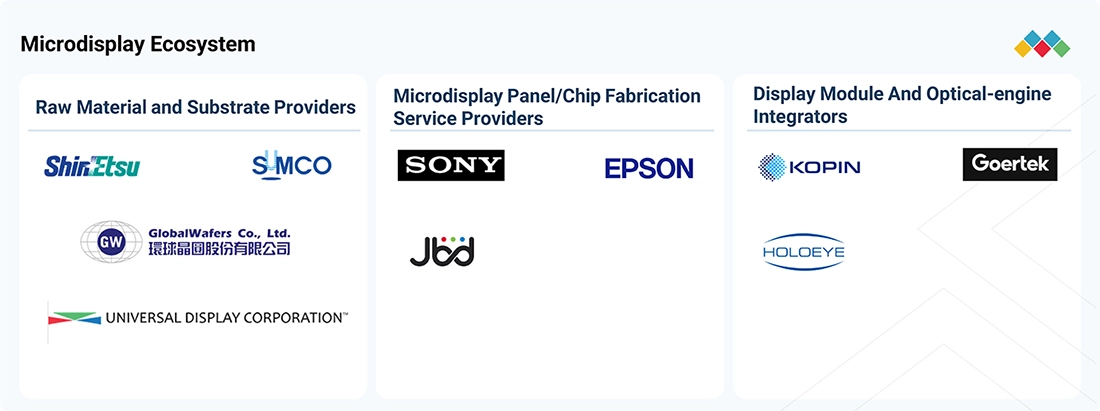
MICRODISPLAY MARKET SIZE, SHARE & TRENDS: COMMERCIAL USE CASES ACROSS INDUSTRIES
| COMPANY | USE CASE DESCRIPTION | BENEFITS |
|---|---|---|
 |
Sony deploys ECX series OLED Microdisplays into professional camera electronic viewfinders and spatial reality goggles. The silicon based panels deliver image output inside binocular headsets, drone flight goggles, and industrial inspection systems. | Delivers contrast ratios reaching 100,000:1 | Provides sub millisecond response times to prevent image smear | Integrates driving circuits directly into the silicon substrate to minimize board dimensions | Reaches brightness levels up to 10,000 nits for outdoor readability |
 |
Seiko Epson incorporates Ultimicron series high temperature polysilicon TFT microdisplays into electronic viewfinders and binocular smart glasses. The optical components project digital data overlays for industrial remote assistance units and aerial photography viewers. | Delivers analog drive technology to eliminate color breakup | Maintains low power consumption during continuous wireless operation | Provides high-pixel density to suppress visible grid patterns | Supports compact optical engine integration for lightweight eyewear frames |
 |
Kopin supplies CyberDisplay LCD and Lightning OLED microdisplays for defense thermal weapon sights and enterprise smart headsets. The micro components deliver critical tactical data to dismounted soldier helmets and warehouse inspection optics. | Features wide operating temperature ranges suitable for military field gear | Integrates low-power driver ASICs to extend wearable device battery life | Delivers high-luminance monochrome and color output without auxiliary heaters | Supports binary amplitude modulation for optical metrology instruments |
 |
SeeYA Technology manufactures silicon-based OLED microdisplays for virtual reality headsets and first person view aerial goggles. The displays project visual feeds within medical loupes, binocular surgical monitors, and consumer media glasses. | Offers pixel densities exceeding 3,000 pixels per inch for ultra fine detail | Incorporates low-latency interfaces to reduce motion sickness in near eye optics | Operates on low voltage drive architectures to minimize unit thermal generation | Delivers high color gamut coverage across standard color spaces |
 |
eMagin produces direct patterned OLED microdisplays for military aviation helmets, thermal night vision systems, and robotic surgery consoles. The components project targeting vectors and high-definition visual feeds in low-light environments. | Eliminates color filter attenuation through direct RGB patterning to increase luminance | Operates across extreme military temperature ranges without external heaters | Delivers high-contrast ratios for rapid target acquisition in night operations | Provides compliance with defense manufacturing standards and long lifecycle support |
Logos and trademarks shown above are the property of their respective owners. Their use here is for informational and illustrative purposes only.
Related Ecosystem
Automotive Electronics And Electrical Equipment
- Battery Electric Vehicle (BEV)
- Light Commercial Vehicles (LCVs)
- Fuel Cell Electric Vehicle (FCEV)
- Sensors
- Hybrid Electric Vehicle (HEV)
- BOSCH LIMITED
- DENSO Corporation
- Continental ag
- Panasonic Holdings Corporation
- Texas Instruments Incorporated
Display Technology
- Augmented Reality
- Liquid Crystal Display (LCD)
- Sensors
- Virtual Reality Devices
- Liquid Crystal on Silicon (LCOS)
- VIVITEK CORPORATION
- Samsung
- Lenovo
- Panasonic Holdings Corporation
- Lg corp
Key Takeaways
- Other African Countries' microdisplay market is valued at $8.9 million in 2025 and is projected to grow to $22.8 million by 2030.
- Other African Countries will experience a 20.7% CAGR, outpacing many mature markets and reflecting strong regional demand for emerging display technologies.
- Growth in Other African Countries is driven by AR/VR adoption, wearable device expansion, and industrial applications in defense and medical imaging.
- Other African Countries represent a secondary but strategically important growth hub within Africa's semiconductor and electronics sector.
Microdisplay Market Report Scope
| Report Metric | Details |
|---|---|
| Base Year | 2025 |
| Fastest Growing Segment | MICRO-LED (Technology) |
| Forecast Period | 2025-2030 |
| Growth Rate | CAGR of 26.4% from 2025 to 2030 |
| Largest Segment | NTE DEVICES (Product) |
| Market Size Base Year (Billions) | ~USD 1.65 (2025) |
| Revenue Forecast (Billions) | ~USD 5.33 (2030) |
| Segments Covered | Product, Near-To-Eye Device Type, Vertical, Technology, Head-Mounted Display Type, Projector Type, Resolution, Size |
Other African Countries Microdisplay Market Report Segmentation
8 segment dimensions are covered across the global market.
By Product
- Head-Up Displays
- Head-Up Displays (Huds)
- Near-To-Eye Devices
- Nte Devices
- Projectors
By Near-To-Eye Device Type
- Cameras/Electronics Viewfinders (Evfs)
- Head-Mounted Displays (Hmds)
By Vertical
- Automotive
- Consumer
- Education
- Industrial & Enterprise
- Medical
- Military, Defense, And Aerospace
- Other Verticals
- Retail & Hospitality
- Sports & Entertainment
By Technology
- Digital Light Processing (Dpl)
- Dlp
- Liquid Crystal Display (Lcd)
- Liquid Crystal On Silicon (Lcos)
- Micro-Led
- Organic Light Emitting Diode (Oled)
By Head-Mounted Display Type
- Ar
- Vr
By Projector Type
- Data Projectors
- Pico Projectors
By Resolution
- Fhd
- Hd
- Higher Than Fhd
- Less Than Hd
By Size
- 0.5-1.0 Inch
- 1.0-2.0 Inch
- Less Than 0.5 Inch
Target Audience
- Microdisplay Manufacturers : Need region-specific demand forecasts and application trends in Other African Countries to optimize production planning, supply chain development, and product localization strategies.
- AR/VR Technology Providers : Require detailed market insights on Other African Countries adoption rates, consumer preferences, and enterprise opportunities to guide product development and market penetration strategies.
- Investment & Private Equity Firms : Seek comprehensive market data on Other African Countries growth potential, competitive landscape, and risk factors to evaluate investment opportunities and portfolio company expansion plans.
- Consumer Electronics OEMs : Need regional market intelligence on Other African Countries demand for microdisplay-enabled devices, competitive positioning, and distribution channels to inform product strategy and market entry.
- Regional Distributors & Resellers : Require market forecasts and segment analysis for Other African Countries to optimize inventory management, identify growth opportunities, and develop targeted sales strategies for microdisplay products.
Reasons to Buy this Report
- Regional Market Quantification : Obtain precise market sizing and forecasting data specific to Other African Countries, enabling accurate investment decisions and resource allocation for regional expansion strategies.
- Growth Opportunity Identification : Identify high-potential segments within Other African Countries microdisplay market, including AR/VR applications and consumer electronics, to prioritize market entry and product development initiatives.
- Competitive Landscape Intelligence : Understand regional competitive dynamics, market gaps, and emerging players in Other African Countries to develop differentiated go-to-market strategies and establish competitive advantages.
- Investment Risk Assessment : Evaluate market maturity, infrastructure readiness, and regulatory environment in Other African Countries to make informed investment decisions and mitigate regional expansion risks.
- Strategic Partnership Guidance : Leverage detailed regional insights to identify optimal distribution partners, technology collaborators, and market entry strategies tailored to Other African Countries' unique characteristics.
Frequently asked questions
What is the current market size of microdisplays in Other African Countries?
Other African Countries' microdisplay market is estimated at $8.9 million in 2025, with expectations to reach $22.8 million by 2030.
What is the projected growth rate for microdisplays in Other African Countries?
Other African Countries is projected to grow at a CAGR of 20.7% between 2025 and 2030, driven by increasing technology adoption and infrastructure development.
Which applications are driving microdisplay demand in Other African Countries?
Other African Countries is experiencing demand growth in AR/VR devices, wearables, defense systems, medical imaging, and consumer electronics applications.
How does Other African Countries compare to the global microdisplay market?
While Other African Countries represents a smaller absolute market, its 20.7% CAGR demonstrates faster growth momentum compared to the global average of 26.4%, indicating strong regional momentum.
What factors are limiting microdisplay adoption in Other African Countries?
Other African Countries faces challenges including limited manufacturing infrastructure, high import costs, lower consumer purchasing power, and nascent digital ecosystem development compared to developed regions.
RESEARCH METHODOLOGY
The research process for this study involved the systematic gathering, recording, and analysis of data on customers and companies operating in the microdisplay market. This process involved the extensive use of secondary sources, directories, and databases (Factiva and OANDA) to identify and collect valuable information for the comprehensive, technical, market-oriented, and commercial study of the microdisplay market. In-depth interviews were conducted with primary respondents, including experts from core and related industries, as well as preferred manufacturers, to obtain and verify critical qualitative and quantitative information and assess growth prospects. Key players in the microdisplay market were identified through secondary research, and their market rankings were determined through a combination of primary and secondary research. This research involved studying the annual reports of top players and conducting interviews with key industry experts, including CEOs, directors, and marketing executives.
Secondary Research
Various sources were utilized in the secondary research process to identify and collect information relevant to this study. These include company annual reports, press releases, investor presentations, white papers, technology journals, certified publications, articles by recognized authors, directories, and databases.
Secondary research was primarily used to gather key information on the industry’s value chain, the total pool of market players, market classification by industry trends at the most detailed level, regional markets, and key developments from both market- and technology-oriented perspectives.
Primary Research
Primary research was also conducted to identify the segmentation types, key players, competitive landscape, and key market dynamics, including drivers, restraints, opportunities, challenges, and industry trends, as well as the key strategies adopted by players operating in the microdisplay market. Extensive qualitative and quantitative analyses were conducted across the complete market engineering process to present key information and insights throughout the report.
Extensive primary research has been conducted following the acquisition of knowledge about the microdisplay market scenarios through secondary research. Several primary interviews were conducted with experts from the demand side (vertical and region) and the supply side (by product, resolution, size, technology, and vertical) across four major geographic regions: North America, Europe, Asia Pacific, and RoW. Approximately 60% and 40% of the primary interviews were conducted from the supply and demand sides, respectively. These primary data have been collected through questionnaires, emails, and telephonic interviews.
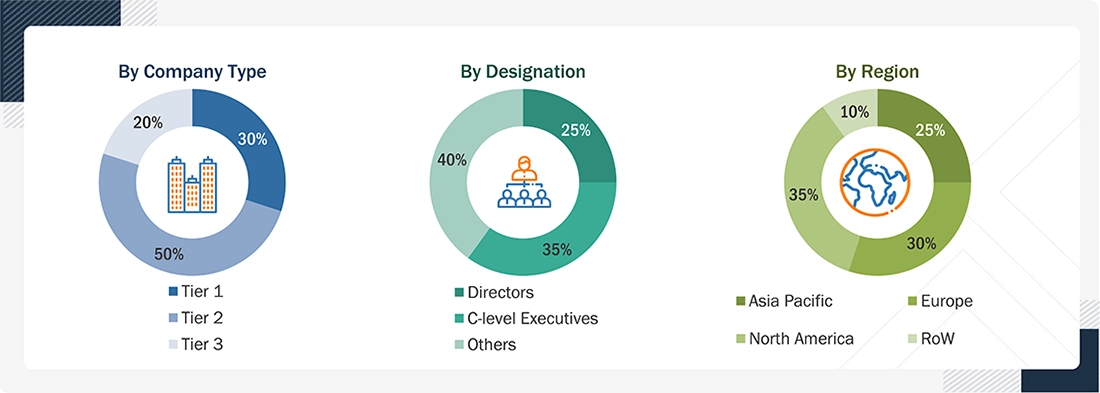
Notes: The three tiers of companies have been defined based on their total/segmental revenue as of 2025: Tier 1 = > USD 1 billion, Tier 2 = USD 1 billion–USD 500 million, and Tier 3 = < USD 500 million.
Other designations include sales, marketing, and product managers.
To know about the assumptions considered for the study, download the pdf brochure
Market Size Estimation
In the complete market engineering process, top-down and bottom-up approaches, along with several data triangulation methods, were used to estimate and validate the size of the microdisplay market and various other dependent submarkets. Key players in the market were identified through secondary research, and their market share in each region was determined through a combination of primary and secondary research. This research methodology involved analyzing the annual and financial reports of the top players and conducting interviews with experts (including CEOs, VPs, directors, and marketing executives) to gather key insights (both quantitative and qualitative).
All percentage shares, splits, and breakdowns were determined using secondary sources and verified through primary sources. All possible parameters affecting the markets covered in this study were accounted for, examined in detail, verified through primary research, and analyzed to obtain final quantitative and qualitative data. This data was consolidated and supplemented with detailed inputs and analysis from MarketsandMarkets and presented in this report.
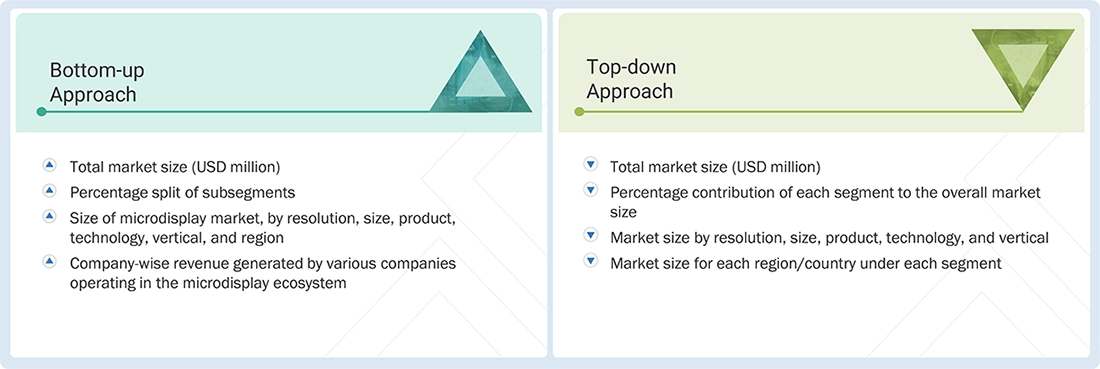
Data Triangulation
After determining the overall market size through the estimation process, as explained above, the total market was divided into several segments and subsegments. To complete the overall market engineering process and obtain precise statistics for all segments and subsegments, the data triangulation procedure was employed, as applicable. The data was triangulated by studying various factors and trends from the demand and supply sides. Additionally, the market has been validated using both top-down and bottom-up approaches.
Market Definition
The microdisplay market comprises ultra-small display panels, which are less than two inches in diagonal size, that deliver high resolution, low power consumption, and superior image quality for compact and precision-based applications. Built on technologies such as liquid crystal display (LCD), liquid crystal on silicon (LCoS), organic light-emitting diode (OLED), digital light processing (DLP), and micro-LED, these displays are integral to augmented and virtual reality (AR/VR) headsets, head-up displays (HUDs), electronic viewfinders, projectors, smart glasses, medical imaging systems, military night vision, and industrial wearables. The market is expanding due to rising adoption of immersive technologies, increased demand for lightweight and high-performance displays in consumer, automotive, healthcare, and defense sectors, and continuous innovations in brightness, pixel density, and AI-enabled imaging, positioning microdisplays as a key enabler of next-generation visual interfaces.
Key Stakeholders
- Brand Product Manufacturers/Original Equipment Manufacturers (OEMs)/Original Device Manufacturers (ODMs)
- Microdisplay Product Manufacturers
- Microdisplay Panel Manufacturers
- Semiconductor Component Suppliers/Foundries
- Microdisplay Material and Component Suppliers
- Manufacturing Equipment Suppliers
- System Integrators
- Technology/IP Developers
- Consulting and Market Research Service Providers
- Microdisplay and Material-related Associations, Organizations, Forums, and Alliances
- Venture Capitalists and Startups
- Research and Educational Institutes
- Distributors and Resellers
- End Users
Report Objectives
- To describe and forecast the microdisplay market, in terms of value, based on product, resolution, size, technology, and vertical
- To define and forecast the market size, in terms of value, with regard to four main regions: North America, Europe, Asia Pacific, and RoW (Rest of the World)
- To provide detailed information regarding drivers, restraints, opportunities, and challenges influencing the growth of the market
- To understand the impact of artificial intelligence (AI) on the market
- To strategically analyze micromarkets with respect to individual growth trends, prospects, and contributions to the total market
- To analyze opportunities for various stakeholders by identifying high-growth segments of the market
- To strategically profile key players and comprehensively analyze their market position in terms of ranking and core competencies, along with detailing the competitive landscape of the market
- To analyze competitive developments, such as acquisitions, product launches, developments, and partnerships in the market
- To provide a detailed overview of the ecosystem analysis, case study analysis, patent analysis, trade analysis, technology analysis, average selling price (ASP) analysis, AI/Gen AI impact analysis, Porter’s five forces analysis, macroeconomic outlook, and regulatory landscape pertaining to the microdisplay market
Available customizations:
With the given market data, MarketsandMarkets offers customizations according to the company’s specific needs. The following customization options are available for the report:
- Detailed analysis and profiling of additional market players (up to five)
Get the Full Microdisplay Market Report
Full forecast, segment splits, and company analysis for all Microdisplay Market.
- US Microdisplay Market
- Canada Microdisplay Market
- Mexico Microdisplay Market
- Germany Microdisplay Market
- France Microdisplay Market
- UK Microdisplay Market
- Spain Microdisplay Market
- Italy Microdisplay Market
- Poland Microdisplay Market
- China Microdisplay Market
- Japan Microdisplay Market
- South Korea Microdisplay Market
- Taiwan Microdisplay Market
- India Microdisplay Market
- Australia Microdisplay Market
- Indonesia Microdisplay Market
- Malaysia Microdisplay Market
- Thailand Microdisplay Market
- Vietnam Microdisplay Market
- Nordics Microdisplay Market
- Rest Of Europe Microdisplay Market
- Rest Of Asia Pacific Microdisplay Market
- Africa Microdisplay Market
- Middle East Microdisplay Market
- South America Microdisplay Market
- Bahrain Microdisplay Market
- Kuwait Microdisplay Market
- Oman Microdisplay Market
- Qatar Microdisplay Market
- Rest Of Middle East Microdisplay Market
- Saudi Arabia Microdisplay Market
- UAE Microdisplay Market
- South Africa Microdisplay Market
Need a Tailored Report?
Customize this report to your needs
Get 10% FREE Customization
Customize This Report