
Asia Pacific Microgrid Market (2025-2030)

The Asia Pacific Microgrid Market was valued at $16566.1 Million in 2025 and projected to reach to $39967.2 Million by 2030, representing a compound annual growth rate of 19.3%. Asia Pacific's microgrid market is positioned as the fastest-growing regional segment globally, driven by massive investments in renewable energy infrastructure and grid modernization across major economies.


| Market Size in | USD 26.32 MN |
| Market Forecast in | |
| CAGR | |
| Forecast Period | |
| Units Considered | Value (USD MN) |
Asia Pacific Microgrid Market Trends and Insights
- Asia Pacific's 19.3% compound annual growth rate significantly outpaces the global average of 17%, driven by accelerating energy transition initiatives and grid modernization across the region.
- Asia Pacific's dominance reflects increasing investments in renewable energy integration, smart grid infrastructure, and distributed energy resources across countries including China, India, Japan, and Southeast Asia. Asia Pacific's microgrid adoption is propelled by rising electricity demand, aging grid infrastructure, and government mandates for clean energy deployment.
- Asia Pacific nations are prioritizing resilience and energy independence through localized power generation and storage solutions.
- The region's diverse regulatory frameworks and varying levels of grid maturity create both opportunities and challenges for microgrid developers and technology providers operating in Asia Pacific. Asia Pacific's competitive landscape features both established semiconductor and electronics manufacturers and emerging microgrid specialists.
- Asia Pacific's market growth is supported by declining renewable technology costs, favorable policy environments, and substantial capital allocation toward digital grid transformation initiatives throughout the region..
Key Market Statistics
- CAGR (2025-2030) 19.3% CAGR
- Market Size, 2025 ~USD 16566.1 Million
- Forecast, 2030 ~USD 39967.2 Million
- Geography Asia Pacific
Asia Pacific Microgrid Market Overview
Outpacing Global Growth :
Asia Pacific's microgrid market grows at 19.3% CAGR, significantly exceeding the global average of 17%, reflecting the region's accelerated energy transition and infrastructure modernization priorities.
China & India Lead Expansion :
China and India collectively represent over USD 22 billion in 2025 market value, driving Asia Pacific's dominance through aggressive renewable energy adoption and smart grid investments.
Rapid Valuation Growth :
The Asia Pacific microgrid market is projected to more than double from USD 16,566.1 million in 2025 to USD 39,967.2 million by 2030, demonstrating exceptional investment momentum.
Grid Modernization Catalyst :
Government initiatives across Asia Pacific for energy security, renewable integration, and distributed generation are fueling widespread microgrid deployment and technology adoption.
Asia Pacific Microgrid Market Dynamics
- China's leadership in distributed energy resources, coupled with India's rapid electrification and energy independence goals, creates substantial opportunities for microgrid solutions.
- The region's 19.3% CAGR reflects structural shifts toward decentralized power systems, energy resilience, and carbon neutrality commitments. Countries including Japan, South Korea, and Australia are advancing microgrid technologies for industrial and residential applications, while Southeast Asian nations are leveraging microgrids to address energy access challenges.
- Supportive regulatory frameworks, declining renewable costs, and increasing grid complexity are accelerating adoption.
- By 2030, Asia Pacific's microgrid market will represent a significant portion of global demand, attracting major technology providers and creating localized innovation ecosystems across the region..
Market Ecosystem
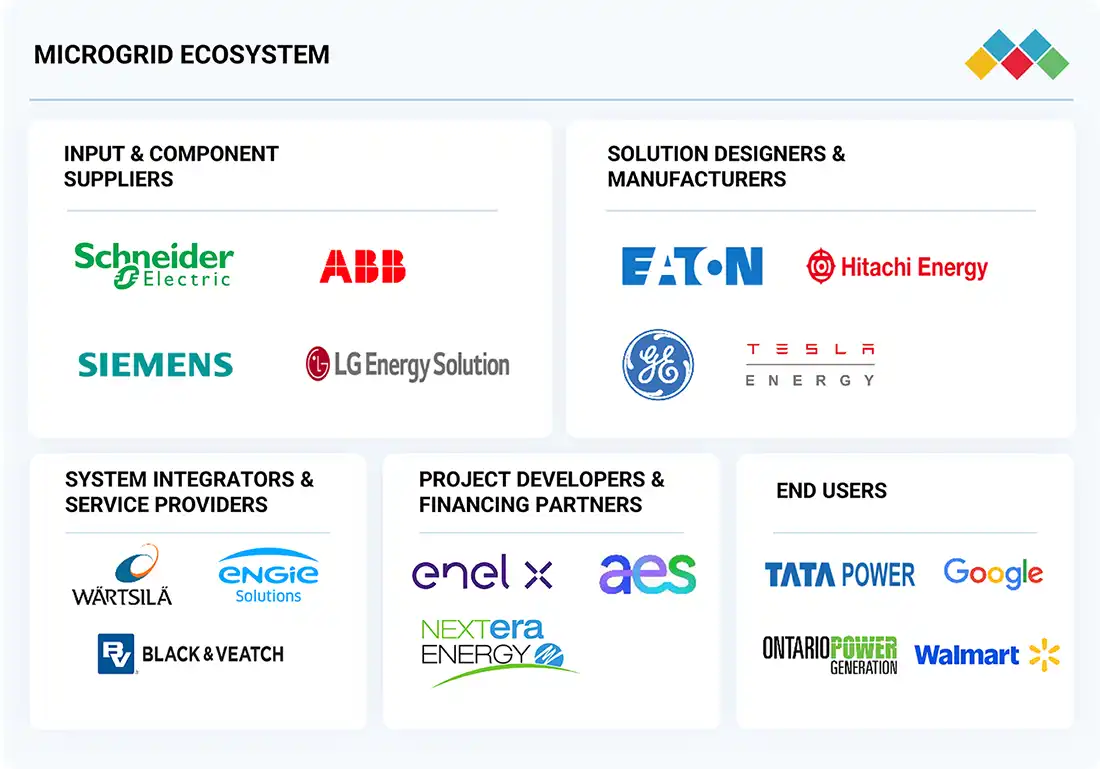
MICROGRID MARKET SIZE, SHARE & GROWTH: COMMERCIAL USE CASES ACROSS INDUSTRIES
| COMPANY | USE CASE DESCRIPTION | BENEFITS |
|---|---|---|
 |
Deployment of modular, renewable-integrated microgrid solutions for commercial & industrial buildings | Improved energy resilience, reduced downtime, and operational cost savings |
 |
Smart microgrid controllers for campuses and urban utilities enabling real-time optimization | Enhanced grid stability, seamless renewable integration, and reduced energy losses |
 |
Hybrid renewable-powered microgrids for remote communities and islanded regions | Reliable power supply, minimized diesel dependency, and lower carbon emissions |
 |
Digital microgrid platforms integrating storage and renewable sources for healthcare facilities | Continuous power for critical operations, improved efficiency, and reduced lifecycle costs |
 |
AI-driven microgrid solutions for government and military facilities | Enhanced energy security, predictive maintenance, and optimized asset utilization |
Logos and trademarks shown above are the property of their respective owners. Their use here is for informational and illustrative purposes only.
Related Ecosystem
Energy Storage
- Energy Harvesting
- HVAC System
- Applicant Tracking System
- Battery Electric Vehicle (BEV)
- Carboxymethyl Cellulose (CMC)
- MOMENTIVE PERFORMANCE MATERIALS INC.
- Panasonic Holdings Corporation
- ABB India Limited
- Lg corp
- FDK Corporation
Engines And Gensets
- Fuel Cell
- Agricultural Tractors
- Analytics Software
- Biometric Systems
- Cogeneration
- Wartsila
- General Electric Company
- Cummins Inc.
- Siemens ag
- UNIPER GLOBAL COMMODITIES SE
Cyber Security
- Cloud Security
- Biometric Systems
- Data Loss Prevention (DLP)
- Multi-Factor Authentication
- Security Analytics
- International Business Machines Corporation
- MITSUI BUSSAN SECURE DIRECTIONS INC
- Cisco Systems, Inc.
- MICROSOFT CORPORATION
- Allot Ltd.
Key Takeaways
- Asia Pacific microgrid market will grow from USD 16.6B (2025) to USD 40.0B (2030) at a 19.3% CAGR, outpacing global growth.
- Asia Pacific's rapid expansion is driven by renewable energy integration, grid modernization, and government clean energy mandates across the region.
- Asia Pacific nations prioritize energy resilience and independence through distributed generation and localized microgrid solutions.
- Asia Pacific's competitive environment combines established electronics manufacturers with specialized microgrid technology providers and system integrators.
Microgrid Market Report Scope
| Report Metric | Details |
|---|---|
| Base Year | 2025 |
| Fastest Growing Segment | SOFTWARE (Offering) |
| Forecast Period | 2025–2030 |
| Growth Rate | CAGR of 17% from 2025 to 2030 |
| Largest Segment | GRID-CONNECTED (Connectivity) |
| Market Size Base Year (Billions) | ~USD 43.4 (2025) |
| Revenue Forecast (Billions) | ~USD 95.16 (2030) |
| Segments Covered | Power Rating, Power Source, Connectivity, Offering, Type |
Asia Pacific Microgrid Market Report Segmentation
5 segment dimensions are covered across the global market.
By Power Rating
- 1–5 Mw
- >5–10 Mw
- Above 10 Mw
- Less Than 1 Mw
By Power Source
- Combined Heat And Power (Chp)
- Diesel
- Fuel Cell
- Natural Gas
- Other Power Sources
- Solar Pv
By Connectivity
- Grid-Connected
- Off-Grid
By Offering
- Hardware
- Services
- Software
By Type
- Controllers
- Energy Storage Systems
- Power Generators
Target Audience
- Energy & Utility Companies : Utilities and energy providers need Asia Pacific market intelligence to develop grid modernization strategies, identify microgrid investment opportunities, and compete in high-growth markets.
- Technology & Equipment Manufacturers : Microgrid solution providers require regional market data to assess demand, benchmark competition, and tailor product offerings for Asia Pacific's diverse regulatory and operational environments.
- Investment & Private Equity Firms : Investors evaluating Asia Pacific energy infrastructure opportunities need comprehensive market sizing and growth forecasts to identify high-potential acquisition and funding targets.
- Government & Policy Makers : Regional and national governments use market research to design energy policies, allocate infrastructure budgets, and establish regulatory frameworks supporting microgrid deployment.
- Consulting & Strategic Planning Teams : Management consultants and corporate strategists require Asia Pacific microgrid market data to advise clients on market entry, competitive positioning, and long-term growth strategies.
Key Companies in the Asia Pacific Microgrid Market
| Company | HQ | Ownership | Strongest segments |
|---|---|---|---|
| AT&S | Canada | Public Company | Custom automated manufacturing and assembly systems,Lifecycle and post-automation services,Contract manufacturing and integration services, |
| TECH MAHINDRA LIMITED | India | Public Company | Application, cloud, and infrastructure services,Digital enterprise applications and platforms,AI, analytics, and automation platforms, |
| MAXWELL TECHNOLOGIES, INC. | United States | Private Company | Ultracapacitor cells, packs, modules, subsystems,High-voltage CONDIS capacitor products,Lithium-ion capacitors, |
| NEXTERA ENERGY RESOURCES | United States | Private Company | Wind power generation,Solar power generation,Gas, oil, and nuclear generation, |
| EMERA INCORPORATED | Canada | Public Company | Florida Electric Utility,Canadian Electric Utilities,Gas Utilities and Infrastructure, |
| ENGIE | France | Public Company | Renewables & Flex Power,Networks (Gas & Power Infrastructure),Local Energy Infrastructures, |
| LENOVO | China | Public Company | Commercial PCs and small form factor signage controllers,Dedicated media players and embedded systems,Tablets and smart devices for kiosks/PoS, |
| ZENSAR TECHNOLOGIES LTD | India | Public Company | Digital and Application Services,Cloud Infrastructure and Security Services,Brand, Creative, and Marketing/Insights Services, |
| VEOLIA | France | Public Company | Municipal and industrial water and wastewater services,Waste collection, recycling, and waste-to-energy,Energy services and district heating/cooling, |
| CONSTELLATION ENERGY | United States | Public Company | Electricity sales (wholesale and retail),Natural gas sales,Energy-related products and sustainable solutions, |
| SCHNEIDER ELECTRIC | France | Public Company | Low- and medium-voltage electrical distribution (switchgear, control gear, wiring devices),Building management, power metering, and smart controls,Industrial automation and variable speed drives, |
| SIEMENS | Germany | Public Company | Digital Industries (automation, PLM, industrial software),Smart Infrastructure (electrification, buildings, grid),Mobility (rail systems, automation, services), |
| GE VERNOVA | United States | Public Company | Power (Gas, Nuclear, Hydro, Steam),Wind (Onshore & Offshore),Electrification (Grid, Power Conversion, Solar & Storage, Software), |
| EATON | Ireland | Public Company | Electrical power distribution, protection, and assemblies,Power quality, reliability, and connectivity,Residential and wiring devices, |
| ABB | Switzerland | Public Company | Electrification,Motion (Drives, Motors, Generators, Traction),Automation (Process, Hybrid, Marine, Software & Services), |
| HONEYWELL INTERNATIONAL INC. | United States | Public Company | Industrial Automation,Building Automation,Energy and Sustainability Solutions (UOP and related), |
| CATERPILLAR | United States | Public Company | Construction Industries equipment and parts,Resource Industries equipment, technology, and services,Energy & Transportation engines, turbines, and rail, |
| TESLA | United States | Public Company | Battery electric vehicles (new),Used vehicles and in-app/software upgrades,Regulatory credits and automotive services, |
| HOMER ENERGY | United States | Subsidiary | Core microgrid optimization software (licenses/subscriptions),Training, certification, and workshops,Advisory, custom studies, and sponsored research, |
| EMERSON ELECTRIC CO. | United States | Public Company | Final Control,Measurement & Analytical,Discrete Automation, |
AT&S
AT&S is a Canadian public company founded in 1978 with 7,000 employees. The company operates as a significant player in its industry across Canada.
TECH MAHINDRA LIMITED
TECH MAHINDRA LIMITED is an Indian public company founded in 1986 with 119,337 employees. It is a major multinational enterprise operating globally.
MAXWELL TECHNOLOGIES, INC.
MAXWELL TECHNOLOGIES, INC. is a private company founded in 1965 and based in the United States. With 368 employees, it operates as an established mid-sized business.
NEXTERA ENERGY RESOURCES
NEXTERA ENERGY RESOURCES is a private company founded in 1997 and based in the United States. With 900 employees, it operates in the energy sector.
EMERA INCORPORATED
EMERA INCORPORATED is a Canadian public company founded in 1998 with 7,812 employees. The company operates as a significant energy and utility provider.
ENGIE
ENGIE is a French public company founded in 1880 with 84,809 employees. It is a major multinational enterprise operating globally in energy and related sectors.
LENOVO
LENOVO is a Chinese public company founded in 1984. It operates as a major multinational technology enterprise.
ZENSAR TECHNOLOGIES LTD
ZENSAR TECHNOLOGIES LTD is an Indian public company founded in 1963 with 10,066 employees. It operates as a significant technology and services provider.
VEOLIA
VEOLIA is a French public company founded in 1853 with 203,100 employees. It is a major multinational enterprise operating globally in environmental and utility services.
CONSTELLATION ENERGY
CONSTELLATION ENERGY is a United States public company founded in 2021 with 15,315 employees. The company operates in the energy sector.
SCHNEIDER ELECTRIC
SCHNEIDER ELECTRIC is a French public company founded in 1836 with 158,122 employees. It is a major multinational enterprise specializing in energy management and automation.
SIEMENS
SIEMENS is a German public company founded in 1847 with 310,312 employees. It is a major multinational conglomerate operating globally across multiple industrial sectors.
GE VERNOVA
GE VERNOVA is a United States public company founded in 2023 with 78,000 employees. The company operates in the energy and industrial technology sectors.
EATON
EATON is an Irish public company founded in 1911 with 97,303 employees. It is a major multinational enterprise specializing in power management solutions.
ABB
ABB is a Swiss public company founded in 1883 with 111,900 employees. It is a major multinational enterprise operating globally in robotics, power, and automation technology.
HONEYWELL INTERNATIONAL INC.
HONEYWELL INTERNATIONAL INC. is a United States public company founded in 1885 with 101,000 employees. It is a major multinational conglomerate operating across aerospace, building technologies, and industrial sectors.
CATERPILLAR
CATERPILLAR is a United States public company founded in 1925 with 118,000 employees. It is a major multinational manufacturer of construction and mining equipment.
TESLA
TESLA is a United States public company founded in 2003 with 134,785 employees. It is a major multinational enterprise specializing in electric vehicles and renewable energy.
HOMER ENERGY
HOMER ENERGY is a United States subsidiary company founded in 2009. The company operates as part of a larger corporate structure.
EMERSON ELECTRIC CO.
EMERSON ELECTRIC CO. is a United States public company founded in 1890 with 71,000 employees. It is a major multinational enterprise specializing in process management and industrial technology.
Countries within Asia Pacific - compare and drill down
| Country | 2025 size (native) |
|---|---|
| Australia | USD 4196.6 Million |
| China | USD 13728.7 Million |
| Japan | USD 3597 Million |
| South Korea | USD 3517.1 Million |
| India | USD 8393.1 Million |
| Indonesia | USD 1658.6 Million |
| Thailand | USD 739.4 Million |
| Vietnam | USD 1219 Million |
| Malaysia | USD 799.3 Million |
Country market size visualization
Reasons to Buy this Report
- Regional Market Sizing & Forecasts : Obtain precise market valuations for Asia Pacific and 8 key countries, with detailed 2025-2030 projections to support strategic planning and investment decisions.
- Competitive Landscape Analysis : Understand market dynamics, key players, and competitive positioning specific to Asia Pacific's microgrid ecosystem to identify partnership and expansion opportunities.
- Growth Driver Identification : Gain insights into region-specific catalysts including renewable energy mandates, grid resilience requirements, and government incentives driving microgrid adoption.
- Country-Level Opportunity Assessment : Evaluate individual market potential across China, India, Japan, South Korea, Australia, and Southeast Asia to prioritize market entry and resource allocation.
- Technology & Deployment Trends : Access detailed analysis of microgrid technologies, use cases, and deployment patterns unique to Asia Pacific's industrial, commercial, and utility sectors.
Frequently asked questions
What is the projected size of the Asia Pacific microgrid market by 2030?
The Asia Pacific microgrid market is projected to reach USD 39,967.2 million by 2030, growing from USD 16,566.1 million in 2025.
What is the CAGR for the Asia Pacific microgrid market?
Asia Pacific's microgrid market is expected to grow at a compound annual growth rate of 19.3% between 2025 and 2030.
Which countries are driving Asia Pacific microgrid market growth?
Key markets in Asia Pacific include China, India, Japan, and Southeast Asian nations, which are investing heavily in renewable energy integration and grid modernization.
What factors are accelerating microgrid adoption in Asia Pacific?
Asia Pacific microgrid growth is driven by rising electricity demand, aging infrastructure, government clean energy policies, declining renewable costs, and the need for grid resilience.
How does Asia Pacific's growth compare to the global microgrid market?
Asia Pacific's 19.3% CAGR exceeds the global average of 17%, reflecting the region's accelerated energy transition and grid modernization priorities.
RESEARCH METHODOLOGY
The research process for this study included systematic gathering, recording, and analysis of data about customers and companies operating in the Microgrid Market. This process involved the extensive use of secondary sources, directories, and databases (Factiva and Oanda) to identify and collect valuable information for the comprehensive, technical, market-oriented, and commercial study of the Microgrid Market. In-depth interviews were conducted with primary respondents, including experts from core and related industries and preferred manufacturers, to obtain and verify critical qualitative and quantitative information and assess growth prospects. Key players in the Microgrid Market were identified through secondary research, and their market rankings were determined through primary and secondary research. This research included studying annual reports of top players and interviewing key industry experts such as CEOs, directors, and marketing executives.
Secondary Research
Various sources were used in the secondary research process to identify and collect information important for this study. These include company annual reports, press releases, investor presentations, white papers, technology journals, certified publications, articles by recognized authors, directories, and databases.
Secondary research was mainly used to obtain key information about the industry’s value chain, the total pool of market players, the market classification according to industry trends to the bottom-most level, regional markets, and key developments from market and technology-oriented perspectives.
Primary Research
Primary research was also conducted to identify the segmentation types, key players, competitive landscape, and key market dynamics, such as drivers, restraints, opportunities, challenges, and industry trends, along with key strategies adopted by players operating in the Microgrid Market. Extensive qualitative and quantitative analyses were performed on the complete market engineering process to list key information and insights throughout the report.
Extensive primary research has been conducted after acquiring knowledge about the Microgrid Market scenarios through secondary research. Several primary interviews have been conducted with experts from the demand (end user and region) and supply side (heating equipment, cooling equipment, ventilation equipment, implementation type, system type, technology) across four major geographic regions: North America, Europe, Asia Pacific, and RoW. Approximately 60% and 40% of the primary interviews were conducted from the supply and demand sides, respectively. These primary data have been collected through questionnaires, emails, and telephonic interviews.
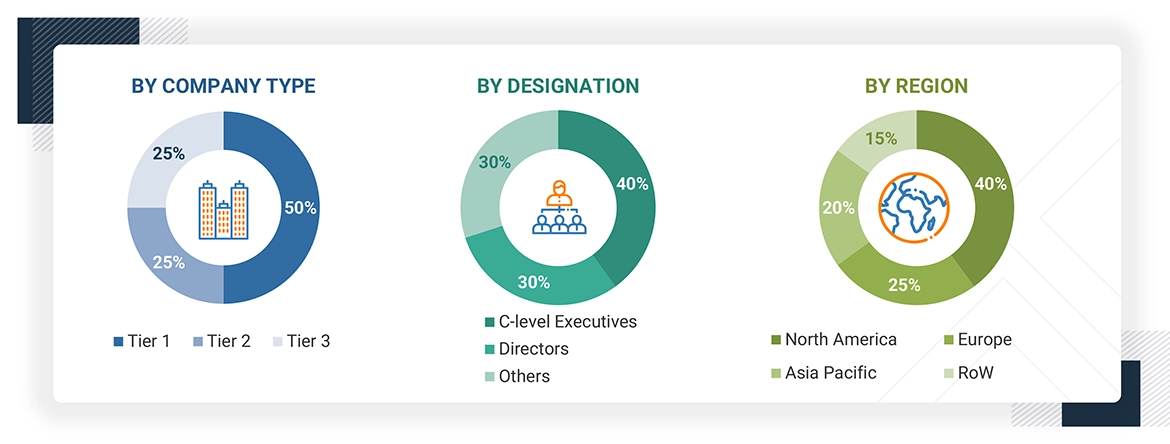
Note: “Others” includes sales, marketing, and product managers
To know about the assumptions considered for the study, download the pdf brochure
Market Size Estimation
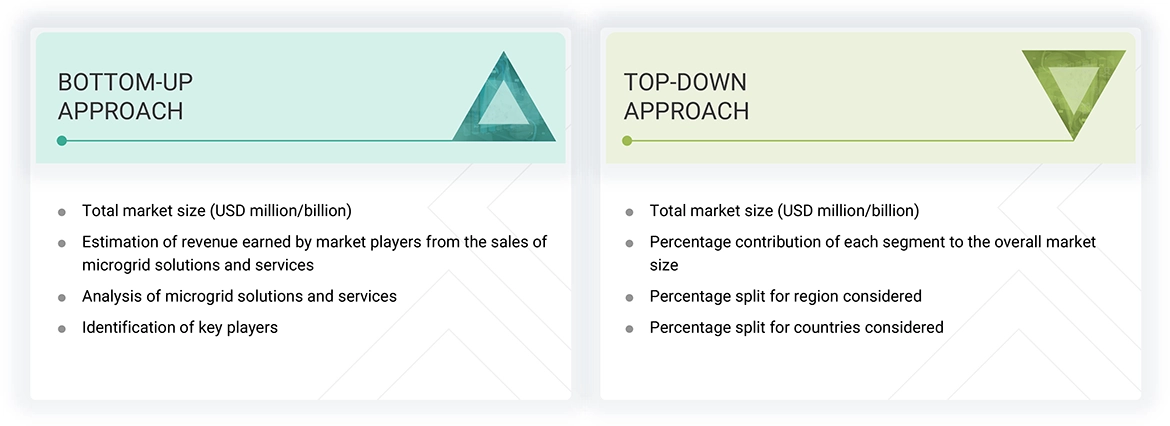
In the market engineering process, the top-down and bottom-up approaches and data triangulation methods have been used to estimate and validate the size of the microgrid market and other dependent submarkets. The research methodology used to estimate the market sizes includes the following:
- Identifying stakeholders in the microgrid market, including regulatory bodies and policy authorities (US Department of Energy, Federal Energy Regulatory Commission [FERC], International Electrotechnical Commission [IEC]), certification agencies, industry associations, consulting firms, technology providers, equipment manufacturers, project developers, utilities, EPC contractors, and end users across sectors such as commercial & industrial buildings, remote areas, military facilities, campuses, healthcare facilities, and utilities
- Analyzing major providers of microgrid solutions and services and their key offerings, including control systems, energy management systems (EMS), distributed energy resources (DERs) integration, advanced metering infrastructure, power electronics (inverters, converters), battery energy storage systems, renewable energy generation units (solar PV, wind, biomass), and dispatchable generation (diesel, natural gas)
- Studying trends of microgrid adoption across end users, segmented by connectivity, power source, power rating, offering, end user, and region
- Tracking recent market developments, including regulatory updates, policy incentives, technology advancements (AI- and IoT-integrated microgrid controllers, blockchain-based energy trading, peer-to-peer energy platforms), deployment of advanced storage technologies, integration of electric vehicle (EV) charging infrastructure, and mergers & acquisitions by key players to forecast market size and identify emerging opportunities
- Conducting multiple discussions with key opinion leaders, including microgrid solution providers, EPC contractors, utilities, renewable energy developers, and regulatory consultants to understand real-time deployment trends, technical challenges, and the growing focus on resilience, energy security, decarbonization, and cost optimization
- Validating market estimates through in-depth consultations with industry experts, ranging from CTOs of leading microgrid technology companies to energy planners, project managers, and sustainability officers, and aligning insights with domain specialists at MarketsandMarkets for accurate and reliable market projections
Microgrid Market : Top-Down and Bottom-Up Approach
Data Triangulation
After arriving at the overall market size by the market size estimation process explained in the earlier section, the overall microgrid market has been divided into several segments and subsegments. The data triangulation and market breakdown procedures have been used to complete the overall market engineering process and arrive at the exact statistics for all segments, wherever applicable. The data was triangulated by studying various factors and trends from the perspectives of demand and supply. Along with data triangulation and market breakdown, the market has been validated by top-down and bottom-up approaches.
Market Definition
A microgrid is a localized energy system that integrates distributed energy resources (DERs), such as solar PV, wind turbines, generators, energy storage, and advanced control systems, to supply electricity to a defined group of consumers. Operating as a single controllable entity, it can function in either grid-connected or island (off-grid) mode to enhance reliability, resilience, and efficiency across campuses, hospitals, military facilities, utilities, commercial & industrial sites, and remote communities. The market encompasses microgrid-integrated DERs across a capacity range from less than 1 MW to above 10 MW.
Key Stakeholders
- Raw Material & Component Suppliers
- Microgrid Developers & EPC Contractors
- Distribution Network Service Providers
- Power-Generating Companies & Energy Producers
- Electric Utilities & Retail Energy Providers
- Technology & Equipment Manufacturers
- Government & Regulatory Agencies
- Standardization Bodies, Forums, and Industry Associations
- Consulting & Advisory Firms
- Research & Academic Institutions
- Financial Institutions & Investors
- End Users
Report Objectives
- To define, describe, segment, and forecast the size of the microgrid market, by offering, connectivity, power rating, power source, end user, and region, in terms of value
- To describe the microgrid market based on types, patterns, and architecture types
- To forecast the size of various segments for four regions, namely North America, Asia Pacific, Europe, and the Rest of the World (RoW), in terms of value and volume
- To offer detailed information on drivers, restraints, opportunities, and challenges influencing market growth
- To provide a detailed overview of the microgrid market value chain
- To strategically analyze the micromarkets concerning individual growth trends, prospects, and contributions to the overall market
- To analyze industry trends, pricing data, patents and innovations, technology analysis, ecosystem analysis, relevant case studies, Porter’s five forces analysis, key stakeholders and buying criteria, key conferences, trends/disruptions impacting customers’ businesses, regulatory landscape, and trade data (export and import data), the impact of AI/Gen AI, and the 2025 US tariff on the market under study, along with the macroeconomic outlook for each region
- To analyze opportunities for various stakeholders by identifying the high-growth segments of the market
- To benchmark the key players and analyze their market position in terms of revenue, market share, and core competencies, and detailed competitive landscape for the market leaders
- To analyze competitive developments, such as product launches, contracts, acquisitions, partnerships, and agreements, carried out by players in the microgrid market
Customization Options
With the given market data, MarketsandMarkets offers customizations according to the specific requirements of companies. The following customization options are available for the report:
Country-wise Information:
- Country-wise breakdown for North America, Europe, Asia Pacific, and the Rest of the World
Company Information:
- Detailed analysis and profiling of additional market players (up to five)
Get the Full Microgrid Market Report
Full forecast, segment splits, and company analysis for all Microgrid Market.
- Australia Microgrid Market
- Canada Microgrid Market
- China Microgrid Market
- France Microgrid Market
- Germany Microgrid Market
- India Microgrid Market
- Indonesia Microgrid Market
- Italy Microgrid Market
- Japan Microgrid Market
- Malaysia Microgrid Market
- Mexico Microgrid Market
- Nordics Microgrid Market
- Poland Microgrid Market
- Rest Of Europe Microgrid Market
- South Korea Microgrid Market
- Spain Microgrid Market
- Thailand Microgrid Market
- UK Microgrid Market
- US Microgrid Market
- Vietnam Microgrid Market
Need a Tailored Report?
Customize this report to your needs
Get 10% FREE Customization
Customize This Report
