
South Korea Microgrid Market (2025-2030)

The South Korea Microgrid Market was valued at $1568.3 Million in 2025 and projected to reach to $3517.1 Million by 2030, representing a compound annual growth rate of 17.5%. South Korea's microgrid market is poised for accelerated growth driven by government renewable energy mandates, corporate sustainability commitments, and technological advancements in smart grid infrastructure.


| Market Size in | USD 26.32 MN |
| Market Forecast in | |
| CAGR | |
| Forecast Period | |
| Units Considered | Value (USD MN) |
South Korea Microgrid Market Trends and Insights
- This growth trajectory reflects South Korea's strategic commitment to renewable energy integration and grid modernization across industrial, commercial, and residential sectors.
- South Korea's advanced semiconductor and electronics infrastructure positions the nation as a critical hub for microgrid technology deployment and innovation. The South Korea microgrid market is driven by government incentives, increasing energy security concerns, and the nation's transition toward carbon neutrality.
- South Korea's aggressive renewable energy targets and smart grid initiatives are accelerating microgrid adoption in urban and industrial zones.
- Between 2025 and 2030, South Korea is expected to see significant investments in distributed energy resources, battery storage systems, and intelligent control technologies that enhance grid resilience and operational efficiency. South Korea's competitive advantage in semiconductor manufacturing and electronics innovation creates a favorable ecosystem for microgrid solution providers.
- South Korea's regulatory framework and substantial R&D investments underscore the market's potential to become a regional leader in microgrid technology and deployment..
Key Market Statistics
- CAGR (2025-2030) 17.5% CAGR
- Market Size, 2025 ~USD 1568.3 Million
- Forecast, 2030 ~USD 3517.1 Million
- Country South Korea
South Korea Microgrid Market Overview
Market Valuation Growth :
South Korea's microgrid market is valued at USD 1,568.3 million in 2025, with a projected CAGR of 17.5% through 2030, reaching USD 3,517.1 million. This growth significantly outpaces the global CAGR of 17%, positioning South Korea as a high-growth market in the Asia-Pacific region.
Renewable Energy Integration :
South Korea is accelerating renewable energy adoption through strategic microgrid deployment across industrial, commercial, and residential sectors. Government initiatives supporting clean energy transition and carbon neutrality targets are driving substantial investments in distributed energy resources and grid modernization infrastructure.
Advanced Technology Infrastructure :
South Korea's world-class semiconductor and electronics manufacturing base provides a competitive advantage in microgrid technology development. The country's expertise in IoT, AI-enabled grid management, and smart energy solutions positions it as a regional innovation hub for next-generation microgrid systems.
Industrial & Commercial Expansion :
South Korea's manufacturing-heavy economy is increasingly adopting microgrids to enhance energy resilience and reduce operational costs. Industrial parks, data centers, and commercial facilities are investing in localized energy systems to achieve sustainability goals and improve grid independence.
South Korea Microgrid Market Dynamics
- The country's focus on achieving carbon neutrality by 2050 and expanding renewable capacity will continue to fuel microgrid adoption across all sectors.
- Investment in grid modernization, energy storage integration, and demand-response systems will create substantial opportunities for technology providers and system integrators. The competitive landscape in South Korea is characterized by strong participation from domestic electronics manufacturers, energy companies, and innovative startups.
- Increasing collaboration between government agencies, utilities, and private enterprises will accelerate pilot projects and commercial deployments.
- As South Korea strengthens its position as a regional technology leader, the microgrid market will benefit from continuous innovation, favorable regulatory frameworks, and growing demand for resilient, sustainable energy solutions..
Market Ecosystem
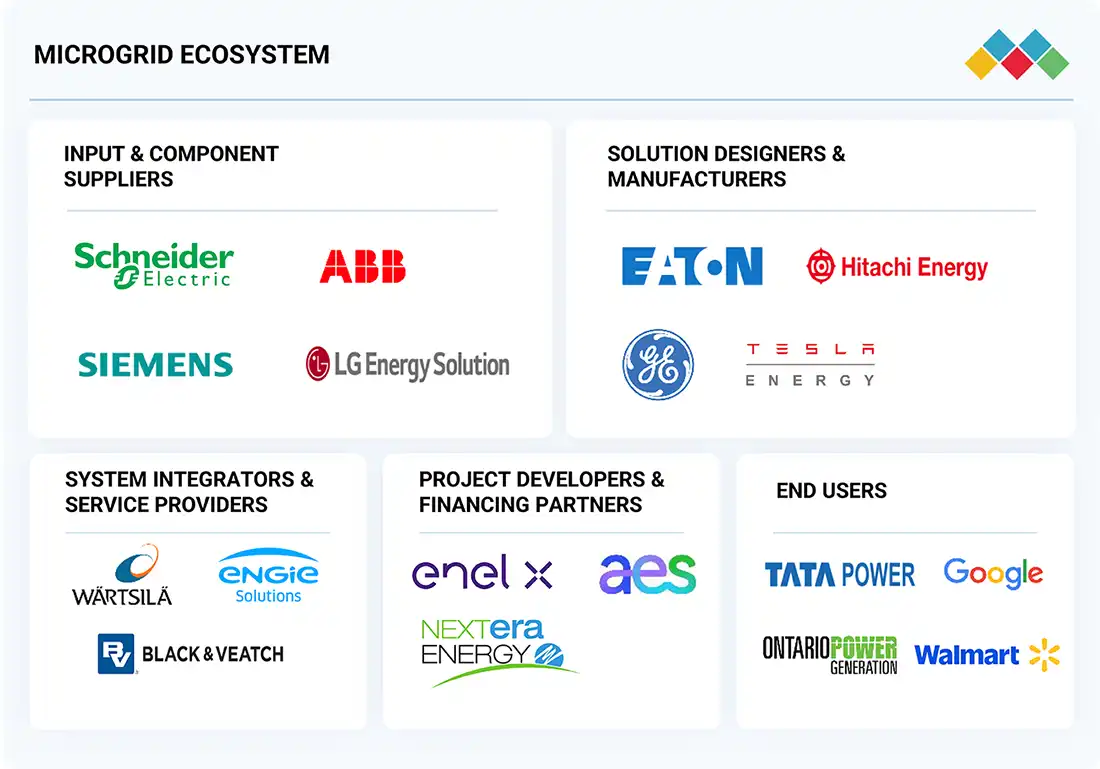
MICROGRID MARKET SIZE, SHARE & GROWTH: COMMERCIAL USE CASES ACROSS INDUSTRIES
| COMPANY | USE CASE DESCRIPTION | BENEFITS |
|---|---|---|
 |
Deployment of modular, renewable-integrated microgrid solutions for commercial & industrial buildings | Improved energy resilience, reduced downtime, and operational cost savings |
 |
Smart microgrid controllers for campuses and urban utilities enabling real-time optimization | Enhanced grid stability, seamless renewable integration, and reduced energy losses |
 |
Hybrid renewable-powered microgrids for remote communities and islanded regions | Reliable power supply, minimized diesel dependency, and lower carbon emissions |
 |
Digital microgrid platforms integrating storage and renewable sources for healthcare facilities | Continuous power for critical operations, improved efficiency, and reduced lifecycle costs |
 |
AI-driven microgrid solutions for government and military facilities | Enhanced energy security, predictive maintenance, and optimized asset utilization |
Logos and trademarks shown above are the property of their respective owners. Their use here is for informational and illustrative purposes only.
Related Ecosystem
Energy Storage
- Energy Harvesting
- HVAC System
- Applicant Tracking System
- Battery Electric Vehicle (BEV)
- Carboxymethyl Cellulose (CMC)
- MOMENTIVE PERFORMANCE MATERIALS INC.
- Panasonic Holdings Corporation
- Lg corp
- ABB India Limited
- FDK Corporation
Engines And Gensets
- Fuel Cell
- Agricultural Tractors
- Analytics Software
- Biometric Systems
- Cogeneration
- Wartsila
- General Electric Company
- Cummins Inc.
- Siemens ag
- UNIPER GLOBAL COMMODITIES SE
Cyber Security
- Cloud Security
- Biometric Systems
- Multi-Factor Authentication
- Security Analytics
- Data Loss Prevention (DLP)
- International Business Machines Corporation
- Cisco Systems, Inc.
- MITSUI BUSSAN SECURE DIRECTIONS INC
- MICROSOFT CORPORATION
- Allot Ltd.
Key Takeaways
- South Korea's microgrid market will more than double from USD 1,568.3 million in 2025 to USD 3,517.1 million by 2030, representing a 17.5% CAGR.
- South Korea's renewable energy mandates and carbon neutrality goals are primary catalysts driving microgrid technology adoption and investment.
- South Korea's semiconductor and electronics expertise provides competitive advantages in developing advanced microgrid control systems and energy management solutions.
- South Korea's industrial and commercial sectors are leading microgrid deployment, supported by government subsidies and energy resilience initiatives.
Microgrid Market Report Scope
| Report Metric | Details |
|---|---|
| Base Year | 2025 |
| Fastest Growing Segment | SOFTWARE (Offering) |
| Forecast Period | 2025–2030 |
| Growth Rate | CAGR of 17% from 2025 to 2030 |
| Largest Segment | GRID-CONNECTED (Connectivity) |
| Market Size Base Year (Billions) | ~USD 43.4 (2025) |
| Revenue Forecast (Billions) | ~USD 95.16 (2030) |
| Segments Covered | Power Rating, Power Source, Connectivity, Offering, Type, End User |
South Korea Microgrid Market Report Segmentation
6 segment dimensions are covered across the global market.
By Power Rating
- 1–5 Mw
- >5–10 Mw
- Above 10 Mw
- Less Than 1 Mw
By Power Source
- Combined Heat And Power (Chp)
- Diesel
- Fuel Cell
- Natural Gas
- Other Power Sources
- Solar Pv
By Connectivity
- Grid-Connected
- Off-Grid
By Offering
- Hardware
- Services
- Software
By Type
- Controllers
- Energy Storage Systems
- Power Generators
By End User
- Commercial & Industrial Buildings
- Government Buildings
- Healthcare Facilities
- Institutes & Campuses
- Military Facilities
- Remote Areas
- Utilities
Target Audience
- Energy & Utility Companies : South Korean utilities and energy providers need market intelligence to develop microgrid strategies, identify investment opportunities, and understand competitive positioning in the rapidly expanding distributed energy sector.
- Technology & Equipment Manufacturers : Semiconductor, electronics, and renewable energy equipment manufacturers require South Korea-specific market data to assess demand, plan product development, and establish manufacturing or distribution partnerships in this high-growth market.
- Government & Policy Makers : South Korean government agencies and policy makers need comprehensive market analysis to inform renewable energy policies, grid modernization initiatives, and carbon neutrality strategies aligned with national sustainability goals.
- Investment & Financial Institutions : Investors, venture capital firms, and financial institutions require detailed market forecasts and opportunity analysis to evaluate investment potential in South Korea's microgrid sector and identify promising startups and established players.
- Industrial & Commercial Enterprises : Manufacturing facilities, data centers, and commercial enterprises need market insights to evaluate microgrid adoption for energy resilience, cost reduction, and sustainability compliance specific to South Korea's regulatory environment.
Key Companies in the South Korea Microgrid Market
| Company | HQ | Ownership | Strongest segments |
|---|---|---|---|
| AT&S | Canada | Public Company | Custom automated manufacturing and assembly systems,Lifecycle and post-automation services,Contract manufacturing and integration services, |
| TECH MAHINDRA LIMITED | India | Public Company | Application, cloud, and infrastructure services,Digital enterprise applications and platforms,AI, analytics, and automation platforms, |
| MAXWELL TECHNOLOGIES, INC. | United States | Private Company | Ultracapacitor cells, packs, modules, subsystems,High-voltage CONDIS capacitor products,Lithium-ion capacitors, |
| NEXTERA ENERGY RESOURCES | United States | Private Company | Wind power generation,Solar power generation,Gas, oil, and nuclear generation, |
| EMERA INCORPORATED | Canada | Public Company | Florida Electric Utility,Canadian Electric Utilities,Gas Utilities and Infrastructure, |
| ENGIE | France | Public Company | Renewables & Flex Power,Networks (Gas & Power Infrastructure),Local Energy Infrastructures, |
| LENOVO | China | Public Company | Commercial PCs and small form factor signage controllers,Dedicated media players and embedded systems,Tablets and smart devices for kiosks/PoS, |
| ZENSAR TECHNOLOGIES LTD | India | Public Company | Digital and Application Services,Cloud Infrastructure and Security Services,Brand, Creative, and Marketing/Insights Services, |
| VEOLIA | France | Public Company | Municipal and industrial water and wastewater services,Waste collection, recycling, and waste-to-energy,Energy services and district heating/cooling, |
| CONSTELLATION ENERGY | United States | Public Company | Electricity sales (wholesale and retail),Natural gas sales,Energy-related products and sustainable solutions, |
| SCHNEIDER ELECTRIC | France | Public Company | Low- and medium-voltage electrical distribution (switchgear, control gear, wiring devices),Building management, power metering, and smart controls,Industrial automation and variable speed drives, |
| SIEMENS | Germany | Public Company | Digital Industries (automation, PLM, industrial software),Smart Infrastructure (electrification, buildings, grid),Mobility (rail systems, automation, services), |
| GE VERNOVA | United States | Public Company | Power (Gas, Nuclear, Hydro, Steam),Wind (Onshore & Offshore),Electrification (Grid, Power Conversion, Solar & Storage, Software), |
| EATON | Ireland | Public Company | Electrical power distribution, protection, and assemblies,Power quality, reliability, and connectivity,Residential and wiring devices, |
| ABB | Switzerland | Public Company | Electrification,Motion (Drives, Motors, Generators, Traction),Automation (Process, Hybrid, Marine, Software & Services), |
| HONEYWELL INTERNATIONAL INC. | United States | Public Company | Industrial Automation,Building Automation,Energy and Sustainability Solutions (UOP and related), |
| CATERPILLAR | United States | Public Company | Construction Industries equipment and parts,Resource Industries equipment, technology, and services,Energy & Transportation engines, turbines, and rail, |
| TESLA | United States | Public Company | Battery electric vehicles (new),Used vehicles and in-app/software upgrades,Regulatory credits and automotive services, |
| HOMER ENERGY | United States | Subsidiary | Core microgrid optimization software (licenses/subscriptions),Training, certification, and workshops,Advisory, custom studies, and sponsored research, |
| EMERSON ELECTRIC CO. | United States | Public Company | Final Control,Measurement & Analytical,Discrete Automation, |
AT&S
AT&S is a Canadian public company founded in 1978 with 7,000 employees. The company operates as a significant player in its industry across Canada.
TECH MAHINDRA LIMITED
TECH MAHINDRA LIMITED is an Indian public company founded in 1986 with 119,337 employees. It is a major multinational enterprise operating globally.
MAXWELL TECHNOLOGIES, INC.
MAXWELL TECHNOLOGIES, INC. is a private company founded in 1965 and based in the United States. With 368 employees, it operates as an established mid-sized business.
NEXTERA ENERGY RESOURCES
NEXTERA ENERGY RESOURCES is a private company founded in 1997 and based in the United States. With 900 employees, it operates in the energy sector.
EMERA INCORPORATED
EMERA INCORPORATED is a Canadian public company founded in 1998 with 7,812 employees. The company operates as a significant energy and utility provider.
ENGIE
ENGIE is a French public company founded in 1880 with 84,809 employees. It is a major multinational enterprise operating globally in energy and related sectors.
LENOVO
LENOVO is a Chinese public company founded in 1984. It operates as a major multinational technology enterprise.
ZENSAR TECHNOLOGIES LTD
ZENSAR TECHNOLOGIES LTD is an Indian public company founded in 1963 with 10,066 employees. It operates as a significant technology services provider.
VEOLIA
VEOLIA is a French public company founded in 1853 with 203,100 employees. It is a major multinational enterprise operating globally in environmental and utility services.
CONSTELLATION ENERGY
CONSTELLATION ENERGY is a United States public company founded in 2021 with 15,315 employees. The company operates in the energy sector.
SCHNEIDER ELECTRIC
SCHNEIDER ELECTRIC is a French public company founded in 1836 with 158,122 employees. It is a major multinational enterprise specializing in energy management and automation.
SIEMENS
SIEMENS is a German public company founded in 1847 with 310,312 employees. It is a major multinational conglomerate operating globally across multiple industrial sectors.
GE VERNOVA
GE VERNOVA is a United States public company founded in 2023 with 78,000 employees. The company operates in the energy and industrial technology sectors.
EATON
EATON is a public company founded in 1911 and based in Ireland with 97,303 employees. It is a major multinational enterprise operating globally in power management.
ABB
ABB is a Swiss public company founded in 1883 with 112,700 employees. It is a major multinational enterprise specializing in robotics, power, and automation technology.
HONEYWELL INTERNATIONAL INC.
HONEYWELL INTERNATIONAL INC. is a United States public company founded in 1885 with 101,000 employees. It is a major multinational conglomerate operating globally across multiple industrial sectors.
CATERPILLAR
CATERPILLAR is a United States public company founded in 1925 with 118,000 employees. It is a major multinational manufacturer of construction and mining equipment.
TESLA
TESLA is a United States public company founded in 2003 with 134,785 employees. It is a major multinational manufacturer of electric vehicles and energy storage solutions.
HOMER ENERGY
HOMER ENERGY is a subsidiary company founded in 2009 and based in the United States.
EMERSON ELECTRIC CO.
EMERSON ELECTRIC CO. is a United States public company founded in 1890 with 71,000 employees. It is a major multinational enterprise operating globally in process management and industrial technology.
Reasons to Buy this Report
- Market-Specific Growth Projections : Access detailed forecasts showing South Korea's microgrid market expanding from USD 1,568.3M to USD 3,517.1M by 2030. Understand the 17.5% CAGR trajectory and identify high-growth segments specific to South Korea's industrial, commercial, and residential sectors.
- Competitive Landscape Analysis : Gain insights into South Korea's unique competitive dynamics, including domestic electronics manufacturers, energy utilities, and innovative startups. Identify key players, market share distribution, and strategic partnerships shaping the South Korean microgrid ecosystem.
- Regulatory & Policy Framework : Understand South Korea's government initiatives, renewable energy mandates, and carbon neutrality targets driving microgrid adoption. Analyze how policy frameworks and incentive programs create market opportunities and influence investment decisions across sectors.
- Technology & Innovation Trends : Explore South Korea's advanced semiconductor and electronics capabilities applied to microgrid systems. Discover emerging technologies in IoT integration, AI-enabled grid management, and energy storage solutions specific to the South Korean market.
- Investment & Expansion Opportunities : Identify strategic entry points and partnership opportunities in South Korea's high-growth microgrid market. Evaluate sector-specific demand in manufacturing, data centers, and commercial facilities to optimize market entry and resource allocation strategies.
Frequently asked questions
What is the projected market size of South Korea's microgrid market by 2030?
South Korea's microgrid market is projected to reach USD 3,517.1 million by 2030, growing from USD 1,568.3 million in 2025 at a 17.5% CAGR.
What are the primary drivers of microgrid adoption in South Korea?
South Korea's microgrid growth is driven by renewable energy mandates, carbon neutrality targets, energy security concerns, and government incentives supporting distributed energy resources and smart grid modernization.
Which sectors are leading microgrid deployment in South Korea?
South Korea's industrial and commercial sectors are leading microgrid adoption, with increasing deployment in manufacturing facilities, data centers, and urban smart grid projects supported by government subsidies.
How does South Korea's semiconductor industry support microgrid market growth?
South Korea's advanced semiconductor and electronics manufacturing capabilities enable the development of sophisticated microgrid control systems, energy management platforms, and intelligent grid technologies essential for market expansion.
What is the CAGR for South Korea's microgrid market from 2025 to 2030?
South Korea's microgrid market is expected to grow at a compound annual growth rate (CAGR) of 17.5% between 2025 and 2030.
RESEARCH METHODOLOGY
The research process for this study included systematic gathering, recording, and analysis of data about customers and companies operating in the Microgrid Market. This process involved the extensive use of secondary sources, directories, and databases (Factiva and Oanda) to identify and collect valuable information for the comprehensive, technical, market-oriented, and commercial study of the Microgrid Market. In-depth interviews were conducted with primary respondents, including experts from core and related industries and preferred manufacturers, to obtain and verify critical qualitative and quantitative information and assess growth prospects. Key players in the Microgrid Market were identified through secondary research, and their market rankings were determined through primary and secondary research. This research included studying annual reports of top players and interviewing key industry experts such as CEOs, directors, and marketing executives.
Secondary Research
Various sources were used in the secondary research process to identify and collect information important for this study. These include company annual reports, press releases, investor presentations, white papers, technology journals, certified publications, articles by recognized authors, directories, and databases.
Secondary research was mainly used to obtain key information about the industry’s value chain, the total pool of market players, the market classification according to industry trends to the bottom-most level, regional markets, and key developments from market and technology-oriented perspectives.
Primary Research
Primary research was also conducted to identify the segmentation types, key players, competitive landscape, and key market dynamics, such as drivers, restraints, opportunities, challenges, and industry trends, along with key strategies adopted by players operating in the Microgrid Market. Extensive qualitative and quantitative analyses were performed on the complete market engineering process to list key information and insights throughout the report.
Extensive primary research has been conducted after acquiring knowledge about the Microgrid Market scenarios through secondary research. Several primary interviews have been conducted with experts from the demand (end user and region) and supply side (heating equipment, cooling equipment, ventilation equipment, implementation type, system type, technology) across four major geographic regions: North America, Europe, Asia Pacific, and RoW. Approximately 60% and 40% of the primary interviews were conducted from the supply and demand sides, respectively. These primary data have been collected through questionnaires, emails, and telephonic interviews.
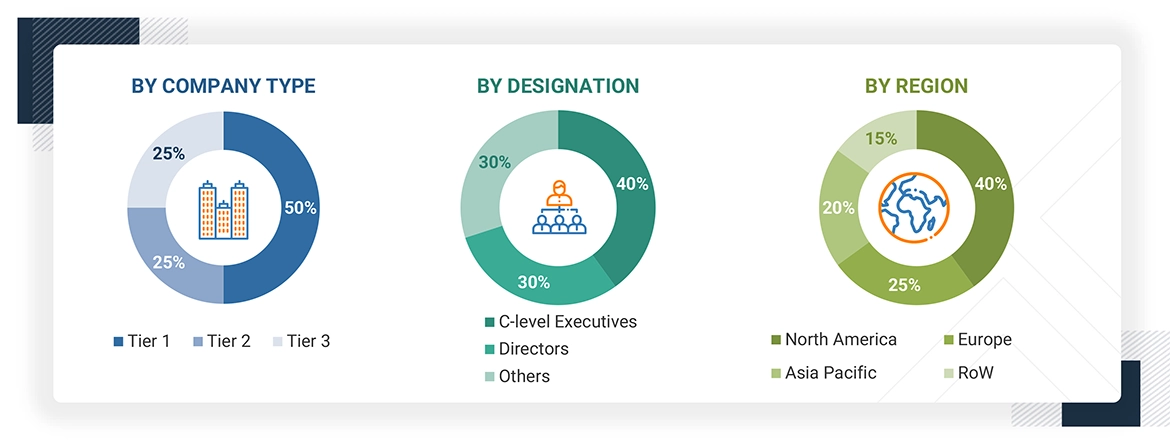
Note: “Others” includes sales, marketing, and product managers
To know about the assumptions considered for the study, download the pdf brochure
Market Size Estimation
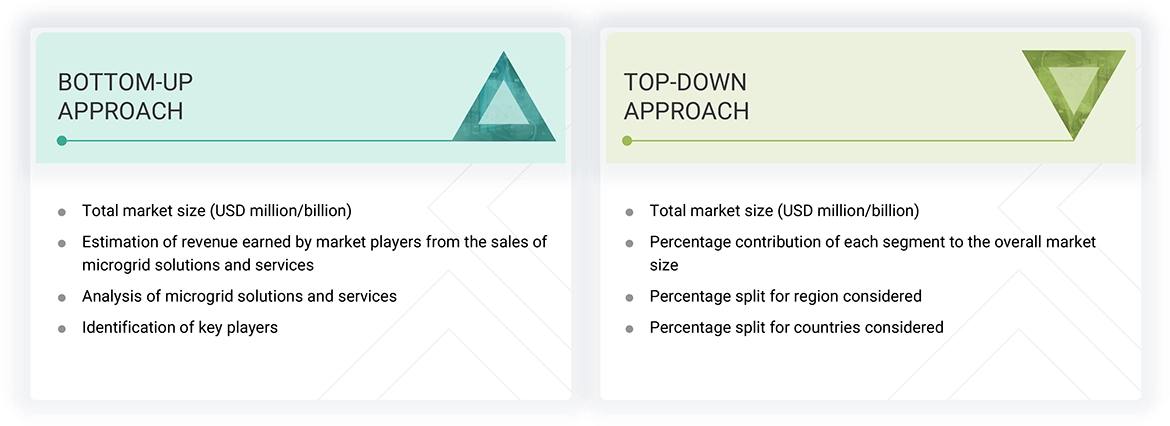
In the market engineering process, the top-down and bottom-up approaches and data triangulation methods have been used to estimate and validate the size of the microgrid market and other dependent submarkets. The research methodology used to estimate the market sizes includes the following:
- Identifying stakeholders in the microgrid market, including regulatory bodies and policy authorities (US Department of Energy, Federal Energy Regulatory Commission [FERC], International Electrotechnical Commission [IEC]), certification agencies, industry associations, consulting firms, technology providers, equipment manufacturers, project developers, utilities, EPC contractors, and end users across sectors such as commercial & industrial buildings, remote areas, military facilities, campuses, healthcare facilities, and utilities
- Analyzing major providers of microgrid solutions and services and their key offerings, including control systems, energy management systems (EMS), distributed energy resources (DERs) integration, advanced metering infrastructure, power electronics (inverters, converters), battery energy storage systems, renewable energy generation units (solar PV, wind, biomass), and dispatchable generation (diesel, natural gas)
- Studying trends of microgrid adoption across end users, segmented by connectivity, power source, power rating, offering, end user, and region
- Tracking recent market developments, including regulatory updates, policy incentives, technology advancements (AI- and IoT-integrated microgrid controllers, blockchain-based energy trading, peer-to-peer energy platforms), deployment of advanced storage technologies, integration of electric vehicle (EV) charging infrastructure, and mergers & acquisitions by key players to forecast market size and identify emerging opportunities
- Conducting multiple discussions with key opinion leaders, including microgrid solution providers, EPC contractors, utilities, renewable energy developers, and regulatory consultants to understand real-time deployment trends, technical challenges, and the growing focus on resilience, energy security, decarbonization, and cost optimization
- Validating market estimates through in-depth consultations with industry experts, ranging from CTOs of leading microgrid technology companies to energy planners, project managers, and sustainability officers, and aligning insights with domain specialists at MarketsandMarkets for accurate and reliable market projections
Microgrid Market : Top-Down and Bottom-Up Approach
Data Triangulation
After arriving at the overall market size by the market size estimation process explained in the earlier section, the overall microgrid market has been divided into several segments and subsegments. The data triangulation and market breakdown procedures have been used to complete the overall market engineering process and arrive at the exact statistics for all segments, wherever applicable. The data was triangulated by studying various factors and trends from the perspectives of demand and supply. Along with data triangulation and market breakdown, the market has been validated by top-down and bottom-up approaches.
Market Definition
A microgrid is a localized energy system that integrates distributed energy resources (DERs), such as solar PV, wind turbines, generators, energy storage, and advanced control systems, to supply electricity to a defined group of consumers. Operating as a single controllable entity, it can function in either grid-connected or island (off-grid) mode to enhance reliability, resilience, and efficiency across campuses, hospitals, military facilities, utilities, commercial & industrial sites, and remote communities. The market encompasses microgrid-integrated DERs across a capacity range from less than 1 MW to above 10 MW.
Key Stakeholders
- Raw Material & Component Suppliers
- Microgrid Developers & EPC Contractors
- Distribution Network Service Providers
- Power-Generating Companies & Energy Producers
- Electric Utilities & Retail Energy Providers
- Technology & Equipment Manufacturers
- Government & Regulatory Agencies
- Standardization Bodies, Forums, and Industry Associations
- Consulting & Advisory Firms
- Research & Academic Institutions
- Financial Institutions & Investors
- End Users
Report Objectives
- To define, describe, segment, and forecast the size of the microgrid market, by offering, connectivity, power rating, power source, end user, and region, in terms of value
- To describe the microgrid market based on types, patterns, and architecture types
- To forecast the size of various segments for four regions, namely North America, Asia Pacific, Europe, and the Rest of the World (RoW), in terms of value and volume
- To offer detailed information on drivers, restraints, opportunities, and challenges influencing market growth
- To provide a detailed overview of the microgrid market value chain
- To strategically analyze the micromarkets concerning individual growth trends, prospects, and contributions to the overall market
- To analyze industry trends, pricing data, patents and innovations, technology analysis, ecosystem analysis, relevant case studies, Porter’s five forces analysis, key stakeholders and buying criteria, key conferences, trends/disruptions impacting customers’ businesses, regulatory landscape, and trade data (export and import data), the impact of AI/Gen AI, and the 2025 US tariff on the market under study, along with the macroeconomic outlook for each region
- To analyze opportunities for various stakeholders by identifying the high-growth segments of the market
- To benchmark the key players and analyze their market position in terms of revenue, market share, and core competencies, and detailed competitive landscape for the market leaders
- To analyze competitive developments, such as product launches, contracts, acquisitions, partnerships, and agreements, carried out by players in the microgrid market
Customization Options
With the given market data, MarketsandMarkets offers customizations according to the specific requirements of companies. The following customization options are available for the report:
Country-wise Information:
- Country-wise breakdown for North America, Europe, Asia Pacific, and the Rest of the World
Company Information:
- Detailed analysis and profiling of additional market players (up to five)
Get the Full Microgrid Market Report
Full forecast, segment splits, and company analysis for all Microgrid Market.
- Canada Microgrid Market
- Mexico Microgrid Market
- US Microgrid Market
- UK Microgrid Market
- Germany Microgrid Market
- France Microgrid Market
- Italy Microgrid Market
- Spain Microgrid Market
- Poland Microgrid Market
- Australia Microgrid Market
- China Microgrid Market
- Japan Microgrid Market
- India Microgrid Market
- Indonesia Microgrid Market
- Thailand Microgrid Market
- Vietnam Microgrid Market
- Malaysia Microgrid Market
- Nordics Microgrid Market
- Rest Of Europe Microgrid Market
Need a Tailored Report?
Customize this report to your needs
Get 10% FREE Customization
Customize This Report
