
Japan Microfluidics Market (2025-2030)

The Japan Microfluidics Market was valued at $1821.51 Million in 2025 and projected to reach to $2791.01 Million by 2030, representing a compound annual growth rate of 8.9%. Japan's microfluidics market is positioned for sustained expansion driven by the country's aging population, advanced healthcare infrastructure, and commitment to precision medicine.


| Market Size in | USD 26.32 MN |
| Market Forecast in | |
| CAGR | |
| Forecast Period | |
| Units Considered | Value (USD MN) |
Japan Microfluidics Market Trends and Insights
- Japan's advanced healthcare infrastructure and strong investment in diagnostic technologies are driving adoption of microfluidic devices across clinical and research applications.
- The country's aging population and emphasis on precision medicine are accelerating demand for point-of-care testing solutions that Japan's microfluidics sector is well-positioned to deliver. Japan's microfluidics market benefits from the nation's leadership in miniaturization technology and semiconductor manufacturing expertise.
- Japan continues to attract significant R&D investment from both domestic and international players seeking to develop next-generation lab-on-chip and organ-on-chip platforms.
- Between 2025 and 2030, Japan is expected to maintain its competitive edge through innovation in drug delivery systems and personalized diagnostics, supported by collaborations between Japanese academic institutions and industry leaders..
Key Market Statistics
- CAGR (2025-2030) 8.9% CAGR
- Market Size, 2025 ~USD 1821.51 Million
- Forecast, 2030 ~USD 2791.01 Million
- Country Japan
Japan Microfluidics Market Overview
Market Valuation Growth :
Japan's microfluidics market is valued at $1,821.51 million in 2025, with a projected CAGR of 8.9% through 2030, reaching $2,791.01 million. This growth outpaces the global average of 8.3%, reflecting Japan's strong market momentum.
Aging Population Driving Demand :
Japan's rapidly aging demographic is accelerating demand for advanced diagnostic and monitoring microfluidic devices. Point-of-care testing and personalized medicine solutions are becoming critical healthcare priorities in the country.
Advanced Healthcare Infrastructure :
Japan's world-class healthcare system and significant R&D investments in diagnostic technologies create a favorable environment for microfluidics adoption across hospitals, clinics, and research institutions.
Precision Medicine Focus :
Japanese healthcare providers are increasingly adopting precision medicine approaches, leveraging microfluidic devices for targeted diagnostics, drug testing, and personalized treatment protocols.
Japan Microfluidics Market Dynamics
- The 8.9% CAGR reflects strong institutional adoption of microfluidic technologies in clinical diagnostics and research applications.
- Japanese manufacturers and healthcare providers are investing heavily in next-generation diagnostic platforms that leverage microfluidics for improved accuracy and efficiency. Looking ahead to 2030, Japan's market will benefit from continued technological innovation, increased government support for healthcare modernization, and growing collaboration between academic institutions and industry players.
- The emphasis on cost-effective, rapid diagnostic solutions positions microfluidics as a key technology for addressing healthcare challenges in an aging society..
Market Ecosystem
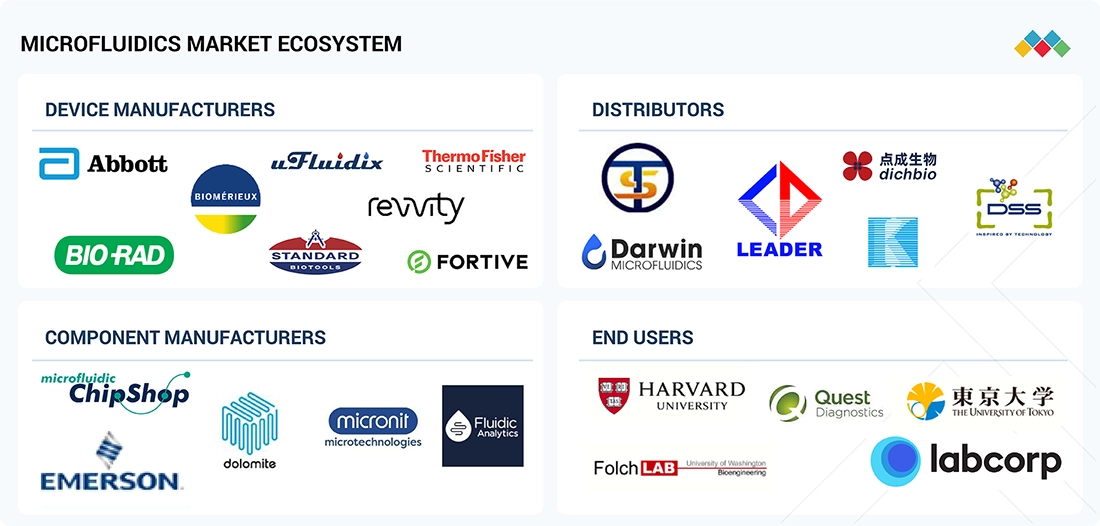
MICROFLUIDICS MARKET SIZE, GROWTH, SHARE & TRENDS ANALYSIS: COMMERCIAL USE CASES ACROSS INDUSTRIES
| COMPANY | USE CASE DESCRIPTION | BENEFITS |
|---|---|---|
 |
The QuantStudio Absolute Q Digital PCR System leverages Microfluidic Array Plate (MAP) technology to deliver precise partitioning and analysis in a single, integrated workflow. | Streamlined digital PCR with higher accuracy, reproducibility, and ease of use | Reduced hands-on time and error rates through automated background correction and false-positive rejection |
 |
It introduced the JSY3000-L/P valve manifold series with up to 64 stations for centralized control of solenoid valves and electro-pneumatic regulators. | Simplified control architecture with reduced wiring and assembly time, saving up to 28% space | Enhanced reliability through IP65/IP67 protection and remote diagnostics for higher uptime and easier maintenance |
 |
It launched the Illumina Complete Long Read technology, enabling both long- and short-read sequencing on a single NovaSeq X Series platform. | Simplified sequencing workflow with high precision (F1 score 99.87%), reduced cost, and minimal sample requirements |
 |
It enabled rapid, decentralized diagnostics with high accuracy and minimal hands-on time. It improved antibiotic stewardship and patient management by providing targeted results at the point of care. | Enabled rapid, decentralized diagnostics with high accuracy and minimal hands-on time |
Logos and trademarks shown above are the property of their respective owners. Their use here is for informational and illustrative purposes only.
Related Ecosystem
Analytical And Scientific Instrumentation
- Environmental Testing
- Gas Chromatography
- Polymerase Chain Reaction (PCR)
- Automated Liquid Handling Systems
- Flow Cytometry
- Thermo Fisher Scientific Inc.
- Danaher Corporation
- Agilent Technologies, Inc.
- Shimadzu Corporation
- Merck KGaA
Key Takeaways
- Japan's microfluidics market will grow from $1,821.51M (2025) to $2,791.01M (2030) at an 8.9% CAGR, outpacing global growth.
- Japan's aging demographic and focus on precision medicine are primary drivers of microfluidic device adoption in diagnostics.
- Japan leverages its semiconductor and miniaturization expertise to lead innovation in lab-on-chip and organ-on-chip technologies.
- Japan attracts substantial R&D investment from global players developing next-generation point-of-care and drug delivery platforms.
Microfluidics Market Report Scope
| Report Metric | Details |
|---|---|
| Base Year | 2025 |
| Fastest Growing Segment | PCR SYSTEMS (Device) |
| Forecast Period | 2025–2030 |
| Growth Rate | CAGR of 8.3% from 2025 to 2030 |
| Largest Segment | MICROFLUIDICS-BASED DEVICES (Product) |
| Market Size Base Year (Billions) | ~USD 24.96 (2025) |
| Revenue Forecast (Billions) | ~USD 37.19 (2030) |
| Segments Covered | Product, Device, Type, Material, Application, End User |
Japan Microfluidics Market Report Segmentation
6 segment dimensions are covered across the global market.
By Product
- Microfluidic
- Microfluidic Components
- Microfluidics-Based Devices
By Device
- Droplet & Particle Production System
- Droplet & Particle Production Systems
- Microfluidic Capillary Electrophoresis
- Next-Generation Sequencing Systems
- Ngs Systems
- Other Devices
- Pcr Systems
By Type
- Capillary Electrophoresis
- Cell-Based Assays
- Clinical Diagnostics
- Drug Delivery
- Flow & Pressure Controllers
- Flow & Pressure Sensors
- Genomic Analysis
- Lab Analytics
- Microdispensing
- Microfluidic Chips
- Microfluidic Valves
- Microneedles
- Micropumps
- Microreactors
- Other Microfluidic Components
- Poct
- Point-Of-Care Testing
- Proteomic Analysis
- Veterinary Diagnostics
- Wearable
By Material
- Cyclic Olefin Copolymers
- Glass
- Other Materials
- Polydimethylsiloxane
- Polymethyl Methacrylate
- Silicon
By Application
- Ivd
- Pharmaceutical & Life Science Research
- Therapeutics
By End User
- Academic & Research Institutes
- Hospitals & Diagnostic Centers
- Pharmaceutical & Biotechnology Companies
Target Audience
- Medical Device Manufacturers : Manufacturers seeking to expand into Japan's high-value microfluidics market need detailed insights on local demand drivers, regulatory pathways, and competitive positioning to optimize market entry strategies.
- Healthcare Providers & Hospitals : Japanese hospitals and diagnostic centers require market intelligence on microfluidic technology adoption trends, cost-benefit analyses, and clinical applications to inform procurement and technology integration decisions.
- Pharmaceutical & Biotech Companies : Pharma and biotech firms developing precision medicine solutions need Japan-specific data on diagnostic microfluidics adoption, partnership opportunities, and market dynamics for drug development and testing applications.
- Research Institutions & Universities : Academic and research organizations in Japan require market insights on microfluidics funding trends, commercialization opportunities, and industry collaboration potential to guide research investments and innovation initiatives.
- Investors & Venture Capital : Investment firms evaluating opportunities in Japan's healthcare technology sector need comprehensive market analysis, growth projections, and competitive intelligence to identify promising microfluidics ventures and portfolio companies.
Key Companies in the Japan Microfluidics Market
| Company | HQ | Ownership | Strongest segments |
|---|---|---|---|
| BECKMAN COULTER | United States | Private Company | Chips,Sensors,Valves, |
| RAINDANCE TECHNOLOGIES | United States | Private Company | Chip,Sensor,Valve, |
| HALMA PLC | United Kingdom | Public Company | Sensor,Valve,Pump, |
| X-FAB | Germany | Public Company | Chip,Sensor,Valve, |
| TECHNICOLOR SA | France | Public Company | Chip,Sensor,Valve, |
| MAXCYTE, INC | United States | Public Company | Microfluidic Chips and Cell-Handling Cartridges (linked to ExPERT PAs),Electroporation Instruments (ExPERT ATx, STx, GTx, VLx),Buffers, Software Protocols, and Accessories, |
| DANAHER CORPORATION | United States | Public Company | Microfluidic Chips & Cartridges,Microfluidic Sensors,Microfluidic Valves & Pumps, |
| ILLUMINA, INC. | United States | Public Company | Microfluidic Chips (including flow cells and integrated cartridges),Microfluidic Sensors,Microfluidic Valves and Pumps, |
| BIOMÉRIEUX | France | Public Company | Chip,Sensor,Valve, |
| THERMO FISHER SCIENTIFIC INC. | United States | Public Company | Microfluidic Chips,Sensors,Valves, |
| ABBOTT LABORATORIES | United States | Public Company | Chip,Sensor,Valve, |
| PARKER HANNIFIN CORP | United States | Public Company | Valves,Pumps,Sensors, |
| SMC CORPORATION | United States | Public Company | AI and HPC servers for life-science workloads,Rack-scale solutions for hospital and diagnostic datacenters,Embedded and edge (5G/IoT/Edge) systems, |
| IDEX CORPORATION | United States | Public Company | Pumps,Valves,Sensors, |
| FORTIVE | United States | Public Company | Chip-adjacent instrumentation and test,Sensor and pump calibration tools,Sterilization and instrument tracking (microfluidic-enabled devices), |
| REVVITY, INC. | United States | Public Company | Microfluidic Chips,Sensors,Valves, |
| AGILENT TECHNOLOGIES, INC. | United States | Public Company | Chip,Sensor,Valve, |
| BIO-RAD LABORATORIES, INC. | United States | Public Company | Chips,Sensors,Valves, |
| BECTON, DICKINSON AND COMPANY | United States | Public Company | Chip,Sensor,Valve, |
| STANDARD BIOTOOLS | United States | Public Company | Microfluidic Chips & Consumables,Microfluidic Instruments & Systems,Services, Software & Licensing, |
BECKMAN COULTER
Beckman Coulter is a United States-based diagnostics and life sciences company founded in 1935 with 11,900 employees. As a private company, it provides laboratory instruments and reagents for clinical and research applications.
RAINDANCE TECHNOLOGIES
Raindance Technologies is a United States-based private company founded in 2004 with 104 employees. It develops digital PCR and microfluidic technologies for genomic analysis and molecular diagnostics.
HALMA PLC
Halma PLC is a United Kingdom-based public company founded in 1894 with 9,000 employees. It operates as a diversified group providing safety, environmental, and life sciences solutions across multiple markets.
X-FAB
X-FAB is a Germany-based public company founded in 1992 with 4,300 employees. It is a specialty semiconductor foundry providing analog and mixed-signal semiconductor manufacturing services.
TECHNICOLOR SA
Technicolor SA is a France-based public company founded in 1985 with 1,552 employees. It provides media and entertainment technology services including post-production, digital cinema, and content delivery solutions.
MAXCYTE, INC
MaxCyte, Inc. is a United States-based public company founded in 1998 with 91 employees. It develops electroporation technology platforms for cell engineering and therapeutic applications.
DANAHER CORPORATION
Danaher Corporation is a United States-based public company founded in 1969 with 59,000 employees. It operates as a diversified conglomerate providing products and services in life sciences, diagnostics, environmental, and applied solutions.
ILLUMINA, INC.
Illumina, Inc. is a United States-based public company founded in 1998 with 8,625 employees. It is a leading provider of DNA sequencing and array-based solutions for genomic analysis.
BIOMÉRIEUX
bioMérieux is a France-based public company founded in 1963 with 14,894 employees. It specializes in in vitro diagnostics and microbiology testing solutions for clinical and industrial applications.
THERMO FISHER SCIENTIFIC INC.
Thermo Fisher Scientific Inc. is a United States-based public company founded in 1956 with 125,000 employees. It is a global leader in serving science, providing laboratory equipment, reagents, software, and services for research and diagnostics.
ABBOTT LABORATORIES
Abbott Laboratories is a United States-based public company founded in 1888 with 115,000 employees. It is a diversified healthcare company providing pharmaceuticals, diagnostics, nutritional products, and medical devices.
PARKER HANNIFIN CORP
Parker Hannifin Corp is a United States-based public company founded in 1917 with 57,950 employees. It manufactures motion and control technologies including hydraulic, pneumatic, and electromechanical systems.
SMC CORPORATION
SMC Corporation is a United States-based public company founded in 1993 with 6,238 employees. It manufactures pneumatic and electric automation components and systems for industrial applications.
IDEX CORPORATION
IDEX Corporation is a United States-based public company founded in 1987 with 8,700 employees. It provides fluid and metering technologies, dispensing equipment, and safety systems for various industrial and life sciences applications.
FORTIVE
Fortive is a United States-based public company founded in 2015 with 10,000 employees. It operates as a diversified industrial technology conglomerate providing software, services, and equipment for manufacturing and infrastructure.
REVVITY, INC.
Revvity, Inc. is a United States-based public company founded in 1937 with 11,000 employees. It provides analytical instruments, software, and services for life sciences research, diagnostics, and environmental testing.
AGILENT TECHNOLOGIES, INC.
Agilent Technologies, Inc. is a United States-based public company founded in 1999 with 18,000 employees. It provides analytical instruments, software, and services for life sciences, diagnostics, and chemical analysis.
BIO-RAD LABORATORIES, INC.
Bio-Rad Laboratories, Inc. is a United States-based public company founded in 1952 with 7,450 employees. It manufactures and distributes life science research products and clinical diagnostics solutions.
BECTON, DICKINSON AND COMPANY
Becton, Dickinson and Company is a United States-based public company founded in 1897 with 72,000 employees. It is a global medical technology company providing medical devices, laboratory equipment, and diagnostic products.
STANDARD BIOTOOLS
Standard Biotools is a United States-based public company founded in 1999 with 387 employees. It develops microfluidic and single-cell analysis technologies for life sciences research and diagnostics.
Reasons to Buy this Report
- Market-Specific Growth Projections : Access detailed forecasts showing Japan's microfluidics market expanding from $1,821.51M to $2,791.01M by 2030, with country-specific CAGR analysis exceeding global averages.
- Demographic Insights & Opportunities : Understand how Japan's aging population is reshaping demand for diagnostic microfluidic solutions, identifying key market segments and emerging application areas specific to Japanese healthcare needs.
- Competitive Landscape Analysis : Gain intelligence on Japanese and international players operating in the microfluidics space, including market positioning, partnerships, and innovation strategies tailored to Japan's healthcare ecosystem.
- Regulatory & Infrastructure Context : Explore Japan's advanced healthcare infrastructure, regulatory environment, and government initiatives supporting microfluidics adoption, enabling informed market entry and expansion strategies.
- Investment & Partnership Opportunities : Identify high-potential segments, emerging technologies, and collaboration opportunities within Japan's microfluidics market for strategic investments and business development initiatives.
Frequently asked questions
What is the projected size of Japan's microfluidics market by 2030?
Japan's microfluidics market is projected to reach $2,791.01 million by 2030, growing from $1,821.51 million in 2025.
What is the CAGR for Japan's microfluidics market?
Japan's microfluidics market is expected to grow at a compound annual growth rate (CAGR) of 8.9% from 2025 to 2030.
What factors are driving growth in Japan's microfluidics market?
Japan's aging population, emphasis on precision medicine, advanced healthcare infrastructure, and leadership in miniaturization technology are key growth drivers for the microfluidics market.
Which applications are most prominent in Japan's microfluidics market?
Point-of-care testing, lab-on-chip diagnostics, organ-on-chip platforms, and drug delivery systems are among the most prominent applications in Japan's microfluidics sector.
How does Japan's microfluidics market compare to global trends?
Japan's microfluidics market CAGR of 8.9% exceeds the global CAGR of 8.3%, reflecting Japan's strong technological capabilities and healthcare investment.
RESEARCH METHODOLOGY
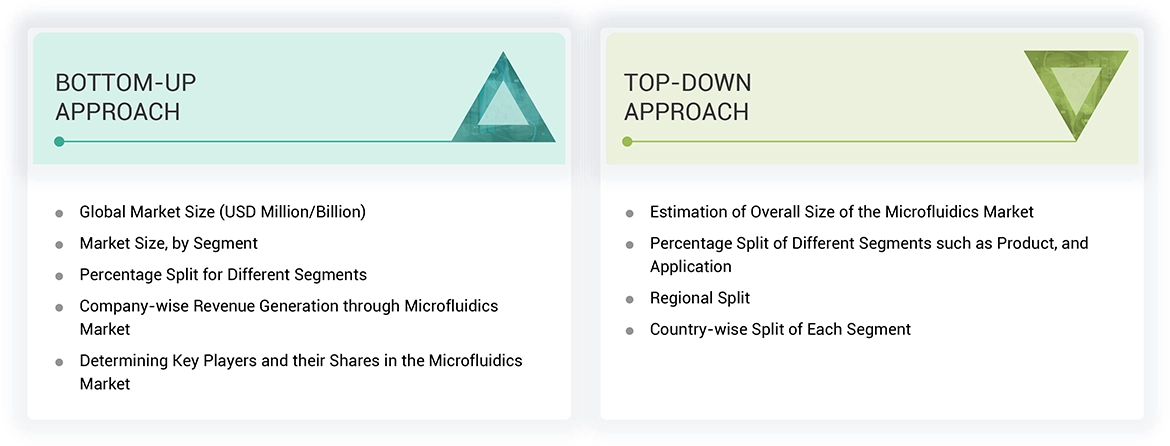
Four main studies were done to estimate the market size of microfluidics. Secondary research was carried out to obtain data associated with the market, peer markets, and parent markets. After that, data was obtained from 3-5 secondary sources; the findings, assumptions, and sizing were confirmed through primary sources. Top-down and bottom-up approaches were utilized to gain insights on complete market size. After that, market breakdown and data triangulation were used to determine the market size of segments and subsegments.
Secondary Research
Directories, databases like D&B Hoovers, Factiva, white papers, Bloomberg Businessweek, annual reports, SEC filings, business filings and investor presentations are few of the important sources used in the secondary research. This helps in gaining fundamental details about prominent companies and market segmentation as per the industry trends at numerous levels and technological viewpoints related with the Microfluidics market.
Primary Research
The primary research compromised performing interviews from both the supply and demand sides to obtain quantitative and qualitative data. CEOs, area sales managers, territory sales managers, regional sales managers and other important officials from top businesses are the primary sources from the supply side. Physicians, researchers, department heads, and staff members from diagnostic centers, hospitals and research institutes were the primary sources from the demand side. The target of this study was to verify the conclusions and assumptions from secondary research by interacting with stakeholders directly.
A breakdown of the primary respondents is provided below:
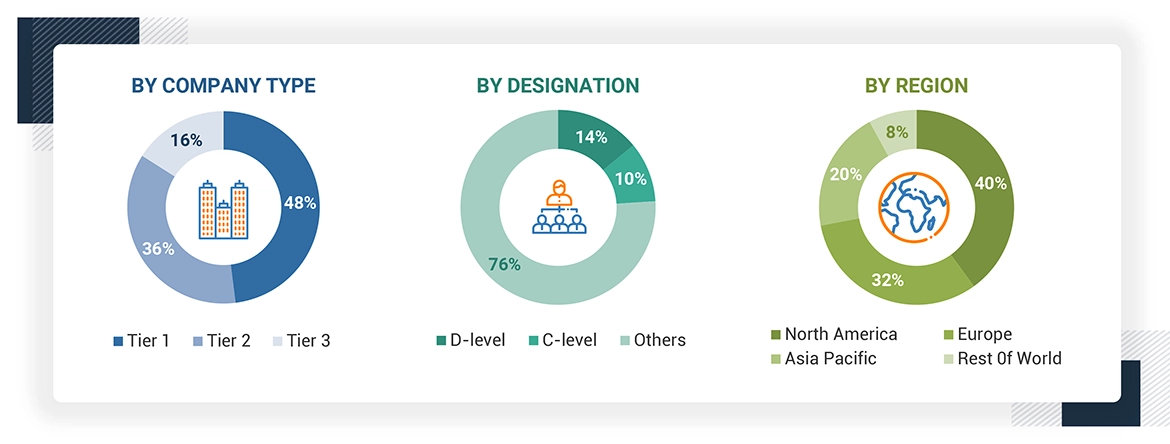
*Others include sales managers, marketing managers, business development managers, product managers, distributors, and suppliers.
Note: Companies are classified into tiers based on their total revenue. As of 2023, Tier 1 = >USD 1 billion, Tier 2 = < USD 500 million, and Tier 3 = < USD 100 million.
To know about the assumptions considered for the study, download the pdf brochure
Market Size Estimation
The revenue share analysis of the major key players for the size of the Microfluidics market is given in this study. Primary and secondary research are used to find prominent players in the Microfluidics and to gain insights of their financials and market share. The primary research approach comprises extremely in-depth interviews with CEOs, directors, and senior marketing executives, while the secondary research procedure mostly relied on the annual and financial reports of major players. Segment-based technique was used to determine the global market value. The revenue details of significant solution and service suppliers was then applied to source these segmented revenues.
The steps in the procedure are
- List the key global companies that are associated with the Microfluidics industry. Note the annual revenues of the players in the Microfluidics industry or the product category/business division.
- As of 2024, it represents an important portion of the market based on revenue mapping of the key competitors. Extrapolation to the global value for the Microfluidics market.
Data Triangulation
The Microfluidics market was categorized into various segments and subsegments with the help of the above procedure. Then, data triangulation and the market segmentation process are carried out to ensure the accuracy of the data for each segment. Factors and trends from demand and supply sides were studied . Top-down and bottom-up approaches provide the outcome from the analysis of the Microfluidics market.
Market Definition
The microfluidics market includes products and technologies that are developed to analyse and regulate fluid volume through microfluidic devices and components. The market covers both the microfluidics components that are important for the working of microfluidics-based devices, such as lab-on-a-chip systems and diagnostic assays, as well as the devices. Microneedles, micropumps, flow and pressure sensors, controllers, and microfluidic valves are some of the important components of microfluidics-based device.Polymers, silicon, and glass are most often used in the development of these components. The market provides innovative technologies for effective and precise fluid management and analysis, which have beneficial applications in research and diagnostics.
Stakeholders
- Microfluidic product manufacturers
- Microfluidic product distributors
- Pharmaceutical companies
- IVD manufacturers
- In vitro diagnostic test (IVD) distributors
- Research institutes
- Contract manufacturing organizations (CMOs)
- Contract research organizations (CROs)
- Healthcare institutions (hospitals, medical schools, and outpatient clinics)
- Government associations
- Market research and consulting firms
- Venture capitalists and investors
Report Objectives
- To define, describe, and forecast the microfluidics market by product, application, end-user, and region
- To provide detailed information about the key factors influencing the market growth, such as drivers, restraints, opportunities, challenges, and industry trends
- To strategically analyze the regulatory scenario, Porter’s five force analysis, value chain analysis, supply chain analysis, ecosystem map, and patent analysis
- To analyze micromarkets with respect to individual growth trends, prospects, and contributions to the microfluidics market
- To analyze market opportunities for stakeholders and provide details of the competitive landscape for key players
- To profile the prominent players in this market and comprehensively analyze their market shares and core competencies
- To strategically analyze the microfluidics market in five regions: North America, Europe, the Asia Pacific, Latin America, and the Middle East & Africa
- To track and analyze competitive developments such as acquisitions, product launches, product approvals, partnerships, and expansions in the microfluidics market
Get the Full Microfluidics Market Report
Full forecast, segment splits, and company analysis for all Microfluidics Market.
- Brazil Microfluidics Market
- Mexico Microfluidics Market
- US Microfluidics Market
- Canada Microfluidics Market
- Germany Microfluidics Market
- France Microfluidics Market
- UK Microfluidics Market
- Italy Microfluidics Market
- Spain Microfluidics Market
- China Microfluidics Market
- India Microfluidics Market
- Australia Microfluidics Market
- South Korea Microfluidics Market
Need a Tailored Report?
Customize this report to your needs
Get 10% FREE Customization
Customize This Report
