
Japan Microphone Market (2025-2030)

The Japan Microphone Market was valued at $271.5 Million in 2025 and projected to reach to $381.2 Million by 2030, representing a compound annual growth rate of CAGR 7.0%. Japan's microphone market is poised for sustained expansion driven by the proliferation of smart devices, increasing adoption of voice-activated technologies, and the country's leadership in consumer electronics manufacturing.


| Market Size in | USD 26.32 MN |
| Market Forecast in | |
| CAGR | |
| Forecast Period | |
| Units Considered | Value (USD MN) |
Japan Microphone Market Trends and Insights
- Japan's advanced consumer electronics ecosystem and strong demand for audio devices across smartphones, wearables, and smart home applications are driving market expansion.
- The country's emphasis on high-quality audio technology and innovation in semiconductor manufacturing positions Japan as a key player in the Asia Pacific microphone sector. Driving Japan's microphone market growth are increasing adoption of voice-activated devices, expansion of remote communication technologies, and rising consumer preference for premium audio experiences.
- Japan's robust automotive and industrial sectors are also integrating advanced microphone solutions for in-vehicle communication and IoT applications.
- Between 2025 and 2030, Japan is expected to maintain steady growth momentum, supported by continuous technological advancements and the proliferation of AI-enabled audio devices across consumer and enterprise segments..
Key Market Statistics
- CAGR (2025-2030) CAGR 7.0%
- Market Size, 2025 ~USD 271.5 Million
- Forecast, 2030 ~USD 381.2 Million
- Country Japan
Japan Microphone Market Overview
Market Valuation :
Japan's microphone market is valued at USD 271.5 million in 2025 and is projected to reach USD 381.2 million by 2030, demonstrating strong growth potential in the Asia-Pacific region.
Consumer Electronics Dominance :
Japan's advanced consumer electronics ecosystem drives microphone demand across smartphones, wearables, and smart home devices, leveraging the country's reputation for innovation and quality audio technology.
Audio Quality Standards :
Japanese manufacturers prioritize high-quality audio specifications, positioning the market as a premium segment with emphasis on noise cancellation, voice clarity, and acoustic performance standards.
Growth Trajectory :
With a CAGR of 7.0% from 2025 to 2030, Japan's microphone market outpaces the global growth rate of 6.7%, reflecting strong domestic demand and technological advancement in audio solutions.
Japan Microphone Market Dynamics
- The market benefits from strong R&D investments by Japanese companies and growing demand for premium audio solutions in both consumer and professional segments.
- Emerging applications in AI-powered voice assistants and IoT devices further accelerate market growth.
- Japan's commitment to technological excellence and quality standards positions it as a key growth driver in the Asia-Pacific microphone market, with manufacturers focusing on miniaturization and advanced acoustic engineering to meet evolving consumer expectations..
Market Ecosystem
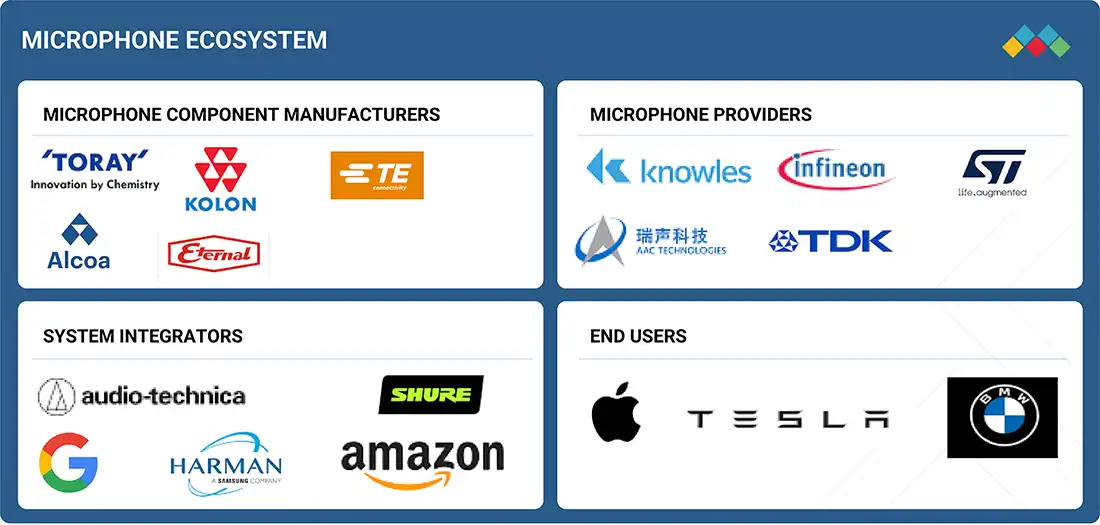
Microphone Market: COMMERCIAL USE CASES ACROSS INDUSTRIES
| COMPANY | USE CASE DESCRIPTION | BENEFITS |
|---|---|---|
 |
MEMS microphones for smartphones, wearables, and hearing aids | Delivers superior sound quality, low power consumption, and compact design for space-constrained devices |
 |
Consumer electronics and AR/VR headsets with advanced audio features | Enables immersive audio experiences, improved sound pickup, and integration into lightweight form factors |
 |
Integration in mobile devices, laptops, and smart accessories | Ensures consistent audio capture, environmental noise reduction, and reliable performance in compact systems |
 |
Smart home devices, automotive systems, and industrial monitoring | Enhances acoustic sensing, supports environmental noise detection, and enables robust performance in harsh conditions |
 |
Premium consumer electronics, automotive, and IoT devices | Provides accurate audio capture, improved signal-to-noise ratio, and seamless integration into digital system |
Logos and trademarks shown above are the property of their respective owners. Their use here is for informational and illustrative purposes only.
Related Ecosystem
Automotive Systems
- Light Commercial Vehicles (LCVs)
- Battery Electric Vehicle (BEV)
- Hybrid Electric Vehicle (HEV)
- Agricultural Tractors
- Fuel Cell Electric Vehicle (FCEV)
- BOSCH LIMITED
- DENSO Corporation
- ZF FRIEDRICHSHAFEN AG
- Continental ag
- GORKOVSKY AVTOMOBILNY ZAVOD
Analytics
- Natural Language Processing (NLP)
- Machine Learning
- Supply Chain Management
- Predictive Analytics
- Image Sensors
- International Business Machines Corporation
- MICROSOFT CORPORATION
- Oracle Corporation
- SAP SE
Electronics System And Components
- Sensors
- Temperature Sensors
- Pressure Sensors
- Actuators
- Image Sensors
- Lenovo
- Samsung
- Texas Instruments Incorporated
- HONEYWELL INTERNATIONAL INC.
- Teledyne Technologies Incorporated
Key Takeaways
- Japan's microphone market is valued at USD 271.5 million in 2025 and will reach USD 381.2 million by 2030, growing at 7.0% CAGR.
- Japan's advanced electronics manufacturing and consumer demand for premium audio drive sustained market expansion through 2030.
- Voice-activated devices, smart home integration, and automotive applications are primary growth catalysts in Japan's microphone sector.
- Japan's focus on AI-enabled audio solutions and IoT connectivity positions the country for competitive advantage in the Asia Pacific region.
Microphone Market Report Scope
| Report Metric | Details |
|---|---|
| Base Year | 2025 |
| Fastest Growing Segment | MEDICAL (Application) |
| Forecast Period | 2025–2030 |
| Growth Rate | CAGR of 6.7% from 2025 to 2030 |
| Largest Segment | MEMS (Technology) |
| Market Size Base Year (Billions) | ~USD 2.88 (2025) |
| Revenue Forecast (Billions) | ~USD 3.98 (2030) |
| Segments Covered | Technology, Application, Mems Type, Communication Technology, Type |
Japan Microphone Market Report Segmentation
5 segment dimensions are covered across the global market.
By Technology
- Electret
- MEMS
- Other Technologies
By Application
- Automotive
- Consumer Electronics
- Industrial
- Medical
- Other Applications
- Security & Surveillance
By Mems Type
- Analog
- Digital
By Communication Technology
- Wired
- Wireless
By Type
- Airplay
- Bluetooth
- Other Wireless Communication Technologies
- Wi-Fi
Target Audience
- Microphone Manufacturers : Manufacturers need Japan-specific market data to optimize product development, identify growth opportunities in premium audio segments, and benchmark competitive positioning against local and international rivals.
- Consumer Electronics OEMs : Smartphone, wearable, and smart home device manufacturers require detailed microphone market insights to inform component sourcing strategies and audio feature differentiation in the Japanese market.
- Investment & Private Equity Firms : Investors evaluating opportunities in Japan's electronics sector need comprehensive market analysis to assess growth potential, identify acquisition targets, and make informed capital allocation decisions.
- Market Entry & Expansion Teams : Companies planning market entry or expansion in Japan require localized market intelligence, competitive analysis, and demand forecasts to develop effective business strategies and resource planning.
- Technology & Innovation Strategists : R&D and innovation leaders need Japan-specific trend analysis to align product roadmaps with market demands, identify emerging applications, and capitalize on the country's advanced audio technology ecosystem.
Key Companies in the Japan Microphone Market
| Company | HQ | Ownership | Strongest segments |
|---|---|---|---|
| EPCOS AG | Germany | Private Company | EMC filters and filter modules,Ferrites and inductive components,Protection devices (surge, overvoltage, ESD), |
| STMICROELECTRONICS | Netherlands | Public Company | Power and Discrete products (P&D),Embedded Processing (EMP),Analog products, MEMS and Sensors Group (AM&S), |
| GOERTEK | China | Public Company | Hearables (TWS, audio glasses, headphones),Smart viewables (VR/MR HMD, AR/AI glasses),Smart wearables (watches, bracelets, rings), |
| TDK CORPORATION | Japan | Public Company | Passive Components,Sensor Application Products,Magnetic Application Products, |
| INFINEON TECHNOLOGIES AG | Germany | Public Company | Automotive (MCUs, power, sensors, connectivity),Green Industrial Power (IGBT and SiC discretes/modules),Power & Sensor Systems (MOSFETs, GaN, sensors, drivers), |
| AAC TECHNOLOGIES | China | Public Company | Acoustics Products,Electromagnetic Drives and Precision Mechanics,Optics Products, |
| ZILLTEK TECHNOLOGY | Taiwan | Public Company | Analog and digital MEMS microphones,Audio amplifiers and voice-path ICs,Power management (DC/DC, LDO), |
| HOSIDEN CORPORATION | Japan | Public Company | Mechanical Components (connectors, jacks, switches),Acoustic Components (microphones, headphones, speakers, receivers),Display Components (touch panels), |
| SONION | Denmark | Private Company | Hearing instrument components (BA receivers, microphones, RIC assemblies, faceplates, UI, connectors),Balanced armature and pro audio drivers/modules (full-range, woofers, tweeters, dampers),Hearables/wearables components (bone conduction actuators, sensors, NFMI antennas), |
| SYNTIANT | United States | Private Company | Neural Decision Processor (NDP) ICs,Software, tools, and optimized AI models,Modules and reference platforms, |
| GETTOP ACOUSTIC CO., LTD. | China | Public Company | MEMS microphones,Electret and traditional acoustic components,Audio modules for smartphones and wearables, |
| BSE CO. LTD. | India | Public Company | Equity and SME trading & listing,Derivatives and currency trading,Clearing, settlement, depository & repository, |
EPCOS AG
EPCOS AG is a German private company founded in 1989 that employs 23,619 people. The company specializes in electronic components and systems.
STMICROELECTRONICS
STMicroelectronics is a Dutch public company founded in 1987 with 48,000 employees. The company is a leading semiconductor manufacturer serving global markets.
GOERTEK
Goertek is a Chinese public company founded in 2001 with 111,585 employees. The company specializes in acoustic and electronic components.
TDK CORPORATION
TDK Corporation is a Japanese public company founded in 1935 with 106,545 employees. The company manufactures electronic components and devices for various industries.
INFINEON TECHNOLOGIES AG
Infineon Technologies AG is a German public company founded in 1952 with 56,500 employees. The company is a leading semiconductor manufacturer serving automotive, industrial, and consumer markets.
AAC TECHNOLOGIES
AAC Technologies is a Chinese public company founded in 1993 with 41,674 employees. The company designs and manufactures acoustic and electronic components.
ZILLTEK TECHNOLOGY
Zilltek Technology is a Taiwanese public company founded in 2005. The company operates in the electronics and semiconductor sector.
HOSIDEN CORPORATION
Hosiden Corporation is a Japanese public company founded in 1947 with 8,465 employees. The company manufactures electronic components and assemblies.
SONION
Sonion is a Danish private company founded in 1974 with 21 employees. The company specializes in miniature audio solutions.
SYNTIANT
Syntiant is a United States-based private company founded in 2017 with 120 employees. The company develops artificial intelligence and machine learning technologies.
GETTOP ACOUSTIC CO., LTD.
Gettop Acoustic Co., Ltd. is a Chinese public company founded in 2001. The company manufactures acoustic components and related products.
BSE CO. LTD.
BSE Co. Ltd. is an Indian public company founded in 1875 with 850 employees. The company operates in the financial and business services sector.
Reasons to Buy this Report
- Market-Specific Sizing Data : Access precise valuation figures for Japan's microphone market with detailed 2025-2030 projections, enabling accurate financial forecasting and investment planning specific to the Japanese market.
- Competitive Landscape Intelligence : Understand Japan's unique competitive dynamics, local manufacturer strategies, and market positioning of both domestic and international players operating in the Japanese microphone segment.
- Application-Specific Insights : Gain detailed analysis of microphone demand across Japan's key segments including smartphones, wearables, smart home devices, and professional audio applications with localized growth drivers.
- Technology Trend Analysis : Identify emerging technologies and innovation trends specific to Japan, including MEMS microphones, noise cancellation advancements, and voice-activated device integration driving market evolution.
- Strategic Market Entry Planning : Develop informed go-to-market strategies for Japan with insights into consumer preferences, regulatory requirements, distribution channels, and partnership opportunities unique to the Japanese market.
Frequently asked questions
What is the current size of Japan's microphone market in 2025?
Japan's microphone market is valued at USD 271.5 million in 2025, reflecting strong demand across consumer electronics, automotive, and industrial applications.
What is the projected market size for Japan's microphone market by 2030?
Japan's microphone market is forecast to reach USD 381.2 million by 2030, representing a 7.0% compound annual growth rate from 2025 to 2030.
What are the primary drivers of growth in Japan's microphone market?
Key growth drivers in Japan include increasing adoption of voice-activated devices, expansion of smart home technologies, rising demand for premium audio experiences, and integration of microphones in automotive and IoT applications.
Which applications are fueling demand in Japan's microphone market?
Japan's microphone demand is driven by smartphones, wearables, smart home devices, automotive systems, industrial IoT solutions, and AI-enabled audio applications across consumer and enterprise segments.
How does Japan's microphone market compare to the broader Asia Pacific region?
Japan represents a significant portion of the Asia Pacific microphone market, leveraging its advanced semiconductor manufacturing capabilities, strong consumer electronics ecosystem, and emphasis on high-quality audio technology innovation.
RESEARCH METHODOLOGY
The study used four major activities to estimate the microphone's market size. Exhaustive secondary research was conducted to gather information on the market and its peer and parent markets. The next step was to validate these findings, assumptions, and market size with industry experts across the value chain through primary research. Both top-down and bottom-up approaches were employed to estimate the total market size. Finally, market breakdown and data triangulation methods were used to estimate the market size for different segments and subsegments.
Secondary Research
In the secondary research process, various sources were used to identify and collect information on the microphone market. Secondary sources for this research study include corporate filings (such as annual reports, investor presentations, and financial statements); trade, business, and professional associations; white papers; certified publications; and articles by recognized authors, directories, and databases. The secondary data was collected and analyzed to determine the overall market size, and was further validated through primary research.
List of key secondary sources
|
Source |
Web Link |
|
Federal Communications Commission (FCC) |
https://www.fcc.gov/ |
|
National Institute of Standards and Technology (NIST) |
https://www.nist.gov/ |
|
Ministry of Electronics and Information Technology (MeitY) |
https://www.meity.gov.in/ |
|
Ministry of Industry and Information Technology (MIIT) |
http://english.miit.gov.cn/ |
|
Ministry of Internal Affairs and Communications (MIC) |
https://www.soumu.go.jp/english/ |
Primary Research
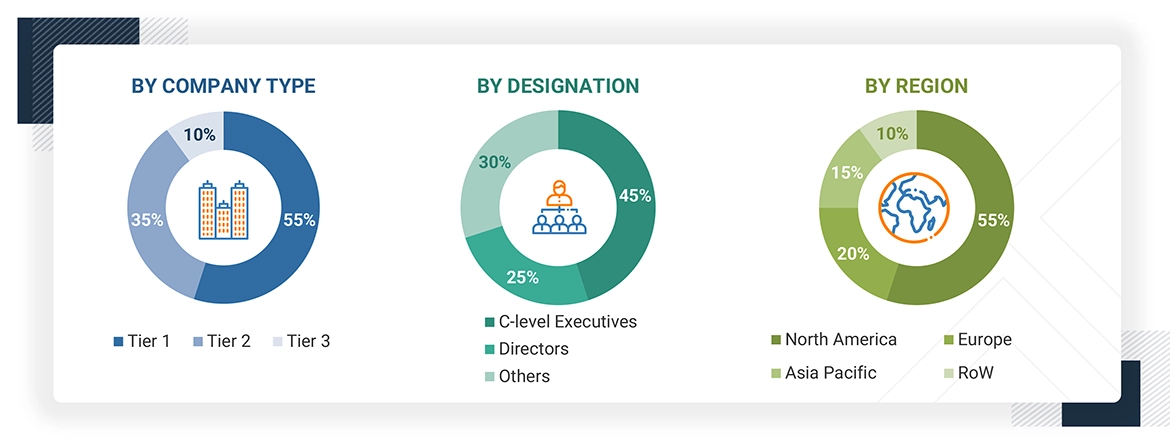
Primary interviews were conducted to gather insights on market statistics, revenue data, market breakdowns, size estimations, and forecasting. Additionally, primary research was used to comprehend various technologies, types, applications, and regional trends. Interviews with stakeholders from the demand side, including CIOs, CTOs, CSOs, and customer/end user installation teams using microphone offerings and processes, were also conducted to understand their perspective on suppliers, products, component providers, and their current and future use of microphones, which will impact the overall market. Several primary interviews were conducted across major countries in North America, Europe, Asia Pacific, and RoW.
To know about the assumptions considered for the study, download the pdf brochure
Market Size Estimation
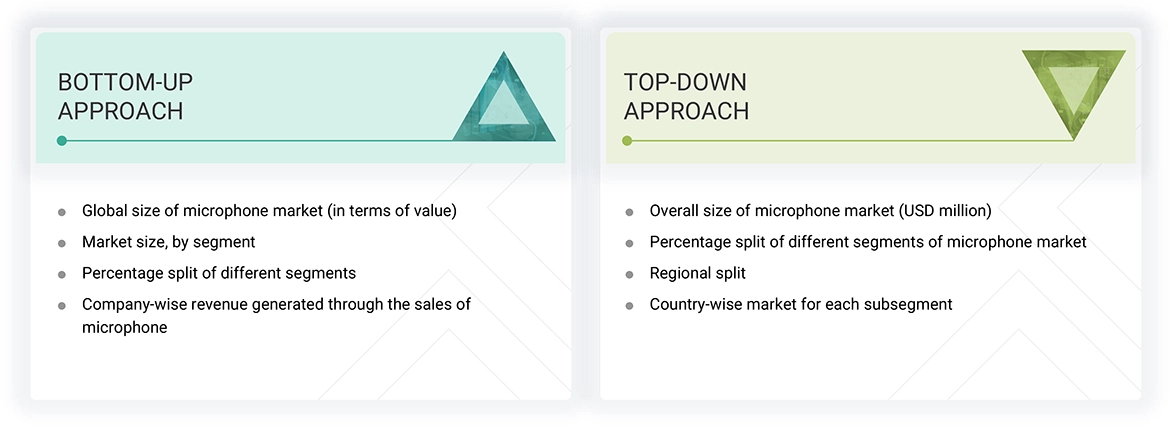
In the complete market engineering process, top-down and bottom-up approaches and several data triangulation methods have been used to estimate and forecast the overall market segments and subsegments listed in this report. Key players in the market have been identified through secondary research, and their market shares in the respective regions have been determined through primary and secondary research. This entire procedure includes the study of annual and financial reports of the top market players and extensive interviews for key insights (quantitative and qualitative) with industry experts (CEOs, VPs, directors, and marketing executives).
All percentage shares, splits, and breakdowns have been determined using secondary sources and verified through primary sources. All the parameters affecting the markets covered in this research study have been accounted for, viewed in detail, verified through primary research, and analyzed to obtain the final quantitative and qualitative data. This data has been consolidated and supplemented with detailed inputs and analysis from MarketsandMarkets and presented in this report. The following figure represents this study's overall market size estimation process.
Microphone Market : Top-Down and Bottom-Up Approach
Data Triangulation
Once the overall size of the microphone market has been determined using the methods described above, it has been divided into multiple segments and subsegments. Market engineering has been performed for each segment and subsegment using market breakdown and data triangulation methods, as applicable, to obtain accurate statistics. Various factors and trends from the demand and supply sides have been studied to triangulate the data. The market size has been validated using both top-down and bottom-up approaches..
Market Definition
A microphone is an electronic device that converts sound waves into an electrical signal. Microphones work based on the principle of transduction, where they convert sound waves (acoustic energy) into electrical signals (electrical energy). This conversion process involves a diaphragm or a membrane that vibrates in response to sound waves. When the diaphragm vibrates, it creates an electrical signal reflecting the recorded sound. This signal is usually in the form of voltage or current. Microphones are widely used in voice recording, live performances, broadcasting, communication devices, and audio production.
The market includes first-level packaged MEMS devices (sensors and actuators) sold by IDMs and fabless companies to OEMs/integrators.
Key Stakeholders
- Microphone manufacturers
- Suppliers and distributors
- Microphone vendors
- System integrators
- Professional audio equipment providers
- Consumers
- Regulatory authorities
- Industry associations and standards organizations
- Research institutions
Report Objectives
- To describe and forecast the microphone market by technology, MEMS type, communication technology, application, and region, in terms of value
- To describe and forecast the market for various segments across four main regions, namely, North America, Europe, Asia Pacific, and RoW, in terms of value
- To describe and forecast the market by technology, in terms of volume
- To strategically analyze micromarkets with regard to individual growth trends, prospects, and contributions to the markets
- To provide detailed information regarding drivers, restraints, opportunities, and challenges influencing market growth
- To analyze opportunities for stakeholders by identifying high-growth segments in the market
- To provide a detailed overview of the microphone value chain
- To strategically analyze key technologies, average selling price trends, trends impacting customer business, ecosystem, regulatory landscape, patent landscape, Porter's five forces, import and export scenarios, trade landscape, key stakeholders, buying criteria, and case studies pertaining to the market under study
- To strategically profile key players in the microphone market and comprehensively analyze their market share and core competencies
- To analyze competitive developments such as partnerships, acquisitions, expansions, collaborations, and product launches, along with R&D in the microphone market
Available customizations:
With the given market data, MarketsandMarkets offers customizations according to the specific requirements of companies. The following customization options are available for the report:
- Detailed analysis and profiling of additional market players (up to 5)
- Additional country-level analysis of the microphone market
Product Analysis
- The product matrix provides a detailed comparison of the product portfolio of each company in the microphone market.
Get the Full Microphone Market Report
Full forecast, segment splits, and company analysis for all Microphone Market.
- Canada Microphone Market
- Mexico Microphone Market
- US Microphone Market
- France Microphone Market
- Germany Microphone Market
- Italy Microphone Market
- Rest Of Europe Microphone Market
- UK Microphone Market
- China Microphone Market
- India Microphone Market
- Rest Of Asia Pacific Microphone Market
- South Korea Microphone Market
- South America Microphone Market
Need a Tailored Report?
Customize this report to your needs
Get 10% FREE Customization
Customize This Report
