
India Military Vehicle Electrification Market (2025-2030)

The India Military Vehicle Electrification Market was valued at $138.5 Million in 2025 and projected to reach to $191.7 Million by 2030, representing a compound annual growth rate of 6.7%. India's military vehicle electrification market is poised for steady growth driven by defence modernization initiatives and the government's commitment to indigenous technology development.


| Market Size in | USD 26.32 MN |
| Market Forecast in | |
| CAGR | |
| Forecast Period | |
| Units Considered | Value (USD MN) |
India Military Vehicle Electrification Market Trends and Insights
- India's defence modernization initiatives and focus on indigenous technology development are driving adoption of electric propulsion systems across tactical and strategic platforms.
- India's commitment to reducing operational costs and enhancing energy efficiency in military operations is accelerating the transition toward electrified vehicle fleets. The Indian military vehicle electrification sector is supported by government procurement policies and defence industry partnerships aimed at building domestic capabilities.
- India's growing emphasis on sustainability and reduced carbon footprint in defence operations aligns with global electrification trends.
- Between 2025 and 2030, India is expected to see increased investment in battery technologies, charging infrastructure, and hybrid-electric platforms tailored to regional operational requirements..
Key Market Statistics
- CAGR (2025-2030) 6.7% CAGR
- Market Size, 2025 ~USD 138.5 Million
- Forecast, 2030 ~USD 191.7 Million
- Country India
India Military Vehicle Electrification Market Overview
Defence Modernization Drive :
India's strategic focus on indigenous defence manufacturing and self-reliance (Atmanirbhar Bharat) is accelerating adoption of electric propulsion systems across military platforms, creating substantial market opportunities.
Market Valuation & Growth :
India's military vehicle electrification market is valued at USD 138.5 million in 2025, projected to reach USD 191.7 million by 2030, with a steady CAGR of 6.7% reflecting sustained investment in modernization.
Indigenous Technology Development :
Government initiatives promoting domestic R&D and manufacturing of electric propulsion systems for tactical and strategic military vehicles are reducing import dependency and fostering local innovation ecosystems.
Tactical & Strategic Platform Integration :
Electrification efforts span both tactical vehicles for ground operations and strategic platforms, with focus on enhancing operational efficiency, reducing logistics costs, and improving environmental sustainability across defence operations.
India Military Vehicle Electrification Market Dynamics
- The 6.7% CAGR reflects India's strategic pivot toward self-reliant defence manufacturing and reduced dependence on imported military technologies.
- Investment in electric propulsion systems across tactical and strategic platforms aligns with broader defence modernization goals and operational efficiency improvements. The market will be shaped by government procurement policies, domestic manufacturing capabilities, and collaboration between defence PSUs and private sector innovators.
- As India strengthens its defence industrial base and invests in next-generation military platforms, electrification will become increasingly integral to modernization strategies, supporting both operational requirements and sustainability objectives..
Market Ecosystem
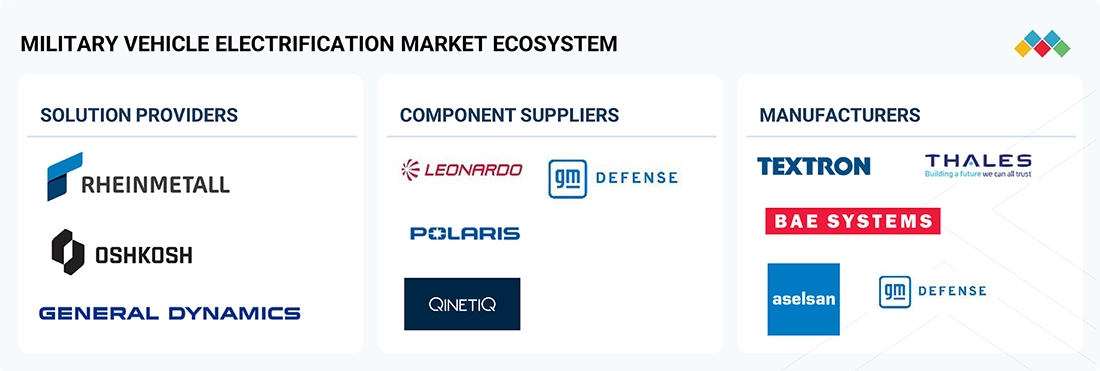
Military Vehicle Electrification Market: COMMERCIAL USE CASES ACROSS INDUSTRIES
| COMPANY | USE CASE DESCRIPTION | BENEFITS |
|---|---|---|
 |
Hybrid and all-electric propulsion in next-generation MBTs by companies like General Dynamics | Improves fuel efficiency and mobility, reduces logistic burden of fuel supply, and enables silent operations during combat |
 |
Hybrid-electric tactical trucks under US Army’s CTT program with regenerative braking and modular power systems | Cuts fuel consumption and maintenance costs, improves operational endurance, and increases survivability in contested areas |
 |
Electrified UGVs such as Mission Master SP and SMET with lithium-ion batteries and silent drive | Increases stealth and range, supports autonomous missions, and allows mobile recharging for longer deployment |
Logos and trademarks shown above are the property of their respective owners. Their use here is for informational and illustrative purposes only.
Related Ecosystem
Defence Platforms And Systems
- Sensors
- Unmanned Ground Vehicles (UGV)
- Fighter Aircraft
- Special Mission Aircraft
- Antennas
- BAE Systems plc
- Thales group
- LOCKHEED MARTIN CORPORATION
- Northrop Grumman Corporation
- L3Harris Technologies, Inc.
Key Takeaways
- India's military vehicle electrification market grows from USD 138.5M (2025) to USD 191.7M (2030) at 6.7% CAGR.
- India's defence modernization strategy prioritizes indigenous electric propulsion technology development and domestic manufacturing.
- India's focus on operational cost reduction and energy efficiency is accelerating electrification adoption across military platforms.
- India's investment in battery infrastructure and hybrid-electric systems positions the country as a regional leader in defence electrification.
Military Vehicle Electrification Market Report Scope
| Report Metric | Details |
|---|---|
| Base Year | 2025 |
| Fastest Growing Segment | OTHER BATTERIES (Batteries) |
| Forecast Period | 2025–2030 |
| Growth Rate | CAGR of 14.5% from 2025 to 2030 |
| Largest Segment | HYBRID (Technology) |
| Market Size Base Year (Billions) | ~USD 3.47 (2025) |
| Revenue Forecast (Billions) | ~USD 6.82 (2030) |
| Segments Covered | Platform, Combat Vehicles, Support Vehicles, Supply Trucks, Mode Of Operation, System, Energy Storage Systems, Batteries, Technology, Voltage, Gcc, Rest Of Middle East |
India Military Vehicle Electrification Market Report Segmentation
12 segment dimensions are covered across the global market.
By Platform
- Combat Vehicles
- Support Vehicles
- Unmanned Armored Vehicles
By Combat Vehicles
- Air Defense Vehicles
- Armored Amphibious Vehicles
- Infantry Fighting Vehicles
- Light Armored Vehicles
- Main Battle Tanks
- Mine Resistant Ambush Protected Vehicles
- Mortar Carriers
- Self-Propelled Howitzers
- Weapon Systems Armored Personnel Carriers
By Support Vehicles
- Command And Control Vehicles
- Other Support Vehicles
- Repair And Recovery Vehicle
- Supply Trucks
By Supply Trucks
- Ambulances
- Ammunition Replenishment Vehicles
- Fuel Trucks
By Mode Of Operation
- Autonomous/Semi-Autonomous
- Manned
By System
- Cooling Systems
- Energy Storage Systems
- Power Conversion Systems
- Power Generation Systems
- Traction Drive Systems/ Propulsion Systems
- Traction Drive Systems/Propulsion Systems
- Transmission Systems
By Energy Storage Systems
- Batteries
- Fuel Cells
By Batteries
- Lead-Acid
- Lithium-Ion Batteries/Lithium- Polymer
- Nickel Metal Hydride
- Other Batteries
- Solid-State
By Technology
- Fully Electric
- Hybrid
By Voltage
- High Voltage (More Than 600 V)
- Low Voltage (Less Than 50 V)
- Medium Voltage (50-600 V)
- Medium Voltage (50-600 V)
- Medium Voltage(50-600 V)
By Gcc
- Saudi Arabia
By Rest Of Middle East
- Israel
- Turkey
Target Audience
- Defence OEMs & Manufacturers : Indian and international defence manufacturers need India-specific market data to develop electrification strategies, plan production capacity, and align with government modernization procurement cycles.
- Government & Defence Agencies : Indian Ministry of Defence, defence PSUs, and military procurement bodies require market intelligence to inform electrification roadmaps, technology standards, and indigenous manufacturing policies.
- Technology & Component Suppliers : Battery, propulsion system, and electronics suppliers targeting India's defence sector need market insights to identify OEM partnerships, localization opportunities, and technology requirements.
- Investment & Strategy Consultants : Private equity, venture capital, and strategic consulting firms evaluating India's defence technology sector require country-specific market data for investment thesis development and portfolio decisions.
- Policy & Research Institutions : Think tanks, research organizations, and policy advisors focused on India's defence modernization and indigenous manufacturing need comprehensive market data to inform strategic recommendations.
Key Companies in the India Military Vehicle Electrification Market
| Company | HQ | Ownership | Strongest segments |
|---|---|---|---|
| TESLA MOTORS | United States | Public Company | Electrified Support Vehicles (powertrain and integration kits),Unmanned and Robotic Platforms (battery and control systems),Combat Vehicle Electrification Subsystems, |
| BALLARD POWER SYSTEMS INC. | Canada | Public Company | PEM fuel cell stacks for hybrid combat and support vehicles,Fuel cell systems for unmanned armored and off-road platforms,Engineering, technology transfer, and integration services, |
| FLENSBERG FAHRZEUGBAU GESELLSCHAFT GMBH | Germany | Private Company | Support Vehicles (hybridized and electrified bodies/trailers),Combat Vehicles (hybrid integration and modules),Unmanned Armored / Remote Platforms, |
| NIKOLA | United States | Private Company | Support Vehicles – BEV,Support Vehicles – FCEV,Combat and Protected Support Platforms (Hybridized), |
| OSHKOSH CORPORATION | United States | Public Company | Combat Vehicles (electrified variants and subsystems),Support Vehicles (tactical, logistics, airport and emergency fleets),Unmanned Armored Vehicles and Robotic Platforms, |
| GENERAL DYNAMICS CORPORATION | United States | Public Company | Combat Vehicles – Hybrid,Support Vehicles – Hybrid,Unmanned Armored Vehicles – Hybrid/Fully Electric, |
| BAE SYSTEMS | United Kingdom | Public Company | Hybrid Combat Vehicles,Hybrid Support Vehicles,Fully Electric Combat / Recon Platforms, |
| LEONARDO S.P.A. | Italy | Public Company | Combat Vehicles,Support Vehicles,Unmanned Armored Vehicles, |
| TEXTRON INC. | United States | Public Company | Combat Vehicles (Hybrid and Auxiliary Electrification),Support Vehicles and Light Tactical Fleets,Unmanned Armored and Ground Vehicles, |
| ST ENGINEERING | Singapore | Public Company | Combat Vehicles – Hybrid and Power Systems,Support Vehicles – Hybrid and Fully Electric,Unmanned Armored and Robotic Vehicles, |
| QINETIQ | United Kingdom | Public Company | Combat Vehicles,Support Vehicles,Unmanned Armored Vehicles, |
| POLARIS INDUSTRIES INC. | United States | Public Company | Electrified Support Vehicles (light tactical, logistics, patrol),Electrified Combat and Reconnaissance Variants,Unmanned and Optionally Manned Armored/Off-road Platforms, |
| ASELSAN A.S. | Turkey | Public Company | Combat Vehicles – Hybrid Power and Power Management,Support Vehicles – Auxiliary Electrification and Mission Power,Unmanned Armored Vehicles – Electric Drive and Control Electronics, |
| OTOKAR AUTOMOTIVE AND DEFENSE INDUSTRY INC. | Turkey | Public Company | Combat Vehicles – Hybridized platforms and power upgrades,Support Vehicles – Electrified logistics and tactical trucks,Unmanned Armored Vehicles – Electrified UGVs, |
| RHEINMETALL AG | Germany | Public Company | Hybrid Combat Vehicles,Hybrid Support and Logistics Vehicles,Unmanned and Remotely Operated Armored Platforms, |
| THALES | France | Public Company | Combat Vehicles,Support Vehicles,Unmanned Armored Vehicles, |
TESLA MOTORS
Tesla Motors is a United States-based public company founded in 2003 that employs 134,785 people. The company designs, manufactures, and sells electric vehicles and energy storage systems.
BALLARD POWER SYSTEMS INC.
Ballard Power Systems Inc. is a Canadian public company founded in 1979 with 492 employees. The company develops and manufactures fuel cell power systems for various applications.
FLENSBERG FAHRZEUGBAU GESELLSCHAFT GMBH
Flensberg Fahrzeugbau Gesellschaft GmbH is a German private company founded in 1872. The company operates in the vehicle manufacturing sector.
NIKOLA
Nikola is a United States-based private company founded in 2015 with 940 employees. The company develops zero-emission hydrogen and electric vehicles for commercial transportation.
OSHKOSH CORPORATION
Oshkosh Corporation is a United States-based public company founded in 1915 with 18,400 employees. The company manufactures specialty vehicles and vehicle bodies for commercial, defense, and emergency response markets.
GENERAL DYNAMICS CORPORATION
General Dynamics Corporation is a United States-based public company founded in 1899 with 117,000 employees. The company operates across aerospace, defense, and security sectors, providing products and services to government and commercial customers.
BAE SYSTEMS
BAE Systems is a United Kingdom-based public company founded in 1979 with 111,400 employees. The company is a global defense, aerospace, and security company providing advanced technology solutions.
LEONARDO S.P.A.
Leonardo S.P.A. is an Italian public company founded in 1948 with 65,455 employees. The company operates in the defense, aerospace, and security sectors, manufacturing advanced technology systems and products.
TEXTRON INC.
Textron Inc. is a United States-based public company founded in 1923 with 34,000 employees. The company manufactures aircraft, defense systems, and industrial products across multiple business segments.
ST ENGINEERING
ST Engineering is a Singapore-based public company founded in 1967 with 27,000 employees. The company provides aerospace, defense, and engineering solutions globally.
QINETIQ
QinetiQ is a United Kingdom-based public company founded in 2001 with 7,378 employees. The company provides science and engineering services to defense, security, and commercial customers.
POLARIS INDUSTRIES INC.
Polaris Industries Inc. is a United States-based public company founded in 1945 with 14,500 employees. The company designs and manufactures powersports vehicles, including off-road vehicles and motorcycles.
ASELSAN A.S.
Aselsan A.S. is a Turkish public company founded in 1975 with 16,243 employees. The company develops and manufactures defense electronics and systems for military applications.
OTOKAR AUTOMOTIVE AND DEFENSE INDUSTRY INC.
Otokar Automotive and Defense Industry Inc. is a Turkish public company founded in 1963. The company specializes in the design and manufacture of military and commercial vehicles.
RHEINMETALL AG
Rheinmetall AG is a German public company founded in 1889 with 28,815 employees. The company operates in the defense and automotive sectors, producing weapons systems, ammunition, and vehicle components.
THALES
Thales is a French public company founded in 1893 with 82,111 employees. The company provides defense, aerospace, and security solutions and services to government and commercial customers worldwide.
Reasons to Buy this Report
- India-Specific Market Sizing : Access precise valuation data for India's military vehicle electrification market (USD 138.5M in 2025) with country-specific forecasts through 2030, enabling accurate investment planning and resource allocation.
- Defence Modernization Insights : Understand how India's defence modernization initiatives and indigenous technology development policies are reshaping military vehicle electrification adoption across tactical and strategic platforms.
- Government Policy & Procurement Trends : Gain intelligence on Indian government procurement strategies, Atmanirbhar Bharat initiatives, and defence PSU electrification roadmaps to identify partnership and supply chain opportunities.
- Competitive Landscape Analysis : Benchmark against domestic and international competitors operating in India's defence sector, understanding local manufacturing capabilities, R&D investments, and technology partnerships.
- Growth Opportunity Identification : Identify high-potential segments within India's military electrification market, including emerging platforms, regional defence requirements, and technology gaps requiring innovative solutions.
Frequently asked questions
What is the current size of India's military vehicle electrification market?
India's military vehicle electrification market is valued at USD 138.5 million in 2025 and is expected to reach USD 191.7 million by 2030.
What is the projected growth rate for India's military vehicle electrification market?
India's military vehicle electrification market is projected to grow at a compound annual growth rate (CAGR) of 6.7% from 2025 to 2030.
What are the key drivers of electrification in India's military sector?
India's defence modernization initiatives, indigenous technology development focus, operational cost reduction, and sustainability commitments are primary drivers of military vehicle electrification adoption.
Which vehicle types are being electrified in India's military?
India is electrifying tactical vehicles, strategic platforms, and support vehicles through hybrid-electric and battery-electric propulsion systems tailored to regional operational requirements.
How is India supporting military vehicle electrification development?
India supports electrification through government procurement policies, defence industry partnerships, investments in battery technology, and charging infrastructure development aligned with domestic manufacturing capabilities.
RESEARCH METHODOLOGY
This research study involved the extensive use of secondary sources, directories, and databases, such as the Stockholm International Peace Research Institute (SIPRI), Department of Defense (DoD), UN Comtrade, Organization for Economic Cooperation and Development (OECD), and Factiva, to identify and collect relevant information on the military vehicle electrification market. Primary sources included industry experts from the market concerned, preferred suppliers, manufacturers, solution providers, technology developers, alliances, and organizations related to all segments of the value chain. All primary sources were interviewed to obtain and verify critical qualitative and quantitative information, as well as assess the prospects of the market.
In-depth interviews were conducted with various primary respondents, including key industry participants, subject-matter experts, C-level executives of key market players, and industry consultants, among others, to obtain and verify critical qualitative and quantitative information and to assess future prospects of the market.
Secondary Research
The market share of companies in the military vehicle electrification market was determined using secondary data made available through paid and unpaid sources and by analyzing product portfolios of major companies operating in the market. These companies were rated based on the performance and quality of their products. These data points were further validated by primary sources.
Secondary sources that were referred to for this research study on the military vehicle electrification market included government sources such as the US Department of Defense (DoD), defense budgets, military modernization program documents, corporate filings such as annual reports, investor presentations, and financial statements, and trade, business, and professional associations. This secondary data was collected and analyzed to arrive at the overall size of the military vehicle electrification, which was further validated by primary respondents.
Secondary research was primarily used to obtain critical information about the value and supply chain of the market. It was also used to identify key players by various products, market classifications, and segmentation per their offerings. Secondary information helps understand industry trends related to Military vehicle electrification technology, mode of operation, voltage, platform, system, and region, and developments from the market and technology-oriented perspectives.
Primary Research
In the primary research process, various sources from the supply and demand sides were interviewed to obtain qualitative and quantitative information on the market. Primary sources from the supply side included industry experts such as vice presidents, directors from business development, marketing, and product development/innovation teams, related key executives from the EV industry, manufacturers, integrators, and key opinion leaders. Extensive primary research was conducted after obtaining information about the current scenario of the military vehicle electrification market through secondary research. Several primary interviews were conducted with the market experts from the demand and supply sides across major countries of North America, Europe, Asia Pacific, the Middle East, and the Rest of the World.
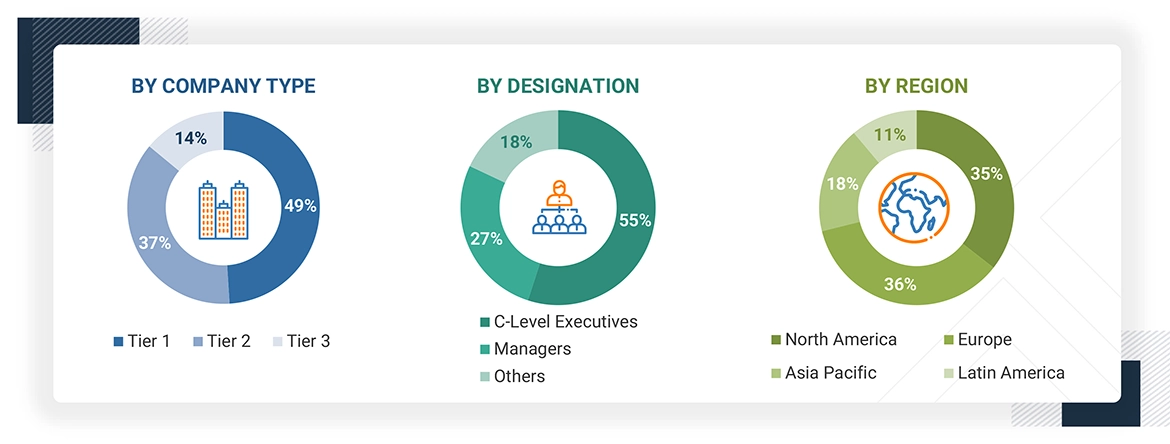
Note: Tiers of companies are based on their revenue in 2021–2022.
Tier 1: Company revenue greater than USD 1 billion; Tier 2: Company revenue between USD 100 million and USD 1 billion; and Tier 3: Company revenue lower than USD 100 million.
Others include Sales Managers, Marketing Managers, and Product Managers.
To know about the assumptions considered for the study, download the pdf brochure
Market Size Estimation
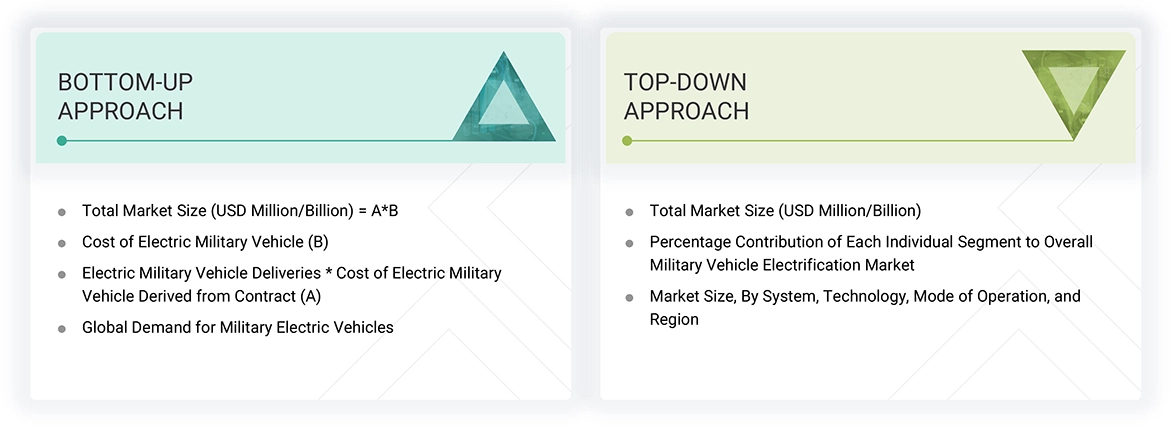
Both the top-down and bottom-up approaches were used to estimate and validate the size of the market. The research methodology used to estimate the market size also included the following details:
- Key players were identified through secondary research, and their market ranking was determined through primary and secondary research. This included a study of annual and financial reports of the top market players and extensive interviews with leaders, including CEOs, directors, and marketing executives.
- All percentage shares, splits, and breakdowns were determined using secondary sources and verified through primary sources. All possible parameters that affect the market covered in this research study were accounted for, viewed in extensive detail, verified through primary research, and analyzed to obtain the final quantitative and qualitative data. This data was consolidated, enhanced with detailed input, analyzed by MarketsandMarkets, and presented in this report.
Bottom-Up Approach
The bottom-up approach was employed to arrive at the overall size of the military vehicle electrification market.
Market Size Estimation Methodology: Bottom-up Approach
|
Step 1 |
Mapped deliveries of military electric vehicles |
Mapped deliveries of all types of electric military vehicles considered under military vehicle electrification segments from 2025 to 2030 |
|
Step 2 |
Classified the components required for each vehicle type |
Each vehicle technology considered in the scope (fully electric and hybrid) requires different types of electric components, and the penetration of each technology is different |
|
Step 3 |
Identified the total cost of manufacturing electric military vehicle |
Identified and mapped the total cost of manufacturing vehicles for each electric military vehicle considered in the study |
|
Step 4 |
Listing contracts for military electric vehicles |
Listing all the contracts for military electric vehicles to validate the market size |
|
Step 5 |
Arriving at the global market size (2025) |
Global market 2025 (Electric military vehicle delivery for 2025 * cost of electric military vehicle derived from contract) |
|
Step 6 |
Arriving at the global market size (2025-2030) |
Global market estimated based on data on existing and upcoming projects announced by OEMs, average digital readiness Index percentage of commercial electric vehicles, and average defense growth rate |
Top-Down Approach
In the top-down approach, military electric vehicle manufacturers were identified. The revenue of players as per their revenue specific to the market was identified. The base market number for each player was determined by assigning a weight to the contracts for military electric vehicles by these companies for the stages of electrification.
Military Vehicle Electrification Market : Top-Down and Bottom-Up Approach
Data Triangulation
The following figure indicates the market breakdown structure and the data triangulation procedure implemented in the market engineering process to develop this report.
The figure above demonstrates the core data triangulation procedure used in this report for every market, submarket, and subsegment. The percentage split for various market segments, including system, platform, technology, mode of operation, voltage, and region, was used to determine the size of the military vehicle electrification market.
Market Definition
Military vehicle electrification is the method of adapting new technologies for the use of electrical power for the operation of automotive drivetrains, auxiliary systems, turret motors/drives, and other mechanical subsystems in military vehicles. It involves the use of hybrid engines, battery technologies, fuel cells, and other primary power sources for military tactical and combat vehicles. It helps increase efficiency, power, and performance in critical missions and operations.
Key Stakeholders
- Military Vehicle Electrification Solution Providers
- Military Vehicle Electrification Platform Providers
- Military Vehicle Electrification System Providers
- Technology Providers
- Armed Forces
- Military Vehicle Electrification Product Manufacturers
- Component Manufacturers
- Distributors and Suppliers
- Investors and Venture Capitalists
- Component Manufacturers
- Distributors and Suppliers
- Universities, Research Organizations, Forums, Alliances, and Associations
- Ministries of Defense
- Original Equipment Manufacturers (OEMs)
- Regulatory Bodies
- R&D Companies
Report Objectives
- To define, describe, and forecast the size of the military vehicle electrification market based on platform, system, technology, mode of operation, and voltage from 2025 to 2030
- To forecast the size of various segments of the market with respect to major regions, namely, North America, Europe, Asia Pacific, the Middle East, and the Rest of the World
- To identify and analyze key drivers, restraints, opportunities, and challenges influencing the growth of the military vehicle electrification market across the globe
- To strategically analyze micromarkets 1 with respect to individual growth trends, prospects, and their contribution to the military vehicle electrification market
- To analyze opportunities for stakeholders in the market by identifying key market trends
- To analyze competitive developments such as contracts, acquisitions and expansions, agreements, partnerships, product launches, and research & development (R&D) activities in the market
- To provide a detailed competitive landscape of the -market, in addition to an analysis of business and corporate strategies adopted by leading market players
- To strategically profile key market players and comprehensively analyze their core competencies2
Micromarkets refer to segments and subsegments of the military vehicle electrification market included in the report.
Core competencies of the companies were captured in terms of their key developments and strategies to sustain their position in the market.
Available Customizations
Along with the market data, MarketsandMarkets offers customizations as per the specific needs of companies. The following customization options are available for the report:
Product Analysis
- Product matrix, which gives a detailed comparison of the product portfolio of each company
Regional Analysis
- Further breakdown of the market segments at the country level
Company Information
- Detailed analysis and profiling of additional market players (up to 5)
Get the Full Military Vehicle Electrification Market Report
Full forecast, segment splits, and company analysis for all Military Vehicle Electrification Market.
- Canada Military Vehicle Electrification Market
- US Military Vehicle Electrification Market
- UK Military Vehicle Electrification Market
- France Military Vehicle Electrification Market
- Germany Military Vehicle Electrification Market
- Italy Military Vehicle Electrification Market
- Australia Military Vehicle Electrification Market
- Japan Military Vehicle Electrification Market
- South Korea Military Vehicle Electrification Market
- Rest Of Europe Military Vehicle Electrification Market
Need a Tailored Report?
Customize this report to your needs
Get 10% FREE Customization
Customize This Report
