
Asia Pacific Millimeter Wave Technology Market (2024-2029)

The Asia Pacific Millimeter Wave Technology Market was valued at $1004.7 Million in 2024 and projected to reach to $3057.4 Million by 2029, representing a compound annual growth rate of 24.9%. The Asia Pacific millimeter wave technology market is positioned for exceptional growth, expanding from $1,004.7 million in 2024 to $3,057.4 million by 2029, representing a robust 24.9% CAGR.


| Market Size in | USD 26.32 MN |
| Market Forecast in | |
| CAGR | |
| Forecast Period | |
| Units Considered | Value (USD MN) |
Asia Pacific Millimeter Wave Technology Market Trends and Insights
- Asia Pacific's millimeter wave sector is driven by accelerating 5G deployment, automotive radar adoption, and satellite communication infrastructure investments across the region.
- The region's dominance in semiconductor manufacturing and electronics production positions Asia Pacific as a critical hub for millimeter wave component development and commercialization. Asia Pacific's millimeter wave market growth significantly outpaces global trends, with a 24.9% compound annual growth rate compared to the global average of 20.1%.
- This acceleration reflects strong demand from telecommunications operators, automotive OEMs, and defense sectors throughout Asia Pacific.
- Key markets including China, Japan, South Korea, and India are investing heavily in next-generation wireless technologies, creating substantial opportunities for millimeter wave solution providers across the region..
Key Market Statistics
- CAGR (2024-2029) 24.9% CAGR
- Market Size, 2024 ~USD 1004.7 Million
- Forecast, 2029 ~USD 3057.4 Million
- Geography Asia Pacific
Asia Pacific Millimeter Wave Technology Market Overview
Rapid 5G Infrastructure Expansion :
Asia Pacific is leading global 5G deployment with massive investments in network infrastructure. Countries like China, Japan, and South Korea are accelerating millimeter wave adoption for enhanced connectivity, driving significant market growth across the region.
Automotive Radar Proliferation :
Advanced driver assistance systems (ADAS) and autonomous vehicle development in Asia Pacific are fueling millimeter wave radar demand. Major automotive manufacturers in the region are integrating mmWave technology for collision avoidance and adaptive cruise control systems.
Semiconductor Manufacturing Hub :
Asia Pacific's dominance in semiconductor production provides a competitive advantage for mmWave component manufacturing. The region's established supply chains and manufacturing expertise enable cost-effective production and rapid technology scaling.
Satellite Communication Investments :
Growing satellite communication infrastructure projects across Asia Pacific are creating new mmWave applications. Government and private sector investments in space technology and broadband connectivity are expanding market opportunities beyond traditional terrestrial applications.
Asia Pacific Millimeter Wave Technology Market Dynamics
- This outpaces the global growth rate of 20.1%, reflecting the region's strategic importance in 5G deployment and semiconductor innovation.
- China, Japan, South Korea, and India are primary growth drivers, supported by government initiatives and substantial private sector investments. Looking ahead, Asia Pacific's mmWave market will be shaped by accelerating 5G commercialization, expanding automotive radar adoption, and emerging satellite communication applications.
- The region's manufacturing capabilities and technological expertise position it as a global leader in mmWave innovation.
- Continued investments in infrastructure, coupled with rising demand for high-speed connectivity and autonomous systems, will sustain double-digit growth through 2029 and beyond..
Market Ecosystem
Related Ecosystem
Communication And Connectivity Technology
- Sensors
- Smart Card & Readers
- Cellular Network
- Femtocell
- Image Sensors
- Cisco Systems, Inc.
- HUAWEI TECHNOLOGIES CO LTD
- Lenovo
- CommScope Holding Company, Inc.
- Texas Instruments Incorporated
Semiconductor Materials And Components
- Sensors
- Gallium Nitride (GaN)
- Digital Signal Processor (DSP)
- Natural Language Processing (NLP)
- Silicon Carbide
- Texas Instruments Incorporated
- Samsung
- APPLIED MATERIALS, INC.
- Stmicroelectronics
- Lenovo
Cns Systems
- C-Band
- Ka-Band
- Antennas
- Unmanned Ground Vehicles (UGV)
- Rotary Wing Aircraft
- L3Harris Technologies, Inc.
- Thales group
- HONEYWELL INTERNATIONAL INC.
- Northrop Grumman Corporation
- LOCKHEED MARTIN CORPORATION
Key Takeaways
- Asia Pacific millimeter wave market valued at $1,004.7M in 2024, expanding to $3,057.4M by 2029 at 24.9% CAGR
- Asia Pacific's growth rate of 24.9% significantly exceeds the global CAGR of 20.1%, reflecting regional technology leadership
- 5G infrastructure rollout and automotive radar integration are primary growth catalysts driving Asia Pacific market expansion
- Asia Pacific's semiconductor manufacturing ecosystem positions the region as the global center for millimeter wave component production
Millimeter Wave Technology Market Report Scope
| Report Metric | Details |
|---|---|
| Base Year | 2024 |
| Fastest Growing Segment | COMMUNICATION & NETWORKING COMPONENTS (Component) |
| Forecast Period | 2024-2029 |
| Growth Rate | CAGR of 20.1% from 2024 to 2029 |
| Largest Segment | 57 - 95 GHZ (Frequency Band) |
| Market Size Base Year (Billions) | ~USD 3.04 (2024) |
| Revenue Forecast (Billions) | ~USD 7.6 (2029) |
| Segments Covered | Component, Frequency Band, Product, Type, License Type, End Use |
Asia Pacific Millimeter Wave Technology Market Report Segmentation
6 segment dimensions are covered across the global market.
By Component
- Antennas & Transceiver Components
- Communication & Networking Components
- Frequency Sources & Related Components
- Imaging Components
- Interface Components
- Other Components
- Power & Battery Components
- Rf & Radio Components
- Sensors & Controls
By Frequency Band
- 24 - 57 Ghz
- 57 - 95 Ghz
- 95 - 300 Ghz
By Product
- Other Products
- Radar & Satellite Communication Systems
- Scanner Systems
- Telecommunication Equipment
By Type
- Active Scanners
- Application-Specific Radar System
- Macro-Cell Equipment
- Passive Scanners
- Perimeter Surveillance Radar
- Satellite Communication System
- Small-Cell Equipment
By License Type
- Fully Licensed
- Light Licensed
- Unlicensed
By End Use
- Aerospace & Defense
- Automotive & Transportation
- Consumer & Commercial
- Healthcare
- Industrial
- Mobile & Telecommunication
- Security & Surveillance
Target Audience
- Semiconductor & Component Manufacturers : Manufacturers need Asia Pacific market data to identify growth opportunities, optimize production capacity, and develop region-specific product strategies. Understanding local demand patterns and competitive dynamics is critical for market penetration.
- Telecommunications & 5G Operators : Telecom companies require detailed market insights to plan 5G infrastructure investments and mmWave deployment strategies across Asia Pacific. Regional forecasts help prioritize markets and allocate capital efficiently.
- Automotive & ADAS Suppliers : Automotive suppliers need Asia Pacific market intelligence to understand radar adoption trends and ADAS penetration rates. Country-level data supports product development and supply chain planning for regional OEMs.
- Investment & Private Equity Firms : Investors require comprehensive market analysis to identify acquisition targets and investment opportunities in Asia Pacific's mmWave ecosystem. Detailed forecasts and competitive insights inform valuation and due diligence processes.
- Government & Policy Makers : Government agencies and policy makers use market data to develop technology roadmaps, allocate R&D funding, and create supportive regulatory frameworks. Regional market insights inform strategic technology initiatives and infrastructure planning.
Countries within Asia Pacific - compare and drill down
| Country | 2025 size (native) |
|---|---|
| China | USD 1039.5 Million |
| Japan | USD 651.2 Million |
| South Korea | USD 507.5 Million |
| India | USD 565.6 Million |
| Rest Of Asia Pacific | USD 293.5 Million |
Country market size visualization
Reasons to Buy this Report
- Regional Market Sizing & Forecasts : Obtain precise market valuations for Asia Pacific and individual countries including China, Japan, South Korea, and India. Access detailed 5-year forecasts with country-level breakdowns to support strategic planning and investment decisions.
- Competitive Landscape Analysis : Understand key players and market dynamics specific to Asia Pacific. Identify regional leaders in mmWave technology, their market share, and competitive positioning to inform partnership and acquisition strategies.
- Growth Driver Identification : Gain insights into region-specific growth catalysts including 5G rollout timelines, automotive ADAS adoption rates, and satellite communication projects. Understand how local policies and investments shape market opportunities.
- Application & Segment Analysis : Explore mmWave applications across telecommunications, automotive, aerospace, and industrial sectors in Asia Pacific. Identify high-growth segments and emerging use cases driving regional demand.
- Strategic Market Entry Planning : Develop informed go-to-market strategies for Asia Pacific with country-specific insights. Understand regulatory environments, supply chain dynamics, and customer preferences to optimize market entry and expansion plans.
Frequently asked questions
What is the current market size of millimeter wave technology in Asia Pacific?
The Asia Pacific millimeter wave technology market was valued at $1,004.7 million in 2024 and is projected to grow to $3,057.4 million by 2029.
What is the expected growth rate for Asia Pacific millimeter wave technology?
Asia Pacific's millimeter wave market is expected to grow at a compound annual growth rate (CAGR) of 24.9% from 2024 to 2029.
How does Asia Pacific's millimeter wave market growth compare to global trends?
Asia Pacific's 24.9% CAGR outpaces the global millimeter wave market CAGR of 20.1%, indicating the region's accelerated adoption and technological advancement.
What are the primary drivers of millimeter wave technology adoption in Asia Pacific?
Key drivers include 5G network deployment, automotive radar systems, satellite communications infrastructure, and the region's advanced semiconductor manufacturing capabilities.
Which countries in Asia Pacific are leading millimeter wave technology adoption?
China, Japan, South Korea, and India are leading Asia Pacific adoption through significant investments in 5G infrastructure, automotive technology, and defense applications.
RESEARCH METHODOLOGY
The research process for this study included systematic gathering, recording, and analysis of data about customers and companies operating in the millimeter wave technology market. This process involved the extensive use of secondary sources, directories, and databases (Factiva, Oanda, and OneSource) for identifying and collecting valuable information for the comprehensive, technical, market-oriented, and commercial study of the millimeter wave technology market. In-depth interviews were conducted with primary respondents, including experts from core and related industries and preferred manufacturers, to obtain and verify critical qualitative and quantitative information as well as to assess growth prospects. Key players in the mm wave technology market were identified through secondary research, and their market rankings were determined through primary and secondary research. This research included studying annual reports of top players and interviewing key industry experts such as CEOs, directors, and marketing executives.
Secondary Research
In the secondary research process, various secondary sources were referred to for identifying and collecting information important for this study. Secondary sources included corporate filings, such as annual reports, investor presentations, and financial statements; trade, business, and professional associations; white papers; millimeter wave technology products-related journals; certified publications; articles by recognized authors; directories; and databases.
Secondary research was conducted to obtain key information about the industry supply chain, market value chain, key players, market classification and segmentation as per industry trends to the bottom-most level, geographic markets, and key developments from both market- and technology-oriented perspectives. Data from secondary research was collected and analyzed to determine the overall market size, which was further validated by primary research.
Primary Research
In the primary research process, various primary sources from the supply and demand sides were interviewed to obtain qualitative and quantitative information for this report. Primary sources from the supply side included industry experts such as CEOs, VPs, marketing directors, technology & innovation directors, and key executives from major companies in the millimeter wave technology market.
After going through market engineering (which includes calculations for market statistics, market breakdown, market size estimations, market forecasting, and data triangulation), extensive primary research was conducted to gather information and verify and validate the critical numbers obtained. Primary research was conducted to identify segmentation types, industry trends, key players, competitive landscape, and key market dynamics such as drivers, restraints, opportunities, and challenges, along with the key strategies adopted by players operating in the market.
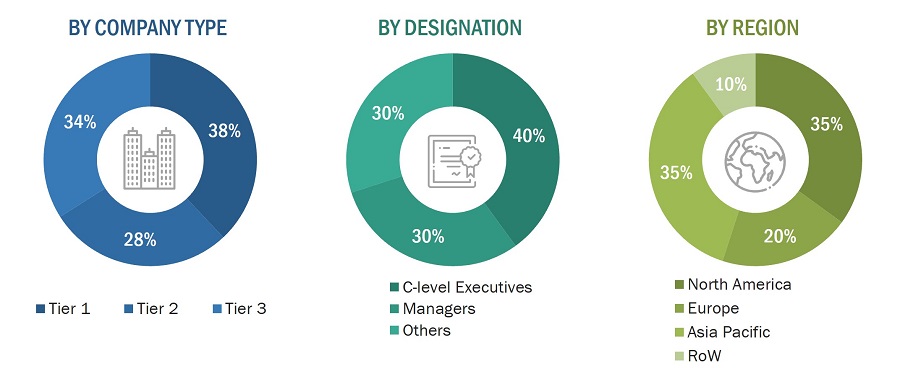
To know about the assumptions considered for the study, download the pdf brochure
Market size Estimation
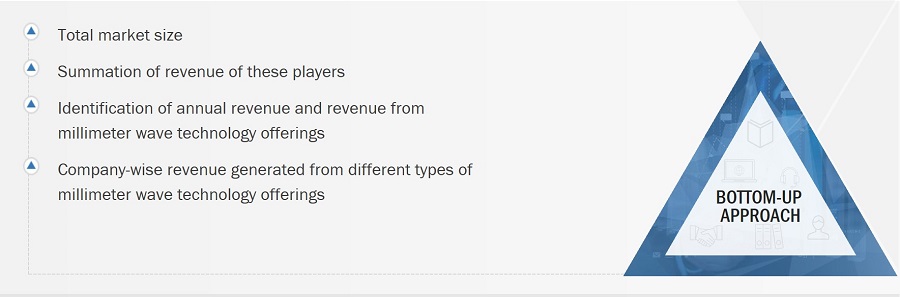
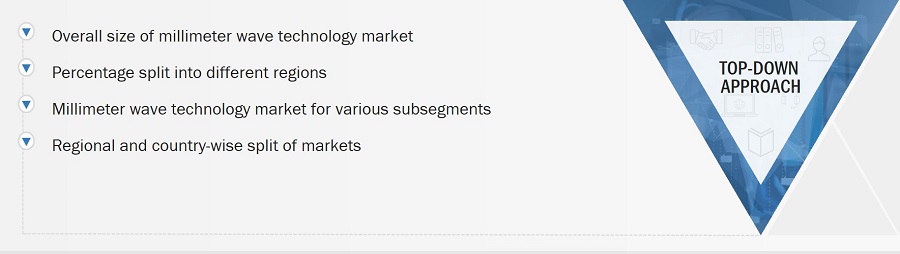
In the complete market engineering process, both top-down and bottom-up approaches were used, along with several data triangulation methods, to estimate and forecast the size of the market and its segments and subsegments listed in the report. Extensive qualitative and quantitative analyses were carried out on the complete market engineering process to list the key information/insights pertaining to the millimeter wave technology market.
The key players in the market were identified through secondary research, and their rankings in the respective regions were determined through primary and secondary research. This entire procedure involved the study of the annual and financial reports of top players, as well as interviews with industry experts such as chief executive officers, vice presidents, directors, and marketing executives for quantitative and qualitative key insights. All percentage shares, splits, and breakdowns were determined using secondary sources and verified through primary sources. All parameters that affect the markets covered in this research study were accounted for, viewed in extensive detail, verified through primary research, and analyzed to obtain the final quantitative and qualitative data. This data was consolidated and enhanced with detailed inputs and analysis from MarketsandMarkets and presented in this report.
Millimeter wave technology market: Bottom-Up Approach.
Millimeter wave technology market: Top-Down Approach.
Data Triangulation
After arriving at the overall size of the millimeter wave technology market from the market size estimation process explained above, the total market was split into several segments and subsegments. Where applicable, the market breakdown and data triangulation procedures were employed to complete the overall market engineering process and arrive at the exact statistics for all segments and subsegments. The data was triangulated by studying various factors and trends from both the demand and supply sides. Along with this, the market size was validated using top-down and bottom-up approaches.
Market Definition
Millimeter wave, also known as extremely high frequency (EHF) or very high frequency (VHF), is the band of spectrum between 30 gigahertz (GHz) and 300 GHz. These waves are named so because their wavelengths range from 1 millimeter to 10 millimeters. Previously, millimeter waves were mainly used in military and satellite communication applications. However, this technology has been gaining traction in mobile and telecom applications, mainly for 5G. In the context of wireless communication, millimeter waves generally refer to bands of the spectrum of around 38 GHz, 60 GHz, and 94 GHz.
Key Stakeholders
- Companies in the millimeter wave technology market
- Providers of millimeter wave components
- Technical standards organizations
- Research institutes and organizations
- Government and financial institutions
- Venture capitalists
- Private equity firms
Report Objectives
- To define, describe, and forecast the millimeter wave technology market based on product, frequency band, license type, end use, component, and region.
-
To forecast the sizes of various segments with respect to four major regions—
North America, Europe, Asia Pacific, and Rest of the World (RoW) - To provide a detailed analysis of the millimeter wave technology supply chain.
- To analyze the impact of the recession on mm wave technology market
- To strategically analyze the micromarkets1 with respect to individual growth trends and prospects and their contributions to the total market
- To analyze competitive developments such as expansions, agreements, partnerships, acquisitions, product developments, and research and development (R&D) in the millimeter wave technology market
- To analyze the opportunities for market players and provide details of the competitive landscape of the market.
- To benchmark the market players using the proprietary company evaluation matrix framework, which analyzes the market players on various parameters within the broad categories of business strategy excellence and strength of product portfolios.
- To strategically profile the key players and comprehensively analyze their market positions in terms of ranking and core competencies2, along with a detailed competitive landscape of the market.
Available customizations
With the given market data, MarketsandMarkets offers customizations according to the specific requirements of companies.
Product analysis
- Detailed analysis and profiling of additional market players
The following customization options are available for the report:
- Market sizing and forecast for additional countries
- Additional five companies profiling
Get the Full Millimeter Wave Technology Market Report
Full forecast, segment splits, and company analysis for all Millimeter Wave Technology Market.
- Rest Of Asia Pacific Millimeter Wave Technology Market
- GCC Countries Millimeter Wave Technology Market
- South America Millimeter Wave Technology Market
- Europe Millimeter Wave Technology Market
- North America Millimeter Wave Technology Market
- Row Millimeter Wave Technology Market
- US Millimeter Wave Technology Market
- Canada Millimeter Wave Technology Market
- Mexico Millimeter Wave Technology Market
- UK Millimeter Wave Technology Market
- Germany Millimeter Wave Technology Market
- France Millimeter Wave Technology Market
- Italy Millimeter Wave Technology Market
- China Millimeter Wave Technology Market
- Japan Millimeter Wave Technology Market
- South Korea Millimeter Wave Technology Market
- India Millimeter Wave Technology Market
- Rest Of Europe Millimeter Wave Technology Market
Need a Tailored Report?
Customize this report to your needs
Get 10% FREE Customization
Customize This Report
