
Asia Pacific Nanorobotics Market (2025-2030)

The Asia Pacific Nanorobotics Market was valued at $810.1 Million in 2025 and projected to reach to $1161.1 Million by 2030, representing a compound annual growth rate of 11.9%. Asia Pacific is positioned as the fastest-growing nanorobotics market globally, driven by robust manufacturing ecosystems and significant R&D commitments from leading economies.


| Market Size in | USD 26.32 MN |
| Market Forecast in | |
| CAGR | |
| Forecast Period | |
| Units Considered | Value (USD MN) |
Asia Pacific Nanorobotics Market Trends and Insights
- Asia Pacific is experiencing accelerated adoption driven by advanced manufacturing capabilities, substantial R&D investments, and growing demand across medical, industrial, and electronics sectors.
- By 2030, Asia Pacific is projected to reach $1,161.1 million, representing a compound annual growth rate of 11.9%, outpacing global expansion trends. The nanorobotics market in Asia Pacific is fueled by strong semiconductor manufacturing ecosystems, particularly in countries leading precision engineering and nanotechnology research.
- Asia Pacific's competitive advantage stems from lower production costs, skilled workforce availability, and government initiatives supporting quantum and nano-scale technologies.
- Strategic partnerships between academic institutions and industry players across Asia Pacific are accelerating commercialization of nanorobotic applications in targeted drug delivery, surgical interventions, and microelectronics fabrication. Asia Pacific's market trajectory reflects increasing healthcare investments, rising demand for minimally invasive procedures, and expansion of electronics manufacturing.
- The region's regulatory frameworks are progressively adapting to support nanorobotics commercialization, positioning Asia Pacific as a primary growth engine for the global nanorobotics sector through 2030..
Key Market Statistics
- CAGR (2025-2030) 11.9% CAGR
- Market Size, 2025 ~USD 810.1 Million
- Forecast, 2030 ~USD 1161.1 Million
- Geography Asia Pacific
Asia Pacific Nanorobotics Market Overview
Market Valuation & Growth :
Asia Pacific nanorobotics market valued at $810.1 million in 2025, expanding at 11.9% CAGR through 2030, outpacing the global growth rate of 10.6%.
Manufacturing Excellence :
Region leverages advanced manufacturing capabilities and established semiconductor infrastructure, positioning it as a global leader in nanorobotics production and commercialization.
R&D Investment Surge :
Substantial government and private sector R&D investments across China, Japan, South Korea, and India are accelerating innovation in nanorobotics applications and technologies.
Multi-Sector Demand :
Growing adoption across medical diagnostics, industrial automation, electronics manufacturing, and precision engineering sectors driving sustained market expansion in Asia Pacific.
Asia Pacific Nanorobotics Market Dynamics
- China, Japan, South Korea, and India are spearheading innovation, with applications expanding rapidly in medical devices, semiconductor fabrication, and industrial automation.
- The region's competitive advantage in electronics manufacturing and emerging biomedical sectors creates substantial growth opportunities. By 2030, the Asia Pacific market is projected to reach $1,161.1 million, reflecting strong demand from healthcare providers, electronics manufacturers, and research institutions.
- Government initiatives supporting nanotechnology development, coupled with increasing venture capital investment, will further accelerate market penetration.
- Strategic partnerships between regional players and global technology leaders are expected to enhance product development and market accessibility across the region..
Market Ecosystem
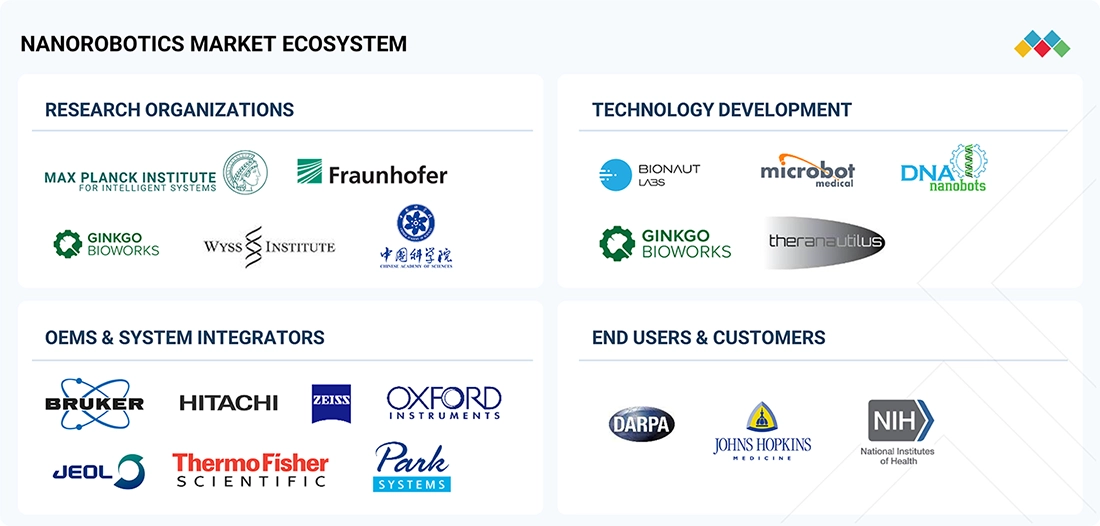
NANOROBOTICS MARKET: COMMERCIAL USE CASES ACROSS INDUSTRIES
| COMPANY | USE CASE DESCRIPTION | BENEFITS |
|---|---|---|
 |
Supports nanorobotics research platforms used in in-vitro biological studies and materials research, where controlled nanorobotic systems are explored for cell interaction, nanoscale positioning, and experimental automation in advanced research labs. | Enables precise nanoscale control, improves experimental repeatability, and supports development of next-generation nanorobotic applications in life sciences and materials R&D. |
 |
Provides tools and integrated environments that support nanorobotics-based workflows for automated nanoscale sample interaction, targeted analysis, and controlled manipulation in biomedical and pharmaceutical research. | Improves workflow automation, increases research efficiency, and accelerates development of nanorobotics-enabled medical and analytical solutions. |
 |
Enables nanorobotics systems for controlled nanoscale motion and interaction, particularly in biological research and advanced materials testing, supporting development of autonomous and semi-autonomous nanoscale systems.` | Enhances precision, supports innovation in nanorobotic system design, and enables scalable research for future medical and industrial applications. |
 |
Supports nanorobotics system development for precision positioning, nanoscale motion control, and automated interaction in industrial and research environments, especially for advanced materials and electronics R&D. | Enables high accuracy, improves consistency in nanoscale operations, and supports commercialization of nanorobotics technologies. |
 |
Provides platforms and solutions that enable nanorobotics-based experimentation and system validation, particularly for medical research, micro-engineering, and advanced materials development. | Improves system reliability, supports innovation in nanorobotics design, and accelerates translation from research to commercial applications. |
Logos and trademarks shown above are the property of their respective owners. Their use here is for informational and illustrative purposes only.
Related Ecosystem
Drones And Robotics
- Sensors
- Articulated Robots
- Cartesian Robots
- Scara Robots
- Actuators
- ABB India Limited
- KUKA AG
- MOMENTIVE PERFORMANCE MATERIALS INC.
- STAUBLI INTERNATIONAL AG
- Fanuc Corporation
Key Takeaways
- Asia Pacific nanorobotics market is valued at $810.1 million in 2025 and projected to grow to $1,161.1 million by 2030 at an 11.9% CAGR.
- Asia Pacific's advanced semiconductor manufacturing base and R&D infrastructure position the region as a global leader in nanorobotics innovation.
- Medical applications including targeted drug delivery and minimally invasive surgery are primary growth drivers for Asia Pacific's nanorobotics adoption.
- Government support for nanotechnology research and strategic industry-academia partnerships are accelerating commercialization across Asia Pacific.
Nanorobotics Market Report Scope
| Report Metric | Details |
|---|---|
| Base Year | 2025 |
| Fastest Growing Segment | IN-VIVO DEPLOYMENT (Deployment) |
| Forecast Period | 2025–2030 |
| Growth Rate | CAGR of 10.6% from 2025 to 2030 |
| Largest Segment | NANO-MANIPULATORS (Type) |
| Market Size Base Year (Billions) | ~USD 2.23 (2025) |
| Revenue Forecast (Billions) | ~USD 3.7 (2030) |
| Segments Covered | Type, Application, End User, Deployment, Technology |
Asia Pacific Nanorobotics Market Report Segmentation
5 segment dimensions are covered across the global market.
By Type
- Electron Microscopy
- Nano-Manipulators
- Nanorobotic Systems
- Scanning Probe Microscopy
By Application
- Diagnostics
- Drug Delivery
- Nano Surgery & Tissue Repair
- Other Applications
By End User
- Hospital & Clinical Centers
- Hospitals & Clinical Centers
- Medical Devices Oems
- Other End Users
- Pharma & Biotech Companies
- Research Institutes & Universities
By Deployment
- In-Vitro/Ex-Vivo Deployment
- In-Vivo Deployment
- Other Deployments
By Technology
- Acoustic/Ultrasound Propulsion
- Biohybrid/Biological Propulsion
- Magnetic Actuation
- Other Technologies
Target Audience
- Medical Device Manufacturers : Need Asia Pacific market data to identify growth opportunities in diagnostic nanorobotics, surgical applications, and drug delivery systems across emerging healthcare markets.
- Semiconductor & Electronics Companies : Require regional market intelligence to assess nanorobotics integration in manufacturing processes, quality control, and precision fabrication across Asia Pacific production facilities.
- Investment & Venture Capital Firms : Seek detailed market forecasts and regional growth drivers to evaluate investment opportunities in nanorobotics startups and technology companies across Asia Pacific.
- Government & Policy Makers : Need market insights to inform nanotechnology policy, R&D funding allocation, and industrial development strategies supporting Asia Pacific's nanorobotics ecosystem.
- Research Institutions & Universities : Require market data to understand commercialization opportunities, funding landscapes, and industry collaboration potential for nanorobotics research in Asia Pacific.
Key Companies in the Asia Pacific Nanorobotics Market
| Company | HQ | Ownership | Strongest segments |
|---|---|---|---|
| VOITH | Germany | Private Company | Voith Hydro (turbines, generators, hydro services),Voith Paper (papermaking components and systems),Voith Turbo (drives, transmissions, couplings, braking systems), |
| BRUKER | United States | Public Company | BSI BioSpin (NMR/EPR and preclinical imaging),BSI CALID (mass spectrometry and molecular diagnostics),BSI Nano (X-ray, AFM, electron microscopy analytics, optical microscopy), |
| JEOL LTD. | Japan | Public Company | Scientific and Metrology Instruments (TEM, SEM, NMR, MS, XRF, microanalysis),Industrial Equipment (thin film, material processing, electron beam metal AM, e-beam lithography),Medical Equipment (clinical chemistry analyzers and related), |
| THERMO FISHER SCIENTIFIC INC. | United States | Public Company | Life Sciences Solutions,Analytical Instruments,Specialty Diagnostics, |
| HITACHI HIGH-TECH CORPORATION | Japan | Private Company | Analytical & Medical Solutions,Nano-Technology Solutions (electron/ion microscopes, CD-SEM, wafer inspection),Industrial Solutions (industrial infrastructure, ICT, control systems), |
| PARK SYSTEMS | South Korea | Public Company | Research AFM and surface analysis systems,In-line AFM metrology for semiconductor and display,Photomask repair and optical profilometry, |
| OXFORD INSTRUMENTS | United Kingdom | Public Company | Imaging and Analysis (AFM, EM, light microscopy, spectroscopy, NMR, Raman, cameras),Advanced Technologies – Deposition and Etch Tools (PECVD, ALD, ICP RIE, DSiE, IBE, IBD),Advanced Technologies – Dilution Refrigerators and Low-Temperature Solutions, |
| EV GROUP (EVG) | Canada | ||
| CIQTEK CO. , LTD. | China | Private Company | Quantum information and NV-based microscopes,Spin resonance (EPR and related),Electron and ion microscopy (FE-SEM, FIB-SEM), |
| NANOBIOTIX | France | Public Company | NBTXR3 – head and neck / soft tissue sarcoma,NBTXR3 – liver, pancreatic, and other solid tumors,Platform and other R&D / collaborations, |
VOITH
Voith is a German private company founded in 1867 with 23,224 employees, operating as a global industrial manufacturer.
BRUKER
Bruker is a United States-based public company founded in 1960 with 11,085 employees, specializing in scientific instruments and analytical solutions.
JEOL LTD.
JEOL Ltd. is a Japanese public company established in 1949 with 3,731 employees, known for manufacturing electron microscopes and scientific instruments.
THERMO FISHER SCIENTIFIC INC.
Thermo Fisher Scientific Inc. is a United States public company founded in 1956 with 125,000 employees, serving as a global leader in life sciences and laboratory services.
HITACHI HIGH-TECH CORPORATION
Hitachi High-Tech Corporation is a Japanese private company founded in 1947 with 11,482 employees, providing advanced analytical and measurement instruments.
PARK SYSTEMS
Park Systems is a South Korean public company founded in 1997 with 396 employees, focusing on nanotechnology instrumentation and atomic force microscopy.
OXFORD INSTRUMENTS
Oxford Instruments is a United Kingdom-based public company founded in 1959 with 1,807 employees, manufacturing scientific and industrial equipment.
EV GROUP (EVG)
Insufficient data provided for company description.
CIQTEK CO. , LTD.
CIQTEK Co., Ltd. is a Chinese private company founded in 2016 with 685 employees, operating in the scientific instrumentation sector.
NANOBIOTIX
Nanobiotix is a French public company founded in 2003 with 100 employees, operating in the biotechnology and nanotechnology sector.
Countries within Asia Pacific - compare and drill down
| Country | 2025 size (native) |
|---|---|
| China | USD 460.7 Million |
| Japan | USD 241.1 Million |
| India | USD 185.9 Million |
| South Korea | USD 147.9 Million |
| Rest Of Asia Pacific | USD 125.5 Million |
Country market size visualization
Reasons to Buy this Report
- Regional Market Intelligence : Gain comprehensive insights into Asia Pacific nanorobotics dynamics, including country-level analysis of China, Japan, India, and South Korea with specific market valuations and growth trajectories.
- Competitive Landscape Analysis : Understand regional competitive positioning, key players, and market consolidation trends specific to Asia Pacific's advanced manufacturing and R&D ecosystems.
- Sector-Specific Opportunities : Identify high-growth applications across medical diagnostics, industrial automation, and electronics manufacturing tailored to Asia Pacific market demands and regulatory environments.
- Investment & Expansion Strategy : Leverage detailed market forecasts and growth drivers to inform strategic investments, partnerships, and market entry decisions across Asia Pacific regions.
- Technology Adoption Trends : Access insights on emerging nanorobotics technologies, adoption rates by sector, and innovation pipelines specific to Asia Pacific's manufacturing and healthcare sectors.
Frequently asked questions
What is the current market size of nanorobotics in Asia Pacific?
Asia Pacific's nanorobotics market is valued at $810.1 million in 2025, with expectations to reach $1,161.1 million by 2030.
What is the projected growth rate for Asia Pacific nanorobotics?
Asia Pacific nanorobotics market is expected to grow at a compound annual growth rate of 11.9% from 2025 to 2030.
Which sectors are driving nanorobotics demand in Asia Pacific?
Medical applications (targeted drug delivery, surgery), semiconductor manufacturing, and electronics fabrication are primary demand drivers in Asia Pacific.
Why is Asia Pacific a key region for nanorobotics development?
Asia Pacific benefits from advanced manufacturing infrastructure, significant R&D investments, skilled workforce, and government support for nanotechnology initiatives.
What challenges does Asia Pacific nanorobotics market face?
Regulatory standardization, high development costs, technical complexity, and the need for specialized talent remain key challenges for Asia Pacific's nanorobotics sector.
RESEARCH METHODOLOGY
The study involved major activities in estimating the current size of the nanorobotics market. Exhaustive secondary research was done to collect information on the nanorobotics market. The next step was to validate these findings, assumptions, and sizing with industry experts across the value chain using primary research. Different approaches, including top-down and bottom-up methods, were employed to estimate the total market size. After that, the market breakup and data triangulation procedures were used to estimate the market sizes of the nanorobotics market segments and subsegments.
Secondary Research
In the secondary research process, various secondary sources were referred to identify and collect information relevant to this study. Secondary sources included annual reports, press releases, and investor presentations of companies; white papers, certified publications, and articles from recognized authors; directories; and databases. Secondary research was primarily conducted to gather critical information on the industry's supply chain and value chain, the total pool of key players, and market classification and segmentation based on industry trends, geographic markets, and key developments from both market- and technology-oriented perspectives. Secondary data has been gathered and analyzed to determine the overall market size, which has also been validated by primary research.
Primary Research
Extensive primary research was conducted after understanding and analyzing the current market scenario for nanorobotics through secondary research. Several primary interviews were conducted with key opinion leaders from both the demand and supply sides in four key regions: North America, Europe, the Asia Pacific, and the rest of the world. Nearly 25% of the primary interviews were held with the demand side and 75% with the supply side. The primary data were gathered primarily through telephonic interviews, which accounted for 80% of the total primary interviews. Surveys and e-mails were also utilized to gather data.
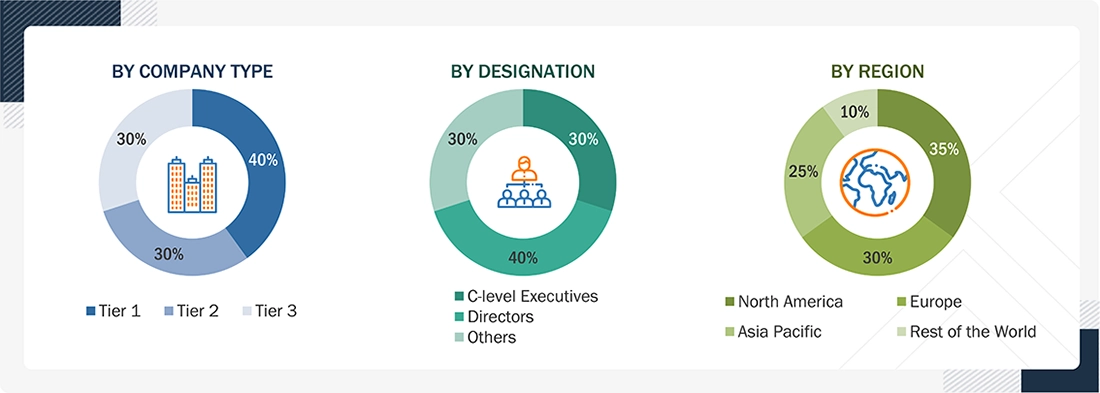
Note: The three tiers of companies are defined based on their total revenue as of 2024: tier 1: revenue of USD 500 million or more; tier 2: revenue between USD 100 million and USD 500 million; and tier 3: revenue of USD 100 million or less. Other designations include sales and marketing executives, researchers, and members of various nanorobotics organizations.
To know about the assumptions considered for the study, download the pdf brochure
Market Size Estimation
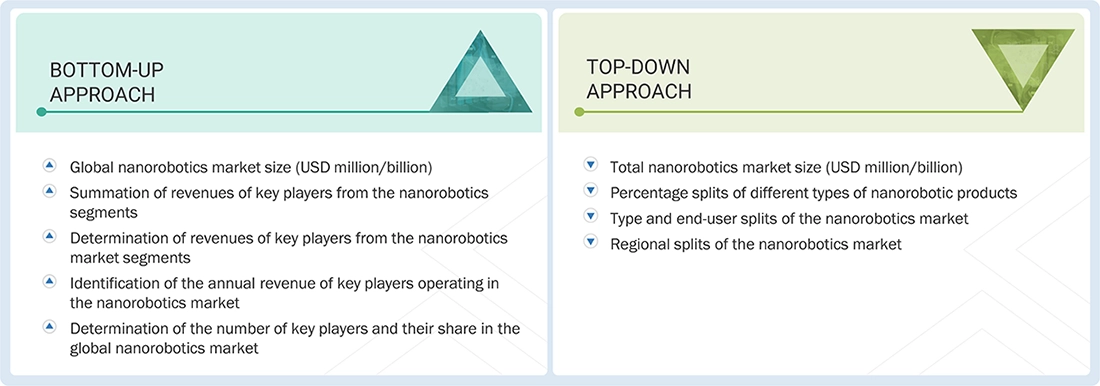
This report used both top-down and bottom-up approaches to estimate and validate the size of the nanorobotics market and related submarkets. Secondary research identified key players in this market, and their market shares in the respective regions were determined through primary and secondary research.
This research methodology included analyzing the annual and financial reports of top companies, as well as interviews with experts (such as CEOs, VPs, directors, and marketing executives) to obtain key insights (both quantitative and qualitative). All percentage shares, splits, and breakdowns were determined using secondary sources and verified through primary sources. All the possible parameters that affect the market covered in this research study were accounted for, viewed in detail, verified through primary research, and analyzed to obtain the final quantitative and qualitative data. This data was consolidated and supplemented with detailed inputs and analysis from MarketsandMarkets and presented in this report. The figures below show the overall market-size estimation process used for this study.
Bottom-Up Approach
- More than 30 companies offering nanorobotics were identified, and their offerings were mapped based on their product, output type, connectivity, technology, type, end use, and region.
- The global nanorobotics market size was derived through the data sanity method. The revenues of nanorobotics providers were analyzed from annual reports and press releases and aggregated to derive the overall market size.
- For each company, a percentage was assigned to the overall revenue to derive the revenues from the nanorobotics segment.
- Each company's percentage was assigned after analyzing various factors, including its product offerings, range of nanorobotic-related offerings, geographical presence, R&D expenditures and initiatives, and recent developments/strategies adopted for growth in the nanorobotics market.
- For the CAGR, the market trend analysis of nanorobotics was carried out by understanding the industry penetration rate and the demand and supply of nanorobotics in different sectors
- Estimates at every level were verified and cross-checked by discussing them with key opinion leaders, including the sales head, directors, operation managers across the market, and domain experts of MarketsandMarkets.
- Various paid and unpaid information sources were studied, such as annual reports, press releases, white papers, and databases.
Top-Down Approach
- Focusing initially on the top-line investments and expenditures being made in the ecosystem of nanorobotics, splitting the market based on type, deployment, technology, application, and end user, and listing key developments in key market areas
- Identifying all major players in the nanorobotics market by type, deployment, technology, application, and end user, and their penetration in various applications through secondary research, and verifying with a brief discussion with industry experts
- Analyzing revenues, product mix, geographic presence, and key applications for which all identified players serve nanorobotics to estimate and arrive at the percentage splits for all key segments
- Discussing these splits with the industry experts to validate the information and identify key growth pockets across all key segments
- Breaking down the total market based on verified splits and key growth pockets across all segments
Nanorobotics Market : Top-Down and Bottom-Up Approach
Data Triangulation
After determining the overall size of the nanorobotics market from the estimation process described above, the market was split into several segments and subsegments. The data triangulation and market breakdown procedures were employed (where applicable) to complete the overall market engineering process and obtain exact statistics for all segments and subsegments. The data was triangulated by studying various factors and trends from both the demand and supply sides. The size of the nanorobotics market was validated using both top-down and bottom-up approaches.
Market Definition
The nanorobotics market refers to the global ecosystem of technologies, systems, and solutions focused on the design, development, and application of nanoscale robotic systems capable of performing controlled tasks at the molecular or cellular level. Key use cases span targeted drug delivery, nanosurgery, tissue repair, in vitro and in vivo research, precision diagnostics, materials science, and advanced nanoscale experimentation.
Key Stakeholders
- Nanotechnology-based medical device companies
- Research and development (R&D) organizations
- Hospitals and clinics
- Diagnostic centers
- Technology, service, and solution providers
- Intellectual property (IP) core and licensing providers
- Government and other regulatory bodies
- Forums, alliances, and associations
- Analysts and strategic business planners
- Venture capitalists and investors
- Market research and consulting firms
Report Objectives
- To define and forecast the size of the nanorobotics in terms of value, based on type, deployment, technology, application, end user, and region
- To forecast the size of the market segments for four major regions—North America, Europe, Asia Pacific, and the Rest of the World
- To define, describe, segment, and forecast the size of the nanorobotics market, in terms of volume, based on type
- To provide detailed information regarding drivers, restraints, opportunities, and challenges influencing the growth of the market
- To provide a comprehensive overview of the value chain of the nanorobotics market ecosystem
- To strategically analyze micromarkets1 with respect to individual growth trends, prospects, and contributions to the total market
- To strategically profile the key players and comprehensively analyze their market position in terms of ranking and core competencies, and provide a detailed competitive landscape of the market
- To analyze competitive developments, such as product launches, acquisitions, collaborations, agreements, and partnerships, in the nanorobotics market
Available customizations:
Based on the market data provided, MarketsandMarkets offers customizations tailored to the company's specific needs. The following customization options are available for the report:
Company Information
- Detailed analysis and profiling of additional market players (up to 7)
Get the Full Nanorobotics Market Report
Full forecast, segment splits, and company analysis for all Nanorobotics Market.
- US Nanorobotics Market
- Canada Nanorobotics Market
- Mexico Nanorobotics Market
- UK Nanorobotics Market
- Germany Nanorobotics Market
- France Nanorobotics Market
- Italy Nanorobotics Market
- China Nanorobotics Market
- Japan Nanorobotics Market
- India Nanorobotics Market
- South Korea Nanorobotics Market
- Rest Of Europe Nanorobotics Market
- Rest Of Asia Pacific Nanorobotics Market
- South America Nanorobotics Market
Need a Tailored Report?
Customize this report to your needs
Get 10% FREE Customization
Customize This Report
