
India Near-infrared Imaging Market (2025-2030)

The India Near-infrared Imaging Market was valued at $45.8 Million in 2025 and projected to reach to $86.6 Million by 2030, representing a compound annual growth rate of 13.6%. India's near-infrared imaging market is positioned for exceptional growth through 2030, driven by increasing healthcare digitalization, rising prevalence of chronic diseases, and growing adoption of advanced diagnostic technologies in hospitals and diagnostic centers.


| Market Size in | USD 26.32 MN |
| Market Forecast in | |
| CAGR | |
| Forecast Period | |
| Units Considered | Value (USD MN) |
India Near-infrared Imaging Market Trends and Insights
- This represents a compound annual growth rate of 13.6%, outpacing global averages and reflecting India's increasing adoption of advanced diagnostic imaging technologies in healthcare settings.
- India's market expansion is driven by rising healthcare infrastructure investments, growing prevalence of chronic diseases, and expanding access to medical imaging in both urban and emerging rural centers. The near-infrared imaging sector in India is benefiting from technological advancements and cost-effective solutions tailored to the Indian healthcare ecosystem.
- India's growing medical device manufacturing capabilities and government initiatives supporting healthcare modernization are accelerating market penetration.
- Between 2025 and 2030, India is expected to see significant uptake across hospitals, diagnostic centers, and research institutions, positioning the country as a key growth market within the Asia Pacific region for near-infrared imaging applications..
Key Market Statistics
- CAGR (2025-2030) 13.6% CAGR
- Market Size, 2025 ~USD 45.8 Million
- Forecast, 2030 ~USD 86.6 Million
- Country India
India Near-infrared Imaging Market Overview
Strong CAGR Outperformance :
India's near-infrared imaging market is growing at 13.6% CAGR, significantly exceeding the global average of 10.6%, indicating accelerated market maturation and technology adoption across Indian healthcare institutions.
Rapid Market Expansion :
The market is projected to nearly double from USD 45.8 million in 2025 to USD 86.6 million by 2030, demonstrating strong investor confidence and increasing healthcare infrastructure investments across India's tier-1 and tier-2 cities.
Healthcare Modernization Drive :
India's push toward advanced diagnostic imaging technologies is fueled by rising healthcare expenditure, government initiatives like National Digital Health Mission, and growing demand for non-invasive diagnostic solutions in both urban and emerging markets.
Emerging Market Opportunity :
With a large patient population and expanding middle-class healthcare consumers, India represents a high-growth frontier market for near-infrared imaging manufacturers seeking to establish regional presence and capture emerging market share.
India Near-infrared Imaging Market Dynamics
- Government support through healthcare infrastructure development and medical device manufacturing incentives is accelerating market penetration.
- The market benefits from India's large patient population, expanding private healthcare sector, and rising awareness of early disease detection benefits.
- Competitive pricing and localized manufacturing capabilities are expected to further boost market accessibility and adoption rates across diverse healthcare settings..
Market Ecosystem
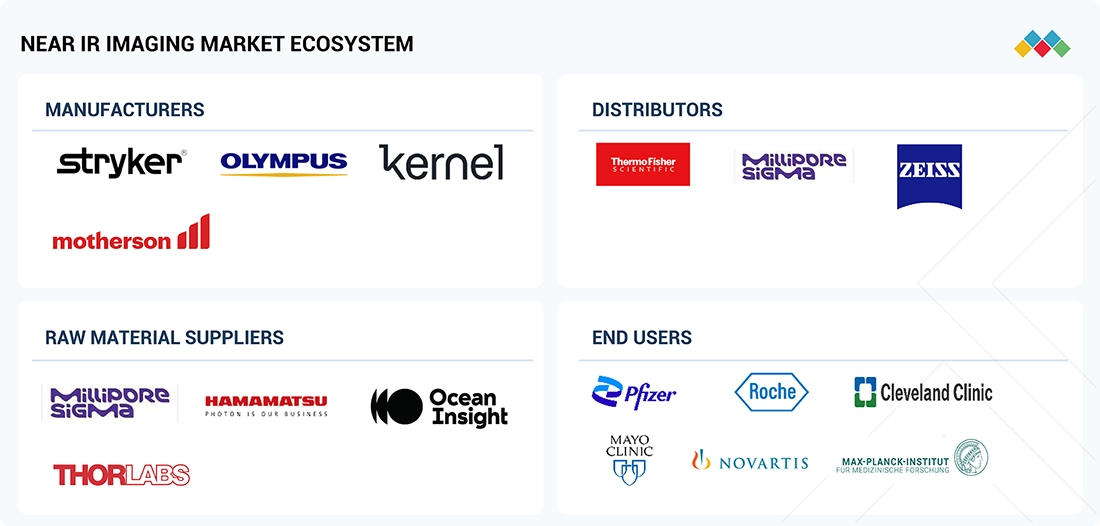
Near Infrared Imaging Market: COMMERCIAL USE CASES ACROSS INDUSTRIES
| COMPANY | USE CASE DESCRIPTION | BENEFITS |
|---|---|---|
 |
Developing / validating chemical imaging (which often uses NIR) for monitoring the uniformity of blends of active and inactive ingredients during powder mixing (pre-tablet stage) | Detecting issues in blending | Content uniformity early reduces rejects and rework |
 |
Build a large database of NIR spectral signatures of its oral medicine tablets, and uses NIR spectra for identification of their tablet product | The ability to test tablets without destroying them, through packaging, quickly | Reduces cost and improves throughput in QC and anti-fraud efforts |
 |
Integrates AI-powered imaging with near-infrared imaging navigation systems | Improved tumor resection precision in cancer surgery |
 |
Preclinical and translational research integrating imaging modalities with robotics | Acceleration of precision medicine and minimally invasive approaches |
Logos and trademarks shown above are the property of their respective owners. Their use here is for informational and illustrative purposes only.
Related Ecosystem
Diagnostic Imaging
- Magnetic Resonance Imaging (MRI)
- Computed Tomography (CT)
- CT Scanners
- Nuclear Imaging
- Positron Emission Tomography
- Siemens healthineers
- PHILIPS HEALTHCARE
- CANON INC.
- FUJIFILM Holdings Corporation
- UNITED IMAGING HEALTHCARE CO., LTD.
Medical Devices
- Polymerase Chain Reaction (PCR)
- Magnetic Resonance Imaging (MRI)
- Disposable Autoinjectors
- Pulse Oximeters
- Blood Pressure Monitors
- Medtronic plc
- Abbott Laboratories
- Stryker Corporation
- Becton, Dickinson and Company
- JOHNSON & JOHNSON
Key Takeaways
- India's near-infrared imaging market is valued at USD 45.8 million in 2025 and is forecast to reach USD 86.6 million by 2030, growing at a 13.6% CAGR.
- India's market growth rate significantly exceeds the global CAGR of 10.6%, driven by healthcare infrastructure expansion and rising chronic disease prevalence.
- India's cost-effective medical device solutions and government healthcare modernization initiatives are accelerating near-infrared imaging adoption across diagnostic and research facilities.
- India is positioned as a key growth market within Asia Pacific, with expanding opportunities in both urban hospitals and emerging rural healthcare centers through 2030.
Near-infrared Imaging Market Report Scope
| Report Metric | Details |
|---|---|
| Base Year | 2025 |
| Fastest Growing Segment | CANCER SURGERIES (Procedure) |
| Forecast Period | 2025–2030 |
| Growth Rate | CAGR of 10.6% from 2025 to 2030 |
| Largest Segment | DEVICES (Product) |
| Market Size Base Year (Billions) | ~USD 1.25 (2025) |
| Revenue Forecast (Billions) | ~USD 2.07 (2030) |
| Segments Covered | Product, Type, Application, Procedure, End User |
India Near-infrared Imaging Market Report Segmentation
5 segment dimensions are covered across the global market.
By Product
- Agents/Probes
- Devices
- Dyes
By Type
- Brain Cancer/Tumor Surgeries
- Colorectal Surgeries
- Fluorescence & Bioluminescence Imaging Systems
- Fluorescence Imaging Systems
- Indocyanine Green
- Nanoparticle Dyes
- Organic Dyes
- Other Cancer Surgeries
- Other Gastrointestinal Surgeries
- Other Reagents
By Application
- Clinical Imaging
- Medical Imaging
- Preclinical Imaging
By Procedure
- Cancer Surgeries
- Cardiovascular Surgeries
- Gastrointestinal Surgeries
- Obstetrics & Gynecological Surgeries
- Obstetrics & Gynecology Surgeries
- Other Procedures
- Plastic/Reconstructive Surgeries
- Reconstructive/Plastic Surgeries
By End User
- Hospitals & Clinics
- Hospitals & Surgical Clinics
- Other End Users
- Pharmaceutical & Biotechnology Companies
- Research Laboratories & Academic Institutes
Target Audience
- Medical Device Manufacturers : Manufacturers need India-specific market data to assess market entry feasibility, benchmark competitive positioning, forecast revenue potential, and develop localized product strategies for the rapidly expanding Indian healthcare sector.
- Healthcare Investors & PE Firms : Investment professionals require validated market sizing and growth projections for India to evaluate portfolio opportunities, support due diligence processes, and identify high-potential healthcare technology companies operating in the region.
- Hospital & Diagnostic Center Operators : Healthcare facility managers need market intelligence to justify capital expenditure on near-infrared imaging equipment, benchmark adoption rates against peers, and plan technology upgrade roadmaps aligned with market growth trends.
- Market Research & Strategy Consultants : Consultants require India-focused market data to support client strategy development, competitive analysis, market entry planning, and business case development for healthcare technology implementations across Indian healthcare networks.
- Government & Healthcare Policy Bodies : Policy makers and healthcare administrators need market insights to inform healthcare infrastructure planning, medical device procurement strategies, and regulatory framework development supporting advanced imaging technology adoption in India.
Key Companies in the India Near-infrared Imaging Market
| Company | HQ | Ownership | Strongest segments |
|---|---|---|---|
| AMS AG | United States | Public Company | Air Distribution (Amadeus GDS and related services),Air IT Solutions (Altéa, New Skies, and airline platforms),Hospitality & Other Solutions, |
| STRYKER | United States | Public Company | Orthopaedics (hips, knees, shoulder, ankle, trauma, extremities, Mako Shoulder),MedSurg (surgical equipment, endoscopy, patient handling, emergency and ICU disposables, communications),Neurotechnology and Spine (stroke, neurovascular, brain and skull surgery, orthobiologics, biosurgery), |
| CARL ZEISS MEDITEC AG | Germany | Public Company | Ophthalmology – Diagnostics (slit lamps, OCT, fundus, perimeters),Ophthalmology – Surgical (microscopes, phaco, vitrectomy, IOLs),Ophthalmology – Refractive / Laser (VISUMAX and consumables), |
| PERKINELMER, INC. | United States | Public Company | Diagnostics assays, reagents, and screening platforms,Life science reagents, antibodies, and genomic workflow tools,Instruments, imaging, and detection systems, |
| OLYMPUS CORPORATION | Japan | Public Company | Gastrointestinal Solutions – endoscopes,Gastroenterology devices and services,Urology products, |
| SHIMADZU CORPORATION | Japan | Public Company | Analytical and Measuring Instruments,Medical Systems (Imaging and X-ray),Industrial and Vacuum Machinery, |
| HAMAMATSU PHOTONICS K.K. | Japan | Public Company | Electron Tube (photomultiplier tubes and related sensors),Opto-Semiconductor (photodiodes, APDs, SPADs, MPPCs),Imaging and Measurement Instruments, |
| MIZUHO MEDICAL CO., LTD. | Japan | Public Company | Rapid immunoassay infectious disease panels (respiratory, GI, strep, others),Women’s health and fecal occult blood rapid tests,Molecular diagnostics (NAAT instruments and mycoplasma pneumoniae kits), |
| TELEDYNE PRINCETON INSTRUMENTS | United States | Subsidiary | Scientific CCD and EMCCD cameras,sCMOS and high-speed scientific cameras,InGaAs and NIR/SWIR cameras, |
| THERMO FISHER SCIENTIFIC INC. | United States | Public Company | Laboratory Products and Biopharma Services,Life Sciences Solutions,Analytical Instruments, |
AMS AG
AMS AG is a publicly traded U.S. company founded in 1987 with 20,605 employees providing sensor and imaging solutions across multiple industries.
STRYKER
Stryker is a publicly traded U.S. medical technology company founded in 1941 with 56,000 employees specializing in surgical equipment, orthopedic devices, and patient care products.
CARL ZEISS MEDITEC AG
Carl Zeiss Meditec AG is a publicly traded German company founded in 1846 with 5,798 employees manufacturing optical and optoelectronic medical devices.
PERKINELMER, INC.
PerkinElmer, Inc. is a publicly traded U.S. company founded in 1937 with 11,000 employees providing diagnostic and research solutions in life sciences and environmental testing.
OLYMPUS CORPORATION
Olympus Corporation is a publicly traded Japanese company founded in 1919 with 28,138 employees manufacturing optical and digital precision equipment for medical, imaging, and industrial applications.
SHIMADZU CORPORATION
Shimadzu Corporation is a publicly traded Japanese company founded in 1875 with 14,649 employees producing analytical and measuring instruments, medical devices, and industrial equipment.
HAMAMATSU PHOTONICS K.K.
Hamamatsu Photonics K.K. is a publicly traded Japanese company founded in 1953 with 6,601 employees manufacturing photonic sensors and imaging devices.
MIZUHO MEDICAL CO., LTD.
Mizuho Medical Co., Ltd. is a publicly traded Japanese company founded in 1977 with 193 employees operating in the medical device sector.
TELEDYNE PRINCETON INSTRUMENTS
Teledyne Princeton Instruments is a subsidiary company specializing in scientific imaging and optical instrumentation.
THERMO FISHER SCIENTIFIC INC.
Thermo Fisher Scientific Inc. is a publicly traded U.S. company founded in 1956 with 125,000 employees providing laboratory equipment, reagents, and analytical services for research and diagnostics.
Reasons to Buy this Report
- Market Size & Growth Validation : Obtain precise market valuation data for India (USD 45.8M in 2025) with verified 13.6% CAGR projections through 2030, enabling accurate financial forecasting and investment decision-making for regional expansion strategies.
- Competitive Positioning Intelligence : Understand India's market dynamics relative to global benchmarks (10.6% global CAGR), identify competitive gaps, and assess market saturation levels to optimize product positioning and pricing strategies for Indian healthcare buyers.
- Regional Growth Opportunity Assessment : Evaluate India as a high-growth emerging market with 89% market expansion potential by 2030, supporting business case development for market entry, partnership formation, and resource allocation decisions in South Asia.
- Healthcare Infrastructure Insights : Access India-specific adoption drivers including government healthcare initiatives, hospital modernization trends, and diagnostic center expansion patterns to identify target customer segments and tailor go-to-market strategies effectively.
- Investment & Partnership Strategy : Leverage comprehensive India market data to support investor pitches, identify acquisition targets, evaluate joint venture opportunities, and negotiate partnerships with local healthcare providers and medical device distributors.
Frequently asked questions
What is the current market size of near-infrared imaging in India?
India's near-infrared imaging market is valued at USD 45.8 million in 2025, with verified data from market research sources.
What is the projected market size for near-infrared imaging in India by 2030?
India's near-infrared imaging market is forecast to reach USD 86.6 million by 2030, representing significant expansion over the five-year period.
What is the CAGR for India's near-infrared imaging market?
India's near-infrared imaging market is growing at a compound annual growth rate of 13.6% from 2025 to 2030, outpacing global growth rates.
What factors are driving growth in India's near-infrared imaging market?
India's market growth is driven by healthcare infrastructure investments, rising chronic disease prevalence, government modernization initiatives, and increasing adoption of advanced diagnostic technologies.
How does India's near-infrared imaging market compare to global trends?
India's 13.6% CAGR significantly exceeds the global CAGR of 10.6%, positioning India as a faster-growing market within the healthcare imaging sector.
RESEARCH METHODOLOGY
This study relied heavily on both primary and secondary sources. Extensive secondary research was conducted to gather information about near-infrared imaging. The next step involved validating these findings, assumptions, and market sizing with industry experts across the value chain through primary research. Various approaches were employed to estimate the overall market size, including top-down and bottom-up methods. Subsequently, market segmentation and data triangulation procedures were applied to determine the market size of different segments and subsegments within the near-infrared imaging market. The research also examined various factors influencing the industry to identify segmentation types, industry trends, key players, the competitive landscape, essential market dynamics, and strategies employed by key market participants.
Secondary Research
The secondary research process relies heavily on various secondary sources, including directories, databases such as Bloomberg Business, Factiva, and D&B Hoovers, white papers, annual reports, company documents, investor presentations, and SEC filings. This type of research was utilized to gather valuable information for a comprehensive, technical, market-oriented, and commercial analysis of the near-infrared imaging market. It also helped acquire crucial insights about key players and the market's classification and segmentation based on industry trends down to the most detailed level. Additionally, significant developments related to market and technology perspectives were identified. A database of the key industry leaders was created using this secondary research.
The market for companies offering near-infrared imaging is assessed through secondary data from paid and unpaid sources. This analysis involves examining the product portfolios of major companies and evaluating their performance and quality. Various sources were consulted during the secondary research process to gather comprehensive information for this study. The secondary research provided essential insights into the value chain, identified the key players, and facilitated market classification and segmentation from market and technology-oriented perspectives.
Primary Research
In the primary research process, various supply and demand sources were interviewed to gather qualitative and quantitative information for this report. The supply-side primary sources included industry experts such as CEOs, vice presidents, marketing and sales directors, technology and innovation directors, and other key executives from prominent companies and organizations in the near-infrared imaging market. On the demand side, primary sources included OEMs, private and contract testing organizations, and service providers. This primary research validated market segmentation, identified key players, and gathered insights on significant industry trends and market dynamics.
After completing the market engineering process, which included calculations for market statistics, market breakdown, estimation, forecasting, and data triangulation, we conducted extensive primary research. This research aimed to gather information and verify the critical numbers obtained through initial calculations. Additionally, various segmentation types, industry trends, and the competitive landscape of near-infrared imaging devices offered by different market players were also identified. Key market dynamics such as drivers, restraints, opportunities, challenges, as well as industry trends and the strategies of major players in the market were also evaluated.
In the comprehensive market engineering process, top-down and bottom-up approaches and various data regulation methods were utilized to estimate and forecast the overall market segments and subsegments outlined in this report. Extensive qualitative and quantitative analyses were conducted throughout the market engineering process to highlight key information and insights presented in the report.
A breakdown of the primary respondents is provided below:
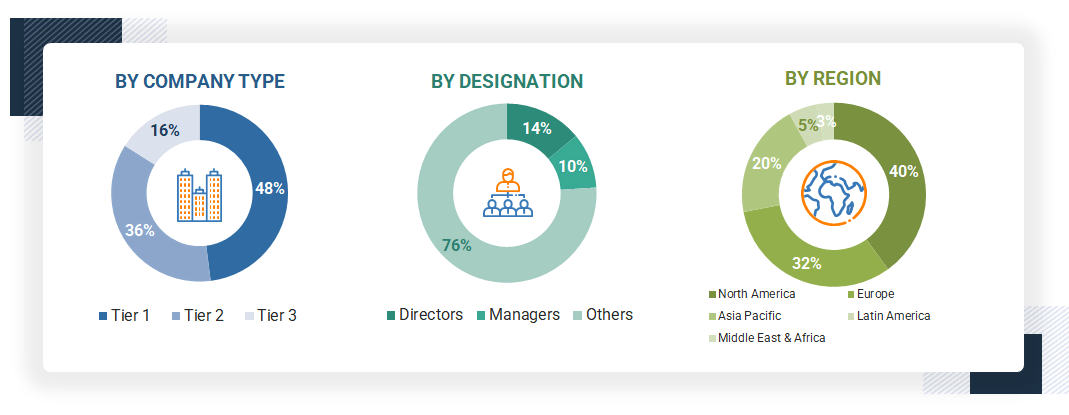
Note 1: Other designations include sales managers, marketing managers, business development managers, product managers, distributors, and suppliers.
Note 2: Companies are classified into tiers based on their total revenue. As of 2024, Tier 1 = >USD 2 billion, Tier 2 = USD 50 million to USD 2 billion, and Tier 3 = < USD 50 million.
To know about the assumptions considered for the study, download the pdf brochure
Market Size Estimation
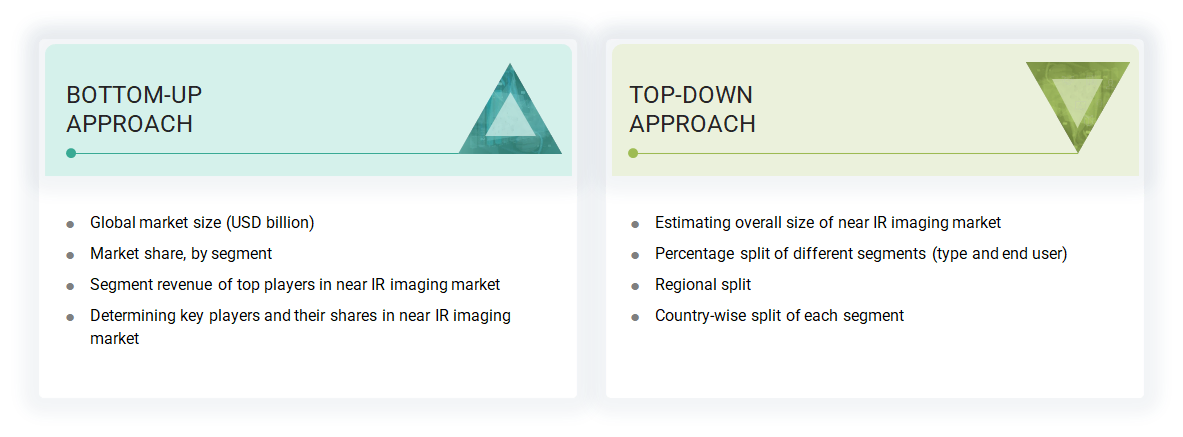
Both top-down and bottom-up approaches were used to estimate and validate the near-infrared imaging market size. These methods were also used extensively to estimate the size of various segments in the market.
Revenue share analysis about the leading players was employed to determine the size of the global near-infrared imaging market. In this case, key players in the market have been identified, and their business revenues were determined through various insights gathered during the primary and secondary research phases. Secondary research included studying the annual and financial reports of top market players. On the other hand, primary research incorporated in-depth interviews with key opinion leaders, particularly chief executive officers, directors, and key marketing executives.
The research methodology used to estimate the market size includes the following:
Data Triangulation
After arriving at the overall market size from the market size estimation process explained above, the global near-infrared imaging market was split into segments and subsegments. Data triangulation and market breakdown procedures were employed to complete the overall market engineering process and arrive at the exact statistics for all segments and subsegments. The data was triangulated by studying various factors and trends from both the demand and supply sides. Additionally, the near-infrared imaging market was validated using both top-down and bottom-up approaches.
Market Definition
Near-infrared imaging refers to the technique of capturing images in the near-infrared spectrum of light. This imaging technique utilizes wavelengths of light that are longer than those visible to the human eye but shorter than thermal radiation.
Stakeholders
- Near-infrared Imaging Solution Manufacturers, Suppliers, and Providers
- Near-infrared Imaging Equipment and Service Solution Providers
- Near-infrared Imaging Integrated Solution Providers
- Pharmaceutical Companies
- Biotechnology Companies
- Academic Institutions and Private Research Institutions
- Private & Public Hospitals and Clinics
- Diagnostic Centers
- CROs and CDMOs
- Consulting Firms
- Research Institutes
- Research Laboratories
- Market Research and Consulting Firms
- Venture Capitalists and Investors
Report Objectives
- To define, describe, and forecast the near-infrared imaging market based on product, procedure, application, end user, and region
- To provide detailed information regarding the major factors influencing the growth potential of the global near-infrared imaging market (drivers, restraints, opportunities, challenges, and trends)
- To analyze the micromarkets with respect to individual growth trends, prospects, and contributions to the global near-infrared imaging market
- To analyze key growth opportunities in the global near-infrared imaging market for key stakeholders and provide details of the competitive landscape for market leaders
- To forecast the size of market segments and/or subsegments with respect to five major regions, namely, North America (the US and Canada), Europe (Germany, the UK, France, Italy, Spain and Rest of Europe), Asia Pacific (Japan, China, India, Australia, South Korea and Rest of Asia Pacific), Latin America (Brazil, Mexico, and Rest of Latin America), and the Middle East & Africa (GCC Countries and the rest of Middle East & Africa)
- To profile the key players in the global near-infrared imaging market and comprehensively analyze their market shares and core competencies
- To track and analyze the competitive developments undertaken in the global near-infrared imaging market, such as agreements, expansions, and product launches
Get the Full Near-infrared Imaging Market Report
Full forecast, segment splits, and company analysis for all Near-infrared Imaging Market.
- US Near-infrared Imaging Market
- Canada Near-infrared Imaging Market
- Germany Near-infrared Imaging Market
- France Near-infrared Imaging Market
- UK Near-infrared Imaging Market
- Italy Near-infrared Imaging Market
- Spain Near-infrared Imaging Market
- China Near-infrared Imaging Market
- Japan Near-infrared Imaging Market
- Australia Near-infrared Imaging Market
- South Korea Near-infrared Imaging Market
- Brazil Near-infrared Imaging Market
- Mexico Near-infrared Imaging Market
Need a Tailored Report?
Customize this report to your needs
Get 10% FREE Customization
Customize This Report
