
US Nonwoven Fabrics Market (2025-2030)

The US Nonwoven Fabrics Market was valued at $12466.6 Million in 2025 and projected to reach to $15203 Million by 2030, representing a compound annual growth rate of 4.0%. The US nonwoven fabrics market is poised for steady growth through 2030, driven by sustained demand from hygiene, medical, and industrial filtration sectors.


| Market Size in | USD 26.32 MN |
| Market Forecast in | |
| CAGR | |
| Forecast Period | |
| Units Considered | Value (USD MN) |
US Nonwoven Fabrics Market Trends and Insights
- This steady expansion reflects strong demand across hygiene products, medical applications, and industrial filtration sectors within the US.
- The US market benefits from advanced manufacturing capabilities, robust healthcare infrastructure, and increasing consumer preference for sustainable nonwoven solutions. Driving growth in the US nonwoven fabrics market are rising healthcare expenditures, heightened awareness of infection control, and expansion in the personal care segment.
- The US continues to lead in innovation and product development, with manufacturers investing in eco-friendly and performance-enhanced nonwoven technologies.
- Between 2025 and 2030, the US market will experience moderate but consistent growth, supported by regulatory compliance requirements and evolving end-user specifications across medical, automotive, and filtration applications..
Key Market Statistics
- CAGR (2025-2030) 4.0% CAGR
- Market Size, 2025 ~USD 12466.6 Million
- Forecast, 2030 ~USD 15203 Million
- Country US
US Nonwoven Fabrics Market Overview
Market Size & Growth :
The US nonwoven fabrics market is valued at $12,466.6 million in 2025 and is projected to reach $15,203.0 million by 2030, growing at a steady CAGR of 4.0% over the forecast period.
Hygiene Product Dominance :
US demand for nonwoven fabrics is primarily driven by the hygiene products sector, including diapers, feminine care products, and adult incontinence items, which represent the largest application segment.
Healthcare & Medical Applications :
The US healthcare sector significantly contributes to market growth through medical textiles, surgical masks, gowns, and wound care products, supported by advanced healthcare infrastructure and regulatory standards.
Advanced Manufacturing Capabilities :
The US benefits from state-of-the-art manufacturing facilities, strong R&D investments, and technological innovation in nonwoven production, positioning it as a leader in quality and efficiency.
US Nonwoven Fabrics Market Dynamics
- Increasing healthcare expenditures, aging population demographics, and heightened awareness of infection control are key growth catalysts.
- The market will benefit from continuous innovation in sustainable and biodegradable nonwoven materials, responding to environmental concerns and regulatory pressures.
- Manufacturing automation and capacity expansions by major players will further strengthen market competitiveness and supply chain resilience in the US..
Market Ecosystem
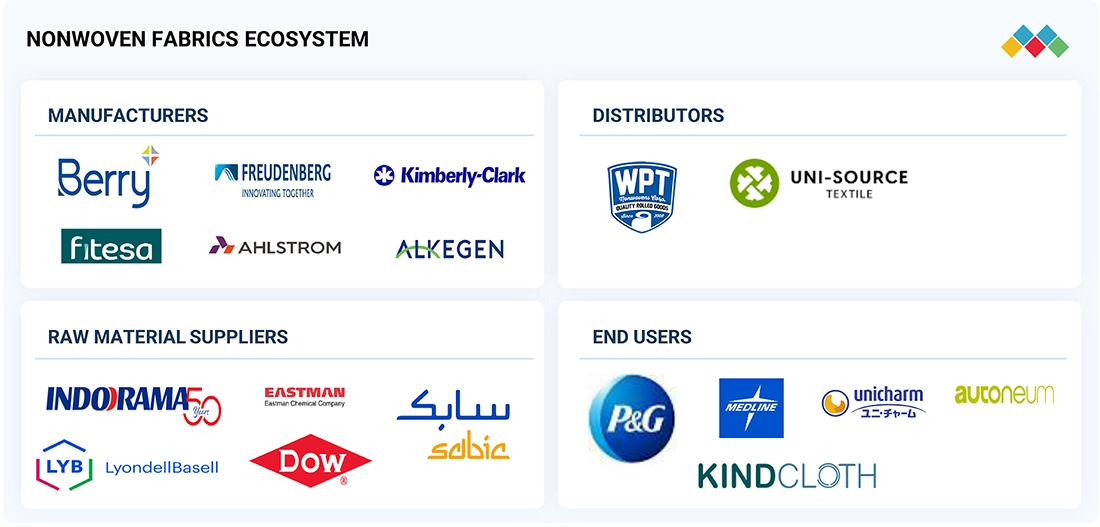
Nonwoven Fabrics Market: COMMERCIAL USE CASES ACROSS INDUSTRIES
| COMPANY | USE CASE DESCRIPTION | BENEFITS |
|---|---|---|
 |
JOFO NonWovens used ExxonMobil’s Vistamaxx propylene-based elastomers to produce a new “soft” nonwoven fabric (branded “SilkSoft”) for hygiene products, that balances softness, drape, and mechanical performance. | The new fabric offers enhanced softness without compromising strength or processability, enabling downgauging and cost-effective manufacture of premium hygiene products. |
Logos and trademarks shown above are the property of their respective owners. Their use here is for informational and illustrative purposes only.
Related Ecosystem
Yarns Fabric And Textile
- Agrotech
- Clothtech
- Indutech
- Oekotech
- Packtech
- MILLIKEN & COMPANY
- Toray Industries, Inc.
- 3M COMPANY
- DuPont de Nemours, Inc.
- Kimberly-Clark Corporation
Key Takeaways
- The US nonwoven fabrics market is valued at $12,466.6 million in 2025 and will reach $15,203.0 million by 2030 at a 4.0% CAGR.
- The US market is driven by strong demand in healthcare, hygiene products, and industrial filtration applications.
- The US leads in innovation with significant investment in sustainable and performance-enhanced nonwoven technologies.
- Regulatory compliance and evolving end-user specifications will support steady growth in the US market through 2030.
Nonwoven Fabrics Market Report Scope
| Report Metric | Details |
|---|---|
| Base Year | 2025 |
| Fastest Growing Segment | HYGIENE (End-Use Industry) |
| Forecast Period | 2025–2030 |
| Growth Rate | CAGR of 5.7% from 2025 to 2030 |
| Largest Segment | SPUNBOND (Technology) |
| Market Size Base Year (Billions) | ~USD 54.73 (2025) |
| Revenue Forecast (Billions) | ~USD 72.21 (2030) |
| Segments Covered | Technology, End-Use Industry, Raw Material, Fabric Type, Application |
US Nonwoven Fabrics Market Report Segmentation
5 segment dimensions are covered across the global market.
By Technology
- Dry Laid
- Other Technologies
- Spunbond
- Wet Laid
By End-Use Industry
- Automotive
- Building & Construction
- Consumer Products
- Filtration
- Hygiene
- Medical
- Other End-Use Industries
By Raw Material
- Cotton
- Polyamide
- Polyester
- Polypropylene
- Viscose
By Fabric Type
- Knitted
- Nonwoven
- Woven
By Application
- Blanket & Bedding
- Clothing
- Dressing Products
- Hygiene Products
- Privacy Curtains
- Upholstery
US: NONWOVEN FABRICS MARKET, BY END-USE INDUSTRY, 2024–2030
| Segment | 2024 | 2025 | 2026 | 2027 | 2028 | 2029 | 2030 | CAGR (%) |
|---|---|---|---|---|---|---|---|---|
| AUTOMOTIVE | 937.9 | 973.4 | 1010.2 | 1048.4 | 1088 | 1129.2 | 1171.8 | 3.8 |
| BUILDING & CONSTRUCTION | 2807.3 | 2887.8 | 2970.6 | 3055.8 | 3143.5 | 3233.6 | 3326.4 | 2.9 |
| CONSUMER PRODUCTS | 869.1 | 892.9 | 917.4 | 942.5 | 968.3 | 994.8 | 1022 | 2.7 |
| FILTRATION | 939.4 | 970 | 1001.6 | 1034.2 | 1067.9 | 1102.8 | 1138.7 | 3.3 |
| HYGIENE | 3373.5 | 3586.6 | 3811.5 | 4048.5 | 4298.4 | 4561.9 | 4839.5 | 6.2 |
| MEDICAL | 1370.2 | 1427.3 | 1486.9 | 1548.9 | 1613.5 | 1680.8 | 1751 | 4.2 |
| OTHER END-USE INDUSTRIES | 1686.8 | 1728.6 | 1771.4 | 1815.3 | 1860.3 | 1906.3 | 1953.6 | 2.5 |
| TOTAL | 11984.1 | 12466.6 | 12969.5 | 13493.6 | 14039.9 | 14609.4 | 15203 | 4 |
Target Audience
- Nonwoven Manufacturers : US-based and international nonwoven producers need market data to optimize production capacity, identify expansion opportunities, and understand competitive positioning within the American market.
- Healthcare & Hygiene Companies : Manufacturers of medical devices, surgical supplies, and hygiene products require detailed market insights to forecast demand, plan supply chains, and develop new product lines for US consumers.
- Investment & Private Equity Firms : Investors evaluating acquisition targets or portfolio companies in the nonwoven sector need accurate market sizing and growth projections to assess valuation and return potential in the US.
- Raw Material Suppliers : Fiber and chemical suppliers serving the US nonwoven industry require market forecasts to plan production capacity, negotiate contracts, and identify emerging demand segments.
- Strategic Consultants & Analysts : Business consultants and market analysts advising clients in healthcare, consumer goods, and industrial sectors need comprehensive US nonwoven market data to support strategic recommendations.
Key Companies in the US Nonwoven Fabrics Market
| Company | HQ | Ownership | Strongest segments |
|---|---|---|---|
| PEGAS NONWOVENS | Czech Republic | Private Company | Hygiene nonwovens (baby diapers, adult incontinence, feminine care),Medical nonwovens and protective clothing,Construction and insulation nonwovens, |
| TEIJIN LIMITED | Japan | Public Company | Hygiene nonwovens and films,Medical and healthcare nonwovens,Filtration nonwovens, |
| JAPAN VILENE COMPANY, LTD. | Japan | Private Company | Automotive Materials (components, cabin and intake filters),Industrial & Filtration Materials,Medical & Pharmaceutical Base Materials, |
| BERRY GLOBAL INC. | United States | Private Company | Spunbond Nonwovens (Hygiene & Medical),Dry Laid & Specialty Nonwovens (Filtration, Wipes, Technical),Wet Laid Nonwovens, |
| FREUDENBERG GROUP | Germany | Private Company | Filtration & Performance Media (air and liquid),Hygiene & Medical (disposables, medical devices interfaces),Automotive & Transportation (interiors, acoustics, floor mats), |
| AHLSTROM | Finland | Private Company | Filtration (liquid and air, including automotive and industrial),Medical and protective materials (surgical fabrics, diagnostics substrates),Food and consumer packaging (compostable and specialty papers), |
| KIMBERLY-CLARK WORLDWIDE, INC. | United States | Subsidiary | Hygiene nonwovens (diapers, femcare, adult care),Medical nonwovens (drapes, gowns, sterilization wraps),Filtration and industrial nonwovens, |
| DUPONT | United States | Public Company | Hygiene & Medical (Tyvek garments, medical packaging nonwovens),Building & Construction (Tyvek house wrap, related nonwovens),Filtration & Water Technologies (membranes, media), |
| TORAY INDUSTRIES, INC. | Japan | Public Company | Spunbond Nonwovens (Hygiene & Medical Focus),Dry-Laid & Needlepunched (Industrial, Automotive, Construction),Wet-Laid & Filtration Nonwovens, |
| ALKEGEN | United States | Private Company | Filtration (hot gas, industrial, emission control mats),High-temperature insulation nonwovens (blankets, papers, felts),Battery and energy storage nonwovens, |
| AVGOL INDUSTRIES 1953 LTD | United States | Public Company | Hygiene (baby, adult, feminine) spunmelt nonwovens,Medical and filtration nonwovens,Building & construction and industrial nonwovens, |
| SUOMINEN CORPORATION | Finland | Public Company | Hygiene (incl. baby and personal care wipes substrates),Household and Workplace Wipes,Medical and Personal Care Nonwovens, |
| JOHNS MANVILLE | United States | Private Company | Building & Construction Nonwovens (insulation facers, roofing, housewraps),Filtration Nonwovens (HVAC, liquid, industrial),Automotive & Industrial Nonwovens, |
| TWE GMBH & CO. KG | Australia | Public Company | Hygiene nonwovens,Medical nonwovens,Filtration nonwovens, |
| MITSUI CHEMICALS ASAHI LIFE MATERIALS | Japan | Public Company | Hygiene nonwovens (baby, femcare, adult incontinence),Medical and healthcare nonwovens,Filtration and functional nonwovens, |
PEGAS NONWOVENS
Pegas Nonwovens is a private company headquartered in the Czech Republic and founded in 1990, specializing in nonwoven materials production.
TEIJIN LIMITED
Teijin Limited is a Japanese public company established in 1918 with 15,689 employees, operating as a major diversified materials and chemicals manufacturer.
JAPAN VILENE COMPANY, LTD.
Japan Vilene Company, Ltd. is a private Japanese manufacturer founded in 1960 with 1,739 employees, specializing in nonwoven materials and related products.
BERRY GLOBAL INC.
Berry Global Inc. is a private U.S.-based company founded in 1967 with 42,000 employees, operating as a major manufacturer of plastic and nonwoven products.
FREUDENBERG GROUP
Freudenberg Group is a private German industrial company established in 1849 with 50,968 employees, serving diverse markets through manufacturing and technology solutions.
AHLSTROM
Ahlstrom is a private Finnish company founded in 1851 with 6,883 employees, specializing in fiber-based materials and filtration products.
KIMBERLY-CLARK WORLDWIDE, INC.
Kimberly-Clark Worldwide, Inc. is a subsidiary of a U.S.-based company founded in 1998, operating in the consumer and professional hygiene products sector.
DUPONT
DuPont is a public U.S. company established in 2015 with 15,000 employees, operating as a major materials science and specialty chemicals manufacturer.
TORAY INDUSTRIES, INC.
Toray Industries, Inc. is a Japanese public company founded in 1926 with 46,294 employees, specializing in advanced fibers, chemicals, and materials.
ALKEGEN
Alkegen is a private U.S.-based company founded in 1891 with 1,044 employees, operating in the specialty chemicals and materials sector.
AVGOL INDUSTRIES 1953 LTD
Avgol Industries 1953 Ltd. is a public company based in the United States, founded in 1953 with 938 employees, specializing in nonwoven materials production.
SUOMINEN CORPORATION
Suominen Corporation is a public Finnish company founded in 1767 with 700 employees, specializing in nonwoven materials and sustainable fiber-based products.
JOHNS MANVILLE
Johns Manville is a private U.S. company established in 1858 with 9,740 employees, manufacturing insulation, roofing, and engineered products.
TWE GMBH & CO. KG
TWE GMBH & Co. KG is a public company based in Australia, founded in 1843 with 2,500 employees, operating in the wine and beverage distribution sector.
MITSUI CHEMICALS ASAHI LIFE MATERIALS
Mitsui Chemicals Asahi Life Materials is a public Japanese company founded in 1892 with 16,967 employees, specializing in advanced materials and chemical products.
Reasons to Buy this Report
- Accurate Market Sizing : Obtain precise valuation data for the US nonwoven fabrics market with verified 2025 baseline ($12.5B) and 2030 projections, enabling confident investment and strategic planning decisions.
- Segment-Specific Insights : Understand demand dynamics across US hygiene, medical, and industrial filtration applications with detailed breakdowns to identify high-growth opportunities and market gaps.
- Competitive Landscape Analysis : Gain intelligence on US manufacturing capabilities, technological advancements, and key player strategies to benchmark performance and identify partnership or acquisition targets.
- Regulatory & Compliance Framework : Access comprehensive information on US healthcare standards, environmental regulations, and quality requirements affecting nonwoven fabric production and market entry strategies.
- Growth Driver Identification : Identify and quantify key growth drivers including aging demographics, healthcare spending trends, and sustainability demands specific to the US market for targeted business development.
Frequently asked questions
What is the current size of the US nonwoven fabrics market?
The US nonwoven fabrics market is estimated at $12,466.6 million in 2025.
What is the projected size of the US nonwoven fabrics market by 2030?
The US nonwoven fabrics market is projected to reach $15,203.0 million by 2030.
What is the CAGR for the US nonwoven fabrics market?
The US nonwoven fabrics market is expected to grow at a compound annual growth rate of 4.0% from 2025 to 2030.
Which sectors drive demand in the US nonwoven fabrics market?
The US nonwoven fabrics market is primarily driven by healthcare, hygiene products, personal care, industrial filtration, and automotive applications.
What are the key growth drivers for the US nonwoven fabrics market?
Key growth drivers in the US include rising healthcare expenditures, infection control awareness, sustainable product innovation, and regulatory compliance requirements.
RESEARCH METHODOLOGY
The study involved four major activities to estimate the current size of the global nonwoven fabrics market. Exhaustive secondary research was conducted to collect information on the market, the peer product market, and the parent product group market. The next step was to validate these findings, assumptions, and sizes with the industry experts across the value chain of nonwoven fabrics through primary research. The top-down and bottom-up approaches were employed to estimate the overall size of the nonwoven fabrics market. After that, market breakdown and data triangulation procedures were used to determine the size of different segments and sub-segments of the market.
Secondary Research
The market for the companies offering nonwoven fabrics is arrived at by secondary data available through paid and unpaid sources, analyzing the product portfolios of the major companies in the ecosystem, and rating the companies by their performance and quality. Various secondary sources, such as Business Standard, Bloomberg, World Bank, and Factiva, were referred to identify and collect information for this study on the nonwoven fabrics market. In the secondary research process, various secondary sources were referred to identify and collect information related to the study. Secondary sources included annual reports, press releases, and investor presentations of nonwoven fabrics vendors, forums, certified publications, and whitepapers. The secondary research was used to obtain critical information on the industry’s value chain, the total pool of key players, market classification, and segmentation from the market and technology-oriented perspectives.
Primary Research
In the primary research process, various primary sources from both the supply and demand sides were interviewed to obtain qualitative and quantitative information for this report. The primary sources from the supply side included industry experts, such as Chief Executive Officers (CEOs), Vice Presidents (VPs), marketing directors, technology and innovation directors, and related key executives from several key companies and organizations operating in the nonwoven fabrics market. After the complete market engineering (calculations for market statistics, market breakdown, market size estimations, market forecasting, and data triangulation), extensive primary research was conducted to gather information and verify and validate the critical numbers arrived at. Primary research was also conducted to identify the segmentation types, industry trends, competitive landscape of nonwoven fabrics offered by various market players, and key market dynamics, such as drivers, restraints, opportunities, challenges, industry trends, and key player strategies. In the complete market engineering process, the top-down and bottom-up approaches and several data triangulation methods were extensively used to perform the market estimation and market forecasting for the overall market segments and subsegments listed in this report. Extensive qualitative and quantitative analysis was performed on the complete market engineering process to list the key information/insights throughout the report.
Following is the breakdown of primary respondents:
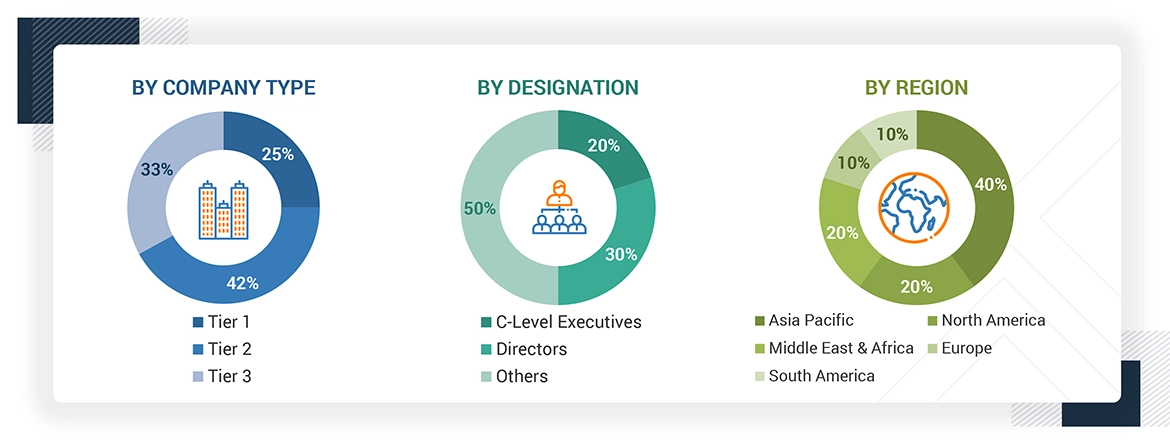
Notes: Other designations include sales, marketing, and product managers.
Tier 1: >USD 1 Billion; Tier 2: USD 500 million–1 Billion; and Tier 3: < USD 500 million.
To know about the assumptions considered for the study, download the pdf brochure
Market Size Estimation
The top-down and bottom-up approaches were used to estimate and validate the global market size. These approaches were also used extensively to estimate the size of various dependent market segments. The research methodology used to estimate the market size included the following:
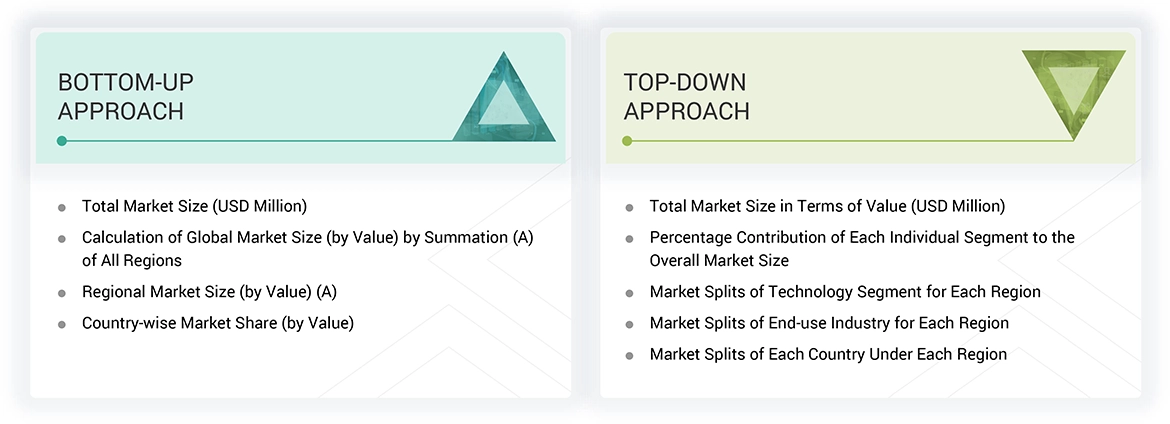
Data Triangulation
The market was split into several segments and subsegments after arriving at the overall market size using the market size estimation processes. The data triangulation and market breakup procedures were employed, wherever applicable, to complete the overall market engineering process and arrive at the exact statistics of each market segment and subsegment. The data was triangulated by studying various factors and trends from both the demand and supply sides.
Market Definition
Nonwoven fabrics are engineered sheets of fibrous material, distinct from paper or traditional textiles, and are created through mechanical, thermal, or chemical bonding processes. Various international standards provide distinct definitions of nonwoven fabrics, primarily to account for the differences in composition and manufacturing methods. The ISO 9092 defines nonwoven fabrics as a web of fibers that can be oriented deliberately or arranged randomly, bonded through mechanisms such as friction, cohesion, or adhesion. ISO standards clearly delineate nonwoven fabrics from paper and textiles, outlining specific criteria for fiber characteristics, including length, diameter ratio, and material density. Several entities recognize this definition, including CEN and national standard organizations such as EDANA, DIN, and AFNOR.
The American Society of Testing and Materials (ASTM) also categorizes nonwoven fabrics as textile structures where fibers are bonded or interlocked through various nonwoven processes, explicitly excluding woven, knitted, or felted fabrics. INDA provides a similar definition, identifying nonwoven fabrics as flat, porous sheets produced directly from fibers, filaments, or plastic films, eliminating the need for yarn creation or weaving processes.
Stakeholders
- Nonwoven fabric manufacturers
- Raw material suppliers
- Converters & processors
- Distributors and traders
- Industry associations and regulatory bodies
- End users
Report Objectives
- To define, describe, and forecast the size of the global nonwoven fabrics market based on type, layer, function, technology, end-use industry, and region in terms of value and volume
- To provide detailed information on the significant drivers, restraints, opportunities, and challenges influencing the market
- To strategically analyze micromarkets concerning individual growth trends, prospects, and their contribution to the market
- To assess the growth opportunities in the market for stakeholders and provide details on the competitive landscape for market leaders
- To forecast the market size of segments and subsegments for North America, Europe, Asia Pacific, South America, and the Middle East & Africa
- To strategically profile key players and comprehensively analyze their market shares and core competencies
- To analyze competitive developments such as product launches, mergers, acquisitions, expansions, collaborations, and partnerships in the nonwoven fabrics market
- To provide the impact of AI/Gen AI on the market
Get the Full Nonwoven Fabrics Market Report
Full forecast, segment splits, and company analysis for all Nonwoven Fabrics Market.
- China Nonwoven Fabrics Market
- India Nonwoven Fabrics Market
- Japan Nonwoven Fabrics Market
- South Korea Nonwoven Fabrics Market
- Indonesia Nonwoven Fabrics Market
- Canada Nonwoven Fabrics Market
- Mexico Nonwoven Fabrics Market
- Germany Nonwoven Fabrics Market
- France Nonwoven Fabrics Market
- UK Nonwoven Fabrics Market
- Russia Nonwoven Fabrics Market
- Spain Nonwoven Fabrics Market
- Italy Nonwoven Fabrics Market
- South Africa Nonwoven Fabrics Market
- Turkey Nonwoven Fabrics Market
- Brazil Nonwoven Fabrics Market
- Argentina Nonwoven Fabrics Market
- Rest Of Europe Nonwoven Fabrics Market
- Rest Of Asia Pacific Nonwoven Fabrics Market
- GCC Countries Nonwoven Fabrics Market
- –Rest Of GCC Nonwoven Fabrics Market
- Rest Of South America Nonwoven Fabrics Market
Need a Tailored Report?
Customize this report to your needs
Get 10% FREE Customization
Customize This Report
